
Goran Augustin1, 2
(1)
Department of Surgery Division of Gastrointestinal Surgery, University Hospital Center Zagreb, Zagreb, Croatia
(2)
School of Medicine University of Zagreb, Zagreb, Croatia
1.1 History
It proves fatal to a woman in a state of pregnancy, if she be seized with any of the acute diseases. Hippocrates
In 1848, Henry Hancock (Fig. 1.1), President of the Medical Society of London, presented a paper to that society describing the treatment of a 30-year-old female in the 8th month of pregnancy in the Charing Cross Hospital in London [1]. She developed abdominal pain, miscarried on the fourth day, and developed a tender mass in the lower right abdomen. She was seen by Hancock 12 days after the disease started. She had distended, tender abdomen, particularly in the lower right abdomen. Hancock prescribed opium and poultices. Two days later her condition was much worse with palpable mass in the lower right abdomen. Then incision was made above and parallel to Poupart’s ligament. When the abdomen was opened, offensive pus and bubbles of gas escaped, followed a couple of weeks later by two fecaliths which Hancock postulated had escaped by ulceration from the diseased appendix. From that time her improvement was rapid and she made a good recovery. Therefore, Hancock is the author of the first reported and successfully operated appendicitis complicating pregnancy.

Fig. 1.1
Henry Hancock (oil on canvas, 91 × 71 cm, painted by George Richmond in 1874; collection: The Royal College of Surgeons of England)
1.2 Incidence, Etiology, and Pathogenesis
The study of the influence of pregnancy on the incidence of appendectomy and appendicitis is a methodological challenge. The incidence of appendectomy and appendicitis and childbearing are strongly related to age, with a peak in the middle of the second decade for appendicitis and appendectomy and a peak in the third decade for childbearing. The incidence of appendicitis and appendectomy shows regional variations and a secular trend with a decreasing incidence. Secular and regional variations are also seen for the incidence of childbirth. The influence of these variations on the incidences of appendectomy, appendicitis, and pregnancy is complex which makes it difficult to determine the expected incidence of appendectomy and appendicitis during pregnancy for comparison purposes. Although there are no references that specifically address postpartum appendicitis, most studies group appendicitis of pregnancy and the puerperium together because of the anatomic and physiological continuum [2]. Up to 1960 there were 373 cases collected [3].
Acute appendicitis or epityphlitis (epi- + Greek typhlon = cecum + -itis, inflammation) is the most common non-obstetric cause of acute abdomen (surgical emergency) in pregnancy. It is present in 1/500–2,000 pregnancies and amounts to 25 % of operative indications for the acute abdomen in pregnancy [4–9]. This high incidence has a multifactorial etiology. Early marriage and repeated pregnancies till menopause make the probability of an acute appendicitis occurring in pregnancy higher. Appendicitis seems to be more common in the second trimester with incidence of 35–50 % [9–11], but there are no proven data that that pregnancy affects the overall incidence of appendicitis [12]. Others claim that there is reduced incidence especially in third trimester because of protective effect of pregnancy [13]. During pregnancy a range of physiological changes take place that may influence the pathogenesis of appendicitis. The immune system is shifted toward a T-helper cell type 2 (TH2)-dominated immunity with a depressed cellular inflammatory response and increased humoral immunity [14]. A decrease in T-helper cell type 1 (TH1)-mediated chronic inflammation, as in rheumatoid arthritis and multiple sclerosis, is observed during pregnancy [15, 16]. Appendicitis is an inflammatory process, and the inverse relation between appendicitis and pregnancy may suggest that the inflammatory response in appendicitis is mediated by a TH1-mediated inflammatory response. It is explained by suppression of TH1-mediated inflammatory response during pregnancy. Appendicitis is an inflammatory process, and this observation indirectly proves that appendicitis is mediated by TH1 inflammatory response [15]. Authors’ comment suggest that the aforementioned mechanism influence only the inflammatory causes and not obstructive which causes gangrene due to obstruction as a secondary event. Other explanations are hormonal influences because there are incidence variations during menstrual cycle [13].
The development of appendicitis may be more fulminating in pregnancy for various reasons. Increased pelvic vascularity and displacement of the appendix by the uterus may hasten strangulation, and increased local lymphatic drainage together with interference with omental migration may favor systemic spread of the inflammatory process.
It is still not possible to presume when appendicitis would develop because etiology and pathogenesis are not completely known and understood [17, 18]. According to the most favored theory, appendicitis is caused by mechanical obstruction of the appendix lumen, because of either fecal stasis, kinking, peritoneal adhesions, or infection-induced swelling of the mural lymphoid tissue. Other possible mechanisms include a breakdown of the mucosal barrier in the appendix by the direct invasion of a pathogen or by an inflammatory response that has been triggered by an infectious agent or some other stimulus. Geographical differences in the incidence in appendicitis and secular trends in general population have been related to the differences and changes in the dietary intake of fiber and in standards of hygiene [19, 20].
A relation with female sex hormones has been proposed because of a lower incidence among women and incidence variations during the menstrual cycle, but studies have given inconsistent results [21–23], and childbearing constitutes a period of increased concentration of female sex hormones. Figure 1.1 illustrates a comparison of pregnancy status at the time of surgery in women who had an appendectomy compared with matched controls in the largest epidemiological study on the subject [13].
This study by Andersson and Lambe shows that patients who had undergone appendectomy were less likely to be pregnant at the time of the operation compared with controls. This inverse relation was dependent on the period of gestation and the underlying diagnosis at the operation. Corroborating results from previous reports, the highest incidence of appendicitis and appendectomy was found in the second trimester of pregnancy. This pattern was seen for perforated appendicitis and negative explorations, whereas for non-perforated appendicitis, the strength of the inverse relation increased continuously throughout the pregnancy. This result does not support the commonly expressed opinion that the incidence of appendicitis is the same in pregnant as in nonpregnant women but rather suggests that pregnancy may protect against appendicitis (Fig. 1.2) [13].
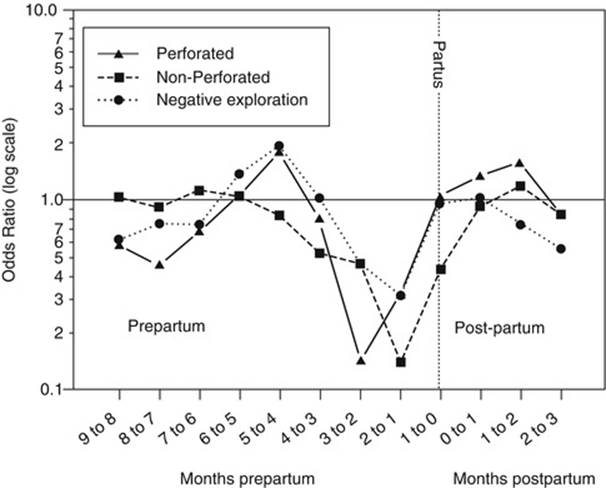
Fig. 1.2
Comparison of pregnancy status at the time of surgery in women who had an appendectomy compared with matched controls. The relation is expressed as the odds ratios according to conditional logistic regression [13]
1.3 History Taking and Clinical Examination
The approach to pregnant patients with severe abdominal pain is similar to that for nonpregnant patients. However, the physiological changes associated with pregnancy must be considered when interpreting findings from the history and physical examination. The uterus enlarges about 20 times during the pregnancy as compared to the nonpregnant state, and this results in stretching of supporting ligaments and muscles, as well as pressure on other intra-abdominal structures and layers of the anterior abdominal wall (Fig. 1.3).

Fig. 1.3
Height of the fundus at comparable gestational dates varies greatly from patient to patient. Those shown are most common. Convenient rule of thumb is that at 5 months gestation, fundus is usually at or slightly above the umbilicus [2]
The abdominal wall also undergoes significant change during pregnancy, with muscle tone reduction and skin elasticity to accommodate the enlarging uterus. The abdominal wall tone remains lax for several weeks postpartum, returning to a near-nonparous level in 6–7 weeks. The hallmarks of acute surgical disease, abdominal guarding and rigidity, do not occur or are attenuated during the early puerperium. Immediately after delivery, the uterus assumes a 15–16-week size [24]. At 1 week postpartum, the uterine fundus returns to the pelvis and is the size of a 12-week gravid uterus. After the first week, uterine involution occurs more slowly, reaching prepregnancy size within 6 weeks. There is a high circulatory level of adrenocorticoids in pregnancy which tends to diminish the tissue response to inflammation and to mask the early signs of infection and hinder localization. Therefore, the difficulties in diagnosis of appendicitis in pregnancy are due to:
· Blunting of signs and symptoms due to abdominal wall distension, dislocation of intra-abdominal organs, and diminished tissue response to inflammation
· Possible changes in appendiceal location as pregnancy advances
· Nausea, vomiting, and abdominal pain which are present in normal pregnancy especially in the first trimester
· Extensive differential diagnosis
It is important to note that there is not one, completely reliable sign or symptom that can aid in the diagnosis of appendicitis in pregnancy, and some of the classic signs of appendicitis such as Rovsing’s and psoas signs have not been shown to be of clinical significance in diagnosing an acute appendicitis in pregnancy [25].
Constant abdominal pain is the most common symptom, and pain in the right lower quadrant (present in 75–84 % of patients) is the most reliable symptom [5, 6, 26, 27]. Classical pain migration is highly suspicious of acute appendicitis and is present in around 50 % of patients [26]. After the 3rd month of pregnancy, the pain could change location and move progressively upward and laterally reaching the level of the right iliac crest at the end of the 6th month of pregnancy. Baer et al. [28] showed by barium enema that the growing uterus progressively displaces the appendix after the 3rd month in a counterclockwise rotation out of the pelvis, into the upper right quadrant, by as much as two fingerbreadths above McBurney’s point (Fig. 1.4). The appendix returns to its normal position by postpartum day 10. Original description by McBurney is that pressure is applied by one finger “exactly between 1½ and 2 in. from the anterior spinous process of the ileum on a straight line drawn from that process to the umbilicus” (McBurney’s point). This landmark was believed to correspond to the areas of the inflamed appendix irritating the abdominal peritoneum over the T11 and T12 dermatome segments.

Fig. 1.4
Change of the location of the appendix during pregnancy according to Baer et al. [28]
Others have found no evidence of upper displacement of the appendix using similar techniques [11, 29–31]. Hodjati and Kazerooni compared patients in the third trimester undergoing elective Cesarean section and appendectomy for appendicitis and did not find statistically significant difference in the change in the position of the appendix. These groups were compared to female nonpregnant patients undergoing appendectomy. The results were similar, and the significant change (more than 2 cm) in the position of the appendix was found in 15–23 % of patients [30]. This discrepancy is probably due to the different extents of cecal fixation. In other words, a growing uterus could displace a mobile cecum with the appendix but not the completely fixed cecum. Also, due to increased separation of parietal and visceral peritoneum by an enlarging uterus, there is decreased perception of somatic pain and localization; thus clinical localization of inflamed appendix is unreliable.
Nausea is nearly always present, and vomiting is present in two-thirds of patients. This is due to progesterone-induced delayed gastric emptying and pressure of enlarged uterus on intra-abdominal structures. These symptoms should be evaluated with caution because many women with normal pregnancies have these symptoms especially in early pregnancy [26]. Suspicion should be raised if new-onset nausea is present (the period of nausea and vomiting in early pregnancy is mostly self-limiting and confined to the first trimester).
Anorexia is present in only one-third to two-thirds of pregnant patients, while it is present almost universally in nonpregnant patients [4, 5, 32]. If new-onset anorexia is present, it should raise suspicion, especially if present with other signs and symptoms suggesting appendicitis.
An atypical clinical picture is most commonly present in the second trimester [9]. Right upper quadrant pain, uterine contractions, dysuria, and diarrhea could also be present [11, 12, 25].
1.4 Examination
An abdominal mass may be missed on physical examination because of the presence of the enlarged gravid uterus [33].
Abdominal tenderness in the right lower quadrant on direct palpation is almost always present [34].
Rebound tenderness is present in 55–75 % of patients [32, 35].
Abdominal muscle rigidity is present in 50–65 % of patients [36]. These two signs are more likely to be present during the first trimester then later in pregnancy, when laxity of the abdominal wall musculature makes this more difficult to detect [12, 37].
The psoas sign (Obraztsova’s sign) is pain on passive extension of the right thigh when the inflamed appendix is in a retrocecal/retroperitoneal location in contact with the psoas muscle. The psoas muscle is stretched by this maneuver. The psoas sign is observed less frequently during pregnancy when compared with nonpregnant patients with appendicitis [4].
Rectal or pelvic tenderness may occur in early pregnancy but is unusual in late pregnancy as the appendix migrates from its pelvic location [37, 38]; therefore, less than half of patients had tenderness on rectal examination [35].
Alders’ sign is used to differentiate between appendicitis and tubo-ovarian pathology in right lower quadrant (RLQ) pain in pregnancy and puerperium [39]. The practitioner should find the point of maximal tenderness while the patient is supine. Then roll the patient onto the left side. If pain shifts toward the center, then it may be tubo-ovarian. The problem in pregnant patients in third trimester is that the enlarged uterus does not allow the tubo-ovarian complex to shift its position. It is obvious that this sign can be of use only if the uterus is large enough to be palpable abdominally and that it may be misleading in the rare case in which a uterine lesion has become fixed by adhesions to the anterior abdominal wall. In acute salpingitis, which does occur in pregnancy, the result of the test will depend on the presence or absence of perisalpingitic adhesions. In the study by Chen et al. [40], 36 % of patients with positive appendicitis had positive Alders’ sign. Unfortunately there was no comparison by trimesters of pregnancy.
Aaron’s sign is a referred pain or discomfort felt in the precordial or epigastric region when continuous firm pressure is applied over McBurney’s point [41].
Arapov’s sign (contracture) is a pain reflex contraction of the right hip joint in appendicitis [42, 43].
The mean maximal axillar temperature for proven appendicitis is between 37.2 and 37.8 C but could be over 39 C in cases of perforation and diffuse peritonitis. Unfortunately only 50 % of pregnant patients with acute appendicitis have low-grade fever [44, 45]. In one series 72 % of patients who had appendicitis (with or without perforation) had temperatures of less than 37.5 C (99.6 F) [35]. This incidence of elevated temperature is not different from normal pregnant population and the finding is also true for tachycardia [44, 46], and both are not sensitive signs [11, 47]. Also if normal pregnant patients have low-grade fever, they have leukocytosis, a finding that further complicates definitive diagnosis [45]. Some studies showed an increased rate of adverse outcomes if the temperature was over 38 °C [48].
In conclusion, it should be stressed that clinical signs and blood indices are unreliable for the diagnosis of appendicitis in pregnancy and lead to an unacceptable rate of false-negative appendectomy, and a false-negative rate of up to 50 % has been reported when imaging studies are not used [49].
1.4.1 Scoring Systems
There are several scoring systems developed for a more precise diagnosis of acute appendicitis in nonpregnant population.
1.4.1.1 Modified Alvarado Score
The most commonly used is the Alvarado score described in 1986 [50] and has been extensively validated in nonpregnant population. The mnemonic is MANTRELS (Table 1.1). Currently there is no scoring system for pregnant patients, and this scoring system was modified keeping in mind the symptoms of normal pregnancy and named Modified Alvarado Score for pregnant patients [51]. The difference in comparison to the standard Alvarado score is that migration of pain is not included and the number of points just for the pain in RLQ is 2 in comparison of 1 point in the standard Alvarado score for nonpregnant population. Leukocyte left shift is not included, and leukocytosis (which could be present in normal pregnancy) has only 1 point in Modified Alvarado Score for pregnant patients, and total score is lower for 1 point (9 vs. 10) (Table 1.1). Positive predictive value was 60 % in Alvarado score range of 5–7 and 100 % in a score range of 7–9. In the same study the sensitivity of ultrasound was 78.6 %.
Table 1.1
Comparison of Alvarado score and modified Alvarado score for pregnant patients
|
Alvarado score |
Alvarado score for pregnant patients |
||
|
Symptoms |
Score |
Symptoms |
Score |
|
Migratory RLQ pain |
1 |
RLQ pain |
2 |
|
Anorexia |
1 |
Anorexia |
1 |
|
Nausea/vomiting |
1 |
Nausea/vomiting |
1 |
|
Signs |
Signs |
||
|
Tenderness in RLQ |
2 |
Tenderness in RLQ |
2 |
|
Rebound tenderness in RLQ |
1 |
Rebound tenderness in RLQ |
1 |
|
Elevated temperature |
|||
|
(≥37.3 °C/≥99.1 °F) |
1 |
Elevated temperature |
|
|
(≥37.3 °C/≥99.1 °F) |
1 |
||
|
Laboratory |
Laboratory |
||
|
Leukocytosis (>10,000/mm3) |
2 |
Leukocytosis (>10,000/mm3) |
1 |
|
Shift to the left (>75 %) |
1 |
||
|
Total score |
10 |
Total score |
9 |
1.5 Differential Diagnosis
Differential diagnosis is more difficult than in nonpregnant patients because of:
· Less reliable history and physical examination (see Sect. 1.3)
· Higher incidence of some pathologic conditions that mimic acute appendicitis
These conditions could be divided into non-obstetric/non-gynecologic and gynecologic/obstetric conditions (Table 1.2 ).
Table 1.2
Differential diagnosis of acute appendicitis during pregnancy and puerperium
|
Non-obstetric/non-gynecologic conditions |
Gynecologic/obstetric conditions |
|
Gastroenteritis |
Ruptured/hemorrhagic ovarian cyst |
|
Urinary tract infections |
Adnexal torsion |
|
Pyelonephritis |
Salpingitis |
|
Nephrolithiasis |
Tubo-ovarian abscess |
|
Acute cholecystitis/cholelithiasis |
Threatened abortion |
|
Acute pancreatitis |
Placental abruption |
|
(Incarcerated) hernia |
Chorioamnionitis |
|
Bowel obstruction |
Pelvic inflammatory disease |
|
Carcinoma of the large bowel |
Degenerative fibroid |
|
Mesenteric adenitis |
Ectopic pregnancy |
|
Rectus hematoma |
Preeclampsia |
|
Pulmonary embolism |
Round ligament syndrome/pain |
|
Right lower lobe pneumonia |
Varicose veins in the parametria |
|
Meckel’s diverticulitis |
Preterm labor |
|
Sickle cell disease |
Pelvic endometriosis |
|
Stump appendicitis |
1.5.1 Round Ligament Pain/Syndrome
Round ligament pain or syndrome (RLP) is one of the most common discomforts of pregnancy and usually starts at the second trimester of gestation and continues until delivery. It usually resolves completely after delivery, although cases of postpartum RLP, e.g., RLP that persisted for a few days after delivery, have been reported. The most common symptoms of RLP are sudden pain in the lower abdomen, usually in the right side of the pelvic area that can extend to the groin, and shooting abdominal pain when performing sudden movements or physical exercise. Pain is sudden and intermittent and lasts only for a few seconds. The pathogenesis of RLP is varied. Although very common during pregnancy, non-gestating women can also experience RLP. The most common causes of RLP are the following: (1) RLP may be caused by a spasm or cramp when the ligament contracts involuntarily. The ligament pulls on nerve fibers and sensitive structures of the female reproductive system. Since the uterus tends to be oriented toward the right side of the body, the pain is also often felt on the right side. This leads to frequent confusion with appendicitis [52]; (2) during pregnancy, the uterus expands to accommodate the growing fetus. This increase in size and weight of the uterus puts stress on the ligament that holds it, causing it to stretch. During physical exertion or sudden movements, the ligament is overly stretched, causing pain; (3) varicosities [53], e.g., enlargement of the blood vessels of the round ligament, can occur during pregnancy, causing pain and swelling. The varicocele starts at the veins draining the round ligament and the inguinal canal and is associated with engorgement of the veins of the ovaries and the pelvis during pregnancy; (4) endometriosis [54, 55] that infiltrates or borders the uterine round ligament can cause RLP in fertile, non-gestating women; and (5) other pathologies that involve the uterine round ligament can cause RLP. However, diagnosis of RLP is problematic. Some of the conditions that may present symptoms similar to those of RLP are appendicitis, ectopic pregnancy, kidney stones, urinary tract infection, uterine contractions, inguinal hernia, ovarian cysts, and endometriosis. If abdominal pain is continuous and accompanied by vaginal bleeding, excessive vaginal discharge, fever, chills, or vomiting, then it is most unlikely to be RLP, and immediate consultation with a health-care provider is warranted [55]. Physical examination, ultrasonography, and blood and urine tests may be able to pinpoint the actual cause of abdominal pain. In some cases, however, RLP was only diagnosed during exploratory surgery [53, 56, 57].
1.5.2 Ovarian Vein Thrombosis
Ovarian vein thrombosis typically presents with symptoms suggestive of acute appendicitis, and color Doppler sonography is the favored diagnostic procedure, with CT being a supplementary tool [58].
Special consideration should be placed on stump appendicitis. It is an acute inflammation of the residual part of the appendix and a rare complication of incomplete appendectomy. It can present clinically as acute appendicitis and/or as an appendiceal stump abscess. It was first reported by Baumgartner in 1949 [59], and currently 60 cases are published and found after open as well as after laparoscopic appendectomy [60]. There is only one case report in pregnancy where fimbriae of the right fallopian tube were stuck on the appendiceal stump end-to-end. Tubal abscess was drained following bridectomy. Right salpingectomy and appendectomy were performed. The chorioamnionitis resulted with preterm delivery [61].
1.5.3 Pathologic Conditions Associated with the Puerperium
1.5.3.1 Metritis
The most common of these is metritis, the broad group of postpartum infections of the genital tract. Metritis is often insidious in onset. Because of the vague initial manifestations, it is often a diagnosis of exclusion. Endometritis, or deciduitis, is an infection of the most superficial layer of the uterus and is the most common site of puerperal infection. The onset of endometritis is commonly 2–5 days postpartum, and the earliest manifestations are malaise, anorexia, and fever. There may be no localizing signs or symptoms in mild cases. The pelvic examination may be normal, even in the presence of severe endometritis. The disease may progress further to involve the myometrium (myometritis) and parametrial structures (parametritis) with extension into the broad ligaments, tubes, ovaries, and pelvic peritoneum [24]. Extensive infection may produce lethargy, chills, high fever, and significant lower abdominal pain, tenderness, and rebound. An accompanying paralytic ileus may cause distention and vomiting. Myometritis and parametritis are usually accompanied by localized peritoneal signs and cervical motion tenderness; rarely will one see generalized peritonitis. In one patient, infection of the genital tract was not given serious consideration because she was 3 weeks postpartum, which is well outside the normal limits for the onset of postpartum metritis.
1.5.3.2 Perihepatitis (Fitz-Hugh-Curtis Syndrome)
Perihepatitis (Fitz-Hugh-Curtis syndrome) is the result of early bacteremic or retroperitoneal lymphatic dissemination of Chlamydia trachomatis or gonococcal pelvic infection [62]. The syndrome is most frequently seen in young women and is more common in the second and third trimesters and puerperium. Inflammation in the right upper quadrant produces perihepatic adhesions. Classically, there is sudden onset of sharp right upper quadrant pain, often pleuritic in quality. Nausea and hiccups are occasionally noted. Physical findings include tenderness under the right costal margin, an occasional hepatic friction rub, and fever. Pelvic examination may be normal or may reveal signs of cervicitis or pelvic inflammatory disease. Liver function tests and cholecystogram may be transiently abnormal. The diagnosis is suggested by a history of recent pelvic infection, but the syndrome can be a sequel of latent or asymptomatic infection. The diagnosis is further supported by isolation of gonococcus on cervical culture and improvement on appropriate antibiotics [62]. It is important to exclude other etiologies because there is no specific diagnostic marker of this syndrome.
1.5.3.3 Pelvic Thrombophlebitis/Right Ovarian Vein Syndrome
Thrombophlebitis and thromboembolic events occur significantly more often in the puerperium than in nonpregnant women. Women in the puerperium are predisposed to deep vein thrombosis attributable to sluggish circulation, trauma to the pelvic vessels during delivery, and estrogen-mediated hypercoagulability. Thrombophlebitis of the pelvic vessels is more common in puerperal females and may be difficult to diagnose. Pelvic thrombophlebitis, or right ovarian vein syndrome, commonly presents with abdominal pain, fever, and a tender midabdominal mass. It may be difficult to distinguish from metritis but should be strongly considered if there is a poor response to appropriate antibiotics (see Part 2, Sect. 1.5.2) [24].
Although urinary tract infection was mentioned in the differential diagnosis section, it remains a common cause of puerperal febrile illness. During pregnancy, the compressive effect of the gravid uterus on the ureters in combination with progesterone effects results in collecting system dilatation, especially on the fight side. Ureteral peristalsis is also decreased. These factors contribute to the predisposition toward urinary tract infections in pregnancy and persist to some degree in the early puerperium. The trauma of delivery may induce bladder hypotonicity; frequent catheterization is often necessary and represents an additional risk factor [24]. Pyelonephritis is most often either right sided or bilateral in location. Unilateral left pyelonephritis in the puerperium is uncommon [24].
1.6 Diagnosis
1.6.1 Introduction
Until recently, negative appendectomy rates of 15–25 % (and up to 50 % in pregnant women) have been tolerated, given the consequences of missing a true case of appendicitis and the understanding that no test or combination of tests existed with sensitivity and specificity above 80–85 % [48, 63]. This is one of the reasons why all investigations must occur in the hospital. All the diagnostic workups should be done on an interdisciplinary basis in cooperation with the obstetrician. Physicians may be reluctant to order a radiological study because of the potential teratogenic risks to the fetus as well as the medical-legal implications of the radiation dose causing birth defects. For acute indications, the benefits for the mother usually outweigh the small risk to the fetus. The greatest effects of radiation occur during the period of rapid cell proliferation, from approximately the first week after conception through week 25. The recommended total dose of radiation during this time is less than 5 rad. During the first 2–3 weeks of pregnancy, while cells are not yet specialized, radiation injury will cause failure of implantation or undetectable death of the embryo. After that, injury usually occurs in the organs under development at the time of exposure. Current recommendations on radiation exposure are as follows: “No single diagnostic procedure results in a radiation dose that threatens the well-being of the developing embryo and fetus” (American College of Radiology) [64].
Fetal risk is considered to be negligible at 5 rad or less when compared with the other risks of pregnancy, and the risk of malformations is significantly increased above control levels only at doses above 15 rad. National Council on Radiation Protection [65]
Exposure to less than 5 rad has not been associated with an increase in fetal anomalies or pregnancy loss [66, 67]. Also, it should be stressed that there are normal risks of pregnancy: 3 % risk of spontaneous birth defects, 15 % risk of spontaneous abortion, 4 % risk of prematurity and growth retardation, and 1 % risk of mental retardation [68]. These data should be explained to the future mother.
Another important consideration for precise diagnosis is that negative appendectomy in pregnant women is associated with fetal loss rate of 2–4 % and early delivery of 4 %, the same rate as in noncomplicated acute appendicitis during pregnancy [69].
1.6.2 Laboratory Findings
Leukocytosis (raised white blood cell count – WBC) is not diagnostic as this can go up in the second and third trimesters and can reach 20,000/mm3 in early labor in normal pregnancy [70]. In view of the wide range of values, however, it is not possible to derive clinical relevance from these data [71]. For the orientation, the values over 16 × 109/l (16,000 mm3) should raise serious suspicion [6, 11, 36, 47, 48]. Unfortunately only 60 % of those with perforation had values over 16,000 mm3 [26]. If there is clinical suspicion of acute appendicitis with normal values of WBC, serial WBC counts may be helpful.
Neutrophil granulocytosis with left shift: the presence of increased proportions of younger, less well-differentiated neutrophils and neutrophil precursor cells in the blood is diagnostic of acute infection. If left shift is not present, then granulocytosis of more than 80 % should be suspicious [45].
A raised C-reactive protein (CRP) could be a normal finding in pregnancy and is therefore of little assistance in establishing the diagnosis [26], but with the high clinical suspicion of appendicitis it confirms the diagnosis. Some studies claim that all positive cases had negative CRP values if the patients were evaluated less than 12 h after the onset of pain [47]. Sixty-eight percent with appendicitis had CRP ± 10 mg/l, but all patients with perforation had elevated CRP (mean 55 mg/l) [26].
The erythrocyte sedimentation rate is physiologically elevated and thus is a less reliable monitor of inflammatory activity during pregnancy [72].
Pyuria (pus in the urine) is observed in 10–20 % of patients with appendicitis. This may also represent concurrent asymptomatic (or symptomatic) bacteriuria found frequently in pregnant population [4]. Other abnormalities such as mild proteinuria and/or hematuria could be present in up to 19 % of pregnant patients [35].
Puerperal changes in blood components may be confusing as well. During the first 10–14 days of the puerperium, WBC counts of 20,000–25,000/mm3 are not unusual; there is also a predominant increase in neutrophils. The erythrocyte sedimentation rate may increase to 50–60 mm/h. Reliance on either the erythrocyte sedimentation rate or the WBC count for the diagnosis of acute infection may be misleading [24].
1.6.3 Transvaginal Ultrasound
There are no Royal College of Obstetricians and Gynaecologists guidelines about the use of transvaginal ultrasound. An observational study suggested that it can be used to look for the following features in acute appendicitis [73]:
· Presence and size of adnexal or uterine pathology which can rule out acute appendicitis
· Free fluid in the pouch of Douglas
· Abnormal pathology in the ileocecal region, for example, appendicitis, cecal tumors, cecal diverticula, or retroperitoneal tumors
1.6.4 Graded Abdominal Ultrasound
As a noninvasive procedure, it is the diagnostic procedure of choice [74]. Abdominal ultrasound has good accuracy in the first and second trimesters but has less accuracy in the third trimester. A noncompressible, blind-ended tubular structure that is visualized in the right lower quadrant with a maximal diameter greater than 6 mm is considered diagnostic. The reported sensitivity, specificity, and accuracy (overall percentage of correct test results) vary dramatically. The reported sensitivity ranges from almost 75–100 % [72, 74–78] to only 40–50 % [45, 79]. In one large study, transabdominal ultrasound used for suspected appendicitis was nondiagnostic in 88 % of patients [80]. Because its positive predictive value was 100 %, it provides confirmation of the diagnosis when it is positive. However, the diagnosis of appendicitis could not be ruled out if negative. The use of this technique with the patient supine is difficult during the late second trimester and third trimester of pregnancy because the large size of the gravid uterus does not allow adequate compression. For women in the late second trimester or third trimester, it is recommended that the patient is placed in the left posterior oblique or left lateral decubitus position, which allows displacement of an enlarged uterus and use of the graded-compression technique without difficulty [74]. There is a significant reduction in the negative appendectomy rate in the ultrasound/CT scan group compared to the clinical evaluation group or the ultrasound group. Thus, an ultrasound followed by a CT scan in patients with a normal or inconclusive ultrasound is recommended [81].
Sometimes differentiation between (giant) Meckel’s diverticulitis and acute appendicitis on ultrasonography can be difficult.
The US Food and Drug Administration (FDA) has proposed an upper limit of 720 mW/cm2 for the spatial-peak temporal average intensity of the ultrasound beam for obstetric ultrasound [82]. Doppler sonography can produce high intensities and should be used judiciously, keeping the exposure time and acoustic output to the lowest level possible [83].
1.6.5 Magnetic Resonance Imaging
Magnetic resonance imaging (MRI) is the diagnostic modality of choice in patients for whom the risks of radiation or the potential nephrotoxicity of iodinated contrast agents is a major concern. MRI is also known to be a reliable imaging modality for diagnosing appendicitis in nonpregnant patients with a sensitivity, specificity, positive predictive value, and negative predictive value (NPV) of 97, 92, 94, and 96 %, respectively [84]. There have only been a small number of studies evaluating the utility of MRI for diagnosing appendicitis during pregnancy. Oto et al. reported a cohort of 118 pregnant patients who presented with abdominal pain who underwent MRI between 2001 and 2007. They were able to detect appendicitis in 11 patients (9.3 %) [85]. After confirmation with surgical, pathologic, and clinical follow-up, MRI was found to have an accuracy of 97.5 % for diagnosing appendicitis during pregnancy [85–89].
The MRI criteria for appendicitis include (Fig. 1.5):

Fig. 1.5
Axial T2-weighted image demonstrating dilated appendix (arrow) consistent with acute appendicitis [89]
· Enlarged appendix with a diameter of greater than 6 mm
· Signs of periappendiceal inflammatory changes, such as the presence of periappendiceal high signal intensity
The MRI criteria that excluded appendicitis were an appendix of less than 6 mm in diameter or an appendix with a diameter of greater than 6 mm with no evidence of periappendicitis (Fig. 1.6).

Fig. 1.6
Coronal T2-weighted image demonstrating normal appendix (arrow) in a 14-week gestation patient [89]
It is most useful for evaluating pregnant patients with acute pain in the lower abdomen thought secondary to an extrauterine cause, such as appendicitis or ovarian torsion [90, 91]. Some recommendations for its use are:
· MRI is used when the appendix is not visualized by abdominal ultrasound.
· MRI is used when no other cause of an acute abdomen is found.
· The patient needs to give informed consent in writing; the safety of MRI for the fetus has not been proved according to the FDA guidelines and the American College of Radiology. Therefore, it is prudent to perform an MRI in pregnant patients only when ultrasound findings fail to establish a diagnosis.
The significant difference between the performance of CT and MRI was not found. However, some advantages of MRI over CT include the following [86]:
· Reduced requirement for contrast administration (CT often requires rectal, oral, and/or intravenous contrast). An entire abdomen can easily be viewed in more planes.
· No radiation exposure.
MRI is not free of theoretical risks including the potential biological effects of the static and time-varying magnetic fields, the heating effects of the radiofrequency pulses, and the acoustic noise generated by the spatial encoding gradients [92]. FDA has expressed caution over the use of MRI in pregnant women and has stated that there is no conclusive evidence to establish safety [92, 93]. However, the clinical studies that have evaluated the safety of MRI during pregnancy reported no adverse effects on the developing conceptus [93]. Thus, MRI is currently preferred by radiologists over CT [94].
There are also some limitations and recommendations. The patient should be informed that there are no known harmful effects from use of MR imaging at 1.5 T or lower magnetic field strengths [95] and that there is lack of experience with the use of field strengths greater than 2.5 T, and they should be avoided at present [96]. Also absolute contraindications for MR are metal implants in the body that are not made of titanium or the composition is not known. Gadolinium administration should be avoided during the first trimester [97–101]. Rapid-sequence MRI is preferable to conventional MRI because of the briefer exposure [99].
1.6.6 Computed Tomography (CT) Scan
Clinicians may not be well informed of the facts relating to the use of diagnostic radiological studies in pregnancy. Lack of understanding of radiation effects on the fetus causes unnecessary anxiety in pregnant patients exposed to diagnostic radiation and may lead to unnecessary pregnancy termination. A study examining physician perceptions of teratogenic risk associated with undergoing plain radiography and CT during early pregnancy found that six of the 208 family practice physicians would recommend pregnancy termination after first trimester CT and one following radiography in the first trimester; 12 % (25/208) of physicians were not sure of the need for pregnancy termination after radiography; and 19 % (39/208) of family practice physicians were not sure about a CT scan examination. The same study reported that 8 % (5/65) of obstetricians included in the study would have recommended pregnancy termination after first trimester CT scan examination [102].
In 1998, Rao et al. published their experience with the use of a helical or spiral CT technique, and results show that the method is highly sensitive and specific for the identification of acute appendicitis in the non-obstetric population with lower costs when CT scanning was used to diagnose appendicitis with sensitivity, specificity, and diagnostic accuracy each of 98 % [103, 104]. Appendix CT scans were identified as positive for appendicitis if found:
· Enlarged appendix (>6 mm in the maximum diameter)
· Periappendiceal inflammatory changes (fat stranding, phlegmon, fluid collection, and extraluminal gas)
Unfortunately, there are instances where the findings at CT scan are not so clear. Several authors comment on “equivocal” readings. In all instances, the “equivocal” readings influence on the sensitivity and specificity of CT scan, depending on how these readings were handled. It is preferable to use the multidetector row CT scan with high-speed mode in pregnant patients since it has half the radiation dose of the high-quality mode and its scanning parameters are otherwise identical. Radiation exposure using this test is 300 mrad, which is below an accepted safe level of radiation exposure in pregnancy of 5 rad. Table 1.3 shows potential dose-dependent radiation effects during fetal development.
Table 1.3
Summary of potential in utero-induced radiation effects [105]
|
Conception age |
<50 mGy |
50–100 mGy |
100 mGy |
|
Prior to conception |
None |
None |
None |
|
1st–2nd weeks |
None |
Probably none |
Possible spontaneous abortion |
|
3rd–8th weeks |
None |
Potential effects uncertain and too subtle to be clinically detectable |
|
|
9th–15th weeks |
None |
Potential effects uncertain and too subtle to be clinically detectable |
|
|
16th–25th weeks |
None |
None |
IQ deficits are not detectable at diagnostic dose |
|
>25th weeks |
None |
None |
None applicable to diagnostic medicine |
Sensitivity and specificity in a pregnant population with acute appendicitis are similar to general population with values reaching 100 % [106]. Limitations include small number of patients (seven), retrospective study, and study performed in a tertiary care institution; therefore, these findings may not be universally applicable. CT established a diagnosis in 30 % of cases with an initial negative ultrasound scan proving the accuracy of CT as well as its superiority over sonography for this indication [107]. In a letter to the editor in response to that series, CT scan was not helpful in the diagnosis in a single patient. Author’s comments on the aforementioned study included the advanced appendicitis with periappendicitis and laparotomy with a paramedian incision. Indirectly, this meant that the 100 % sensitivity and specificity was because of significant pathologic changes in advanced appendicitis [108].
The conclusion and recommendation is that the CT scan should be used when there is an uncertain clinical diagnosis or equivocal laboratory or ultrasound findings or where access to MRI or MRI expertise is limited.
1.6.7 Chest Radiograph
It may be useful in identifying right lower lobe pneumonia from appendicitis in pregnant patients with right-sided abdominal pain. A plain abdominal radiograph can be used to identify air fluid levels or free air but indicated according to signs and symptoms of perforation (sudden sharp and severe pain) or obstruction (significant or feculent vomiting, no stool and flatus evacuation for several days).
Simplified diagnostic algorithm is presented on Fig. 1.7 [80].

Fig. 1.7
Algorithm for the evaluation of pregnant patients with suspected appendicitis [80]
1.7 Negative Appendectomy
1.7.1 Incidence
Negative appendectomy rates in the gravid patient vary considerably (4–55 %) [7, 26, 79, 80, 109–112]. In comparison, the rate of negative appendectomy in the general population ranges 10–15 % and as high as 26 % among the reproductive age females. Of interest is that only 15–20 % of patients undergoing negative appendectomies had another pathologic diagnosis (e.g., ovarian cyst, ovarian torsion, mesenteric adenitis, fibroids, and salpingitis) identified as the cause of their abdominal pain [80]. These high negative appendectomy rates may be due to the surgeon’s propensity for early intervention to prevent perforation and avoid unnecessary morbidity and mortality. There is a decreased risk of negative appendectomies in the puerperium. This indicates that puerperal women experience abdominal pain less frequently or are less prone to seek care for abdominal pain [13]. There is no significant difference of negative appendectomy rate between laparoscopic and open appendectomy groups [109].
1.7.2 Indications for Appendectomy
There is still a dilemma to perform or not a laparoscopic appendectomy if the appendix looks macroscopically normal in the nonpregnant patient, as well as among the population with no other abdominopelvic pathology. It has been argued that retaining a normal-looking appendix allows it to be used in reconstructive procedures [113]. On the other hand, some investigators believe that the appendix should be removed to rule out appendicitis histologically, also making the diagnosis of appendicitis less likely if the patient’s symptoms return [114]. It can partly be explained by the fact that gross changes are not visible if intramural, mucosal, and submucosal changes in appendix are present histologically and could be responsible for the symptoms. Van den Broek et al. reported that 9 % of their series continued to have recurrent RLQ pain after negative laparoscopy, yet they did not recommend appendectomy in these patients [115]. This is due to early intraluminal inflammation that subsequently leads to transmural inflammation, or the inflammation subsides and could lead to chronic appendicitis with recurrent episodes of right lower quadrant pain and other symptoms mimicking acute appendicitis. Several studies report 20–22 % of patients with clinical suspicion of acute appendicitis who underwent appendectomy responded very well to appendectomy in spite of a normal microscopic examination of the appendix. Explanation could be found in other underlying causes such as appendix colic, appendiceal fecalith, and functional appendiceal abnormality or functional appendicopathy that might be the contributory factors rather than acute inflammation [116, 117]. In a study from 2009 of laparoscopic appendectomy, there were 30 % of intraoperative diagnoses of normal appendix confirmed with inflammation confirmed histologically. Authors recommend appendectomy in these situations [118]. These conclusions are similar to SAGES guidelines for laparoscopic appendectomy (04/2009):
If no other pathology is identified, the decision to remove the appendix should be considered but based on the individual clinical scenario (Level III, Grade A). Macroscopically normal appendices may have abnormal histopathology. Several studies have shown a 19–40 % rate of pathologically abnormal appendix in the setting of no visual abnormalities. Therefore, the risk of leaving a potentially abnormal appendix must be weighed against the risk of appendectomy in each individual scenario.
Furthermore, some neoplasms of the appendix can occur in an organ that appears grossly unremarkable [119, 120]. If pseudomyxoma peritonei is observed, the appendix should always be removed and subjected to a thorough histological examination.
Conclusion in one sentence should be: “As a surgeon you should not be deterred from removing an appendix once the diagnosis is suspected, because pregnancy is not affected by removal of a normal appendix” [121].
It should be noted that using modern diagnostic modalities, correct diagnosis of biliary origin of acute abdomen during pregnancy is very high. It can be presented as index of wrong diagnosis.
Index of wrong diagnosis (%) = provisionally diagnosed cases – confirmed cases × 100 provisionally diagnosed cases
For acute appendicitis it is around 40 % and only 8.5 % for acute cholecystitis [7, 122]. A correct diagnosis of acute appendicitis between 1951 and 1973 was 58–68 % [124–126].
1.7.3 Perinatal Outcome
Because of the unreliability of the clinical diagnosis of appendicitis in pregnancy, an aggressive surgical approach to the disease process has been advocated to avoid progression to appendiceal perforation, which has been associated with a high rate of fetal demise [127, 128]. However, more recently it has been reported that negative appendectomies also may be associated with a significant rate of fetal demise. In a review by McGory et al. on 3,133 pregnant patients, rates of fetal loss and early delivery in patients with complicated appendicitis were 6 and 11 %, respectively [69]. In comparison, the rates for fetal loss and early delivery in patients undergoing a negative appendectomy were 4 and 10 %, respectively. This study was limited because only fetal demise and early delivery occurring during the hospitalization in which the appendectomy was performed was reported. Freeland et al. did not find any relationship of the early delivery and the fetal demise due to the appendectomy [80], while Ito et al. found similar adverse perinatal outcomes in patients with negative appendectomy and inflamed appendicitis. In this study by Ito et al., perforated appendicitis caused significantly higher adverse perinatal outcomes [129]. These adverse outcomes in negative appendectomy and inflamed appendicitis group were the same as in general population; therefore, it is questionable that negative appendectomy causes adverse perinatal results [130].
1.8 Management
Once investigations have been carried out in hospital and the diagnosis of acute appendicitis has been confirmed, management is always surgical removal of the inflamed appendix. Murphy in 1916 said for appendicitis in general population but can be adopted also for pregnant women: “Let us return to our ideal; early operation is the only safe practice.” This can be performed by several different procedures simply divided into laparotomy or laparoscopy procedures.
1.8.1 Anesthetic Considerations
Anesthetic concerns in the pregnant patient can be broken down into two major categories: teratogenicity of the anesthetic agents and maternal physiological changes as a result of anesthetic agents. The teratogenicity of anesthetic agents, defined as the potential effect in chromosomal damage or in carcinogenesis in the fetus, is minimal [131]. In a consensus statement published in the New England Journal of Medicine in 2000, no anesthetic agents were listed as definitively causative of fetal malformations [132]. Increased oxygen consumption and mechanical displacement of the abdominal organs cause the pregnant patient to increase minute ventilation, primarily through a 30–40 % increase in tidal volume [133]. A compensatory respiratory alkalosis with a PaCO2 from 30 to 35 mmHg develops. Intubation may be more difficult because of increased airway edema later in the pregnancy, and smaller endotracheal tubes should be used at this time. Because decreased lower esophageal sphincter pressure and delayed gastric emptying in pregnancy can cause an increased risk of aspiration, cricoid pressure should be used to prevent aspiration during intubation [134]. End-tidal CO2 monitoring should be used intraoperatively. Hypotension in the pregnant patient should be treated initially with aggressive intravenous fluid resuscitation. The patient should be placed in the left lateral decubitus position, if possible, to increase venous return. Trendelenburg positioning can also be used in the hypotensive patient to increase venous return [131].
1.8.2 Open Appendectomy
As in other surgical procedures, type of incision is very important for successful completion of the operation. Despite the type of incision used, the operation should be completed with minimal uterine manipulation. There are several incisions that could be performed. Despite the surgical approach, the most experienced abdominal surgeon should perform the procedure to shorten the operation time and possible postoperative complications as much as possible.
1.8.2.1 Muscle Splitting Incision (McBurney’s Incision, Gridiron Incision)
This is the incision of choice for open approach for the removal of the appendix in pregnant patients in all trimesters. In the latter pregnancy, the incision could be positioned above McBurney’s incision because of possible displacement of the appendix in the right upper quadrant. This change of the location of the incision is not necessary because the appendix was easily located in 94 % of the incisions made through McBurney’s point and in 80 % of the incisions made above McBurney’s point [135].
There is one case report of significant uterine injury during appendectomy in pregnancy [136]. Inadvertently, the uterine wall was incised to 3 cm in length on the right anterolateral aspect leading to bleeding and leakage of amniotic fluid from the incision site. Two topics should be discussed: first is adequacy of residual amniotic fluid and second is the contamination of amniotic fluid with purulent or feculent material. During operation the ultrasound scan should be performed to determine the presence of a fetal heart rate and to get an impression of residual amniotic fluid volume. With a live fetus and enough amniotic fluid, the gestation could be continued. The risk of chorioamnionitis is addressed by the use of perioperative broad-spectrum antibiotics. The immediate risk of preterm labor is addressed by the use of indomethacin, although a calcium channel blocker is also an option and would not affect amniotic fluid volume or potentially mask an infection. Cesarean delivery prior to the onset of labor is recommended to minimize the risks of uterine rupture [137]. If, on the other hand, significant leakage occurs or there is dilemma about fetal vitality, the baby should be delivered by Cesarean section during the same operation.
1.8.2.2 Midline Vertical Incision
This incision is used when acute abdomen with diffuse peritoneal irritation is present. This is important for two main reasons:
· Allows the surgeon to deal with unexpected surgical findings
· Allows Cesarean delivery if necessary
1.8.2.3 Right Transrectal/Pararectal Incision
These incisions are rarely used. If the diagnosis is certain, then McBurney’s incision is made. If acute abdomen with diffuse peritoneal irritation is present, then midline vertical incision is made.
1.8.3 Laparoscopic Appendectomy
Laparoscopic appendectomy during pregnancy continues to be controversial especially in the latter part of the second and the third trimester. Several case reports and small series have reported success during all trimesters without complications [48, 110, 138], but in the same institutions, there is higher percentage of open approach during the third trimester [48]. Thus, there is some bias in these studies, and conclusions are not yet presented as recommendations.
In the case of appendicitis, some might argue that the laparoscopic approach exposes the fetus to excessive risks from trocar placement and the effects of carbon dioxide on the developing fetus and the long-term effects of this exposure with significant fetal loss [70, 139]. Laparoscopic procedures are approximately 50 % longer with conflicting studies showing decreased length of stay and hospitalization [140, 141], but with increasing number of laparoscopic procedures performed worldwide, the duration of open and laparoscopic operations would become the same [48]. Questions arise regarding the risk for decreased uterine blood flow due to increased intra-abdominal pressures from insufflation and the possibility of fetal carbon dioxide absorption [127]. Carbon dioxide used for the creation of pneumoperitoneum could lead to fetal carbon dioxide absorption with potential subsequent fetal acidosis. This could be minimized with maintenance of intra-abdominal pressure <12 mmHg and minimizing operative time. Clinical and experimental studies found no substantial adverse effects for the fetus when the maximal pneumoperitoneum pressure was limited to 10–12 mmHg and duration of less than 60 min [142, 143]. Others stress the importance of the absorption of carbon monoxide, produced by the use of monopolar energy, through the peritoneum. The absorbed carbon monoxide can produce carboxyhemoglobin and metahemoglobin that compete with hemoglobin in the uptake and transport of oxygen. It is recommended to continually remove the smoke produced by tissue fulguration [144]. Harmonic scissors produce vapor-free gas, avoiding the potential effects of carbon monoxide [145]. Other negative effect of electrocautery is the potential for uterine irritation.
There are many advantages of laparoscopic technique. Authors note that laparoscopy expands the ability to explore the abdomen with less uterine manipulation [146]. Further, it increases the ability to locate and treat the ectopic appendix and results in relatively small incisions compared with the open technique or helps in detecting other unexpected sources of pain [147, 148]. With open technique of trocar placement, there is almost no possibility of injury of intra-abdominal organs. Direct uterine injury during trocar placement has been reported but without fetal loss [149]. Also reduced cecal manipulation during appendectomy with less cecal trauma causes earlier restore of large bowel function and earlier passage of the first flatus and first postoperative stool (author’s clinical observation, not published results). In addition to general advantage of smaller incisions, less postoperative pain, and earlier return to normal activity, laparoscopy can result in less manipulation of the uterus while obtaining optimum exposure of the surgical field. Lower rates of dehiscence or herniation during labor are another potential benefit. Rapid return to full activity could reduce the frequency of maternal thrombosis and embolic events, which can be a source of maternal mortality in some patients, and it is known that thromboembolic events are more common in pregnancy [142, 147, 150]. Some studies found significantly shorter hospital stay in the laparoscopic group (3.4 vs. 4.2 days) [48]. A study from the Swedish Health Registry evaluated 2,233 laparoscopic and 2,491 open laparotomy cases from two million deliveries in Sweden from 1973 to 1993 [151]. Outcomes evaluated birth weight, gestational duration, intrauterine growth retardation, congenital malformations, stillbirths, and neonatal deaths with no statistically significant differences comparing the laparoscopy and laparotomy group. It appears that there was an increased risk for infants in both laparoscopy and laparotomy groups to weigh less than 2,500 g, to be delivered before 37 weeks, and to have an increased incidence of growth restriction compared with the total population.
A recent review advises prudence with the use of laparoscopy during pregnancy [152]. The outcome of that review was dictated mainly by a large observational study in which a significantly higher adverse outcome after laparoscopic appendectomy in pregnant patients was found – fetal loss with laparoscopy (5.6 %) versus open appendectomy (3 %). A recommendation for caution based on this study can be criticized for two reasons: First, an important limitation of an observational study is the risk of confounding by indication, making this study unsuitable to test if one surgical procedure is superior over the other. A second limitation is that the outcome of fetal loss (5.6 %) in that study is favorable compared to that of most of the literature on both laparoscopic and open appendectomy during pregnancy, suggesting that both procedures are relatively safe during pregnancy.
Current practical/clinical SAGES guidelines (04/2009) statement is:
Laparoscopic appendectomy may be performed safely in pregnant patients with suspicion of appendicitis (Level II, Grade B). Laparoscopic appendectomy can be performed safely in any trimester and is considered by many to be the standard of care for gravid patients with suspected appendicitis.
1.8.3.1 Laparoscopic Technique
In the first and early second trimesters, the technique is similar as in nonpregnant patients. In an advanced pregnancy, the port positions are somewhat specific (see further text). The patient is placed supine on the operating room table. Restraining straps are placed across the chest and thighs, and sequential pneumatic compression devices are placed on both lower extremities. Some authors recommend a Foley catheter [109] and a nasogastric tube placement and removal at the end of the operation. A prophylactic antibiotic is administered intravenously 30 min before the skin incision. Maternal end-tidal CO2 is monitored and should be controlled within physiological range (30–40 mmHg).
Patients are tilted to the left to displace the uterus from the inferior vena cava and to remove the small bowel from the operating field, and a slight Trendelenburg position may be added, if necessary. The procedure is always performed using three ports, and their placement is modified in accordance with gestational age. In the advanced pregnancy, the first port (5 or 10 mm – laparoscope) is placed 2–4 cm cephalad to the gravid uterus in the upper midline between the umbilicus and xiphoid process. The bigger the uterus, the more cranial the first trocar is placed for easier intraperitoneal manipulation.
1.8.3.2 Pneumoperitoneum
Pneumoperitoneum is carried out using an open (Hasson) technique for entering the abdominal cavity under direct vision. Other possibility is to use a Veress needle but with the higher risk of perforation of intra-abdominal organs or pneumoamnion [141, 153]. Schreiber reports, while carrying out a laparoscopic appendectomy, injuring the uterine wall with the mandrel of the 5 mm trocar during introduction. There was loss of a little amniotic fluid, but there was no severe bleeding. The remainder of the pregnancy was without complications [154]. An optical trocar can be used for entering the abdomen. Currently, the so-called Direct Vision Initial Ports (like the OptiView, by Ethicon, Cincinnati, OH, USA, and the Visiport, by US Surgical, Norwalk, CT, USA) are available. They can be used with or without pneumoperitoneum. These kinds of trocars are introduced under direct vision. The pneumoperitoneum pressure is maintained between 10 and 12 mmHg. There are several modifications of instrument placement and their size depending on the laparoscopic technique and equipment. Some authors recommend the second port (5 or 12 mm) is placed laterally in the right lower quadrant, and the third port (5 or 10 mm) is placed in the right upper quadrant in a more cranial location. Twelve milimeters ports are used when the linear cutting stapler is used for the transection of the appendix at its base (Fig. 1.8) [155]. Other combinations of trocar placement are presented on Fig. 1.8 depending on the degree of uterine enlargement [109].

Fig. 1.8
Patient positioning, port placement, and intraoperative fetal monitoring for laparoscopic appendectomy in advanced pregnancy (see text for details) [155]
Fetal heart rate is recorded immediately before and after surgery and during operation every 5 min in the lower left quadrant without disinflation (Fig. 1.9). Lu et al. found that external monitors of uterine contractions were variably effective in the insufflated abdomen [156]. For patients with potentially viable fetuses managed surgically, steroids were generally administered 24 h preoperatively to speed fetal lung maturation.

Fig. 1.9
Trocar placement for laparoscopic appendectomy in different stages of pregnancy [109]
1.8.3.3 Intraoperative CO2 Monitoring
Intraoperative CO2 monitoring by capnography should be used during laparoscopy in the pregnant patient (Level III). Fetal acidosis with insufflation has not been documented in the human fetus, but concerns over potential detrimental effects of acidosis have led to the recommendation of maternal CO2 monitoring [157, 158]. Initially, there was a debate over maternal blood gas monitoring of arterial carbon dioxide (PaCO2) versus end-tidal carbon dioxide (ETCO2) monitoring, but the less invasive capnography has been demonstrated to adequately reflect maternal acid-base status in humans [159]. Several large studies have documented the safety and efficacy of ETCO2measurements in pregnant women [160–162] making routine blood gas monitoring unnecessary.
1.8.3.4 Fetal Heart Rate Monitoring
Fetal heart monitoring should occur pre- and postoperatively in the setting of urgent abdominal surgery during pregnancy (Level III). While intraoperative fetal heart rate monitoring was once thought to be the most accurate method to detect fetal distress during laparoscopy, no intraoperative fetal heart rate abnormalities have been reported in the literature [163, 164]. This has led some to recommend only pre- and postoperative monitoring of the fetal heart rate as no increased fetal morbidity has been reported [160, 162]. The effects of general anesthesia on cardiotocography result in a reduction of beat-to-beat variation with normal baseline frequency. The decreased variability can persist until 90 min in the postoperative course due to the residual effects of anesthetic agents on the fetus. This could be misinterpreted as fetal distress leading to emergency delivery and hence adding to fetal morbidity and mortality [165]. It should be noted that transvaginal sonography must be used during the procedure because the signals from abdominal ultrasound would be lost during insufflation [166, 167].
1.8.4 Conversion from Laparoscopic to Open Approach
The question could arise about influence of conversion from laparoscopic to open approach to the mother and fetus. Studies did not show increased rate of complications and increased maternal or fetal mortality and preterm delivery. In the open approach group, preterm delivery rate was 11.8 % versus 15.8 % in the laparoscopic approach [160]. Caution should be present because of a small number of patients that had undergone such conversions [160]. Theoretically if conversion is indicated, then mostly (1) the anatomy is difficult or (2) inflammation is in an advanced stage in the form of perforation or abscess. Both situations are connected to longer operative time and higher percentage of complications.
1.8.5 Perioperative Considerations
1.8.5.1 Risk of Drug-Induced Congenital Defects
Interests of both the mother and the fetus must be considered in therapy during pregnancy. Usually, these interests do not conflict, because what is good for the mother is generally good for the fetus. Sometimes, however, maternal therapy must be modified to substitute alternative but safer therapy because of the concerns about drug teratogenicity (e.g., substituting a histamine2 receptor antagonist for misoprostol, an abortifacient that is contraindicated during pregnancy) [168, 169]. Rarely, the maternal and fetal interests are diametrically opposed, as in the use of chemotherapy for maternal cancer, a therapy that is potentially lifesaving to the mother but life threatening to the fetus [33]. These conflicts raise significant medical, legal, and ethical issues.
There are many categories of drugs that could have deleterious effects on a fetus, and the detailed elaboration is out of the scope of this book. There are two main categories of medications used in all patients either prophylactically or therapeutically. All teratogenic drugs generally determine a specific pattern or single malformation during a sensitive period of gestation with a dose-dependent effect [170].
Antibiotics
Antibiotics should be administered preoperatively (30–60 min prior to skin incision) in all patients (administered to 94 % of patients found in the literature) [140]. These should be from the FDA Class B drugs which are found to be safe for the fetus. Standard antibiotics in use are second-generation cephalosporins which comprise 60 % of all classes of antibiotics used during pregnancy for acute appendicitis found in literature [140]. If a gangrenous or perforated appendix is found, cephalosporins are used in combination with metronidazole (FDA Class B) [25].
NSAIDs
Use of NSAIDs during the second and third trimesters is associated with oligohydramnios and anuria and, close to term, to precocious closure of Botallo’s duct, with subsequent pulmonary hypertension, intracranial hemorrhage, and necrotizing enterocolitis [171–176]. During pregnancy the drug of choice for analgesic, anti-inflammatory, and antipyretic action is paracetamol. When appendectomy is performed with Cesarean section through median laparotomy, then all classes of medications could be used as in nonpregnant patients unless contraindicated for maternal reasons.
1.8.5.2 Thromboprophylaxis
Gestational hormones, particularly estrogen, contribute to a mild hypercoagulopathy during pregnancy by increasing the synthesis of clotting factors [177]. Thromboembolic phenomena are also promoted by intra-abdominal vascular stasis resulting from compression by the enlarged gravid uterus. Epidemiological studies estimate the annual frequency of deep venous thrombosis (DVT) in the general population is 0.16–1 % [178, 179], of which 2 % are pregnancy related [180]. Therefore, risk of thromboembolic event, either DVT or PE, during pregnancy and puerperium is estimated to be tenfold higher [181–185], reaching up to 2 % [186]. Puerperium is the period with highest VTE risk [181, 183, 184, 187, 188] which was reported to be up to 25-fold higher than that in nonpregnant women [181, 183, 184]. It has been reported that 43–60 % of pregnancy-related PE episodes take place during puerperium [184, 185]. Established risk factors for VTE during pregnancy include maternal age (1/800 for age >35 years; 1/1,600 for age <35 years) [181, 184, 187], obesity (body mass index (BMI) >30) [189, 190], preeclampsia/hypertension, parity ≥3 [186], previous VTE or congenital or acquired thrombophilia [188, 191–194], smoking, diabetes [195], multiple gestation [189], black race [196], and anemia. During the labor there are other factors: type of delivery (with three to sixfold higher risk for Cesarean vs. vaginal delivery, higher for emergency Cesarean [184, 197, 198], and mid-cavity instrumental delivery) [197, 198], prolonged labor >12 h [189, 198, 199], immobility, major abdominal surgery for >30 min during pregnancy or puerperium [181], preterm delivery [185], excessive blood loss (>1 l), or blood transfusion. In the postpartum period, other factors may be added as dehydration, immobility, and anemia [178, 100]. The factors that contribute the most to the incidence of thromboembolic events, due to their high prevalence, are age >35 years, obesity, and Cesarean delivery [198]. Cesarean delivery increases the risk of VTE because it involves pelvic surgery that may last >30 min, adding to the prothrombotic effects of delivery, pregnancy weight gain, and other risk factors (see above). The VTE incidence rate following Cesarean section is 1.78 % [185], with an odds ratio of 2 [185]. The latest guidelines [178, 186, 200] recommend that thromboprophylaxis with low-molecular-weight heparin (LMWH) in women who undergo an emergency Cesarean section and in women who undergo an elective Cesarean section also has an additional risk factor. However, the duration of post-Cesarean thromboprophylaxis has been discussed and is an important factor, given the elevated risk of VTE during puerperium, especially during the first week postpartum [178, 200] and the trend to earlier post-Cesarean hospital discharge. So the latest guidelines [178] recommend thromboprophylaxis in these women during 7 days. However, there is no scientific evidence about the duration of the thromboprophylaxis, only clinical recommendations [178, 200, 201].
There are no recommendations for thromboprophylaxis after laparotomy or open or laparoscopic appendectomy in pregnancy; therefore, similar recommendations should apply as for general pregnant patients after obstetric operation.
1.8.5.3 Tocolysis
Although preterm contractions caused by uterine irritation from peritonitis occur in up to 83 % of the cases, preterm labor and delivery occur in only 5–14 % of the cases. However, up to 50 % of the patients in the third trimester deliver preterm [201]. Open procedures and laparoscopy do not differ with respect to the incidence of preterm delivery and other complications [160].
Different agents have been used as tocolytic agents prophylactically like magnesium sulfate, terbutaline, or 17-hydroxyprogesterone [203, 204]. Beta2-receptor agonist (ritodrine) is perhaps the most used tocolytic agent. Some authors claim that tocolytic treatment after the onset of contractions could not prevent preterm labor and should be ordered for the patients with delayed presentation and advanced gestational age in order to prevent preterm labor and fetal loss [79]. No study has documented positive effects on the outcome. The current conclusion and recommendation is that the use of these agents is a matter of choice [203, 205, 206]. Current SAGES and EAES guidelines recommend tocolytics only if uterine contractions are present. In other words, tocolytics should not be used for prevention of uterine contractions. Tocolytics were thought to calm the uterus from the insult of acute abdomen and the intraoperative uterine manipulation, but their benefit is equivocal [207]. Figure 1.10 stratifies the different tocolytics used and their effect on the fetal outcome [122]. Authors show that there is no significant difference in efficacy of different tocolytics and also no significant difference in the outcome when tocolytics are used or not, the finding confirmed by others [208]. These findings are different from those which Allen et al. reported, as they recorded a 100 % success rate of tocolysis in prevention of labor [209].

Fig. 1.10
Comparison of different tocolytics used and their effect on the fetal outcome (no statistically significant difference) [122]
Tocolytics not only fail to improve fetal outcome but also had serious maternal and fetal side effects, which could contraindicate their use, especially ritodrine and prostaglandin synthetase inhibitors. Ritodrine causes maternal and fetal tachycardia, nausea, and vomiting [122, 210], so it impairs very important signs for managing acute abdomen. Prostaglandin synthetase inhibitors are blamed for constriction of ductus arteriosus when used as a tocolytic, but recently it was found that when used between 26 and 34 weeks of pregnancy, the danger is minimal [211]. In the study by El-Amin Ali et al. [122], no teratogenesis due to prostaglandin synthetase inhibitor was detected, and the reported complications of altered hematological indices, transient renal insufficiency, and necrotizing enterocolitis [212] were not detected. Another drawback of the use of prostaglandin synthetase inhibitor is its anti-inflammatory and antipyretic effect, which might mask important clinical parameters for acute abdomen case management and give the surgeon a false sense of security. Unlike ritodrine and prostaglandin synthetase inhibitor, nifedipine is safer and does not alter the disease symptomatology [207]. Although nifedipine was blamed for causing hypotension, this proved to be insignificant [210, 213]. Albeit feared for teratogenicity [214], the evidence is not conclusive [215], and no malformations were reported in the study by El-Amin Ali et al. [122]. In the study by Lu et al., 26 % of patients with symptomatic cholelithiasis developed preterm contractions requiring treatment with tocolytic agents. One patient with biliary colic failed tocolysis and delivered a 1,250 g infant at 32 weeks gestation, and another with acute cholecystitis had pulmonary edema as a complication of tocolysis [156]. Selective use only, when uterine contractions were present was indicated in study by Sungler et al. [216]. Both patients (25th and 32nd weeks of gestation) receiving tocolysis had preterm labor on admission for 6 and 9 days, respectively, but had complicated gallstone disease in pregnancy. Also, tocolysis, despite its efficacy when indicated, has its risks.
In conclusion, tocolytics are not only ineffective but may have serious side effects, and failure to take prompt action in such adverse conditions will be deleterious to the mother and the fetus. Tocolytics should not be used prophylactically. Maybe future studies will define high-risk groups that could benefit from such prophylactic tocolysis.
1.8.5.4 Pathohistological Examination
All the extracted specimens should be sent to pathohistological examination because in this pregnant patient group, other pathologies other than appendicitis (including carcinoid tumor) could be found [48].
Pregnancy complicated with acute appendicitis and appendiceal endometriosis is a rare condition whose frequency ranges 3–8/10,000 deliveries [217]. Only 11 cases of endometriosis causing appendicitis are published. Hematoxylin-eosin shows acute appendicitis, and the appendiceal wall has foci of endometrial implants with acute inflammation. A panel of immunohistochemical stains, including cytokeratins 7 and 20, estrogen receptor, and CD10, confirms that the intramural glands and the appendiceal mucosa are of different nature, as the former reacted as endometrial mucosa, whereas the latter reacted as a colonic-type mucosa [218]. A decidual polyp, which occluded most of the appendiceal lumen, is proposed as a rare cause of acute appendicitis during pregnancy. Commonly, most cases of endometriosis of the appendix are discovered as a result of incidental appendectomy. Data show that 30 % of these cases were complicated by perforation at the time of surgery; that there were no maternal or fetal complications in 45 % of the cases; and that there was one case of preterm labor with infant death. All complications occurred in the third trimester of pregnancy [219–229]. It may be speculated that decidual reaction in pregnancy affects decidual cells present within the appendix as well. Changes in intra-appendiceal decidual cells would induce more inflammatory response, which, in turn, may increase the risk of perforation. There is even a case of intussusception of the appendix mimicking the appendicitis described [230].
1.8.5.5 Postoperative Course
Potential advantages of laparoscopic appendectomy in the pregnant patient include decreased fetal depression due to lessened postoperative narcotic requirements, lower risks of wound complications, and diminished postoperative maternal hypoventilation [231]. Nasogastric tube is extracted after the operation and early ambulation after several hours. Oral intake is started on the first postoperative day.
1.9 Specific Considerations
1.9.1 Incidental Meckel’s Diverticulum
Symptomatic Meckel’s diverticulum (MD) during pregnancy is exceptionally rare. Walser et al. in 1962 published the first report of Meckel’s diverticulitis in a pregnant woman [232]. Only 24 cases of MD-complicated pregnancy have been reported up to date [233–235]. In the pregnant patient, the average maternal age of all reported cases of symptomatic MD was 24 years (14–31 years). The most common complication was perforation (57 %), maternal mortality was 16 %, fetal mortality was 13 %, and incidence of preterm deliveries was 25 % [234]. Given the high incidence of perforation resulting in an enormous rate of maternal and fetal mortality, removal of incidentally found MD is justified in the pregnant patient [234]. An epidemiological, population-based study from the Mayo Clinic demonstrates that the benefits from removal of an incidental MD in general population are far superior to the risk of developing complications. Authors found that if the patient in general population fulfills any of the following criteria (or combination), then there is an indication for the incidental MD to be removed:
· Patient age younger than 50 years
· Male sex
· MD length greater than 2 cm
· Ectopic or abnormal features within a diverticulum
The same indications should be used in pregnant patients. Author’s data show that when one criterion is met, the overall proportion of symptomatic MD was 17 %. When two, three, or all four criteria were met, the proportion increased to 25, 42, and 70 %, respectively [236].
During open approach, if the asymptomatic MD or symptomatic Meckel’s diverticulitis is found, diverticulectomy or wedge small bowel resection with subsequent bowel continuity is performed. Laparoscopic surgical technique is the same as in nonpregnant population. An endoscopic linear cutting stapler is introduced through a 12 mm trocar and applied to the base of the MD, perpendicular to the base of the MD but transverse to the longitudinal axis of the bowel. The stapler is fired and the MD resected off the ileum. Small bleeding points at the edge of the staple line, if present, are sutured intracorporeally with 3-0 Vicryl. All the specimens are delivered through 12 mm port with the use of an endobag. A wedge resection is not necessary in these incidental findings because the base of the MD is not inflamed. If suture techniques are used after excision, bowel continuity is achieved by placing intracorporeal sutures with 2-0 or 3-0 resorptive sutures. Pathologic specimen should always be sent for pathohistological examination.
1.9.2 Acute Appendicitis and Ectopic/Heterotopic Pregnancy
Ectopic pregnancies occur at a frequency of approximately 16/1,000 patients [237]. Ectopic pregnancy has been rarely reported in conjunction with appendicitis; there are 24 such cases in the medical literature since 1960 [238–241].
One of these cases is maybe not really concurrent appendicitis because the patient presented 1 week after termination of ectopic pregnancy [237]. It is unknown whether appendicitis is coincidentally associated with ectopic pregnancy. A causal relation between ectopic pregnancy (EP) and AA has been postulated. Some authors postulate that ectopic pregnancy may cause an initial contiguous inflammatory reaction in the adjacent appendix, which creates a portal for infection in the appendix by normal colonic bacterial flora, so-called periappendicitis [241]. In the opposite direction, an antecedent AA with spontaneous resolution could also conceivably result in peritubular inflammatory adhesions favoring the development of the ectopic pregnancy. It is of particular interest that 75 % of tubal pregnancies involve the right tube [8]. Previously reported cases of concurrent ectopic pregnancy and appendicitis have indicated a predilection for right tubal ectopic pregnancy (75 %) versus left tubal ectopic pregnancy (16 %) [241]. The rarest form is AA with heterotopic pregnancy. This is the most difficult situation because the patient has three potential causes of abdominal pain: appendix, normal intrauterine fetus, and extrauterine pregnancy [242]. Details on the subject are presented in the next Sect. 1.9.3.
Although advances in pelvic sonography by transvaginal and high-frequency sonogram [243] and highly sensitive tests for βHCG have facilitated earlier diagnosis of ectopic pregnancy before the onset of clinical symptoms, differences in operator technique and obscuring bowel and gas may render preoperative diagnosis of appendicitis and/or ectopic pregnancy inconclusive. A corollary of this is that lack of definitive findings on sonography (such as free pelvic fluid, echogenic adnexal mass for ectopic pregnancy, and noncompressible appendix >6 mm with free fluid for appendicitis), in the presence of high clinical suspicion from a complete history and physical examination, should not preclude a differential diagnosis including appendicitis and ectopic pregnancy in the workup of acute abdomen in a pregnant patient [12, 26, 241, 242].
Because of the uncertainty in diagnosis and to improve the maternal prognosis, emergency exploratory must be practiced. Recently, confirmation of the diagnosis and the management of both ectopic pregnancy and acute appendicitis could have been made by performing a laparoscopy, either microlaparoscopy or classic laparoscopy, prior to preceding to an open laparotomy as many authors recommend [26, 241, 244, 245].
1.9.3 Acute Appendicitis in Patients with In Vitro Fertilization and Embryo Transfer
1.9.3.1 In Vitro Fertilization (General Considerations)
In vitro fertilization (IVF) is now widely used for the treatment of infertility, and validated age-stratified national success rates and outcomes are published annually [246–248]. To facilitate patient counseling, clinical decision making, and access to health-care provision, prediction models for live birth after IVF have been constructed [249]. However, these studies have been limited by their sample size, development before the introduction of intracytoplasmic sperm injection (ICSI), or lack of validation in external populations [250–254]. Established multivariable prediction models may therefore not be applicable to contemporary couples seeking treatment. Consequently, clinicians and regulatory bodies have not adopted prediction models and predominantly quote age-related success rates [246–248]. Given the known complications with multiple gestations and prematurity, the focus has moved to defining the most appropriate IVF outcome variable as a singleton term live birth [255–257]. Low birth weight and macrosomia are also known to be associated with immediate and long-term risk to offspring health [258], and IVF singletons are at increased risk of these complications [259, 260]. It is now recognized that factors leading to infertility may be responsible for adverse perinatal outcome rather than the process itself [261–264]; however, which parental characteristics of infertile couples contribute to adverse perinatal outcomes in IVF singletons and can thereby be targeted for intervention remain unknown. Nelson and Lawlor developed the most comprehensive model, which encompasses a series of new measures including the use of donor oocytes, ICSI, cycle number, and whether there had been a previous spontaneous or IVF-related live birth or fetal loss. Using this novel model, there is statistically significant improvement in the overall prediction of live birth [265]. Maternal characteristics, in particular maternal age, source of the oocyte, and cervical causes of infertility are strongly associated with the risk of low birth weight and preterm delivery in singleton live births resulting from IVF. Notably, some of these associations were in the opposite direction to those seen for successful live birth. Thus, in women who successfully have a singleton live birth with IVF, the risk of low birth weight is reduced in older compared with younger women, and both low birth weight and preterm are reduced when the woman’s own embryo has been used [265].
1.9.3.2 Published Reports
In cases of IVF-ET techniques, the complication of ectopic/heterotopic pregnancy is relatively common, reportedly occurring in 1–3 % of these pregnancies [266, 267], while heterotopic pregnancy has been estimated at 1/30,000 non-IVF pregnancies [268, 269]. Transfer of four or more embryos poses an additional risk for heterotopic pregnancy [270]. There are five cases of acute appendicitis in IVF-ET pregnant patients which is significant incidence in comparison to the incidence of non-IVF pregnancies (24 cases – see Sect. 1.9.3). Of these, three cases are spontaneously developed acute appendicitis. One developed simultaneous heterotopic pregnancy (9 weeks) undergoing rupture and acute appendicitis. Right salpingectomy and appendectomy were performed. The patient delivered dizygotic male twins at 37 weeks gestation by Cesarean section [245]. Another similar case developed appendicitis and heterotopic pregnancy (6 weeks), and appendectomy and right salpingectomy were performed. The patient delivered a male neonate at 38 weeks gestation by Cesarean section insisted by the patient [271]. The third case described a woman with a perforated appendix and an ectopic pregnancy [244]. The remaining two are iatrogenic appendiceal punctuations with the needle for oocyte retrieval and subsequent development of perforated appendicitis. One case was published in 1996, and on histological examination, the appendix showed several puncture holes [272]. Another case, a first case published in a patient with IVF pregnancy in 1992, was caused by puncturation of the appendix and development of appendicitis [273].
Indicative for iatrogenic injury is the development of appendicitis (or bowel perforation) several (up to 9) days after the IVF procedure. Even a case of ovarian stimulation followed by natural intercourse and subsequent ovarian hyperstimulation syndrome (OHSS) and acute appendicitis is described [274]. Epigastric pain is not an uncommon symptom in patients with severe OHSS with massive ascites. Febrile morbidity is often observed in patients with severe OHSS without infection [275]. An elevated white blood cell count is also found both in patients with severe OHSS [276] and in those with appendicitis. The possibility is raised that OHSS might affect the course of concurrent appendicitis. An increased rate of infectious disease was reported in patients with OHSS, possibly due to immunodeficiency as a consequence of hypoglobulinemia, a frequent occurrence in patients with severe OHSS [275]. Severe stress associated with symptoms of OHSS, a hospital stay, multiple monitoring, and therapies might also impair immunoprotective status [277, 278]. In a recent report of perforated duodenal ulcer with OHSS, severe stress was suggested to be a causative factor [279]. Following this logic, it may be that appendicitis with OHSS could be more aggressive and is likely to rupture than without OHSS. Once bacteria are seeded into the peritoneal cavity associated with OHSS, they may grow rapidly to form abdominal abscesses, because ascitic fluid of OHSS serves as an excellent culture medium for bacteria with its rich source of nutrients including albumin [280]. It seems that OHSS, if complicated by intraperitoneal inflammatory disease, may worsen its potentially life-threatening conditions.
In patients with severe abdominal pain after both IVF and ET techniques, appendicitis and ectopic pregnancy should be included in the differential diagnosis [271]. During diagnostic laparoscopy, both appendix and adnexa should be always examined in IVF pregnant patient despite proven normal intrauterine pregnancy, especially if appendicitis is proven intraoperatively with fresh blood in the pelvis or around the adnexa or appendicitis. Additional confirmation of this rule is that βHCG in heterotopic pregnancy is elevated due to normal intrauterine pregnancy and is not diagnostic for heterotopic pregnancy.
Appendectomy for appendicitis is mandatory in all cases (Fig. 1.11), and therapeutic approach of simultaneous ectopic (EP)/heterotopic pregnancy (HP) depends on several factors:

Fig. 1.11
Laparoscopic view of unruptured ectopic pregnancy in the right Fallopian tube. Arrow shows the knot placed on the base of antecedent appendectomy [281]
· Ruptured HP
1.
2.
· Ruptured EP:
1
The benefits of salpingectomy over salpingotomy are uncertain. Salpingectomy may be easier and safer, especially in the presence of a live intrauterine pregnancy. It reduces the risk of complications such as the persistent bleeding or retention of trophoblastic tissue that can occur after salpingotomy [269]. Also, if Fallopian tubes are significantly damaged and not functional for further spontaneous pregnancies, salpingectomy is recommended. Salpingectomy should be considered also if contralateral Fallopian tube is healthy as this treatment does not preclude future fertility. For non-ruptured variants, therapeutic recommendations are:
· Unruptured HP:
1.
2.
· Unruptured EP:
1.
1.9.3.3 Ovarian Hyperstimulation Syndrome
For patients who appear to develop high-risk signs of ovarian hyperstimulation syndrome, such as rapidly increasing estradiol levels or massive follicular recruitment, decrease of medication dosages or alteration of the ratio of individual medications in the regimen could be attempted, but if non-obstetric acute abdomen is suspected or proven, all these medications should be withdrawn. There is one case of OHSS with perforated appendicitis, but there is no mention of perioperative care except appendectomy and antibiotics and no mention of any complications of prolonged (37 days) postoperative course [274].
1.9.4 Acute Appendicitis and Sickle Cell Disease
There is no data available regarding the incidence of acute appendicitis and appendectomy in sickle cell disease (SCD) patients during pregnancy. It is known that incidence of acute appendicitis is lower in nonpregnant population with sickle cell disease than in general nonpregnant population [282, 283]. Also, homozygous SCD is now known to be widespread and has broad clinical variability; therefore, conclusions are difficult to be made. In the study by Al-Mulhim [284], 75 % of the SCD patients reported pain in their right lower quadrant, the same as those reported in other studies for pregnant nonsickler patients [26]. Vomiting was a common complaint (67 %), and it was comparable to other reports for pregnant nonsickler patients with acute appendicitis [285]. Only 50 % of the inflamed appendix patients had fever, while none of the sickler patients had pyrexia in the normal appendix group. In the study by Al-Mulhim, 75 % of the acute appendicitis patients with SCD had leukocytosis >16,000/mm3. In agreement with the findings of other studies, we found a significant difference in the leukocyte counts in patients having acute appendicitis compared to those with non-inflamed appendices [206]. As with nonsickler patients, delaying the appendectomy in SCD patients with appendicitis beyond 24 h in their third trimester was associated with gangrene and perforation of the appendix [5, 286]. Pregnancies in SCD patients present a clinical challenge as maternal mortality is 1–2 % and perinatal mortality is 5–6 % [287, 288]. Maternal mortality is rarely encountered in cases of acute appendicitis in pregnant nonsickler patients [26], and there was none in the study by Al-Mulhim [284]. The fetal loss and the rate of premature delivery were 9 and 18 %, respectively, which is consistent with other reports [6, 289]. The incidence of complication in SCD patients in Al-Mulhim’s study is lower than in other studies [290]. This may be because of the milder form of SCD in this area (Al-Hassa) due to the presence of high levels of HbF in the affected population. The high HbF levels protect against several clinical features associated with SCD, but the association between HbF levels and the severity of the disease process is complex [287, 291].
1.9.5 Appendiceal Endometriosis Presenting as Acute Appendicitis
Pregnancy complicated with acute appendicitis (AA) and appendiceal endometriosis (AE) is a rare condition whose frequency ranges 3–8/10,000 deliveries [217]. Endometriosis of the appendix accounts for 0.0075–0.045 % of all cases of extrapelvic endometriosis [223]. In 1999, Ortiz-Hidalgo et al. reported endometriosis of the vermiform appendix frequency as low as 1 % of all cases of pelvic endometriosis [292]. A more recent case series published by Gustofson et al. provides an estimate of the prevalence of appendiceal localization of the disease in patients with chronic pelvic pain (total of 133 and 13 of whom with previous appendectomy and 109 with history of right lower quadrant pain) and possible endometriosis who underwent laparoscopy [293]. According to this study, the prevalence of appendiceal endometriosis in patients with biopsy-proven endometriosis or with right lower quadrant pain was 4.1 and 3.7 % respectively. Notably, this was higher than the 2.8 % prevalence confirmed by literature review by Giorgakis et al. in 2012 and much higher than its prevalence in all patient population (0.4 %) [294].
When age, parity, and pregnancy duration at diagnosis, as reported by Ghazanfar et al. [295], Mourad et al. [11], and Andersson and Lambe [13], were compared for women experiencing AE and AA during pregnancy, no differences were found between the groups. The frequency of the presenting signs and symptoms such as abdominal pain, nausea, vomiting, body temperature, and white blood cell count was not different in AE and AA and therefore not helpful in establishing the correct diagnosis (Table 1.4). In contrast, the occurrence of complications during the third trimester was higher in women with AE (Table 1.5). This difference, however, was impossible to evaluate because of the small sample size and missing variables, e.g., timing between diagnosis and surgery. It may be speculated that decidual reaction in pregnancy affects decidual cells present within the appendix as well. Changes in intra-appendiceal decidual cells would induce more inflammatory response, which, in turn, may increase the risk of perforation.
Table 1.4
Summary of reported cases of appendiceal endometriosis presenting as acute appendicitis during the pregnancy
|
Author |
Age (years) gravidity/parity GA (weeks) |
Symptoms and signs |
WBC count per μl |
Surgery/complications |
Pathology |
|
Lane [224] |
34; 12; NS |
NS |
12,000 |
NS |
Decidual reaction |
|
Tedeshi and Masand [229] |
30; 2/3; 12 |
NS |
NS |
NS |
Decidual reaction |
|
Finch and Lee [221] |
28; NS; NS |
NS |
NS |
Preterm labor, infant death |
Decidual reaction, inflammation |
|
Cutait et al. [219] |
26; 1/0; 12 |
RQL pain, t = 37.5 °C |
Leukocytosis |
None |
Decidual reaction, inflammation |
|
Pigne et al. [217] |
28; 2/1; 19 |
RQL pain, t = 37.5 °C |
NS |
Laparotomy |
Endometriosis decidualization |
|
Gini et al. [222] |
23; 1/0; 35 |
RQL pain |
NS |
Laparotomy |
Perforation, decidual formation in all 3 layers |
|
Nielsen et al. [226] |
NS; NS; term |
NS |
NS |
NS |
Perforation, decidual reaction |
|
Nakatani et al. [225] |
25; 2/0; 26 |
RQL pain, t = 37.8 °C |
16,000 |
Laparotomy |
Perforation, decidual cells and glands in all 3 layers |
|
Silvestrini and Marcial [227] |
28; 2/1; 21 |
RQL pain, diarrhea |
Leukocytosis |
Laparotomy |
Appendiceal endometriosis, decidual polyp |
|
Stefanidis et al. [228] |
27; 3/2; 20 |
RQL pain, t = 37.5 °C |
15,600 |
Laparotomy |
Endometriosis with seromuscular involvement |
|
Perez et al. [218] |
21; 3/1; 12 |
RQL pain |
14,700 |
Laparotomy |
Endometriosis with stromal decidualization |
|
Giorgakis et al. [294] |
35; NA; 27 |
RLQ pain, t = 38 °C |
Leukocytosis |
Laparotomy |
Endometriosis decidualization |
|
Dimitriadis et al. [296] |
22; 2/1; 27 |
RQL pain, afebrile |
13,100 |
Laparoscopy |
Endometriosis decidualization |
Abbreviations: GA gestational age, NS not specified, RQL right lower quadrant
Table 1.5
Comparison between appendiceal endometriosis presenting as acute appendicitis in pregnancy with pregnancy complicated with acute appendicitis in general [218]
|
Variable |
Appendiceal endometriosis in pregnancy (Perez et al.) [217] |
Acute appendicitis in pregnancy (Ghazanfat et al., Mourad et al.) [11, 294] |
|
Age (years) |
27 |
27 |
|
Primiparous (%) |
27 |
32 |
|
Multiparous (%) |
45 |
68 |
|
First trimester (%) |
36 |
38 |
|
Second trimester (%) |
28 |
52 |
|
Third trimester (%) |
36 |
10 |
|
RLQ pain (%) |
73 |
72 |
|
Mean temperature |
37.5 °C |
37.6 °C |
|
Mean WBC (mm3) |
9,800 |
16,400 |
1.9.6 Surgical Considerations in the Postpartum Period
The abdominal wall also undergoes significant change during pregnancy, with muscle tone reduction and skin elasticity to accommodate the enlarging uterus. The abdominal wall tone remains lax for several weeks postpartum, returning to a near-nonparous level in 6–7 weeks. The hallmarks of acute surgical disease, abdominal guarding and rigidity, do not occur during the early puerperium. This single feature of the puerperium is responsible for confusion and delay in proper surgical diagnosis. Some authors found pronounced abdominal distension and acute diffuse tenderness due to peritonitis with secondary paralytic ileus, but little guarding [297, 298].
Puerperal changes in blood components may be confusing as well. During the first 10–14 days of the puerperium, WBC counts of 20,000–25,000/mm3 are not unusual; there is also a predominant increase in neutrophils. The erythrocyte sedimentation rate may increase to 50–60 mm/h. Reliance on either the erythrocyte sedimentation rate or the WBC count for the diagnosis of acute infection may be misleading.
The enlarged uterus did not hamper exposure, even in the first week. At the time of surgery, the uterine fundus was inferior to the umbilicus. This is consistent with subsequent reports of technical success and good exposure in pregnant patients undergoing laparoscopy during the first and second trimesters [299]. There were no adhesions encountered in the Cesarean section group. The course of the procedure and recovery was identical to the remainder of patients.
The final unique consideration in the postpartum patient is the presence of a healing abdominal incision after Cesarean section. There are no published studies on outcomes for recent abdominal incisions subjected to early pneumoperitoneum. The authors did not want to unilaterally deny LC to this group, but trepidation led them to limit the pneumoperitoneum to the absolute minimum necessary for safe exposure. Pneumoperitoneum was limited to 10 mmHg pressure in the Cesarean section patients. This may have been beneficial in preventing undue mechanical strain on the healing wound, though we have no controls with the standard (15–16 mmHg pressure) for comparison. It seems prudent to utilize the minimal intra-abdominal pressure necessary for adequate exposure in these patients. Although evidence suggests fascial separation, if present, occurs early, it remains to be seen what long-term status these incisions will achieve. No hernia has developed in these patients with follow-up to 5.5 years [300].
1.10 Prognosis
The mortality of appendicitis complicating pregnancy is the mortality of delay. Edmund Adam Babler, 1908
1.10.1 Perforation Rate
Perforation rates for pregnant patients have been reported as high as 55 % compared to 4–19 % of the general population [46, 140]. Delay in diagnosis leads to appendiceal perforation. As in nonpregnant patients, it has many potential deleterious consequences. In cases of pregnant patients, these consequences imply to both mother and fetus. Trend in overall perforation rate is lowering from 25 % [301] to 15 % during the last two decades [9]. The rate of perforation through the trimesters is increasing to 8.7, 12.5, and 26.1 %, respectively [9]. A 66 % perforation rate has been reported when operation is delayed by more than 24 h compared with 0 % incidence when surgical management is initiated prior to 24 h after presentation [46]. This is one of the most important observations for the surgeons and gynecologists. There are several causes for the treatment delay [302]:
· Atypical clinical picture with uncertain diagnosis when watchful waiting is indicated
· Time delay during consultations between the gynecologist and surgeon if institutions are dislocated
· Time delay during the transfer of the patient when the departments and institutions are dislocated
The difficulty in making a clinical diagnosis particularly close to term combined with the previously quoted high incidences of fetal and maternal mortality for appendiceal perforation has led to a traditionally low threshold for surgical intervention. This is partly due to inaccurate preoperative diagnostic imaging. This has resulted in a higher negative appendectomy rate, ranging 23–55 % in pregnant women compared with 18 % in nonpregnant women [11, 13, 68, 150, 152, 206, 306]. The first trimester yields a greater accuracy, but more than 40 % of patients in the second and third trimesters will have a normal appendix [128]. Perforation can also result in an increased risk of generalized peritonitis because the omentum cannot isolate the infection [12, 304].
1.10.2 Fetal Outcome
The effects of any medical intervention on fetal mortality have to be considered in the context of certain preexisting background risks that are common to all pregnancies. These include a 3 % risk for birth defects, 15 % for miscarriage, 4 % for prematurity, 4 % for growth retardation, and 1 % for mental retardation or neurological developmental problems. Appendicitis is the most common surgical cause of fetal loss during pregnancy because of its frequency during pregnancy and frequently atypical clinical picture with delayed diagnosis and treatment [305]. In 1908, Babler reported more than 200 cases of appendicitis in pregnancy with maternal mortality of 24 % and a fetal mortality of 40 %. As a result, Babler claimed that “the mortality of appendicitis complicating pregnancy is the mortality of delay” [306]. Up to 1973 the overall fetal mortality after removal of the appendix was 20 %, and fetal mortality seems to be related to the severity of the disease rather than the period of gestation [125]. Hinshaw found a fetal loss rate of 30 % when the appendix was perforated, but only 3 % with simple acute appendicitis [307]. Black in 1960, reporting on 358 cases of acute appendicitis in pregnancy, found a fetal mortality of 0–4 % when the appendix was the only structure affected and 8–10 % when peritonitis was present [3].
Today the combined miscarriage/fetal mortality is declining; when the appendix is not perforated, fetal mortality is 0–5 % [7, 9, 27, 45, 202, 308]. When the appendix is perforated, fetal mortality raises to 20–36 % [9, 25, 45, 202, 206, 308–311]. It should be stated that the data presented in many articles have included retrospective studies for the collection of sufficient number of patients for data analysis using extended time periods. In many of these articles, fetal mortality was higher in years before 1990 at a time when the current possibilities offered by modern neonatology, fast and accurate diagnostic workup, intensive care and antibiotic therapy were limited or not available. One large study on 778 pregnant patients with appendicitis found interesting findings [7]:
· Increase in the risk of delivery the week after appendectomy when the operation was performed after 23 weeks gestation, with no further increase if the pregnancy continued beyond 1 week
· Decrease in mean birth weight of 78 ± 24 g with more infants weighing <3,000 g
· An increase of live-born infants dying within 7 days of birth
· No increase of stillborn infants
· No increase of congenitally malformed infants
The problem raised in some articles was the rate of fetal loss of 3 % after negative laparotomy and appendectomy of a normal appendix. Some of these investigators included complications in long-term follow-up after appendectomy and did not take into account the expected number of perinatal and intrauterine deaths in the total (normal) pregnant population [46, 121]. A similar observation was found by McGory et al., and there was one topic that should be discussed further. It should be noted that in 15 % of negative appendectomies, another pathology was found. Mostly these pathologic findings were of genital origin, and in this subgroup of patients with the diagnosis of leiomyoma or inflammation of the uterus, there was significantly higher incidence of fetal loss and early delivery [69]. Others concluded that if there was an effect of surgical trauma on the fetoplacental-uterine elements, it should, in uncomplicated cases, have ceased approximately 1 week after appendectomy. In some cases, however, RLP was only diagnosed during exploratory surgery [53, 56]. This increased risk of delivery the week following surgery was present when performed after 23 weeks gestation [11]. Any complication and increased risk of preterm delivery after that period in a patient without surgical complications should not be related to the operation itself [7, 206].
Premature delivery rate was often omitted in reports on appendicitis, but it ranges 15–45 % [6, 35, 312]. It is now believed that subclinical IAI is a cause of preterm premature rupture of membranes and/or preterm labor and, as such, is an important contributor to the leading cause of infant morbidity and mortality complications from prematurity [313]. Open procedures and laparoscopy do not differ with respect to the incidence of preterm delivery and other complications [109, 160]. It is more likely that the subsequent spontaneous abortions and fetal demise were associated with maternal disease severity rather than with operative technique.
1.10.3 Maternal Outcome
Overall, maternal mortality is less than 1 % [12, 25, 26, 206]. It is rare in the first trimester and increases with advancing gestational age [121]. It is associated with:
· A delay in surgery of more than 24 h after onset of symptoms
· Appendiceal perforation
The delay in surgery of more than 24 h after onset of symptoms significantly increases the perforation rate and adverse maternal and especially fetal outcome [6, 46]. If appendiceal perforation is present, maternal mortality occurs in up to 4 % of patients in contrast to less than 1 % in non-perforated appendicitis [301, 311]. Current studies have even 0 % of maternal mortality even with perforated appendicitis [308]. The risk of perforation increases with gestational age, and perforation in the third trimester often results in preterm labor [12]. The risk for premature delivery is the greatest during the first week after surgery. Others find similar risk factors for adverse outcome and also included maternal temperature greater than 38 °C, leukocytosis greater than 16 × 109/l, or more than 48 h between onset of symptoms and emergency room presentation [48]. In one series from 1973, there was no mortality [125].
The advantages of laparoscopic technique include decreased surgical trauma, decreased gravid uterine manipulation, earlier recovery of bowel function, shorter time of oral intake, shorter postoperative length of stay in hospital, and faster return to work [109, 148].
References
1.
Hancock H. Disease of the appendix caeci cured by operation. Lancet. 1848;2:380–2.
2.
Brennan DF, Harwood-Nuss AL. Postpartum abdominal pain. Ann Emerg Med. 1989;18:83–9.PubMed
3.
Black WP. Acute appendicitis in pregnancy. Br Med J. 1960;1:1938–41.PubMedCentralPubMed
4.
Bailey LE, Finley Jr RK, Miller SF, Jones LM. Acute appendicitis during pregnancy. Am Surg. 1986;52:218–21.PubMed
5.
Gomez A, Wood M. Acute appendicitis during pregnancy. Am J Surg. 1979;137:180–3.PubMed
6.
Horowitz MD, Gomez GA, Santiesteban R, Burkett G. Acute appendicitis during pregnancy. Diagnosis and management. Arch Surg. 1985;120:1362–7.PubMed
7.
Mazze RI, Kallen B. Appendectomy during pregnancy: a Swedish registry study of 778 cases. Obstet Gynecol. 1991;77:835–40.PubMed
8.
Sivanesaratnam V. The acute abdomen and the obstetrician. Baillieres Best Pract Res Clin Obstet Gynaecol. 2000;14:89–102.PubMed
9.
Ueberrueck T, Koch A, Meyer L, et al. Ninety-four appendectomies for suspected acute appendicitis during pregnancy. World J Surg. 2004;28:508–11.PubMed
10.
Kazim SF, Pal KM. Appendicitis in pregnancy: experience of thirty-eight patients diagnosed and managed at a tertiary care hospital in Karachi. Int J Surg. 2009;7:365–7.PubMed
11.
Mourad J, Elliott JP, Erickson L, Lisboa L. Appendicitis in pregnancy: new information that contradicts long-held clinical beliefs. Am J Obstet Gynecol. 2000;182:1027–9.PubMed
12.
Tracey M, Fletcher HS. Appendicitis in pregnancy. Am Surg. 2000;66:555–60.PubMed
13.
Andersson RE, Lambe M. Incidence of appendicitis during pregnancy. Int J Epidemiol. 2001;30:1281–5.PubMed
14.
Wegman TG, Lin H, Guilbert L, Mosmann TR. Bidirectional cytokine interactions in the maternal-fetal relationship: is successful pregnancy a TH2 phenomenon? Immunol Today. 1993;14:353–6.
15.
Confavreux C, Hutchingson M, Hours MM, et al. Rate of pregnancy-related relapses in multiple sclerosis. N Engl J Med. 1998;339:285–91.PubMed
16.
Thurnau GR. Rheumatoid arthritis. Clin Obstet Gynecol. 1983;26:558–78.PubMed
17.
Koepsell TD. In search of the causes of appendicitis. Epidemiology. 1991;2:319–21.PubMed
18.
Luckmann R, Davis P. The epidemiology of acute appendicitis in California: racial, gender, and seasonal variation. Epidemiology. 1991;2:323–30.PubMed
19.
Barker DJP. Acute appendicitis and dietary fibre: an alternative hypothesis. Br Med J. 1985;290:1125–7.
20.
Burkitt DP. Aetiology of the appendicitis. Br J Surg. 1971;58:695–9.PubMed
21.
Arnbjörnson E. Acute appendicitis risk in various phases of the menstrual cycle. Acta Chir Scand. 1983;149:603–5.
22.
Elder S, Faraggi D, Abrahamson J, Schein M. The menstrual cycle and acute appendicitis. Eur J Surg. 1995;161:897–900.
23.
Robinson JA, Burch BH. An assessment of the value of the menstrual history in differentiating acute appendicitis from pelvic inflammatory disease. Surg Gynecol Obstet. 1984;159:149–52.PubMed
24.
Easterling WE, Herbert WN. The puerperium. In: Danforth DN, Scott JR, editors. Obstetrics and gynecology. Philadelphia: JP Lippincott; 1986. p. 755–66.
25.
Al-Mulhim AA. Acute appendicitis in pregnancy. A review of 52 cases. Int Surg. 1996;81:295–7.PubMed
26.
Andersen B, Nielsen TF. Appendicitis in pregnancy: diagnosis, management and complications. Acta Obstet Gynecol Scand. 1999;78:758–62.PubMed
27.
Babaknia A, Parsa H, Woodruff JD. Appendicitis during pregnancy. Obstet Gynecol. 1977;50:40–4.PubMed
28.
Baer JL, Reis RA, Arens RA. Appendicitis in pregnancy: with changes in position and axis of the normal appendix in pregnancy. J Am Med Assoc. 1932;98:1359–64.
29.
Fink K. Monatschr f Gerburtsch U Gynak. 1925;71:328.
30.
Hodjati H, Kazerooni T. Location of the appendix in the gravid patient: a re-evaluation of the established concept. Int J Gynaecol Obstet. 2003;81:245–7.PubMed
31.
Hoffmann K. Arch f Gynak. 1920;112:230.
32.
Richards C, Daya S. Diagnosis of acute appendicitis in pregnancy. Can J Surg. 1989;32:358–60.PubMed
33.
Cappell MS. Colon cancer during pregnancy: the gastroenterologist’s perspective. Gastroenterol Clin North Am. 1998;27:225–56.PubMed
34.
Smith JA, Bartlett MK. Acute surgical emergencies of the abdomen in pregnancy. New Engl J Med. 1940;223:529–31.
35.
Masters K, Levine BA, Gaskill HV, Sirinek KR. Diagnosing appendicitis during pregnancy. Am J Surg. 1984;148:768–71.PubMed
36.
Cunningham FG, McCubbin JH. Appendicitis complicating pregnancy. Obstet Gynecol. 1975;45:415–20.PubMed
37.
DeVore GR. Acute abdominal pain in the pregnant patient due to pancreatitis, acute appendicitis, cholecystitis, or peptic ulcer disease. Clin Perinatol. 1980;7:349–69.PubMed
38.
Ali HS. Ectopic pregnancy presenting with obturator nerve pain. J Accid Emerg Med. 1998;15:192–3.PubMedCentralPubMed
39.
Alders N. A sign for differentiating uterine from extrauterine complications of pregnancy and puerperium. Br Med J. 1951;2:1194–5.PubMedCentralPubMed
40.
Chen CF, Yen SJ, Tan KH, et al. Acute appendicitis during pregnancy. J Med Sci. 1999;19:256–62.
41.
Aaron CD. A sign indicative of chronic appendicitis. J Am Med Assoc. 1913;60:350–1.
42.
Arapov DA, Simonian KS, Kaplan BS. Paradoxes of acute appendicitis. Vestn Khir Im I I Grek. 1968;101:22–6.PubMed
43.
Arapov DA, Potemkin NT, Tsarev NI, et al. Acute appendicitis. Voen Med Zh. 1973;3:33–6.PubMed
44.
Nunnelee JD, Musselman R, Spaner SD. Appendectomy in pregnancy and postpartum: analysis of data from a large private hospital. Clin Excell Nurse Pract. 1999;3:298–301.PubMed
45.
Zhang Y, Zhao YY, Qiao J, Ye RH. Diagnosis of appendicitis during pregnancy and perinatal outcome in the late pregnancy. Chin Med J (Engl). 2009;122:521–4.
46.
Tamir IL, Bongard FS, Klein SR. Acute appendicitis in the pregnant patient. Am J Surg. 1990;160:571–6.PubMed
47.
Hoshino T, Ihara Y, Suzuki T. Appendicitis during pregnancy. Int J Gynaecol Obstet. 2000;69:271–3.PubMed
48.
Sadot E, Telem DA, Arora M, et al. Laparoscopy: a safe approach to appendicitis during pregnancy. Surg Endosc. 2010;24:383–9.PubMed
49.
Maslovitz SG, Gutman G, Lessing JB, et al. The significance of clinical signs and blood indices for the diagnosis of appendicitis during pregnancy. Gynecol Obstet Invest. 2003;56:188–91.PubMed
50.
Alvarado A. A practical score for the early diagnosis of acute appendicitis. Ann Emerg Med. 1986;15:557–64.PubMed
51.
Saddique M, Oqbal P, Ghazi A. Appendicitis in pregnancy; does modified Alvarado score have a predictive value. Pak J Surg. 2009;25:25–8.
52.
Pastore PA, Loomis DM, Sauret J. Appendicitis in pregnancy. J Am Board Fam Med. 2006;19:621–6.PubMed
53.
IJpma FFA, Boddeus KM, de Haan HH, van Geldere D. Bilateral round ligament varicosities mimicking inguinal hernia during pregnancy. Hernia. 2009;13:85–8.PubMed
54.
Apostolidis S, Michalopoulos A, Papavramidis TS, et al. Inguinal endometriosis: three cases and literature review. South Med J. 2009;102:206–7.PubMed
55.
Tokue H, Tsushima Y, Endo K. Magnetic resonance imaging findings of extrapelvic endometriosis of the round ligament. Jpn J Radiol. 2009;27:45–7.PubMed
56.
al-Qudah MS. Postpartum pain due to thrombosed varicose veins of the round ligament of the uterus. Postgrad Med J. 1993;69:820–1.PubMedCentralPubMed
57.
Chi C, Taylor A, Munjuluri N, Abdul-Kadir R. A diagnostic dilemma: round ligament varicosities in pregnancy. Acta Obstet Gynecol Scand. 2005;84:1126–7.PubMed
58.
Prieto-Nieto MI, Perez-Robledo JP, Rodriguez-Montes JA, Garci-Sancho-Martin L. Acute appendicitis-like symptoms as initial presentation of ovarian vein thrombosis. Ann Vasc Surg. 2004;18:481–3.PubMed
59.
Baumgardner LO. Rupture of appendiceal stump three months after uneventful appendectomy with repair and recovery. Ohio State Med J. 1949;45:476–7.
60.
Subramanian A, Liang MK. A 60-year literature review of stump appendicitis: the need for a critical view. Am J Surg. 2012;203:503–7.PubMed
61.
Bellı S, Yalçinkaya C, Ezer A, et al. Stump appendicitis and chorioamnionitis due to incomplete appendectomy: a case report. Turk J Gastroenterol. 2011;22:540–3.PubMed
62.
Reichert JA, Valle RF. Fitz-Hugh-Curtis syndrome. J Am Med Assoc. 1976;236:266–8.
63.
Flum DR, Morris A, Koespell T, Dellinger EP. Has misdiagnosis of appendicitis decreased over time? A population-based analysis. J Am Med Assoc. 2001;286:1748–53.
64.
Hall EJ. Scientific view of low level radiation risks. Radiographics. 1991;11:509–18.PubMed
65.
National Council on Radiation Protection and Measurements. Medical radiation exposure of pregnant and potentially pregnant women. Bethesda: NCRP Report No. 54; 1977.
66.
American College of Obstetrics and Gynecology, ACOG, Committee on Obstetric Practice. Guidelines for diagnostic imaging during pregnancy. Washington, DC: ACOG Committee Opinion No. 299; 2004.
67.
Subramaniam R, Amorosa JK. Imaging the pregnant patient for nonobstetric conditions: algorithms and radiation dose considerations. Radiographics. 2007;27:1705–22.PubMed
68.
Brent RL, Mettler FA. Pregnancy policy. Am J Roentgenol. 2004;182:819–22.
69.
McGory ML, Zingmond DS, Tillou A, et al. Negative appendectomy in pregnant women is associated with a substantial risk of fetal loss. J Am Coll Surg. 2007;205:534–40.PubMed
70.
Amos JD, Schorr SJ, Norman PF, et al. Laparoscopic surgery during pregnancy. Am J Surg. 1996;171:435–7.PubMed
71.
Viktrup L, Hee P. Appendicitis during pregnancy. Am J Obstet Gynecol. 2001;185:259–60.PubMed
72.
Van den Broe NR, Letsky EA. Pregnancy and the erythrocyte sedimentation rate. Br J Obstet Gynaecol. 2001;108:1164–7.
73.
Caspi B, Zbar AP, Mavor E, et al. The contribution of transvaginal ultrasound in the diagnosis of acute appendicitis: an observational study. Ultrasound Obstet Gynecol. 2003;21:273–6.PubMed
74.
Lim HK, Bae SH, Seo GS. Diagnosis of acute appendicitis in pregnant women: value of sonography. Am J Roentgenol. 1992;159:539–42.
75.
Abu-Yousef MM, Bleichen JJ, Maher JW, et al. High-resolution sonography of acute appendicitis. Am J Radiol. 1987;149:53–8.
76.
Jeffrey Jr RB, Laing FC, Lewis FR. Acute appendicitis: high-resolution real-time US findings. Radiology. 1987;163:11–4.PubMed
77.
Puylaert JBCM. Acute appendicitis. US evaluation using graded compression. Radiology. 1986;158:355–60.PubMed
78.
Puylaert JBCM, Rutgers PH, Lalisang RI, et al. A prospective study of ultrasonography in the diagnosis of appendicitis. N EngI J Med. 1987;317:666–9.
79.
Yilmaz HG, Akgun Y, Bac B, et al. Acute appendicitis in pregnancy–risk factors associated with principal outcomes: a case control study. Int J Surg. 2007;5:192–7.PubMed
80.
Freeland M, King E, Safcsak K, Durham R. Diagnosis of appendicitis in pregnancy. Am J Surg. 2009;198:753–8.PubMed
81.
Wallace CA, Petrov MS, Soybel DI, et al. Influence of imaging on the negative appendectomy rate in pregnancy. J Gastrointest Surg. 2008;12:46–50.PubMed
82.
Barnett SB. Routine ultrasound scanning in first trimester: what are the risks? Semin Ultrasound CT MR. 2002;23:387–91.PubMed
83.
Abramowicz JS, Kossoff G, Marsal K, Ter Haar G. Safety Statement, 2000 (reconfirmed 2003). International Society of Ultrasound in Obstetrics and Gynecology (ISUOG). Ultrasound Obstet Gynecol. 2003;21:100.PubMed
84.
Incesu L, Coskun A, Selcuk MB, et al. Acute appendicitis: MR imaging and sonographic correlation. Am J Roentgenol. 1997;168:669–74.
85.
Oto A, Ernst R, Ghulmiyyah L, et al. MR imaging in the triage of pregnant patients with acute abdominal and pelvic pain. Abdom Imaging. 2008;34:243–50.
86.
Cobben LP, Groot I, Haans L, et al. MRI for clinically suspected appendicitis during pregnancy. Am J Roentgenol. 2004;183:671–5.
87.
Israel G, Malguria N, McCarthy S, et al. MRI vs. ultrasound for suspected appendicitis during pregnancy. J Magn Reson Imaging. 2008;28:428–33.PubMed
88.
Pedrosa I, Levine D, Eyvazzadeh A, et al. MR imaging evaluation of acute appendicitis in pregnancy. Radiology. 2006;238:891–9.PubMed
89.
Vu L, Ambrose D, Vos P, et al. Evaluation of MRI for the diagnosis of appendicitis during pregnancy when ultrasound is inconclusive. J Surg Res. 2009;156:145–9.PubMed
90.
Kanal E, Borgstede JP, Barkovich AJ, et al. American College of Radiology White Paper on MR Safety: 2004 update and revisions. Am J Roentgenol. 2004;182:1111–4.
91.
Singh A, Danrad R, Hahn PF, et al. MR imaging of the acute abdomen and pelvis: acute appendicitis and beyond. Radiographics. 2007;27:1419–31.PubMed
92.
De Wilde JP, Rivers AW, Price DL. A review of the current use of magnetic resonance imaging in pregnancy and safety implications for the fetus. Prog Biophys Mol Biol. 2005;87:335–53.PubMed
93.
Chen MM, Coakley FV, Kaimal A, et al. Guidelines for computed tomography and magnetic resonance imaging use during pregnancy and lactation. Obstet Gynecol. 2008;112(2 pt 1):333–40.PubMed
94.
Brown MA. Imaging acute appendicitis. Semin Ultrasound CT MR. 2008;29:293–307.PubMed
95.
Shellock FG, Crues JV. MR procedures: biologic effects, safety, and patient care. Radiology. 2004;232:635–52.PubMed
96.
Wagner LK, Lester RG, Saldana LR. Exposure of the pregnant patient to diagnostic radiations: a guide to medical management. 2nd ed. Madison: Medical Physics; 1997.
97.
Forstner R, Kalbhen CL, Filly RA, et al. Abdominopelvic MR imaging in the nonobstetric evaluation of pregnant patients. Am J Roentgenol. 1996;166:1139–44.
98.
Karam PA. Determining and reporting fetal radiation exposure from diagnostic radiation. Health Phys. 2000;79 Suppl 5:S85–90.PubMed
99.
Kennedy A. Assessment of acute abdominal pain in the pregnant patient. Semin Ultrasound CT MR. 2000;21:64–77.PubMed
100.
Osei EK, Faulkner K. Fetal doses from radiological examinations. Br J Radiol. 1999;72:773–80.PubMed
101.
Timins JK. Radiation during pregnancy. N J Med. 2001;98:29–33.PubMed
102.
Rathnapalan S, Bona N, Chandra K, et al. Physicians perception of teratogenic risk associated with radiography and CT during early pregnancy. Am J Radiol. 2004;182:1107–9.
103.
Rao P, Rhea J, Novelline R, et al. Helical CT technique for the diagnosis of appendicitis: prospective evaluation of a focused appendix CT examination. Radiology. 1997;202:139–44.PubMed
104.
Rao PM, Rhea JT, Novelline RA, et al. Effect of computed tomography of the appendix on treatment of patients and use of hospital resources. N Engl J Med. 1998;338:141–6.PubMed
105.
ACR practice guideline for imaging pregnant or potentially pregnant adolescents and women with ionizing radiation. ACR practice guideline for continuing medical education. Practice Guidelines and Medical Standards. Am Coll Radiol (Reston, Va). 2008:23–37.
106.
Ames Castro M, Shipp TD, Castro EE, et al. The use of helical computed tomography in pregnancy for the diagnosis of acute appendicitis. Am J Obstet Gynecol. 2001;184:954–7.PubMed
107.
Lazarus E, Mayo-Smith WW, Mainier MB, et al. CT in the evaluation of nontraumatic abdominal pain in pregnant women. Radiology. 2007;244:784–90.PubMed
108.
Dupuis O, Audra P, Mellier G. Is helical computed tomography 100 % sensitive to diagnose acute appendicitis during pregnancy? Am J Obstet Gynecol. 2002;186:336.PubMed
109.
Chung JC, Cho GS, Shin EJ, et al. Clinical outcomes compared between laparoscopic and open appendectomy in pregnant women. Can J Surg. 2013;56:341–6.PubMedCentralPubMed
110.
Gurbuz AT, Peetz ME. The acute abdomen in the pregnant patient. Surg Endosc. 1997;11:98–102.PubMed
111.
Lemaire BM, van Erp WF. Laparoscopic surgery during pregnancy. Surg Endosc. 1997;11:15–8.PubMed
112.
Lemieux P, Rheaume P, Levesque I, et al. Laparoscopic appendectomy in pregnant patients: a review of 45 cases. Surg Endosc. 2009;23:1701–5.PubMed
113.
Wheeler R, Malone PS. Use of the appendix in reconstructive surgery. A case against incidental appendectomy. Br J Surg. 1991;78:1283–5.PubMed
114.
Wilcox RT, Traverse LW. Have the evaluation and treatment of acute appendicitis changed with new technology? Surg Clin North Am. 1997;77:1355–70.PubMed
115.
van den Broek WT, Bijnen AB, de Ruiter P, Gouma DJ. A normal appendix found during diagnostic laparoscopy should not be removed. Br J Surg. 2001;88:251–4.PubMed
116.
Hussain A, Mahmood H, Singhal T, et al. What is positive appendicitis? A new answer to an old question. Clinical, macroscopical and microscopical findings in 200 consecutive appendectomies. Singapore Med J. 2009;50:1145–9.PubMed
117.
Wang Y, Reen DJ, Puri P. Is a histologically normal appendix following emergency appendicectomy always normal. Lancet. 1996;347:1076–9.PubMed
118.
Phillips AW, Jones AE, Sargen K. Should the macroscopically normal appendix be removed during laparoscopy for acute right iliac fossa pain when no other explanatory pathology is found? Surg Laparosc Endosc Percutan Tech. 2009;19:392–4.PubMed
119.
Carr NJ, Sobin LH. Unusual tumors of the appendix and pseudomyxoma peritonei. Semin Diagn Pathol. 1996;13:314–25.PubMed
120.
Carr NJ, McCarthy WF, Sobin LH. Epithelial noncarcinoid tumors and tumor-like lesions of the appendix: A clinicopathologic study of 184 patients with a multivariate analysis of prognostic factors. Cancer. 1995;75:757–68.PubMed
121.
Halvorsen AC, Brandt B, Andreasen JJ. Acute appendicitis in pregnancy: complications and subsequent management. Eur J Surg. 1992;158:603–6.PubMed
122.
El-Amin Ali M, Yahia Al-Shehri M, Zaki ZM, et al. Acute abdomen in pregnancy. Int J Gynaecol Obstet. 1998;62:31–6.PubMed
123.
Bryan Jr WM. Surgical emergencies in pregnancy and in the puerperium. Am J Obstet Gynecol. 1955;70:1204–11.PubMed
124.
Priddle HD, Hesseltine HC. Acute appendicitis in the obstetric patient. Am J Obstet Gynecol. 1951;62:150–5.PubMed
125.
Saunders P, Milton PJ. Laparotomy during pregnancy: an assessment of diagnostic accuracy and fetal wastage. Br Med J. 1973;3:165–7.PubMedCentralPubMed
126.
Shnider SM, Webster GM. Maternal and fetal hazards of surgery during pregnancy. Am J Obstet Gynecol. 1965;92:891–900.PubMed
127.
Sharp HT. The acute abdomen during pregnancy. Clin Obstet Gynecol. 2002;45:405–13.PubMed
128.
Stone K. Acute abdominal emergencies associated with pregnancy. Clin Obstet Gynecol. 2002;45:553–61.PubMed
129.
Ito K, Ito H, Whang EE, Tavakkolizadeh A. Appendectomy in pregnancy: evaluation of the risks of a negative appendectomy. Am J Surg. 2012;203:145–50.PubMed
130.
Di Saverio S, Tugnoli G, Sofia S, et al. Re: appendectomy in pregnancy: evaluation of the risks of a negative appendectomy. Am J Surg. 2012;204:560–1.PubMed
131.
Melnick DM, Wahl WL, Dalton VK. Management of general surgical problems in the pregnant patient. Am J Surg. 2004;187:170–80.PubMed
132.
Gideon Koren G, Pastuszak A, Ito S. Drugs in pregnancy. N Engl J Med. 1998;338:1128–37.
133.
Gordon MC. Maternal physiology in pregnancy. In: Gabbe SG, Niebyl JR, Simpson JL, editors. Obstetrics: normal and problem pregnancies. 4th ed. New York: Churchill Livingstone; 2002. p. 63–91.
134.
Pedersen H, Finster M. Anesthetic risk in the pregnant surgical patient. Anesthesiology. 1979;51:439–51.PubMed
135.
Popkin CA, Lopez PP, Cohn SM, et al. The incision of choice for pregnant women with appendicitis is through McBurney's point. Am J Surg. 2002;183:20–2.PubMed
136.
Danso D, Dimitry ES. Perforated 26 weeks pregnant uterus at appendicectomy. Br J Obstet Gynecol. 2004;111:628–9.
137.
Ofir K, Sheiner E, Levy A, et al. Uterine rupture: risk factors and pregnancy outcome. Am J Obstet Gynecol. 2003;189:1042–6.PubMed
138.
Schreiber JH. Laparoscopic appendectomy in pregnancy. Surg Endosc. 1990;4:100–2.PubMed
139.
Rizzo AG. Laparoscopic surgery in pregnancy: longterm follow-up. J Laparoendosc Adv Surg Tech A. 2003;13:11–5.PubMed
140.
Hale DA, Molloy M, Pearl RH, et al. Appendectomy: a contemporary appraisal. Ann Surg. 1997;225:252–61.PubMedCentralPubMed
141.
Lachman E, Schienfeld A, Voss E, et al. Pregnancy and laparoscopic surgery. J Am Assoc Gynecol Laparosc. 1999;6:347–51.PubMed
142.
Curet MJ. Special problems in laparoscopic surgery. Previous abdominal surgery, obesity, and pregnancy. Surg Clin North Am. 2000;80:1093–110.PubMed
143.
Curet MJ, Vogt DA, Schob O, et al. Effects of CO2 pneumoperitoneum in pregnant ewes. J Surg Res. 1996;63:339–44.PubMed
144.
Beebe DS, Swica H, Carlson N, et al. High levels of carbon monoxide are produced by electro-cautery of tissue during laparoscopic cholecystectomy. Anesth Anal. 1993;77:338–41.
145.
Barrett WL, Garber SM. Surgical smoke – a review of the literature. Is this just a lot of hot air? Surg Endosc. 2003;17:979–87.PubMed
146.
Bennett TL, Estes N. Laparoscopic cholecystectomy in the second trimester of pregnancy: a case report. J Reprod Med. 1993;38:833–4.PubMed
147.
de Perrot MD, Jenny A, Morales M, et al. Laparoscopic appendicectomy during pregnancy. Surg Laparosc Endosc Percutan Tech. 2000;10:368–71.PubMed
148.
Lyass S, Pikarsky A, Eisenberg VH, et al. Is laparoscopic appendicectomy safe in pregnant women? Surg Endosc. 2001;15:377–9.PubMed
149.
Reedy MB, Gallan HL, Richards WE, et al. Laparoscopy during pregnancy: a study of laparoendoscopic surgeons. J Reprod Med. 1997;42:33–8.PubMed
150.
Moreno-Sanz C, Pascual-Pedreno A, Picazo-Yeste JS, Seoane-Gonzalez JB. Laparoscopic appendectomy during pregnancy: between personal experiences and scientific evidence. J Am Coll Surg. 2007;205:37–42.PubMed
151.
Reedy MB, Kallen B, Kuehl TJ. Laparoscopy during pregnancy: a study of five fetal outcome parameters with use of the Swedish Health Registry. Am J Obstet Gynecol. 1997;177:673–9.PubMed
152.
Walsh CA, Tang T, Walsh SR. Laparoscopic versus open appendectomy in pregnancy: a systematic review. Int J Surg. 2008;6:339–44.PubMed
153.
Friedman JD, Ramsey PS, Ramin KD, Berry C. Pneumoamnion and pregnancy loss after second trimester laparoscopic surgery. Obstet Gynecol. 2002;99:512–3.PubMed
154.
Schreiber JH. Results of outpatient laparoscopic appendectomy in women. Endoscopy. 1994;26:292–8.PubMed
155.
Barnes SL, Shane MD, Schoemann MB, et al. Laparoscopic appendectomy after 30 weeks pregnancy: report of two cases and description of technique. Am Surg. 2004;70:733–6.PubMed
156.
Lu EJ, Curet MJ, El-Sayed YY, Kirkwood KS. Medical versus surgical management of biliary tract disease in pregnancy. Am J Surg. 2004;188:755–9.PubMed
157.
Comitalo JB, Lynch D. Laparoscopic cholecystectomy in the pregnant patient. Surg Laparosc Endosc. 1994;4:268–71.PubMed
158.
Soper NJ, Hunter JG, Petrie RH. Laparoscopic cholecystectomy during pregnancy. Surg Endosc. 1992;6:115–7.PubMed
159.
Bhavani-Shankar K, Steinbrook RA, Brooks DC, Datta S. Arterial to end-tidal carbon dioxide pressure difference during laparoscopic surgery in pregnancy. Anesthesiology. 2000;93:370–3.PubMed
160.
Affleck DG, Handrahan DL, Egger MJ, Price RR. The laparoscopic management of appendicitis and cholelithiasis during pregnancy. Am J Surg. 1999;178:523–9.PubMed
161.
Fatum M, Rojansky N. Laparoscopic surgery during pregnancy. Obstet Gynecol Surv. 2001;56:50–9.PubMed
162.
Rollins MD, Chan KJ, Price RR. Laparoscopy for appendicitis and cholelithiasis during pregnancy: a new standard of care. Surg Endosc. 2004;18:237–41.PubMed
163.
Glasgow RE, Visser BC, Harris HW, et al. Changing management of gallstone disease during pregnancy. Surg Endosc. 1998;12:241–6.PubMed
164.
Graham G, Baxi L, Tharakan T. Laparoscopic cholecystectomy during pregnancy: a case series and review of the literature. Obstet Gynecol Surv. 1998;53:566–74.PubMed
165.
Immer-Bansi A, Immer FF, Henle S, et al. Unnecessary emergency caesarean section due to silent C.T.G. during anaesthesia. Br J Anaesth. 2001;87:791–3.PubMed
166.
Cosenza CA, Saffari B, Jabbour N, et al. Surgical management of biliary gallstone disease during pregnancy. Am J Surg. 1999;178:545–8.PubMed
167.
Wang CJ, Yen CF, Lee CL, Soong YK. Minilaparoscopic cystectomy and appendectomy in late second trimester. JSLS. 2002;6:373–5.PubMedCentralPubMed
168.
Broussard CN, Richter JE. Treating gastro-esophageal reflux disease during pregnancy and lactation: what are the safest therapy options. Drug Saf. 1998;19:325–37.PubMed
169.
Costa SH, Vessey MP. Misoprostol and illegal abortion in Rio de Janeiro, Brazil. Lancet. 1993;341:1258–61.PubMed
170.
Shaefer C. Drugs during pregnancy and lactation. 1st ed. The Netherlands: Elsevier; 2001.
171.
Alano MA, Ngougmna E, Ostrea Jr EM, Konduri GG. Analysis of nonsteroidal antiinflammatory drugs in meconium and its relation to persistent pulmonary hypertension of the newborn. Pediatrics. 2001;107:519–23.PubMed
172.
Corby DG. Aspirin in pregnancy: maternal and fetal effects. Pediatrics. 1978;62:930–45.PubMed
173.
Levin DL. Morphologic analysis of the pulmonary vascular bed in infants exposed in utero to prostaglandin synthetase inhibitors. J Pediatr. 1978;92:478–83.PubMed
174.
Major CA, Lewis DF, Harding JA, et al. Tocolysis with indomethacin increases the incidence of necrotizing enterocolitis in the low-birth-weight neonate. Am J Obstet Gynecol. 1994;170:102–6.PubMed
175.
Moise KJ, Huhta JC, Sharif DS, et al. Indomethacin in the treatment of premature labor: effects on the fetal ductus arteriosus. N Engl J Med. 1988;319:327–31.PubMed
176.
Rumack CM, Guggenheim MA, Rumack BH, et al. Neonatal intracranial hemorrhage and maternal use of aspirin. Obstet Gynecol. 1981;58(Suppl):52S–6.PubMed
177.
Stirling Y, Woolf L, North WR, et al. Haemostasis in normal pregnancy. Thromb Haemost. 1984;52:176–82.PubMed
178.
Scottish Intercollegiate Guidelines Network (SIGN). Prevention and management of venous thromboembolism. A national clinical guideline. Edinburgh: SIGN; 2010.
179.
Tooher R, Gates S, Dowswell T, Davis LJ. Prophylaxis for venous thromboembolic disease in pregnancy and the early postnatal period. Cochrane Database Syst Rev. 2010;5:CD001689.PubMed
180.
Heit JA, Kobbervig CE, James AH, et al. Trends in the incidence of venous thromboembolism during pregnancy or postpartum: a 30-year population-based study. Ann Intern Med. 2005;143:697–706.PubMed
181.
Anderson Jr FA, Spencer FA. Risk factors for venous thromboembolism. Circulation. 2003;107(23 Suppl 1):I9–16.PubMed
182.
Bates SM, Greer IA, Pabinger I, et al. Venous thromboembolism, thrombophilia, antithrombotic therapy, and pregnancy: American College of Chest Physicians evidence-based clinical practice guidelines (8th edition). Chest. 2008;133 Suppl 6:844S–86.PubMed
183.
Romero A. Risk of venous thromboembolic disease in women. A qualitative systematic review. Eur J Obstet Gynecol Reprod Biol. 2005;121:8–17.PubMed
184.
Scottish Intercollegiate Guidelines Network (SIGN). Prophylaxis of venous thromboembolism. A national clinical guideline. Edinburgh: Scottish Intercollegiate Guidelines Network (SIGN); 2002.
185.
Simpson EL, Lawrenson RA, Nightingale AL, Farmer RDT. Venous thromboembolism in pregnancy and the puerperium: incidence and additional risk factors from a London perinatal database. Br J Obstet Gynaecol. 2001;108:56–60.
186.
Royal Collegue of Physicians, National Clinical Guideline Centre-Acute and Chronic Conditions. Venous thromboembolism: reducing the risk of venous thromboembolism (deep thrombosis and pulmonary embolism) in patients admitted to hospital. London. 2010.
187.
Conard J, Horellou MH, Samama MM. Pregnancy and venous thromboembolism. North-American and European guidelines. American College of Chest Physicians. J Mal Vasc. 2009;34:300–13.PubMed
188.
Gerhardt A, Scharf RE, Beckmann MW, et al. Prothrombin and factor V mutations in women with a history of thrombosis during pregnancy and the puerperium. N Engl J Med. 2000;342:374–80.PubMed
189.
Danilenko-Dixon DR, Heit JA, Silverstein MD, et al. Risk factors for deep vein thrombosis and pulmonary embolism during pregnancy or post partum: a population-based, case-control study. Am J Obstet Gynecol. 2001;184:104–10.PubMed
190.
James AH, Jamison MG, Brancazio LR, Myers ER. Venous thromboembolism during pregnancy and the postpartum period: incidence, risk factors, and mortality. Am J Obstet Gynecol. 2006;194:1311–5.PubMed
191.
Duhl AJ, Paidas MJ, Ural SH, et al. Antithrombotic therapy and pregnancy: consensus report and recommendations for prevention and treatment of venous thromboembolism and adverse pregnancy outcomes. Am J Obstet Gynecol. 2007;197:457.e1–21.
192.
Martinelli I, Legnani C, Bucciarelli P, et al. Risk of pregnancy-related venous thrombosis in carriers of severe inherited thrombophilia. Thromb Haemost. 2001;86:800–3.PubMed
193.
Royal College of Obstetrics and Gynaecologists. Thromboembolic disease in pregnancy and the puerperium: acute management, Green-top guidelines. London: Royal College of Obstetricians and Gynaecologists (RCOG); 2007.
194.
Spyropoulos AC. Emerging strategies in the prevention of venous thromboembolism in hospitalized medical patients. Chest. 2005;128:958–69.PubMed
195.
James AH, Tapson VF, Goldhaber SZ. Thrombosis during pregnancy and the postpartum period. Am J Obstet Gynecol. 2005;193:216–9.PubMed
196.
Seddighzadeh A, Zurawska U, Shetty R, Goldhaber SZ. Venous thromboembolism in patients undergoing surgery: low rates of prophylaxis and high rates of filter insertion. Thromb Haemost. 2007;98:1220–5.PubMed
197.
Bazzan M, Donvito V. Low-molecular-weight heparin during pregnancy. Thromb Res. 2001;101:V175–86.PubMed
198.
Marik PE, Plante LA. Venous thromboembolic disease and pregnancy. N Engl J Med. 2008;359:2025–33.PubMed
199.
Phillips OP. Venous thromboembolism in the pregnant woman. J Reprod Med Obstet Gynecol. 2003;48(Suppl):921–9.
200.
Royal College of Obstetricians and Gynaecologists. Reducing the risk of thrombosis and embolism during pregnancy and the puerperium, Green-top guidelines. London: Royal College of Obstetricians and Gynaecologists (RCOG); 2009.
201.
Gates S, Brocklehurst P, Davis LJ. Prophylaxis for venous thromboembolic disease in pregnancy and the early postnatal period. Cochrane Database Syst Rev. 2002;2:CD001689.PubMed
202.
Kammerer W. Nonobstetric surgery during pregnancy. Med Clin North Am. 1979;63:1157–64.PubMed
203.
Kort B, Katz VL, Watson WJ. The effect of nonobstetric operation during pregnancy. Surg Gynecol Obstet. 1993;177:371–6.PubMed
204.
Punnonen R, Aho AJ, Grönroos M, Liukko P. Appendectomy during pregnancy. Acta Chir Scand. 1979;145:555–8.PubMed
205.
Doberneck RC. Appendectomy during pregnancy. Am Surg. 1985;51:265–8.PubMed
206.
Hee P, Viktrup L. The diagnosis of appendicitis during pregnancy and maternal and fetal outcome after appendectomy. Int J Gynecol Obstet. 1999;65:129–35.
207.
Caritis SN, Darby M, Chan LC. Pharmacological treatment of preterm labor. Clin Obstet Gynecol. 1988:31;635–51.
208.
Toth M, Witkin SC, Ledger A, Thaler H. The role of infection in the etiology of preterm birth. Obstet Gynaecol. 1988;71:723–6.
209.
Allen JR, Helling TS, Langerfield M. Intraabdominal surgery during pregnancy. Am J Surg. 1989;158:567–74.PubMed
210.
Kupferming M, Lessing JB, Yoron Y, Deyser MR. Nifedipine versus ritodrine for suppression of preterm labor. Br J Obstet Gynecol. 1993;100:1090–4.
211.
Moise KJ. The effect of advancing gestational age on the frequency of fetal ductal constriction secondary to maternal indomethacin use. Am J Obstet Gynecol. 1993;168:1350–3.PubMed
212.
Major CA, Lewis DF, Hardin JA, et al. Does tocolysis with indomethacin increase the incidence of necrotizing enterocolitis in the low birth weight neonate. Am J Obstet Gynecol. 1991;164:361–5.
213.
Ferguson J, Dyson DC, Holbrook Jr RH, et al. Cardiovascular and metabolic effects associated with nifedipine and ritodrine tocolysis. Am J Obstet Gynecol. 1989;161:788–95.PubMed
214.
Read MD, Wellby DE. The use of calcium antagonist nifedipine. to suppress preterm labor. Br J Obstet Gynecol. 1986;93:504–18.
215.
Teyer WR, Randal HW, Graves WL. Nifedipine versus ritodrine for suppression or preterm labor. J Reprod Med. 1990;35:649–53.
216.
Sungler P, Heinerman PM, Steiner H, et al. Laparoscopic cholecystectomy and interventional endoscopy for gallstone complications during pregnancy. Surg Endosc. 2000;14:267–71.PubMed
217.
Pigne A, Faguer C, Giorgi H, et al. Appendiceal endometriosis disclosed by pregnancy. Med Chir Dig. 1980;9:721–2.PubMed
218.
Perez CM, Minimo C, Margolin G, Orris J. Appendiceal endometriosis presenting as acute appendicitis during pregnancy. Int J Gynaecol Obstet. 2007;98:164–7.PubMed
219.
Cutait R, Borges JL, Camara-Lopes LH, et al. Endometriosis of the vermiform appendix inducing acute appendicitis in a pregnant woman. Rev Paul Med. 1980;96:77–8.PubMed
220.
Faucheron JL, Pasquier D, Voirin D. Endometriosis of the vermiform appendix as an exceptional cause of acute perforated appendicitis during pregnancy. Colorectal Dis. 2008;10:518–9.PubMed
221.
Finch DR, Lee E. Acute appendicitis complicating pregnancy in the Oxford region. Br J Surg. 1974;61:129–32.PubMed
222.
Gini PC, Chukudebelu WO, Onuigbo WI. Perforation of the appendix during pregnancy: a rare complication of endometriosis [case report]. Br J Obstet Gynaecol. 1981;88:456–8.PubMed
223.
Honore GM. Extrapelvic endometriosis. Clin Obstet Gynecol. 1999;42:699–711.PubMed
224.
Lane RE. Endometriosis of the vermiform appendix. Am J Obstet Gynecol. 1960;79:372–7.PubMed
225.
Nakatani Y, Hara M, Misugi K, Korehisa H. Appendiceal endometriosis in pregnancy: report of a case with perforation and review of the literature. Acta Pathol Jpn. 1987;37:1685–90.PubMed
226.
Nielsen M, Lykke J, Thomsen JL. Endometriosis of the vermiform appendix. Acta Pathol Microbiol Immunol Scand A. 1983;91:253–6.PubMed
227.
Silvestrini IE, Marcial MA. Endometriosis of the appendix with decidual polyp formation: a rare cause of acute appendicitis during pregnancy. P R Health Sci J. 1995;14:223–5.PubMed
228.
Stefanidis K, Kontostolis S, Pappa L, Kontostolis E. Endometriosis of the appendix with symptoms of acute appendicitis in pregnancy. Obstet Gynecol. 1999;93(5 Pt 2):850.PubMed
229.
Tedeschi LG, Masand GP. Endometriosis of the intestines: a report of seven cases. Dis Colon Rectum. 1971;14:360–5.PubMed
230.
Fylstra DL, Toussaint WN, Anis M. Intussusception of the appendix mimicking appendicitis during pregnancy: a case report. J Reprod Med. 2009;54:327–9.PubMed
231.
Spirtos NM, Eisenkop SM, Spirtos TW, et al. Laparoscopy – a diagnostic aid in cases of suspected appendicitis. Its use in women of reproductive age. Am J Obstet Gynecol. 1987;156:90–4.PubMed
232.
Walser HC, Margulis RR, Ladd JE. Meckel’s diverticulitis, a complication of pregnancy. Obstet Gynecol. 1962;20:651–4.PubMed
233.
Huerta S, Barleben A, Peck MA, et al. Meckel’s diverticulitis: a rare etiology of an acute abdomen during pregnancy. Curr Surg. 2006;63:290–3.PubMed
234.
Rudloff U, Jobanputra S, Smith-Levitin M, et al. Meckel’s diverticulum complicating pregnancy. Case report and review of the literature. Arch Gynecol Obstet. 2005;271:89–93.PubMed
235.
Wong YS, Liu SY, Ng SS, et al. Giant Meckel’s diverticulitis: a rare condition complicating pregnancy. Am J Surg. 2010;200:184–5.PubMed
236.
Cullen JJ, Kelly KA, Moir CR, et al. Surgical management of Meckel’s diverticulum. An epidemiologic, population-based study. Ann Surg. 1994;220:564–8.PubMedCentralPubMed
237.
Nguyen H, Le K, Le C, Nguyen H. Concurrent ruptured ectopic pregnancy and appendicitis. J Am Board Fam Pract. 2005;18:63–6.PubMed
238.
Ankouz A, Ousadden A, Majdoub KI, et al. Simultaneous acute appendicitis and ectopic pregnancy. J Emerg Trauma Shock. 2009;2:46–7.PubMedCentralPubMed
239.
Hazebroek EJ, Boonstra O, van der Harst E. Concurrent tubal ectopic pregnancy and acute appendicitis. J Minim Invasive Gynecol. 2008;15:97–8.PubMed
240.
Pelosi MA, Apuzzio J, Iffy L. Ectopic pregnancy as an etiologic agent in appendicitis. Obstet Gynecol. 1979;53(3 Suppl):4S–6.PubMed
241.
Riggs JC, Schiavello HJ, Fixler R. Concurrent appendicitis and ectopic pregnancy. A case report. J Reprod Med. 2002;47:510–4.PubMed
242.
Radwan M, Maciolek-Blewniewska G, Malinowski A. Spontaneous heterotopic pregnancy and acute appendicitis treated by laparoscopy. Int J Gynaecol Obstet. 2007;96:129.PubMed
243.
Molander P, Paavonen J, Sjoberg J, et al. Transvaginal sonography in the diagnosis of acute appendicitis. Ultrasound Obstet Gynecol. 2002;20:496–501.PubMed
244.
Akman MA, Katz E, Damewood MD, et al. Perforated appendicitis and ectopic pregnancy following in-vitro fertilization. Hum Reprod. 1995;10:3325–6.PubMed
245.
Barnett A, Chipchase J, Hewitt J. Simultaneous rupturing heterotopic pregnancy and acute appendicitis in an in-vitro fertilization twin pregnancy. Hum Reprod. 1999;14:850–1.PubMed
246.
Australian Government Department of Health and Ageing. Report of the independent review of assisted reproductive technologies. 2006. Available: http://www.health.gov.au/internet/main/publishing.nsf/Content/ART-Report.
247.
Centers for Disease Control and Prevention ASfRM, Society for Assisted Reproductive Technology. 2006 assisted reproductive technology success rates: national summary and fertility clinic reports. Atlanta: CDC; 2008. Available: http://www.cdc.gov/art/art2006/index.htm.
248.
Nyboe Andersen A, Goossens V, Bhattacharya S, et al. Assisted reproductive technology and intrauterine inseminations in Europe, 2005: results generated from European registers by ESHRE: ESHRE. The European IVF Monitoring Programme (EIM), for the European Society of Human Reproduction and Embryology (ESHRE). Hum Reprod. 2009;24:1267–87.PubMed
249.
Leushuis E, van der Steeg JW, Steures P, et al. Prediction models in reproductive medicine: a critical appraisal. Hum Reprod Update. 2009;15:537–52.PubMed
250.
Hunault CC, Eijkemans MJ, Pieters MH, et al. A prediction model for selecting patients undergoing in vitro fertilization for elective single embryo transfer. Fertil Steril. 2002;77:725–32.PubMed
251.
Hunault CC, te Velde ER, Weima SM, et al. A case study of the applicability of a prediction model for the selection of patients undergoing in vitro fertilization for single embryo transfer in another center. Fertil Steril. 2007;87:1314–21.PubMed
252.
Stolwijk AM, Zielhuis GA, Hamilton CJCM, et al. Pregnancy: prognostic models for the probability of achieving an ongoing pregnancy after in-vitro fertilization and the importance of testing their predictive value. Hum Reprod. 1996;11:2298–303.PubMed
253.
Stolwijk AM, Straatman H, Zielhuis GA, et al. External validation of prognostic models for ongoing pregnancy after in- vitro fertilization. Hum Reprod. 1998;13:3542–9.PubMed
254.
Templeton A, Morris JK, Parslow W. Factors that affect outcome of invitro fertilisation treatment. Lancet. 1996;348:1402–6.PubMed
255.
Evers JL. Female subfertility. Lancet. 2002;360:151–9.PubMed
256.
Min JK, Breheny SA, MacLachlan V, Healy DL. What is the most relevant standard of success in assisted reproduction? The singleton, term gestation, live birth rate per cycle initiated: the BESST endpoint for assisted reproduction. Hum Reprod. 2004;19:3–7.PubMed
257.
WHO. Current practices and controversies in assisted reproduction: report of a WHO Meeting. In: Vayena E, Rowe PJ, Griffin PD, editors. Medical, ethical and social aspects of assisted reproduction. Geneva: WHO Publications; 2002. p. 381–96.
258.
Barker DJ. Fetal and infant origins of adult disease. London: Publisher British Medical Journal; 1992.
259.
Allen VM, Wilson RD, Cheung A. Pregnancy outcomes after assisted reproductive technology. J Obstet Gynaecol Can. 2006;28:220–50.PubMed
260.
Jackson RA, Gibson KA, Wu YW, Croughan MS. Perinatal outcomes in singletons following in vitro fertilization: a meta-analysis. Obstet Gynecol. 2004;103:551–63.PubMed
261.
Basso O, Baird DD. Infertility and preterm delivery, birthweight, and caesarean section: a study within the Danish National Birth Cohort. Hum Reprod. 2003;18:2478–84.PubMed
262.
Draper ES, Kurinczuk JJ, Abrams KR, Clarke M. Assessment of separate contributions to perinatal mortality of infertility history and treatment: a case control analysis. Lancet. 1999;353:1746–9.PubMed
263.
Nygren KG, Finnstrom O, Kallen B, Olausson PO. Population-based Swedish studies of outcomes after in vitro fertilisation. Acta Obstet Gynecol Scand. 2007;86:774–82.PubMed
264.
Romundstad LB, Romundstad PR, Sunde A, et al. Effects of technology or maternal factors on perinatal outcome after assisted fertilisation: a population-based cohort study. Lancet. 2008;372:737–43.PubMed
265.
Nelson SM, Lawlor DA. Predicting live birth, preterm delivery, and low birth weight in infants born from in vitro fertilisation: a prospective study of 144,018 treatment cycles. PLoS Med. 2011;8:e1000386.PubMedCentralPubMed
266.
Karande VC, Flood JT, Heard N, et al. Analysis of ectopic pregnancies resulting from in-vitro fertilization and embryo transfer. Hum Reprod. 1991;6:446–9.PubMed
267.
Rizsk B, Tan SL, Morcos S. Heterotopic pregnancy after IVF and ET. Am J Obstet Gynaecol. 1991;164:161–4.
268.
Louis-Sylvestre C, Morice P, Chapron C, Dubuisson JB. The role of laparoscopy in the diagnosis and management of heterotopic pregnancies. Hum Reprod. 1997;12:1100–2.PubMed
269.
Rabbani I, Polson DW. Heterotopic pregnancy is not rare: a case report and literature review. J Obstet Gynaecol. 2005;25:204–5.PubMed
270.
Dimitry ES, Subak-Sharpe R. Nine cases of heterotopic pregnancy in 4 years of in-vitro fertilization. Fertil Steril. 1990;53:107–10.PubMed
271.
Daponte A, Spyridakis M, Ioannou M, et al. Live birth after laparotomy for concurrent heterotopic pregnancy and appendicitis in a 6 weeks IVF pregnancy. Arch Gynecol Obstet. 2007;275:397–9.PubMed
272.
Roest J, Mous HV, Zeilmaker GH, Verhoeff A. The incidence of major clinical complications in a Dutch transport IVF programme. Hum Reprod Update. 1996;2:345–53.PubMed
273.
Van Hoorde GJ, Verhoeff A, Zeilmaker GH. Perforated appendicitis following transvaginal oocyte retrieval for in-vitro fertilization and embryo transfer. Hum Reprod. 1992;7:850–1.PubMed
274.
Fujimoto A, Osuga Y, Yano T, et al. Ovarian hyperstimulation syndrome complicated by peritonitis due to perforated appendicitis. Hum Reprod. 2002;17:966–7.PubMed
275.
Abramov Y, Elchalal U, Schenker JG. Febrile morbidity in severe and critical ovarian hyperstimulation syndrome: a multicentre study. Hum Reprod. 1998;13:3128–31.PubMed
276.
Fabregues F, Balasch J, Manau D, et al. Haematocrit, leukocyte and platelet counts and the severity of the ovarian hyperstimulation syndrome. Hum Reprod. 1998;13:2406–10.PubMed
277.
Agarwal SK, Marshall Jr GD. Stress effects on immunity and its application to clinical immunology. Clin Exp Allergy. 2001;31:25–31.PubMed
278.
Cohen S, Miller GE, Rabin BS. Psychological stress and antibody response to immunization: a critical review of the human literature. Psychosom Med. 2001;63:7–18.PubMed
279.
Uhler MR, Budinger GR, Gabram SG, Zinaman MJ. Perforated duodenal ulcer associated with ovarian hyperstimulation syndrome: case report. Hum Reprod. 2001;16:174–6.PubMed
280.
Laroche M, Harding G. Primary and secondary peritonitis: an update. Eur J Clin Microbiol Infect Dis. 1998;17:542–50.PubMed
281.
David P, Rosso E, Pessaux P, et al. Acute appendicitis and ectopic pregnancy? Which came first? J Visc Surg. 2011;148:e323.PubMed
282.
Al-Nazer MA, Al-Saeed HH, Al-Salem AH. Acute appendicitis in patients with sickle cell disease. Saudi Med J. 2003;24:974–7.PubMed
283.
Antal P, Gauderer M, Koshy M, Berman B. Is the incidence of appendicitis reduced in patients with sickle cell disease? Pediatrics. 1998;101:E7.PubMed
284.
Al-Mulhim AS. Appendectomy during pregnancy in sickle cell disease patients. Saudi J Gastroenterol. 2008;14:114–7.PubMedCentralPubMed
285.
Brant HA. Acute appendicitis in pregnancy. Obstet Gynecol. 1967;29:130–8.PubMed
286.
Farquharson RG. Acute appendicitis in pregnancy. Scott Med J. 1980;25:36–8.PubMed
287.
Al-Mulhim K. Pregnancy in sickle cell disease in the Al Hassa region of Saudi Arabia. Ann Saudi Med. 2000;20:471–3.PubMed
288.
Howard RJ, Tuck SM, Pearson TC. Pregnancy in sickle cell disease in the UK: result of a multicentre survey of the effect of prophylactic blood transfusion on maternal and fetal outcome. Br J Obstet Gynaecol. 1995;102:947–51.PubMed
289.
Erylimaz R, Sahin M, Bas G, et al. Acute appendicitis during pregnancy. Dig Surg. 2002;19:40–4.
290.
Leborgne-Samuel Y, Janky E, Venditelli F, et al. Sickle cell anemia and pregnancy: Review of 68 cases in Guadeloupe. J Gynecol Obstet Boil Rep. 2000;29:86–93.
291.
Maude GH, Hayes RJ, Serjeant GR. The haematology of steady state homozygous sickle cell disease: interrelationships between haematological indices. Br J Haematol. 1987;66:549–58.PubMed
292.
Ortiz-Hidalgo C, Cortés-Aguilar D, Ortiz del la Pena J. Endometriosis of the vermiform appendix (EVA) is an uncommon lesion with a frequency < 1 % of all cases of pelvic endometriosis. Recent case. World J Surg. 1999;23:427.PubMed
293.
Gustofson RL, KIM N, Liu S, Stratton P. Endometriosis and the appendix: a case series and comprehensive review of the literature. Fertil Steril. 2006;86:298–303.PubMed
294.
Giorgakis E, Karydakis V, Farghaly A. Perforated endometrial appendicitis in pregnancy. Hippokratia. 2012;16:181–3.PubMedCentralPubMed
295.
Ghazanfar A, Nasir SM, Choudary ZA, Ahmad W. Acute appendicitis complicating pregnancy: experience with the management of 50 patients. J Ayub Med Coll Abbottabad. 2002;14:19–21.PubMed
296.
Dimitriadis PA, Makar RR, Kingston G, Farouk R. Appendiceal endometriosis and carcinoid presented as acute appendicitis in pregnancy: a rare case report and review of the literature. Case Rep Obstet Gynecol. 2013;2013:360459.PubMedCentralPubMed
297.
Meiling RL. Appendicitis complicating pregnancy, labor and the puerperium. Surg Gynecol Obstet. 1947;85:512–22.PubMed
298.
Munro A, Jones PF. Abdominal surgical emergencies in the puerperium. Br Med J. 1975;20(4):691–4.
299.
Curet MJ, Allen D, Josloff RK, et al. Laparoscopy during pregnancy. Arch Surg. 1996;131:546–51.PubMed
300.
Diettrich NA, Kaplan G. Surgical considerations in the contemporary management of biliary tract disease in the postpartum period. Am J Surg. 1998;176:251–3.PubMed
301.
Mahmoodian S. Appendicitis complicating pregnancy. South Med J. 1992;85:19–24.PubMed
302.
Machado NO, Grant CS. Laparoscopic appendicectomy in all trimesters of pregnancy. JSLS. 2009;13:384–90.PubMedCentralPubMed
303.
Thomas SJ, Brisson P. Laparoscopic appendectomy and cholecystectomy during pregnancy: six case reports. JSLS. 1998;2:41–6.PubMedCentralPubMed
304.
Cappell MS, Friedel D. Abdominal pain during pregnancy. Gastroenterol Clin North Am. 2003;32:1–58.PubMed
305.
Squires RA. Surgical considerations in pregnancy. Audiol Dig Genet Surg. 1998;45:6.
306.
Babler EA. Perforative appendicitis complicating pregnancy. J Am Med Assoc. 1908;51:1310–3.
307.
Hinshaw WR. J Oklahoma Med Assoc. 1963;56:4.
308.
Corneille MG, Gallup TM, Bening T, et al. The use of laparoscopic surgery in pregnancy: evaluation of safety and efficacy. Am J Surg. 2010;200:363–7.PubMed
309.
Al-Fozan H, Tulandi T. Safety and risks of laparoscopy in pregnancy. Curr Opin Obstet Gynecol. 2002;14:375–9.PubMed
310.
Angelini DJ. Obstetric triage revisited: update on non-obstetric surgical conditions in pregnancy. J Midwifery Womens Health. 2003;48:111–8.PubMed
311.
Firstenberg MS, Malangoni MA. Gastrointestinal surgery during pregnancy. Gastroenterol Clin North Am. 1998;27:73–88.PubMed
312.
Hunt MG, Martin Jr JN, Martin RW, et al. Perinatal aspects of abdominal surgery for nonobstetric disease. Am J Perinatol. 1989;6:412–7.PubMed
313.
Fahey JO. Clinical management of intra-amniotic infection and chorioamnionitis: a review of the literature. J Midwifery Womens Health. 2008;53:227–35.PubMed