
Anushuya Devi Kasi1 and Stergios K. Doumouchtsis2, 3
(1)
Department of Obstetrics, Gynaecology and Urogynaecology, Epsom and St. Helier NHS Trust, Epsom, Surrey, UK
(2)
Department of obstetrics and gynaecology, Epsom and St Helier University Hospitals NHS Trust, London, UK
(3)
University of Athens, Medical School, Athens, Greece
Anushuya Devi Kasi (Corresponding author)
Email: dranushuya@gmail.com
Stergios K. Doumouchtsis
Email: sdoum@yahoo.com
Abstract
Eighty-five percent of women sustain perineal trauma of varying degrees during childbirth. Overall the risk of anal sphincter injury is 1 % of all vaginal deliveries. There are numerous risk factors associated with the development of perineal trauma. The non-modifiable factors are ethnic origin, nulliparity and maternal age. The potentially modifiable risk factors are mainly obstetric: macrosomia, epidural anaesthesia, prolonged second stage, instrumental delivery and episiotomy.
Even with optimal obstetric management, childbirth injuries are still a common occurrence. Strategies designed to prevent diseases can act at three different levels. Primary prevention strategies aim to prevent by modifying the risk factors prior to the onset of a condition. Secondary prevention strategies aim to identify and treat people with preclinical disease. Tertiary prevention strategies focus on treating and managing people with the disease and attempt to treat or prevent further complications.
Primary prevention strategies include elective caesarean section, antenatal pelvic floor muscle training, warm compresses and antenatal perineal massage. The secondary prevention strategies are related to perineal massage during second stage, maternal position during delivery, whirl pool baths, vacuum and forceps delivery, perineal support, pushing during second stage, episiotomy, perineal hyaluronidase injection, EPI-NO®. The tertiary prevention strategies aim to address the mode of delivery in subsequent pregnancies for women with previous childbirth injuries to the pelvic floor.
Preventing perineal trauma would prove to be a significant health benefit factor in childbearing women. It would also reduce the cost and complications that follow it.
Keywords
Childbirth traumaPerineal traumaChildbirth injuriesRisk assessmentPrevention strategiesPrimary preventionSecondary preventionTertiary preventionEPI-NO®Prediction
Introduction
Eighty-five percent of women sustain some degree of perineal trauma during childbirth [1]. The overall risk of obstetric anal sphincter injury is 1 % of all vaginal deliveries [2]. Childbirth trauma is associated with increased maternal morbidity both in the short term and long term. The morbidities could be both physical and psychological. In a study conducted by MacArthur et al. [3], about 47 % of women experienced at least one or more of the following symptoms within 3 months after delivery, which included backache, headache, haemorrhoids, depression, bowel and bladder symptoms and persisted for at least 6 weeks; 23–42 % have postpartum pain and discomfort for 10–12 days postpartum, 7–10 % have long-term pain (3–18 months following delivery) [4–6].
Twenty-three percent of women experience superficial dyspareunia at 3 months, 3–10 % report faecal incontinence [7, 8], and 24 % have urinary problems [4, 5] after perineal trauma. Levator ani avulsions occur in 13–36 % of women mainly during the first vaginal delivery [9]. This is mainly by stretching and shearing of the muscle from its attachment during vaginal delivery.
Urinary, faecal incontinence and uterovaginal prolapse are considered to be sequelae of childbirth. The first vaginal delivery is the time when women sustain most of the damage [10]. Clinical and epidemiological studies strongly indicate that women who have a vaginal delivery are at higher risk of subsequent incontinence than nulliparous women and those who are delivered by caesarean section. Urinary or anal incontinence are related to direct damage of the pelvic floor and disruption of the nerve supply. Some women are more prone to get prolapse than others due to an inherent weakness of collagen within the pelvic floor fascia [11].
A systematic review has estimated the prevalence of any post-partum urinary incontinence after vaginal delivery to be 31 % (95 % CI: 30–33 %), and weekly or daily incontinence 12 % (95 % CI: 11–13 %) and 3 % (95 % CI: 3–4 %), respectively [12].
Sexual dysfunction and postpartum perineal pain may also occur. A large prospective survey of Swedish postpartum women reported that 8 % (167/2154) of women had not had sexual intercourse within 6 months after childbirth; of those with an anal sphincter injury the proportion was higher at 13.6 % [13].
The above epidemiological data highlight the scale of the burden of vaginal childbirth on the pelvic floor and the associated sequelae, as well as the importance of developing strategies for the prediction and primary and secondary prevention. Risk assessment is the cornerstone of these strategies.
Risk Assessment
Risk Factors for Perineal Injury
For the past 20 years attempts have been made to identify, modify and prevent the risk factors for perineal trauma. Numerous factors are associated with the development of perineal trauma.
The non-modifiable factors are ethnic origin, nulliparity, maternal age. The potentially modifiable risk factors are mainly obstetric: macrosomia, epidural anaesthesia, prolonged second stage, instrumental delivery, episiotomy.
Asian Ethnicity
A meta-analysis by Pergialiotis et al. [14] showed that Asian ethnicity was associated with an increased risk of severe perineal laceration (OR 2.74 [95 % CI, 1.31–5.72]; P < 0.01). This review included 111,697 women from four studies [15–18]. They were admittedly heterogenous. Groutz et al. [15] included a total of 566 Asian women in their study. This study showed an incidence of severe perineal trauma as high as 2.5 % in Asian women, tenfold higher than the incidence in the general obstetric population. High prevalence of severe perineal tears among Asian women delivering in Western countries was previously reported by others, and is thought to be associated with a relatively short perineum that is less likely to stretch well, or relatively higher birthweights secondary to dietary changes [16, 19–22]. Another possible explanation was the lack of effective communication between these women and the local midwifes during the course of labour and delivery [16]. Data regarding obstetric parameters and prevalence of perineal tears among Asian women in their own countries are limited. Nakai et al. [23] studied the incidence and risk factors for severe perineal tears among Japanese women. Of 7946 singleton vaginal vertex deliveries that occurred between 1997 and 2005, 135 women (1.7 %) had severe perineal tears. The severe perineal lacerations in this study included third- or fourth-degree tears.
Maternal Age
Pelvic floor disorders are common among older women. This is mainly because of the adverse impact of aging on tissue integrity and elasticity. Hornemann et al. [24], in a retrospective study including 2967 women, found maternal age to be the second most important risk factor for severe perineal lacerations. However, owing to the methodology of the study, clear cut-off threshold values for maternal age could not be defined. Rortveit and Hunskaar [25] however, showed that maternal age older than 25 years at the first delivery increased the risk for urinary incontinence, and specifically stress urinary incontinence, compared to younger nulliparas. Groutz et al. [26] showed that maternal age of more than 37 years at the time of delivery was a risk factor for postpartum urinary incontinence.
Obesity
Obesity is recognized as a risk factor for pelvic floor disorders following vaginal delivery [27, 28]. The threshold values and morbidity associated with different modes of delivery are not, however, defined. Obesity was found to be a risk factor for pelvic organ prolapse in women with one child. Dolan et al. [27] found that there is a fourfold increased likelihood of severe SUI in obese women.
Parity
Nulliparous women are more likely to sustain pelvic floor trauma during labour. Studies have shown that vaginal delivery increases the risk of both anal sphincter complex injury and urinary incontinence in nulliparous women by two- to five-fold [29]. A study by Sultan et al. confirmed that anal sphincter defects were common in nulliparous women who had vaginal deliveries [31]. A possible explanation is reduced tissue elasticity of the pelvic floor in nulliparous women. Petersen and Uldbjerg demonstrated that the content of hydroxyproline and the strength of the collagen in the uterine cervix of multiparas is reduced [30]. The incidence of clinically detected obstetric sphincter tears is usually less than 3 % in nulliparous women. According to Handa et al., nulliparous women had more than six times the risk of anal sphincter laceration compared to multiparous women [31]. A meta-analysis by Oberwalder et al. [32] included 5 studies with 717 deliveries and revealed a 26.9 % incidence of anal sphincter defects in nulliparous women and an 8.5 % incidence of new sphincter defects in multiparous women. A prospective observational study by Smith et al. [33] including 2574 women with a planned singleton vaginal delivery in one obstetric unit, three freestanding midwifery-led units and home settings in South East England concluded that the proportion of multiparous women who delivered with an intact perineum were three times higher than that of the nulliparous women. The multivariate analysis of this study showed that multiparity was associated with reduced odds of obstetric anal sphincter injuries. A retrospective cohort study by Lowder et al. [34], which assessed 20,674 deliveries also concluded that anal sphincter laceration occurred in 16 % of women with first vaginal deliveries and 18 % with vaginal birth after caesarean section (VBAC). In this study multivariable logistic regression modeling for primary anal sphincter laceration showed that first vaginal delivery had OR of 5.1 and 95 % CI 4.4, 5.9, and VBAC had OR of 5.1, 95 % CI 4.2, 6.2 when compared with the reference group with second vaginal delivery. A study from Norway also showed that a nulliparous woman is a dominant risk factor for obstetric anal sphincter injury [35].
Mant et al. [36] showed strong association between parity and vaginal delivery with pelvic organ prolapse (POP). Compared with nulliparous women, women with one child were four times more likely and women with two children were 8.4 times more likely to experience POP.
Leijonhufvud et al. [37] also showed an increased risk of both stress incontinence and genital prolapse with increasing parity in 63,229 women delivered by vaginal delivery between 1973 and 1983.
Rortveit et al. [25] found a strong association between parity and stress UI, with relative risks of 1.9 (95 % CI, 1.6–2.2) for primiparous women and 2.3 (95 % CI – 2–2.6) for women with two deliveries.
See Fig. 16.1 for a graph of the effect of vaginal parity on the development of urinary incontinence and pelvic organ prolapse.
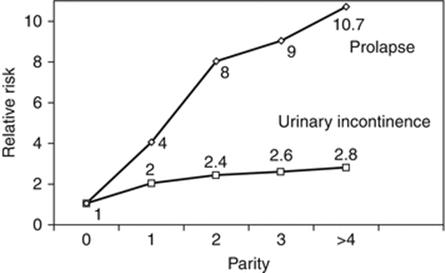
Fig. 16.1
Graph of the effect of vaginal parity on the development of urinary incontinence and pelvic organ prolapse (Reprinted from Lavy et al. [129]; with kind permission from Springer Science and Business Media)
Instrumental Delivery
All types of assisted vaginal delivery are considered as an independent risk factor for severe perineal trauma [38]. Among the potentially modifiable variables, forceps leads the list.
Use of forceps and vacuum has shown to increase the risk of fecal incontinence by two- to seven-fold [7, 39]. Sultan et al. [7], MacArthur et al. [40], and Combs et al. [41] found an increased risk of perineal trauma with forceps but not vacuum. The force of forceps against the pelvic floor muscles and surrounding tissues has been estimated at 75 psi [42]. Forceps delivery markedly increases the risk of third and fourth degree tears and also causes pelvic neuropathy.
In the study by Sultan et al. [7], 81 % of forceps deliveries caused endosonographic anal sphincter defects, compared with 24 % of vacuum extractions. Defaecatory symptoms were also much more frequent in the forceps delivery group. Vacuum extraction is generally thought to be less traumatic than forceps delivery. Handa et al. [31] found an increased risk of lacerations with both forceps and vacuum. Others [41, 43], including a meta-analysis by Eason et al. [44], also have implicated both forms of operative delivery, with forceps carrying a greater risk than vacuum. A prospective, randomized trial by Johanson et al. [45] showed significantly less perineal trauma in the vacuum-extraction group.
A Cochrane review [46], which included 10 trials, concluded that the use of the vacuum extractor for assisted vaginal delivery, compared with forceps, was associated with significantly less maternal trauma.
Forceps has a higher rate of maternal morbidity than vacuum but this also depends on the experience of the operator. This is probably because the shanks of the forceps stretch the perineum and can cause injury to the perineum especially to the anal sphincter if pulled excessively in the posterior direction to encourage flexion of the fetal head.
Prolonged Second Stage
Prolonged second stage of labour carries a twofold increased risk of incontinence. Prolonged second stage of labour is associated with neuromuscular injury [47, 48]. A retrospective cohort study of 15,759 nulliparous women by Cheng et al. [49] concluded that maternal complications like postpartum haemorrhage, third- or fourth-degree lacerations were increased when second stage of labour was increased more than an hour. Rates of caesarean delivery increased when the second stage of labour was prolonged >3 h. When the second stage lasted >4 h, the caesarean delivery rate increased to 32.8 %. Similarly, rates of vaginal delivery declined rapidly from >80.0 % in the 1- to 2-h interval to 56.6 % when the second stage ended during the 2- to 3-h interval. It further declined to 18.8 % when the second stage was prolonged >4 h. In contrast, the rate of operative vaginal delivery increased with time, approaching 50 % after a second stage of >4 h. The frequency of postpartum hemorrhage increased from 7.1 % in cases of 0- to 1-h interval of second stage to 30.9 % when second stage was prolonged >4 h. There was an increase in the rates of third and fourth degree tears from 11.6 % in the 0- to 1-h interval to 34.2 % when the second stage lasted more than 4 h.
Pelvic floor damage may occur even in the first stage of labour. Therefore a caesarean section performed after the start of labour is not necessarily protective.
In summary, the longer the duration of the second stage of labour, the higher the risks of adverse maternal and perinatal outcomes in both nulliparous and multiparous women. The increased risks appear independent of the mode of delivery.
Epidural Analgesia
Women who had epidural anaesthesia for pain relief in labour were almost twice as likely to have third- or fourth-degree perineal lacerations than those who did not have epidurals [50]. The reason for that association was increased operative deliveries and episiotomies with epidurals. The effect of epidural analgesia during labour on the occurrence of perineal tear is complex, as there are many confounding factors. There is evidence that nulliparous women use epidural analgesia at a statistically significant higher rate than parous women; women who use epidural analgesia demonstrate a prolonged second stage of labour; an increased use of augmentation of labour; and more use of epidural analgesia with occipito-posterior position may increase the risk of anal sphincter damage [51, 52]. On the other hand, women undergoing epidural analgesia have a higher rate of episiotomy and epidural analgesia results in women being more relaxed and under control with a slower and more controlled second stage that might reduce the risk [51]. In another study by Eskandar et al. [53], epidural analgesia reduced the rate of severe perineal tear by 12 %. Combs et al. [41] in a study of 2832 consecutive operative vaginal deliveries, also reported no effect of epidural on third- or fourth-degree lacerations. The combination of operative vaginal delivery, epidural and episiotomy increases the risk of childbirth injuries.
Malpresentation and Malposition
Persistent occipitoposterior position leads to a larger presenting diameter and often to a difficult delivery with increased risks of postpartum incontinence [46]. Face and brow presentations also increase the risk of incontinence because of the larger presenting diameter. Breech deliveries do not appear to increase the risk.
Macrosomia
Birthweight more than 4 kg is associated with potential fetal problems like birth trauma, shoulder dystocia and lower apgar scores. On the maternal side, potential complications include higher rates of perineal trauma especially third- and fourth-degree tears [47], pudendal nerve injury, and significantly weaker anal squeeze pressures [54]. Vaginal delivery of at least 4000 g raises the risk of long term stress incontinence [55]. A study by De Leeuw et al. [43] showed a significant correlation between birthweight and the occurrence of third-degree tears. Shiono et al. [56] reported a significant odds ratio of 1.10 per 100-g increase in birthweight. Other studies have also confirmed an increased risk with fetal birthweight exceeding 4 kg [57, 58].
Macrosomic babies disrupt the fascial supports of the pelvic floor. Injury to the pelvic and pudendal nerves may also occur. Shoulder dystocia is also associated with perineal and anal sphincter trauma. It is not clear whether shoulder dystocia per se causes perineal trauma. Manoeuvres used in shoulder dystocia are associated with an increased risk of anal sphincter damage. This was confirmed by Moller Bek and Laurbeg [59]. However, a decision analysis of elective caesarean section for macrosomia determined that 539 elective caesarean sections need to be performed to prevent one case of anal incontinence.
De Leeuw et al. [43] found that birthweight is significantly associated with third degree perineal tears, with an odds ratio per increase of birthweight by 500 g of 1.47 (95 % CI: 1.43–1.51) (Fig. 16.2).
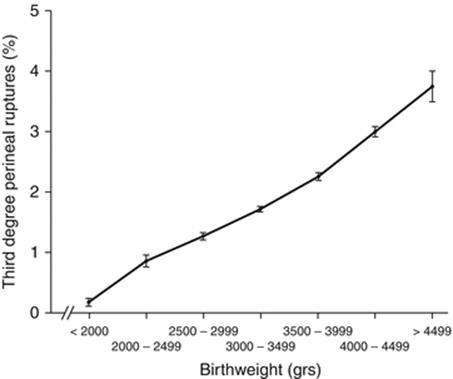
Fig. 16.2
De Leeuw et al. found that birthweight was significantly associated with third degree perineal tears, with an odds ratio per increase of birthweight by 500 g of 1.47 (95 % CI: 1.43–1.51) (Reprinted from De Leeuw et al. [43]; with permission from John Wiley and Sons)
Episiotomy
Although episiotomy is the commonest operation performed in obstetrics, there is little evidence to demonstrate any benefit with its routine use.
In a number of trials [5, 60–66], restrictive use of episiotomy appeared to reduce perineal trauma that required suturing [60]. The weighted risk difference in sutured perineal trauma between the restrictive and liberal episiotomy was −0.23 (95 % CI −0.35,−0.11), i.e., a 23 % absolute decrease in the risk of sutured perineal trauma with restrictive episiotomy. Avoiding routine episiotomy in 4.4 women would prevent one case of perineal trauma that requires suturing.
In the episiotomy trials, the weighted risk difference in anal sphincter tears between restrictive and liberal episiotomy group was −0.004 (95 % CI −0.02, 0.01). Restricting the analysis to mediolateral episiotomy trials [5, 60, 63, 64] did not change the risk difference. The trial by Klein et al. [65] on median episiotomy reported no difference in anal sphincter tears between groups randomized to liberal or restrictive episiotomies. Coats et al. trial compared median to mediolateral epsiotomies [67]. Anal sphincter trauma occurred in 24 % of cases with median and 9 % with mediolateral episiotomies. This study has been criticized because the group allocation was not masked.
In Klein’s RCT of median episiotomy [65], 7.6 % (53 of 698) of women had anal sphincter tears, compared with 1.1 % (44 of 3952) in the mediolateral episiotomy trials [5, 60, 63, 64].
Legino et al. [68] showed that there was a sharp rise in third-degree tears when episiotomy technique switched from mediolateral to median technique. Although mediolateral episiotomy does not protect the anal sphincter, median episiotomy clearly increases the risk of anal sphincter injuries.
Liberal episiotomy did not reduce pain or dyspaerunia. A large Argentine [60] trial found more pain with the use of liberal episiotomies. Routine episiotomy did not prevent urinary incontinence at 3 months postpartum according to Klein et al. [65] and at 3 months and 3 years according to Sleep et al. [5].
Prevention of Childbirth Injuries
Even with optimal obstetric management, childbirth injuries are still a common occurrence. Nevertheless, several strategies have been put forward to minimise the risks. Strategies designed to prevent diseases can act at three different levels. Primary prevention strategies aim to prevent by modifying the risk factors prior to the onset of a condition. Secondary prevention strategies aim to identify and treat people with preclinical disease. Tertiary prevention strategies aim to treat or prevent further complications by managing patients with the disease.
Interventions to Prevent Perineal Trauma
Primary Prevention Strategies
Elective Caesarean Section
Elective caesarean delivery is the only true primary prevention strategy. Caesarean delivery after the onset of labour is not protective of injuries to the pelvic floor. Some functional loss to the pelvic floor might be avoided by elective caesarean section but not by emergency caesarean section [57, 69].
Elective cesarean section can certainly prevent mechanical trauma to the anal sphincter but not neurological trauma [70], but this has not been demonstrated for the urethral sphincter. The surgical and anaesthetic risks of a caesarean section and the risks associated with repeat caesarean sections for future pregnancies need to be considered in making an informed decision.
Studies have shown an increased risk of long-term urinary incontinence [71], and surgery for POP and/or SUI [37], following vaginal delivery; most epidemiological studies suggest that caesarean section provides only partial protection. This is for both emergency and elective caesarean section. Eight or nine caesarean sections need to be performed to avoid one case of urinary incontinence [71]. A 12 year large cohort study by Mcarthur et al has concluded that caesarean section is not protective of urinary incontinence unless all the women had only caesarean deliveries. Even after exclusive caesarean deliveries the prevalence of urinary incontinence was as high as 40 % [109].
With regards to POP, patients delivered exclusively by caesarean section have a significantly reduced risk of objectively measured POP 12 years after delivery [73] and a reduced risk of symptoms by 20 years [71]. Yet the lifetime risk of undergoing a single operation for POP and UI is estimated to be 11.1 % [74], which suggests that the development of PFD may be attributable to factors beyond vaginal versus caesarean deliveries. An intervention such as primary elective caesarean delivery for all births could potentially cause harm to a proportion of women who would otherwise have been delivered vaginally and not have experienced pelvic floor disorders.
Nevertheless, there may be a role for elective caesarean delivery in women with non-modifiable risk factors as part of an alternative primary prevention strategy.
Antenatal Pelvic Floor Muscle Training
Pregnancy and birth trauma are risk factors for urinary incontinence. The incidence of stress urinary incontinence during pregnancy has been reported in the range of 19.9–70 % in nulliparous women [75–77] while in the postpartum period after one vaginal delivery it ranges from 0.7 to 35 % [78, 79].
Antenatal pelvic floor muscle training has been shown to reduce the incidence of postnatal SUI in the short term [80–82]. However, a 6-year [83] and 8-year [84] follow-up showed no significant improvement. By 8 years there was no difference in the quality of life between the study and control group. This was mainly because of the poor compliance with PFMT. Only 38 % of the women performed pelvic floor muscle training (PFMT) twice per week or more. There was no difference in outcome between those who performed regularly compared with those who performed less frequently. However the National Institute of Clinical Excellence (NICE) [85] recommends PFMT for all women in a first pregnancy for prevention of SUI based on data from two randomized controlled trials (RCTs) [81, 82]. An RCT on antenatal pelvic floor exercises to prevent and treat urinary incontinence by Ko et al. [86] on 300 women, concluded that there was a significantly lower incidence of self reported urinary incontinence in the PFMT group than the control group. It also showed that women who delivered vaginally experienced more postpartum leakage than those who delivered by caesarean section.
Warm Compresses and Antenatal Perineal Massage
Antenatal perineal massage has been proposed as a method of decreasing the incidence of perineal trauma. Daily antenatal perineal stretching massage by the woman or her partner has been found to prevent perineal trauma and perineal pain [87]. Antenatal perineal stretching massage has a protective effect in nulliparous women and is associated with an overall reduction in the incidence of trauma requiring suturing as well as lower incidence of episiotomy. These findings were significant for women without previous vaginal birth only. No differences were seen in the incidence of first- or second-degree perineal tears. No significant differences were observed in the incidence of instrumental deliveries, sexual satisfaction, or incontinence of urine, faeces or flatus for any women who practiced perineal massage compared with those who did not.
Five studies [88–92] evaluated the effectiveness of perineal massage. Two of those studies failed to analyse by intention to treat [88] and two of the studies failed to randomize [89]. Two large and similar trials and a pilot study [90] evaluated massage with sweet almond oil for 5–10 min daily from 34 weeks until delivery. The Labrecque and colleagues’ trial [91] reported that in women with first vaginal births, 24.3 % of those that had been randomized to massage had intact perineums compared with 15.1 % of controls who did not massage. A simultaneous trial with subsequent or second births showed no significant benefit of massage [91]. A similar trial by Shipman et al. [92] in nulliparous women found a 6.2 % increase of intact perineums in the massage group compared to the controls. The weighted risk difference from all those trials was – 0.08, i.e., one case of perineal trauma that required suturing would be avoided for every 13 women who did antenatal perineal massage [44].
Secondary Prevention Strategies
Secondary prevention strategies should aim to address obstetric practices that can be modified during labour and delivery.
Perineal Massage During Second Stage
Some accoucheurs ease the perineum back over the crowning head, whereas others believe that manual stretching increase the local tension and causes laceration. There are no randomised controlled trials to provide evidence for or against perineal stretching massage in the second stage. One study from Turkey on 396 nulliparous women who delivered vaginally, concluded that perineal massage during labour decreases the rate of episiotomy and lacerations [93]. Another randomized controlled trial by Stamp et al. [94] on 1340 women concluded that the practice of perineal massage in labour does not increase the likelihood of an intact perineum or reduce the risk of pain, dyspaerunia, or urinary and fecal problems. This trial was underpowered and did not assess the outcome of third degree tears. A Cochrane review showed there was a significant effect of warm compresses and perineal massage during the second stage of labour on reduction of perineal trauma and suturing [95] but suggested that further research is required to see if it prevents OASIS. The procedure has shown to be acceptable to women and midwives.
Maternal Position During Delivery
Randomised controlled trials have evaluated birthing position for the second stage of labour. Two studies [60, 61] assessed squatting or other unsupported upright position compared with recumbent positions for the second stage of labour. Seven randomised controlled trials [96–102] comparing upright and recumbent position, showed that women delivering in upright position were less likely to have an episiotomy, had more lacerations and required repair. A Cochrane review on position in the second stage of labour for women without epidural anaesthesia [103] stated that there was no difference in second degree perineal tears and fewer episiotomies were performed in the birthing stool or squatting position. The rates of episiotomy were also lower for women using birth chair, but second degree perineal tears were increased. However, when considering all women, there was a higher risk of second degree tears in the upright positions except when the birthing cushion was used. The current evidence on the effectiveness of various delivery positions in the prevention of perineal trauma still remains inconclusive. So, it is suggested that women should be encouraged to deliver in whichever position is most comfortable for them.
Whirlpool Baths
Whirlpool baths have a place mainly in low risk midwifery units, but there was only one trial of Jacuzzi whirlpool baths in labour albeit not for birth. This showed less perineal trauma in the group assigned to the Jacuzzi [104].
Vacuum Versus Forceps Delivery
Perineal trauma after forceps and vacuum delivery has been compared in many RCTs [44, 105, 106]. Eason et al. [44] compared seven randomized controlled trials and showed that women delivered by forceps had more anal sphincter trauma than women delivered by vacuum extraction. Compared to vacuum extraction, forceps delivery was associated with almost twice the risk of developing faecal incontinence [105]. Vacuum delivery therefore causes significantly less maternal trauma compared to forceps. The weighted risk difference for anal sphincter trauma was −0.06 (95 % CI −0.10,−0.02). Obstetricians would need to deliver 18 women by vacuum than forceps to prevent one case of anal sphincter tear.
Perineal Support
A recent trend has been towards hands off (not to support the perineum) approach for normal vaginal delivery during crowning. There is lack of evidence for this change of practice. In a recent survey of midwifery practice in England, 50 % of the midwives preferred a hands off/poised approach [107]. A recent Cochrane review has suggested no difference in OASIS rates between ‘hands on’ or ‘hands poised/off’ [95]. One of the studies (Decosta et al. [108]) was small and did not give any estimable effect. Mayerhofer et al. [109] reported only on third-degree tears. McCandlish et al. [4] reported on both third- and fourth-degree tears. There was considerable heterogeneity in the studies. The perineal techniques of the studies were different. The outcome measures were different. The terms “hands on,” “hands off,” “standard care” and “perineal support” meant different things across the studies and were not always defined sufficiently. In the McCandlish et al. study [4], “hands off” not only meant no hand on the perineum and infant’s head until the head was born, but also no manual assistance for the birth of the shoulders, while Mayerhofer et al. [109] defined “hands off” as no hands on the perineum or fetal head until the head was born, but made no distinction between “hands on” and “hands off” for the assistance of the birth of the shoulders. In the Albers’ study [110] “hands off” only meant no hands on the perineum until crowning of the head. Although the standard care or “hands on” manual support techniques are poorly described in most of the studies, it is clear that all studies implied a slow and controlled delivery of the head. Another randomized trial by Albers’ et al which compared hands off the perineum technique and warm compress did not show any advantage or disadvantage in reducing the obstetric genital trauma [111]. Evidence from Finland suggests that their lower OASIS rate (0.6 %) is a result of the more frequent use of perineal support and episiotomy, compared with other Nordic countries (OASIS rates 3.6–4.2 %) [112]. In Norway, recent implementation studies of the ‘hands on’ method have shown a 50 % reduction in OASIS rates [113, 114], supporting a return to the use of the traditional method of perineal support as a method of prevention [115].
Pushing During Second Stage
During the second stage of labour, women may be encouraged to bear down throughout a contraction. A prolonged second stage, in which strong voluntary pushes are encouraged, has been implicated in denervation injury [69]. Parnell et al. [116] and Thompson [117] found no difference in perineal trauma between women who only pushed spontaneously and those who were directed to push throughout the contraction.
Episiotomy
The role of episiotomy has already been discussed elsewhere. Whether episiotomy should be used as a form of prevention is still controversial. However, a quasi randomized study by Coats et al. [67] in nulliparous women showed that midline episiotomies had 12 % anal sphincter tears compared with a 2 % anal sphincter tears in mediolateral episiotomies. A prospective study of almost 300,000 vaginal deliveries reported that the selective use of mediolateral episiotomy did protect against damage to the anal sphincter complex [43].
Perineal Hyaluronidase Injection for Reducing Perineal Trauma
Perineal hyaluronidase injection has been used during the second stage of labour for reducing perineal trauma. Four randomised controlled trials involving 599 woman were included in a Cochrane review [118]. Two trials compared hyaluronidase with placebo injection and three trials compared hyaluronidase with no intervention. In comparison to the group that received no intervention, the group, which received hyaluronidase during the second stage of labour, had a lower incidence of perineal trauma but no difference when compared with placebo injection. The role of perineal hyaluronidase during second stage is yet to be established.
Birth and Vaginal Training Devices - EPI-NO®
EPI-NO® – a new birth and vaginal training device – was developed to reduce the number of episiotomies and increase the incidence of an intact perineum by training with the device. A German doctor, Wilhelm Horkel, designed it. It consists of an inflatable silicone balloon connected to a hand pump. EPI-NO® is designed to dilate the vagina with the aim of adaptation of vagina and perineum to the delivering fetus. Furthermore, women can train their pelvic floor muscles and are able to develop a feeling for pushing process during labour. First results of a German trial demonstrated not only a significant decrease of perineal trauma (42 %) and much lower episiotomy rates (33 %) but also a significant reduction of analgesics, patient anxiety of birth and shortening the duration of second stage of labour after training with EPI-NO® [119].
Similar experience was reported by Kok et al. [120] who found a significant reduction in episiotomies and a tendency towards lower rates of injured perineum (90 % vs. 96.6 %). Similar results with significantly higher rates of intact perineum and a lower rate of perineal tears were observed in an Australian trial [121]. Another prospective randomized multicentre trial concluded that training with EPI-NO® is safe for both mother and child, easy to use, helps to avoid unnecessary episiotomies and increases the likelihood of having an uninjured perineum [122]. Further improvement of these results by means of combining EPI-NO® and perineal massage should be evaluated. A randomized controlled pilot study of EPI-NO® on levator trauma by Shek et al. [123] showed a weak trend towards a lower incidence of levator avulsion and irreversible overdistension in women allocated to EPI-NO® group than in those who actually used the device. It also concluded that a larger sample study size was needed to determine the efficacy on EPI-NO® on levator muscle. Shek et al. [123] also performed a subgroup analysis in women who delivered by prelabour or first-stage caesarean section. No significant differences in peripartum changes of hiatal areas and pelvic organ descent between the control and EPI-NO® groups were found.
Tertiary Prevention Strategies
Tertiary prevention strategies aim to address the mode of delivery in subsequent pregnancies for women with previous childbirth injuries to the pelvic floor.
A study by Fynes et al. [124] evaluated the effect of a second vaginal delivery on anal sphincter structure and function. This study assessed women at risk for cumulative anal sphincter injury and development of anal incontinence and included 59 women who went through two successive vaginal deliveries. After two vaginal deliveries 25.4 % of women reported symptoms of anal incontinence. Seven out of eight women with anal incontinence during their second pregnancy noticed deterioration of symptoms after their second vaginal delivery. The study concluded that women with persistent or transient anal incontinence, and asymptomatic women with anal sphincter defects after their first vaginal delivery, are at high risk for cumulative injury. The study concluded that elective caesarean delivery and a repeat sphincter repair should be given as an option for women with persistent anal incontinence and a sphincter defect. For asymptomatic women with anal sphincter defects appropriate counselling regarding risk of anal incontinence after a second vaginal delivery should be given, so the women can make an informed decision about their subsequent delivery. The Royal College of Obstetricians and Gynaecologists also recommends that all women who have sustained an obstetric anal sphincter injury in a previous pregnancy and are symptomatic or have abnormal endoanal ultrasonography and or manometry should have the option of elective caesarean birth.
Peleg et al. [125] found that women with a history of a third- or fourth-degree tear were 2.3 times as likely to have a repeat tear in a subsequent delivery than women without a history of third- or fourth-degree tear.
Prevention or Prediction?
Preventing perineal trauma would prove to be a significant health benefit factor in childbearing women. It would also reduce the cost and complications that follow it. Hamilton et al. developed a prediction model using CART analysis [126]. Classification and regression trees (CART) analysis is also known as recursive partitioning. It is seldom described in obstetric literature. Hamilton et al. developed their model from a large dataset that included information from several institutions. CART analysis takes individual risk factors, determines the one that best separates patients with or without the problem of interest, and divides the dataset on that basis. The process is carried out repeatedly, identifying the next most discriminating factor in turn. It continues until no variables with discriminating ability are left. At the end of CART analysis, patients are grouped and the risk factors are assessed for a given outcome for each of the groups. William Grobman [127] critically evaluated this model. Firstly, the discriminatory capacity of the original model does not appear to be better. Secondly, this demonstrates that populations other than the one in which the model was developed will still have their outcomes accurately predicted by the model. Several specific aspects of the model presented by Hamilton et al. [126] also are important to consider. Hamilton et al. considered episiotomy of primary importance in the model. This suggests a potential weakness as episiotomy is not a routine in many institutions. Thus, in these circumstances, the ability of the tree to provide further clinically usable information is extremely limited for the vast majority of the population. If a woman does not have an episiotomy, the only other discriminatory factor is the length of the second stage, and this can be used to distinguish women with point-estimate probability of 1.7 % from those with a point-estimate probability of 8.9 %. The authors also documented the combination of episiotomy, instrumental delivery, and birthweight, noting, for example, that every one of the women who had episiotomy, vacuum, and a newborn with a birthweight 4312 g or more ended up with a third- or fourth-degree laceration. This was based on a sample size of just seven women, so that the confidence interval for this probability was wide. The use of birth weight in this model is an important one. The birth weight is an acceptable factor to use if the CART is used for the purpose of an understanding of the factors. However, if the purpose of the CART is to help in prediction, then a factor such as birthweight is unlikely to be helpful as it is not known accurately before birth. This cannot be simply substituted for the actual birthweight used in the model because the predicted probabilities may no longer be valid. CART analysis should be validated in different populations before it is to be used as a prediction model.
Awareness of the risk factors does not always help to predict which women will sustain a sphincter tear and tears occur in women without risk factors. Approximately one third of births are in nulliparous women. An occipito-posterior position of the fetal head is probably present in about one in five women at the start of labour. In many of these women the fetal head rotates to an occipito-anterior position, although this may not occur until late in labour or at the time of an assisted delivery. A persistent occipito-posterior position cannot be predicted.
Risk prediction models have been tried but whether they effectively assist in prevention is debatable. Introduction of high-quality prediction models into clinical practice may result in reduced incidence of childbirth trauma. However, validation of such prediction models is important.
A contentious debate regarding the role of primary elective caesarean has gained interest. An important aspect of this debate relates to the potential benefits of caesarean in the prevention of pelvic floor dysfunction. However the development of appropriate prevention strategies has been impossible by a lack of adequate data. Patel et al. [128] developed an epidemiological approach for the assessment of prevention opportunities at delivery. The study focused mainly on primary prevention. However, they also accepted that the development of appropriate prevention strategies has been stalled by lack of data. Primary prevention denotes an action taken to prevent the development of a disease in a person who is well and does not have the disease in question. Epidemiological studies usually aim to determine the incidence and risks of a disease in a population. The science of epidemiology is based on the determination of whether an association between an exposure and an outcome reflects a causal association. With respect to prevention, measures based on absolute differences are preferred, because they provide an estimate of the excess risk that is associated with a given exposure. Attributable risk measures indicate the potential for prevention if the exposure could be eliminated, given that the exposure and outcome are linked causally. The basic concept of absolute risk is that it subtracts the incidence of the outcome in the unexposed (e.g., incidence of PFD in women who did not undergo vaginal delivery) from that in the exposed (e.g., incidence of PFD in women who have undergone vaginal delivery). On the basis of these epidemiological data, Patel et al. calculated the attributable risk percentage from a cohort study using the following formulas: [incidence in exposed – incidence in unexposed]/incidence of exposed × 100 or ([relative risk – 1]/relative risk × 100. However the data required to calculate the excess risk of POP attributable to vaginal delivery are not available. Long-term prospective studies are required to provide data that in turn could be used for the development of targeted prevention strategies. Further epidemiological studies are still awaited for a definitive recommendation.
In conclusion, it seems that elective caesarean section before labour is the only true primary prevention strategy for childbirth injuries to the pelvic floor but the risks of an elective caesarean section should be taken into account while counselling a woman. Alternative primary prevention strategies include antepartum pelvic floor exercises, use of vaginal training devices and perineal massage. Secondary prevention strategies must focus on modifying obstetric practices that predispose women to childbirth injury. These factors may include restrictive use of episiotomy, mediolateral episiotomy when necessary, spontaneous over forceps-assisted vaginal delivery, vacuum extraction over forceps delivery, and perineal massage during second stage. Tertiary prevention strategies should address the mode of delivery recommended for women with childbirth injuries who desire future pregnancies.
References
1.
Kettle C, Tohill S. Perineal care. BMJ Clin Evid Online. 2011;2011. pii: 1401.
2.
Royal College of Obstetricians and Gynecologists. Green-top guideline no. 29 published March 2007 updated Nov 2014. Third- and Fourth- degree Perineal Tears,Management (Green-top Guideline No.29).
3.
MacArthur C, Lewis D, Bick D. Stress incontinence after childbirth. Br J Midwifery. 1991;1:207–14.
4.
McCandlish R, Bowler U, Van Asten H, Berridge G, Winter C, Sames L, Garcia J, et al. A randomised controlled trial of care of the perineum during second stage of normal labour. Br J Obstet Gynaecol. 1998;105(12):1262–72.PubMed
5.
Sleep J, Grant A, Garcia J, Elbourne D, Spencer J, Chalmers I. West Berkshire perineal management trial. BMJ. 1984;298:587–690.
6.
Glazener CMA, Abdalla M, Stroud P, Naji S, Templeton A, Russell IT. Postnatal maternal morbidity: extent, causes, prevention and treatment. Br J Obstet Gynaecol. 1995;102:286–7.
7.
Sultan AH, Thomas JM, Bartram CI. Anal-sphincter disruption during vaginal delivery. N Engl J Med. 1993;329(26):1905–11.PubMed
8.
Sleep J, Grant A. Pelvic floor exercises in postnatal care. Br J Midwifery. 1987;3:158–64.
9.
Lien KC, Mooney B, Delancey JOL, Ashton Miller JA. Levator ani muscle stretch induced by simulated vaginal birth. Obstet Gynaecol. 2004;103:31–40.
10.
Viktrup L, Lose G. The risk of stress incontinence 5 years of after first delivery. Am J Obstet Gynecol. 2001;185:52–87.
11.
Henry MM, Parks AG, Swash M. The pelvic floor musculature in the descending perineum syndrome. Br J Surg. 1982;69:470–2.PubMed
12.
Thom DH, Rortveit G. Prevalence of postpartum urinary incontinence: a systematic review. Acta Obstet Gynecol Scand. 2010;89:1511–22.PubMed
13.
Radestad I, Olsson A, Nissen E, Rubertsson C. Tears in the vagina, perineum, sphincter ani, and rectum and first sexual intercourse after childbirth: a nationwide follow-up. Birth. 2008;35:98–106.PubMed
14.
Pergialiotis V, Vlachos D, Protopapas A, Pappa K, Vlachos G. Risk factors for severe perineal lacerations during childbirth. Int J Gynecol Obstet. 2014;125:6–14.
15.
Groutz A, Hasson J, Wengier A, Gold R, Skornick-Rapaport A, Lessing JB, et al. Third- and fourth-degree perineal tears: prevalence and risk factors in the third millennium. Am J Obstet Gynecol. 2011;204(4):347.e1–4. doi:10.1016/j.ajog.2010.11.019. Epub 2010 Dec 22.
16.
Dahlen HG, Ryan M, Homer CS, Cooke M. An Australian prospective cohort study of risk factors for severe perineal trauma during childbirth. Midwifery. 2007;23(2):196–203.PubMed
17.
Anthony S, Buitendijk SE, Zondervan KT, van Rijssel EJ, Verkerk PH. Episiotomies and the occurrence of severe perineal lacerations. Br J Obstet Gynaecol. 1994;101(12):1064–7.PubMed
18.
Riskin-Mashiah S, O'Brian Smith E, Wilkins IA. Risk factors for severe perineal tear: can we do better? Am J Perinatol. 2002;19(5):225–34.PubMed
19.
Byrd LM, Hobbiss J, Tasker M. Is it possible to predict or prevent third degree tears? Colorectal Dis. 2005;7(4):311–8.PubMed
20.
Goldberg J, Hyslop T, Tolosa J, Sultana C. Racial differences in severe perineal lacerations after vaginal delivery. Am J Obstet Gynecol. 2003;188:1063–7.PubMed
21.
Dhawan S. Birth weights of infants of first generation Asian women in the United Kingdom compared with second generation Asian women. BMJ. 1995;311:86–8.PubMedPubMedCentral
22.
Schwartz N, Seubert DE, Mierlak J, Arslan AA. Predictors of severe perineal lacerations in Chinese women. J Perinat Med. 2009;37:109–13.PubMed
23.
Nakai A, Yoshida A, Kawabata I, Kawabata I, Hayashi M, Yokota A, et al. Incidence and risk factors for severe perineal laceration after vaginal delivery in Japanese patients. Arch Gynecol Obstet. 2006;274:222–6.PubMed
24.
Hornemann A, Kamischke A, Luedders DW, Beyer DA, Diedrich K, Bohlmann MK. Advanced age is a risk factor for higher grade perineal lacerations during delivery in nulliparous women. Arch Gynecol Obstet. 2010;281(1):59–64.PubMed
25.
Rortveit G, Hunskaar S. Urinary incontinence and age at the first and last delivery: the Norwegian HUNT/EPINCONT study. Am J Obstet Gynecol. 2006;195(2):433–8.PubMed
26.
Groutz A. First vaginal delivery at an older age: does it carry an extra risk for the development of stress urinary incontinence. Neurourol Urodyn. 2007;26:779–82.PubMed
27.
Dolan LM, Hilton P. Obstetric risk factors and pelvic floor dysfunction 20 years after first delivery. Int Urogynecol J Pelvic Floor Dysfunct. 2010;21(5):535–44.
28.
Wilson PD, Herbison RM, Herbison GP. Obstetric practice and the prevalence of urinary incontinence three months after delivery. Br J Obstet Gynaecol. 1996;103(2):154–61.PubMed
29.
Zetterström J, López A, Anzén B, Norman M, Holmström B, Mellgren A. Anal sphincter tears at vaginal delivery: risk factors and clinical outcome of primary repair. Obstet Gynecol. 1999;94(1):21–8. Review.PubMed
30.
Petersen LK, Uldbjerg N. Cervical hydroxyprolin concentration in relation to age. In: Lippert PC, Woessner JF, editors. The extracellular matrix of the uterus, cervix and the fetal membranes. New York: Perinatology Press; 1991. p. 138–9.
31.
Handa VL, Danielsen BH, Gilbert WM. Obstetric anal sphincter lacerations. Obstet Gynecol. 2001;98(2):225–30.PubMed
32.
Oberwalder M, Connor J, Wexner SD. Meta-analysis to determine the incidence of obstetric anal sphincter damage. Br J Surg. 2003;90(11):1333.PubMed
33.
Smith LA, Price N, Simonite V, Burns EE. Incidence of and risk factors for perineal trauma: a prospective observational study. BMC Pregnancy Childbirth. 2013;13:59.PubMedPubMedCentral
34.
Lowder JL, Burrows LJ, Krohn MA, Weber AM. Risk factors for primary and subsequent anal sphincter lacerations: a comparison of cohorts by parity and prior mode of delivery. Am J Obstet Gynecol. 2007;196(4):344.e1–5.
35.
Baghestan E, Irgens LM, Børdahl PE, Rasmussen S. Trends in risk factors for obstetric anal sphincter injuries in Norway. Obstet Gynecol. 2010;116(1):25–34.PubMed
36.
Mant J, Painter R, Vessey M. Epidemiology of genital prolapse: observations from the Oxford Family Planning Association Study. BJOG. 1997;104:579–85.
37.
Leijonhufvud A, Lundholm C, Cnattingius S, Granath F, Andolf E, Altman D. Risks of stress urinary incontinence and pelvic organ prolapse surgery in relation to mode of childbirth. Am J Obstet Gynecol. 2011;204:70.e1–7.
38.
Hudelist G, Gelle'n J, Singer C, Ruecklinger E, Czerwenka K, Kandolf O, et al. Factors predicting severe perineal trauma during childbirth: role of forceps delivery routinely combined with mediolateral episiotomy. Am J Obstet Gynecol. 2005;192(3):875–81.PubMed
39.
Donnelly VS, Fynes M, Campbell DM, Johnson H, O’Connell PR, O'Herlihy C. Obstetric events leading to anal sphincter damage. Obstet Gynecol. 1998;92:955–61.PubMed
40.
MacArthur C, Glazener CMA, Wilson PD, Herbison GP, Gee H, Lang GD, et al. Obstetric practice and faecal incontinence three months after delivery. BJOG. 2001;108:678–83.PubMed
41.
Combs A, Robertson P, Laros R. Risk factors for third-degree and fourth-degree perineal lacerations in forceps and vacuum deliveries. Am J Obstet Gynecol. 1990;163:100–4.PubMed
42.
Meyer S, Hohlfeld P, Achtari C, Russolo A, Degrandi P. Birthtrauma: short and long term effects of forceps delivery compared with spontaneous delivery on various pelvic floor parameters. Br J Obstet Gynaecol. 2000;107:1360–5.
43.
De Leeuw JW, Struijk PC, Vierhout ME, Wallenburg HCS. Risk factors for third degree perineal ruptures during delivery. Br J Obstet Gynaecol. 2001;108:383–7.
44.
Eason E, Labrecque M, Wells G, Feldman P. Preventing perineal trauma during childbirth: a systematic review. Obstet Gynecol. 2000;95(3):464–71.PubMed
45.
Johanson RB, Rice C, Doyle M. A randomised prospective study comparing the new vacuum extractor policy with forceps delivery. BJOG. 1993;100:524–30.
46.
Fernando R, Sultan AH, Kettle C, Thakar R, Radley S. Methods of repair for obstetric anal sphincter injury. Cochrane Database Syst Rev. 2006;(3):CD002866.
47.
Snooks SJ, Swash M, Henry MM, Setchell M. Risk factors in childbirth causing damage to the pelvic floor innervation. Br J Surg. 1986;72:S15–7.
48.
Genadry R. A urogynecologist’s view of the pelvic floor effects of vaginal delivery/cesarean section for the urologist. Curr Urol Rep. 2006;7:376–83.PubMed
49.
Cheng YW, Hopkins LM, Caughey AB. How long is too long: does a prolonged second stage of labor in nulliparous women affect maternal and neonatal outcomes? Am J Obstet Gynecol. 2004;191(3):933–8.PubMed
50.
Robinson JN, Norwitz ER, Cohen AP, McElrath TF, Lieberman ES. Epidural analgesia and third- or fourth-degree lacerations in nulliparas. Obstet Gynecol. 1999;94(2):259–62.PubMed
51.
Bodner-Adler B, Bodner K, Kimberger O, Wagenbichler P, Kaider A, Husslein P, et al. The effect of epidural analgesia on the occurrence of obstetric lacerations and on the neonatal outcome during spontaneous vaginal delivery. Arch Gynecol Obstet. 2002;267:81–4.PubMed
52.
Albers LL, Migliaccio L, Bedrick EJ, Teaf D, Peralta P. Does epidural analgesia affect the rate of spontaneous obstetric lacerations in normal births? J Midwifery Womens Health. 2007;52(1):31–6.PubMed
53.
Eskandar O, Shet D. Risk factors for 3rd and 4th degree perineal tear. J Obstet Gynaecol. 2009;29(2):119–22.PubMed
54.
Sultan AH, Kamm MA, Hudson CN. Pudendal nerve damage during labour: prospective study before and after childbirth. Br J Obstet Gynaecol. 1994;101:22–8.PubMed
55.
Goldberg RP, Abramov Y, Botros S, Miller JJ, Gandhi S, Nickolov A, et al. Delivery mode is a major environmental determinant of stress urinary incontinence: results of the Evanston-Northwestern Twin Sisters Study. Am J Obstet Gynecol. 2005;193:2149–53.PubMed
56.
Shiono P, Klebanoff MA, Caarey JC. Midline episiotomies: more harm than good? Obstet Gynecol. 1990;75:765–70.PubMed
57.
Sultan AH, Kamm MA, Bartram CI, Hudson CN. Perineal damage at delivery. Contemp Rev Obstet Gynecol. 1994;6:18–24.
58.
Poen AC, Felt-Bersma RJF, Dekker GA, Deville W, Ma C, Meuwissen SGM. Third degree obstetric perineal tears: risk factors and the preventive role of mediolateral episiotomy. Br J Obstet Gynaecol. 1997;104:563–6.PubMed
59.
Moller Bek K, Laurberng S. Intervention during labour: risk factors associated with complete tear of the anal sphincter. Acta Obstet Gynecol Scand. 1992;71:520–4.PubMed
60.
Argentine Episiotomy Trial Collaborative Group. Routine vs selective episiotomy: a randomised controlled trial. Lancet. 1993;42:1517–8.
61.
Dannecker C, Hillemanns P, Strauss A, Hasbargen U, Hepp H, Anthuber C. Episiotomy and perineal tears presumed to be imminent: randomized controlled trial. Acta Obstet Gynecol Scand. 2004;83(4):364–8.PubMed
62.
Eltorkey MM, Al Nuaim MA, Kurdi AM, Sabagh TO, Clarke F. Episiotomy, elective or selective: a report of a random allocation trial. J Obstet Gynaecol. 1994;14:317–20.
63.
Harrison RF, Brennan M, North PM, Reed JV, Wickham EA. Is routine episiotomy necessary? BMJ. 1984;288:1971–5.PubMedPubMedCentral
64.
House MJ, Cario G, Jones MH. Episiotomy and the perineum: a random controlled trial. J Obstet Gynaecol. 1986;7:107–10.
65.
Klein MC, Gauthier RJ, Jorgensen SH, Robbins JM, Kaczorowski J, Johnson B, et al. Does episiotomy prevent perineal trauma and pelvic floor relaxation? Online J Curr Clin Trials. 1992;10.
66.
Rodriguez A, Arenas EA, Osorio AL, Mendez O, Zuleta JJ. Selective vs routine midline episiotomy for the prevention of third- or fourth-degree lacerations in nulliparous women. Am J Obstet Gynecol. 2008;198(3):285.e1–4.
67.
Coats PM, Chan KK, Wilkins M, Beard RJ. A comparison between midline and mediolateral episiotomies. Br J Obstet Gynaecol. 1980;87:408–12.PubMed
68.
Legino LJ, Woods MP, Rayburn WF, McGoogan LS. Third and fourth degree perinal tears. 50 years’ experience at a University hospital. J Reprod Med. 1988;33:423–6.PubMed
69.
Allen RE, Hosker GL, Smith ARB, Warrell DW. Pelvic floor damage and childbirth: a neurophysiological study. Br J Obstet Gynaecol. 1990;97:770–9.PubMed
70.
Fitzpatrick M, O’Herlihy C. The effects of labour and delivery on the pelvic floor. Best Pract Res Clin Obstet Gynaecol. 2001;15(1):63–73.PubMed
71.
John LJ, Ommen R, Sreedharan J, Muttappally MJ. Prevalence of urinary incontinence 20 years after childbirth: a national cohort study in singleton primiparae after vaginal or caesarean delivery. BJOG. 2013;120(9):1151–2.PubMed
72.
Glazener C, Elders A, MacArthur C, Lancashire RJ, Herbison P, Hagen S, et al. (ProLong Study Group). Childbirth and prolapse: long-term associations with the symptoms and objective measurement of pelvic organ prolapse. BJOG. 2013;120:161–8.
73.
Olsen AL, Smith VJ, Bergstrom JO, Colling JC, Clark AL. Epidemiology of surgically managed pelvic organ prolapse and urinary incontinence. Obstet Gynecol. 1997;89:501–6.PubMed
74.
Hvidman L, Foldspang A, Mommsen S, Bugge Neilsen J. correlates of urinary incontinence in pregnancy. Int Urogynecol J. 2002;13:278–83.
75.
Raza Khan F, Graziano S, Kenton K, Shott S, Brubaker L. Pereiparum urinary incontinence in a reacially diverse obstetrical population. Int Urogynecol J. 2006;17:525–30.
76.
Brown SJ, Donath S, MacArthur C, McDonald EA, Krastev AH. Urinary incontinence in nulliaprous women before and during pregnancy: prevalence, incidence, and associated risk factors. Int Urogynecol J. 2010;21(2):193–202.PubMed
77.
Viktrup L, Lose G, Rolf M, Barfoed K. The frequency of urinary symptoms during pregnancy and puerperium in the primipara. Int Urogynecol J. 1993;4:27–30.
78.
Morkved S, Bø K. Prevalence of urinary incontinence during pregnancy and postpartum. Int Urogynaecol J. 1999;10:394–8.
79.
Sampselle CM, Miller JM, Mims BL, Delancey JO, Ashton-Miller JA, Antonakos CL. Effect of pelvic muscle exercise on transient incontinence during pregnancy and after birth. Obstet Gynecol. 1998;91:406–12.PubMed
80.
Morkved S, Bø K, Schei B, Salvesen KA. Pelvic floor muscle training during pregnancy to prevent urinary incontinence: a single-blind randomized controlled trial. Obstet Gynecol. 2003;101:313–9.PubMed
81.
Reilly ETC, Freeman RM, Waterfield MR, Waterfield AE, Steggles P, Pedlar F. Prevention of postpartum stress incontinence in primigravidae with increased bladder neck mobility: a randomised controlled trial of antenatal pelvic floor exercises. BJOG. 2002;109:68–76.PubMed
82.
Glazener CM, Herbison GP, MacArthur C, Grant A, Wilson PD. Randomised controlled trial of conservative management of postnatal urinary and faecal incontinence: six year follow up. BMJ. 2005;330:337.PubMedPubMedCentral
83.
Agur WI, Steggles P, Waterfield M, Freeman RM. The long term effectiveness of antenatal pelvic floor muscle training: 8 year follow up of a randomized controlled trial. BJOG. 2008;115:985–90.PubMed
84.
National Institute of Health & Clinical Excellence (NICE). The management of urinary incontinence in women. Guideline 40. 2006. www.nice.org.uk/nicemedia/pdf/CG40fullguideline.pdf.
85.
Ko PC, Liang CC, Chang SD, Lee JT, Chao AS, Cheng PJ. A randomized controlled trial of antenatal pelvic floor exercises to prevent and treat urinary incontinence. Int Urogynecol J. 2011;22(1):17–22. doi:10.1007/s00192-010-1248-4.PubMed
86.
Beckmann MM, Stock OM. Antenatal perineal massage for reducing perineal trauma. Cochrane Database Syst Rev. 2013;(4):CD005123.
87.
Avery MD, Burket BA. Effect of perineal massage on the incidence of episiotomy and perineal laceration in a nurse-midwifery service. J Nurse Midwifery. 1986;31:128–34.PubMed
88.
Avery MD, Van Arsdale L. Perineal massage—effect on the incidence of episiotomy and laceration in a nulliparous population. J Nurse Midwifery. 1987;32:181–4.PubMed
89.
Labrecque M, Marcoux S, Pinault JJ, Laroche C, Martin S. Prevention of perineal trauma by perineal massage during pregnancy: a pilot study. Birth. 1994;21:20–5.PubMed
90.
Labrecque M, Eason E, Marcoux S, Lemieux F, Pinault JJ, Feldman P, et al. Randomized controlled trial of prevention of perineal trauma by perineal massage during pregnancy. Am J Obstet Gynecol. 1999;180:593–600.PubMed
91.
Shipman MK, Boniface DR, Tefft ME, McCloghry F. Antenatal perineal massage and subsequent perineal outcomes: a randomized controlled trial. Br J Obstet Gynaecol. 1997;104:787–91.PubMed
92.
Karaçam Z, Ekmen H, Calişir H. The use of perineal massage in the second stage of labor and follow-up of postpartum perineal outcomes. Health Care Women Int. 2012;33(8):697–718.PubMed
93.
Stamp G, Kruzins G, Crowther C. Perineal massage in labour and prevention of perineal trauma: randomised controlled trial. BMJ. 2001;322(7297):1277–80.PubMedPubMedCentral
94.
Aasheim V, Nilsen ABV, Lukasse M, Reinar LM. Perineal techniques during the second stage of labour for reducing perineal trauma. Cochrane Database Syst Rev. 2011;(12):CD006672.
95.
Stewart P, Hillan E, Calder AA. A randomised trial to evaluate the use of a birth chair for delivery. Lancet. 1983;1:1296–8.PubMed
96.
Liddell HS, Fisher PR. The birthing chair in the second stage of labour. Aust N Z J Obstet Gynaecol. 1985;25:65–8.PubMed
97.
Turner MJ, Romney ML, Webb JB, Gordon H. The birthing chair: an obstetric hazard? J Obstet Gynaecol. 1986;6:232–5.
98.
Stewart P, Spiby H. A randomized study of the sitting position for delivery using a newly designed obstetric chair. Br J Obstet Gynaecol. 1989;96:327–33.PubMed
99.
Gardosi J, Sylvester S, B-Lynch C. Alternative positions in the second stage of labour: a randomized controlled trial. Br J Obstet Gynaecol. 1989;96:1290–6.PubMed
100.
Waldenstrom U, Gottvall K. A randomized trial of birthing stool or conventional semirecumbent position for second stage labor. Birth. 1991;18:5–10.PubMed
101.
Crowley P, Elbourne D, Ashurst H, Garcia J, Murphy D, Duignan N. Delivery in an obstetric birth chair: a randomized controlled trial. Br J Obstet Gynaecol. 1991;98:667–74.PubMed
102.
Gupta JK, Hofmeyr GJ, Shehmar M. Position in the second stage of labour for women without epidural anaesthesia. Cochrane Database Syst Rev. 2012;(5):CD002006.
103.
Rush J, Burlock S, Lambert K, Loosley Millman M, Hutchison B, Enkin M. The effects of whirlpool baths in labor: a randomized controlled trial. Birth. 1996;23:136–43.PubMed
104.
Fitzpatrick M, Behan M, O’Conell OR, O’Herlihy C. Randomised clinical trial to assess anal sphincter function following forceps or vacuum assisted vaginal delivery. Br J Obstet Gynecol. 2003;110:424–9.
105.
Weerasekera DS, Premaratne S. A randomized prospective trial of the obstetric forceps versus vacuum extraction using define criteria. J Obstet Gynaecol. 2002;22(4):344–5.PubMed
106.
Trochez R, Waterfield M, Freeman R. Hands on or hands off the perineum: a survey of care of the perineum in labour (HOOPS). Int Urogynecol J. 2011;22:1279–85.PubMed
107.
Costa D, De Souza Caroci da Costa ML, Gonzalez Riesco ML. A comparison of “hands off” versus “hands on” techniques for decreasing perineal lacerations during birth. J Midwifery Womens Health. 2006;51(2):106–11.
108.
Mayerhofer K, Bodner-Adler B, Bodner K, Rabl M, Kaider A, Wagenbichler P, et al. Traditional care of the perineum during birth. A prospective, randomized, multicenter study of 1,076 women. J Reprod Med. 2002;47(6):477–82.PubMed
109.
MacArthur C, Glazener C, Lancashire R, Herbison P, ProLong Study Group. Exclusive caesarean section delivery and subsequent urinary and faecal incontinence: a 12-year longitudinal study. BJOG. 2011;118:1001–7.PubMed
110.
Albers LL. Reducing genital tract trauma at birth: launching a clinical trial in midwifery. J Midwifery Womens Health. 2003;48:109.
111.
Albers LL, Sedler KD, Bedrick EJ, Teaf D, Peralta P. Midwifery care measures in the second stage of labor and reduction of genital tract trauma at birth: a randomized trial. J Midwifery Womens Health. 2005;50(5):365–72.PubMedPubMedCentral
112.
Laine K, Gissler M, Pirhonen J. Changing incidence of anal sphincter tears in four Nordic countries through the last decades. Eur J Obstet Gynecol Reprod Biol. 2009;146:71–5.PubMed
113.
Hals E, Oian PMDP, Pirhonen TRN, Gissler M, Hjelle S, Nilsen EB, et al. A multicenter interventional program to reduce the incidence of anal sphincter tears. Obstet Gynecol. 2010;116:901–8.PubMed
114.
Laine K, Skjeldestad F, Sandvik L, Staff AC. Incidence of obstetric anal sphincter injuries after training to protect the perineum: cohort study. BMJ Open. 2012;2:e001649.PubMedPubMedCentral
115.
Freeman R. Can we prevent childbirth-related pelvic floor dysfunction? BJOG. 2013;120:137–40.PubMed
116.
Parnell C, Langhoff-Roos J, Iversen R, Damgaard P. Pushing method in the expulsive phase of labor. Acta Obstet Gynecol Scand. 1993;72:31–5.PubMed
117.
Thomson AM. Pushing techniques in the second stage of labour. J Adv Nurs. 1993;18:171–7.PubMed
118.
Zhou F, Wang XD, Li J, Huang GQ, Gao BX. Hyaluronidase for reducing perineal trauma. Cochrane Database Syst Rev. 2014;(2):CD010441.
119.
Hillebrenner J, Wagenpfeil S, Schuchardt R, Schelling M, Schneider KT. Initial experiences with primiparous women using a new kind of Epi-no labor trainer. Z Geburtshilfe Neonatol. 2001;205:12–9.PubMed
120.
Kok J, Tan KH, Koh S, Cheng PS, Lim WY, Yew ML, et al. Antenatal use of a novel vaginal birth training device by term primiparous women in Singapore. Singapore Med J. 2004;45:318–23.PubMed
121.
Kovacs GT, Heath P, Heather C. First Australian trial of the birth-training device Epi-No: a highly significantly increased chance of an intact perineum. Aust N Z J Obstet Gynaecol. 2004;44:347–8.PubMed
122.
Ruckhaberle E, Jundt K, Bauerle M, Brisch KH, Ulm K, Dannecker C, et al. Prospective randomised multicentre trial with the birth trainer EPI-NO® for the prevention of perineal trauma. Aust N Z J Obstet Gynaecol. 2009;49:478–83.PubMed
123.
Shek KL, Chantarasorn V, Lander S, Phipps H, Dietz HP. Does the Epi-No Birth Trainer reduce levator trauma? A randomized controlled trial. Int Urogynecol J. 2011;22:1521–8.PubMed
124.
Fynes M, Donnelly V, Behan M, O'Connell PR, O'Herlihy C. Effect of second vaginal delivery on anorectal physiology and fecal incontinence: a prospective study. Lancet. 1999;354:983–6.PubMed
125.
Peleg D, Kennedy CM, Merrill D, Zlatnik FJ. risk of repetition of a severe perineal laceration. Obstet Gynecol. 1999;93:1021–4.PubMed
126.
Hamilton EF, Smith S, Yang L, Warrick P, Ciampi A. Third- and fourth degree perineal lacerations: defining high-risk clinical clusters. Am J Obstet Gynecol. 2011;204:309.e1–6.
127.
Grobman WA. Building a better prediction model. Am J Obstet Gynecol. 2011;20(4):279–80.
128.
Patel DA, Xu X, Thomason AD, Ransom SB, Ivy JS, DeLancey JO. Childbirth and pelvic floor dysfunction: an epidemiologic approach to the assessment of prevention opportunities at delivery. Am J Obstet Gynecol. 2006;195(1):23–8.PubMedPubMedCentral
129.
Lavy Y, Sand PK, Kaniel CI, Hochner-Celni D. Can pelvic floor injury secondary to delivery be prevented? Int Urogynecol J. 2012;23:165–73.PubMed