
Thomas R. Moore, MD
Planning is bringing the future into the present so that you can do something about it now; it pays to plan ahead. It wasn't raining when Noah built the ark.
—Robert Cushing
THE GLOBAL CHALLENGE OF PRECONCEPTION CARE IN DIABETES
Worldwide 1 in 10 pregnancies may be associated with diabetes. At present, an estimated 347 million people worldwide have diabetes and more than half of these are women. At least one-third of these, some 60 million globally, are of reproductive age, who will embark on pregnancies with suboptimal glucose control, which in turn will place their fetuses and newborns at significant short-term and lifetime risk. Moreover, the longitudinal trends in diabetes prevalence are discouraging, with an emerging global epidemic of diabetes that can be traced to burgeoning overweight, obesity, and physical inactivity.1
In the United States, a similarly alarming problem has evolved. In 2010, there were 22 million persons with diabetes in the reproductive ages of 20-39 years and an additional 54 million had impaired glucose tolerance or “prediabetes” with the potential to develop fetal and maternal morbidities of hyperglycemia during pregnancy. Further, the startling upswing in the prevalence of diabetes in the United States is exclusive due to increasing rates of type 2 diabetes.2 Thus, if preconception care of women with diabetes is to be effectively applied, a major redirection of medical and social resources will be necessary.
THE MORBIDITIES OF DIABETES DURING PREGNANCY IN WOMEN WITH POOR GLYCEMIC CONTROL
It has long been recognized that preexisting diabetes poses special risks for both mother and fetus if glucose is not well controlled in the first trimester. Specifically, the occurrence of fetal structural anomalies increases severalfold and these include disorders of the nervous, cardiovascular, gastrointestinal, and renal systems, as well as skeletal anomalies. Estimates of the increases in fetal malformations typically are in the three to four times range, with central nervous system malformations almost doubled, cardiac malformations increased 20% to 30%, and renal and skeletal abnormalities severalfold. A recent study by Guerin3 in 2007 demonstrated a curvilinear relationship between preconception hemoglobin A1c (HbAlc) and the incidence of congenital anomalies. With an HbA1c of 6.9 or less, the incidence of birth defects was approximately 2.5%, almost equivalent to the nondiabetic population. However, in women beginning pregnancy with HbA1c above 10%, the risk of congenital anomalies was elevated by three- to fourfold in the 6%-7% range. For women whose HbA1c exceeded 13%, as many as one in seven fetuses had a congenital anomaly. Most of these malformations occur in the first trimester and thus typically coincide with or precede maternal recognition of pregnancy. Even in the most adept clinical hands, women whose diabetes is suboptimally controlled prior to conception will rarely achieve adequate control by mid embryogenesis to normalize the risk of fetal malformations.
Other hazards for the fetus and newborn associated with maternal pregestational diabetes include excessive fetal fat accretion, progressive of remodeling of the fetal heart (interventricular septal hypertrophy), intermittent hypoxia associated with unchecked glucose excursions, and an increase in stillbirth. For those who reach the late third trimester, the perils of labor and delivery are substantial as fetal tolerance for the oxygen reductions associated with uterine contractions is poor. And, because fetal fat accretion increases thoracic and abdominal girth but does not affect cranial dimensions, fetus is at increased risk for shoulder dystocia and neurologic injury.
The incidence of these morbidities is directly proportional to maternal glycemic control. Langer et al.4 in 1991 estimated the risk of shoulder dystocia to be approximately 2.5% among babies with birth weight of 4000 g for both normoglycemic and diabetic gravidas, whereas among babies weighing 4500 g, the risk of shoulder dystocia was almost tripled if the mother had diabetes.
Thus, it appears that since most of fetal adipose accretion and cardiovascular stress occurs in the second and third trimesters, it may be possible, without preconception diabetes care, to avoid these complications. However, a patient who has been chronically accustomed to maintaining glucose values well above the normal range rarely is able to control her blood sugars in the critical second and third trimesters adequately to avoid substantial fetal fat accretion. A better approach would be to delay pregnancy until maternal glucose control is optimized for fetal well-being.
THE BENEFICIAL EFFECTS OF PRECONCEPTION CARE FOR PREGESTATIONAL DIABETES
The benefits of preconception care were established by Fuhrmann et al.5 in 1983, documenting a cohort study that demonstrated fetal malformations in only 0.8% of women attending a preconception care clinic as opposed to a 7.5% rate in those who did not. Table 29-1 demonstrates a comparison of five studies of preconception care summarized by Temple.6 With preconception care, the mean malformation rate was substantially lower (crude mean 1%) than among those who had usual care (crude mean 6.7%), yielding a net reduction of 86% (range 70%-100%). This marked difference in the malformation rates is associated with a strikingly modest reduction in HbA1c (crude mean 17%, range 9%-29%) occurring prior to conception. In aggregate, these studies demonstrate the utility of preconception care for avoiding congenital malformations in women with pregestational diabetes.
The value of a preconception care clinic has been assessed in a number of randomized controlled trials, 11 of which were recently summarized in a meta-analysis by Wahabi et al.7 in 2010. Preconception care was associated with a significant reduction in prepregnancy HbA1c, a 75% reduction in congenital anomalies and perinatal mortality was similarly reduced by 65%.
The utilization of preconception care in medical clinics of the National Health Service among women with pregestational diabetes was evaluated by the Confidential Enquiry Into Maternal and Child Health (CEMACH) in 2007 in the United Kingdom.8 In this extensive assessment, it was demonstrated that among women with type 1 diabetes, preconception counseling occurred in only 38% and glucose assessments in only 40%. Only 40% were taking folic acid supplements. Among women with type 2 diabetes, the figures were more discouraging with preconception counseling occurring only in 25% and glucose assessment in 30%. Given that these results were obtained in a country with universal health insurance, there is little reason to believe that statistics derived from the experience of women in the United States is better.
The problem of providing preconception care has been further complicated recently by the emergence of an epidemic of obesity. As demonstrated by Anderson et al.9 in a large case- control study after adjusting for maternal ethnicity, age, education, smoking, alcohol use, and periconceptional vitamin use, obese women had substantially increased risks of delivering offspring with anencephaly (odds ratio = 2.3; 95% confidence interval [CI] 1.2-4.3), spina bifida (2.8; CI 1.7-4.5), and isolated hydrocephaly (2.7; CI 1.5-5.0). Odds ratios were higher for the joint effects of maternal obesity and maternal diabetes.
Similarly, Martinez-Frias et al.10 also noted that the increase in congenital birth defects occurring in pregnancy with diabetes is potentiated by coexisting obesity. Whereas nonobese women with diabetes had congenital malformation rates near those of nondiabetic controls (approximately 2%) in obese diabetic women (body mass index [BMI] above 30) had malformed fetuses in the 4%-5% range. Thus, although it may have been considered formerly that women with mild degrees of type 2 diabetes may be at somewhat less risk of congenital anomalies, the overlay of obesity multiplies the risk significantly.
TABLE 29-1 Studies Comparing Outcomes of Women with Diabetes Receiving Preconception Care (PCC) to Those Entering Pregnancy without Preconception Care
|
Percent |
PCC |
No PCC |
Percent |
||||
|
PCC |
No PCC |
HbA1c |
Malformation |
Malformation |
Malformation |
||
|
Author |
Reference |
HbA1c |
HbA1c |
Reduction |
(%) |
(%) |
Reduction |
|
Goldman |
22 |
7.4 |
10.4 |
29 |
0.0 |
9.6 |
100 |
|
et al. |
|||||||
|
Steel et al. |
23 |
8.4 |
10.5 |
20 |
1.4 |
10.4 |
87 |
|
Rosenn et al. |
24 |
8.5 |
9.9 |
14 |
0.0 |
1.4 |
100 |
|
Temple et al. |
25 |
6.6 |
7.6 |
13 |
1.8 |
6.1 |
70 |
|
Murphy et al. |
26 |
6.9 |
7.6 |
9 |
1.8 |
6.1 |
70 |
|
Crude Mean |
7.56 |
9.2 |
17 |
1.00 |
6.72 |
86 |
The task of providing preconception care to women with gestational diabetes in a prior pregnancy, who did not complete postpartum metabolic testing and are therefore at risk of entering a next pregnancy with significant hyperglycemia, continues to be challenging.
PRECONCEPTION CARE: IS GLUCOSE CONTROL ENOUGH?
Multiple studies have demonstrated the value of the folic acid supplementation in reducing congenital anomalies in pregnant women. Carea Villasenor11 in 2003 catalogued a decade-long and progressive drop in spina bifida rates in the Baltimore, Maryland area. Not until fortification of food and increased emphasis on vitamin supplementation in doctors’ offices was initiated, did the rate drop further. Among women with diabetes, the effects of folic acid in the reduction of congenital anomalies are even more impressive. When nondiabetic women taking supplemental vitamins are compared to women with diabetes not taking supplemental folic acid, the odds ratio for cardiac defect was 13.35, whereas if women with diabetes took supplemental folic acid, the odds ratio of the malformed infant dropped to 5.5.12
PRECONCEPTION CARE: CURRENT RECOMMENDATIONS
The American College of Obstetricians Gynecologists (ACOG) Practice Bulletin Number 60, 2005 Pregestational Diabetes Mellitus,13 recommends preconception counseling for all women with pregestational diabetes, which should include discussion of potential vascular complications occurring during pregnancy (ophthalmic, renal, cardiovascular). Because of the link between thyroid dysfunction and diabetes, assessment of thyroid function is recommended and 400 μg daily folic acid supplementation is advised with the proviso that it could be possibly higher. It is notable the contraception is not mentioned in that Practice Bulletin.
The American Diabetes Association (ADA) recommendations for preconception care of women with diabetes published in 201214 endorsed incorporation of preconception counseling in routine diabetes clinic visits for all women of childbearing potential. They recommend that HbA1c level should be maintained as close to normal as possible (less than 7%) before conception is attempted. They also recommend that women with diabetes contemplating pregnancy should be evaluated and treated as indicated for vascular complications of diabetes, discontinuance of medications that may pose risk to the fetus including statins, angiotensin-converting enzyme inhibitor (ACE) inhibitors, ARBs, and most noninsulin therapy. Also notable in the ADA standards is the absence of recommendations regarding the role of contraception.
EFFECTIVENESS OF PRECONCEPTION CARE FOR WOMEN WITH DIABETES
The status of preconception care delivered in the medical clinics of the British National Health Service was assessed in 2007 with the CEMACH study, which was summarized recently by Temple.6 Among the principal findings of the study were the following:
• Lack of preconception care was associated with a fivefold increase in adverse pregnancy outcomes.
• Only 17% of the medical units that participated in the survey, all of which were actively providing care to women with diabetes, actually provided multidisciplinary preconception care to women.
• Regarding women with type 1 diabetes, fewer than half received prepregnancy counseling (39%), folic acid supplements (43%), or achieved a HbA1c less than 7% (35%).
• Regarding women with type 2 diabetes, the percentage receiving preconception care was significantly less with only 25% receiving prepregnancy counseling and only 29% taking folic acid.
The CEMACH study also assessed the attributes of women whose pregnancies were planned versus those that occurred unplanned. A critical feature associated with having a planned pregnancy was having a positive relationship with the preconception health-care team that provided encouraging and empowering prepregnancy advice as opposed to health-care teams providing discouraging and negative views of a potential pregnancy.
A U.S. study by Perritt et al.15 utilizing the Pregnancy Risk Assessment Monitoring System, assessed contraception use among women with preexisting medical problems. Whereas 50%-60% of women with recognized cardiac disease or hypertension were utilizing contraception, among those with diabetes mellitus fewer than 25% reported utilizing contraception. Clearly, if a reduction in diabetes-associated fetal malformations is to be achieved, active strategies to provide appropriate contraception during the preconceptional period must be developed and implemented.
THE IMPORTANCE OF POSTPARTUM CARE IN PRECONCEPTION CARE
It is important that women with gestational diabetes mellitus (GDM) come to understand whether they have overt, type 2 diabetes persisting after delivery of their babies so that their preconceptional glucose control can be optimized for the next pregnancy. Accordingly, ACOG and other expert bodies recommend testing of women with GDM in the postpartum period. Unfortunately, success in this area has fallen far short of expectations. In one study of postpartum GDM testing by Carson et al.16 that summarized data from 13 studies involving over 10,000 GDM women, only 35% underwent postpartum testing for type 2 diabetes. When active outreach measures were utilized to improve compliance, only 65% of GDMs had been tested up to 12 weeks postpartum. Unfortunately, this leaves one-third to two-thirds of women at risk for type 2 diabetes undiscovered. In a subsequent pregnancy, such women frequently are not diagnosed before the end of the first trimester of the next pregnancy after organogenesis has taken place. Other studies have shown that in some populations, fewer than one-third of women ever attend their postpartum visit largely due to complicating social circumstances and lack of insurance funding.
UNDERUTILIZATION AND UNDERPERFORMANCE OF PRECONCEPTION CARE: WHAT CAN BE
DONE?
Role of Health Insurance
A number of programs have been developed to incentivize healthcare providers to optimize identification and care of populations with chronic diseases (“Pay for Performance”). One example of this is the California P4P program overseen by the Integrated Healthcare Association, a consortium of eight health plans representing 10 million insured individuals.17 The P4P Program focuses on seven elements encompassing cardiovascular, diabetes, musculoskeletal, prevention, respiratory, maternity, and utilization. P4P sets goals for quality care to be delivered by their providers and compensation bonuses are gauged to achieve improvement in specific health measures. In diabetes care, current elements for which practitioners and physician groups can qualify for additional funding include controlling HbA1c to a level below 8%, reducing low-density lipoproteins (LDL) into a healthy range and keeping blood pressure below 140/90 mmHg. The results from 2010 are at once encouraging and discouraging. Screening for LDL and glucose control was achieved in 90% of the physician groups but controlling HbA1c below 8% occurred in only slightly more than 50%. This obviously leaves approximately half of women at risk for pregnancy with HbA1c in a suboptimal range.
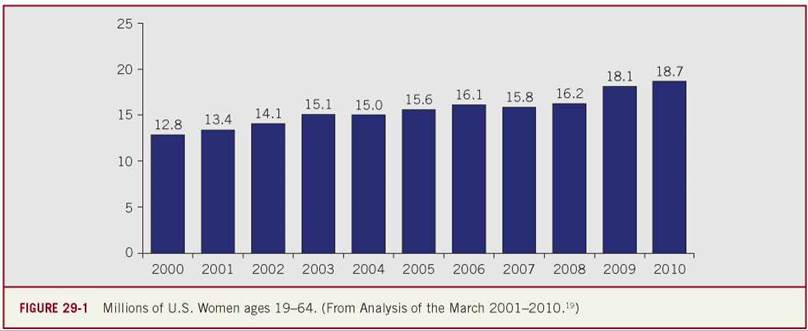
Although the results of the California P4P program among the insured population is encouraging, no similar programs are available to the uninsured or to many of those covered by Medicaid insurance. The National Institute for Reproductive Health documented that in 2004, 20% of U.S. women were uninsured (19 million).18 Of these, half have had no regular doctor, 40% did not fill prescriptions due unaffordability, and 67% stated they need a care but could not get it due to cost. Figure 29-1, which demonstrates the numbers of uninsured women in reproductive ages trended from 2000 to 2010, shows an increase of six million uninsured women in the past decade.19
Fortunately, recent U.S. federal law requires that states participating in Medicaid extend Medicaid eligibility to all pregnant women with incomes below 133% of the federal poverty level (FPL).20 However, no similar provisions exist for nonpregnant women, with Medicaid income eligibility thresholds as low as 19% in Alabama. While women who become pregnant, United States have uniform access to maternity care from the earliest diagnosis of pregnancy, preconception care remains unavailable to a substantial number of women with diabetes.
The Affordable Care Act (ACA) may indeed improve the picture of preconception care. For those states opting to participate in the Medicaid expansion, nonpregnant women with income below 133% of FPL will gain access to coverage. Through the new ACA insurance exchanges, a vast formerly uninsured population of nonpregnant women will have access to prenatal and preconceptional care regardless of their history and preexisting conditions. Unfortunately, at the time of this writing, a substantial number of states legislatures have declined to participate in the Medicaid expansion clause, leaving women in those states in a situation where they do not have ready access to preconception care.
PRECONCEPTION CARE: A WAY FORWARD
There are a number of seemingly insurmountable obstacles in the way of improving the picture for women with diabetes and at risk for diabetes when they are nonpregnant. Expanding insurance coverage for the nonpregnant population is on the horizon but will require participation of the remaining states presently resisting Medicaid expansion. Lack of prepregnancy planning on the part of women with or at risk for diabetes, and especially those with type 2 diabetes and obesity can be expected to be substantially suboptimal for the foreseeable future. Active outreach programs to at-risk women will be necessary and at present have not been put forward in an organized way by expert bodies such as ADA and ACOG.
What is potentially achievable and could represent significant progress is a wider availability of multidisciplinary clinics for women with diabetes. Multidisciplinary care means that realistic but encouraging advice regarding prepregnancy management and glycemic control is provided. There is little doubt based on the CEMACH study that the presence of an obstetrician, midwife, or other obstetrical care giver is an essential component of effective preconception care for women with diabetes.
It is also possible to improve postpartum visit compliance, incorporate effective lifestyle education and ensure glucose tolerance testing is performed for those with gestational diabetes and women who are obese. Moreover, expert bodies and insurance plans must emphasize these important aspects of obstetrical care, at least as important as successful delivery of the fetus.
Redesigning care models to promote effective and reliable handoff from obstetrical provider to primary care provider and a Medical Home that will treat all reproductive aged women as potentially preconceptional is essential.
Finally, utilization of effective contraception for all women with obesity and glucose intolerance is necessary if preconceptional glycemic targets are to be achieved and fetal status optimized. Contraception counseling must be actively incorporated into postpartum and routine care of all reproductive aged women if the presently excessive and correctable incidence of fetal anomalies is to be reduced.
Table 29-2 summarizes the desirable elements of a preconception care program for women at risk of diabetes.21

REFERENCES
1. Danaei G, Finucane MM, Lu Y, et al. National, regional, and global trends in fasting plasma glucose and diabetes prevalence since 1980: systematic analysis of health examination surveys and epidemiological studies with 370 country-years and 2.7 million participants. Lancet. 2011;378(9785):31-40.
2. Veeraswamy S, Vijayam B, Gupta VK, Kapur A. Gestational diabetes: the public health relevance and approach. Diabetes Res Clin Pract. 2012;97:350-358.
3. Guerin A, Nisenbaum R, Ray JG. Use of maternal GHb concentration to estimate the risk of congenital anomalies in the offspring of women with prepregnancy diabetes. Diabetes Care. 2007;30:1920-1925.
4. Langer O, Berkus MD, Huff RW, Samueloff A. Shoulder dystocia: should the fetus weighing greater than or equal to 4000 grams be delivered by cesarean section? Am J Obstet Gynecol. 1991;165(4 Part 1):831-837.
5. Fuhrmann K, Reiher H, Semmler K, et al. Prevention of congenital malformations in infants of insulin-dependent diabetic mothers. Diabetes Care. 1983;6(3):219-223.
6. Temple R. Preconception care for women with diabetes: is it effective and who should provide it? Best Pract Res Clin Obstet Gynaecol. 2011;25(1):3-14.
7. Wahabi HA, Alzeidan RA, Bawazeer GA, et al. Preconception care for diabetic women for improving maternal and fetal outcomes: a systematic review and meta-analysis. BMC Pregnancy Childbirth. 2010;10:63.
8. Confidential Enquiry into Maternal and Child Health. Diabetes in Pregnancy: Are We Providing the Best Care? Findings of a National Enquiry. England, Wales and Northern Ireland; London, UK: CEMACH; 2007.
9. Anderson JL, Waller DK, Canfield MA, et al. Maternal obesity, gestational diabetes, and central nervous system birth defects. Epidemiology. 2005;16(1):87-92.
10. Martinez-Frias ML, Frias JP, Bermejo E, et al. Pre-gestational maternal body mass index predicts an increased risk of congenital malformations in infants of mothers with gestational diabetes. Diabet Med. 2005;22:775-781.
11. Correa-Villasenor A, Cragan J, Kucik J, et al. The Metropolitan Atlanta Congenital Defects Program: 35 years of birth defects surveillance at the Centers for Disease Control and Prevention. Birth Defects Res A Clin Mol Teratol. 2003;67:617-624.
12. Parker SE, Yazdy MM, Tinker SC, et al. The impact of folic acid intake on the association among diabetes mellitus, obesity, and spina bifida. Am J Obstet Gynecol. 2013;209:239.e1-239.e8.
13. ACOG Committee on Practice Bulletins. Clinical Management Guidelines for Obstetrician-Gynecologists. Number 60, March 2005. Pregestational diabetes mellitus. Obstet Gynecol. 2005;105(3):675-685.
14. American Diabetes Association. Standards of medical care in diabetes-2012. Diabetes Care. 2012;35(suppl 1):S11-S63.
15. Perritt JB, Burke A, Jamshidli R, et al. Contraception counseling, pregnancy intention and contraception use in women with medical problems: an analysis of data from the Maryland Pregnancy Risk Assessment Monitoring System (PRAMS). Contraception. 2013;88:263-268.
16. Carson MP, Frank MI, Keely E. Original research: postpartum testing rates among women with a history of gestational diabetes—systematic review. Prim Care Diabetes. 2013;7(3):177-186.
17. http://www.ncqa.org/HEDISQualityMeasurement/ OtherMeasurementActivities/PayforPerformance.aspx
18. National Institute for Reproductive Health. Quick Sheet: Uninsured Women's Acess to Care. http://www.nirhealth.org/sections/publica- tions/documents/UninsuredWomen1.pdf
19. Analysis of the March 2001-2010. Current Population Surveys by N. Tilipman and B. Sampat of Columbia University for The Commonwealth Fund.
20. Robertson R, Squires D, Garber T, et al. Oceans apart: the higher health costs of women in the U.S. compared to other nations, and how reform is helping. Issue Brief (Commonw Fund). 2012; 19:1-20.
21. Temple R, Murphy H. Type 2 diabetes in pregnancy—an increasing problem. Best Pract Res Clin Endocrinol Metab. 2010;24: 591-603.
22. Goldman JA, Dicker D, Feldberg D, et al. Pregnancy outcome in patients with insulin-dependent diabetes mellitus with preconceptional diabetic control: a comparative study. Am J Obstet Gynaecol. 1986;155:293-297.
23. Steel JM, Johnstone FD, Hepburn DA, Smith AF. Can prepregnancy care of diabetic women reduce the risk of abnormal babies? Br Med J. 1990;301:1070-1074.
24. Rosenn B, Miodovnik M, Combs CA, et al. Pre-conception management of insulin dependant diabetes: improvements in pregnancy outcome. Obstet Gynecol. 1991;77:846-849.
25. Temple RC, Aldridge VJ, Murphy HR. Prepregnancy care and pregnancy outcomes in women with type 1 diabetes. Diabetes Care. 2006;29:1744-1749.
26. Murphy H, Roland J, Skinner T, et al. Effectiveness of a regional prepregnancy care program in women with type 1 and type 2 diabetes: benefits beyond glycemic control. Diabetes Care. 2010;33(12): 2514-2520.