
Narcotic Agonist Analgesic
PREGNANCY RECOMMENDATION: Human Data Suggest Risk
BREASTFEEDING RECOMMENDATION: Compatible
PREGNANCY SUMMARY
The National Birth Defects Prevention Study discussed below found evidence that opioid use during organogenesis is associated with a low absolute risk of congenital birth defects.
Respiratory depression in the newborn is a potential complication if fentanyl is used close to delivery. As with all opioids, neonatal withdrawal may occur after chronic, long-term exposure during pregnancy.
FETAL RISK SUMMARY
Fentanyl is an opioid analgesic. When given by IV injection, the terminal elimination half-life is 219 minutes. Although not teratogenic in rats, fentanyl impaired fertility and was embryotoxic at IV doses 0.3 times the upper human dose given for a period of 12 days (1).
The placental transfer of fentanyl has been documented in the 1st and 2nd trimesters (2) and at term (3–7). A study published in 1998 measured fentanyl concentrations in fetal fluids (amniotic and/or chorionic cavities), fetal blood (after 12 weeks’ gestation), and maternal serum 5–22 minutes after an IV bolus (1.5 mcg/kg) in 42 healthy women scheduled for pregnancy termination (between 6 and 16 weeks) under general anesthesia (2). Fentanyl was detected in amniotic fluid at less than 12 weeks’, but not later, and in fetal blood. None of the samples of chorionic fluid, however, contained detectable fentanyl (2).
In a study comparing women in labor who received 50 or 100 mcg of fentanyl IV every hour as needed (N = 137) (mean dose 140 mcg, range 50–600 mcg) to those not requiring analgesia (epidural or narcotic) (N = 112), no statistical differences were found in newborn outcome in terms of the incidence of depressed respirations, Apgar scores, and the need for naloxone (3). In blinded measurements taken at 2–4 and 24 hours, no differences were observed between the two groups of infants in respiratory rate, heart rate, blood pressure, adaptive capacity, neurologic evaluation, and overall assessment. The last dose of fentanyl was given at a mean of 112 minutes before delivery. Cord blood levels of the narcotic were always significantly lower than maternal serum levels (cord:maternal ratios were approximately 0.5 but exact data were not given) (p <0.03). Doses used were considered equianalgesic to 5–10 mg of morphine or 37.5–75 mg of meperidine (3).
Respiratory depression has been observed in one infant whose mother received epidural fentanyl during labor (4). Fentanyl may produce loss of fetal heart rate (FHR) variability without causing fetal hypoxia (3,5). However, no effect on FHR variability or accelerations was observed when epidural fentanyl was given to women receiving adequate epidural lidocaine analgesia (6). The narcotic has been combined with bupivacaine for spinal anesthesia during labor (7,8). In four studies, the addition of fentanyl to bupivacaine had no effect on neonatal respiration (9,10–12) and, in two, did not adversely affect neurobehavioral scores (9,12). Placental transfer of fentanyl was documented in one study with cord:maternal venous plasma ratios of 1.12 for total drug and 1.20 for free drug (9). A study of a continuous epidural infusion of fentanyl and bupivacaine found no accumulation of either drug over a 1- to 15-hour interval in 21 laboring women and observed no adverse fetal effects (13). The mean cord:maternal venous fentanyl concentration was 0.94.
In 15 women undergoing elective cesarean section, fentanyl 1 mcg/kg given IV within 10 minutes of delivery produced an average cord blood:maternal blood ratio over 10 minutes of 0.31 (range 0.06–0.43) (14). No respiratory depression was observed, and all neurobehavioral scores were normal at 4 and 24 hours.
A 1998 case report described respiratory muscle rigidity in a newborn that was attributed to fentanyl (15). Because of severe maternal disease (pulmonary valve stenosis with congestive heart failure and pregnancy-induced hypertension) and Doppler measurements showing periodically absent diastolic flow in the umbilical cord, a cesarean section under general anesthesia was performed at 31 weeks’ gestation to deliver a 1440-g male infant. Betamethasone had been given to the mother for fetal lung maturation before delivery. The mother was premedicated with morphine (7.5 mg) and scopolamine (0.3 mg), followed by fentanyl (300 mcg; note: reference states “mg” but assumed to be “mcg”), diazepam (7.5 mg), ketamine (300 mg), and vecuronium (7 mg). The newborn had no respiratory movements and had a heart rate of about 100 beats/minute (Apgar score 3 at 1 minute). Attempts to ventilate the infant by mask and then by intubation with positive pressure produced no chest movements until 8 minutes after delivery. A chest X-ray showed normal lungs with no sign of hyaline membrane disease. After treatment of severe respiratory alkalosis at 1 hour of age, the infant made an uneventful recovery and was developing normally at 1 year of age. The author attributed the chest wall rigidity to fentanyl because this is a common adverse effect in adults administered the agent during anesthesia (15).
A 31-year-old woman was treated with transdermal fentanyl patches (125 mcg/hr) throughout gestation for severe cervical and lumbar spinal injuries sustained in a road traffic accident before conception (16). An elective cesarean section was performed at 38 weeks’ gestation to deliver a healthy, 3.13-kg female infant with Apgar scores of 9 at 1 and 5 minutes, respectively. The infant’s head circumference was 35.4 cm (50th percentile). Blood concentrations of fentanyl were as follows: mother (predelivery) 3.56 ng/mL, infant 1.23 ng/mL (at birth), 0.31 ng/mL (day 1), and <0.25 ng/mL) (day 2). At 24 hours of age, the bottle-fed baby was noted to be jittery, fisting, and irritable with a high-pitched cry. The mean Finnegan scores (an assessment of acute opioid withdrawal in newborns based on nursing observations) on days 1 and 2 were 4.5 (“mild” is 0–7) with a single peak of 11 (“abstinence” is 8–11) at 72 hours of age. Finnegan scores were consistently less than 4 by day 4 and, at 96 hours of age the infant had no signs of opioid withdrawal. No drug therapy of the withdrawal was required at any time. The infant was developing normally at follow-up (16).
Results of a National Birth Defects Prevention Study (1997–2005) were published in 2011 (17). This population-based case–control study examined the association between maternal use of opioid analgesics and >30 types of major structural birth defects. In 17,449 case mothers, therapeutic opioid use was reported by 454 (2.6%) compared with 134 (2.0%) of 6701 control mothers. Indications for use of opioid analgesics were surgical procedures (41%), infections (34%), chronic diseases (20%), and injuries (18%). Dose, duration, or frequency was not evaluated. The exposure period evaluated was from 1 month before to 3 months after conception. Limiting the exposure period to the first 2 months after conception produced similar results. Infants with >1 defect were included in multiple birth defect categories. The following opioids were included (number of cases for each agent not specified): codeine, hydrocodone, hydromorphone, fentanyl, meperidine, methadone, morphine, oxycodone, pentazocine, propoxyphene, and tramadol. The birth defect, total number, number exposed, and the adjusted odds ratio (aOR) with 95% confidence interval (CI) were as follows (see below table):
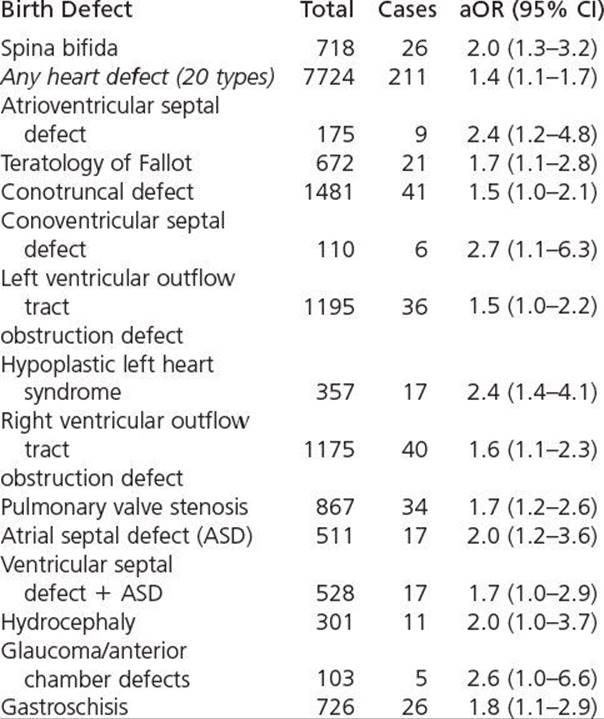
The authors speculated that the activity of opioids and their receptors as growth regulators during development of the embryo might be a mechanism to explain the above findings. The exposure data were obtained by retrospective maternal self-report; the authors acknowledged that recall bias and misclassification might have affected their results. They concluded that the absolute risk was a modest absolute increase above the baseline risk for birth defects (17).
BREASTFEEDING SUMMARY
Fentanyl is excreted into milk. A study published in 1992 measured fentanyl colostrum concentrations in 13 healthy women who had received fentanyl (2 mcg/kg) during cesarean section or postpartum tubal ligation (18). Serum and colostrum samples were collected at six intervals up to 10 hours after drug administration. The peak serum and colostrum fentanyl levels occurred at 0.75 hours, with mean values of 0.19 and 0.40 ng/mL, respectively, falling to undectable and 0.05 ng/mL, respectively, at 10 hours. Colostrum fentanyl concentrations were always greater than serum levels at every measurement. It was concluded that breastfeeding was safe because of the low colostrum concentrations and the low oral bioavailability of fentanyl (18).
The American Academy of Pediatrics classifies fentanyl as compatible with breastfeeding (19).
References
1.Product information. Duragesic. Janssen Pharmaceutica, 2000.
2.Shannon C, Jauniaux E, Gulbis B, Thiry P, Sitham M, Bromley L. Placental transfer of fentanyl in early human pregnancy. Hum Reprod 1998;13:2317–20.
3.Rayburn W, Rathke A, Leuschen MP, Chleborad J, Weidner W. Fentanyl citrate analgesia during labor. Am J Obstet Gynecol 1989;161:202–6.
4.Carrie LES, O’Sullivan GM, Seegobin R. Epidural fentanyl in labour. Anaesthesia 1981;36:965–9.
5.Johnson ES, Colley PS. Effects of nitrous oxide and fentanyl anesthesia on fetal heart-rate variability intra- and postoperatively. Anesthesiology 1980;52:429–30.
6.Viscomi CM, Hood DD, Melone PJ, Eisenach JC. Fetal heart rate variability after epidural fentanyl during labor. Anesth Analg 1990;71:679–83.
7.Justins DM, Francis D, Houlton PG, Reynolds F. A controlled trial of extradural fentanyl in labour. Br J Anaesth 1982;54:409–13.
8.Milon D, Bentue-Ferrer D, Noury D, Reymann JM, Sauvage J, Allain H, Saint-Marc C, van den Driessche J. Peridural anesthesia for cesarean section employing a bupivacaine–fentanyl combination. Ann Fr Anesth Reanim 1983;2:273–9.
9.Fernando R, Bonello E, Gill P, Urquhart J, Reynolds F, Morgan B. Neonatal welfare and placental transfer of fentanyl and bupivacaine during ambulatory combined spinal epidural analgesia for labour. Anaesthesia 1997;52:517–24.
10.Benlabed M, Dreizzen E, Ecoffey C, Escourrou P, Migdal M, Gaultier C. Neonatal patterns of breathing after cesarean section with or without epidural fentanyl. Anesthesiology 1990;73:1110–3.
11.Halonen PM, Paatero H, Hovorka J, Haasio J, Korttila K. Comparison of two fentanyl doses to improve epidural anaesthesia with 0.5% bupivacaine for cesarean section. Acta Anaesthesiol Scand 1993;37:774–9.
12.Porter J, Bonello E, Reynolds F. Effect of epidural fentanyl on neonatal respiration. Anesthesiology 1998;89:79–85.
13.Bader AM, Fragneto R, Terui K, Arthur GR, Loferski B, Datta S. Maternal and neonatal fentanyl and bupivacaine concentrations after epidural infusion during labor. Anesth Analg 1995;81:829–32.
14.Eisele JH, Wright R, Rogge P. Newborn and maternal fentanyl levels at cesarean section (abstract). Anesth Anal 1982;61:179–80.
15.Lindemann R. Respiratory muscle rigidity in a preterm infant after use of fentanyl during cesarean section. Eur J Pediatr 1998;157:1012–3.
16.Regan J, Chambers F, Gorman W, MacSullivan R. Neonatal abstinence syndrome due to prolonged administration of fentanyl in pregnancy. Br J Obstet Gynaecol 2000;107:570–2.
17.Broussard CS, Rasmussen SA, Reefhuis J, Friedman JM, Jann MW, Riehle-Colarusso T, Honein MA, for the National Birth Defects Prevention Study. Maternal treatment with opioid analgesics and risk for birth defects. Am J Obstet Gynecol 2011;204:314–7.
18.Steer PL, Biddle CJ, Marley WS, Lantz RK, Sulik PL. Concentration of fentanyl in colostrum after an analgesic dose. Can J Anaesth 1992;39:231–5.
19.Committee on Drugs, American Academy of Pediatrics. The transfer of drugs and other chemicals into human milk. Pediatrics 2001;108:776–89.