
Narcotic Agonist Analgesic, Respiratory Drug (Antitussive)
PREGNANCY RECOMMENDATION: Human Data Suggest Risk
BREASTFEEDING RECOMMENDATION: Limited Human Data—Potential Toxicity
PREGNANCY SUMMARY
The National Birth Defects Prevention Study discussed below found evidence that opioid use during organogenesis is associated with a low absolute risk of congenital birth defects. Interestingly, this supports the FDA data also presented below. Similar to other opioid analgesics, the use of hydrocodone late in pregnancy has the potential to cause respiratory depression and withdrawal in the newborn (see also Codeine).
FETAL RISK SUMMARY
Hydrocodone is a centrally acting narcotic agent that is related to codeine. It is combined with other drugs for use as an analgesic or as an antitussive. In a reproductive study in hamsters, a single SC injection (102 mg/kg) during the critical period of CNS organogenesis produced malformations (cranioschisis and various other lesions) in 3.4% of the offspring (1). Because of its narcotic properties, withdrawal could theoretically occur in infants exposed in utero to prolonged maternal ingestion of hydrocodone.
In a surveillance study of Michigan Medicaid recipients involving 229,101 completed pregnancies conducted between 1985 and 1992, 332 newborns had been exposed to hydrocodone during the 1st trimester (F. Rosa, personal communication, FDA, 1993). A total of 24 (7.2%) major birth defects were observed (14 expected), 5 of which were cardiovascular defects (3 expected). No anomalies were observed in five other defect categories (oral clefts, spina bifida, polydactyly, limb reduction defects, and hypospadias) for which specific data were available. The total number of malformations is suggestive of a possible association but other factors, including the mother’s disease, concurrent drug use, and chance, may be involved.
At a 1996 meeting, data on 118 women using hydrocodone (N = 40) or oxycodone (N = 78) during the 1st trimester for postoperative pain, general pain, or upper respiratory infection were matched with a similar group using codeine for these purposes (2). Six (5.1%) of the infants exposed to hydrocodone or oxycodone had malformations, an odds ratio of 2.61 (95% confidence interval 0.6–11.5) (p = 0.13). There was no pattern evident among the six malformations (2).
Results of a National Birth Defects Prevention Study (1997–2005) were published in 2011 (3). This population-based case–control study examined the association between maternal use of opioid analgesics and >30 types of major structural birth defects. In 17,449 case mothers, therapeutic opioid use was reported by 454 (2.6%) compared with 134 (2.0%) of 6701 control mothers. Indications for use of opioid analgesics were surgical procedures (41%), infections (34%), chronic diseases (20%), and injuries (18%). Dose, duration, and frequency were not evaluated. The exposure period evaluated was from 1 month before to 3 months after conception. Limiting the exposure period to the first 2 months after conception produced similar results. Infants with >1 defect were included in multiple birth defect categories. The following opioids were included (number of cases for each agent not specified): codeine, hydrocodone, hydromorphone, fentanyl, meperidine, methadone, morphine, oxycodone, pentazocine, propoxyphene, and tramadol. The birth defect, total number, number exposed, and the adjusted odds ratio (aOR) with 95% confidence interval (CI) were as follows:
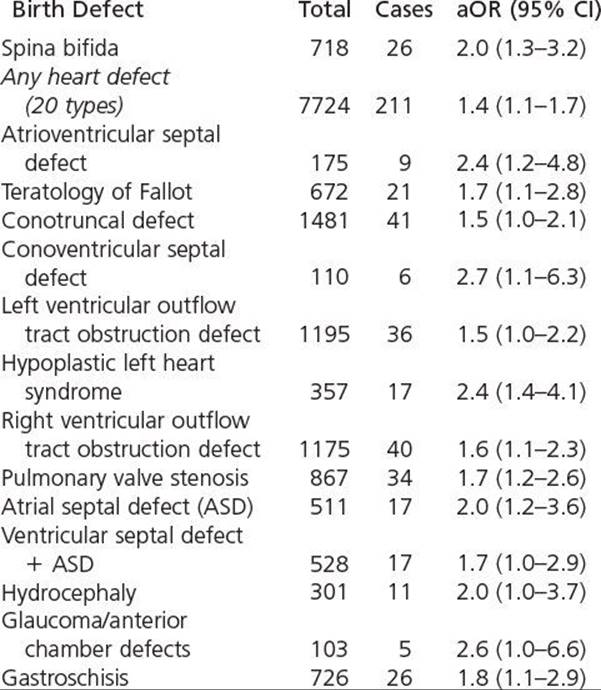
The authors speculated that the activity of opioids and their receptors as growth regulators during development of the embryo might be a mechanism to explain the above findings. The exposure data were obtained by retrospective maternal self-report; the authors acknowledged that recall bias and misclassification might have affected their results. They concluded that the absolute risk was a modest absolute increase above the baseline risk for birth defects (3).
BREASTFEEDING SUMMARY
A mother, breastfeeding her third infant, experienced severe pain from cracked nipples associated with a fungal infection (4). She had successfully breastfed her two previous infants for 1–2 years. At about 3 weeks postpartum, because acetaminophen alone or combined with codeine had not been successful in controlling her pain, she was started on hydrocodone/acetaminophen (10/650 mg/tablet) two tablets every 4 hours. Good analgesia was obtained, but both the mother and infant were “groggy and sleepy most of the day.” After 24 hours, the mother decreased the dose to 1 tablet every 3–5 hours alleviating the symptoms in her and the infant. She eventually discontinued the drug combination completely after 3 weeks. The fungal infection was successfully treated with long-term (30 days) oral fluconazole (4). Although hydrocodone milk concentrations were not measured, it is obvious that sufficient amounts were excreted into milk to cause marked sedation in the infant. Such excretion is consistent with the molecular weight (about 381) of hydrocodone.
Severe apnea, requiring mouth-to-mouth resuscitation, intubation, and IV naloxone, developed in a 5-week old, 3.8-kg breastfed infant (5). The mother had been prescribed methadone and hydrocodone/acetaminophen (doses not specified) for migraine headaches and had taken these agents before breastfeeding the infant. The infant’s urine drug screen was positive for opioids. It could not be determined if the infant toxicity was due to methadone, hydrocodone, or a combination of the two agents (5).
A 2007 study reported milk concentrations of hydrocodone in two women (6). In the first case, a 22-year-old, 63.6-kg woman was treated during the 3rd trimester with hydrocodone/acetaminophen two tablets every 3–4 hours to control headaches caused by left-sided temporal schwannoma (skull-based tumor). She continued the analgesic combination after delivery at 35 weeks’ gestation. On postpartum day 7, the patient underwent a craniotomy to remove the tumor and was continued on 5 mg of hydrocodone/acetaminophen one to two tablets every 4 hours as needed. She received 105 mg hydrocodone over 81 hours. During that time, an electric pump was used to obtain breast milk for her infant. The milk hydrocodone concentrations were 8.6–127.3 mcg/L with the levels dependent upon the mother’s dose and the time interval from the last dose. The average milk concentration, based on AUC, was 57.2 mcg/L. The infant dose, if exclusively breastfed, was 8.58 mcg/kg/day, or 3.1% of the mother’s weight-adjusted dose. In the second case, a 22-year-old, 73.5-kg woman at 16 days postpartum was admitted to the hospital for treatment of mastitis and urosepsis. In addition to antibiotics, she received hydrocodone/acetaminophen (5/500 mg) every 6 hours, but only took three doses (15 mg hydrocodone) over a 24-hour period. Milk was obtained as in the first case. Milk concentrations of the opioid were 5.2–47.2 mcg/L depending on the time from the last dose. The average milk concentration, based on AUC, was 20.4 mcg/L. The infant dose, if exclusively breastfed, was 3.07 mcg/kg/day, or 3.7% of the mother’s weight-adjusted dose (6).
In their comments, the authors noted that although the infant doses relative to their mother’s weight-adjusted dose were nearly the same (3.1% vs. 3.7%), the absolute infant doses were much different (8.58 vs. 3.07 mcg/kg/day) (6). Because the infants were not hospitalized, the authors could not determine if either infant experienced an adverse reaction. However, toxicity would have been more likely in the first infant because of the higher dose.
In a 2011 study, 30 postpartum women received hydrocodone–acetaminophen for pain while fully breastfeeding their infants (7). The study period averaged 55.3 hours (range 16.9–84.1 hours). The average milk concentration of hydrocodone was 14.2 mcg/L. The infant dose as a percentage of the mother’s weight-adjusted dose was 1.6% (range 0.2%–9%). Hydromorphone, a metabolite of hydrocodone, was detected in 12 of the 30 women. The total median opiate dosage from breast milk was 0.7% (range 0.1%–9.9%) of the therapeutic dose for older infants. The infants were not followed for evidence of adverse effects (7).
Occasional doses of hydrocodone probably represent a minimal risk for a nursing infant, but higher or frequent maternal dosing may cause toxicity. Regardless, mothers taking hydrocodone products while breastfeeding should observe their infants for breathing difficulty, sedation, excessive sleepiness, gastrointestinal effects, and changes in feeding patterns.
References
1.Geber WF, Schramm LC. Congenital malformations of the central nervous system produced by narcotic analgesics in the hamster. Am J Obstet Gynecol 1975;123:705–13.
2.Schick B, Hom M, Tolosa J, Librizzi R, Donnfeld A. Preliminary Analysis of First Trimester Exposure to Oxycodone and Hydrocodone (Abstract). Presented at the Ninth International Conference of the Organization of Teratology Information Services, Salt Lake City, Utah, May 2–4, 1996. Reprod Toxicol 1996;10:162.
3.Broussard CS, Rasmussen SA, Reefhuis J, Friedman JM, Jann MW, Riehle-Colarusso T, Honein MA, for the National Birth Defects Prevention Study. Maternal treatment with opioid analgesics and risk for birth defects. Am J Obstet Gynecol 2011;204:314–7.
4.Bodley V, Powers D. Long-term treatment of a breastfeeding mother with fluconazole-resolved nipple pain caused by yeast: a case study. J Hum Lact 1997;13:307–11.
5.Meyer D, Tobias JD. Adverse effects following the inadvertent administration of opioids to infants and children. Clin Pediatr (Phil) 2005;44:499–503.
6.Anderson PO, Sauberan JB, Lane JR, Rossi SS. Hydrocodone excretion into breast milk: the first two reported cases. Breastfeed Med 2007;2:10–14.
7.Sauberan JB, Anderson PO, Lane JR, Rafie S, Nguyen N, Rossi SS, Stellwagen LM. Breast milk hydrocodone and hydromorphone levels in mothers using hydrocodone for postpartum pain. Obstet Gynecol 2011;117:611–7.