
IN THIS CHAPTER
Giving yourself a break after delivery
Lifting and carrying your baby without injuring yourself
Choosing when and how to exercise
Getting back to your pre-pregnancy weight
Wheeew! You made it through that marathon called labor and delivery (see Book 2, Chapters 4 and 5), and you now hold in your arms a beautiful baby. Thanks to all the stretching and exercising you did throughout your pregnancy, your body was in good shape for this event, and you can expect it to heal more quickly than if you hadn’t stayed fit and active. However, right after you deliver your baby, you need to allow some time for your body to recover.
This chapter focuses on the first days and weeks after you deliver your baby, a time when you need to be especially gentle with yourself, and shows you how to keep from injuring yourself as you lift and carry your baby, who will gain weight rapidly in the coming weeks.
All that bending, lifting, and carrying is definitely exercise, but sometime in the days and weeks after you deliver and as you begin to develop a daily routine with your new bundle of joy, you may begin to miss your old workout routine. You may not miss the discomfort and the sweat, but certainly you’ll miss the extra energy and natural high that come from exercising and the wonderful sense of accomplishment that you get when you complete a workout. The question is, when should you return to physical activity — and at what level? And if you take several weeks off, how do you start up again? This chapter dishes the dirt.
Resting Up First
The first few days after you deliver your baby is not the time to be thinking about your workout routine. After all, you’ve just been through the mother of all workouts — labor and delivery — and now’s the time to rest. But you may have trouble getting the rest you need while meeting your baby’s many needs during this time. Here are some tips for getting rest with a new baby in the house:
· Always nap when your baby naps. For the first few weeks of your baby’s life, don’t try to use your baby’s nap times to catch up on housework, check email, exercise, or do anything else except sleep.
· Take as much time away from work as you can afford. Even if you’re the very definition of a workaholic and can’t imagine being away from your work for more than a few hours, you have to let it go for a few weeks, for your own health and the health of your baby. You desperately need sleep right now, and trying to sneak in a few hours of work each day takes away potential nap times.
· Get someone to help you with housework. Don’t let housework interfere with your rest time — whether your partner does your share of the chores, you enlist a family member or friend to help with laundry and cleaning, or you hire outside help, get as much help as you need so you can take care of yourself and your baby.
· Arrange to do an activity you fully enjoy at least once or twice per week. Whether you quietly read a book, binge-watch Netflix for a few hours, take a bubble bath, go shopping, or do whatever else interests you, spend some time pampering yourself. Take advantage of the time your partner is bonding with your baby, take up friends and family on offers to babysit, or hire a babysitter who’s experienced with infants for a few hours. Spending time by yourself doing activities you love makes you better able to relax and actively participate in your child’s care.
· Limit visits from well-meaning friends and family. Establish set hours during which friends and family can visit, times when you and your baby are awake.
· Continue taking your prenatal vitamins, eat well, and drink plenty of fluids. If you aren’t getting the proper nutrients and drinking enough fluids, you may become malnourished and/or dehydrated — both add to fatigue. Research shows that including plenty of protein (in lean meats, lean dairy products, beans, nuts, and so on) and vitamin C (most notably in citrus fruits and many green vegetables) in your diet helps your body recover quickly. (Book 3, Chapter 1 offers some post-pregnancy nutrition advice.) Also drink eight to ten glasses of water and other fluids every day.
· Take care when getting out of bed or getting up from lying down, especially if you had a cesarean delivery. Rising straight up from lying on your back puts tremendous stress on your low back and abdomen, especially when your muscles are weak from the physical changes of pregnancy. Getting up that way also stresses any incisions and stitches you may have. A better way to get off your back and onto your feet is to roll over to one side and push yourself up slowly with your arms into a sitting position; then drop your legs down in front of you and use your arms to help press up your body as you stand.
Caring for Baby without Stressing Your Body
Just as you have to master proper lifting technique when you go to work for UPS or FedEx and carry those heavy boxes around, as a new mother, you need to be trained in your new job of hoisting and carrying your baby. The fact is, new mothers who are instructed in proper lifting techniques suffer fewer back injuries and other aches and pains, so this section gives you the lowdown on how to stand properly when lifting any object (not just your baby), how to lift your baby from various positions, and how to carry her without straining yourself.
Standing up straight
Before lifting and carrying your baby, practice good posture. When you’re standing correctly, your lower back isn’t curved in, and your shoulders aren’t hunched. Instead, your shoulders are back, your pelvis is tucked under your hips, and your chest is pressed slightly forward.
When you think of good posture, envision your body functioning in a way that allows for balanced, relaxed movement. When your body is balanced with all parts working together normally, your muscles don’t have to work overtime to maintain balance. The most relaxed way to stand is with
· Your eyes level and focused forward
· Your shoulders relaxed and slightly rotated down and back
· Your pelvis in a neutral position and not tilted forward or back, and your weight balanced over the center of your foot (to find the neutral position of your pelvis, tilt it forward and back several times until you find a comfortable spot in the middle)
 If you drew a line from your head to your feet while standing with proper posture, the line would run straight down, in between your ears, shoulders, hips, knees, and ankles. When your posture is poor, your neck may lean forward, you may hunch your shoulders and hump your upper back, and your low back may sway. All these awkward positions can lead to headaches, neck and back stiffness and pain, and weakness and discomfort in your hands and legs.
Lifting your baby from the floor or a stroller (and putting her down)
To pick your baby up off the floor or out of a stroller, do the following:
1. Kneel down with one knee on the floor and the other foot planted flat on the floor.
You can also squat, keeping both feet flat and both knees deeply bent.
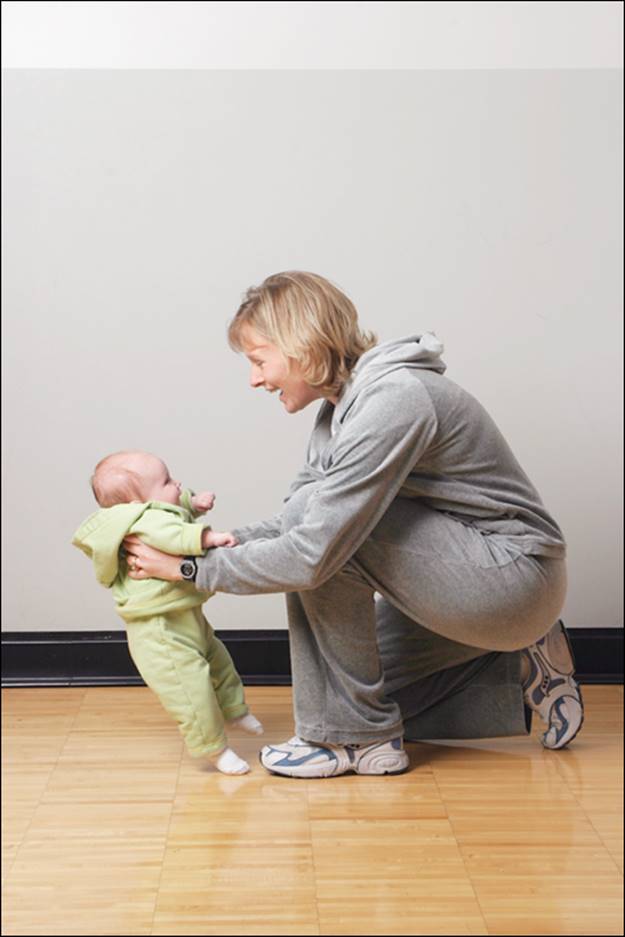
2. Move in as close as possible to your baby (or to the stroller) so you don’t have to reach out very far, as shown in Figure 5-1.
3. Bring your baby close to your body before you lift.
4. Breathe in, and then exhale, contracting your tummy. Take another breath and exhale as you lift.
This breath supports your low back.
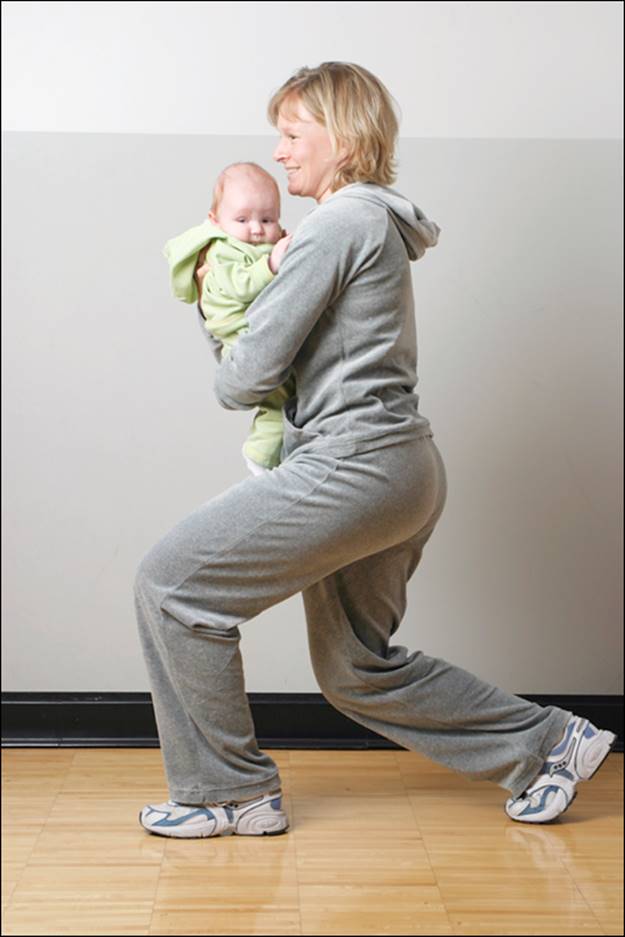
5. Lift your baby, holding her tight and using your leg muscles, not your back, to gradually rise to a standing position, as shown in Figure 5-2.
Photograph by John Urban
FIGURE 5-1: Bending down to pick up your baby.
Photograph by John Urban
FIGURE 5-2: Gradually rising to a standing position.
To lift a baby from a baby carrier, whether on the floor or on a car seat, follow the same steps as those just outlined: Kneel or squat in front of the carrier, position the handle up and out of your way, and slide your baby out. Keep your baby straight while you pull her toward you to release her from the carrier. Reverse these steps to put your baby into a carrier.
To put your baby down (on the floor or into a stroller), reverse the process:
1. Hold your baby close to your body.
2. Squat or kneel (see the preceding list for proper form), and then set your baby on the floor or into the stroller.
Avoid hunching your back and/or lifting or setting your baby down while bending from your hips — doing so puts too much stress on your low back. Do all your lifting and lowering with your legs, keeping your back fairly straight and your abdominal muscles contracted.
Lifting your baby from a changing table or crib
To lift your baby from a changing table or crib, do the following:
1. Stand as close as possible to the edge of the changing table or side of the crib, with one foot forward and one foot back. Slightly bend both of your knees.
Be sure that the table or crib is at the proper height for you. The top of the table should be at about waist height. If the crib has a drop-down side, be sure to drop it down before putting your baby in the crib or getting him out.
 If you’re a shorter woman and have trouble reaching into the crib, don’t buy a crib that doesn’t have drop-down sides. Test drive a few models before you buy by reaching down into them in the showroom.
2. Slide your baby toward you by pulling his bottom blanket until he is at the edge of the crib.
3. Prepare to lift your baby by reaching one hand around and under his back and the other hand around and under his neck.
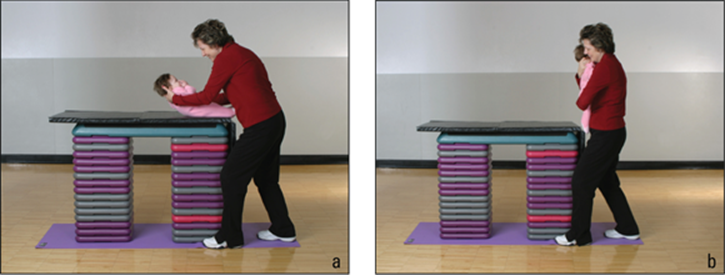
4. Sit your baby up and slide him toward you so that he’s as close to you as possible, as shown in Figure 5-3a.
5. Before you lift, breathe in, tightening your lower abs, and exhale as you lift.
This abdominal contraction supports your low back — use it anytime you’re lifting.
6. Lift your baby up into your arms, shifting your weight to your back leg and keeping your back straight as you lift. Refer to Figure 5-3b.
Never twist and lift your baby or twist and set him down — doing so puts tremendous stress on your low back.
Photograph by John Urban
FIGURE 5-3: Lifting your baby from a changing table.
 To set your baby down into a crib, reverse this process, setting your baby down into the crib as close to the side as possible, without twisting your back as you set him down and while bending your knees slightly.
When lifting your baby from a crib that doesn’t have a collapsible side (which means that you have to reach down in to lift your baby), always first slide the baby near the side of the crib closest to you. (To slide your baby closer to you, always place him on a blanket, which you can slide toward you when you’re lifting him up.) Prepare to lift him by placing your hands under his back and neck. Then, keeping your back straight and bending your knees, breathe in, tighten your lower abs, and exhale as you hold and lift your baby, letting your legs do as much of the lifting work as possible.
EXERCISE AND BREAST MILK PRODUCTION
Studies show that exercise doesn’t interfere with your ability to produce breast milk. The La Leche League is an organization of women who help other new mothers successfully breastfeed. The league is famous for its breastfeeding guidelines, which help you monitor whether your baby is getting enough breast milk. The following is a sampling of the League’s guidelines that let you know you’re breastfeeding successfully:
· Your baby nurses 8 to 12 times per day, whenever she is hungry and until she is satisfied.
· Beginning her fourth day, your baby wets five to eight diapers per day and has two to five bowel movements per day.
· Beginning her fourth day, your baby gains 4 to 7 ounces of weight per week.
· You can hear your baby swallowing as she breastfeeds.
· Your baby is growing normally.
If your baby doesn’t feed this often, wet this number of diapers, gain this amount of weight, or appear to be growing normally, contact your healthcare provider immediately. And visit the league’s site at www.lalecheleague.org for breastfeeding information and local contacts in your area. Book 5 covers breastfeeding in detail.
Carrying your baby
As you probably already know, you’re going to be carrying your baby a lot, and you’re not always going to want or be able to carry her in the same way. Following are a few ways to carry your baby safely and comfortably.
The football carry
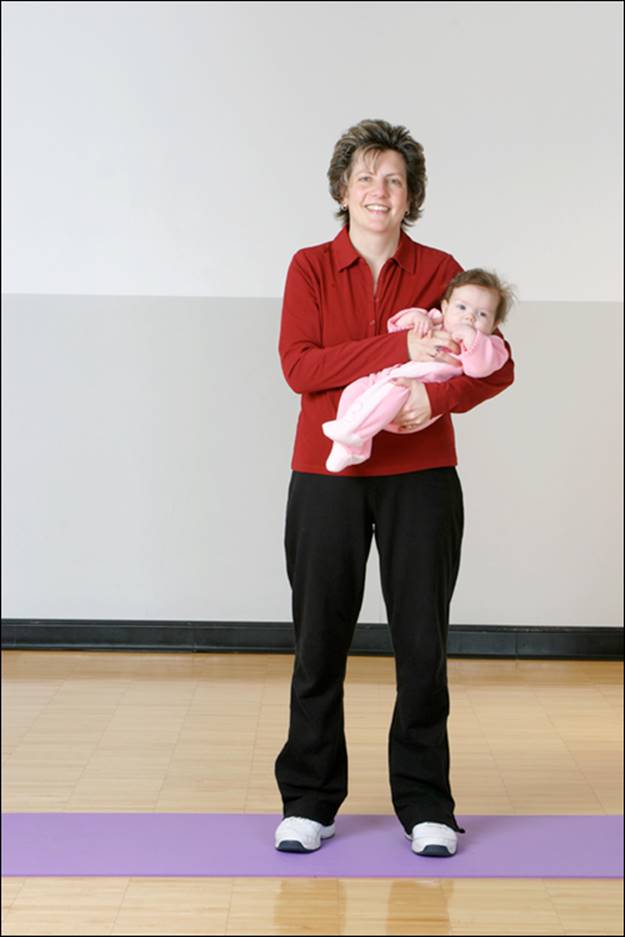
Carrying your baby like a football (see Figure 5-4), in the crook of your arm and resting on your forearm and wrist, is convenient when she’s still a newborn. You may feel pressure on your wrists, however, so alternate arms frequently. As she grows, however, this method becomes too difficult.
Photograph by John Urban
FIGURE 5-4: The football carry.
The hip carry
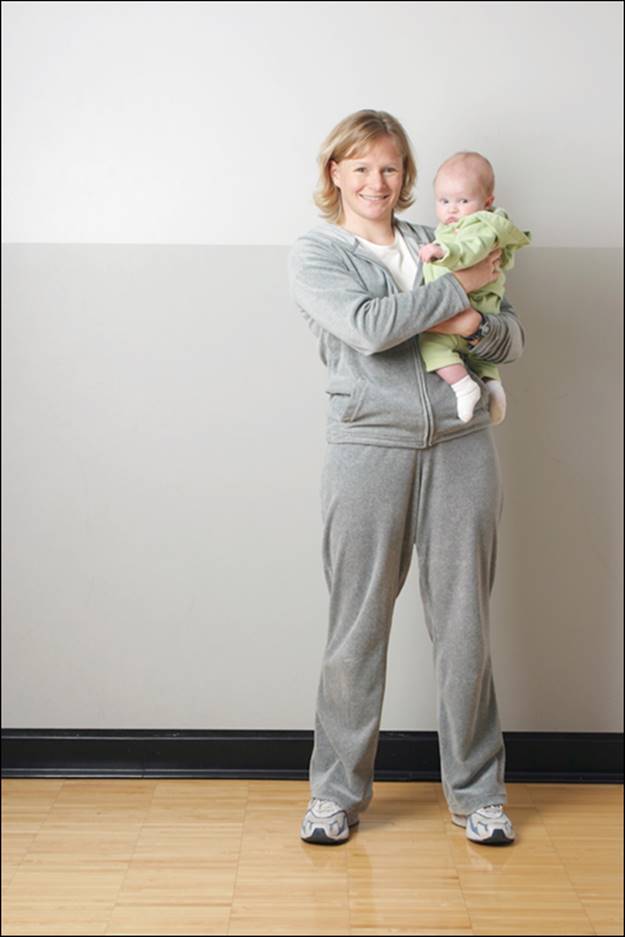
When you’re preparing a meal, doing laundry, talking on the phone, or negotiating any other task that takes up one hand, use the hip carry, shown in Figure 5-5. Without thrusting out your hip, simply straddle your baby over one hipbone, alternating hips from time to time.
Photograph by John Urban
FIGURE 5-5: The hip carry.
The front carry
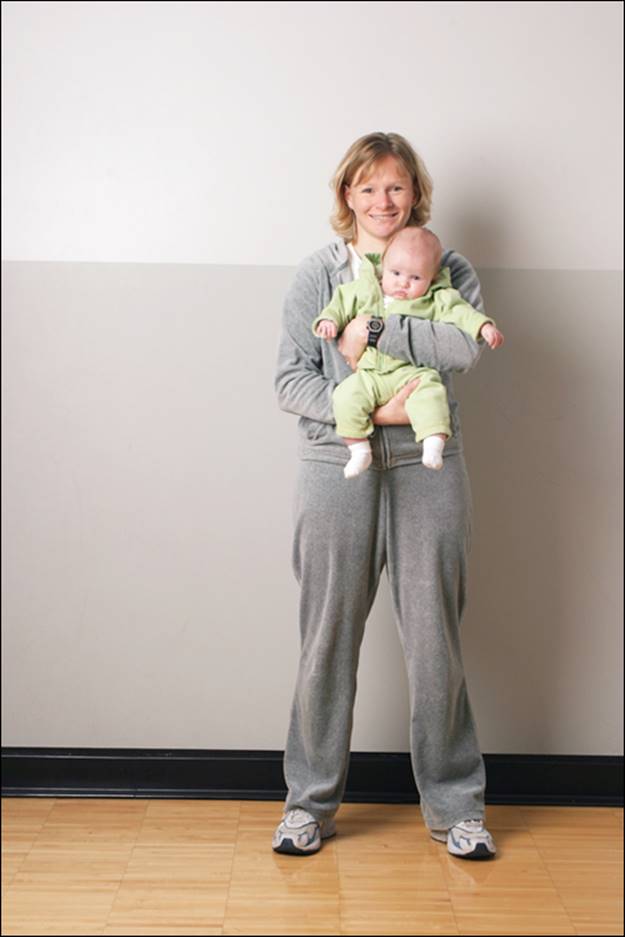
When you need to carry your baby for long periods and don’t need your hands for any other activity, use the front carry (see Figure 5-6). Keep your baby tight to your body as you walk. As your baby becomes too heavy for you to lift even in a front carry, put her in a stroller or other carrying device. Try to keep your shoulder blades pulled back to avoid slouching.
Photograph by John Urban
FIGURE 5-6: The front carry.
The hands-free carry
If you use a baby backpack (in which your baby sits in a sling attached to your back), a baby front pack (same idea, but your baby sits on your front side), or a baby sling (a device that goes over one shoulder and under the opposite armpit so that your baby can lie down in front of you), be sure to set your baby in the pack or sling on a table, and then strap the pack or sling to your body. If the back or sling has a waist strap, use it to keep some of the weight off your back. Keep the pack securely fastened to your body to avoid having the weight pull away from you and cause added muscle strain.
If you’re having a lot of discomfort from a backpack or front pack, head back to the store where you purchased it and have them help you fit it properly to your body.
Pushing your baby in a stroller
When taking your baby with you on a walk, keep a straight back as you push and use your legs and buttock muscles to do the work. Make sure that the handle height of the stroller fits you well so you don’t have to bend forward or raise your hands into an uncomfortable position to push. If the handgrips are too hard, purchase some foam and tape it securely to the grips to add cushioning.
If you plan to fitness walk or run with your baby in a stroller, invest in a running stroller, which is made specifically for those activities. The wheels on a running stroller move easily through rough terrain, and the stroller is easy to propel. Running strollers cost more than standard strollers, but you won’t regret your decision to buy one. Talk with other moms who walk or run with a stroller to find out which brands work well and hold up to consistent use.
Deciding When to Exercise and What Activities to Do
You’ll likely have one of these reactions to exercise after delivering a baby:
· You see exercise as an utter impossibility. If you fall into this category, start with stretches and keep in mind that a ten-minute walk is far better than no walk at all; any exercise tends to ease constipation and hemorrhoids (which many moms are all-too-familiar with right after delivery).
Gradually build up your walks or other exercises to your pre-delivery routine, following the guidelines in Book 4, Chapter 4, and even consider exercising more than you did when you were pregnant. You’ll speed weight loss and quickly get your body back to its pre-pregnancy shape.
· You can’t wait to get back to exercising so you can lose your pregnancy weight gain. If this describes you, good for you! Remember, though, that you do need time to heal from labor and delivery, so don’t rush resuming your exercise routine. If, shortly after delivery, you work out too intensely or for too long, you run a high risk of injuring yourself, which means you’ll have to go even longer without exercise. Instead, take several weeks or months to build back up to your pre-delivery exercise routine, and then continue to increase your duration and frequency as much as your schedule allows.
To get back to your exercise routine after delivering your baby, make sure you fit all the following guidelines:
· Your healthcare provider has given you the go-ahead to get started.
· Any incisions or tears have healed.
· You feel ready to get back to exercise.
· Your postpartum recovery is progressing normally, and you’re healthy.
· You feel good after exercise, you don’t experience any increase in vaginal bleeding, and you don’t feel any other physical discomfort.
If you’ve had a cesarean delivery, don’t forget that it’s major surgery. You must give yourself time to recover. This means avoiding excess exertion (including going up and down stairs and lifting your baby from the floor or over your head), limiting your activities (you’ll need to wait at least until your six-week checkup before working out again), and taking good care of your incision. Keep an eye on the wound and call your healthcare provider if the area becomes increasingly red, feels warm, or starts to drain fluid and also if you run a fever.
Returning to Your Pre-Pregnancy Weight and Strengthening Your Abs
The good news about your post-pregnancy weight is that you’ll lose about 12 pounds shortly after delivering your baby. However, you gained more than 12 pounds during your pregnancy, which means you have some work to do. Instead of trying in one or two weeks to lose weight that you gained over a period of nine months, give yourself time to lose the weight you need to lose — no more than a half pound per week. With diet and exercise, you can get back to your pre-pregnancy condition. For an entire book full of dieting techniques, tips, and tricks, check out Dieting For Dummies, 2nd Edition, by Jane Kirby, RD, and the American Dietetic Association (Wiley).
To firm your abdominal muscles and regain strength, begin gentle abdominal exercises as soon as you feel ready. Traditional sit-ups put too much stress on your abdomen and back, so avoid those for the next few weeks and months. A better way to safely strengthen your abdominal muscles is through a series of exercises developed by physical therapist Shirley Sahrmann. These exercises, which are described in the following sections, are designed to strengthen the muscles below your belly button — the ones that you rely on most for low-back support but that are most weakened during pregnancy. As you do these exercises, progress slowly and be patient with your body. Your abdominal muscles and the skin around your abdomen need time to firm up.
The Sahrmann abdominal exercise series contains five levels of exercises, all developed to progressively strengthen the lower abdominal muscles without putting stress on your low back. The beginning ones appear here, and you can find all five levels of this technique in How to Raise Children Without Breaking Your Back by Hollis Herman, MS, PT, OCS and Alex Pirie (Ibis Publications).
If you’ve had a cesarean delivery or experienced diastasis recti, the separation of the abdominal muscles, check with your healthcare provider before starting any abdominal exercises.
Basic breath
The first exercise, the basic breath, shows you how to isolate and control your abdominal muscles.
1. Lie on your back with your arms at your sides, your knees bent and together, and your feet resting on the floor.
2. Inhale and exhale a few times to get yourself ready.
Don’t flatten your back or tilt your pelvis; just let the natural curve in your back remain. Breathe in and out slowly and deeply.
3. Exhale and tighten your tummy muscles, pulling your navel toward your spine.
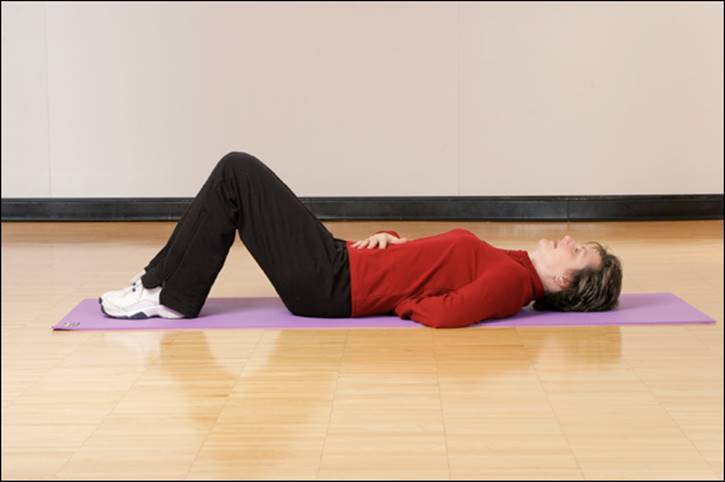
Concentrate on contracting the muscles below your belly button without flattening your back. Put one hand under the small of your back and the other hand on your belly, as shown in Figure 5-7, if that helps you maintain the proper position.
4. Hold the contraction for a count of 5 (keep breathing normally as you hold), and then relax. Repeat 5 to 10 times.
Photograph by John Urban
FIGURE 5-7: The basic breath helps you control your abs.
Leg slides (Sahrmann exercise #1)
When you’re able to contract, hold, and relax your abdominal muscles without moving your back or losing the contraction in your tummy, you’ve mastered the basic breath, which means that you can move on to leg slides, which work the lower abdominal muscles.
1. Lie on the floor with your knees bent and your arms at your sides. Hold your tummy in by doing the basic breath contraction.
Place your right hand on your belly, if needed.
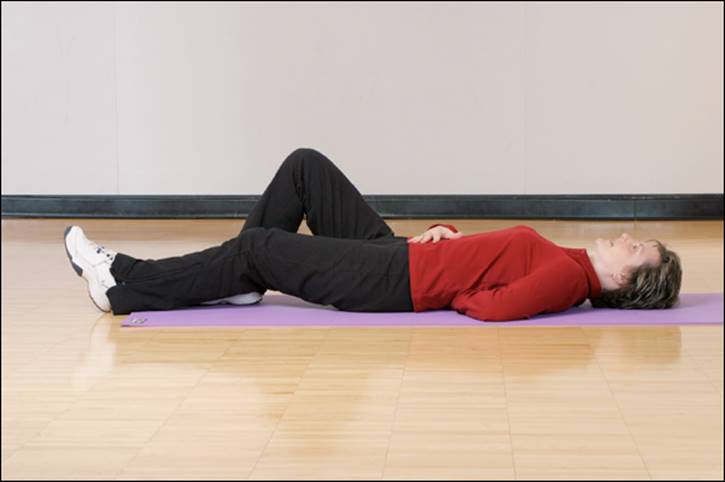
2. While continuing to breathe and holding the abdominal contraction, keep your right leg bent and slowly slide your left leg forward until it’s straight and resting on the floor, as shown in Figure 5-8.
Don’t flatten your back; keep the natural curve in your spine.
3. Slide your left leg back to the bent-knee position.
4. Relax your tummy and repeat Steps 2 and 3 with your right leg.
Start with 5 repetitions on each leg. With time, build up to 20 leg slides on each leg.
Photograph by John Urban
FIGURE 5-8: The leg slide strengthens your lower abdominal muscles.
Leg raises (Sahrmann exercise #2)
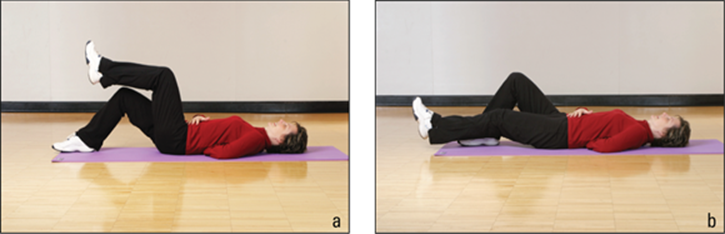
Leg raises are more difficult lower abdominal exercises; do these only after you master 20 repetitions of leg slides. If your back keeps coming up off the floor or your tummy pops up while doing this exercise, go back to doing leg slides until your abdomen strengthens.
1. Lie on the floor with your knees bent and your arms at your sides. Hold your tummy in by doing the basic breath contraction.
Place your right hand on your belly, if needed.
2. Raise your left knee toward your chest, as shown in Figure 5-9a.
3. Slowly straighten and lower your left leg until it’s parallel to and about 2 to 3 inches above the floor, as shown in Figure 5-9b.
Be sure to keep your left leg just barely off the floor.
4. Return your left leg to its starting position and relax your tummy. Repeat with your right leg.
Start with 5 repetitions on each leg. With time, build up to 20 leg raises on each leg.
Photograph by John Urban
FIGURE 5-9: Leg raises strengthen your lower abdominal muscles even more.