
Wanda Nicholson1
(1)
Department of Obstetrics and Gynecology, Diabetes and Obesity Core, Center for Women’s Health Research, University of North Carolina School of Medicine, Chapel Hill, NC, USA
Wanda Nicholson
Email: wanda_nicholson@med.unc.edu
Abstract
Obesity in pregnancy is part of a vicious cycle that contributes to the epidemic of obesity and diabetes across generations. Breaking the cycle of transgenerational obesity will require a better understanding of the epidemiological and clinical aspects of obesity as well as the translation of science into standardized clinical care and targeted interventions across the life span of women and children. The objective of this book is to (1) summarize the state of the science of perinatal obesity and (2) provide clinicians with the information they need to effectively care for their patients during this important teachable moment in their lives.
Keywords
ObesityPregnancyGestational diabetesWeight lossTransgenerational obesityPerinatal obesity
Introduction
“The womb may be more important than the home,” David Barker, from the fetal and infant origins of adult disease. [1]
More than two-thirds of women of childbearing age are overweight or obese [2], contributing to a vicious cycle of obesity in the expectant mother and adverse birth outcomes and obesity in her offspring (Fig. 1.1). Evidence of the pervasive concern over adult obesity is reflected in the recent American Medical Association statement that reclassified obesity as a “disease” (it was recently known as a “condition”). While some may claim that the reclassification is purely symbolic, it opens the door for clinician reimbursement for obesity counseling, prevention, and treatment with behavioral or lifestyle strategies. The change in classification represents a real paradigm shift in obesity prevention. Obesity in pregnancy is both fascinating and concerning because it involves the health of two patients – both mother and child whose partnership is intertwined from conception to delivery and beyond. As such, the mother-child dyad is at the forefront of our efforts to better understand and clinically manage obesity and to develop reasonable clinical and behavioral interventions to modify the risk of obesity in mothers and their offspring.
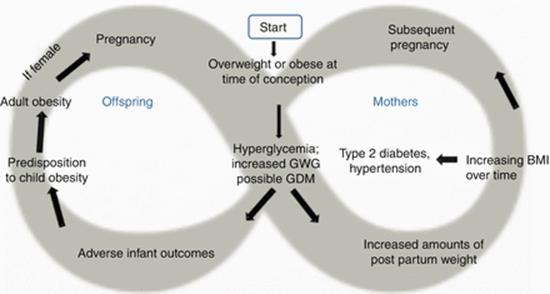
Figure 1.1
Transgenerational cycle of obesity for mothers and their offspring. GWG gestational weight gain, GDM gestational diabetes, BMI body mass index
Obesity in Pregnancy and Implications for Mother and Offspring
One of the downstream consequences of the epidemic of obesity in the USA is that more women are entering pregnancy already suffering from the burden of overweight and obesity. There are a myriad of adverse outcomes associated with a pregnancy complicated by obesity, including subfertility, preeclampsia, fetal macrosomia, and cesarean delivery. Obstetrical complications can increase as much as threefold in obese versus nonobese mothers. Obesity is a common risk factor for insulin resistance. Insulin sensitivity is already reduced by 50–60 % over the course of pregnancy, so it is not surprising that overweight or obese women who are prone to beta-cell dysfunction and glucose intolerance prior to pregnancy are at increased risk of gestational diabetes (GDM) during pregnancy (Fig. 1.1) [3, 4]. For example, in comparison to women with a normal body mass index, the risk of developing GDM rises exponentially with increasing BMI, with odds ratios (OR) of 1.97 (95 % CI 1.77–2.19), 3.01 (95 % CI 2.34–3.87), and 5.55 (95 % CI 4.27–7.21) for those who are overweight obese and morbidly obese, respectively [5]. Other markers of obesity, such as waist circumference and waist-to-hip ratio, are independently associated with a higher 2-h post-glucose response, suggesting that central obesity is an independent predictor of GDM.
Overweight and obese women are at increased risk for excessive gestational weight gain (GWG) [4–6]. The combination of pre-pregnancy overweight and obesity and excessive GWG is particularly concerning. The most recent Institute of Medicine (IOM) recommendations [7] for a smaller weight gain range for those classified as overweight (7–11.5 kg) and obese (5–9 kg) have garnered considerable attention. Longitudinal studies show a direct association between maternal obesity and infant birth weight. For women who are overweight or obese prior to conception, an increase in GWG is associated with an increase in fetal adiposity. The combination of maternal overweight or obesity and exceeding the IOM guidelines increases the risk of delivering a large-for-gestational-age infant and the associated complications of dysfunctional labor and potential cesarean delivery [8].
A growing concern, from both a clinical and public health perspective, is the intrauterine environment and the concept of transgenerational obesity (Fig. 1.1) [9, 10]. Obesity, GDM, and excessive weight are thought to change the intrauterine environment and contribute to increase risk of obesity in children. Early work by David Barker [1, 11] set the stage for ongoing research in fetal programming and development of adult diabetes and hypertension [12]. The Barker hypothesis postulates that nutritional insults to the fetus during critical periods of development may lead to in utero alterations in fetal metabolism or fetal programming that favors obesity-related conditions in adulthood. Of particular interest is the hypothesis that offspring of women with obesity may be predisposed to greater energy consumption and higher levels of sedentary behavior, a finding that is supported by animal models. Though outside the scope of this text, animal models have been useful in elucidating the contribution of maternal phenotypes (e.g., obesity and dietary intake) on the intrauterine environment and growth trajectories in the offspring [13]. The combination of obesity and pregnancy, inflammatory markers, adipokines, and the hormonal milieu contributes to a complex interrelation of mechanisms that with further research can broaden our understanding of the transgenerational effects of obesity.
Breaking the cycle of transgenerational obesity will require a better understanding of the epidemiological and clinical aspects of obesity as well as the translation of science into standardized clinical care and targeted interventions across the life span of women and children. To date, there are few published texts that translate the evolving state of the science of overweight and obesity from the maternal and child health perspective. The overall objectives in writing this book are to (1) translate the state of the science on overweight and obesity in the perinatal period, thus arming clinicians and public health officials that provide care to childbearing women with the knowledge necessary to communicate with their patients on the effects of obesity in this important time period; (2) communicate important clinical aspects of care that can be effectively communicated to patients by their providers in a busy practice setting; and (3) summarize the evidence for perinatal, family, and community lifestyle interventions that have been shown to be effective in promoting a healthy weight and modifying the risk of developing diabetes and obesity.
This book is our attempt to summarize the latest developments in our clinical understanding of obesity in pregnancy. Obesity is a multicomplex disease, and prevention and treatment will require transdisciplinary approaches, including clinical, research, and population-based perspectives. The content of the book differs from other textbooks on obesity because each chapter is written from a clinical and population-based perspective. Our collaborative team of experts provides important, relevant insight into each topic, emphasizing the intersection between clinical care, research, and broad dissemination of research findings. The first section provides an overview of the biological mechanisms underlying the clinical effects of obesity on the expectant mother and developing fetus. Dr. Calhoun reviews the biological pathways that account for the effect of obesity on infertility and subfertility. She summarizes the current clinical care of the overweight or obese woman and subfertility, and the lifestyle and medical options currently used to achieve conception. Both the preconception period and pregnancy represent important teachable moments in the lives of childbearing age women. Of particular concern to clinicians and public health officials is the contribution of pre-pregnancy obesity to the persistently high rates of medical complications of pregnancy (diabetes, hypertension) and adverse birth outcomes (preterm birth, low birth weight infants, and infant deaths) [14]. Dr. Witkop outlines important steps in preconception and pregnancy care in the overweight or obese women and the clinical issues to consider during this critical time period. Her chapter provides a step-by-step assessment for preconception care that can be used by multiple types of providers in diverse clinical settings. She summarizes the Institute of Medicine gestational weight gain guidelines and the role of clinicians in promoting a healthy weight before and during pregnancy. Also in this section, Dr. Witkop discusses the complex decisions faced by women and their clinicians and the important role of shared decision making in developing a labor and delivery plan that incorporates best practice and patient preferences.
In the next section, we explore complex relationships of demographics and psychosocial factors with obesity. Dr. Gunderson provides an epidemiological assessment of secular trends in maternal risk factors for postpartum weight retention. Dr. Payne and Meltzer-Brody help us to better understand the relationship of depression symptoms and obesity in the perinatal period. Drs. Cox, Baptiste-Roberts, and Gary-Webb discuss women’s perception of body image and the association with weight and diabetes prevention.
Implementing diet and physical activity interventions in the periconception period takes advantage of an important “teachable moment” [15] and offers an opportunity for women to improve their health status not only to achieve a healthy pregnancy but to change the course of their long-term health. Thus, we have set the stage to discuss the current state of the science on lifestyle interventions – both diet and physical activity for mothers and their families. Dr. Nicholson summarizes the findings for the effect of combined diet and physical activity interventions on weight and adiposity in the postpartum period and outlines a research agenda to move the science forward in postpartum care for overweight or obese women. Drs. Downs, Chasen-Taber, and Evenson outline the role of physical activity in promoting a healthy weight during pregnancy and suggested guidelines for clinical counseling.
The next section focuses on the effect of maternal obesity on child growth and adiposity. Drs. Strobino, Minkovitz, and Erenthral summarize the literature on the effect of maternal pre-pregnancy body mass index (BMI), gestational weight gain on early child growth, including infant birth weight and weight and adiposity up to age 2. Dr. Baptiste-Roberts continues this discussion, providing a summary of the data on the effect on maternal obesity on child growth trajectories after the first year of life. Addressing child obesity prevention and treatment from a family perspective could be an effective strategy. Drs. Ward, Erinosho, Wasser, and Ms. Munoz discuss the findings from a comprehensive review of 19 studies of family-centered interventions to prevent or reduce or treat child obesity.
Obesity among women of childbearing age is a major public health issue warranting additional studies that investigate its impact on short- and long-term maternal and child outcomes as well as best practices for weight management during pregnancy and the postpartum period. Our book concludes with a discussion of where key organizations stand on screening for obesity and summarizes the next generation of research needed to inform clinical care.
References
1.
Barker DJ. The fetal and infant origins of adult disease. BMJ. 1990;301(6761):1111.PubMedCrossRef
2.
Weiss JL, Malone FD, Emig D, Ball RH, Nyberg DA, Comstock CH, Saade G, Eddleman K, Carter SM, Craigo SD, Carr SR, D’Alton ME. Obesity, obstetric complications and cesarean delivery rate–a population-based screening study. Am J Obstet Gynecol. 2004;190(4):1091–7.PubMedCrossRef
3.
Ferrara A. Increasing prevalence of gestational diabetes mellitus: a public health perspective. Diabetes Care. 2007;30 Suppl 2:S141–6.PubMedCrossRef
4.
Greene MF, Solomon CG. Gestational diabetes mellitus – time to treat. N Engl J Med. 2005;352(24):2544–6.PubMedCrossRef
5.
Yeung EH, Hu FB, Solomon CG, Chen L, Louis GM, Schisterman E, Willett WC, Zhang C. Life-course weight characteristics and the risk of gestational diabetes. Diabetologia. 2010;53(4):668–78.PubMedCrossRef
6.
Baptiste-Roberts K, Barone BB, Gary TL, Golden SH, Wilson LM, Bass EB, Nicholson WK. Risk factors for type 2 diabetes among women with gestational diabetes: a systematic review. Am J Med. 2009;122(3):207–214.e4.PubMedCrossRef
7.
Institute of Medicine. Weight gain during pregnancy: reexamining the guidelines. Washington, DC: National Academies Press; 2009.
8.
Hull HR, Thornton JC, Ji Y, Paley C, Rosenn B, Mathews P, Navder K, Yu A, Dorsey K, Gallagher D. Higher infant body fat with excessive gestational weight gain in overweight women. Am J Obstet Gynecol. 2011;205(3):211.e1–7.CrossRef
9.
Gluckman PD, Hanson MA, Cooper C, Thornburg KL. Effect of in utero and early-life conditions on adult health and disease. N Engl J Med. 2008;359(1):61–73.PubMedCrossRef
10.
Dabelea D, Hanson RL, Lindsay RS, Pettitt DJ, Imperatore G, Gabir MM, Roumain J, Bennett PH, Knowler WC. Intrauterine exposure to diabetes conveys risks for type 2 diabetes and obesity: a study of discordant sibships. Diabetes. 2000;49(12):2208–11.PubMedCrossRef
11.
Barker DJ. In utero programming of cardiovascular disease. Theriogenology. 2000;53(2):555–74.PubMedCrossRef
12.
Barker DJ, Bull AR, Osmond C, Simmonds SJ. Fetal and placental size and risk of hypertension in adult life. BMJ. 1990;301(6746):259–62.PubMedCrossRef
13.
Shankar K, Harrell A, Liu X, Gilchrist JM, Ronis MJ, Badger TM. Maternal obesity at conception programs obesity in the offspring. Am J Physiol Regul Integr Comp Physiol. 2008;294(2):R528–38.PubMedCrossRef
14.
Johnson DB, Gerstein DE, Evans AE, Woodward-Lopez G. Preventing obesity: a life cycle perspective. J Am Diet Assoc. 2006;106(1):97–102.PubMedCrossRef
15.
McBride CM, Emmons KM, Lipkus IM. Understanding the potential of teachable moments: the case of smoking cessation. Health Educ Res. 2003;18(2):156–70.PubMedCrossRef