
Neta Benshalom-Tirosh1, Dan Tirosh1, Naama Steiner2 and Asher Bashiri1
(1)
Department of Obstetrics and Gynecology, Faculty of Health Sciences, Soroka University Medical Center, Ben-Gurion University of the Negev, Be’er Sheva, Israel
(2)
Recurrent Pregnancy Loss Clinic, Department of Obstetrics and Gynecology, Soroka Medical Center, Be’er Sheva, Israel
Asher Bashiri
Email: abashiri@bgu.ac.il
Keywords
EndocrinologyRecurrent pregnancy lossHypothyroidismDiabetesLuteal phase deficiencyHyperprolactinemiaPolycystic ovary syndromeProgesterone
Progesterone, Luteal Phase Deficiency, and Recurrent Pregnancy Loss
Progestins and Progesterone Receptors
In addition to progesterone, the natural progestin, there are several different classes of progestins , such as retro-progesterone (dydrogesterone), and several progesterone derivatives. Several synthetic supplements act as prodrugs and need to be metabolized in order to become biologically active. The progestogenic effect, inducing characteristic changes in the estrogen-primed endometrium, is common for all progestins, but there is a wide range of additional biologic effects, which vary between different progestins [1]. Dydrogesterone is a retro-progesterone, a stereoisomer of progesterone with additional carbon. It is highly selective as a progestin and due to its structure, it binds almost exclusively to the progesterone receptor, with a lower affinity than that of progesterone, but perhaps a better bioavailability [1].
The biological effect of progesterone is mediated by two types of human progesterone receptor (hPR-A and hPR-B ). In most cell contexts, hPR-B functions as a transcriptional activator of progesterone-responsive genes, whereas hPR-A functions as a transcriptional inhibitor. It has been demonstrated that alteration in expression of progesterone receptor subtypes may alter progesterone’s biologic effect in different target tissues [2]. Other factors affecting the activity of progesterone may be the result of polymorphism in progesterone receptors [3]; however, further research is required concerning this issue.
Progesterone-Induced Blocking Factor
The trophoblast tissue has special characteristics, inducing an immunomodulation process, actively protecting itself from the maternal immune system. Maternal progesterone and its interaction with progesterone receptors at the level of the decidua seem to have a major role in this defense mechanism [4]. Progesterone-induced blocking factor (PIBF) , a protein that can block natural killer (NK) cell-mediated lysis of certain tumor cells , has been identified in pregnant women [5]. PIBF is thought to have an anti-abortive effect that may be related to a shift from Th1 to Th2 cytokines. Studies have shown that there is a Th1 tendency in RPL [4]. In a study by Raghuphaty et al. [6] studying 24 women with a history of successful pregnancies and 23 women with a history of unexplained RPL, the Th1/Th2 cytokines ratio was higher in the RPL group whereas there was a clear Th2 bias during the first trimester in the successful pregnancy group. Another suggested role for PIBF in protecting the trophoblast is through changes in NK cells activity [4]. Even though the role of these cells in normal pregnancy is still controversial, there have been reports of alteration of the subtypes of noncytotoxic NK cells in the decidua of a first trimester pregnancy [7, 8]. The relative proportion of these cells is increased in normal pregnancy compared with that of a nonpregnant uterus. However their activity is lower in the normal pregnancy compared to a nonpregnant uterus or to women with RPL [9].
In a study by Kalinka et al. [10], 27 women with threatened miscarriage were treated for 10 days with dydrogesterone (30–40 mg/day). Serum progesterone and estradiol concentrations, along with urine PIBF concentrations, were measured by ELISA. The results were compared to those of 16 healthy pregnant controls who received no treatment. There were no statistical differences between pregnancy outcomes in dydrogesterone-treated women with threatened miscarriage and healthy controls. Serum progesterone concentrations in the control patients increased as the pregnancy progressed, but not in the threatened miscarriage group. However, following dydrogesterone treatment, a statistically significant rise in the initially low PIBF levels was observed in the miscarriage group, reaching a comparable PIBF level to the healthy control group. This suggests that dydrogesterone might improve pregnancy success rates in threatened miscarriage by inducing PIBF production.
Luteal Phase Deficiency
The luteal phase is the later phase of the menstrual cycle , beginning with ovulation and the formation of the corpus luteum and ending in either pregnancy or lysis of the corpus luteum. The main hormone associated with this phase is progesterone, produced in large amounts by the corpus luteum and playing a critical role in increasing endometrium receptiveness for implantation of the blastocyst. The corpus luteum receives a signal to continue producing progesterone through the secretion of human chorionic gonadotropin (hCG) by the trophoblast, which also secretes estradiol, estrone, and relaxin. Removal of the corpus luteum prior to the completion of 8 weeks gestation results in miscarriage [11]. Luteal phase deficiency (LPD) is affected by several factors, including stress, exercise, weight loss, hyperprolactinemia, and menstrual cycles at the onset of puberty or perimenopause [12]; however, the exact mechanism for this disorder is unclear. Several hypotheses have been proposed to establish this mechanism. It could be associated with decreased levels of follicle stimulating hormone (FSH) and luteinizing hormone (LH) that may cause the corpus luteum to undergo atrophy. Other suggested mechanisms for LPD include decreased response to progesterone by the endometrium or failure of progesterone production secondary to abnormal follicle formation, along with a poor quality of the oocyte [12].
Even though the exact mechanism of LPD is unclear, there is no debate regarding the crucial role progesterone has in maintaining the early pregnancy. One possible mechanism is through the inhibition of oxytocin-induced myometrial activity around the time of ovulation [13]. Another suggested pathway is through inhibition of prostaglandin excitation, and diversity in prostaglandin E2 (PGE2)-induced changes in glycosaminoglycan (GAG) synthesis by human fibroblasts of the cervix during pregnancy [14]. Other than its role in the luteal phase, progesterone also has an immunosuppressive effect, which helps maintain the pregnancy, and it also helps relax the uterine muscles, possibly by inhibiting prostaglandins and thus preventing uterine contractions [15, 16].
LPD can be diagnosed by measuring serum progesterone or by performing an endometrial biopsy. Although histologic dating of the endometrium after timed biopsy has been the historical gold standard for the diagnosis of LPD, the value and reproducibility of this modality is currently under debate. In a study of timed endometrial biopsies examining 130 fertile women, Murray and colleagues [17] found that histologic endometrial dating had neither the accuracy nor the precision to diagnose LPD and did not influence the clinical management of these patients. Luteal phase serum progesterone levels between 2 and 10 ng/ml and serum progesterone levels below 15 ng/ml in the first 10 weeks of gestation are considered diagnostic of corpus luteum dysfunction [6]. However, one should keep in mind that serum progesterone levels are not predictive of pregnancy outcome [4].
Recommendations for Progesterone Treatment in Women with Recurrent Pregnancy Loss
There are several studies supporting the administration of progesterone supplements to women with unexplained RPL. In a study by Zibdeh et al. [18], 180 women with unexplained RPL were randomized to receiving oral dydrogesterone, intramuscular hCG, or no treatment (controls). Treatment was started as soon as possible after confirmation of pregnancy and continued until the 12th gestational week. Pregnancy loss was significantly less common in the dydrogesterone group (13.4 %) than in the control group (29 %). There were no differences between the groups with respect to pregnancy complications or congenital abnormalities. This study demonstrated that hormonal support with dydrogesterone can increase the chances of a successful pregnancy in women with a history of RPL. In a systematic review conducted by Carp et al. [19] assessing whether dydrogesterone lowers the incidence of subsequent miscarriage in women with RPL, 509 women who fulfilled the criteria for meta-analysis were included. The number of subsequent miscarriages or continuing pregnancies per woman was compared between women receiving dydrogesterone and women managed by standard bed rest or placebo intervention. There was a 10.5 % miscarriage rate after dydrogesterone administration compared to 23.5 % in control women (OR for miscarriage 0.29 [CI 0.13–0.65]) and a 13 % absolute reduction in the miscarriage rate. The results of this study show a significant reduction of 29 % in the odds for miscarriage when dydrogesterone is compared to standard care, indicating an actual treatment effect.
In a Cochrane database review published in 2013 [20], a subgroup analysis of women with RPL (defined as 3 or more consecutive miscarriages) treated with progesterone demonstrated a statistically significant decrease in miscarriage rate compared to placebo or no treatment (OR 0.39; 95 % CI 0.21–0.72); no statistically significant differences were found between the routes of administration of progesterone—oral, vaginal, or intramuscular (see Fig. 3.1).

Fig. 3.1
Progestogen versus placebo/no treatment. Outcome 3 miscarriages (women with previous recurrent miscarriage only). [Adapted from Haas DM, Ramsey PS. Progestogen for preventing miscarriage. Cochrane Database Syst Rev. Has 2008;10:CD003511. With permission from John Wiley & Sons, Inc]
Even though the studies regarding progesterone supplementation in RPL are scarce and not always statistically significant, the majority of them promote the use of progesterone in women with unexplained RPL. Further research in this area is recommended and is currently being conducted.
Recommendations based on current evidence state that progesterone supplementation may be of benefit in cases of RPL, especially when the etiology is unexplained [21, 22]. In our experience the use of progesterone up until 12 weeks of gestation s hould be considered for women with RPL, and that is the common practice in our clinic.
Prolactin and Recurrent Pregnancy Loss
Measurement of prolactin levels is part of the endocrinologic evaluation of RPL.
Hyperprolactinemia affects the hypothalamic-pituitary-ovarian axis and may cause insufficient folliculogenesis and oocyte maturation and/or a short luteal phase. Increased circulating prolactin levels stimulate a generalized increase in hypothalamic dopaminergic neural activity, intended to suppress prolactin secretion but also inhibiting GnRH neurons. The end result is anovulation or an even more profound hypogonadotropic hypogonadism, depending on the extent to which gonadotropin secretion is suppressed. Mild hyperprolactinemia (20–50 ng/mL) may cause only a short luteal phase, resulting from poor preovulatory follicular development. Moderate hyperprolactinemia (50–100 ng/mL) frequently causes oligomenorrhea or amenorrhea , and higher prolactin levels (>100 ng/mL) typically result in frank hypogonadism with low estrogen levels and their clinical consequences [23].
Nevertheless, the association between hyperprolactinemia and RPL is debatable. In a case–control study, Bussen et al. evaluated the frequency of endocrine abnormalities during the follicular phase in women with a history of RPL. The concentration of prolactin in the study group of 42 women with RPL (three or more consecutive miscarriages) was significantly higher compared to the control group (42 nulligravid females with tubal or male factor infertility without miscarriage) (p = 0.015). They concluded that RPL is associated with abnormalities in prolactin secretion during the follicular phase [24].
Hirahara et al. found that treating with bromocriptine to achieve appropriate circulating levels of prolactin in women with RPL and prolactin disorder may improve subsequent pregnancy outcomes. The percentage of successful pregnancies was higher in the bromocriptine-treated group than in the group that was not treated with bromocriptine (85.7 % vs. 52.4 %, p < 0.05), and the serum prolactin levels during early pregnancy were significantly higher in patients who miscarried (31.8–55.3 ng/mL) than in patients whose pregnancies were successful [25]. On the other hand, Li et al. measured some endocrine function in the early follicular phase (days 3–5) in 144 women with unexplained recurrent (≥3) miscarriages. No association was found between recurrent miscarriage and hyperprolactinemia [26].
Although the association between hyperprolactinemia and RPL is somewhat controversial, we recommend, as do others [21], to screen for prolactin levels as part of RPL evaluation.
Polycystic Ovary Syndrome and Recurrent Pregnancy Loss
Definition and Diagnosis
Polycystic ovary syndrome (PCOS) is a complex and multifactorial disorder , first described in 1935 by Stein and Leventhal [27]. The syndrome is a combination of hyperandrogenism, ovulatory dysfunction, and polycystic ovaries. The prevalence of PCOS is 4–7 % of women of reproductive age [28–30].
In recent years several expert groups addressed the issue of defining uniform diagnostic criteria for PCOS [31], i.e., the National Institutes of Health (NIH) criteria [32], the Rotterdam criteria [33], and the Androgen Excess Society [34]. These different criteria stressed the fact that the definition for PCOS is controversial and it has a wide spectrum of clinical presentation. The most widespread diagnostic criteria are the Rotterdam criteria, which require the presence of 2 out of 3 criteria for establishing a diagnosis: (1) Oligo- or anovulation, (2) Clinical and/or biochemical signs of hyperandrogenism , (3) Polycystic ovaries (presence of 12 or more follicles in each ovary measuring 2–9 mm in diameter, and/or increased ovarian volume >10 mL) [33].
All of these diagnostic criteria require the exclusion of other etiologies (e.g., congenital adrenal hyperplasia, androgen secreting tumors, Cushing’s syndrome).
A large proportion of women with PCOS have some degree of ovulatory dysfunction, which results in oligomenorrhea or amenorrhea, and subsequent decreased infertility [35]. Hyperinsulinemia and insulin resistance are also common features among women with PCOS and are thought to have an important role in the pathophysiology of the syndrome [36]; however, it is not included in the diagnostic criteria. Moreover, in several studies that evaluated the prevalence of impaired glucose metabolism, it was found that 30–35 % of women with PCOS had impaired glucose tolerance and 7–10 % had type 2 diabetes mellitus [35, 37, 38].
Association with RPL
The prevalence of PCO morphology among women with RPL is thought to be as high as 40 % [39], although there are reports about higher prevalence [40]. Using a combination of clinical findings and ultrasound (US) or biochemical features, Yang et al. found that the prevalence of PCOS among women with RPL was even as high as 56 % [41]. On the other hand, Li et al. found that the prevalence of hyperandrogenemia in RPL was 14.6 % while ultrasound features of PCO existed in only 7.8 % [26]. This wide range is probably the result of the use of nonuniform definitions for PCOS. Cocksedge et al. examined PCOS prevalence among women with RPL, using the current recommended Rotterdam criteria for diagnosis. The study investigated a total of 300 women with RPL and found that about 10 % of women had PCOS [42].
The Mechanism for Recurrent Pregnancy Loss Among Women with Polycystic Ovary Syndrome
The exact mechanisms that may cause RPL in PCOS patients are obscure. Several etiologies have been proposed, related to the pathophysiology, endocrinology , and metabolic disturbances in PCOS. Among these are obesity, insulin resistance or hyperinsulinemia, thrombophilia-associated disorders, elevated LH, and hyperandrogenism [39, 43, 44].
Elevated BMI
Many women with PCOS suffer from obesity and various comorbidities related to it (diabetes, HTN, coronary heart disease) [35]. A body mass index greater than 30 kg/m2 increases the risk for RPL (OR: 3.5) [44, 45]. It has also been demonstrated that there is some correlation between PCOS, BMI, and RPL [46]. Weight loss among women with elevated BMI is associated with decreased pregnancy loss rates [47]. However, to date, no study has evaluated the association between weight loss and reduction in the risk for additional miscarriage in RPL patients [44].
Insulin Resistance and Hyperinsulinemia
In recent years there has been increasing interest in the role of insulin resistance and hyperinsulinemia linked to PCOS and RPL. Several studies have evaluated insulin resistance and RPL [48, 49]. In a population of women with RPL, there was found to be a higher prevalence of insulin resistance when compared with matched controls (OR: 3.55; 95 % CI 1.4–9.0) [48].
These findings were supported by studies showing that treatment with an insulin-sensitizing agent (metformin) reduced subsequent risk for miscarriage in women with RPL. Metformin lowers hepatic glucose production and increases insulin sensitivity and thereby lowers insulin blood levels. A retrospective cohort study has shown that the use of metformin during pregnancy is associated with a reduction in the miscarriage rate in women with RPL and PCOS [50]. Thereafter, a small prospective case–control clinical trial showed benefit of metformin treatment among PCOS women with RPL and abnormal glucose tolerance test [51]. Nawaz and Rizvi demonstrated, in a case–control study, that among infertile women treated with metformin there was significant decrease in the rate of pregnancy loss among women with RPL (12 % vs. 49 %; p < 0.001) [52]. However, to date, there are no randomized controlled trials assessing the role of metformin in women with RPL.
The only systematic review of randomized controlled trials concerning metformin and pregnancy loss among women with PCOS found that there was no improvement in pregnancy loss risk with metformin treatment [53].
Currently, routine metformin treatment durin g pregnancy is not recommended for women with PCOS [21, 31, 54].
Thrombophilic-Associated Disorders
Hyperinsulinemia and elevated activity of plasminogen activator inhibitor-1 (PAI-1) have been linked to increased incidence of miscarriage observed among women with PCOS [48, 55–57]. PAI-1 inhibits plasmin formation during plasminogen activation and subsequent fibrinolysis and has been reported to be elevated in women with PCOS. Elevated levels of PAI have been reported to be an independent risk factor for early spontaneous pregnancy loss [56]. In addition to its effects on insulin resistance, metformin lowers circulating levels of plasminogen activator inhibitor (PAI) [58].
Hyperhomocysteinemia is a common finding in women with PCOS [59] and was found to be associated with both RPL and PCOS [60]. It was shown that combined treatment with aspirin and low molecular weight heparin (LMWH) in women with hyperhomocysteinemia improved successful pregnancy rates [61]. In a small (~20 women) nonrandomized controlled study investigating women with PCOS with a history of one or more previous spontaneous miscarriages, who also had thrombophilia and/or hypofibrinolysis, it was found that the use of low molecular weight heparin along with metformin reduced pregnancy loss by 4.4-fold compared to previous gestations without treatment [62, 63].
Elevated LH and Hyperandrogenism
Hyperandrogenism and elevated LH are considered a part of the biochemical features of PCOS and have classically served a significant role in diagnosis of women with PCOS [35, 64]. In recent years, their significance in the diagnosis of PCOS has decreased, and since LH is released in pulses, abnormal levels are generally not used in order to diagnose PCOS [35].
Although elevated follicular phase LH and hyperandrogenism have been linked to RPL [39, 43], routine testing for LH and free-T in order to diagnose PCOS in patients with RPL is not recommended, since it did not predict subsequent miscarriage [65]. There was no difference in subsequent pregnancy outcome in women with prior RPL with high LH and elevated testosterone, compared to those with normal values [39, 66]. Suppressing LH secretion did not improve the outcome of pregnancy [67, 68].
PCOS is a complex entity, which encompasses a spectrum of endocrinologic and metabolic phenomena. When reviewing the literature dealing with RPL and its relation to PCOS, we may conclude that the relation of PCOS and RPL is weak; the different mechanisms suggested are just other supporting evidence for that. We can single out insulin resistance as one of the leading possible connections between PCOS and RPL, which may lead us to the notion that glucose metabolism, rather than PCOS per se, is more strongly related to the etiology of RPL.
When searching for an etiology for RPL in an index case, we should not try to reach the diagnosis of PCOS unless specific clinical features strongly suggest this entity, and aim at testing this woman’s glucose tolerance.
Treatment Options
In the committee opinion of the American Society for Reproductive Medicine (ASRM) dealing with the recommended evaluation and treatment of RPL, PCOS is mentioned to have controversial scientific evidence for its association with pregnancy loss [21].
The recommendations for PCOS women with RPL should include weight reduction when BMI is elevated, and consider metformin in a specific population of women with elevated levels of both insulin and androgen.
Weight Loss
Life style modification, specifically weight loss, has a beneficial effect on several medical conditions related to obesity and PCOS. An additional benefit of the medical recommendation for BMI reduction for obese PCOS patients might be in lowering the incidence of RPL (see Chap. 9).
Metformin Supplementation
Metformin use during pregnancy does not appear to be linked to teratogenicity or developmental disorders among exposed children studied during their first 18 months of life [62]. There is insufficient evidence to evaluate the effect of metformin in pregnancy to prevent early pregnancy loss in women with RPL. Empirical treatment may be offered only in the context of clinical trial [43].
The use of LMWH may reduce the incidence of RPL in a selected group of women with PCOS and thrombophilia [62, 63] and needs additional research before we can recommend its use as part of treatment guidelines in those patients.
Thyroid Disorders and Recurrent Pregnancy Loss
Thyroid disorders are among the most common endocrine disorders in women of childbearing age. Thyroid disorders are divided into (1) Hyperthyroidism—excess activity resulting in increased level of thyroid hormones (T3 triiodothyronine and T4 thyroxine) and decreased levels of TSH (thyroid-stimulating hormone), and (2) Hypothyroidism—decrease in the level of thyroid hormones with elevated TSH.
Thyroid disorders have been associated with several early pregnancy and obstetric adverse outcomes such as infertility (or subfertility), early pregnancy loss, preeclampsia, stillbirth, and preterm labor and delivery [69–71]. A certain degree of impairment in neurocognitive development has also been described in relation to overt hypothyroidism [72].
There is evidence that pregnant women express different levels of TSH and free T4, and therefore measurements of thyroid functions may require gestation-specific reference ranges, according to the pregnancy trimester [73]. This is also reinforced by the observation that in women requiring thyroid replacement therapy during pregnancy, there is an increase in levothyroxine requirement starting as early as the first trimester, and a need for close monitoring of thyroid functions throughout pregnancy [74, 75].
Hypothyroidism and Pregnancy Loss
Hypothyroidism is the second most common endocrinopathy during pregnancy, and its incidence ranges from 2 to 5 %. Autoimmune thyroiditis (also known as Hashimoto’s thyroiditis) and iatrogenic thyroid gland destruction as a therapeutic measure for hyperthyroidism are the most common etiologies for this endocrinopathy in pregnant women [74, 76, 77]. Disorders of hypothyroidism can be divided into overt and subclinical hypothyroidism, the latter usually presenting with elevated TSH and normal levels of thyroid hormones.
Observational studies have described an increased rate of first trimester pregnancy loss in women with overt and subclinical hypothyroidism. It has been shown that the risk of child loss (composite outcome for miscarriage and fetal and neonatal death) was significantly increased with the increase in TSH levels during early pregnancy, even within normal range. There was no such association between FT4 levels and the risk of child loss in the same population [78]. It has also been shown that women with subclinical hypothyroidism have a lower gestational age at miscarriage [79].
In euthyroid women, negative to thyroid autoantibodies, the rate of pregnancy loss was found to be significantly higher in women with TSH between 2.5 and 5.0 mIU/L compared to women with TSH level below 2.5 mIU/L [80]. This finding raises questions about redefining the normal range of TSH during pregnancy, especially in the first trimester, influencing risk for miscarriage.
Treatment with thyroid replacement therapy (levothyroxine ), when adequate, results in a lower miscarriage rate. In a population of women diagnosed with hypothyroidism, when levothyroxine treatment was inadequate, the outcome of pregnancy was miscarriage in 60 % of overtly hypothyroid women and in 71.4 % of subclinically hypothyroid women (p < 0.006). When treatment was adequate, term pregnancy was achieved in 100 % of overtly hypothyroid women and 90.5 % of subclinically hypothyroid women (p < 0.006) [69].
Hypothyroidism and Recurrent Pregnancy Loss
Several studies have described the relationship between hypothyroidism and RPL. The prevalence of hypothyroidism among women with a history of RPL ranges from 4 to 10 % [79, 81, 82]. The rate of subclinical hypothyroidism in the RPL population has a wider range between 7 and 29 % [82–85]. This rate is also influenced by the TSH threshold for defining subclinical hypothyroidism [80, 85].
In one observational cohort study examining over 200 women with a history of RPL, no statistically significant difference was shown with regard to the subsequent live birth rate between the subclinical hypothyroidism and euthyroid groups, nor in the treated and untreated subclinical hypothyroidism subgroups [82].
Hyperthyroidism
The prevalence of hyperthyroidism during pregnancy ranges from 0.1 to 1 %, with Graves’ disease accounting for most of the cases [74, 86]. The prevalence of hyperthyroidism among women with a history of RPL in one study was shown to be 3 % [82].
The relationship between pregnancy loss and hyperthyroidism was described mainly in reports of small numbers of subjects, and hyperthyroidism is generally not considered a major risk factor for miscarriage. Maternal hyperthyroidism before and during pregnancy was associated with a higher prevalence of spontaneous miscarriages, even when these women were treated [87]. One report of a specific familial disorder showed a higher rate of miscarriage in women affected by familial resistance to thyroid hormones (high serum concentration of free thyroxine and triiodothyronine without suppressed thyrotropin) compared to unaffected relatives [88]. Currently, there is no recommendation to routinely evaluate hyperthyroidism in women with RPL [21, 68].
Positive Anti-thyroid Peroxidase and Anti-thyroid Thyroglobulin in Women with Pregnancy Loss
In recent years, there h as been a rise in interest in the effect of thyroid autoantibodies on first trimester pregnancy loss, and more specifically recurrent pregnancy loss. It is thought that anti-thyroid antibodies exert their effect in both a TSH-dependent and a TSH-independent manner [85–89].
The prevalence of anti-thyroid antibodies in females of childbearing age is 10–18 % [83, 84, 90, 91]. In one study less than 20 % of the women with anti-thyroid antibodies were clinically hypothyroid [83]. The prevalence of anti-thyroid antibodies in women with RPL is significantly higher, between 19 and 30 % [83, 84, 91, 92].
Although in some studies the presence of thyroid autoantibodies did not affect the future risk of pregnancy loss in the population of women with RPL [92], a meta-analysis of 22 studies showed a clear association between thyroid autoimmunity and miscarriage with a pooled odds ratio of 2.5 in eight case–control studies and a pooled relative risk of 2.3 in 14 cohort studies [93]. A second meta-analysis of 31 studies published around the same time evaluated linkage between anti-thyroid antibodies and miscarriage, with 28 studies showing a positive association. When dividing the meta-analysis to cohort and case–control studies, the data in the cohort showed an odds ratio of 3.9 for miscarriage with the presence of thyroid autoantibodies. The odds ratio of miscarriage for women with RPL with positive thyroid autoantibodies was 4.22. For case–control studies the odds ratio for miscarriage was 1.8, and slightly higher in women with RPL (OR 1.86, p = 0.008) [94].
The antibodies most frequently associated with pregnancy loss and RPL are anti-thyroid-peroxidase (anti-TPO) and anti-thyroglobulin (anti-TG) [84, 91, 95]. Several studies have demonstrated that women with RPL positive for anti-thyroid antibodies also have a higher rate of other autoimmune antibodies (up to 90 %), suggesting a more general maternal immune system abnormality leading to RPL (see Fig. 3.2) [89, 91, 95].
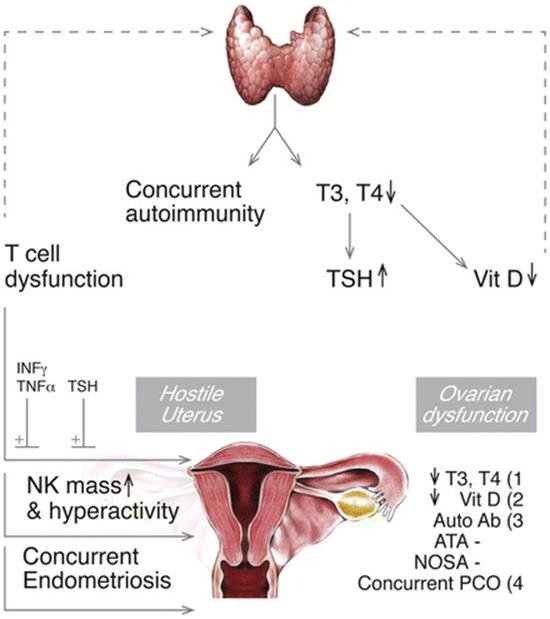
Fig. 3.2
Schematic illustration of the pathophysiological mechanisms that underlie infertility and pregnancy loss in women with hypothyroid autoimmunity. Dashed lines denote factors that potentially contribute to thyroid autoimmunity in addition to their effect on infertility (vitamin D and T cell dysfunction). For clarity, mechanisms are grouped into those that are primarily associated with hostile uterine environment and ovarian dysfunction. Concurrent autoimmunity is frequently seen in women with thyroid hypothyroidism and is associated with non-organ–specific antibodies (NOSA) in addition to autoimmune thyroid antibodies (ATA; other indirect effects are not indicated). Concurrent endometriosis and polycystic ovary are indicated due to their increased association with thyroid autoimmunity. Thyroxine, T4; Triiodothyronine, T3; Vit D, Vitamin D; TSH, Thyroid-stimulating hormone; Interferon-g, INFg; Tumor necrosis factor-a, TNF-a; Natural killer cells, NK; PCO, polycystic ovaries. [Reprinted from Twig G, Shina A, Amital H, Shoenfeld Y. Pathogenesis of infertility and recurrent pregnancy loss in thyroid autoimmunity. J Autoimmun. 2012;38(2-3):J275-81. With permission from Elsevier]
Treatment with thyroid replacement therapy in early pregnancy has been suggested in women with positive antibodies regardless of thyroid functions. In one study, in women positive for anti-TPO antibodies there was no difference in the prevalence of miscarriage between hypothyroid and euthyroid groups after treatment with L-thyroxine [84].
Screening Recommendation for Women with Recurrent Pregnancy Loss
TSH measurement, with or without thyroid hormone levels, is an inexpensive and sensitive tool for evaluation of thyroid function abnormalities. As such, it has been recommended by several clinical societies as a part of the preliminary evaluation for women with RPL [21, 22]. However, some authors recommend considering TSH measurement for the evaluation of RPL only for women with clinical signs or symptoms of thyroid abnormalities [96]. Notably, recent studies have advocated a change in the threshold for subclinical hypothyroidism, suggesting that TSH values above 2.5 mIU/L might be considered outside the normal range [21, 80].
Universal screening of thyroid functions for pregnant women is currently not recommended, since it did not result in a decrease in adverse outcomes when compared with case findings according to risk factors [97].
Recommendations for screening for thyroid autoantibodies are still inconclusive. Currently, societies dealing with reproductive medicine conclude that there is insufficient data to recommend routine screening of antibodies, especially when TSH is measured in the normal range [21, 68]. Recent clinical practice guidelines cosponsored by the American Association of Clinical Endocrinologists and the American Thyroid Association state that anti-TPO measurement should be considered when evaluating patients with RPL, regardless of infertility [98].
Several studies have shown some advantage in a measurement of TSH values after a short TRH stimulation test, where abnormal response or the expression of higher TSH values are thought to be related to early pregnancy loss and RPL [99, 100]. However, this test is not commonly accepted as part of RPL evaluation.
In view of the recent literature, our recommendation is that baseline TSH levels (with or without thyroxine levels) should be measured in all patients presenting with RPL, and that measurement of anti-TPO and anti-TG should be considered in patients in whom thyroid dysfunction is suspected in view of clinical signs and symptoms or abnormal TSH/thyroxine levels. Establishing the presence of thyroid autoantibodies in this population may also contribute to further research in search of a better understanding of the association between thyroid autoimmuni ty and RPL.
Treatment Recommendation for Women with Recurrent Pregnancy Loss
Currently the standard of care for pregnant women or women trying to conceive is treatment with thyroid replacement therapy in order to achieve a euthyroid state [75]. It has been shown that adequate treatment of hypothyroid state during gestation minimizes the risks of many possible adverse outcomes, including the risk for pregnancy loss [22, 68, 69].
In regard to patients with positive autoantibodies who are euthyroid, there is insufficient evidence as to the need for thyroid replacement therapy [84]. The clinical practice guidelines cosponsored by the American Association of Clinical Endocrinologists and the American Thyroid Association state that treatment with L-thyroxine should be considered in women of childbearing age with normal serum TSH levels when they are pregnant or planning a pregnancy if they have or have had positive levels of serum anti-TPO, particularly when there is a history of miscarriage or past history of hypothyroidism [98].
Due to the relationship between thyroid autoimmunity and the presence of other autoantibodies in women with RPL, several studies have evaluated the use of intravenous immunoglobulin (IVIG) in thyroid autoantibodies positive patients. This treatment is not common, especially since thyroid replacement therapy appears to be more effective than IVIG in preventing a new miscarriage in a population with RPL [101].
In conclusion, thyroid replacement therapy should be initiated for every woman with RPL and abnormal thyroid function tests. As for euthyroid women with positive autoantibodies, the initiation of treatment is not well established and should be tailor ed according to individual patient characteristics pending further research in this area.
Uncontrolled Diabetes and Recurrent Pregnancy Loss
Women with poorly controlled pregestational diabetes, reflected by hemoglobin A1c (HbA1c) levels higher than 8 %, seem to have higher rates of spontaneous abortion in early pregnancy compared to women without diabetes. Diabetic women with good metabolic control are no more likely to experience pregnancy loss compared with nondiabetic women [102]. A direct correlation exists between HbA1c levels, the incidence of pregnancy loss, and congenital malformations, even in nondiabetic patients [103]. Therefore it is recommended in ASRM guidelines to assess HbA1c for women with RPL [21].
One of the possible mechanisms for the increased rate of pregnancy loss in women with elevated HbA1c is an increase in congenital malformations. A meta-analysis conducted by Ray et al. [104] compared levels of HbA1c of diabetic pregnant women with preconception care to those without any care. In 14 cohort studies reviewed, the pooled rate of major anomalies was lower among preconception care recipients (2.1 %) than in nonrecipients (6.5 %) (RR 0.36, 95 % CI 0.22–0.59), and this finding was linked by the authors to a significantly lower first trimester HbA1c in women who received preconception care.
The level of HbA1c related to an increase in first trimester pregnancy loss is also an important study issue. Greene et al. conducted a study of 303 pregnant type 1 DM patients; the risk of spontaneous abortion was found to be 12.4 % with first trimester HbA1c ≤9.3 %, and 37.5 % with HbA1c > 14.4 % (risk ratio (RR) 3.0, 95 % CI 1.3–7.0) [105]. In an observational study conducted by Temple et al. [106], women were divided into two groups according to their HbA1c concentration upon their first visit. Women with values <7.5 % (mean of normal range plus 5 standard deviations) were defined as having fair-control and those with values ≥7.5 % were defined as having poor control. There were 242 pregnancies in 158 women; 32 pregnancies had an adverse outcome, with 18 (7 %) spontaneous miscarriages. Adverse outcome was significantly higher in the poor-control group than the fair-control group (RR 4.3, 95 % CI 1.8–10). Also, when comparing the spontaneous miscarriage rate, the poor-control group had a fourfold increase in the spontaneous miscarriage rate compared with the fair-control group (RR 4.0, 95 % CI 1.2–13.1). Therefore, it can be concluded that to prevent most pregnancy losses in diabetic women, the recommended level of HbA1c should be ≤7.5.
Finally, screening for diabetes mellitus should be done to patients with RPL at least by fasting glucose. However, as was mention before, it is r ecommended in the ASRM guidelines to assess HbA1c for women with RPL [21].
References
1.
Schindler AE, Campagnoli C, Druckmann R, Huber J, Pasqualini JR, Schweppe KW, et al. Classification and pharmacology of progestins. Maturitas. 2003;46 Suppl 1:S7–16.PubMed
2.
Wen DX, Xu YF, Mais DE, Goldman ME, McDonnell DP. The A and B isoforms of the human progesterone receptor operate through distinct signaling pathways within target cells. Mol Cell Biol. 1994;14(12):8356–64.PubMedPubMedCentral
3.
Su MT, Lee IW, Chen YC, Kuo PL. Association of progesterone receptor polymorphism with idiopathic recurrent pregnancy loss in Taiwanese Han population. J Assist Reprod Genet. 2011;28(3):239–43.PubMedPubMedCentral
4.
Druckmann R, Druckmann MA. Progesterone and the immunology of pregnancy. J Steroid Biochem Mol Biol. 2005;97:389–96.PubMed
5.
Faust Z, Laskarin G, Rukavina D, Szekeres-Bartho J. Progesterone-induced blocking factor inhibits degranulation of natural killer cells. Am J Reprod Immunol. 1999;42(2):71–5.PubMed
6.
Raghupathy R, Makhseed M, Azizieh F, Omu A, Gupta M, Farhat R. Cytokine production by maternal lymphocytes during normal human pregnancy and in unexplained recurrent spontaneous abortion. Hum Reprod. 2000;15(3):713–8.PubMed
7.
Shemesh A, Tirosh D, Sheiner E, Tirosh NB, Brusilovsky M, Segev R, et al. First trimester pregnancy loss and the expression of alternatively spliced NKp30 isoforms in maternal blood and placental tissue. Front Immunol. 2015;6:189.PubMedPubMedCentral
8.
Lachapelle MH, Miron P, Hemmings R, Roy DC. Endometrial T, B, and NK cells in patients with recurrent spontaneous abortion. Altered profile and pregnancy outcome. J Immunol. 1996;156(10):4027–34.PubMed
9.
Chao KH, Yang YS, Ho HN, Chen SU, Chen HF, Dai HJ, et al. Decidual natural killer cytotoxicity decreased in normal pregnancy but not in anembryonic pregnancy and recurrent spontaneous abortion. Am J Reprod Immunol. 1995;34(5):274–80.PubMed
10.
Kalinka J, Szekeres-Bartho J. The impact of dydrogesterone supplementation on hormonal profile and progesterone-induced blocking factor concentrations in women with threatened abortion. Am J Reprod Immunol. 2005;53(4):166–71.PubMed
11.
Csapo AI, Pulkkinen M. Indispensability of the human corpus luteum in the maintenance of early pregnancy. Luteectomy evidence. Obstet Gynecol Surv. 1978;33(2):69–81.PubMed
12.
Luisi SLL, Genazzani AR. Endocrinology of pregnancy loss. In: Carp HJA, editor. Recurrent pregnancy loss, causes, controversies and treatment. Boca Raton: Taylor and Francis Group; 2008. p. 79–87.
13.
Csapo AI, Pinto-Dantas CA. The effect of progesterone on the human uterus. Proc Natl Acad Sci U S A. 1965;54(4):1069–76.PubMedPubMedCentral
14.
Carbonne B, Dallot E, Haddad B, Ferre F, Cabrol D. Effects of progesterone on prostaglandin E(2)-induced changes in glycosaminoglycan synthesis by human cervical fibroblasts in culture. Mol Hum Reprod. 2000;6(7):661–4.PubMed
15.
Tan H, Yi L, Rote NS, Hurd WW, Mesiano S. Progesterone receptor-A and -B have opposite effects on proinflammatory gene expression in human myometrial cells: implications for progesterone actions in human pregnancy and parturition. J Clin Endocrinol Metab. 2012;97(5):E719–30.PubMedPubMedCentral
16.
Szekeres-Bartho J, Halasz M, Palkovics T. Progesterone in pregnancy; receptor-ligand interaction and signaling pathways. J Reprod Immunol. 2009;83(1-2):60–4.PubMed
17.
Murray MJ, Meyer WR, Zaino RJ, Lessey BA, Novotny DB, Ireland K, et al. A critical analysis of the accuracy, reproducibility, and clinical utility of histologic endometrial dating in fertile women. Fertil Steril. 2004;81(5):1333–43.PubMed
18.
El-Zibdeh MY. Dydrogesterone in the reduction of recurrent spontaneous abortion. J Steroid Biochem Mol Biol. 2005;97(5):431–4.PubMed
19.
Carp H. A systematic review of dydrogesterone for the treatment of recurrent miscarriage. Gynecol Endocrinol. 2015;1–9.
20.
Haas DM, Ramsey PS. Progestogen for preventing miscarriage. Cochrane Database Syst Rev. 2013;10, CD003511.PubMed
21.
Medicine PCotASfR. Evaluation and treatment of recurrent pregnancy loss: a committee opinion. Fertil Steril. 2012;98(5):1103–11.
22.
Jauniaux E, Farquharson RG, Christiansen OB, Exalto N. Evidence-based guidelines for the investigation and medical treatment of recurrent miscarriage. Hum Reprod. 2006;21(9):2216–22.PubMed
23.
Speroff L, Fritz MA. Clinical gynecologic endocrinology and infertility. 8th ed. Philadelphia: Lippincott Williams & Wilkins; 2011.
24.
Bussen S, Sütterlin M, Steck T. Endocrine abnormalities during the follicular phase in women with recurrent spontaneous abortion. Hum Reprod. 1999;14(1):18–20.PubMed
25.
Hirahara F, Andoh N, Sawai K, Hirabuki T, Uemura T, Minaguchi H. Hyperprolactinemic recurrent miscarriage and results of randomized bromocriptine treatment trials. Fertil Steril. 1998;70(2):246–52.PubMed
26.
Li TC, Spuijbroek MD, Tuckerman E, Anstie B, Loxley M, Laird S. Endocrinological and endometrial factors in recurrent miscarriage. BJOG. 2000;107(12):1471–9.PubMed
27.
Stein IFLM. Amenorrhea associated with bilateral polycystic ovaries. Am J Obstet Gynecol. 1935;29:181.
28.
Knochenhauer ES, Key TJ, Kahsar-Miller M, Waggoner W, Boots LR, Azziz R. Prevalence of the polycystic ovary syndrome in unselected black and white women of the southeastern United States: a prospective study. J Clin Endocrinol Metab. 1998;83(9):3078–82.PubMed
29.
Asunción M, Calvo RM, San Millán JL, Sancho J, Avila S, Escobar-Morreale HF. A prospective study of the prevalence of the polycystic ovary syndrome in unselected Caucasian women from Spain. J Clin Endocrinol Metab. 2000;85(7):2434–8.PubMed
30.
Azziz R, Woods KS, Reyna R, Key TJ, Knochenhauer ES, Yildiz BO. The prevalence and features of the polycystic ovary syndrome in an unselected population. J Clin Endocrinol Metab. 2004;89(6):2745–9.PubMed
31.
Bulletins--Gynecology ACoP. ACOG Practice Bulletin No. 108: Polycystic ovary syndrome. Obstet Gynecol. 2009;114(4):936–49.
32.
Dunaif AGJ, Haseltine FP, Merriam GR. Polycystic ovary syndrome. Boston: Blackwell Scientific Publications; 1992.
33.
Group REA-SPCW. Revised 2003 consensus on diagnostic criteria and long-term health risks related to polycystic ovary syndrome. Fertil Steril. 2004;81(1):19–25.
34.
Azziz R, Carmina E, Dewailly D, Diamanti-Kandarakis E, Escobar-Morreale HF, Futterweit W, et al. Positions statement: criteria for defining polycystic ovary syndrome as a predominantly hyperandrogenic syndrome: an Androgen Excess Society guideline. J Clin Endocrinol Metab. 2006;91(11):4237–45.PubMed
35.
Ehrmann DA. Polycystic ovary syndrome. N Engl J Med. 2005;352(12):1223–36.PubMed
36.
Dunaif A. Insulin resistance and the polycystic ovary syndrome: mechanism and implications for pathogenesis. Endocr Rev. 1997;18(6):774–800.PubMed
37.
Ehrmann DA, Barnes RB, Rosenfield RL, Cavaghan MK, Imperial J. Prevalence of impaired glucose tolerance and diabetes in women with polycystic ovary syndrome. Diabetes Care. 1999;22(1):141–6.PubMed
38.
Legro RS, Kunselman AR, Dodson WC, Dunaif A. Prevalence and predictors of risk for type 2 diabetes mellitus and impaired glucose tolerance in polycystic ovary syndrome: a prospective, controlled study in 254 affected women. J Clin Endocrinol Metab. 1999;84(1):165–9.PubMed
39.
Rai R, Backos M, Rushworth F, Regan L. Polycystic ovaries and recurrent miscarriage--a reappraisal. Hum Reprod. 2000;15(3):612–5.PubMed
40.
Watson H, Kiddy DS, Hamilton-Fairley D, Scanlon MJ, Barnard C, Collins WP, et al. Hypersecretion of luteinizing hormone and ovarian steroids in women with recurrent early miscarriage. Hum Reprod. 1993;8(6):829–33.PubMed
41.
Yang CJ, Stone P, Stewart AW. The epidemiology of recurrent miscarriage: a descriptive study of 1214 prepregnant women with recurrent miscarriage. Aust N Z J Obstet Gynaecol. 2006;46(4):316–22.PubMed
42.
Cocksedge KA, Saravelos SH, Metwally M, Li TC. How common is polycystic ovary syndrome in recurrent miscarriage? Reprod Biomed Online. 2009;19(4):572–6.PubMed
43.
Cocksedge KA, Li TC, Saravelos SH, Metwally M. A reappraisal of the role of polycystic ovary syndrome in recurrent miscarriage. Reprod Biomed Online. 2008;17(1):151–60.PubMed
44.
Sugiura-Ogasawara M. Recurrent pregnancy loss and obesity. Best Pract Res Clin Obstet Gynaecol. 2015;29(4):489–97.PubMed
45.
Lashen H, Fear K, Sturdee DW. Obesity is associated with increased risk of first trimester and recurrent miscarriage: matched case-control study. Hum Reprod. 2004;19(7):1644–6.PubMed
46.
Al-Azemi M, Omu FE, Omu AE. The effect of obesity on the outcome of infertility management in women with polycystic ovary syndrome. Arch Gynecol Obstet. 2004;270(4):205–10.PubMed
47.
Clark AM, Ledger W, Galletly C, Tomlinson L, Blaney F, Wang X, et al. Weight loss results in significant improvement in pregnancy and ovulation rates in anovulatory obese women. Hum Reprod. 1995;10(10):2705–12.PubMed
48.
Craig LB, Ke RW, Kutteh WH. Increased prevalence of insulin resistance in women with a history of recurrent pregnancy loss. Fertil Steril. 2002;78(3):487–90.PubMed
49.
Chakraborty P, Goswami SK, Rajani S, Sharma S, Kabir SN, Chakravarty B, et al. Recurrent pregnancy loss in polycystic ovary syndrome: role of hyperhomocysteinemia and insulin resistance. PLoS One. 2013;8(5), e64446.PubMedPubMedCentral
50.
Jakubowicz DJ, Iuorno MJ, Jakubowicz S, Roberts KA, Nestler JE. Effects of metformin on early pregnancy loss in the polycystic ovary syndrome. J Clin Endocrinol Metab. 2002;87(2):524–9.PubMed
51.
Zolghadri J, Tavana Z, Kazerooni T, Soveid M, Taghieh M. Relationship between abnormal glucose tolerance test and history of previous recurrent miscarriages, and beneficial effect of metformin in these patients: a prospective clinical study. Fertil Steril. 2008;90(3):727–30.PubMed
52.
Nawaz FH, Rizvi J. Continuation of metformin reduces early pregnancy loss in obese Pakistani women with polycystic ovarian syndrome. Gynecol Obstet Invest. 2010;69(3):184–9.PubMed
53.
Palomba S, Falbo A, Orio F, Zullo F. Effect of preconceptional metformin on abortion risk in polycystic ovary syndrome: a systematic review and meta-analysis of randomized controlled trials. Fertil Steril. 2009;92(5):1646–58.PubMed
54.
Mathur R, Alexander CJ, Yano J, Trivax B, Azziz R. Use of metformin in polycystic ovary syndrome. Am J Obstet Gynecol. 2008;199(6):596–609.PubMed
55.
Atiomo WU, Bates SA, Condon JE, Shaw S, West JH, Prentice AG. The plasminogen activator system in women with polycystic ovary syndrome. Fertil Steril. 1998;69(2):236–41.PubMed
56.
Glueck CJ, Wang P, Fontaine RN, Sieve-Smith L, Tracy T, Moore SK. Plasminogen activator inhibitor activity: an independent risk factor for the high miscarriage rate during pregnancy in women with polycystic ovary syndrome. Metabolism. 1999;48(12):1589–95.PubMed
57.
Glueck CJ, Wang P, Bornovali S, Goldenberg N, Sieve L. Polycystic ovary syndrome, the G1691A factor V Leiden mutation, and plasminogen activator inhibitor activity: associations with recurrent pregnancy loss. Metabolism. 2003;52(12):1627–32.PubMed
58.
Palomba S, Orio F, Falbo A, Russo T, Tolino A, Zullo F. Plasminogen activator inhibitor 1 and miscarriage after metformin treatment and laparoscopic ovarian drilling in patients with polycystic ovary syndrome. Fertil Steril. 2005;84(3):761–5.PubMed
59.
Wijeyaratne CN, Nirantharakumar K, Balen AH, Barth JH, Sheriff R, Belchetz PE. Plasma homocysteine in polycystic ovary syndrome: does it correlate with insulin resistance and ethnicity? Clin Endocrinol (Oxf). 2004;60(5):560–7.
60.
Kazerooni T, Ghaffarpasand F, Asadi N, Dehkhoda Z, Dehghankhalili M, Kazerooni Y. Correlation between thrombophilia and recurrent pregnancy loss in patients with polycystic ovary syndrome: a comparative study. J Chin Med Assoc. 2013;76(5):282–8.PubMed
61.
Chakraborty P, Banerjee S, Saha P, Nandi SS, Sharma S, Goswami SK, et al. Aspirin and low-molecular weight heparin combination therapy effectively prevents recurrent miscarriage in hyperhomocysteinemic women. PLoS One. 2013;8(9), e74155.PubMedPubMedCentral
62.
Glueck CJ, Goldenberg N, Pranikoff J, Loftspring M, Sieve L, Wang P. Height, weight, and motor-social development during the first 18 months of life in 126 infants born to 109 mothers with polycystic ovary syndrome who conceived on and continued metformin through pregnancy. Hum Reprod. 2004;19(6):1323–30.PubMed
63.
Ramidi G, Khan N, Glueck CJ, Wang P, Goldenberg N. Enoxaparin-metformin and enoxaparin alone may safely reduce pregnancy loss. Transl Res. 2009;153(1):33–43.PubMed
64.
Kumar A, Woods KS, Bartolucci AA, Azziz R. Prevalence of adrenal androgen excess in patients with the polycystic ovary syndrome (PCOS). Clin Endocrinol (Oxf). 2005;62(6):644–9.
65.
Sugiura-Ogasawara M, Sato T, Suzumori N, Kitaori T, Kumagai K, Ozaki Y. The polycystic ovary syndrome does not predict further miscarriage in Japanese couples experiencing recurrent miscarriages. Am J Reprod Immunol. 2009;61(1):62–7.PubMed
66.
Nardo LG, Rai R, Backos M, El-Gaddal S, Regan L. High serum luteinizing hormone and testosterone concentrations do not predict pregnancy outcome in women with recurrent miscarriage. Fertil Steril. 2002;77(2):348–52.PubMed
67.
Clifford K, Rai R, Watson H, Franks S, Regan L. Does suppressing luteinising hormone secretion reduce the miscarriage rate? Results of a randomised controlled trial. BMJ. 1996;312(7045):1508–11.PubMedPubMedCentral
68.
17 RCoOaGRG-TGN. The investigation and treatment of couples with recurrent first-trimester and second-trimester miscarriage. April 2011.
69.
Abalovich M, Gutierrez S, Alcaraz G, Maccallini G, Garcia A, Levalle O. Overt and subclinical hypothyroidism complicating pregnancy. Thyroid. 2002;12(1):63–8.PubMed
70.
Poppe K, Glinoer D. Thyroid autoimmunity and hypothyroidism before and during pregnancy. Hum Reprod Update. 2003;9(2):149–61.PubMed
71.
van den Boogaard E, Vissenberg R, Land JA, van Wely M, van der Post JA, Goddijn M, et al. Significance of (sub)clinical thyroid dysfunction and thyroid autoimmunity before conception and in early pregnancy: a systematic review. Hum Reprod Update. 2011;17(5):605–19.PubMed
72.
Haddow JE, Palomaki GE, Allan WC, Williams JR, Knight GJ, Gagnon J, et al. Maternal thyroid deficiency during pregnancy and subsequent neuropsychological development of the child. N Engl J Med. 1999;341(8):549–55.PubMed
73.
Lambert-Messerlian G, McClain M, Haddow JE, Palomaki GE, Canick JA, Cleary-Goldman J, et al. First- and second-trimester thyroid hormone reference data in pregnant women: a FaSTER (First- and Second-Trimester Evaluation of Risk for aneuploidy) Research Consortium study. Am J Obstet Gynecol. 2008;199(1):62.e1–6.
74.
LeBeau SO, Mandel SJ. Thyroid disorders during pregnancy. Endocrinol Metab Clin North Am. 2006;35(1):117–36. vii.PubMed
75.
Alexander EK, Marqusee E, Lawrence J, Jarolim P, Fischer GA, Larsen PR. Timing and magnitude of increases in levothyroxine requirements during pregnancy in women with hypothyroidism. N Engl J Med. 2004;351(3):241–9.PubMed
76.
Nambiar V, Jagtap VS, Sarathi V, Lila AR, Kamalanathan S, Bandgar TR, et al. Prevalence and impact of thyroid disorders on maternal outcome in asian-Indian pregnant women. J Thyroid Res. 2011;2011:429097.PubMedPubMedCentral
77.
Casey BM, Dashe JS, Spong CY, McIntire DD, Leveno KJ, Cunningham GF. Perinatal significance of isolated maternal hypothyroxinemia identified in the first half of pregnancy. Obstet Gynecol. 2007;109(5):1129–35.PubMed
78.
Benhadi N, Wiersinga WM, Reitsma JB, Vrijkotte TG, Bonsel GJ. Higher maternal TSH levels in pregnancy are associated with increased risk for miscarriage, fetal or neonatal death. Eur J Endocrinol. 2009;160(6):985–91.PubMed
79.
De Vivo A, Mancuso A, Giacobbe A, Moleti M, Maggio Savasta L, De Dominici R, et al. Thyroid function in women found to have early pregnancy loss. Thyroid. 2010;20(6):633–7.PubMed
80.
Negro R, Schwartz A, Gismondi R, Tinelli A, Mangieri T, Stagnaro-Green A. Increased pregnancy loss rate in thyroid antibody negative women with TSH levels between 2.5 and 5.0 in the first trimester of pregnancy. J Clin Endocrinol Metab. 2010;95(9):E44–8.PubMed
81.
Rao VR, Lakshmi A, Sadhnani MD. Prevalence of hypothyroidism in recurrent pregnancy loss in first trimester. Indian J Med Sci. 2008;62(9):357–61.PubMed
82.
Bernardi LA, Cohen RN, Stephenson MD. Impact of subclinical hypothyroidism in women with recurrent early pregnancy loss. Fertil Steril. 2013;100(5):1326–31.PubMed
83.
Kutteh WH, Yetman DL, Carr AC, Beck LA, Scott RT. Increased prevalence of antithyroid antibodies identified in women with recurrent pregnancy loss but not in women undergoing assisted reproduction. Fertil Steril. 1999;71(5):843–8.PubMed
84.
Lata K, Dutta P, Sridhar S, Rohilla M, Srinivasan A, Prashad GR, et al. Thyroid autoimmunity and obstetric outcomes in women with recurrent miscarriage: a case-control study. Endocr Connect. 2013;2(2):118–24.PubMedPubMedCentral
85.
Liu H, Shan Z, Li C, Mao J, Xie X, Wang W, et al. Maternal subclinical hypothyroidism, thyroid autoimmunity, and the risk of miscarriage: a prospective cohort study. Thyroid. 2014;24(11):1642–9.PubMedPubMedCentral
86.
Carlé A, Pedersen IB, Knudsen N, Perrild H, Ovesen L, Rasmussen LB, et al. Epidemiology of subtypes of hyperthyroidism in Denmark: a population-based study. Eur J Endocrinol. 2011;164(5):801–9.PubMed
87.
Andersen SL, Olsen J, Wu CS, Laurberg P. Spontaneous abortion, stillbirth and hyperthyroidism: a danish population-based study. Eur Thyroid J. 2014;3(3):164–72.PubMedPubMedCentral
88.
Anselmo J, Cao D, Karrison T, Weiss RE, Refetoff S. Fetal loss associated with excess thyroid hormone exposure. JAMA. 2004;292(6):691–5.PubMed
89.
Twig G, Shina A, Amital H, Shoenfeld Y. Pathogenesis of infertility and recurrent pregnancy loss in thyroid autoimmunity. J Autoimmun. 2012;38(2-3):J275–81.PubMed
90.
Bagis T, Gokcel A, Saygili ES. Autoimmune thyroid disease in pregnancy and the postpartum period: relationship to spontaneous abortion. Thyroid. 2001;11(11):1049–53.PubMed
91.
Ticconi C, Giuliani E, Veglia M, Pietropolli A, Piccione E, Di Simone N. Thyroid autoimmunity and recurrent miscarriage. Am J Reprod Immunol. 2011;66(6):452–9.PubMed
92.
Rushworth FH, Backos M, Rai R, Chilcott IT, Baxter N, Regan L. Prospective pregnancy outcome in untreated recurrent miscarriers with thyroid autoantibodies. Hum Reprod. 2000;15(7):1637–9.PubMed
93.
Chen L, Hu R. Thyroid autoimmunity and miscarriage: a meta-analysis. Clin Endocrinol (Oxf). 2011;74(4):513–9.
94.
Thangaratinam S, Tan A, Knox E, Kilby MD, Franklyn J, Coomarasamy A. Association between thyroid autoantibodies and miscarriage and preterm birth: meta-analysis of evidence. BMJ. 2011;342:d2616.PubMedPubMedCentral
95.
Marai I, Carp H, Shai S, Shabo R, Fishman G, Shoenfeld Y. Autoantibody panel screening in recurrent miscarriages. Am J Reprod Immunol. 2004;51(3):235–40.PubMed
96.
Christiansen OB, Nybo Andersen AM, Bosch E, Daya S, Delves PJ, Hviid TV, et al. Evidence-based investigations and treatments of recurrent pregnancy loss. Fertil Steril. 2005;83(4):821–39.PubMed
97.
Negro R, Schwartz A, Gismondi R, Tinelli A, Mangieri T, Stagnaro-Green A. Universal screening versus case finding for detection and treatment of thyroid hormonal dysfunction during pregnancy. J Clin Endocrinol Metab. 2010;95(4):1699–707.PubMed
98.
Garber JR, Cobin RH, Gharib H, Hennessey JV, Klein I, Mechanick JI, et al. Clinical practice guidelines for hypothyroidism in adults: cosponsored by the American Association of Clinical Endocrinologists and the American Thyroid Association. Thyroid. 2012;22(12):1200–35.PubMed
99.
Lazzarin N, Moretti C, De Felice G, Vaquero E, Manfellotto D. Further evidence on the role of thyroid autoimmunity in women with recurrent miscarriage. Int J Endocrinol. 2012;2012:717185.PubMedPubMedCentral
100.
Dal Lago A, Vaquero E, Pasqualetti P, Lazzarin N, De Carolis C, Perricone R, et al. Prediction of early pregnancy maternal thyroid impairment in women affected with unexplained recurrent miscarriage. Hum Reprod. 2011;26(6):1324–30.PubMed
101.
Vaquero E, Lazzarin N, De Carolis C, Valensise H, Moretti C, Ramanini C. Mild thyroid abnormalities and recurrent spontaneous abortion: diagnostic and therapeutical approach. Am J Reprod Immunol. 2000;43(4):204–8.PubMed
102.
Mills JL, Simpson JL, Driscoll SG, Jovanovic-Peterson L, Van Allen M, Aarons JH, et al. Incidence of spontaneous abortion among normal women and insulin-dependent diabetic women whose pregnancies were identified within 21 days of conception. N Engl J Med. 1988;319(25):1617–23.PubMed
103.
Jovanovic L, Knopp RH, Kim H, Cefalu WT, Zhu XD, Lee YJ, et al. Elevated pregnancy losses at high and low extremes of maternal glucose in early normal and diabetic pregnancy: evidence for a protective adaptation in diabetes. Diabetes Care. 2005;28(5):1113–7.PubMed
104.
Ray JG, O’Brien TE, Chan WS. Preconception care and the risk of congenital anomalies in the offspring of women with diabetes mellitus: a meta-analysis. QJM. 2001;94(8):435–44.PubMed
105.
Greene MF, Hare JW, Cloherty JP, Benacerraf BR, Soeldner JS. First-trimester hemoglobin A1 and risk for major malformation and spontaneous abortion in diabetic pregnancy. Teratology. 1989;39(3):225–31.PubMed
106.
Temple R, Aldridge V, Greenwood R, Heyburn P, Sampson M, Stanley K. Association between outcome of pregnancy and glycaemic control in early pregnancy in type 1 diabetes: population based study. BMJ. 2002;325(7375):1275–6.PubMedPubMedCentral