
Yih-Ing Hser1 and M. Douglas Anglin
(1)
Department of Psychiatry and Behavioral Sciences, UCLA Integrated Substance Abuse Programs, 1640 S. Sepulveda Blvd., Suite 200, Los Angeles, CA 90025, USA
Yih-Ing Hser
Email: yhser@ucla.edu
Abstract
Recovery from addiction is a complex and dynamic process, with considerable variations across individuals. Despite historical and recent surge of interest in recovery among many stakeholders in the addiction field, empirical research on recovery has been limited. The varying definitions of recovery across different stakeholder groups best illustrate the wide-ranging thinking on recovery, yet how recovery is conceptualized, promoted, and achieved has important implications for how treatment systems should be structured, delivered, and evaluated. The concept of addiction as a chronic illness is redefining the fundamental way we view drug abuse and its treatment. Currently, many efforts are directed toward determining how to provide a continuity of treatment and how to measure if treatment systems are successfully addressing addiction as a chronic disease. In this chapter, we describe empirical patterns of drug use trajectories over the life course, discuss the diverse ways of conceptualizing recovery, and identify key aspects of addiction that require attention as we investigate and treat addiction to promote long-term, stable recovery.
Keywords
Addiction recovery managementAddiction recoveryAddiction as a chronic illnessContinuity of care
Introduction
Illicit drug use continues to be a top public concern, directly or indirectly affecting individuals, families, and communities, with detrimental effects that may persist across generations. Patterns of substance abuse are extremely heterogeneous, with many individuals having used drugs and stopped the use, but for others, addiction becomes a chronic and recurring condition [1–6], oftentimes spanning decades of an individual’s lifetime [3–5, 7]. While various treatment options are now available and have been shown to be effective, most treatment effects are short-lived. Many dependent users cycle through several treatments before they achieve more stable recovery, resulting in prolonged adverse consequences associated with addiction. The traditional acute care model of drug abuse treatment appears ill suited to address the chronic condition. As such, focus has increasingly turned toward embracing long-term and continuity-of-care models for understanding and treating drug addiction [3, 8, 9]. Meanwhile, the field is increasingly interested in recovery, shifting from the focus on pathology to more positive outcomes such as well-being or quality of life [10, 11]. Recovery-oriented systems of care have been emerging, promoted, and in several states, implemented [12].
Recovery from addiction is a complex and dynamic process, with considerable variations across individuals. Despite historical and recent surge of interest in recovery among many stakeholders in the addiction field, empirical research on recovery has been limited. The varying definitions of recovery across different stakeholder groups best illustrate the wide-ranging thinking on recovery, yet how recovery is conceptualized, promoted, and achieved has important implications for how treatment systems should be structured, delivered, and evaluated. Consequently, while the vision to broadening the systems of care to support long-term recovery is admirable, strategies for implementation remain to be developed and effectiveness empirically investigated. In this chapter, we describe empirical patterns of drug use trajectories over the life course, discuss the diverse ways of conceptualizing recovery, and identify key aspects of addiction and recovery that require attention as we investigate and treat addiction as a chronic disease and move toward a recovery-oriented system of care that supports long-term, stable recovery.
We describe and discuss relevant issues from a life course perspective, which uses a more integrated systems approach to studying substance abuse and recovery. This perspective takes into account varied and multiple factors that might contribute to abstinence, relapse, or stable recovery, which will be helpful given the complex nature of substance use and its dynamic interplay with various social systems [9]. The approach complements the shift in the treatment and research paradigms from short-term “snapshots” of substance use and treatment episodes to long-term developmental patterns of behavior and outcomes over time, and it takes into consideration factors that may shape or be shaped by these pathways.
A Life Course Conceptual Framework
The life course perspective has roots in the social sciences, and its application to addiction most closely resembles the approach applied in the developmental criminology research studying criminal careers. Key life course concepts include developmental trajectories, transitions and turning points, and their relationships to one another. The life course approach applied in the study of drug use emphasizes long-term patterns of continuity and change that can be both gradual and radical in relation to transitions in terms of social roles (e.g., parent, offender) over the life span [9, 13]. This approach is particularly appropriate given the now widely accepted perspective that drug addiction is a chronic and recurring condition for many, which necessitates a chronic disease management view [6].
Elder [14] defines life course as interconnected trajectories as people age. Trajectories are interdependent sequences of events in different life domains. In the developmental criminology literature, Sampson and Laub [15] refer to trajectories as “long-term patterns and sequences of behavioral transition” (p. 351), which are affected by the degree of social capital (individuals’ interpersonal relations and institutional ties, i.e., to family, work) available to an individual [16]. Social capital is important because personal change does not happen in a vacuum, but it is influenced by the social context that can facilitate or impede recovery from addiction; the resources developed through the structure and functions of social relationships are part of an individual’s “recovery capital” [17, 18]. Transitions are changes in stages or roles (e.g., getting a new job; becoming abstinent) that are short term. Some transitions can lead to turning points that engender long-term behavioral change. The essential characteristic of a turning point is that it redirects a trajectory; it is not simply a temporary detour [19].
Recovery involves a lifestyle change, which implies a long-term commitment that is consistent with the life course perspective. From the life course perspective, questions about the process of transition into recovery concern whether the initiation of recovery is a drawn-out process versus a dramatic transformation, and whether those changes are triggered by critical events as turning points. Questions about maintaining recovery include whether there are variations in the recovery trajectory and what are the underlying factors or mechanisms. Identifying what constitutes a turning point toward recovery is of great interest. The life course perspective also has the advantage of recognizing developmental stage as protective and risk factors may differ across the life span. Thus, the life course perspective offers a rich source of theoretical concepts, terminologies, and measures for the study of addiction and recovery careers.
Drug Use Trajectories
Guided by the life course perspective, we have conducted several studies to empirically investigate developmental trajectories of drug use [5, 20]. It is important to note that whereas drug use persists over the lifespan for some, for others it may decelerate gradually or dramatically and then may cease entirely, or it may exhibit a recurring pattern of repeated acceleration and deceleration with periods of abstinence. Longitudinal studies that allow the depiction of long-term patterns of drug use, however, are limited. Below, we use data from our own studies and those in the public domain to illustrate empirical findings of the overall drug use trajectories for both the general population and drug-dependent samples, followed with distinctive trajectories among drug users.
Drug Use Trajectories Among the General Population
Based on the National Survey of Drug Use and Health (NSDUH), marijuana is the most prevalently used drug in the general population. While substance use generally peaks in the late teens to young adulthood (Fig. 2.1), most drug use begins before age 15 [21]. To further illustrate the longitudinal patterns of alcohol and drug use among the general population, we analyzed the National Longitudinal Survey of Youth (NLSY79). NLSY79 is a nationally representative sample of 12,686 young men and women who were 14–22 years old when they were first surveyed in 1979 [22]. Individuals were surveyed annually from 1979 to 1994 and biennially from 1996 to the present. The survey has collected extensive information about youths’ labor market behaviors, and in certain years, about alcohol and drug use. Heavy alcohol use (more than six drinks in one occasion) is the most prevalent problem among the general population, followed by marijuana, cocaine, and heroin use, which is consistently at a very low level. As shown in Fig. 2.2, alcohol and marijuana use peeked during the teens, and cocaine use occurred mostly during young adulthood; use of all substances gradually declines as the cohort aged, although declines covered different age periods and occurred at different rates over time.

Fig. 2.1
Past-year drug use by age (National Survey of Drug Use & Health, 2002, N = 54,079)

Fig. 2.2
Past-year alcohol and drug use over time (National Longitudinal Survey of Youth, NLSY79, N = 12,686)
Drug Use Trajectories Among Drug-Dependent Users
In contrast to the use patterns among the general population, research findings have generally shown that severe or dependent users tend to persist in their drug use, often for substantial periods of their lifespan. The UCLA Center for Advancing Longitudinal Drug Abuse Research (CALDAR) has accumulated data from several long-term follow-up studies. Using CALDAR data combined from five longitudinal studies (N = 1,797), we were able to compare the trajectories of primary heroin, cocaine, and methamphetamine (meth) use over the first 10 years after initiation [20, 23]. The study findings showed that heroin addiction is characterized by long periods of regular use (13–18 days per month over 10 years), while stimulants such as cocaine (8–11 days) and meth (around 12 days) are generally used at a lower frequency and are reflective of an episodic pattern (e.g., weekend users) (see Fig. 2.3). The use of alcohol and marijuana also persisted, although generally at a lower level than the primary drug. Despite the varying levels of use, the group means of use for all three types of primary drugs appear to suggest a persistent pattern of use over a long period of time (e.g., at least for the first 10 years of the addiction careers observed in the study), which supports the chronic nature of addiction to heroin, cocaine, and meth. These findings also suggest that the treatment activities and approaches for individuals with a diagnosis of opiate addiction (almost daily use) should be different from that for those dependent on stimulants (episodic use).
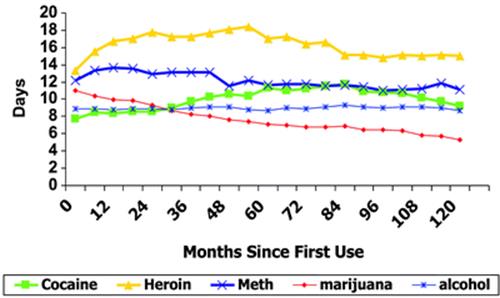
Fig. 2.3
Days using per month over 10 years since first use (N = 1,797)
Distinctive Trajectories Among Drug Users
Although our work and other studies often show convergent findings on the persistence of drug use typically over a long period, some addicts may cease their drug use careers earlier than others [5]. Recent advances in analytic methods, particularly the application of growth mixture modeling in the analysis of longitudinal data, have allowed researchers to identify distinct trajectories of behavior over extended time [24–27]. Examples of this methodology include applications to the study of developmental trajectories of cigarette smoking [28, 29], alcohol use [30], and marijuana use [31, 32] from adolescence to young adulthood. These studies generally demonstrate the importance of examining subgroups, particularly their associated risk factors and subsequent outcomes.
Applying growth mixture modeling to the CALDAR longitudinal dataset (N = 1,797), we were able to reveal heterogeneous trajectory groups (Fig. 2.4): those who prolonged their drug use at a relatively low level (on average, less than once per month; 5% of the sample) or at a moderate level (about 5 days per month; 35%); those who decreased (14%) or increased (14%) drug use over long periods of time; and yet others who persisted in high levels of use (about 15 days per month; 30%) even over decades [20]. Heroin users were most likely to be in the high-use group (52%), and cocaine (50%) and meth (35%) users are most likely to be in the moderate-use group. Drug users in the high-use group had the earliest onset of arrest and primary drug use, spent the longest time incarcerated and the shortest time employed, and many of them (44%) had their first drug treatment in prison. In contrast, users in the low-use group were the smallest group and were oldest when first arrested, spent the least time in prison, and had the longest duration of employment.

Fig. 2.4
Five distinctive drug use trajectories (N = 1,797)
Other studies on the onset of drug use have shown that adolescents who begin drug use at early ages typically use drugs more frequently, escalate to higher levels of use more quickly, and are more likely to persist in using [33, 34]. Similarly, we have also found that users who persistently used a high level of heroin, cocaine, or meth had earlier onsets of use of these drugs [35]. Most importantly, while quitting drug use can be facilitated by formal treatment and/or self-help participation, few people (about 25%) had these experiences in the 10 years following first use [20]. We turn back to this point later when we discuss the treatment and cumulative treatment effects.
Recovery Careers
Until recently, stable cessation and recovery has received little attention in drug abuse research. Thus, it is not surprising that despite the theoretical and policy importance of understanding why people initiate recovery and are able to maintain recovery, we do not have robust conceptual models or rich empirical investigations of recovery.
Conceptualization and Definitions of Recovery
Although the topic of recovery has been around for decades, a recent surge in interest has inspired the first serious attempts to define recovery from addiction. In defining recovery, some stakeholders consider abstinence from illicit drug use to be the only factor in determining recovery, while others believe recovery requires abstinence from alcohol and tobacco as well as any other drugs. Yet others suggest that recovery should be more broadly defined and that improved health and quality of life (e.g., employment) should be the primary criteria [10–12, 36, 37]. In 2005, the Substance Abuse and Mental Health Services Administration’s Center for Substance Abuse Treatment (SAMHSA/CSAT) held a National Summit on Recovery, which convened over 100 individuals representing a variety of stakeholders in the addiction treatment and recovery field. While it was acknowledged that individuals may choose to define recovery differently, as a starting point for further discussion, the consensus definition embraced the concept of recovery as a process of change through which an individual achieves abstinence and improved health, wellness, and quality of life [12].
Apparently, the meaning and measures of these concepts need to be developed or operationalized for research purposes. For example, when does recovery begin and how long must abstinence be maintained for a person to be considered fully “recovered?” Some maintain that individuals who intend to make changes be considered “in recovery,” while most others take into consideration a certain period of time (e.g., 1–2 years) of abstinence and/or improvement in other life domains. Some studies have suggested that 5 years of abstinence may be critical to indicate the likelihood of a “complete” recovery [35, 38]. These different ways of viewing or defining recovery have implications not only for research but for how treatment systems should be structured, delivered, and evaluated to optimize recovery.
Long-Term Follow-Up Studies Informing Recovery
Long-term follow-up studies on substance use and addiction have been limited, and most of those that exist are based on treatment cohorts. Although natural recovery or spontaneous recovery (i.e., recovery without treatment) is possible and likely widespread particularly among less severe users [39], most literature reviewed in this chapter is based on treatment samples where most empirical data are available. Results of these long-term follow-up studies generally show that relapse is problematic even after decades and that the risk of death is high [4]. Abstinence rates vary by the duration criteria used in studies. In a 10-year follow-up study of 200 alcoholics who received inpatient treatment, 51% were abstinent at the time of the follow-up but only 10% reported being abstinent for 3 or more years [40]. Based on an 8-year follow-up study, Dennis et al. [38] reported on the outcomes among a cohort of 1,326 substance users receiving treatment. At the follow-up, 501 (or 37.8%) were abstinent from alcohol and illicit drugs, of them 142 individuals (10.7% of the sample) had been abstinent for at least 3 years, and only 77 (or 5.8%) had been abstinent for 5 years or more. In a 12-year follow-up of cocaine-dependent sample [41], 22.3% tested positive for cocaine, and slightly more than one half (51.9%) had achieved stable recovery by maintaining abstinence from cocaine for more than 5 years. In a 33-year follow-up study [4], we examined life course cessation among heroin addicts and showed that eventual cessation of heroin use is a slow process and may not occur for some older addicts. Opiate use patterns of the cohort were remarkably stable; by 50–60 years of age, only about half of the sample interviewed tested negative for heroin.
Predictors of Recovery
Besides treatment and self-help group participation, few studies have examined the predictors of recovery. It seems obvious that the longer the period of nonuse, the less likely it is that an individual will relapse [4, 42, 43]. Several studies have found that social and personal resources that persons possess can be instrumental in overcoming substance dependence.
Studies by Scott et al. [45] support that cumulative time of abstinence is a strong predictor of future recovery. They found that the duration of abstinence at a given interview was among the best predictors of maintaining abstinence over the subsequent year, with the likelihood of sustaining abstinence for another 12 months increasing from 36% among those with less than a year of abstinence to 86% among those with 3 or more years of abstinence. Yet even after 3–7 years of abstinence, 14% per year continued to relapse. As the length of abstinence increased, days in employment increased, with commensurate reduction in the number of days of incarceration, the amount of crime, high-cost service utilization (e.g., emergency department, hospital, jail), and their consequent costs to society [44, 45]. Similarly, based on our 33-year follow-up data, we examined the likelihood of eventual cessation of heroin use (during the period between 1985/86 and 1996/97) associated with the lengths of abstinence before the 1985/86 interview [4]. The rate of abstinence in 1996/97 was 15.3% among the 85 subjects who reported active use at the 1985/86 follow-up, was 16.7% among the 66 who reported abstinence for up to 5 years, 75% among the 36 men who reported abstinence for 6–15 years, and 72.2% among the 34 men abstinent for more than 15 years. Thus, increased durations of abstinence predict future abstinence, yet even among those abstinent for as long as 15 years, one-quarter had eventually relapsed at the subsequent observation point.
Using a cross-sectional design, Laudet et al. [46] conducted a survey with 51 individuals between the ages of 23 and 74 in various stages of recovery and found that those with long-term (vs. short-term) abstinence were more likely to have experienced hitting bottom (e.g., more consequences and poor quality of life). Engagement in 12-step was also important after the initiation of abstinence. Another qualitative study [17] included 46 individuals who overcame their addiction to alcohol and drugs without treatment. The study found that these individuals’ recovery process appeared to be typically triggered by assorted personal problems, experienced as turning points for the desire to change, which was then sustained with ongoing strategies such as alternative activities, changing social networks, and increased reliance on family and nonusing friends.
Scott et al. [45] also reported that treatment predicted recovery initiation but not maintenance. Conversely, 12-step participation predicts maintenance of abstinence but not initiation. On the other hand, Moos and Moos [47] compared the long-term remission among treated and untreated drinkers and reported a 62% remission rate in helped drinkers compared with 43% in the drinkers who did not seek help from treatment services. In the untreated group, those who improved had more personal resources and fewer alcohol-related deficits, leading the authors to conclude that the likelihood of relapse rises in the absence of personal and social resources that reflect maintenance factors for stable remission.
Hser [35] compared and contrasted the recovery group (defined as abstinent for at least 5 years prior to the interview at the 33-year follow-up) and the nonrecovery groups. The two groups did not differ in deviant behaviors and family/school problems in their earlier lives. Both groups tried formal treatment and self-directed recovery (“self-treatment”), often many times. While the nonrecovered addicts were significantly more likely to use substances in coping with stressful conditions, to have spouses who also abused drugs, and to lack non-drug-using social support, stable recovery 10 years later was predicted only by ethnicity, self-efficacy, and psychological well-being. These findings suggest that in addition to early intervention efforts to curtail heroin addiction, increasing self-efficacy and addressing psychological problems are likely to enhance the odds of maintaining long-term stable recovery.
Theory-Based Processes Promoting Recovery
As noted in the above literature, there are many predictors of recovery from substance use disorders, although most predictor identification research has not been guided by theory [48]. Focusing on protective resources that may facilitate recovery, Moos [48] examined four relevant theories and identified their common elements. These theories are the social control theory, behavioral economics and behavioral choice theory, social learning theory, and stress and coping theory. The common social processes indicated by these theories include the provision of support, goal direction, and monitoring, engagement in rewarding activities other than substance use, exposure to abstinence-oriented norms and models, and attempts to build self-efficacy and coping skills. These social processes enhance the development of personal and social resources that protect individuals against the reemergence of substance use and abuse. Dr. Moos noted that these findings are similar to factors shown to aid recovery in long-term follow-up of men with alcohol use disorder identified by Vaillant [49, 50]. These considerations have implications for tailoring treatment and continuing care to strengthen the protective resources that promote recovery.
Studies in the criminal careers research, on the other hand, have suggested that developmental transitions (e.g., into adolescence or adulthood) and critical life events (e.g., employment, marriage, military service) are turning points that modify life trajectories and redirect behavior paths. In examining trajectories of offending over the life course of delinquent males followed from ages 7 to 70, Sampson and Laub [51] found that while crime declined with age for all offender groups, childhood prognoses account poorly for long-term trajectories of offending. Instead, the dynamics of life course transitions and turning points were better determinants of long-term outcomes.
Similarly, in the 33-year follow-up study of heroin addicts, we tested several hypotheses regarding stable recovery from heroin use [36]. Problems with family and school in earlier life did not predict recovery in later life periods, even though they are often demonstrated to be key risks for later problems in life in other studies. Our findings of the high prevalence of continued heroin use in this aging sample and the lack of association of older age with recovery are consistent with others that have suggested that the concept of maturing out does not apply to many heroin addicts [52–54]. The substitution hypothesis also received little support from our data, as most recovered individuals in our sample demonstrated lower levels of use of alcohol or other drugs [4], in contrast to those of the nonrecovered individuals. Our findings are consistent with prior studies on relapse documenting that negative emotional states (depression, anxiety) and lack of constructive coping skills are risk factors, while self-efficacy and adequate social support are protective factors in maintaining stable recovery.
Individuals cope with stressors through their identified and preferred coping strategies, and what seems to separate the two groups is that the recovery group was more likely to have a non-drug-using supportive network, to use substance-free strategies to cope with stressful conditions, and to have greater self-confidence and determination to stay away from heroin, while the nonrecovery group relied on drugs to deal with stress. Thus, developing stress-coping strategies, identifying personal and social resources, and engaging in prosocial activities should all be considered as parts of effective strategies for achieving and maintaining stable recovery. Such findings also provide empirical support for relapse prevention interventions and clinical practice that incorporate these components.
The life course perspective suggests further theoretical consideration that takes into account the issue of life stages. For example, both the developmental criminology and our long-term follow-up study of heroin addicts found that childhood prognoses do not account for long-term trajectories. The CALDAR longitudinal dataset also demonstrates few earlier experiences in deviant behaviors and family or school problems predicted distinctive patterns of trajectories [9], suggesting that predictors of recovery status for different groups may vary depending on the stage of the life course. These phenomena could be due to dynamics of turning points over individuals’ life course or due to risk and protective factors changing across life stages. These theoretical alternatives need to be further examined in future research to more precisely ascertain determinants of recovery or their relative importance.
Addiction Treatment
While there are many pathways to recovery and formal treatment is only one discrete aspect to recovery, effective treatment can facilitate recovery. Evaluation studies consistently support the effectiveness of drug abuse treatment [1, 3, 55–57]. At the same time, high relapse rates and readmission to treatment raise the question: Is drug abuse treatment based on an acute care model suited to address the chronic condition? Noting the similarities between chronic addiction and other chronic illness, the field has increasingly called for shifting to the chronic care or management approach akin to the model used in the treatment of other chronic conditions [6, 9, 58]. In this section, we describe the state of addiction treatment, its effectiveness, and current movement toward a recovery-supported system of care.
Current Treatment Services for Drug Addiction
The past three decades of efforts to curtail drug use and related problems in the USA have given rise to a wide range of treatment options. Individuals with drug problems may choose from a host of treatment programs including hospital-based inpatient stays, residential care, outpatient drug-free (nonmethadone) treatment, day treatment, narcotics substitution therapy (mostly methadone maintenance, also including buprenorphine), and self-help group meetings. Services available at such programs may include drug education; individual, group, and family counseling and cognitive-behavioral therapy; specialized medical care; educational and vocational training; relapse prevention training; social and community support; and pharmacotherapy. Formal treatment programs usually provide a combination of such service components, although the quality and quantity of these services vary greatly from program to program.
The increasing recognition that drug addiction is a chronic relapsing disorder has also resulted in increased availability of aftercare programs. Although some individuals with drug disorders are able to achieve sustained recoveries after receiving treatment, for many others, drug addiction is characterized by periods of abstinence followed by relapse and reentry into the treatment system. Thus, individuals are generally encouraged to participate in some form of aftercare extending beyond the formal treatment episode. The primary goal of this phase is to maintain the gains that have been achieved in treatment and to prevent relapse. Most aftercare programs, regardless of the treatment setting of the primary care, have usually consisted of outpatient aftercare group therapy sessions and participation in self-help programs such as Alcoholics Anonymous (AA), Cocaine Anonymous (CA), or Narcotics Anonymous (NA). These programs support the individual’s efforts to become and remain drug-free.
Despite the existence of various services and options, programs often operate in isolation, and cross-referral among programs has been limited [59, 60]. Patients may not be admitted to the program most appropriate for them, and dropout rates have been high. Even for patients who have completed treatment, once discharged, they may not receive continued care until they relapse and are then readmitted to yet another treatment.
Treatment Outcomes and Cumulative Treatment Effects
Many treatment evaluation studies have provided evidence of the overall effectiveness of drug treatment [1, 55–58, 61]. No single treatment type works best for all patients, however, and the most consistent finding in treatment evaluation research is that the length of stay in treatment is positively associated with more favorable treatment outcomes. For some addicts, treatment may be a turning point toward stable recovery. For others, treatment effects tend to be short-lived [3, 6] as many relapse after treatment.
Given the high relapse rates following treatment, it is not surprising that many drug users experience several episodes of treatment [9, 62]. In fact, research on drug addiction reveals that drug treatment is rarely a one-time event. Instead, many drug-dependent individuals are involved in treatment multiple times over their addiction careers, with each treatment episode of varying lengths of stay [3]. For these individuals, multiple treatment episodes may be necessary to achieve incremental improvement and eventual cessation.
A treatment career approach to understanding how best to intervene with drug use is broadly intended to encompass the complexity of diverse addiction patterns, especially those dynamic phenomena pertaining to recovery from the chronic, relapsing nature of addiction. Examining the incremental and cumulative effects of multiple treatment episodes over an extended time (i.e., the treatment career) complements the usual focus on single episodes of treatment used in conventional outcome evaluations [3, 9].
The challenge in assessing cumulative treatment effects in the observational studies is that those multiple treatment episodes generally do not stand alone over the life course. Multiple treatments are often the results of drug use and related problems; even though a given treatment may reduce drug use, subsequent drug use may result in additional treatment. As a result, different treatment profiles of subjects may reflect some different dynamic processes. This dynamic process poses challenges in statistical methodology when the cumulative effect is investigated assessing past treatments according to drug use outcome (e.g., abstinence) at a later time. One standard approach to this problem is to apply regression analysis predicting the mean of drug use outcome at a later stage as a function of those past treatments. We developed and applied a marginal structural model [63–65] to the CALDAR longitudinal data to unbiasedly estimate the causal effect of cumulative treatments on a later drug use outcome in the presence of time-dependent confounders that are themselves affected by past treatments [63, 65]. Our study [66] demonstrated that the cumulative treatment occurring over the previous 10 years significantly increased the likelihood of drug use abstinence in the subsequent 5-year period.
The cumulative treatment effects are indicative of the need for multiple treatment episodes, at least for many addicts. As mentioned earlier, however, most treatment programs in the current service delivery system lack interconnection, so the multiple treatments that patients receive likely occur as a result of relapse as opposed to planned continuing care. Previous studies have shown that multiple treatments in a continuing care arrangement produced more favorable outcomes than non-coordinated discrete treatments [67]. Efforts to integrate treatment components to develop coordinated long-term care should take these findings into consideration.
Emerging Long-Term Care Models
Long-term care models responding to the need for treating addiction as a chronic disorder are still being developed. The long-term care concept has a range of definitions including continuing care, aftercare, step-down care, stepped care, extended intervention, disease management model, or chronic care model. Narcotics replacement treatment (e.g., methadone maintenance, buprenorphine) is medically assisted care intended for long-term maintenance, but is only for opioid dependence. Self-help has long been available and has received wide support not only in the recovery community but also in the treatment field. In this section, we briefly discuss several other long-term care interventions that recently underwent empirical investigations, as well as the recent emerging recovery-oriented systems of care.
Long-Term Care Interventions
Studies have shown improved treatment outcomes associated with successive treatments that provide an orderly progression of services (i.e., inpatient, followed by residential treatment, outpatient treatment, and self-help group participation) [68]. Research efforts are increasingly documenting how continuing care (or aftercare) maintains progress achieved in the formal phase of treatment [69]. The Recovery Management Checkups (RMC) developed by Dennis and Scott [8] consisted of quarterly assessments after intake and referring those with problems to linkage managers with the aim for ongoing monitoring and linking them back to treatment. The intervention has shown that patients receiving RMC are more likely to return to treatment, stayed in treatment longer, and demonstrated improved outcomes. Another line of research involves telephone interventions delivered following the formal treatment. These phone interventions provide counseling over the phone, are cheap, and are appealing to the patients. There is evidence of association with improved outcomes, although it might be more appropriate for less severe patients [70]. While the empirical literature in this area is still limited, overall findings appear to be promising. Innovative methods should be further explored. The fast-growing internet technologies and other electronic devices provide great opportunities to engage and network with patients because of the wide access and more appealing interaction mechanism, particularly among young people.
Recovery-Oriented Systems of Care
Consistent with the current discussions on reconceptualizing and restructuring treatment delivery systems to better address addiction as a chronic condition, major efforts are being led by SAMHSA to foster the redesign and development of recovery-oriented systems of care (ROSC; CSAT, p. 8) [12] in order to support sustained recovery. Several states are transitioning to recovery oriented services with the vision of changing from intense episodes of acute specialty care to multisystem, person-centered, continuum of care, and from addressing pathology to promoting global health/wellness. Continuing the current and past recommendations, ROSC promotes evidence-based interventions, comprehensive services (e.g., employment, mental health), and accountability. Conceptually, there is a shift from deficits to strength-based emphasis, and with greater consumer involvements. Other major areas unique to ROSC that differ from the current system include, for example, the following:
· Involvement of consumers in the management of their own health care; individuals, in collaboration with their caregivers, assume responsibility for wellness management for a variety of conditions.
· Mutual aid or peer support groups (recovery coaches, recovery support specialist, community recovery support centers) are explicitly promoted.
· Recovery support services delivered within recovery-oriented systems of care are nonclinical services that may be provided to individuals not requiring or seeking treatment. They may also be provided during and after treatment.
While the vision and goals for sustained support for recovery are admirable, these concepts and procedures need to be operationalized and strategically developed. For example, quality of care is a promising outcome bringing addiction research and treatment further into the realm of public health. However, if addiction treatment providers are being held accountable for improved quality of life of their patients, what are the mechanisms and resources for service providers to achieve such performance goals? Additional issues include allocation of resources for long-term and comprehensive services and defining measureable outcomes. Perhaps the most important question is whether this system would produce better outcomes. ROSC as an evidence-based practice requires a system-level outcome evaluation.
Implications and Future Research
The typical person seeking addiction treatment evolves from a drug user, to an abuser, to an addicted person over a period of years. During this course, it is common for them to develop social, health, mental health, and legal problems. Those psychosocial complications affect how responsive the patient will be to treatment and the likelihood of relapse after treatment. A comprehensive treatment delivery system should have a variety of treatment programs and services available to meet patients’ diverse needs at various phases of recovery. Additionally, because drug addiction is typically a chronic disorder characterized by occasional relapses, a short-term, one-time treatment often is not sufficient. Many addicted individuals require prolonged treatment and multiple treatment episodes to achieve long-term abstinence and fully restored functioning. An effective treatment delivery system needs to incorporate strategies to sustain long-term treatment effectiveness.
In this chapter, we have reviewed empirical research findings regarding drug use and recovery trajectories and related factors. We also describe the current and emerging treatment service systems. The findings on efficacy of cumulative treatment versus single episode assessment support a comprehensive service system including a long-term care approach that supports and maintains stable recovery for different drug use disorders and patient populations. Still, many aspects of recovery or the care system in support of recovery require further development and empirical support. Below we provide some research questions to be addressed in future research.
Improving Understanding of Recovery
The literature on life course theory and addiction has identified many key concepts and domains that provide a preliminary basis for a conceptual framework for understanding the drug use and recovery trajectories and turning points. Much of the empirical evidence supporting the various components and relationships is still lacking. As mentioned earlier, considerable research has been conducted in understanding onset and relapse, and research is only recently starting to accumulate regarding distinct long-term patterns of substance use and recovery trajectories. However, we do not understand the relationship between internal and external processes that contribute to recovery careers, turning points, or the lack of them. We have limited knowledge and virtually no empirical evidence about the nature and timing of recovery, related factors (e.g., social capital, stage in life, human agency, self-awareness), and the underlying mechanisms that sustain or lead to changes in drug use behavior toward recovery over the life course.
Future research should address the following research questions: What constitutes the empirical support for different ways of conceptualizing recovery, in what contexts, and their implications for research, policy, and practice? Specifically, should abstinence be considered only from a particular drug or from all substances? How long an abstinence period is necessary to predict long-term stable recovery? What factors impact patterns of abstinence and relapse in the context of other indicators such as quality of life? Are there patterns of recovery that include improvements in quality of life, employment, social support, and family relationships, as well as reductions in substance use over time (apart from abstinence)?
Developing Empirically Based Long-Term Care Strategies
The recovery-oriented systems of care (ROSC) movement has incorporated many well-accepted concepts such as integrated and comprehensive services, accountability, and evidence-based practices, and it has been broadened by including the larger communities, particularly the recovery communities. The evidence base supporting practices to promote long-term recovery is still rather limited. Additionally, current treatment programs are often isolated entities, and cross-referring is an exception rather than the rule. Furthermore, patients’ willingness to accept and comply with ROSC-type long-term care is largely unknown. Strategies are needed to shape the systems to make the “continuity of care” and “disease management” acceptable, accessible, and efficient.
Longitudinal intervention studies are needed to more effectively adapt treatment strategies suited to specific stages of drug use over the life course in order to facilitate long-lasting recovery. Longitudinal studies are needed that experimentally test a series of interventions with random assignment contingent upon response to the prior intervention and patient’s preference. As with medical model treatment dealing with other brain diseases, the treatment for drug dependence faces the challenge of recommending a sequence of treatments for those who do not satisfactorily respond to initial treatment attempt. Unproductive and unsubstantiated variation in treatment practices can be reduced and outcomes improved if such treatment sequence recommendations can be empirically based on better efficacy, acceptability, or cost. Further, clinical trials protocol development should consider patient preferences to more closely represent decision-making processes that occur in actual clinical practice by preserving the central role that patients play in negotiating treatment decisions. Clinicians, particularly in mental health, have increasingly recognized the value of patient-directed care as a means to empower patients as well as improve the therapeutic alliance, treatment adherence, and outcomes [71]. This integrative approach, demonstrated by a series of articles testing interventions for depressed patients [72], appears promising and serves as an excellent example for addiction research.
Finally, individual or group differences always need to be considered in clinical practice to optimize the likelihood of recovery. Research needs to address how patterns and mechanisms of recovery differ by individuals’ characteristics (e.g.,gender, ethnicity/race, psychiatric comorbidity, and HIV risk profiles) and with regard to their service system interactions.
Summary
· The life-course drug use perspective offers a rich framework guiding the study of recovery in terms of transitions (to incorporate developmental and social context), turning points (to characterize changes), and social capital (to characterize the potential role of social ties).
· For many addicted drug users, drug addiction persists over a long period of time. Thus, studying long-term dynamic changes over the life course allows for characterizing distinctive patterns of drug use trajectories and identifying critical factors contributing to persistence or change over the life span.
· There are distinctive trajectory patterns of drug use and recovery over the life course.
· Developing stress-coping strategies, identifying personal and social resources, and engaging in prosocial activities should all be considered as parts of effective strategies for achieving and maintaining stable recovery.
· Risk and protective factors related to initiating and sustaining recovery may vary depending on the life stage.
· Periods of no use are aided by treatment and self-help participation for heroin, cocaine, and meth users, but few of these users receive treatment (about 25%) during the 10 years after first use.
· Cumulative treatment (or total duration of treatment summed across episodes) is associated with favorable outcomes in subsequent periods.
· Post-treatment continuity of care (e.g., phone monitoring, self-help groups) is effective in reducing drug use and forestalling relapse.
· Innovative longitudinal intervention strategies need to be developed.
Acknowledgment
This work was supported in part by the UCLA Center for Advancing Longitudinal Drug Abuse Research (CALDAR) under grant P30DA016383 (PI: Hser) from the National Institute on Drug Abuse (NIDA). Dr. Hser is also supported by a NIDA Senior Scientist Award (K05DA017648).
References
1.
Anglin MD, Hser Y. Treatment of drug abuse. In: Tonry M, Wilson JQ, editors. Drugs and crime, vol. 13. Chicago, IL: University of Chicago Press; 1990. p. 393–460.
2.
Compton WM, Glantz M, Delany P. Addiction as a chronic illness: putting the concept into action. Eval Program Plan. 2003;26:353–4.CrossRef
3.
Hser Y, Anglin MD, Grella CE, Longshore D, Prendergast ML. Drug treatment careers: a conceptual framework and existing research findings. J Subst Abuse Treat. 1997;14:543–58.PubMedCrossRef
4.
Hser Y, Hoffman V, Grella CE, Anglin MD. A 33-year follow-up of narcotics addicts. Arch Gen Psychiatry. 2001;58:503–8.PubMedCrossRef
5.
Hser Y, Huang D, Chou C, Anglin MD. Trajectories of heroin addiction: growth mixture modeling results based on a 33-year follow-up study. Eval Rev. 2007;31:548–63.PubMedCrossRef
6.
McLellan AT, Lewis DC, O’Brien CP, Kleber HD. Drug dependence, a chronic medical illness: implications for treatment, insurance, and outcomes evaluation. JAMA. 2000;284:1689–95.PubMedCrossRef
7.
Dennis M, Scott C. Managing addiction as a chronic condition. Addict Sci Clin Pract. 2007;4(1):45–55.PubMedCrossRef
8.
Scott CK, Dennis ML. Recovery Management Checkup (RMC) protocol for people with chronic substance use disorders. Bloomington, IL: Chestnut Health Systems; 2002.
9.
Hser Y, Longshore D, Anglin MD. The life course perspective on drug use: a conceptual framework for understanding drug use trajectories. Eval Rev. 2007;31:515–47.PubMedCrossRef
10.
Laudet AB. What does recovery mean to you? lessons from the recovery experience for research and practice. J Subst Abuse Treat. 2007;33:243–56.PubMedCrossRef
11.
White WL. Addiction recovery: its definition and conceptual boundaries. J Subst Abuse Treat. 2007;33:229–41.PubMedCrossRef
12.
Center for Substance Abuse Treatment. National Summit on Recovery: 2005 Conference Report. DHHS Publication No. (SMA) 07-4276. Rockville, MD: Substance Abuse and Mental Health Services Administration; 2007.
13.
Teruya C, Hser YI. Turning points in the life course: current findings and future directions in drug use research. Curr Drug Abuse Rev. 2010; [Epub ahead of print]
14.
Elder Jr GH. Perspectives in the life course. In: Elder GH, editor. Life course dynamics. Ithaca, NY: Cornell University Press; 1985. p. 23–49.
15.
Sampson RJ, Laub JH. Socioeconomic achievements in the life course of disadvantaged men: military service as a turning point, 1940–1965. Am Sociol Rev. 1996;61:347–67.CrossRef
16.
Laub JH, Sampson RJ. Turning points in the life course: why change matters to the study of crime. Criminology. 1993;31:301–25.CrossRef
17.
Cloud W, Granfield R. The social process of exiting addiction: a life course perspective. In: Blomqvist J, Koski-Jannes A, Ojesjo L, editors. Addiction and life course. Helsinki, Finland: Nordic Council on Alcohol and Drug Research; 2004. p. 185–202.
18.
Granfield R, Cloud W. Social context and “natural recovery”: the role of social capital in the resolution of drug-associated problems. Subst Use Misuse. 2001;36:1543–70.PubMedCrossRef
19.
Wheaton B, Gotlib IH. Trajectories and turning points over the life course: concepts and themes. In: Gotlib IH, Wheaton B, editors. Stress and adversity over the life course: trajectories and turning points. New York, NY: Cambridge University Press; 1997. p. 1–25.CrossRef
20.
Hser Y, Huang D, Brecht M, Li L, Evans E. Contrasting trajectories of heroin, cocaine, and methamphetamine use. J Addict Dis. 2008;27:13–21.PubMedCrossRef
21.
Substance Abuse and Mental Health Services Administration. Overview of findings from the 2002 National Survey on Drug Use and Health (Office of Applied Studies, NHSDA Series H-21, DHHS Publication No. SMA 03-3774). Rockville, MD: SAMHSA; 2003.
22.
Center for Human Resource Research. NLSY97 Codebook Supplement Main File Round 8, Prepared for the U.S. Department of Labor, by Center for Human Resource Research. Columbus, OH: The Ohio State University; 2006.
23.
Hser Y, Evans E, Huang D, Brecht M, Li L. Comparing the dynamic course of heroin, cocaine, and methamphetamine use over 10 years. Addict Behav. 2008;33:1581–9.PubMedCrossRef
24.
Nagin DS. Analyzing developmental trajectories: semi-parametric group-based approach. Psychol Methods. 1999;4:39–177.CrossRef
25.
Nagin DS. Group-based modeling of development. Cambridge, MA: Harvard University Press; 2005.
26.
Muthen B. Latent variable analysis: growth mixture modeling and related techniques for longitudinal data. In: Kaplan D, editor. Handbook of quantitative methodology for the social sciences. Newbury Park, CA: Sage Publications; 2004. p. 345–68.
27.
Muthen B, Asparouhov T. Growth mixture analysis: models with non-Gaussian random effects. In: Fitzmaurice G, Davidian M, Verbeke G, Molenberghs G, editors. Advances in longitudinal data analysis. Boca Raton, FL: Chapman & Hall/CRC Press; 2006.
28.
Chassin L, Presson CC, Pitts SC, Sherman SJ. The natural history of cigarette smoking from adolescence to adulthood in a midwestern community sample: multiple trajectories and their psychosocial correlates. Health Psychol. 2000;19:223–31.PubMedCrossRef
29.
Orlando M, Tucker JS, Ellickson PL, Klein DJ. Developmental trajectories of cigarette smoking and their correlates from early adolescence to young adulthood. J Consult Clin Psychol. 2004;72(3):400–10.PubMedCrossRef
30.
Chassin L, Pitts SC, Prost J. Binge drinking trajectories from adolescence to emerging adulthood in a high-risk sample: predictors and substance abuse outcomes. J Consult Clin Psychol. 2002;70:67–78.PubMedCrossRef
31.
Hix-Small H, Duncan TE, Duncan SC, Okut H. A multivariate associative finite growth mixture modeling approach examining adolescent alcohol and marijuana use. J Psychopathol Behav Assess. 2004;26:255–70.CrossRef
32.
Ellickson PL, Martino SC, Collins RL. Marijuana use from adolescence to young adulthood: multiple developmental trajectories and their associated outcomes. Health Psychol. 2004;23:299–307.PubMedCrossRef
33.
Anthony JC, Petronis KR. Early-onset drug use and risk of later drug problems. Drug Alcohol Depend. 1995;40:9–15.PubMedCrossRef
34.
Yu J, Williford WR. The age of alcohol onset and alcohol, cigarette, and marijuana use patterns: an analysis of drug use progression of young adults in New York State. Int J Addict. 1992;27:1313–23.PubMed
35.
Hser Y. Predicting long-term stable recovery from heroin addiction: findings from a 33-year follow-up study. J Addict Dis. 2007;26:51–60.PubMedCrossRef
36.
The Betty Ford Institute Consensus Panel. What is recovery? A working definition from the Betty Ford Institute. J Subst Abuse Treat. 2007;33:221–8.CrossRef
37.
World Health Organization (WHO). Basic documents. 35th ed. Geneva, Switzerland: WHO; 1985.
38.
Dennis ML, Foss MA, Scott CK. An eight-year perspective on the relationship between the duration of abstinence and other aspects of recovery. Eval Rev. 2007;31:585–612.PubMedCrossRef
39.
Sobell L, Cunningham JA, Sobell MB. Recovery from alcohol problems with and without treatment: prevalence in two population surveys. Am J Public Health. 1996;7:966–72.CrossRef
40.
Cross G, Morgan C, Moonye A, Martin C, Rafter J. Alcoholism treatment: a ten-year follow-up study. Alcohol Clin Exp Res. 1990;14:169–73.PubMedCrossRef
41.
Hser Y, Stark ME, Paredes A, Huang D, Anglin MD, Rawson R. A 12-year follow-up of a treated cocaine-dependent sample. J Subst Abuse Treat. 2006;30:219–26.PubMedCrossRef
42.
Scott CK, Foss MA, Dennis ML. Pathways in the relapse–treatment–recovery cycle over 3 years. J Subst Abuse Treat. 2005;28:S63–72.PubMedCrossRef
43.
Weisner C, Ray GT, Mertens JR, Satre DD, Moore C. Short-term alcohol and drug treatment outcomes predict long-term outcome. Drug Alcohol Depend. 2003;1071(3):281–94.CrossRef
44.
Salome HJ, French MT, Scott C, et al. Investigating the economic costs and benefits of addiction treatment: econometric analysis of the Chicago Target Cities project. Eval Program Plann. 2003;26(3):325–38.CrossRef
45.
Scott CK, Foss MA, Dennis ML. Factors influencing initial and longer-term responses to substance abuse treatment: a path analysis. Eval Program Plann. 2003;26:287–96.CrossRef
46.
Laudet A, Savage R, Mahmood D. Pathways to long-term recovery: a preliminary investigation. J Psychoactive Drugs. 2002;34:305–11.PubMedCrossRef
47.
Moos RH, Moos BS. Rates and predictors of relapse after natural and treated remission from alcohol use disorders. Addiction. 2006;101:212–22.PubMedCrossRef
48.
Moos RH. Theory-based processes that promote the remission of substance use disorders. Clin Psychol Rev. 2007;27:537–51.PubMedCrossRef
49.
Vaillant GE. A long-term follow-up of male alcohol abuse. Arch Gen Psychiatry. 1996;53:243–9.PubMedCrossRef
50.
Vaillant G. A 60-year follow-up of alcoholic men. Addiction. 2003;98:1043–51.PubMedCrossRef
51.
Sampson RJ, Laub JH. Life-course desisters? Trajectories of crime among delinquent boys followed to age 70. Criminology. 2003;41:555.CrossRef
52.
Simpson DD, Sells SB. Opioid addiction and treatment: a 12-year follow-up. Malabar, FL: Krieger; 1990.
53.
Termorshuizen F, Krol A, Prins M, van Ameijden EJ. Long-term outcome of chronic drug use: The Amsterdam Cohort Study among Drug Users. Am J Epidemiol. 2005;161:271–9.PubMedCrossRef
54.
Winick C. Maturing out of narcotic addiction. Bull Narc. 1962;14:1–8.
55.
Anglin MD, Hser Y. Legal coercion and drug abuse treatment: research findings and social policy implications. In: Inciardi J, editor. Handbook of drug control in the United States. Westport, CT: Greenwood Press; 1990. p. 151–76.
56.
Simpson DD, Joe GW, Fletcher BW, Hubbard RL, Anglin MD. A national evaluation of treatment outcomes for cocaine dependence. Arch Gen Psychiatry. 1999;56:507–14.PubMedCrossRef
57.
Simpson DD, Joe GW, Broome KM. A national 5-year follow-up of treatment outcomes for cocaine dependence. Arch Gen Psychiatry. 2002;59:538–44.PubMedCrossRef
58.
Institute of Medicine (IOM). Improving the quality of health care for mental and substance-use conditions. Washington, DC: National Academy Press; 2006.
59.
Rawson, R. Building a treatment system: elements and challenges. Presentation at the Hawaii Addiction Conference/AAPI Workgroup Scientific Conference; May 2009; Honolulu, Hawaii.
60.
McLellan AT, Carise D, Kleber HD. Can the national addiction treatment infrastructure support the public’s demand for quality care? J Subst Abuse Treat. 2003;25:117–21.PubMedCrossRef
61.
Gerstein DR, Harwood HJ. National Academy of Sciences, Institute of Medicine, Division of Health Care Services, Committee for the Substance Abuse Coverage Study, Washington, DC. Treating drug problems, vol. 1: a study of the evolution, effectiveness, and financing of public and private drug treatment systems. Washington, DC: National Academy Press; 1990.
62.
Anglin MD, Hser Y, Grella CE. Drug addiction and treatment careers among clients in the Drug Abuse Treatment Outcome Study (DATOS). Psychol Addict Behav. 1997;11:30823.CrossRef
63.
Robins JM. Causal inference from complex longitudinal data. In: Berkane M, editor. Latent variable modeling and applications to causality. Lecture notes in statistics, vol. 120. New York, NY: Springer; 1997. p. 69–117.CrossRef
64.
Robins JM. Marginal structural models versus structural nested models as tools for causal inference. In: Halloran E, editor. Statistical models in epidemiology. New York, NY: Springer; 1999. p. 95–134.
65.
Robins JM, Hernán MA, Brumback B. Marginal structural models and causal inference in epidemiology. Epidemiology. 2000;11:550–60.PubMedCrossRef
66.
Li L, Evans E, Hser Y. A marginal structural modeling approach to assess the cumulative effect of drug treatment on later drug use abstinence. J Drug Issues. 2010;40(1):221–40.
67.
Hser Y, Huang D, Teruya C, Anglin MD. Diversity of drug abuse treatment utilization patterns and outcomes. Eval Program Plann. 2004;27:309–19.CrossRef
68.
Khalsa ME, Paredes A, Anglin MD, Potepan P, Potter C. Combinations of treatment modalities and therapeutic outcome for cocaine dependence. In: Tims FM, Leukefeld CG, editors. Cocaine treatment: research and clinical perspectives. Rockville, MD: National Institute on Drug Abuse; 1993. p. 237–59. NIDA Research Monograph 135.
69.
McKay JR. Is there a case for extended interventions for alcohol and drug use disorders? Addiction. 2005;100:1594–610.PubMedCrossRef
70.
McKay JR, Merikle E, Mulvaney FD, Weiss RV, Koppenhaver JM. Factors accounting for cocaine use two years following initiation of continuing care. Addiction. 2001;96:213–25.PubMedCrossRef
71.
Wagner EH, Austin BT, Von Korff M. Organizing care for patients with chronic illness. Milbank Q. 1996;74:511–44.PubMedCrossRef
72.
Rush AJ, Koran LM, Keller MB, et al. The treatment of chronic depression, part I. Study design and rationale for evaluating the comparative efficacy of sertraline and imipramine as acute, crossover, continuation and maintenance phase therapies. J Clin Psychiatry. 1993;59:589–97.CrossRef