
Sandra A. Brown1 , Danielle E. Ramo and Kristen G. Anderson
(1)
Departments of Psychiatry and Psychology, University of California, San Diego, and Psychology Service VA San Diego Healthcare System, San Diego, CA, USA
Sandra A. Brown
Email: sanbrown@ucsd.edu
Abstract
A growing literature has emerged examining long-term patterns of substance use among teens who exhibit casual and more severe use. This work evaluates treatment outcomes for teens who have substance abuse problems and identifies important developmental correlates of those outcomes as teens age into young adulthood. This research informs the development of valuable addiction recovery management models and identifies some factors that are particularly important to be considered in teens as compared to adults. This chapter reviews the literature on trajectories of substance abuse among teens who use alcohol and drugs. We first consider patterns of substance involvement among those teens who have had an episode of alcohol or drug treatment. We then consider three domains of empirically identified factors associated with substance use after treatment, including (1) biological factors (psychiatric comorbidity, neurocognitive factors), (2) personal characteristics (e.g., demographic factors, motivation, cognition, personality traits, self-help group attendance), and (3) social/environmental factors (e.g., living environment, peer associations, parental factors). We then examine substance use trajectories of those teens who have not entered treatment. We examine the primary substance use patterns identified in the literature and the factors associated with a “natural recovery” or with a more persistent pattern of use as these youth age into adulthood. We conclude by summarizing the key differences between teens who enter treatment and those who do not, highlighting how teen recovery patterns differ from adult recovery patterns, and discuss the importance of adolescent recovery patterns to an addiction recovery model.
Keywords
Addiction recovery managementAdolescentTrajectories of substance useLong-term patterns of useTreatment outcomes for adolescents
Introduction
Treatment of alcohol and drug problems during adolescence is important not only because of the impact on short-term recovery for youth but also because of the potential long-term impact on alcohol and drug involvement and development.
Although limited, there is a growing literature on longer term outcomes for youth. This literature informs us regarding the specific extent to which, and how, adolescent substance involvement changes with age, and the manner in which treatment is effective in arresting the deleterious effects of alcohol and substance use among youth as they mature into young adulthood. This growing literature has begun to focus on important developmental tasks of adolescence and emerging adulthood. Further, longitudinal research can demonstrate how patterns of alcohol and drug use over time influence success in the new tasks and roles of adulthood.
The present chapter focuses on long-term patterns of substance involvement of adolescents called trajectories. We describe separately these patterns for youth whose drinking and other drug use has resulted in treatment, and for those in the community.
Understanding the long-term course of adolescent and other drug involvement is critical as we develop models of recovery, as well as treatment strategies and techniques. Only by knowledge of constellations of risk that drive poorer outcomes and life tasks and transitions which accentuate risk can we optimally assist youth interested in recovery. Adolescence is a time of development during which many aspects of life are in flux. Table 8.1 demonstrates the major developmental tasks of adolescence, demonstrating the range of responsibilities involved in transitioning from adolescence into adulthood. As we describe processes by which teens use alcohol and drugs and recover from problems with these substances, the developmental tasks outlined here will serve as risk or protective factors for an individual in different ways. No doubt, knowledge of developmental milestones in adolescence has important implications for individuals, their families, and the social systems, which seek to facilitate the development of successful and productive adults.
Table 8.1
The diversity of developmental contexts and tasks during late adolescence/early adulthood (ages 16–20)
|
Developmental contexts |
|
|
Contexts |
Examples |
|
Living arrangements |
Alone |
|
In a dorm |
|
|
With parents |
|
|
With friends |
|
|
With romantic partner |
|
|
Educational settings |
High school |
|
College |
|
|
Night school |
|
|
Trade school |
|
|
Work settings |
Part-time versus full-time employment |
|
Career initiation |
|
|
Unemployment |
|
|
Developmental tasks |
|
|
Tasks |
Examples |
|
Relational |
Dating and sexual behavior |
|
Marriage |
|
|
Starting a family |
|
|
Socializing with peers |
|
|
Occupational/Educational |
Completion of mandatory education |
|
Vocational training |
|
|
College/professional education |
|
|
Starting a career |
|
|
Legal |
Driver’s license |
|
Criminal responsibility |
|
|
Financial responsibility |
|
Note: From Brown et al. [16] Copyright, American Academy of Pediatrics, reprinted with permission
What Happens to Teens After Drug and Alcohol Treatment?
Early work demonstrated that teens tend to relapse quickly, with approximately half of the adolescents receiving community-based treatment for substance use disorders (SUDs) relapsing within the first 3 months following treatment [1] and two thirds to four fifths of youth relapsing after 6 months [2, 3]. A growing body of research has identified patterns of substance-related outcomes for those who received substance abuse treatment as adolescents. Most of this work has classified teens into groups based on the extent of their substance use in the first year [4, 5] to 3 years [6]. For example, in a 3-year longitudinal study, Chung et al. [7] characterized patterns of alcohol dependence symptoms across 3 years in adolescents who had either inpatient or outpatient treatment. They identified five patterns of alcohol use, based on classification of participants as “abstainers,” “nonproblem drinkers,” and “problem drinkers” at 1 and 3 years after treatment: chronic problem drinker (37%), “worse” (15%), “better” (14%), stable nonproblem drinker (21%), and abstainer/nonproblem (12%). This classification strategy was compared to one in which alcohol symptom severity was used to classify individuals. By using diagnostic symptoms, five trajectories were identified: Better-Low Severity (2%), Better-Moderate Severity (34%), Slow Improvers (14%), Moderate Severity (40%), and High Severity (9%).
These studies highlight the usefulness of empirically based alcohol or drug use trajectories and the varying ways in which to categorize use among teens after substance abuse treatment, calling for longer-term follow-up periods to understand the course of substance use into early adulthood.
Longer-term substance use patterns among treated teens have tended to use clinical categorization to classify teens based on substance use after treatment. For example, work in our lab has characterized the substance involvement, social and behavioral functioning in the years after treatment [2, 8–10]. Based on quantity/frequency of use and associated problems exhibited over multiple follow-up time points after treatment, youth were clinically categorized into five groups: Abstainers (7%), Users (8%), Slow improvers (10%), Worse with time (27%), and Continuous heavy users (48%) [2]. Using a similar approach, Winters et al. [11] compared substance use patterns of adolescents in a 12-step-based Treatment group, Waiting List control group, and Community Control group across five and a half years. Based on frequency of use and SUD diagnostic criteria at three follow-up time points, they found that the Treatment group had consistently better outcomes than Waiting List controls, while Community Controls demonstrated lower substance use than the other two group at all three assessed time points.
In an effort to describe teen alcohol use in the 8 years following treatment, Abrantes described four trajectories of alcohol patterns in 140 adolescents who had an inpatient treatment episode [7]. Based on these 8-year trajectories, teens were labeled as Abstainers (22%), Infrequent users (24%), Worse with time (36%), and Frequent users (18%). Worse alcohol trajectories were associated with more severe alcohol dependence symptoms, severe drug use during treatment, and poorer psychosocial functioning in late adolescence. This longitudinal work identified trajectories on the basis of alcohol outcomes and underscores the importance of extending the trajectory analysis approach beyond the 8-year period as well as incorporating the use of multiple substances (i.e., marijuana and other drugs), which are so often used in conjunction with alcohol among youth in substance abuse treatment [12]. In this study, important fluctuations in use were linked to development.
In the longest clinical outcome study to date, Anderson et al. [13] identified six longitudinal patterns of alcohol and other drug use over the decade following adolescent treatment: Abstainers/Infrequent Users(29%), Late Adolescent Resurgence (18%), Early 20s Resurgence (14%), Frequent Drinkers (16%), Frequent Drinkers/Drug Dependent (17%), and Chronic (6%). Figure 8.1 highlights the topography of alcohol, marijuana, and other drug use within each trajectory class. These trajectories reflect both the diversity of youth outcomes and dynamics of drug and alcohol involvement as adolescents transition into adulthood. Consistent with recent findings for youth in the first year post treatment [4, 5], the vast majority of this sample, approximately two thirds, dramatically improved after treatment. Two trajectory classes represented differences in the timing of accelerations in substance engagement (Late Adolescent Resurgence and Emerging Adulthood Resurgence). Similarly, Clark et al. [14] found six trajectory classes when modeling retrospective reports of SUD symptoms across early adolescence to mid-adulthood in SUD adults, including the presence of classes distinguished by developmental shifts in mid-adolescence, late adolescence, and emerging adulthood. These time periods correspond to important developmental transitions in emerging adulthood roles and responsibilities [15–18]. Additional measures of alcohol and other drug involvement and DSM-IV diagnosis support the characterization of distinct patterns of substance engagement and problems for teens following treatment.
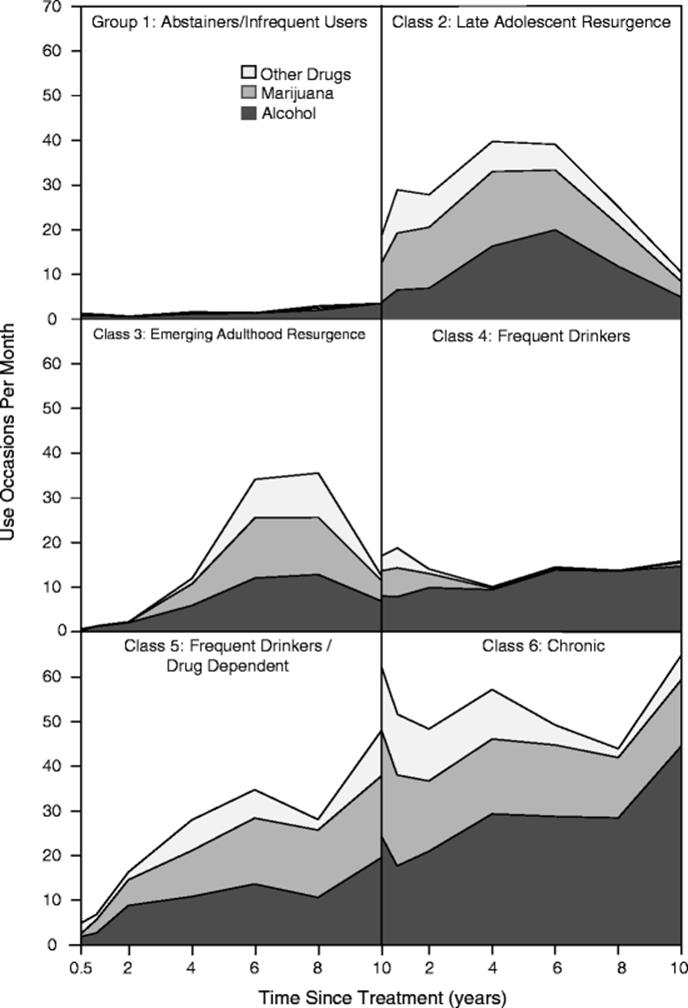
Fig. 8.1
Composite use of alcohol, marijuana, and other drugs across a decade after adolescent treatment. Units are in days per month for each type of substance (e.g., days beer + days wine + days hard liquor, eight types of drugs). Note: from Anderson et al. [13]
What Predicts Adolescent Recovery After Treatment?
A body of research has sought to identify factors associated with treatment outcomes. Factors can be thought of in four major categories: background variables, pretreatment substance use, environmental influences, and personal characteristics. Background variables focus on demographic characteristics such as age, gender, ethnicity, and socioeconomic status (SES). While studies have shown that girls are at less risk for posttreatment substance use than boys [19, 20], less consistent evidence has been found for the impact of age, ethnicity, and SES [10, 21].
Pretreatment substance use has been implicated in adult substance treatment outcomes [22, 23], but studies have shown that pretreatment substance use characteristics alone have not been predictive of relapse patterns up to 1 year following treatment in teens [20, 24, 25]. This is surprising given the diversity of substances to which youth are exposed and presumed differences in addictive potential across substances. However, one study from our laboratory has found that those youth who relapse on alcohol or marijuana progress to other substances more slowly than those who relapse on their drug of choice [26].
Environmental influences capture the interpersonal and historical factors implicated in substance use outcomes. Family environment, the extent to which youth feel supported and connected to their family of origin, can have protective influences on treatment outcomes for teens [27]. However, a body of research has shown that family history of alcoholism can convey risk for poor substance-related decision making in that children in families with alcoholics display higher levels of impulsivity than their peers [17]. While general indices of peer support suggest that poorer support exerts a detrimental impact on teen substance use [28–30], having nonusing social supports in one’s social networks is predictive of abstinence for around a year after treatment [9, 25, 31]. As teens age into young adulthood, developmental milestones such as high-school graduation, professional occupations, marriage/cohabitation, and financial responsibility for children are associated with better outcomes among those who were in treatment as adolescents [13].
Personal characteristics such as personality, motivation, learning, self-esteem, and psychiatric diagnosis and symptomatology can impact youth trajectories post-treatment. For example, factors such as disinhibition [32, 33] and alcohol expectancies [34–36] have been implicated in the initiation and maintenance of use patterns across development. In addition, externalizing disorders and internalizing disorders have been associated with poorer prognosis for SUD teens [32, 37]. Entering treatment without a concurrent mental health problem is associated with greater likelihood of abstaining 1 year after treatment [9].
Recovery Without Treatment for Adolescents
In the Unites States, the vast majority of youth with harmful or disordered substance use do not receive treatment (89–94%) [38]. Such low rates of service provision are a function of lack of access to services, lack of self-awareness regarding the need for treatment, and the perception among youth that treatment is not geared to their needs [16, 39]. Irrespective of the issues underlying limited service utilization, the fact remains that youth, similar to adults, often do not receive formal treatment for alcohol and drug-related problems, and a sizable proportion recover [40–42]. As many as 15–20% of high-school students who drink make purposeful efforts to cut down or stop drinking. Studies of binge drinking among high-school students show substantial variability in drinking over time. As many as 15% of student drinkers who binge change to abstaining or nonbinge consumption each year [43]. Epidemiological research demonstrates that far more individuals cease meeting criteria for a substance use disorder than receive treatment, and consequently, it appears that many youth do not continue on a trajectory of disordered use across their lifespan [16, 44].
One issue in evaluating recovery without treatment for youth is identifying the boundary condition necessary for the onset and discontinuance of problematic engagement with alcohol and other drugs [45]. As with treated youth, a diversity of metrics has been used to identify use patterns across time in nontreated youth, ranging from quantity/frequency (or each individually), heavy use, problems, and exceeding diagnostic thresholds. Do we identify onset as meeting diagnostic criteria for alcohol- and drug-use disorders? Work by Pollack and Martin [46] and Chung and Martin [47] would suggest that the presence of diagnostic orphans (i.e., youth who do not meet diagnosis for SUDs but are experiencing clinically significant problems) would be overly exclusionary and fail to account for use patterns that would be of clinical concern within or outside of the treatment context [42]. Similarly, how do we determine when youth have recovered? Work by our group suggests that different outcome indices (e.g., relapse status, dependence symptoms) are predicted by different factors for youth in treatment [9]. For the purposes of this review, we describe multiple patterns of change for adolescents using alcohol or other drugs at levels associated with developmentally significant problems, abuse, or dependence, as well as a reduction in use to less intense or problematic levels.
Common Patterns of Recovery in Nontreated Youth
Most studies of youth identify four to six longitudinal patterns of substance use for teens [48]. However, some have questioned whether this represents true differences within the population or is an artifact of the modeling strategies employed [49]. Studies have examined patterns of alcohol, and to a lesser extent other drug use, in community samples of youth. While the focus of this chapter is on youth with problematic engagement with alcohol and other drugs, it is important to note that the most common use pattern endorsed by youth is that of nonuse and is the most consistent pattern identified across studies [16]. While nonusers become less frequent in community samples as youth move from early adolescence to emerging adulthood [50], many youth in the community do not engage in alcohol or drug use and most do not exhibit problematic use.
The majority of studies on adolescent use patterns have focused on alcohol, given that alcohol is the most commonly used illicit substance among adolescents [50]. In a recent integrative review, Brown et al. [16] have summarized the most common trajectories of alcohol use identified in longitudinal research on adolescents, from middle adolescence (e.g., age 16) to emerging adulthood (e.g., age 20). These six patterns include: Abstainers/Light Drinkers (stable, low, or nonuse of alcohol; ~20–65%), Stable Moderate Drinkers (stable moderate use, limited heavy use; ~30%), Fling Drinkers (developmentally limited use; ~10%), Decreasers (early onset but declining course; ~10%), Chronic Heavy Drinkers (early onset and stable course of heavy drinking; <10%), and Late-Onset Heavy Drinkers (late onset but rapid escalation to heavy drinking; <10%). Fling drinkers and Decreasers are of interest when considering recovery without treatment for alcohol-use problems. Theoretically, these groups have been typified as developmentally limited drinkers or alcoholics [51, 52], characterized by heavy or potentially disordered drinking that remits as a function of young adult development.
While these patterns might typify drinking patterns within adolescence, of interest to the study of recovery patterns is the relation between adolescent alcohol-use disorders (AUDs) and remission. Jacob et al. [53] examined trajectories of AUDs from adolescence to mid-1940s among men from the Vietnam Era Twin Registry. They identified four trajectories in those meeting diagnostic criteria for AUDs: Severe Chronic Alcoholics (23%), Severe Nonchronic Alcoholics (11%), Young Adult Alcoholics (37%), and Late Onset Alcoholics (28%). The Young Adult Alcoholics were characterized by high probabilities of early diagnosis, peaking around age 21 and declining thereafter. The authors suggest that this group represents the continued recovery of adolescents with developmentally limited alcoholism. Interestingly, the Young Adult Alcoholics were least likely to seek treatment for their alcohol use.
Less data is available for the longitudinal patterns of other drug use in nonclinical samples of adolescents. Marijuana use has been examined across time for youth ranging from late childhood to emerging adulthood, in isolation and in conjunction with alcohol. Marijuana use was monitored for 10 years beginning with a large school-based sample of early adolescents (2,000+; age 13) [54]. Abstainers (45% of the sample), the most common pattern, were excluded from the trajectory analyses. Four use trajectories were identified: Early High Users (5% of the sample; monthly–weekly use at age 13, decreasing use until 18 with stable moderate use afterwards [three to ten times/year]), Stable Light Users (17%; low level of use at 13 and beyond [no more than ten times/year]), Occasional Light Users (53%; no use at age 13 and low rates of use at each time point), and Steady Increasers (25%; no use at age 13 with increasing level across time to highest use group by age 23 [monthly–weekly use]). Early High Users seemingly “burn out” on their use of marijuana in adolescence, even though this pattern is associated with continued light use into emerging adulthood.
Polysubstance use is the norm rather than the exception for youth with SUDs [44]. Authors have examined the developmental patterns of polysubstance use among youth from late childhood to emerging adolescence. Using a sample of almost 500 community teens, Flory et al. [55] modeled alcohol and marijuana trajectories separately for girls and boys. They identified three patterns of alcohol and marijuana consumption by sex, similar in shape, if not magnitude, of use: Nonusers, Early Onset, and Late Onset. Most participants were assigned to the Nonusing group, followed by the Late onset, with the lowest probability of group membership for Early onset. Women were more likely to demonstrate the Early and Nonuse patterns compared to men. As to recovery, the Early-Onset group demonstrated precocious engagement with marijuana, beginning around age 11–12, peaking around age 15–16 years, and declining at the final assessment at 19–21 years. In both sexes, there was an overlap between alcohol and marijuana use trajectories, such that early-onset use of both substances occurred together. While it is tempting to consider the Early-onset group as representing “recovery,” caution must be used as this group also demonstrated the highest level of psychopathology and poor functioning at study outset and also had high levels of alcohol abuse/dependence and arrests compared to low-use groups, suggesting that the reductions of use at the final assessment point might be better accounted for by external influences on use (e.g., treatment and/or incarceration) than actual recovery.
Conjoint developmental trajectories of alcohol and tobacco, bridging late adolescence through emerging adulthood (ages 18–26 years), suggest heavy drinking and smoking cigarettes should be considered concurrently [56]. Using a U.S. national longitudinal dataset (Monitoring the Future; MTF), six classes were used to describe use patterns over time: Chronic High Drinker/Smoker (6%), Chronic High Drinker/Low Smoker (14%), Moderate Drinker/Developmentally Limited Smoker (5%), Nondrinker/smoker (56%), Low Drinker/Chronic High Smoker (8%), Moderate Drinker/Late Onset High Smoker (5%), and Moderate Drinker/Smoker (6%). Interestingly, while patterns suggested a general decrease in heavy drinking across development, smoking remained relatively stable. Jackson and colleagues suggest that this level of developmental comorbidity between two abused substances better elucidates the co-occurrence and mutual influences in addiction than previous modeling attempts.
Chassin et al. [17] examined AOD patterns in a mixed sample of children of alcoholics (COAs) and controls. First, they modeled trajectories integrating alcohol consumption and other drug use in youth from age 11 to 30 years. Four patterns of consumption were identified across adolescence into adulthood: Light Drinking/Rare Drug Use (24%), Moderate Drinking/Experimental Drug Use (45%), Heavy Drinking/Drug Use (20%), and Abstainers (11%). The most common illicit substances used were marijuana and amphetamines. In terms of dependence diagnoses, Chassin and colleagues identified five trajectories across development: No Diagnosis (identified a priori; 61%), Alcohol Only (~19%), Drug Only (~10%), Comorbid (6%; high probability of both alcohol and drug dependence), and Persistent(~5%; mostly persistent alcohol diagnosis). Interestingly, these investigators examined the associations between use patterns and dependency and found that consumption patterns were related to dependence status. Particularly, individuals with a high probability of being within the Heavy Drinking/Heavy Drug Use group were more likely to be diagnosed, across each type of diagnosis classification. Classification as a Light Drinker/Rare Drug User was associated with the least likelihood of dependence diagnosis (abstainers were excluded from analysis). This finding suggests that the examination of use, as depicted above, has direct implications for dependence status. Youth who moderate or reduce their use across time are less likely to meet criteria for a dependence diagnosis and, therefore, more likely to meet the definition of recovery posited at the beginning of this section.
Predictors of Recovery in Nontreated Samples
While there is utility in depicting developmental patterns of substance use and dependence across time, of particular interest both scientifically and clinically is the ability to predict what factors might impact these trajectories. For example, the studies depicted above have explored the impact of a diversity of predictors such as sex [55, 57, 58], race and ethnicity [54, 56], familial factors [17, 54–56], socioeconomics [55–57], peer and parental use [55], personality [17, 55, 56], psychopathology [17, 56], and outcome expectancies [56] on the probability of being assigned to a particular trajectory group. Unfortunately, while some studies have found these factors to differentiate between alcohol and drug patterns across time in youth, the predominant focus of this work has focused on the predictors of progression to high or problematic use in adolescence. Thus, there is often little or no attention to factors associated with recovery or reductions in use. This makes the identification of factors associated with reductions in use in community samples difficult to identify within the existent literature [16].
One area of consistency within the literature is the identification of sex differences in patterns of use, some of which are associated with reductions in use across time. While some authors have used the strategy of modeling separate trajectories as a function of sex [55, 57, 58], others have examined the relative likelihood of teenaged girls or boys falling within a particular pattern of substance use and problems. For studies that have modeled separate paths of use for girls and boys, the patterns are relatively similar for each sex, but often the intensity of use is higher for boys in comparison to girls. However, in samples where differing patterns emerged for alcohol use [57, 58], trajectories for girls seemed to include a time-limited or decreasing group, while such a pattern was not identified for boys. While these two studies represent findings from different cultures (i.e., US and East Germany) and different operationalizations of drinking behavior, this suggests a need for further examination of sex or gender effects on recovery from more intensive alcohol use in adolescent samples.
A study of natural recovery from binge drinking among college students (ages 18–29 years; mean age: ~20) suggests that a minority of college students reduce or stop binge drinking from high school to college (22%) [59]. Natural reducers, those who reduced binge drinking without treatment, were more likely to be older, be married, and attend church more regularly. Additionally, subtle changes were identified in alcohol expectancies and self-efficacy such that reducers had lower enhancement expectancies and greater self-efficacy to resist pressure to drink. While this study did not examine trajectories of use per se, it suggests that research into recovery without treatment for adolescents has the potential to identify modifiable, external contingencies related to reductions in use.
Conclusions and Directions for the Development of Recovery Models
The present chapter summarizes many of the current findings regarding long-term course of alcohol and drug involvement in youth. We have particularly focused on adolescence through young adulthood and made distinctions between patterns that emerge for youth in the general population and longitudinal trajectories that unfold for those teens whose alcohol or drug problems are severe enough for them to be placed in formal treatment.
It is clear that diversity in alcohol and other drug-use patterns is the norm for adolescents, regardless of the sample source. While the vast majority of youth who use illegal substances use only alcohol, and the majority never meet criteria for an alcohol or drug-use disorder, there is much diversity in use, which emerges over time among those who initiate alcohol and other drug involvement while they are still underage. There are substance involvement patterns in both community and clinical samples that appear time-limited whereas other trajectories bode poorly for the long-term involvement and development of the teen. Many of the predictors commonly considered to have prognostic value for the onset or progression of alcohol or drug involvement appear to have little utility for prediction of short-term or long-term resolution of alcohol or drug involvement. It is clear, however, that the continued heavy use of alcohol and other drugs is associated with poorer life functioning across many domains critical to development and to successful accomplishment of adult roles. Long-term recovery appears to be a more difficult outcome to predict using our current models of substance involvement. Clearly, research is needed that focuses on the key elements associated with transitions out of substance involvement and the factors that are associated with long-term recovery rather than short-term abstinence. Personal characteristics may be helpful in this process but only as they directly relate to the environmental or developmental challenges faced by youth as they progress into new stages of responsibility and take on new roles necessitated by progression into young adulthood.
Unlike the majority of adults with alcohol- or drug-use disorders who historically have entered treatment, adolescents in treatment are commonly using many substances when they enter treatment. While alcohol alone is often the precipitant of treatment for adults, youth entering treatment have typically had a history of heavy alcohol use but have progressed to concomitant use of other substances. Consequently, the long-term outcomes and trajectories of teens in treatment can only be understood after fully considering all the substances used. One cannot assume that by knowing the use of a treatment participant’s drug of choice, similar use (or abstinence) can be presumed for other drugs including alcohol. Research suggests marked variability in both nicotine and alcohol use relative to other substances, and important developmental outcomes may vary as a function of this concomitant use. Similarly, some youth with a history of polysubstance abuse may resolve into heavy use of alcohol with no concomitant use of other drugs. This clinically important information could not have been gleaned without the use of newer statistical procedures that afford the opportunity to consider the complicated longitudinal patterns of substance involvement as teens transition into adulthood.
Given the important differences in the developmental demands and expectations for girls and boys across adolescence, it is not surprising that gender differences emerge in the trajectories of use for teens in the general population as well as those who receive alcohol and drug treatment. In general, in community samples of youth, similar patterns may emerge across genders; however, boys tend to use in a more severe fashion than girls, and girls show more resolution. Several long-term studies suggest that recovery is more likely for female treatment participants than male adolescents. Of course, this is not the case when other psychopathologies are present which tends to dampen the recovery rates for both genders in both the short and long term. These research findings suggest the need for gender-focused research, which might clarify the predictors or maintaining factors operative for females, but not for males. Additionally, certain treatment strategies or processes may be more important to the recovery process of females than males. Other foci and strategies may need to be developed to optimize the recoveries of males in this age range. For example, while researchers and clinicians would agree that supports for sobriety are critical for all those in treatment, certain supports may be more critical in facing specific developmental challenges of males relative to females (e.g., employment), whereas other developmental tasks may have a stronger protective role in terms of recovery (e.g., pregnancy and childbirth for females). Such gender-specific developmentally relevant research could substantially aid in the development of more fruitful models of youth recovery.
The long-term trajectories of youth in the community and youth in treatment hold tremendous potential for building and informing models of youth recovery from alcohol- and other drug-use disorders. Community sample patterns can not only assist in defining norms and prevalence of common trajectories but also help identify the timing and context of transitions into and out of problematic substance involvement. These trajectories can guide researchers and clinicians to the major inflexion points in substance involvement. Investigation of these typical change points can help us ascertain the personal, developmental, and environmental factors involved in accelerations in use or transitions in patterns, as well as recovery timing and context. Similarly, trajectory-focused investigations of youth in treatment may not only teach us the developmental timing and context of risk but also provide the focus for recovery-oriented investigations and potential new interventions. For example, our longitudinal research found that late adolescence (around age 18) was a period of particular acceleration in use for those who had been treated but were currently abstaining [13]. By investigating the environmental changes that occurred during this period, it became clear that moving out of the family of origin changes many contingencies related to abstinence (e.g., exposure to alcohol/drugs, access and availability of substances, social supports for abstinence, consequences of use, etc.) [18]. Thus, this developmental task can become a focus for targeted intervention efforts to support recovery for youth facing this risk as they transition into adulthood. Similarly, other investigators have identified high-risk social interactions linked to developmental transitions (e.g., 21st birthday celebrations) that may trigger accelerations in use or the onset of a diagnostically significant event (e.g., blackouts, withdrawal, etc.) [13]. Trajectory research can assist in identifying these developmental events, challenges, and opportunities to build recovery rather than diminish success. Additionally, identifying points of desistance or precipitants of new abstention efforts can aid in the identification of motivations and resources youth draw upon in their successful efforts to recover.
Just as we have highlighted the diversity in trajectories of substance involvement of youth as they transition into adulthood, there are multiple trajectories of recovery. Not all youth will recover at the same rate or in the same way. Even early abstinence is attained in different ways by different youth. What a trajectory approach provides is an empirical foundation to begin to understand the personal, environmental, and developmental factors that constitute pathways to success, which are fundamental to a Recovery Management Approach to addiction treatment.
Key Points
· The long-term trajectories of youth in the community and youth in treatment hold tremendous potential for building and informing models of addiction recovery management.
· Diversity in alcohol- and other drug-use patterns is the norm for adolescents.
· There are substance involvement patterns in both community and clinical samples that appear time-limited, whereas other trajectories bode poorly for the long-term involvement and development of teens.
· Continued heavy use of alcohol and other drugs is associated with poorer life functioning across many domains critical to development and successful accomplishment of adult roles.
· Adolescents in treatment are commonly using many substances when they enter treatment; consequently, the long-term outcomes and trajectories of teens in treatment can only be understood after fully considering all thesubstances used.
· Gender differences emerge in the trajectories of use for teens in the general population as well as for those receiving alcohol and drug treatment.
References
1.
Brown SA, Mott MA, Myers MG. Adolescent alcohol and drug treatment outcome. In: Watson RR, editor. Drug and alcohol abuse prevention. Clifton, NJ: Humana Press; 1990. p. 373–403.CrossRef
2.
Brown SA, D’Amico EJ, McCarthy DM, Tapert SF. Four-year outcomes from adolescent alcohol and drug treatment. J Stud Alcohol. 2001;96:381–8.
3.
Cornelius JR, Maisto SA, Pollock NK, et al. Rapid relapse generally follows treatment for substance use disorders among adolescents. Addict Behav. 2001;27:1–6.
4.
Chung T, Maisto SA, Cornelius JR, Martin CS. Adolescents’ alcohol and drug use trajectories in the year following treatment. J Stud Alcohol. 2004;65:105–14.PubMed
5.
Chung T, Maisto SA, Cornelius JR, Martin CS, Jackson KM. Joint trajectory analysis of treated adolescents’ alcohol use and symptoms over 1 year. Addict Behav. 2005;30:1690–701.PubMedCrossRef
6.
Godley SH, Dennis ML, Godley MD, Funk RR. Thirty-month relapse trajectory cluster groups among adolescents discharged from out-patient treatment. Addiction. 2004;99 Suppl 2:129–39.PubMedCrossRef
7.
Chung T, Martin C, Grella CE, Winters KC, Abrantes AM, Brown SA. Course of alcohol problems in treated adolescents. Alcohol Clin Exp Res. 2003;27:253–61.PubMedCrossRef
8.
Abrantes A, McCarthy DM, Aarons G, Brown SA. Long-term trajectories of alcohol involvement following addictions treatment in adolescence. Symposium presented at the Research Society on Alcoholism. San Francisco, CA; June 2002.
9.
Anderson KG, Ramo DE, Schulte MT, Cummins K, Brown SA. Substance use treatment outcomes for youth: integrating personal and environmental predictors. Drug Alcohol Depend. 2007;88(1):42–8.PubMedCrossRef
10.
Brown SA, Myers MG, Mott MA, Vik PW. Correlates of success following treatment for adolescent substance abuse. Appl Prev Psychol. 1994;3:61–73.CrossRef
11.
Winters KC, Stinchfield R, Latimer W, Lee S. Long-term outcome of substance-dependent youth following 12-step treatment. J Subst Abuse Treat. 2007;33:61–9.PubMedCrossRef
12.
Substance Abuse and Mental Health Services Administration, Office of Applied Studies. Treatment Episode Data Set (TEDS): 1995–2005. National Admissions to Substance Abuse Treatment Services, DASIS Series: S-37. Rockville, MD: Substance Abuse and Mental Health Services Administration, Office of Applied Studies; 2007.
13.
Anderson KG, Ramo DE, Cummins K, Brown SA. Alcohol and drug involvement after adolescent treatment and functioning during emerging adulthood. Drug Alcohol Depend. 2010;107(2–3):171–81.PubMedCrossRef
14.
Clark DB, Jones BL, Wood DS, Cornelius JR. Substance use disorder trajectory classes: diachronic integration of onset age, severity, and course. Addict Behav. 2006;31:995–1009.PubMedCrossRef
15.
Aseltine Jr RH, Gore S. Work, postsecondary education, and psychosocial functioning following the transition from high school. J Adolesc Res. 2005;20(6):615–39.CrossRef
16.
Brown SA, McGue MK, Maggs J, et al. A developmental perspective on alcohol and youth ages 16–20. Pediatrics. 2008;121:S290–310.PubMedCrossRef
17.
Chassin L, Flora DB, King KM. Trajectories of alcohol and drug use and dependence from adolescence to adulthood: the effects of familial alcoholism and personality. J Abnorm Psychol. 2004;113:483–98.PubMedCrossRef
18.
Kypri K, McCarthy DM, Coe MT, Brown SA. Transition to independent living and substance involvement of treated and high risk youth. J Child Adolesc Subst Abuse. 2004;13(3):85–100.CrossRef
19.
Catalano RF, Hawkins JD, Wells EA, Miller J, Brewer D. Evaluation of the effectiveness of adolescent drug and alcohol abuse treatment, assessment of risks for relapse, and promising approaches for relapse prevention. Int J Addict. 1991;25:1085–140.
20.
Latimer WW, Newcomb M, Winters KC, Stinchfield RD. Adolescent substance abuse treatment outcome: the role of substance abuse problem severity, psychosocial, and treatment factors. J Consult Clin Psychol. 2000;68:684–96.PubMedCrossRef
21.
Jainchill N, DeLeon G, Yagelka J. Ethnic differences in psychiatric disorders among adolescent substance abusers in treatment. J Psychopathol Behav Assess. 1997;18:133–48.CrossRef
22.
Schuckit MA, Smith TL, Daeppen J-B, et al. Clinical relevance of the distinction between alcohol dependence with and without a physiological component. Am J Psychiatry. 1998;155:733–40.PubMed
23.
Scott CK, Foss MA, Dennis ML. Factors influencing initial and longer-term responses to substance abuse treatment: a path analysis. Eval Program Plann. 2003;26:287–95.CrossRef
24.
Brown SA, Vik PW, Creamer VA. Characteristics of relapse following adolescent substance abuse treatment. Addict Behav. 1989;14:291–300.PubMedCrossRef
25.
Richter SS, Brown SA, Mott MA. The impact of social support and self-esteem on adolescent substance abuse treatment outcome. J Subst Abuse. 1991;3:371–85.PubMedCrossRef
26.
Brown SA, Tapert SF, Tate SR, Abrantes AM. The role of alcohol in adolescent relapse and outcome. J Psychoactive Drugs. 2000;32:107–15.PubMedCrossRef
27.
Friedman AS, Terras A, Kreisher C. Family and client characteristics as predictors of outpatient treatment outcome for adolescent drug abusers. J Subst Abuse. 1995;7:345–56.PubMedCrossRef
28.
Latimer WW, Winters KC, Stinchfield R, Travers RE. Demographic, individual, and interpersonal predictors of adolescent alcohol and marijuana use following treatment. Psychol Addict Behav. 2000;14:162–73.PubMedCrossRef
29.
Piko B. Perceived social support from parents and peers: which is the stronger predictor of adolescent substance abuse? Subst Use Misuse. 2000;35:617–30.PubMedCrossRef
30.
Ashby Wills T, Resko JA, Ainette MG, Mendoza D. Role of parent support and peer support in adolescent substance use: a test of mediated effects. Psychol Addict Behav. 2004;18:122–34.CrossRef
31.
McCrady BS. To have but one true friend: implications for practice of research on alcohol use disorders and social network. Psychol Addict Behav. 2004;18:113–21.PubMedCrossRef
32.
Brown SA, Gleghorn A, Schuckit MA, Myers MG, Mott MA. Conduct disorder among adolescent alcohol and drug abusers. J Stud Alcohol. 1996;57:314–24.PubMed
33.
Caspi A, Moffitt TE, Newman DL, Silva PA. Behavioral observations at age 3 years predict adult psychiatric disorders: longitudinal evidence from a birth cohort. Arch Gen Psychiatry. 1996;53:1033–9.PubMedCrossRef
34.
Christiansen BA, Goldman MS. Alcohol-related expectancies versus demographic/background variables in the prediction of adolescent drinking. J Consult Clin Psychol. 1983;51:249–57.PubMedCrossRef
35.
Stacy AW, Newcomb MD, Bentler PM. Cognitive motivation and drug use: a 9-year longitudinal study. J Abnorm Psychol. 1991;100:502–15.PubMedCrossRef
36.
Smith GT, Goldman MS, Greenbaum PE, Christiansen BA. Expectancy for social facilitation from drinking: the divergent paths of high-expectancy and low-expectancy adolescents. J Abnorm Psychol. 1995;104:32–40.PubMedCrossRef
37.
Tomlinson KL, Brown SA, Abrantes A. Psychiatric comorbidity and substance use treatment outcomes of adolescents. Psychol Addict Behav. 2004;18:160–9.PubMedCrossRef
38.
Substance Abuse and Mental Health Services Administration. The trends in substance use, dependence or abuse, and treatment among adolescents: 2002–7. Washington, DC: US Department of Health and Human Services Office of Applied Studies; 2008.
39.
D’Amico EJ, McCarthy DM, Metrik J, Brown SA. Alcohol-related services: prevention, secondary intervention, and treatment preferences of adolescents. J Child Adolesc Subst Abuse. 2004;14(2):61–80.CrossRef
40.
Blomqvist J. Self-change from alcohol and drug abuse: often-cited classics. In: Klingman H, Sobell LC, editors. Promoting self-change from addictive behaviors: practical implications for policy, prevention, and treatment. New York, NY: Springer; 2007.
41.
Blomqvist J. Self-change from alcohol and drug abuse: often-cited classics. In: Klingman H, Sobell LC, editors. Promoting self-change from addictive behaviors: practical implications for policy, prevention, and treatment. New York, NY: Springer; 2006.
42.
Clark DB. The natural history of adolescent alcohol use disorders. Addiction. 2004;99 Suppl 2:5–22.PubMedCrossRef
43.
D’Amico EJ, Metrik J, McCarthy DM, Frissell KC, Applebaum M, Brown SA. Progression into and out of binge drinking among high school students. Psychol Addict Behav. 2001;15(4):341–9.PubMedCrossRef
44.
Brown SA. Facilitating change for adolescent alcohol problems: a multiple options approach. In: Wagner EF, Waldron HB, editors. Innovations in adolescent substance abuse interventions. Amsterdam: Pergamon/Elsevier; 2001. p. 167–85.
45.
Smart RG. Natural recovery or recovery without treatment from alcohol and drug problems as seen from survey data. In: Klingman H, Sobell LC, editors. Promoting self-change from addictive behaviors: practical implications for policy, prevention, and treatment. New York, NY: Springer; 2007. p. 59–71.CrossRef
46.
Pollock NK, Martin CS. Diagnostic orphans: adolescents with alcohol symptoms who do not qualify for DSM-IV abuse or dependence diagnoses. Am J Psychiatry. 1999;156:897–901.PubMed
47.
Chung T, Martin CS. Classification and course of alcohol problems among adolescents in addictions treatment programs. Alcohol Clin Exp Res. 2001;25(12):61–9.CrossRef
48.
Wiesner M, Weichold K, Silbereisen RK. Trajectories of alcohol use among adolescent boys and girls: identification, validation, and sociodemographic characteristics. Psychol Addict Behav. 2007;21:62–75.PubMedCrossRef
49.
King KM. Patterns of alcohol use across adolescence: are there really four types of teenagers. Symposium Presented at the Research Society on Alcoholism Annual Meeting. San Diego, CA; June 2009.
50.
Johnston LD, O’Malley PM, Bachman JG, Schulenberg JE. Monitoring the future: national results on adolescent drug use: overview of key findings, 2007. Bethesda, MD: National Institute on Drug Abuse; 2007. p. 1–70.
51.
Schulenberg JE, Maggs JL. A developmental perspective on alcohol use and heavy drinking during adolescence and the transition to young adulthood. J Stud Alcohol. 2002;14(Suppl):54–70.
52.
Zucker RA, Chermack ST, Curran GM. Alcoholism: a life span perspective on etiology and course. In: Sameroff AJ, Lewis M, Miller SM, editors. Handbook of developmental psychopathology. 2nd ed. New York, NY: Kluwer Academic/Plenum; 2000. p. 569–87.CrossRef
53.
Jacob T, Bucholz KK, Sartor CE, Howell DN, Wood PK. Drinking trajectories from adolescence to the mid-forties among alcohol dependent males. J Stud Alcohol. 2005;66:745–55.PubMed
54.
Ellickson PL, Martino SC, Collins RL. Marijuana use from adolescence to young adulthood: multiple developmental trajectories and their associated outcomes. Health Psychol. 2004;23:299–307.PubMedCrossRef
55.
Flory K, Lynam D, Milich R, Leukefeld C, Clayton R. Early adolescent through young adult alcohol and marijuana use trajectories: early predictors, young adult outcomes, and predictive utility. Dev Psychopathol. 2004;16:193–213.PubMedCrossRef
56.
Jackson KM, Sher KJ, Schulenberg JE. Conjoint developmental trajectories of young adult alcohol and tobacco use. J Abnorm Psychol. 2005;114(4):612–26.PubMedCrossRef
57.
Weisner M, Weichold K, Silbereisen RK. Trajectories of alcohol use among adolescent boys and girls: identification, validation, and sociodemographic characteristics. Psychol Addict Behav. 2007;21(1):62–75.CrossRef
58.
Windle M, Mun EY, Windle RC. Adolescent-to-young adulthood heavy drinking trajectories and their prospective predictors. J Stud Alcohol. 2005;66:313–22.PubMed
59.
Vik PW, Celluci T, Ivers H. Natural reduction in binge drinking for college students. Addict Behav. 2003;28:643–55.PubMedCrossRef