
Rodrick Wallace1
(1)
New York State Psychiatric Institute, New York, NY, USA
Summary
Institutions, commercial enterprises, communities, political entities, and the social milieus in which they are enmeshed must engage in cognitive process to address day-to-day contingencies and incorporate the learning needed to successfully adapt to larger evolutionary selection pressures. Failure of cognition, we show using control and information theory models, will be driven by environmental challenges that can force such systems into persistent ground states where cognitive process becomes pathologically fixated. The consequent path-dependent developmental path then remains pathological in the absence of sufficiently sustained external correction pressures. Under combat conditions this might translate into “all possible targets are enemies.” Among human tribal groups, “only we are real people,” and so on. These powerful dynamics preclude the engineering resilience approach of current US security doctrine: While it may be possible to ensure return to normal function for relatively simple power and communications networks under moderate perturbation, extension of the idea to socioeconomic entities is a ludicrous fantasy. Ecosystem and evolutionary perspectives that recognize the possibility of path-dependence and long-term eutrophication, in various forms, are more relevant, and may lead to realistic and sustainable policy objectives.
11.1 Introduction
The term “resilience” [as used in US security doctrine] refers to the ability to adapt to changing conditions and withstand and rapidly recover from disruption due to emergencies…The United States officially recognized resilience in national doctrine in the 2010 National Security Strategy, which states that we must enhance our resilience – the ability to adapt to changing conditions and prepare for, withstand, and rapidly recover from disruption. (US Dept. of Homeland Security 2016).
Translated into military terms Bergson’s “elan vital” [the all-conquering will] became the doctrine of the offensive. In proportion as a defensive strategy gave way to an offensive strategy, the attention paid to the Belgian frontier gradually gave way in favor of a progressive shift of gravity eastward toward the point where a French offensive could be launched to break through to the Rhine.(Tuchman, The Guns of August, 1962).
Western cultural atomism, it has been argued (Wallace 2015a,b Chap. 1, and the references therein), limits, and indeed badly deforms, theory in economics, evolution, and human psychology. An example of ideological deformation in “resilience” research is the work of Gao et al. (2016) published by the prestigious journal Nature—and supported by the Army Research Laboratories and the Defense Threat Reduction Agency—that seeks “universal resilience patterns in complex networks.” Gao et al. (2016) claim
[Our] analytical results unveil the network characteristics that can enhance or diminish resilience, offering ways to prevent the collapse of ecological, biological or economic systems, and guiding the design of technological systems resilient to both internal failures and environmental changes.
This is a predetermined result clearly driven by the doctrine quoted above. Military-funded research is centrally tasked with implementing doctrine, here constrained to deliver a simplistic engineering resilience involving the ability to bounce back to near normal function after significant perturbation. US security doctrine thus inhibits exploration more complex—and far more likely—scenarios that do not have politically palatable outcomes.
This is indeed reminiscent of “elan vital” , a doctrine that involved, in addition to command blindness regarding German incursion through Belgium, such tactics as mass charges into concentrations of machine guns entrenched behind barbed wire. Today, US security doctrine calls for “Resilience.” A 100 years has not been enough time for Western military practitioners to appreciate the deadly burdens of tactical and strategic fantasy. The recent US occupation of Iraq also comes to mind.
Apparently this is all of a piece.
We know that enterprises and institutions—cognitive entities that can learn from experience and incorporate that learning into corporate culture—are subject to evolutionary selection pressures strongly enforcing path dependence (Hodgso and Knudsen 2010; Wallace 2015a, and the references therein). “Buggy whip” industries become extinct in the face of significant market shifts if they do not adapt rapidly enough.
Evolutionary dynamics profoundly challenge the engineering resilience requirements of US defense and homeland security doctrine for enterprises, institutions, and socioeconomic systems. Intractable difficulties emerge from the powerful cognitive processes that must incorporate learning into corporate culture for successful adaptation, while crafting responses under shifting day-to-day market demands. Most particularly, facing environmental pressures, in a large sense, cognitive entities for which information about the real world is an essential control signal can be rapidly driven into a pathological ground state of policy paralysis and fixation that may ensure their ultimate demise. We will provide models of this taken from control and information theories.
In sum, the cognitive dynamics essential to short-term institutional function and long-term adaptation are synergistic with path-dependent evolutionary process in precluding doctrine and policy based on ideas of ensuring simple bounce back to normal following serious disturbance.
11.2 A Control Theory Model
Civilian aircraft can, often for considerable periods, remain in stable flight as long as their center of pressure is well behind their center of gravity: Perturbations of trajectory quickly diminish. By contrast, cognitive systems like human institutions usually operate on rapidly shifting topological roadways of complicated “real time” multimodal demand. These are highly turbulent topologies, and, to function successfully, cognitive systems embedded in them must receive constant flows of sufficiently detailed descriptive information. One analog is that of driving at high speed on a twisting, pot-holed road at night, a feat demanding not only a reliable vehicle and fast reflexes, but also excellent headlights. See Chap. 8
We thus argue that a cognitive process operating under such constraints is inherently unstable in the sense of control theory’s Data Rate Theorem, viewing incoming information about the rapidly shifting topology of demand as the control signal. This fact has profound implications, particularly for path-dependent phenomena.
The canonical first model uses a linear expansion around a nonequilibrium steady state for which the rate of control information is sufficient for stability.
Paraphrasing Nair et al. (2007), the Data Rate Theorem (DRT) contends that there is a minimum rate at which control information must be provided for an inherently unstable system to remain stable. Making a linear expansion near a nonequilibrium steady state, an n-dimensional vector of system parameters at time t, xt , determines the state at time t + 1 according to Fig. 11.1, with

(11.1)
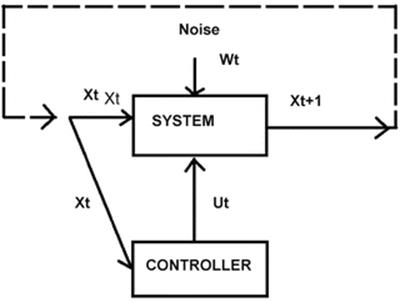
Fig. 11.1
A linear expansion near a nonequilibrium steady state for an inherently unstable control system. A and B are square matrices, xt the vector of system parameters at time t, ut the vector of control signals at time t, Wt a white noise vector, and xt+1 = A xt +B ut + Wt . The Data Rate Theorem states that the minimum rate at which control information must be provided for system stability is ![$$\mathcal{H}>\log [\vert \det [\mathbf{A}^{m}\vert ]$$](computational-psychiatry.files/image382.png) , where Am is the subcomponent of A having eigenvalues ≥ 1
, where Am is the subcomponent of A having eigenvalues ≥ 1
A, B are fixed n × n matrices, ut is the vector of control information, and Wt is an n-dimensional vector of white noise. The DRT under such a condition states that the minimum control information rate for stability,  , satisfies the inequality
![$$\displaystyle{ \mathcal{H} > \log[|\det(\mathbf{A}^{m})|]\equiv a_{0}}$$](computational-psychiatry.files/image329.png)
(11.2)
where, for m ≤ n, Am is the subcomponent of A having eigenvalues ≥ 1. The right-hand side of Eq. (11.2) defines the rate at which the system generates topological information. A more general version of this result is derived in the Mathematical Appendix using a Rate Distortion Theorem approach.
Defining a parameter ρ as a scalar representing the magnitude of some index of multimodal system demand that will be explored further below, we can extend Eq. (11.2) as

(11.3)
where a0 is an inherent system parameter and f(ρ) is a positive, monotonically increasing function of environmental stress. The Mathematical Appendix uses a Black–Scholes model to approximate the “cost” of as a function of the “investment” ρ. The first approximation is linear, so that  .
.
Expanding f(ρ) to similar order, i.e.,

(11.4)
defines the limit condition for stability as

(11.5)
For ρ = 0, the stability requirement is that κ 2∕κ 4 > a0. At large ρ the condition becomes κ 1∕κ 2 > a0. If κ 2∕κ 4 ≫ κ 1∕κ 2 < a0, the stability condition may be breached at high demand densities, and the system becomes instable. See Fig. 11.2.
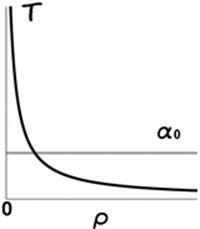
Fig. 11.2
The horizontal line represents the critical limit a0. If a0 < κ 2∕κ 4 ≫ κ 1∕κ 3 < a0, at some intermediate value of demand ρ, the temperature analog  falls below that limit, the system becomes “supercooled,” and failure becomes increasingly probable
For a cognitive system embedded in a rapidly shifting and complicated demand stream “highway,” there may be several different ρ-values that are not independent but interact and influence each other. Generally there will not be a simple scalar index of demand, but an unsymmetric n × n matrix  having elements ρ i, j, i, j = 1… n.
Can we still find a scalar “ρ” under such complex circumstances so that Fig. 11.2 applies? An n × n matrix has n invariants ri , i = 1… n that remain fixed when a certain class of “principal component analysis” transformations is applied. The invariants are found via the characteristic equation of the matrix

(11.6)
det is the determinant, λ is a parameter that is an element of a ring, and In the n × n identity matrix. The invariants are the coefficients of λ in the polynomial  , normalized so that the coefficient of λ n is 1.
The ri , we claim, can be used to construct an invariant scalar measure, subject to the approximation inherent in projecting an n × n matrix onto one dimension.
Since n × n matrices themselves form a ring,

(11.7)
and a matrix satisfies its own characteristic equation.
An n × n matrix will thus have n such invariants from which a new scalar index Γ = g(r1, …, rn ) can be constructed to replace ρ in Eq. (11.5). The first invariant will be the trace and the last ± the determinant of .
We reiterate that reduction of the complicated interaction matrix to the scalar Γ is an ambiguous matter, at best an approximation that must be dynamically fitted to each fog-of-war ecosystem. There is, as a consequence, no one-size-fits-all simplification methodology, although there may be equivalence classes of different systems that can be mapped onto a particular method.
This development is another example of the “Rate Distortion Manifold” (RDM) of Glazebrook and Wallace (2009), or the equivalent “Generalized Retina” of Wallace and Wallace (2013, Sect. 10.1) in which high dimensional data flows can be projected down onto lower dimensional, shifting and tunable “tangent spaces” with minimal loss of essential information.
The RDM approach is in contrast to the treatment of engineering resilience—return to a single stable mode after perturbation—by Gao et al. (2016) who condense network topologies by defining an “effective state” of a multidimensional network system using the average nearest-neighbor activity. They thus collapse a multidimensional dynamic equation into one-dimensional form. By contrast, here the DRT provides an inherently one-dimensional format whose complexities reside in the matrix , leading to an understanding of complex ecological resilience in the sense of Holling (1973), that is, the existence of a number of quasi-stable modes, with the possibility of transitions between them driven by changes in context indexed by an appropriately chosen “temperature” analog  , defined now in terms of the complicated “retina” index Γ rather than ρ.
will, we can show, undergo dynamics strongly affected by embedding stochastic circumstances.
How is a control signal ut in Fig. 11.1 expressed in the system response xt+1? In standard Rate Distortion Theorem manner (Cover and Thomas 2006), we deterministically retranslate an observed sequence of system outputs Xi = x1 i , x2 i , … into a sequence of possible control signals  and to compare that sequence with the original control sequence U i = u0 i , u1 i , …, with the difference between them having a particular value under some chosen distortion measure and hence having an average distortion

(11.8)
p(U i ) is the probability of the sequence Ui .  is the distortion between Ui and the sequence of control signals that has been deterministically reconstructed from system output.
It is then possible to apply a Rate Distortion argument. The Rate Distortion Theorem asserts that there is a Rate Distortion Function that determines the minimum channel capacity—R(D)—necessary to keep the average distortion below some fixed limit D. Again, see Cover and Thomas (2006) for details. Taking Feynman’s (2000) interpretation of information as a form of free energy, it is possible to construct a Boltzmann-like pseudoprobability in the temperature analog :
![$$\displaystyle{ dP(R,\mathcal{T} ) = \frac{\exp [-R/\mathcal{T} ]dR} {\int _{0}^{\infty }\exp [-R/\mathcal{T} ]dR} }$$](computational-psychiatry.files/image244.png)
(11.9)
since higher must necessarily be associated with greater channel capacity.
The integral of the denominator is interpreted as a statistical mechanical partition function, allowing definition of a “second order” free energy Morse Function F (Pettini 2007):
![$$\displaystyle{ \exp [-F/\mathcal{T} ] =\int _{ 0}^{\infty }\exp [-R/\mathcal{T} ]dR = \mathcal{T} }$$](computational-psychiatry.files/image391.png)
(11.10)
This gives ![$$F(\mathcal{T} ) = -\mathcal{T}\log [\mathcal{T} ]$$](computational-psychiatry.files/image246.png) .
.
Similarly, a “second order” entropy-analog can also be defined:

(11.11)
An analog to the Onsager treatment of nonequilibrium thermodynamics (de Groot and Mazur 1984) can now be used, using the gradient of  in as the driving factor, and a stochastic version of the standard Onsager equation emerges:

(11.12)
μ is an analog to a diffusion coefficient and β is the magnitude of the impinging white noise dWt .
By a now-familiar argument, applying the Ito chain rule to  in Eq. (11.12) (Protter 1990), using Jensen's inequality for a concave function gives the nonequilibrium steady state expectation of as

(11.13)
μ parameterizes the efforts of the control apparatus to maintain stability. Thus, according to this approximation, rising system noise—β—can significantly increase the probability that falls below the critical limit, triggering a failure of control.
It is critical to note that, since  is an expectation, according to the model, there will always be some probability that will fall below the critical value a0 in the multimodal expression

(11.14)
Raising μ and limiting β decreases that probability, but does not eliminate it. Instability remains possible at every level of μ.
β itself can, of course, have further structure, leading to more complicated dynamics.
11.3 A Cognitive Model
The DRT argument above indicates a significantly raised probability of a transition between stable and unstable behavior if the temperature analog from Eq. (11.14) falls below a critical value. It is possible to extend the argument, involving more complicated patterns of phase transition, using the cognitive approach of Atlan and Cohen (1998). They define a system as cognitive if it compares incoming signals with a learned or inherited picture of the world, and then actively chooses a response from a larger set of what is possible to it. Choice implies the existence of—and indeed virtually defines—an information source, since it reduces uncertainty in a formal way (Wallace 2012, 2015a,b).
Assuming such a “dual” information source is associated with the inherently unstable cognitive system under study, an equivalence class algebra can be constructed by choosing different system origin states and defining the equivalence of subsequent states at a later time by the existence of a high probability path connecting them to the same origin state. Disjoint partition by equivalence class is analogous to orbit equivalence classes in dynamical systems. This inherently defines a symmetry groupoid associated with the cognitive process (Wallace 2012). Groupoids are generalizations of group symmetries in which there is not necessarily a product defined for each possible element pair (Weinstein 1996). The canonical simple example is the disjoint union of different groups.
The equivalence classes across possible origin states then define a set of information sources dual to different cognitive states available to the inherently unstable cognitive system. These instantiate a very large groupoid, with each orbit corresponding to a transitive groupoid whose disjoint union is the full groupoid. Each subgroupoid is associated with a dual information source, and larger groupoids will have richer dual information sources than smaller.
Take  as the dual information source associated with some groupoid element Gi . Assuming Eqs. (11.5)–(11.7), it becomes possible to construct another Morse Function (Pettini 2007), again using Eq. (11.14) to define the “temperature” .
Let  be the Shannon uncertainty of the information source associated with the groupoid element G i . Define a Boltzmann-like pseudoprobability:
![$$\displaystyle{ P[H_{G_{i}}] \equiv \frac{\exp [-H_{G_{i}}/\mathcal{T} ]} {\sum _{j}\exp [-H_{G_{j}}/\mathcal{T} ]} }$$](computational-psychiatry.files/image395.png)
(11.15)
The sum is now over the different possible cognitive modes of the full system.
A “free energy” Morse Function  can again be defined:
![$$\displaystyle\begin{array}{rcl} \exp [-\mathcal{F}/\mathcal{T} ]& \equiv & \sum _{j}\exp [-H_{G_{j}}/\mathcal{T} ] \\ \mathcal{F}& =& -\mathcal{T}\log \Big[\sum _{j}\exp [-H_{G_{j}}/\mathcal{T} ]\Big]{}\end{array}$$](computational-psychiatry.files/image417.png)
(11.16)
Using the underlying groupoid generalized symmetries, it is possible to invoke an obvious extension of Landau’s version of phase transition (Pettini 2007). Landau argued that spontaneous symmetry breaking of a group structure represents phase change in physical systems, with higher energies available at higher temperatures being more symmetric. The shift between symmetries is then punctuated in the temperature index, here the constructed in terms of the scalar index Γ = g(r1, …, rn ). This is now in the context of groupoid rather than group symmetries. Typically, for physical systems, there are only a few phases possible, with sharply punctuated transitions between them as decreases.
Sufficient conditions for the pathological stability of the hypercondensed “ground state” cognitive phase in which “all possible targets are enemies,” or some analog, can be explored using the approach of Wallace (2016).
Assuming a vector of parameters J measuring deviations from a pathological nonequilibrium steady state, the “free energy” analog  in Eq. (11.16) can be used to define a new “entropy” scalar as the Legendre transform

(11.17)
Again, a first order dynamic equation follows using the stochastic version of the Onsager formalism from nonequilibrium thermodynamics (de Groot and Mazur 1984)

(11.18)
μ i, kdefines a diffusion matrix, the σ i are parameters, and dBt represents a noise that may not the usual Brownian motion under undifferentiated white noise.
If it is possible to factor out Ji , then Eq. (11.18) can be represented as:

(11.19)
Here, Yt i may be a complicated stochastic process.
Equation (11.20) can now be solved in expectation using the Doleans-Dade exponential (Protter 1990):
![$$\displaystyle{ E(J_{t}^{i}) \propto \exp (Y _{ t}^{i} - 1/2[Y _{ t}^{i},Y _{ t}^{i}]) }$$](computational-psychiatry.files/image419.png)
(11.20)
where [Yt i , Yt i ] is the quadratic variation of the stochastic process Yt i (Protter 1990). Using the Mean Value Theorem, if
![$$\displaystyle{ 1/2d[Y _{t}^{i},Y _{ t}^{i}]/dt> dY _{ t}^{i}/dt }$$](computational-psychiatry.files/image263.png)
(11.21)
then the pathological ground state is stable. That is, deviations from nonequilibrium steady state measured by Jt i then converge in expectation to 0. Thus sufficient ongoing fog-of-war noise or other environmental stress which determines the quadratic variation terms can lock-in the failure of “target discrimination,” in a large sense. There will be no return to the “normal” state under such circumstances: the “engineering resilience” of Gao et al. (2016), and of current US security doctrine, fails.
As described above, similar dynamics arise in ecosystem resilience theory (Holling 1973) that characterizes multiple quasi-stable nonequilibrium steady states among interacting populations. The standard example is that pristine alpine lake ecosystems, which have limited nutrient inflows, can be permanently shifted into a toxic eutrophic state by excess nutrient influx—a sewage leak, fertilizer runoff, and so on. Once shifted, the lake ecology will remain trapped in a mode of recurrent “red tide”-like plankton blooms even after sewage or fertilizer inflow is stemmed.
The quadratic variation can be estimated from time series data using the spectral methods of Dzhaparidze and Spreij (1994), taken from the literature on financial engineering, in which these approaches are standard.
11.4 Discussion and Conclusions
Institutions, commercial enterprises, communities, and their enmeshing social structures must engage in cognitive process to address rapidly changing patterns of challenge and opportunity, and, more slowly, incorporate the learning necessary for successful adaptation to shifts in large-scale evolutionary selection pressures. Failure of cognition, we have indicated, can be triggered by environmental challenges that drive such structures into highly persistent ground states where cognitive process becomes pathologically fixated, initiating a pathological developmental pathway.
Under combat conditions this dynamic might translate into “all possible targets are enemies.”
Among human tribal groups of various sorts, something like “only we are real people” emerges, leading to or enforcing social fragmentation.
Failing enterprises often focus on analogs to counting boxes of office pens and numbers of headquarters toilet paper rolls instead of on new products or market strategies.
As described above, the accelerating political and public health instabilities following the Cold War-induced deindustrialization of the USA provide a powerful case history (Wallace and Wallace 2010, Chap. 7; Wallace 2015a, Chap. 7). Details of how US deindustrialization was driven by 50 years of Cold War can be found in Ullmann (1988), Melman (1971), and related works.
Wallace and Wallace (1998) and Wallace (2011) explore the long-term impacts of a “planned shrinkage” policy aimed against minority voting blocks in New York City and implemented by the targeted withdrawal of fire extinguishment resources from poverty-stricken, high fire incidence, high population density neighborhoods. This deliberate policy triggered rapid downward spirals of social and physical disintegration causing great exacerbation of multiple indices of morbidity, mortality, and criminal activity.
Readers will have their own examples.
None of this resembles the engineering resilience of current US security doctrine as expressed in the opening quotation and instantiated by Gao et al. (2016). While it may be possible to stabilize relatively simple power and communications networks under moderate perturbation, extension of the approach to institutions, enterprises, economic structures, and communities is ludicrous. Ecosystem and institutional evolutionary perspectives that recognize the possibility of persistent eutrophication, in various forms, are more to the point (e.g., Holling 1973), although the implications will most surely not please the present US security establishment, whose many wishful-thinking “Elan”-like doctrines, and the policies based on them, have contributed materially to the nation’s decline (Wallace 2015a, Chap. 7; Wallace and Wallace 2010, Chap. 7, and the references therein).
Ecosystem resilience and institutional evolutionary theories may, if properly adapted, provide tools actually useful in achieving realistic policy goals.
References
Atlan, H., and I. Cohen. 1998. Immune information, self-organization, and meaning. International Immunology 10: 711–717.CrossRefPubMed
Cover, T., and J. Thomas. 2006. Elements of Information Theory, 2nd ed. New York: Wiley.
de Groot, S., and P. Mazur. 1984. Nonequilibrium Thermodynamics. New York: Dover.
Dzhaparidze, K., and P. Spreij. 1994. Spectral characterization of the optional quadratic variation process. Stochastic Processes and Their Applications 54: 165–174.CrossRef
Feynman, R. 2000. Lectures on Computation. New York: Westview Press.
Gao, H., B. Barzel, and A. Barabasi. 2016. Universal resilience patterns in complex networks. Nature 530: 307–312. See erratum. doi: 10.1038/nature18019.
Glazebrook, J., and R. Wallace. 2009. Rate distortion manifolds as model spaces for cognitive information. Informatica 33: 309–345.
Hodgson, G., and T. Knudsen. 2010. Darwin’s Conjecture: The Search for General Principles of Social and Economic Evolution. Chicago, IL: University of Chicago Press.CrossRef
Holling, C. 1973. Resilience and stability of ecological systems. Annual Reviews of Ecological Systematics 4: 1–23.CrossRef
Melman, S. 1971. The War Economy of the United States: Readings in Military Industry and Economy. New York: St. Martin’s Press.
Nair, G., F. Fagnani, S. Zampieri, and R. Evans. 2007. Feedback control under data rate constraints: An overview. Proceedings of the IEEE 95: 108–137.CrossRef
Pettini, M. 2007. Geometry and Topology in Hamiltonian Dynamics. New York: Springer.CrossRef
Protter, P. 1990. Stochastic Integration and Differential Equations. New York: Springer.CrossRef
Tuchman, B. 1962. The Guns of August. New York: Dell.
Ullmann, J.E. 1988. The Anatomy of Industrial Decline. Westport, CT: Greenwood-Quorum.
US Dept. of Homeland Security. 2016. https://www.dhs.gov/topic/resilience.
Wallace, D. 2011. Discriminatory mass de-housing and low-weight births: Scales of geography, time, and level. Journal of Urban Health 88: 454–468.CrossRefPubMedPubMedCentral
Wallace, R. 2012. Consciousness, crosstalk and the mereological fallacy: An evolutionary perspective. Physics of Life Reviews 9: 426–453.CrossRefPubMed
Wallace, R. 2015a. An Ecosystem Approach to Economic Stabilization: Escaping the Neoliberal Wilderness. New York: Routledge Advances in Heterodox Economics.
Wallace, R. 2015b. An Information Approach to Mitochondrial Dysfunction: Extending Swerdlow’s Hypothesis. Singapore: World Scientific.
Wallace, R. 2016. Subtle noise structures as control signals in high-order biocognition. Physics Letters A 380: 726–729.
Wallace, D., and R. Wallace. 1998. A Plague on Your Houses. New York: Verso.
Wallace, R., and D. Wallace. 2010. Gene Expression and Its Discontents: The Social Production of Chronic Disease. New York: Springer.CrossRef
Wallace, R., and D. Wallace. 2013. A Mathematical Approach to Multilevel, Multiscale Health Interventions: Pharmaceutical Industry Decline and Policy Response. London: Imperial College Press.CrossRef
Weinstein, A. 1996. Groupoids: Unifying internal and external symmetry. Notices of the American Mathematical Society 43: 744–752.