
Interpersonal effectiveness skills are a composite of social-skills training (McKay, Davis, & Fanning, 1983), assertiveness training (Alberti & Emmons, 1990; Bower & Bower, 1991), and listening skills (Barker, 1990; Rogers, 1951) which have been combined by Linehan (1993a) for dialectical behavior therapy. In addition, we’ve added negotiation skills (Fisher & Ury, 1991) to complete the program.
Relationships are precious, and they are vulnerable. They bring love, companionship, and support. Yet, sometimes in a matter of moments, they can become broken beyond repair. Keeping your relationships healthy and alive requires interpersonal skills that you can learn in this chapter and the next. The most necessary and important of these skills is assertiveness, which is the ability to (1) ask for what you want, (2) say no, and (3) negotiate conflict without damaging the relationship. Before learning assertiveness, however, there are some key things you need to know.
Mindful Attention
Relationships require attention. Whether it’s a lover, friend, coworker, or merely a carpool companion, maintaining a good relationship depends on noticing the other person’s feelings and reactions and then watching the process between you. Using the mindfulness skills you practiced in chapters 3 through 5, you can observe facial expression, body language, tone of voice, and choice of words during a conversation to get a fix on the mood and state of the relationship.
Paying attention means staying in the here and now—not thinking about what you want to say next or focusing on some memory. It means remaining present to what you see, hear, and sense emotionally. In the same way that you can breathe, walk, or even do dishes mindfully, you can also relate with full awareness to the present moment. When you pay attention, you notice trouble coming—before it overwhelms you—and also gain time to ask clarifying questions that can help you correct misconceptions.
Not paying attention—focusing away from the moment between you and others—has a heavy price. You’ll end up doing one or more of the following:
· Missing vital cues about the other person’s needs and reactions
· Projecting, inaccurately, your fears and feelings on the other
· Blowing up or running away when “surprised” by a negative response you could have seen coming
Mindful attention also involves watching your own experience in relation to others. Do you need something from the other person (for example, more attention or some help)? Do you need to change the process between you (for example, critical comments, demands, intrusive questions)? Do you have feelings that signal something important about what’s going on (hurt, sadness, loss, shame, anxiety)? Noticing your feelings can help you figure out what needs to change in a relationship—before you blow up or run away.
In summary, then, the first interpersonal skill you need to cultivate is mindful attention because it helps you read important signals about the state of a relationship.
Exercise: Mindful Attention
In the very next conversation you have, practice being an observer of the moment by attending to the other person’s physical and verbal behavior. If you find anything ambiguous or hard to read, ask a clarifying question. Here are some examples:
· How are you feeling? Are you doing okay?
· How are we doing? Are we okay?
· How are things between us?
· I notice ___________ ; is that accurate?
· Is everything okay with you? With us?
Also notice your own needs and feelings in the interaction—do any of these require communication? How could you say it in a way that preserves the relationship?
Bill had noticed his girlfriend Gina looking away from him during dinner. When he asked “How are things between us?” she told him that she’d been hurt not to be invited to his office solstice party. This gave him a chance to explain that he hated company events and only planned to put in an appearance for a few minutes.
Passive Versus Aggressive Behavior
These interpersonal patterns have a huge impact on your relationships. Being passive sometimes seems safe. You go along with what the other person expects. Long term, however, passivity is the royal road to interpersonal disaster. When you give in to others and abandon your own needs, it creates frustration and resentment that builds inside of you. Eventually, the relationship becomes so painful that you blow up, collapse into depression, or run away. The paradox of being passive is that in the short term, giving in seems to protect the relationship. Long term, however, the relationship takes a shape you can’t stand—and you have to destroy it to stop the pain.
In comparison, aggressive behaviors also destroy relationships because they push people away. An aggressive interpersonal style derives from two sources. The first is a strong sense of the way things shouldbe. In particular, you are acutely aware of how others ought to behave. You see clearly the right and wrong way to act in each situation. When others act in a way that violates your sense of what is appropriate or right, you may feel a strong need to punish them.
The second source of aggression is a need to control interpersonal events. Things have to go a certain way, and you expect certain outcomes to happen or not happen. So when the other person either violates your sense of what’s right or fails to do what you expect, anger starts to roil up in you. You apply more pressure to control what happens. At times, you may feel so determined that you explode—and drive others away.
Passivity and aggression both destroy relationships. Either one of these patterns ends up being very painful for you—and those you care for. The assertiveness skills you’ll be introduced to in the next chapter are a middle way. They will give you the tools to seek what you need in relationships, set limits, and negotiate conflicts—all without anger or coercive efforts to control.
Exercise: Identify Your Style
Think back over recent interactions in your five most significant relationships. Place a check ( ) next to the statements that reflect your typical 'margin-left:5.0pt;text-align:justify;text-indent: 0cm;line-height:normal'>1. I go along with something, even if I don’t like it.
2. I push people to do what’s right, even if there’s an upset.
3. I try to be pleasant and easygoing, no matter what people do or say.
4. I give people a piece of my mind when they deserve it.
5. I always try to be sensitive to what other people need and feel, even if my own needs get lost in the process.
6. I know what I want and insist on it, even if it means having to get angry.
7. When there’s a conflict, I tend to give in and let things go the other person’s way.
8. When people don’t do what’s appropriate or reasonable, I don’t let them get away with it.
9. I’ll pull away from a relationship rather than say anything that could be upsetting.
10. You can’t let people continue being selfish or stupid; you have to shake them till they see what they’re doing.
11. I leave people alone, let them be whatever they are.
12. If people ignore my needs or insist on things that don’t work for me, I get more and more upset till they pay attention.
If you tended to mark odd numbers, your predominant style is passive; if you checked even numbers, you may have a tendency to an aggressive problem-solving style.
“I Want–They Want” Ratio
Every relationship consists of two people trying to get what they need. Sometimes they need the same thing—companionship, recreation, calm, and quiet—and it’s easy. But when they need different things at the same time, or when one of them needs something the other doesn’t want to give, there’s trouble. For relationships to succeed you must be able to do the following:
· Know and say what you desire.
· Notice or find out what the other person desires.
· Negotiate and compromise so you can get at least some of what you want.
· Give what you can of what the other person wants.
If the “I want–they want” ratio isn’t balanced, your relationship becomes unstable. Paying attention to what each person desires and using assertiveness skills to negotiate conflicts is vital to maintaining healthy relationships.
Exercise: “I Want–They Want”
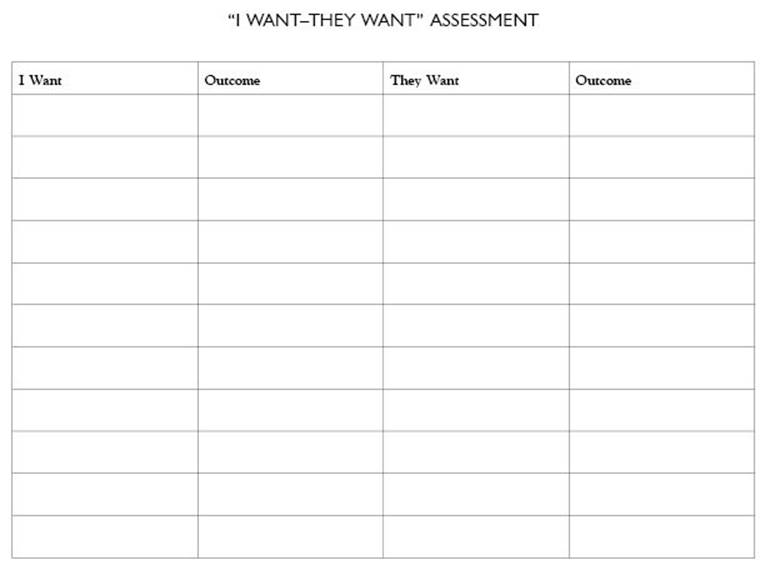
The following exercise will help you assess the “I want–they want” ratio. Choose one relationship you want to evaluate. In the left-hand column, fill in the things you want and need in that relationship.
Under “Outcome,” assess how well those needs are met. In the two right-hand columns, do the same for the other person. Now take a look at the outcomes on each side of the chart. Are more of one person or the other’s needs being met? How does the relationship deal with those unmet needs? Are they ignored or negotiated? Are they sources of blame or withdrawal?
“I Want–I Should” Ratio
Every relationship requires keeping a delicate balance between seeking what you want to do and doing what you think you should do (for the good of the relationship or the other person). If most of your focus is directed toward getting and doing what you want with little attention to what must be done for the other, you’ll soon earn resentment. If you’re overbalanced on the side of “shoulds”—how you should act, what you should do for the other person—the relationship will begin to feel like a joyless burden, and you’ll dream of escape.
For many, “shoulds” can become a controlling tyranny, forcing them to ignore important needs. They’re so busy being good and giving that they fail to notice how depressed and desperate they’ve become. Sooner or later, the pain of denying yourself grows too big, and you have to escape or blow up the relationship.
Exercise: The “Shoulds”
Put a check () next to the items that describe your beliefs or feelings:
You should try to give everything that’s asked of you in a relationship, even when it means putting your own needs aside.
When someone is in pain, you should do anything required to help them.
You should be caring and considerate at all times.
You shouldn’t ask for something if you know the other person doesn’t want to give it.
There is a right way to act with people, and it should be followed even if it means keeping quiet about your feelings and needs.
You shouldn’t say no to people; it’s impolite.
You shouldn’t express feelings that might upset someone; it’s wrong.
You should respond to the needs of others because their needs are a high priority.
You should never hurt or offend anyone.
You should try not to disappoint others.
The more items you checked, the stronger your beliefs about the right and wrong way to relate with others and the more likely you are to deny your own needs in a relationship. There’s nothing wrong with having values about how to treat others, but if those values overpower your ability to ask for what you want, you’ll end up feeling helpless in any relationship.
Skill Building
Improving your interpersonal skills will take hard work. You don’t need anyone to tell you how difficult it is to change relationship patterns. But you know why it’s important—some relationships you value have blown up because you didn’t know how to fix things that went wrong. This chapter and the next will give you new tools to manage how you function in relationships. Sometimes they’ll work, sometimes they won’t; and sometimes you may forget to use them. But you’ll also be amazed how much they can improve a conversation or help to solve a problem.
It’s hard, but it’s okay if you fall down sometimes—if you blow up or withdraw—because it takes time to learn a new way. Practicing your new interpersonal skills will yield the following results:
· Help you be more effective in your dealings with people
· Improve your ability to get your needs met
· Help you negotiate conflicts without damaging a relationship
· Strengthen your self-respect by giving you alternatives to old, damaging patterns of anger or withdrawal
Key Interpersonal Skills
There are six core interpersonal skills that will change how your relationships feel:
1. Knowing what you want. How do you know what you want in a relationship? In some cases, you sense a yearning. Or you’re aware of discomfort. The key is to pay attention and look for a way to describe, in your own mind, what you’re feeling.
2. Asking for what you want—in a way that protects the relationship. The next chapter will give you an effective method and format for doing this. But for the moment, the basic idea is to put your needs into words that are clear, not attacking, and ask for specific behavioral change.
3. Negotiating conflicting wants. The willingness to negotiate starts with a clear commitment that there won’t be winners or losers. It assumes that each person’s needs are valid and understandable, and it draws on a willingness to compromise so that each person gets some of what he or she wants. A simple protocol for negotiating conflicting needs is provided in the next chapter.
4. Getting information. One of the most crucial of all interpersonal skills is finding out what the other person needs, fears, hopes for, and so on. The major blocks to getting information are when you (1) falsely assume you know what the other person wants; (2) project your own fears, needs, and feelings on the other person; (3) fear appearing to pry; (4) fear hearing the worst possible answer; and (5) don’t know how to ask or what to look for. The next chapter will give you some key strategies for getting information.
5. Saying no—in a way that protects the relationship. You can say no in three ways: (1) in a limp, powerless style that just gets overridden; (2) in a hard-edged, aggressive style that alienates people; or (3) in an assertive style that validates the other person’s needs and desires while setting firm boundaries around what you will and won’t do. The first two strategies undermine relationships because someone is going to end up feeling controlled and resentful. We’ll describe how to implement the third strategy in the next chapter.
6. Acting according to your values. Being passive or aggressive in a relationship diminishes both your self-respect and the self-respect of others, because someone is losing out in the relationship—someone’s needs and feelings are being ignored. Being clear about how you want to treat others is a critical step to interpersonal effectiveness. Ask yourself, “What type of relationships do I want with other people?” Do you want a loving relationship, a trustworthy relationship, or a committed relationship? Hopefully, as you’ve been using the skills and exercises in this workbook, you’ve begun to think about how you value your relationships. Acting in your relationships according to what you value is another crucial step that will determine the entire nature of your relationships. Don’t be surprised when valueless relationships don’t work out well. Try setting positive intentions and values for each of your relationships, and act in those relationships according to what you’re trying to achieve.
Exercise: Identify Your Interpersonal Values
On the following lines, list any of your interpersonal behaviors that diminish self-respect. Include anything that emotionally damages you or another person. Also write down sins of omission—things you should have done, but didn’t.
Example: I get angry as soon as someone criticizes me.
___________
___________
___________
___________
Now, in the space that follows, list your values regarding how people should be treated. These are your basic rules about what you and others are entitled to in a relationship.
Example: It’s important to me to hear that someone I love is hurting.
___________
___________
___________
___________
When you compare the two lists, assess whether you’re using interpersonal strategies that violate your values. Which core values do you disregard most frequently? How are your relationships impacted when you violate your values?
In the next chapter, you will learn interpersonal strategies that will help you be effective while at the same time preserving your self-respect.
Blocks to Using Interpersonal Skills
Despite how diligent you are about using your new interpersonal skills, there will still be many obstacles along the way that might temporarily block the success of your relationships. But don’t worry—identifying these obstacles is half the battle. Once you know what they are, you can prepare to overcome them. Here are some of the most common blocks to using interpersonal skills:
· Old habits—of the aggressive kind
· Old habits—of the passive kind
· Overwhelming emotion
· Failure to identify your needs
· Fear
· Toxic relationships
· Myths
Old Habits—of the Aggressive Kind
In your family of origin, you observed how people solved interpersonal problems, and you began to model your own behavior on what you saw. If members of your family dealt with conflict using anger, blame, or withdrawal, these are the strategies you may have learned to use as well.
Techniques for influencing others that utilize fear, shame, or hurtful psychological pressure are called aversive strategies. There are eight of them:
1. Discounting: The message to the other person is that his or her needs or feelings are invalid and don’t have legitimacy or importance. Here’s an example: “You’ve been watching TV all day; why do you expect me to come home and do the bills?”
2. Withdrawing/abandoning: The message is “Do what I want or I’m leaving.” The fear of abandonment is so powerful that many people will give up a great deal to avoid it.
3. Threatening: The message here is “Do what I want or I’ll hurt you.” The most typical threats are to get angry or somehow make the other person’s life miserable. Here’s an example: “Hey, okay, I won’t ask you to help me again. Maybe I’ll ask somebody else.”
4. Blaming: The problem, whatever it is, becomes the other person’s fault. Since they caused it, they have to fix it. Here’s an example: “The reason we’re running up our credit cards every month is that you never saw a store you didn’t like.”
5. Belittling/denigrating: The strategy here is to make the other person feel foolish and wrong to have a particular need, opinion, or feeling. Here’s an example: “Why do you want to go to the lake all the time? All you ever do is get allergy attacks up there.”
6. Guilt-tripping: This strategy conveys the message that the other person is a moral failure, that their needs are wrong and must be given up. Here’s an example: “If you don’t trust me, that tells me something is very wrong with our relationship.”
7. Derailing: This strategy switches attention away from the other person’s feelings and needs. The idea is to stop talking about them and instead talk about yourself. Here’s an example: “I don’t care what you want to do, right now I feel hurt.”
8. Taking away: Here the strategy is to withdraw some form of support, pleasure, or reinforcement from the other person as punishment for something they said, did, or wanted. Here’s an example: John said, “I’m not really in the mood for hiking; it’s boring,” after his partner was unwilling to invest in a new camera (adapted from McKay, Fanning, & Paleg, 1994).
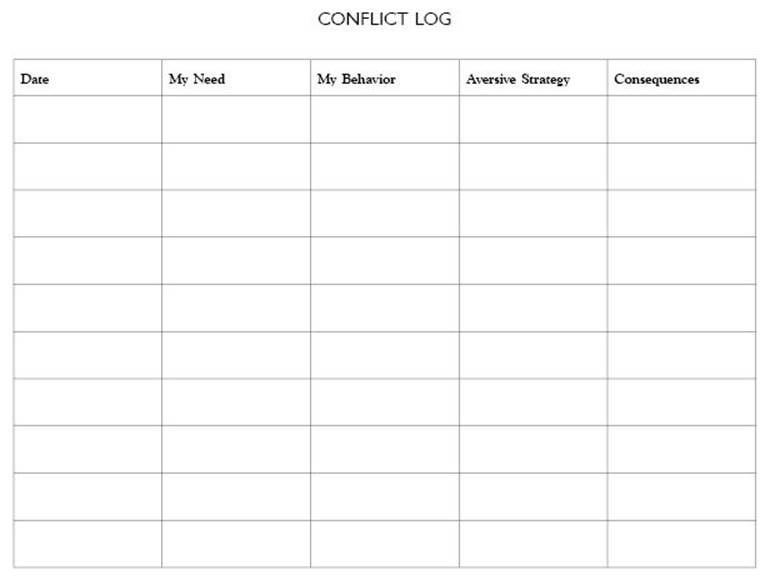
As you review this list, are there strategies you recognize from your own behavior? Think back to times you’ve used aversive tactics—what was the impact on your relationship? Is this something you want to change? The best way to stop aversive behavior is to observe it closely.
Exercise: Conflict Log
The following Conflict Log will help you.
Old Habits—of the Passive Kind
Some old habits are of the passive rather than aggressive variety. You may have learned in your family how to shut down or surrender when there is a conflict. You can use the same Conflict Log (using “Passive Strategy” rather than “Aversive Strategy” in column four to track conflicts when you withdraw or shut down.
After keeping the log, ask these questions:
· What kind of needs or situations trigger your use of aversive or passive strategies?
· Which strategies do you most frequently rely on?
· Are you getting what you want using aversive or passive strategies?
· What are the most frequent emotional consequences for using these strategies?
The assertiveness skills in the next chapter will give you more effective alternatives to the aversive and passive responses you’ve typically used.
Overwhelming Emotion
A third major block to using interpersonal skills is high emotion. Sometimes your best intentions and most carefully laid plans go up in smoke when you’re upset. For some people, particularly those who have grown up in abusive homes, getting angry can cause a dissociative fugue state. In that frame of mind, they may do or say things that, on later reflection, seem to have been done by someone else. “It didn’t feel like me telling my wife to get out,” one man insisted. “I felt like I was possessed, in the control of some force outside myself.”
There is good evidence that angry, dissociative states are responsible for a lot of emotional and even physical violence. What can you do when overwhelming emotion threatens to unravel your hard-won interpersonal skills? There are two things you can learn to do right now. First, pay attention to the red flags that indicate you’re starting to lose control. Different people have different signals. Here are some that are typical:
· Feeling hot or flushed
· Heart pounding
· Short of breath
· Tension in your hands, arms, forehead, or shoulders
· Talking more rapidly or more loudly than usual
· Feeling a strong need to win, to crush someone, to make them feel bad
Exercise: Red-Flag Feelings and Behaviors
Make a list in the following space of red-flag feelings or behaviors that in the past signaled a loss of control:
___________
___________
___________
___________
___________
Now when conflicts arise, watch out for the red flags. If you notice them, you can use a second technique you’ve already learned: When you first notice that you’re beginning to get overwhelmed by your emotions, start using your mindful breathing skills (see page 80). Take slow, diaphragmatic breaths, and put all of your attention on the physical experience of the breath. This will help to calm you and to disconnect the old neural pathways that made you feel overwhelmed.
Failure to Identify Your Needs
Interpersonal skills won’t do you much good if you don’t know what you want in a situation. If you can’t clearly articulate your needs, all you’re left with is frustration. The first section of the next chapter will offer you strategies for identifying what you want in terms of specific behavioral change from others. Once you can articulate a need to yourself, the sections on assertiveness and making a simple request will give you tools to say it out loud.
Fear
When you feel afraid of something, interpersonal skills often go out the window. You’re just too full of catastrophic “what ifs” to think clearly. “What if I’m rejected? What if I lose my job? What if I can’t stand this?” Catastrophic thoughts can scare you into using aggressive and aversive strategies. Or they can cause you to avoid a situation altogether. The net result is that you don’t function well and aren’t effective.
Wise-mind meditation (see page 87) can help you manage in the face of fear, as can mindful breathing. Another thing you can do is directly confront your catastrophic thoughts. There are two steps to this.
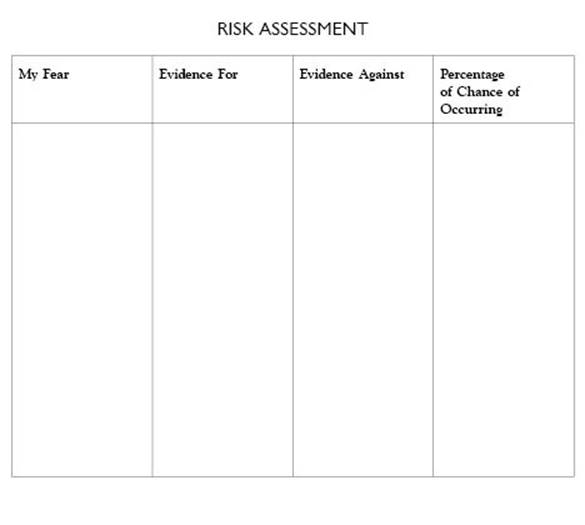
Exercise 1: Risk Assessment
Notice that the Risk Assessment/Risk Planning Worksheet on the next page is divided into four columns. In column one, write down your fear, and in column two list all the evidence you have that the fear will come true. In column three, write down all available evidence that the catastrophe won’t occur. Now, after reviewing evidence for and against, write your estimate of the percentage of chance that the catastrophe will happen.
Exercise 2: Risk Planning
In the “Risk Planning” portion of the worksheet, imagine that the catastrophe you fear has actually happened. How would you cope? Do you have resources, family, or friends to help you? Do you have a plan for how you would do your best with the situation? What skills do you have to get you through?
The Risk Assessment/Risk Planning Worksheet is something you may want to photocopy and use again and again—whenever fear threatens to torpedo your relationship skills.
RISK PLANNING
Make a coping plan utilizing your skills and resources in the event your feared scenario comes true.
1. ___________
2. ___________
3. ___________
4. ___________
5. ___________
6. ___________
Toxic Relationships
Relationships where people use aversive strategies on you can make your interpersonal skills very difficult to use. No matter how determined you are to be assertive rather than aggressive or passive, people who blame, threaten, or belittle you can often trip you up and make you want to explode or run away.
The best solution is to get away from these folks. They’re not going to change, and you’ll never stop being vulnerable to their attacks. However, if these are people you can’t avoid—for example, a boss or a family member—there are two things you must do to cope. First, you have to calm yourself before dealing with them. Use mindful breathing or wise mind to get centered. Second, based on past experience, you need to anticipate exactly how the toxic individual is likely to act, and then you need to make a specific plan—even a script—to deal with it. Planning ahead and developing a detailed response will keep you from falling back on old, ineffective patterns. See the assertiveness sections in the next chapter for the tools necessary to talk your way out of aversive traps.
Myths
The last of the major blocks to using interpersonal skills is found in the four paralyzing myths of relationship:
1. If I need something, it means there is something wrong or bad about me.
2. I won’t be able to stand it if the other person gets mad or says no.
3. It’s selfish to say no or ask for things.
4. I have no control over anything.
Each of these myths inhibits you from saying what you need and setting limits. Let’s look at each of them.
· Myth #1. Every human being needs things from other human beings—whether it’s attention, support, love, help, or just plain kindness. We are not sufficient unto ourselves, and our whole lives are spent negotiating with others for everything we require to survive—physically and emotionally. So needing things can’t be shameful or wrong; it is basic to the human condition. In contrast to this myth, a healthy alternative coping thought is “I have a right to want things.”
· Myth #2. Hearing an angry refusal hurts. Sometimes it hits so hard and suddenly that it takes your breath away. But is it true you can’t stand it? Think of the rejections you’ve suffered in your life—they were difficult, but you survived them. Refusals hurt, there’s no doubt about it, but the worst thing is living with years of pain because you never asked for what you want. In contrast to this myth, a healthy alternative coping thought is “I have a right to ask for things—even if the other person won’t give them.”
· Myth #3. You may feel that it’s selfish to ask for things because of messages in your early family that said your needs didn’t count or that your needs were less important than the needs of others. When you examine it, is this really true? Is there something flawed or wrong with you that makes your needs relatively unimportant? The truth is that everyone’s needs are valid, and equally important. It isn’t selfish to ask for things or set limits. It’s normal. It’s healthy and necessary. Our survival as individuals depends on knowing and saying what we want. Because if we don’t, folks don’t pay attention. A helpful coping thought is “It’s normal and healthy to ask for things.”
· Myth #4. Control is relative. You can’t control the behavior of others, even though some folks go nuts trying. What can be controlled is your behavior. Passive or aggressive styles often have bad outcomes. People ignore your needs or get angry and resist you. That’s why you feel helpless—the strategies you’re using aren’t effective. Assertive behavior gets better results. People—more often than not—listen and respond positively. In contrast to this myth, a helpful alternative coping thought is “I can choose to behave in more effective ways.”