
Introduction
There are many causes of limited mouth opening which may be classified as follows.
Intra-articular (intracapsular)
• Closed lock due anterior displacement of the meniscus without reduction.
• Osseous or fibro-osseous ankylosis, secondary to trauma, infection or osteoarthritis.
• Fibrodysplasia ossificans progressiva (formerly myositis ossificans).
• Ankylosing spondylitis, juvenile rheumatoid arthritis.
Extra-articular (extracapsular)
• Trismus.
• Disuse muscle atrophy, contractures secondary to intra-articular ankylosis or psychogenic trismus.
• Post-radiotherapy and thermal scarring.
• Post-traumatic scarring.
• Oral submucous fibrosis.
• Post-cancrum oris scarring.
• Fibrodysplasia ossificans progressiva (formerly myositis ossificans).
Only the management of intra-articular ankylosis with its marked disturbance in facial skeletal growth will be considered here.
Aetiology
Although most causes of extra-articular ankylosis are self-evident the aetiology of intra-articular ankylosis is obscure. It is uncommon in the West and the prevalence seems to be higher in tropical and sub-tropical countries although there is no reliable epidemiology.
Certain factors are significant; extra- and intracapsular joint trauma are common in children and adults but ankylosis is very rare (Figures 13.1a–13.1e). Experimental ankylosis is very difficult to produce in animals without inserting a bone graft.
Removal of the meniscus produces a condylar overgrowth similar to the ankylosis deformity but without fusion (Figures 13.2a–13.2c).
However the rare fibrodysplasia ossificans progressiva which has an unexplained short first toe (Figure 13.3) and widespread heterotopic bone formation, is associated with an excess of the bone morphogenetic protein 4 (BMP 4) gene which may be due to a deficiency of the BMP inhibitor genes, curiously named gremlin (DRM) and noggin. Also the progressive ankylosis gene ank produces intra-articular and peri-articular joint fusion in man and mice.
The outcome of such a localised abnormal genotype could be a deficiency of RANKL (receptor activator of nuclear kappa ligand) a key messenger responsible for osteoclastogenesis, when the affected structures are challenged by trauma or infection.
The natural history is usually infantile and pre-adolescent loss of the meniscus due to:
• birth trauma with displacement of the meniscus;
• juvenile joint infection — middle ear, mastoid or haematogenous; and
• juvenile rheumatoid arthritis (Stills disease), plus the unexplained tendency for local ectopic bone formation (see BMP 4, noggin, gremlin and ank above).
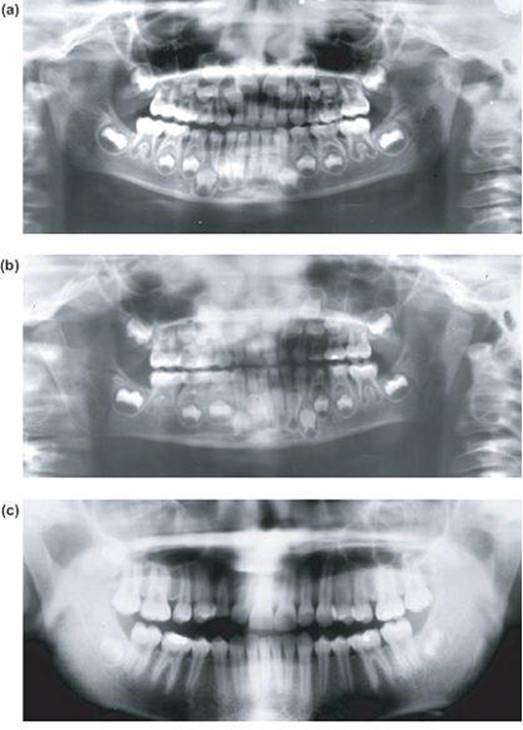
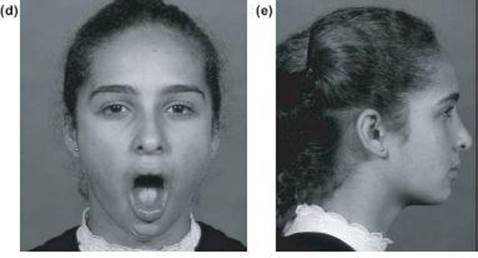
Figure 13.1 (a) Radiograph showing bilateral intracapsular fractures at 6 years. (b) Condylar remodelling 6 months later. (c), (d) and (e) Normal growth without ankylosis at 14 years.
The idiopathic intracapsular bony fusion appears to arise through the following sequence of events.
i) Condylar damage and loss of meniscus due to traumatic displacement, inflammmation or infection.
ii) Irregular reparative condylar overgrowth with varying degrees of mechanical, fibrous and bony ankylosis with ossification of the joint capsule.
iii) Extra-articular ankylosis due to masticatory muscle contracture.
The same pattern is less frequently seen in adults following trauma, ankylosing spondylitis or osteoarthritis.
Presentation
Ankylosis in children produces impaired mandibular growth with bilateral deformity in all dimensions. This deformity is asymmetrical in unilateral cases with a straight small hemimandible on the ankylosed side, and a marked contralateral bowing deformity. Retrognathia and retrogenia (Figures 13.4a–13.4c) become more apparent with age. This produces an occlusal cant down to the normal side. In rare bilateral cases the mandible is short but symmetrical. In all cases the inter-incisal opening can be up to 10 mm even with total bony fusion reflecting the bone elasticity within the masticatory system. There appear to be two causes of the impaired growth pattern.

Figure 13.2 (a) Normal rabbit condyle and meniscus. (b) Hemi-condylar overgrowth following partial meniscectomy. (c) Total meniscectomy showing condylar overgrowth with mechanical but not bony ankylosis, illustrating a modelling role of the meniscus on condylar growth (loaned by Dr. Rudolph Sprintz).
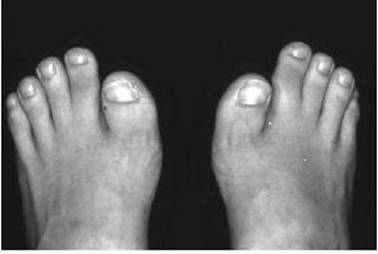
Figure 13.3 Short great toe characteristic of fibrodysplasia ossificans progressiva.
i) The loss of the condylar fibrocartilage.
Although the condylar growth cartilage is not considered to be the primary growth centre for the entire mandible, it makes a significant contribution to the height of the condylar head, neck and the ascending ramus including the angle of the mandible. This can be seen very clearly after perinatal ankylosis following birth trauma when the dental lamina has to extend backwards into the ascending ramus due to the lack of local alveolar bone at the angle (Figure 13.4f). The contralateral intact condylar growth centre continues to grow down and forwards towards the affected side producing the characteristic bowing deformity.
ii) The loss of function.
Persistent impaired function of any bone inhibits its linear and cross-sectional growth as can be seen in the ankylosed mandible in Figures 13.5a–13.5d. However this is avoided when the mandibular body is freed early before the adolescent growth spurt and function is restored. Figure 13.4 shows the natural history of a childhood ankylosis treated with a costochondral graft from the age of 4 through to 27 years.
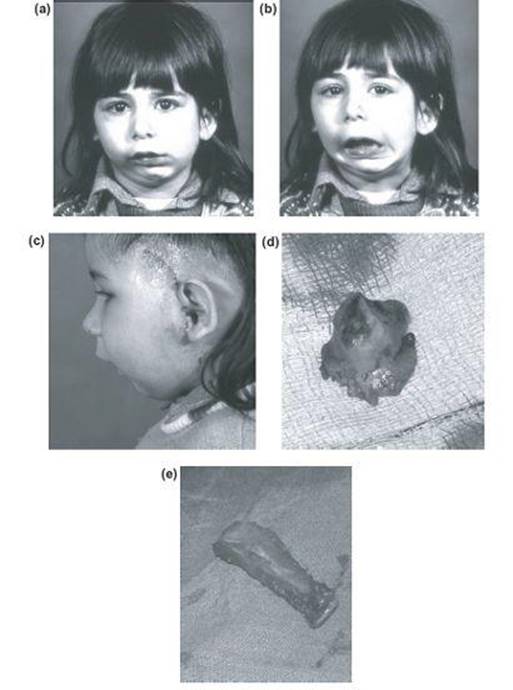
Figure 13.4 Left TMJ ankylosis following birth trauma showing characteristic facial deformity at 4 years (a), (b) and (c). Excised ankylosed condyle showing the wide adherent margin (d). Costochondral graft (e). The radiograph shows inverted mushroom ankylosis and extension of the dental lamina into the shortened ascending ramus.
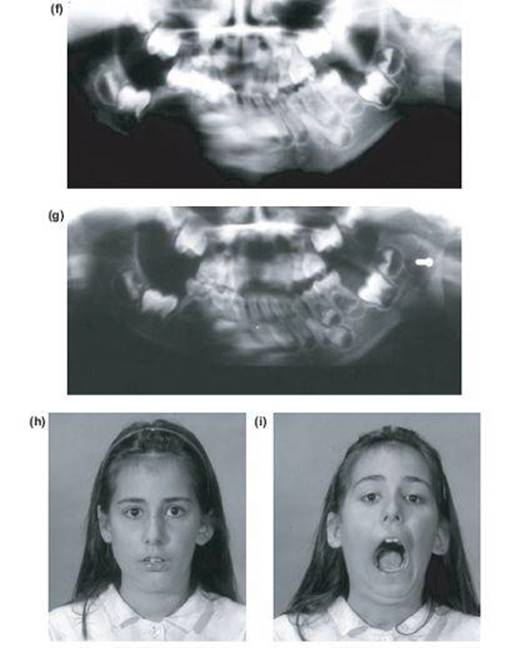
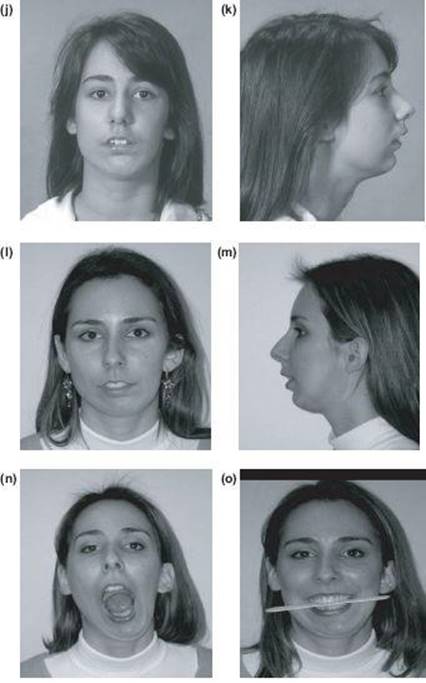
Figure 13.4 (f) and (g) Following division of the ankylosis, ipsilateral coronoidectomy and costochondral graft. Early pre-adolescent arthroplasty allows catch-up growth and remodelling at 13 years (h) and (i), 19 years (j) and (k) and at 27 years. (l), (m), (n), (o) Inadequate growth of the costochondral graft is seen as deviation of the chin at rest and on opening, with a secondary limitation of the ipsilateral maxilla producing inclination of the occlusal plane. The ankylosis defect or surgery has also produced winging of the left ear.
However it is interesting to compare this with the outcome of a simple gap arthroplasty where the mandible can develop normally even without a condylar growth cartilage replacement (Figure 13.6).
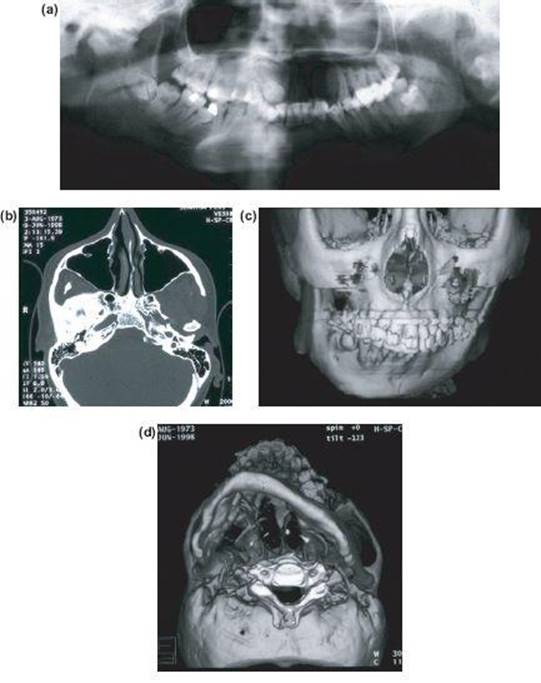
Figure 13.5 Imaging showing (a) apparent fibrosseous ankylosis of right TMJ but (b) shows complete fusion with base of skull. (c) 3D CT shows straight ankylosis side with deformed growing contralateral side with occlussal cant and (d) lower border of mandible shows impaired growth in all dimensions (case of Kieren Coghlin).
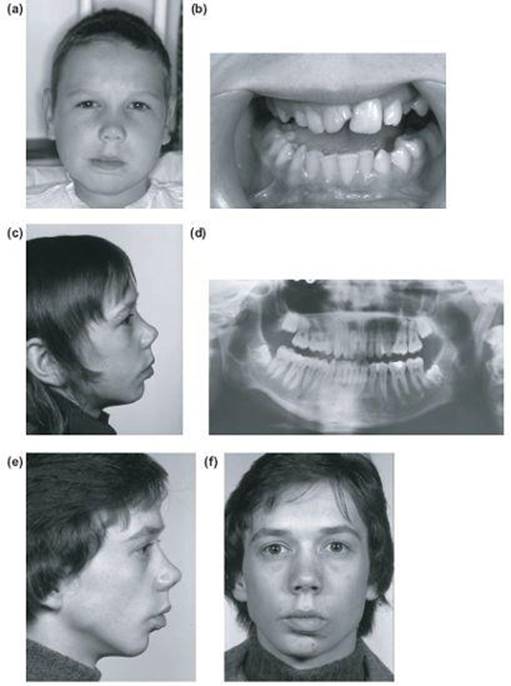
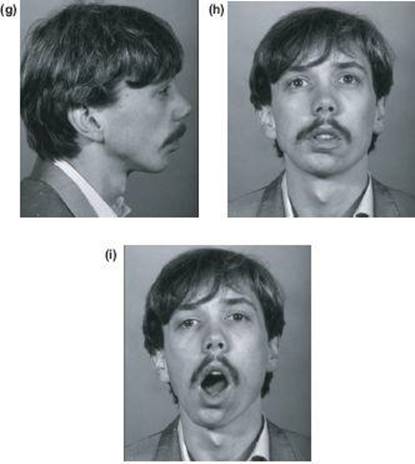
Figure 13.6 Post-traumatic right TMJ ankylosis at 10 years (a) and (b) treated with only a wide gap arthroplasty. (c) and (d) Facial growth and a functional pseudarthrosis. Normal growth and function at 19 (e) and (f) and 26 years with excellent opening but asymmetry limited to the loss of the condylar head and neck height (g)-(i).
It has been estimated that from 3-16 years the ascending ramus grows approximately 2 cm in height and the body of the mandible 2.5 cm in length. The aims of treatment are to:
• restore the ramus height and its growth potential as early as possible,
• release the functional growth of the mandibular body, and
• prevent secondary deformity.
Treatment Principles
• Excise the bony fusion as early as possible.
• Reconstruct.
• Prevent recurrent ankylosis.
• Restore function.
• Correct the secondary deformity.
• Correct the occlusion.
There are many treatment strategies depending on the age of the patient the duration of the deformity and degree of secondary deformity, but in all cases, success depends on preventing recurrence of the localised idiopathic fibrodysplasia ossificans.
Treatment Choices
1. Pre-adolescent ankylosis presenting in childhood.
a) Excision with the insertion of an interpositional temporalis myofascial peninsular flap and reconstruction with a costochondral growth centre to restore function and ramus growth.
b) Bilateral coronoidectomies (coronoidotomies).
c) Or excision of the ankylosis creating a simple gap arthroplasty with an interpositional temporalis myofascial peninsular flap followed by distraction osteogenesis (see below and Chapter 10).
The anteroposterior deficiency and asymmetry in childhood is usually self-corrected with catch-up growth.
2. The pre-adolescent ankylosis presenting during or postadolescence.
a) Excision with the insertion of an interpositional temporalis myofascial peninsular flap or a sialastic “membrane” and reconstruction with a costochondral graft to restore function and ramus growth if early enough.
b) Bilateral coronoidectomies (coronoidotomies): the earlier the restoration of function the more spontaneous growth and remodelling will be achieved in adolescence.
c) Or as the alternative to the excision of the ankylosis, simply creating a gap arthroplasty with an interpositional temporalis myofascial peninsular flap and the addition of distraction osteogenesis (see point 5 below and Chapter 10).
3. Pre-adolescent ankylosis presenting after the completion of facial growth.
a) As 2 above, with a rotational advancement genioplasty.
b) Marked retrognathia will require a sagittal split or inverted L osteotomy.
4. Late ankylosis in adults with no interference with facial growth.
a) Division of the ankylosis conserving ramus height, sculpting the condylar head with the interposition of an articular membrane such as a temporalis myofascial peninsular flap, a 2 mm sialastic membrane or the retrieved meniscus (Figures 13.7a–13.7d).
b) Bilateral coronoidectomies (coronoidotomies).
In all cases the tendency for localised fibrodysplasia ossificans to produce a recurrent fusion must be inhibited by a 7-day pre- and 2-month postoperative course of bisphosphonate, which is currently alendronic acid 10 mg a day in the morning.
5. Distraction osteogenesis (see Chapter 9).
There is now evidence that
• division of the ankylosis,
• bilateral coronoidectomies (otomies) to free temporalis contractures,
• a myofascial interpositional arthroplasty, and
• distraction osteogenesis
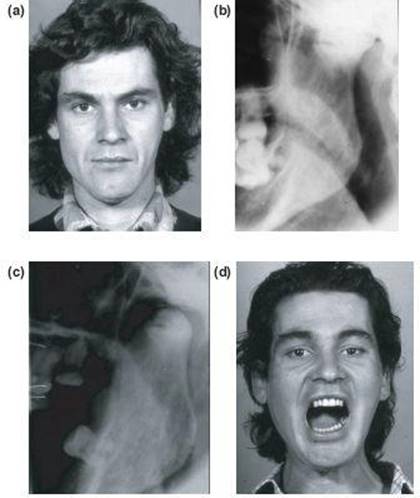
Figure 13.7 (a) Left TMJ ankylosis following adult trauma does not impair facial growth. (b) Linear radiolucency within the fused “golfball exostosis” is site of failed division of bony mass. (c) Separation at skull base, with insertion of sialastic membrane and coronoidectomy, provides function. (d) Without loss of ramus height.
restore movement and function and simultaneously elongates the deformed mandible. As bisphosphonates delay bone formation their role in distraction osteogenesis is as yet unpredictable.
Preoperative Imaging (Figure 13.5)
• OPG.
• True lateral skull.
• CT scan with 3D reconstruction.
• Standard orthognathic photographic series.
Timing
Resection of the ankylosis should be carried out as early as possible to enable normal growth and avoid secondary deformity. The exception is any extra-articular jaw osteotomy which should be deferred until facial growth has ceased.
Surgical Approach
The preoperative preparation differs from the standard orthognathic workup in several respects.
1. The anaesthetist must be skilled in the intubation of patients who are unable to open their mouths. This has been been made easier by the use of fibreoptic intubation but still represents a challenge especially in cases with marked retrognathia. The facilities for a tracheostomy should always be available.
2. The temporal area must be shaved and cleaned before the patient is taken into theatre. This facilitates the incision and prevents hair straying into the operative field.
3. The face and mouth are cleaned with aqueous povidone iodine and draped, exposing both ears for access and orientation. Asmall piece of sterile petroleum jelly gauze (tulle grasse) is inserted into the depths of the external auditory meatus. Alarge piece will work its way out within minutes of starting the operation.
4. The incision is marked with a surgical pen, from the temporal area (2 cm above and 2 cm anterior to the tip of the pinna) diagonally downwards and backwards to the attachment of the ear, and then following the junctional contour to the upper end of the tragal cartilage. It then follows the crest of the cartilage down to the lobe and then skirts behind it (Figure 13.8a).
5. The whole length is infiltrated with bupivocaine and adrenaline to achieve local vasoconstriction.
6. Incise the skin with a No. 15 blade from above downwards, retraction with skin hooks will reveal the superficial veins which are coagulated with bipolar diathermy and divided. The incision along the crest of the tragus will reveal but preserve the cartilage. With fine tooth forceps the skin is dissected forwards off the cartilage and then the attachment of the lobe can be divided from front to back. The length and depth of this incision are crucial for comfortable exposure of the deeper structures (Figure 13.8b). This “parotid” incision gives excellent access to the acending ramus, eliminates the need for an additional submandibular approach and leaves a totally discrete scar.
7. By keeping the temporal incision well back, the orbito-frontal branches of the facial nerve will be safe in the upper anterior flap. The main trunk of the VII nerve emerges from the stylomastoid foramen one and a half fingers breadths below the tragal cartilage (the external auditory meatus) and passes forward 1-2 cm beneath the skin surface deep to the superficial lobe of the parotid gland, and so remains safely enclosed in the depths of the lower anterior flap. The auricular temporal vessels will be encountered but should be readily controlled with bipolar diathermy and 3/0 vicryl ties.
8. After arresting all bleeding points, the incision is deepened through the temporalis fascia down to muscle and down to bone at the root of the zygomatic arch. A small vessel at this point must be coagulated. Below the arch there is a natural vertical cleft in the deeper tissues that can be opened with the blade along the anterior surface of the cartilaginous external auditory meatus and then with Macindoe scissors (Figure 13.8b).
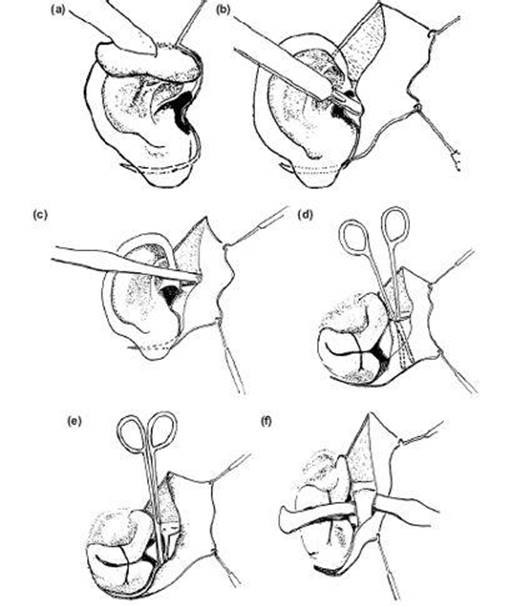
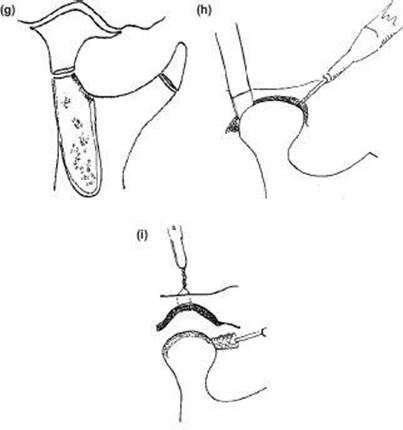
Figure 13.8 (a) The temporal preand sub-auricular incision. (b) Dissection along tragal cartilage to open pre-auricular cleft. (c) Sub-periosteal elevation along zygomatic arch. (d) Creation of vertical pocket in the plane of the root of zygoma and the ankylosis. (e) Dividing the posterior partition of the pocket to expose the ankylosis. (f) Isolating the ankylosis with retractors. (g) The bony fusion has been separated with a bur and fine osteotome, the condylar neck has been divided together with a coronoidectomy. The ramus decortication is for the costochondral graft. (h) Division of the ankylosis with preservation of ramus height in an adult without facial deformity. (i) A sialastic interpositional membrane suspended from the glenoid fossa.
9. Confirm the periosteal incision on the root of the zygomatic arch is down to bone with the rasp end of a Howarth periosteal elevator, reverse it and insert the elevator firmly forward along the surface of the arch. This will raise a tent of fascia both above and below the arch which must be released with scissors at both ends of the incision (Figure 13.8c). Posteriorly it is convenient to fold the ear and suture the lobe to the pinna with 2/0 vicryl.
10. The operative plane below the arch is now developed obliquely downwards and forwards with a periosteal elevator and then Macindoe scissors from the surface of the root of the zygoma onto the surface of the ankylosis (Figure 13.8d). This creates a pocket overlying the ankylosis with a posterior partition separating it from the vertical pre-auricular cleft. This partition must be divided with scissors to create a free peri-articular area to work in (Figure 13.8e).
11. It is now possible to expose the arch as far forward as the zygomatic bone itself. Where the flap can be held with a small Langenbeck retractor.
12. In all cases the joint capsule has been ossified and has disappeared so that sub-periosteal exploration down from the arch will immediately expose the lateral aspects of the ankylosis.
13. Carefully but firmly push the elevator distally around the condylar neck and leave it or a malleable strip against the deeper aspect of the bone as a retractor. Repeat this on the anterior surface of the condylar neck area. With marked loss of ramus height, the space below the arch may be tight admitting only a narrow instrument such as a Frear elevator as a retractor (Figure 13.8f).
14. The child's ankylosis differs morphologically from the fusion occurring in an adult. In the child the fusion resembles an upturned mushroom (Figure 13.8g) whereas adult cases tend to be a proliferative golf ball. The line of fusion should be visible or estimated and is explored by firmly tapping a 5 mm osteotome progressively deeper into its depth at three or four points. It should now be possible to lever the bony mass away from the skull base. The mass is separated by a bur cut at the base of the condylar neck (Figure 13.8g).
Sub-periosteal dissection forward to the anterior border of the ramus can usually enable the coronoidectomy (otomy) to be done through the pre-auricular incision.
15. There are two forms of adult ankylosis:
(i) simple bony fusion following osteoarthritis or ankylosing spondilitis and
(ii) those following trauma with an exostotic mass continuous with the zygomatic arch and skull base.
Both have no loss of ramus height, and simply require a line of cleavage. The former is usually apparent and can be separated with a narrow osteotome. The exostotic form has to be estimated and cut deeply with a tungsten carbide fissure bur. A sturdy 1 cm osteotome is then necessary to lever this bony mass from the overlying skull base preserving it to be sculpted into a new condyle with an acrylic bur (Figure 13.8h).
16. In the adolescent and adult the temporalis and its tendon and to a lesser extent the other elevator muscles have undergone a degree of contracture which must be released with a bilateral coronoidectomy or otomy. This can be done on the ankylosis side by extending the sub-periosteal exposure forward over the ascending ramus and retaining access with an Obwegeser channel retractor passed around the anterior border. The lower bur cut instead of just sectioning the neck can be extended simultaneously forward just below the sigmoid notch to the anterior border of the ramus to include the coronoid process (Figure 13.9a).
17. At this point it is essential to inspect the specimen and also explore the depths of the wound on the ankylosis side as the fusion of a fractured condylar neck to skull base can be wrongly assumed to be the complete ankylosis, whereas the medially displaced condyle is often fused with the skull base above and to the medial aspect of the ascending ramus below. If this is the case the aberrant condyle must also be separated and removed (Figure 13.9b). In post-traumatic cases the exploration should also attempt to locate and retrieve the meniscus.
18. A contralateral coronoidectomy or otomy is essential to give maximum opening. This is done intraorally after stretching the mouth open with a Featherstone or similar self-retaining gag. Two blade (Lacs) retractors are required and are pressed, one on each side of the anterior border of the ascending ramus. Incise downwards between them through the mucosa and muscle to the bone. Elevate the periosteum and muscle layer on both sides of the ascending ramus and insert the blade retractor (Lacs) in each pocket, then using the forked Langenbeck retractor, the coronoid is exposed and grasped with curved Kocher forceps and divided obliquely at its base with a bur. The last remaining bony bridge which is the anterior rim of the sigmoid notch is fractured with an osteotome inserted in the bur cut and twisted. As the coronoid process is elongated its removal can be difficult and is probably unnecessary. The stretched opening of the mouth can now with effort be doubled (Figures 13.10a to 13.10c).
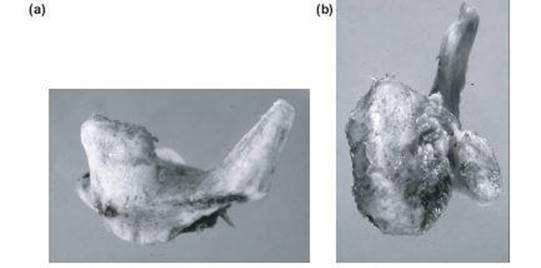
Figure 13.9 (a) and (b) Combined excision of ankylosis and coronoid showing the major restraint to opening was the concealed medially displaced condylar head which was fused to both the skull base and ascending ramus.
19. Reconstruction using the costochondral graft.
· Where growth or ramus height are required a costochondral graft is harvested and trimmed to provide a suitable articular surface (Figure 13.11).
· A groove is prepared on the lateral surface of the ramus by superficial decortication with a bur and an osteotome.

Figure 13.10 (a) Opening after resection of fused condylar head and coronoidectomy. (b) Intraoral contralateral coronoidotomy and (c) significant increase in mouth opening.
· The bite is propped open 10 mm in the ipsilateral molar area with a folded tonsil swab side and the rib placed on the groove with the costal cartilage extending up against the glenoid fossa and 2 screws inserted to fix it.
· The meniscus is replaced if it can be localised from a medial fracture displacement. Otherwise the choice is a temporalis myofascial peninsula flap or a 2 mm sialastic membrane.
· The 2 cm broad myofascial flap is outlined postero-superiorly as shown with its base at the origin of the arch. It is incised down to the calvarium, elevated and firmly pulled (and pushed) down and under the zygomatic arch with a heavy suture passed through its mobile distal end. This suture can be passed down through the arch with a wire “pull” loop, a pair of curved Kochers or Adsons right angled forceps. It is then pulled backwards into the condylar fossa and anchored with a heavy suture passed upwards through a drill hole, done from above through the most distomedial point of the roof of the glenoid fossa (Figure 13.11). This procedure is much easier with the condyle subluxed from the fossa by maximally stretching the mouth open and then reduced to sit beneath the flap.
· Of the many autogenous and alloplast materials used as alternative interpositional membranes, 2 mm sialastic has proved to be ideal for this role suspended by 0.5 wire from the glenoid fossa. The margins must be carefully trimmed to avoid overextension (Figure 13.8i).
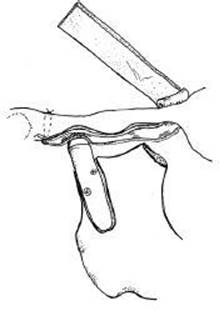
Figure 13.11 Costochondral graft with temporalis myofascial peninsular flap rotated downwards through the zygomatic arch and backwards to act as a meniscus.
20. Reconstruction preserving the condyle.
This is useful in late onset ankylosis where there is a proliferative fusion and no loss of ramus height. The bone is sculpted into a neocondyle and the fossa trimmed to accommodate it with an acrylic bur. In these cases a myofascial flap or 2 mm sialastic sheet are used as an interpositional membrane as described above (Figures 13.8h and 13.8i).
21. Reconstruction with a prosthetic joint. With the many autogenous alternatives, prosthetic total joint replacement is rarely required but may be essential in the older osteoporotic or rheumatoid patient. The principles are the same as the costochondral graft with the exception that the occlusion has to be carefully defined. Alloplastic joints do not remodel and have to be accurately placed to avoid morphoincompatibility where function will erode the tense overlying tissues leading to exposure and infection.
22. Post-adolescent cases require an augmentation and rotation genioplasty (Figures 13.12a to 13.12c). In a bilateral case, if an advancement osteotomy (or distraction osteogenesis) is required, ideally this follows preparatory orthodontics. The osteotomy is not usually necessary when the ankylosis is treated before adolescence especially with a costochondral graft or with distraction osteogenesis.
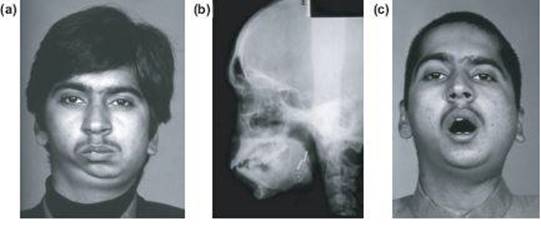
Figure 13.12 (a) Characteristic adult asymmetrical retrognathia from left TMJ ankylosis in childhood. (b) and (c) After costochondral graft arthroplasty and rotation advancement genioplasty.
23. Vacuum drains are inserted, and the wounds closed with subcutaneous 3/0 vicryl and 5/O prolene for the skin. Afirm turban pressure dressing is applied, ensuring that gauze or wool is placed behind the pinna of the ear to avoid compression ischaemia.
24. Postoperative care. Analgesics and antibiotics are prescribed as usual with the addition of daily alendronic acid 10 mg in the morning for 2 months. This is taken 30 minutes before breakfast when upright to avoid oesophagitis. A fluid and soft diet is essential to achieve a compromise between rest and function to be followed by stretching exercises with a modified laboratory chemistry clamp (Figure 13.13) at least 3 times a day for 6 months.
25. The closure of the maxillary cant can be facilitated by taking impressions and a squash bite as soon as possible (intraoperatively is inappropriately messy) and the models mounted to enable a maxillary plate with a lateral bite wedge to keep open the ipsilateral buccal occlusion until an orthodontic assessment and the insertion of a functional appliance to level the occlusion (Figures 13.14a to 13.14c).
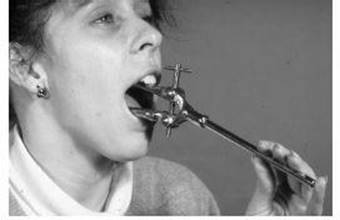
Figure 13.13 Modified laboratory retort (chemistry) clamp with plastic tubing to protect teeth, provides well controlled stretching exercises.
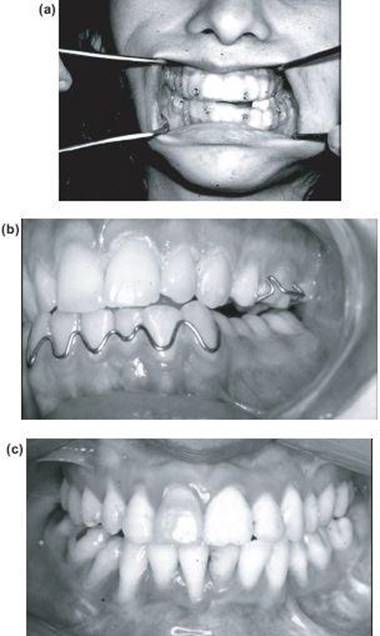
Figure 13.14 (a) Acrylic wedge to maintain postoperative lateral open bite and ramus height. Another patient to show (b) functional appliance to facilitate closure of postoperative lateral open bite (c) closure achieved.
Complications
• Damage to the orbital and frontal branches of the facial nerve is to be avoided by careful flap design.
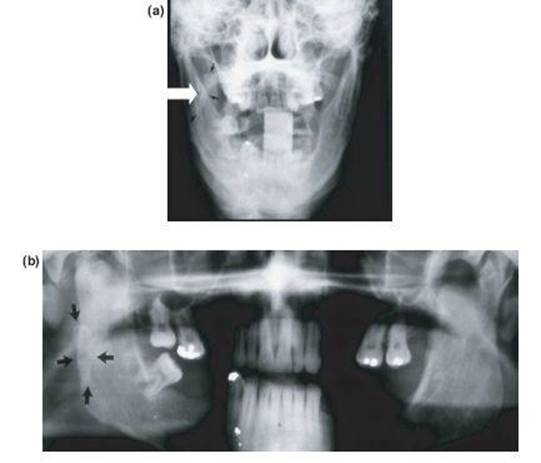
Figure 13.15 (a) and (b) Gradual postoperative onset of impaired opening due to fibrodysplasia ossificans of the medial pterygoid muscle. Treated with 3 months bisphosphonate and stretching.
• Limited opening due to inadequate bone removal especially on the medial aspect of the condylar neck — will be revealed by a CT scan and requires a repeat arthroplasty.
• Persistent limited opening due to a failure to do a bilateral coronoidectomies or otomies. These may be done intraorally but must be supplemented by stretching exercises and bisphosphonates.
• Postoperative fibrodysplasia ossificans in the medial pterygoid and masseter can occur and will also require bisphosphonates and stretching exercises for 2-3 months (Figures 13.15a and 13.15b).
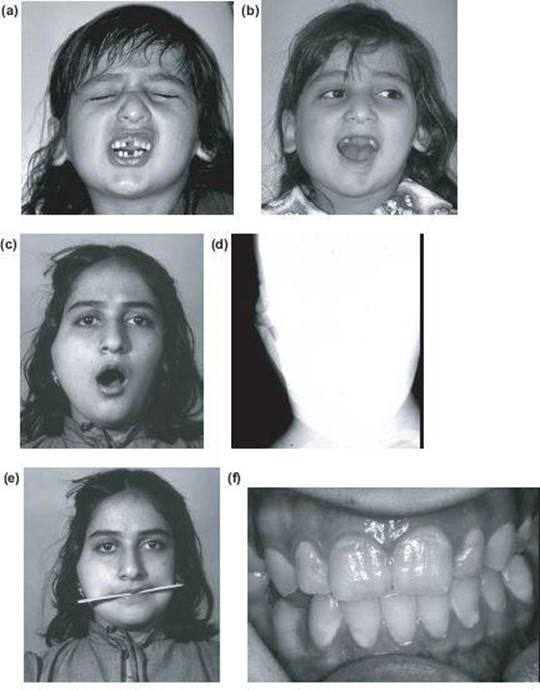
Figure 13.16 (a) Ankylosis in a 5-year-old. (b) Postoperative opening. (c) and (d) Pseudohemimandibular hyperplasia due to costchondral overgrowth at 12 years with lateral displacement of overgrown graft. (e) and (f)Occlussal cant.
· Marked malocclusion will require orthodontics and an osteotomy.
· Failure of the costochondral graft to grow. With function this acts as an interpositional arthroplasty enabling mandibular growth. Asymmetry is rarely great can be corrected by an osteotomy or distraction osteogenesis when mandibular growth has completed.
· Fusion of the graft with re-ankylosis requires a repeat arthroplasty and bisphosphanates or distraction osteogenesis.
· Excess growth of the graft with a pseudohemimandibular elongation can be corrected by trimming the articular end of the graft and levelling the occlusal plane orthodontically (Figures 13.16a–13.16f).
· Pneumothorax (see Complications and Emergencies section).
Summary
The excision of the ankylosis, joint reconstruction with a costochondral graft and bilateral temporalis myotomies remain the most common management. However there is evidence that restoration of growth and function may also be achieved with an interpositional arthroplasty as described for the adult case, and distraction osteogenesis as an alternative to a costochondral graft (see Chapter 9).