
Introduction
The face has evolved as the most important of all human anatomical structures. It houses the principal receptors for sight, sound, taste and smell, has obvious and complex sexual significance, and the cere-bro-neuromuscular means of expressing speech and emotion. Facial attractiveness is one of our most important social and psychological characteristics and the psychopathology of facial deformity is a complex spectrum extending from emotional problems in the normally integrated individual to manifestations of personality disorders, neurosis, depression and psychosis.
1. Social Aspects of Facial Deformity
Those who are blessed with an attractive face are frequently perceived as being more friendly, sensitive and successful than those who are unattractive. This unfair social advantage does not take into account overriding compensatory factors such as intellect, personality and motivation. Certain facial stereotypes are inappropriately portrayed as being associated with particular characteristics, for example a Class III malocclusion may be perceived as aggressive or a marked Class II as weak or stupid. Bat ears and large noses are similarly a source of teasing in childhood, thus creating a hypersensitive awareness, which may undermine self-esteem and self-confidence. There is also evidence that unattractive individuals are discriminated against in a wide range of situations from early life through to adulthood. Perceptions of facial attractiveness are said to vary from person to person and amongst different ethnic groups. Probably as a result of international media influence, this preference is changing in favour of the white western European stereotype of beauty.
We now appreciate that dentofacial deformity may be a severe handicap in many situations. This supports the view that the majority of patients requesting orthognathic treatment must suffer in some way the effects of discrimination or imagined discrimination in order to make them seek treatment which has inherent discomfort and risks. Therefore a psychological assessment of all orthognathic patients is a vital part of the planning procedure as it enables the identification of a wide range of psychological problems. It is vital to identify any of these problems before inappropriate planning decisions have been made. Ideally a liaison psychiatrist or clinical psychologist would undertake this role, however where constraints are placed on providing the optimum service, the orthodontist or orthognathic surgeon must be responsible for the initial screening and identify and refer those patients of particular concern.
2. The Psychological Assessment
The social and psychological acceptance of aesthetic orthognathic treatment has increased the demand for treatment. Despite this the treatment plan should be based not only on aesthetics and function, but also on the patient's perceptions of what they wish to obtain from treatment. Patients often perceive their facial appearance and in particular their profile, quite differently from clinicians. This emphasises the need for good communication from the outset when planning orthognathic procedures. The communication process is critical and will usually take several visits to accurately identify the patients' subjective problems and the changes they are seeking. The clinician must then decide whether these expectations can be met. Unfortunately, there is no validated proforma for quantifying inappropriate psychological characteristics. Despite this, the following standardised approach is essential to avoid overlooking problem areas and should be done on a one-to-one basis and not in a large multidisciplinary clinic, where patients may be reluctant to disclose personal details. A number of patients will require referral to a liaison psychiatrist or clinical psychologist for a more thorough assessment before proceeding further. This decision will be based on a multistage triage procedure.
A. In addition to patients in whom the clinician intuitively feels concerns, those to be considered for referral include patients with:
· A history of previous cosmetic surgery.
· Minimal facial deformity.
· Expectations that clearly exceed surgical feasibility.
· An obsessional concern with certain features.
B. There are a number of key interrelated questions which should be asked:
• What is the main complaint?
This question establishes how the patient perceives their problem. The accuracy of the complaint is not important, for example the patient may feel they have a prognathic mandible when actually they have a retrognathic maxilla. However, they must be able to recognise the problem and be relatively clear about it. Those who offer vague non-specific complaints such as “I just don't like my face” tend to make poor surgical patients compared with those who are clear about their complaint — “I think my chin sticks out and is not symmetrical”.
• What does the patient expect from treatment?
This is very important and the way this question is phrased can influence the response. It is helpful to ask “How do you think this treatment will affect your life?” Those patients who want to look better and feel more self-confident are classified as expecting primary gain from treatment and tend to be good surgical patients. Patients requiring psychological assessment prior to agreeing to treatment include those who: (i) are concerned with secondary gain such as promotion, a better job or new partner
(ii) do not have any idea what they expect from treatment and
(iii) are not able to verbalise their answers to these questions.
• How long has he/she been concerned about their face? Why is he/she seeking treatment now?
Patients should always be asked how long they have had these concerns. Those who have become concerned only recently should again be assessed by a psychologist/psychiatrist as their worries may have been triggered by a recent life event such as redundancy, divorce, or bereavement. It is then appropriate to delay treatment until the patient has reached a more stable state before considering any intervention.
• How does their dentofacial deformity interfere with their life?
A patient who can function in a normal way at work, socialise with friends and has developed a reasonable body image despite the facial deformity is likely to be satisfied following treatment. Those who have become reclusive as a result of their concerns must be investigated further, especially where the extent of the deformity does not justify this abnormal behaviour pattern.
• What is the main source of motivation?
The internally motivated patient usually has long standing inner feelings about their appearance, which impair their enjoyment of life, whereas the externally motivated patient is usually seeking treatment to please someone else (e.g. parent or partner). Externally motivated patients may require a change in their environment rather than orthognathic treatment. They require careful psychological assessment and counseling prior to consideration for treatment. Patients who are internally motivated usually make better candidates for orthognathic intervention.
• Does the patient have family support?
This very important issue is frequently overlooked. Obviously patients should not be refused treatment if they have little family or social support. However, in this situation, the orthognathic team may need to offer more support than usual, particularly in the immediate pre-and postoperative periods when patients are at their most vulnerable. This is where a liaison nurse or social worker can play an extremely important role.
• Has the patient previously sought treatment elsewhere?
Patients who embark upon numerous consultations (or “doctor shopping”) often do so because they are dissatisfied with a previous rejection or a treatment plan which does not meet their unrealistic expectations. Other patients may already have undergone previous operations for dentofacial complaints. Such a history should be investigated fully, prior to agreeing to further intervention (see later section on BDD).
• Has the patient received any medical treatment that may be of importance?
This is to determine whether the patient has undergone any previous psychiatric treatment. The diagnosis of psychiatric disorders is difficult for those with little or no psychiatric training but establishing the medication history can be an invaluable clue. Some clinicians find it useful to utilise screening questionnaires such as the Hospital Anxiety and Depression (HAD) scale or the Orthognathic Quality of Life Questionnaire (OQLQ), although such questionnaires are relatively limited in what they can tell you about the patient. The general medical history may also include conditions that make orthog-nathic treatment difficult or impossible, such as haemophilia, severe thallasaemia, acromegaly or osteoclast dysfunction bone dysplasias.
If any of these questions raise doubts the clinician should delay treatment for specialist assessment, to be followed by an interdisciplinary case conference. This delay will also help determine how keen the patient is to proceed with surgery.
3. Dissatisfaction with Treatment
The important measures of postoperative outcome and patient satisfaction are clinical audit to determine whether the treatment plan has been achieved. The majority of patients are satisfied with the outcome of orthognathic treatment even where there are minor discrepancies in the anatomical result. Careful management appears to be the key factor. Patients who experience less pain and numbness than expected, tend to be more satisfied and enjoy higher self-esteem than those who experience as much, or more pain and numbness than expected. This reinforces the need to inform patients of all possible problems they may encounter and give strong personal support if complications arise.
There are a number of other causes of postoperative dissatisfaction. The majority are due to an unfavourable interpersonal relationship with the clinician, rather than deficient technical skills or poor surgical outcome. Occasionally there is no obvious justification and the adverse reaction is the result of a psychological problem triggered by the surgery. Dissatisfaction may manifest itself in a number of ways including entering into litigation, obsessional behaviour, seeking additional surgical procedures, depression or even frank psychosis and physical aggression.
Most forms of post-surgical dissatisfaction can be avoided by careful patient assessment as described earlier, and realistic explanations of the procedure in terms of pain, swelling, speech, eating and time off work. It is now mandatory to include, in the process of informed consent, the possibility of the most common and important complications, which although self-evident are often overlooked. Not only should the information be given verbally but also reinforced with a detailed information leaflet. Most patients will remember only a small or selective part of what they are told in a clinic, especially when nervous. The principal clinic nurses should also be trained to inform and counsel all orthognathic patients pre-and postoperatively and where appropriate, advice should be provided for the immediate family, as this provides an additional person to remember the information being provided and ask questions.
It is important that the surgeon is vigilant in the postoperative phase and does not delegate aftercare to inexperienced junior staff. Many surgeons take for granted postoperative morbidity and are unaware of the psychological upheaval arising from the long anticipated change. Other patients may experience strong negative feelings when facing postoperative orthodontic treatment which should be kept to a minimum. Some patients experience debilitating postoperative clinical depression which once diagnosed must be immediately treated medically rather by ineffectual reassurance. A short course of anti-depressants will produce a marked improvement, but continued psychiatric care may be required. Frank psychosis is extremely rare because it may take the form of delusional states or violence, which need immediate attention with antipsychotic medication either through the hospital on-call psychiatrist or the patient's general medical practitioner.
Subjective Disorders of Appearance
Body Dysmorphic Disorder (BDD) Formerly
Dysmorphophobia
Body dysmorphic disorder describes the patient with a persistent subjective feeling of ugliness or a physical defect which is minor and perhaps not even detectable by the clinician. This condition was formerly known as dysmorphophobia but is now termed BDD. In order to make this diagnosis, three criteria must be fulfilled:
· There is a preoccupation with a defect in the appearance. The defect is either imagined, or if a minor defect is present, the individual's concern is inappropriately excessive.
· This preoccupation causes significant distress to the patient and dominates all aspects of their life.
· The preoccupation is not accounted for by any other psychiatric disorder.
Presenting Features
The main feature of BDD is an obsession with an imagined or greatly exaggerated defect in the appearance. The area of concern may remain the same over a long period or change with time. It frequently affects the face, therefore orthodontists and maxillofacial surgeons should be fully aware of the presenting features.
BDD usually begins during adolescence with symptoms persisting over a number of years, but there is often a delay in seeking treatment. BDD patients have preoccupations which are distressing and time consuming. They may spend hours thinking about their “defect”, studying it in the mirror or attempting to camouflage the area and may become housebound and even attempt suicide. A high proportion of patients avoid social relations and suffer impairment of their academic or work performance. Some experience suicidal ideation and exhibit aggressive behaviour.
BDD patients require early identification and careful assessment at their initial appointment. It is important not to risk making matters worse by drawing the patient's attention to other potential “defects”. Referral letters are often misleading if the practitioner has uncritically accepted the patient's complaint. However, a history of innumerable referrals, with or without surgery, is a crucial marker of the condition. Some patients attempt to hide the problem unless specifically questioned and will avoid disclosing visits to other clinicians. In other cases they will demand constant reassurance about the supposed defect and often attend appointments with pictures, photographs or diagrams to show the problem or idealistic faces that they wish to emulate. BDD patients are frequently very well read and have researched the management of facial disfigurement on the internet, use medical terminology and “lead” the initial assessment so that the unwary clinician feels forced into undertaking treatment. It is vital that clinicians are aware of the inevitable poor outcome in carrying out unnecessary treatment for such persuasive patients.
The Body Dysmorphic Disorder Examination (BDDE) and the Body Dysmorphic Disorder Modification of the Yale-Brown Obsessive Compulsive Scale (BDD-YBOCS) may prove useful where a tentative diagnosis has been made. However the analysis and management from this point, requires a psychiatrist familiar with the condition.
Treatment Options
Surgery
BDD patients may constantly pursue surgical treatment for their “defect” and consult numerous surgeons in the hope of finding someone who is willing to operate on them. However, surgery rarely improves the situation and should only be considered when there is a detectable and remedial defect and the patient complies with psychiatric care. Unfortunately inappropriate surgery makes the condition worse with the patient frequently finding a new problem. The unsuspecting clinician may not only be faced with persistent dissatisfaction but also become the target of violence or litigation.
Pharmacological Treatment
Like all idiopathic conditions the medical management is empirical. The selective serotonin re-uptake inhibitors are currently the preferred pharmacological treatment option for BDD patients. However, the lack of controlled clinical trials has made the assessment of pharmacological treatment in BDD uncertain. There is strong support for adjunctive cognitive behavioural psychotherapy.
Counselling and Psychological Therapy
A number of different psychological treatment options are available including cognitive behavioural therapy and systematic desensitisation. BDD symptoms seem to be significantly reduced in subjects who have undergone this form of therapy and studies have shown that the disorder appears to have been eliminated in 82% of cases immediately post-treatment and 77% at follow-up.
Ethnic Dysphoria
Dentofacial aesthetic norms vary between ethnic groups and when planning surgical changes special consideration should be given as to whether they are racially appropriate. Some ethnic patients, influenced by popular Caucasian features, may demand changes which are either unsuitable or unattainable. An example of this would be an African girl seeking a European profile (Figure 6.1). Her bimaxillary protrusion reproduces exactly the natural beauty of her tribal origin, seen in the classic sculpture of a Benin bronze. This could be altered with orthodontics or upper and lower seg-mental surgery but might not produce the aesthetic satisfaction the patient anticipated. The merits of change in such cases must be carefully discussed between patient, orthodontist, surgeon and psychologist. Where the dissatisfaction is marked the patient is best considered to be a case of BDD.
Gender Dysphoria
Gender dysphoria is an uncommon BDD variant in which the patient, usually a male, wishes to change gender. Where this is stated, or when the patient is referred from a psychiatric unit specialising in gender reorientation, the aim of the treatment is obvious. However, occasionally the demand for a less prominent mandible or more prominent malar bones in an otherwise satisfactory face can be difficult to understand unless seen as part of this problem. Again, psychiatric assessment of the patient is essential.
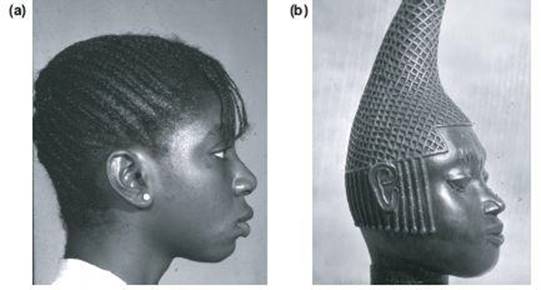
Figure 6.1 (a) and (b) British girl of Nigerian origin who wanted to look like her European school friends, compared with the ideal beauty of the Benin bronze.
Conclusions
Patients who seek surgery for dentofacial deformity frequently harbour emotional concerns and require careful psychological assessment, sound informative discussion and comprehensive information sheets. It is important to detect those patients with facial deformity and latent psychopathology who require specialist psychological assessment and support prior to treatment. Clinicians must also be aware that occasionally patients may reveal unexpected postoperative psychiatric disorders which require treatment. The body dysmorphic disorder patient must be identified early and treated appropriately. Surgery is rarely an appropriate option. Gender and ethnic dysphoria are allied idiopathic conditions where the patient appears determined to achieve an apparently irrational change in their features.
The importance of well established team care cannot be overemphasised.