
Rim for success, not perfection. Never give up your right to be wrong, because then you will lose the ability to learn new things and move forward with your life.
-Dr. David M. Burns
Just as there's a physical recovery period after surgery, there are periods of emotional and social adjustment that are pretty much universal for band patients. But, unlike tissue healing, which mends the surgical incisions, the time lines for psychological and interpersonal change are far less predictable. Throughout this book you have read over and over that weight-loss success after an AGB is not automatic; it requires a personal commitment to making lifestyle changes. But the reality is that there are numerous internal (psychological) and external (social) factors that continually challenge that personal commitment.
Also, just beneath the surface is a feeling of uncertainty regarding your new lifestyle and everything that goes along with it. Added into the equation for change are the social stigmas typically associated with obesity, not the least of which is your own concern that everyone else views bariatric surgery, and the AGB specifically, as a "last resort." This combination of influences invariably creates an underlying fear of failure.
Interestingly, there is another real problem that many obese patients havethat being the fear of success. If you've been overweight your entire life it can be frightening to consider what it might feel like not to stand out in a crowd. That concern is seldom talked about because everyone assumes that anyone who is morbidly obese wants to lose weight, and generally that's true. But I have seen patients struggle with their changing identity, and occasionally this can even lead to a subconscious sabotage behavior.
Success, like happiness, is a state of mind. I frequently use the example of results among professional golfers. Several years back I had the occasion to meet a young professional golfer who had actually won one of the lesser tour events a year or so before. When I asked how he thought he might do in the upcoming local event, he replied, "I hope to finish in the top 10." Had I asked Tiger Woods or Phil Mickelson the same question, I suspect the answer would have been, "I plan to win!" That is simply a reflection of confidence and attitude.
The really interesting part of this particular story is that later that same year the same young player who was hoping for success actually won the PGA championship, one of the four major events on the tour. From that point forward his career skyrocketed. He is currently ranked in the top 10 in the world. His swing didn't change. He doesn't hit the ball any farther. What changed was his level of confidence and perhaps, most important, a personal realization that it is okay to succeed.
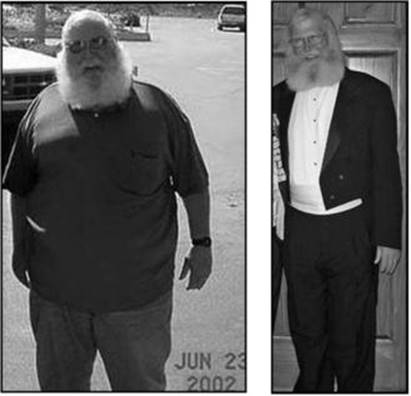
Mike's Story
(Left) Mike, one year pre-op, 427 pounds.
(Right) Mike, three years post-op, 235 pounds.
I was 427 pounds, 6 feet, 3 inches tall, and 52 years old, and I was having trouble at work. I'm a land surveyor, and I was at the point where I couldn't get out of the truck and walk the 100 to 150 feet it took to help set up equipment. I ended up sitting, running my crew by radio. One day I heard one of them referring to my truck as "Mike's motorized wheelchair." That was enough.
I heard on the radio an advertisement for weight-loss surgery at Cedar Sinai in Los Angeles, pulled over, and called. I went in for the appointment, told the doctor my medical history, my weight problem history, and he did some tests. After about 30 minutes, the doctor said, "I think you need surgery, but I don't think bypass is for you." He asked if I'd considered the band. He spent an hour talking with me, sketched the band for me, and showed me how it works. I thought this sounded good. I started researching the band and quickly became convinced that it was for me.
I knew I was facing a life-threatening condition. I was on blood pressure medication, gout medication, and aspirin to thin my blood. I had arthritis in my knees, my left leg was completely numb from my hip to my knee, and I had a limp. I thought I could be dead in a year.
I tried insurance with no success. They refused four appeals including two done by an attorney who specializes in weight-loss claims for bariatric patients. I found a band support group and started attending. At each meeting I'd stand up and say I was still looking for a way to get the band but hadn't found one yet.
I am a professional Santa Claus, own my own costume, and at the holidays I offered my services to the band support group. After the gift exchange with the kids, a doctor who was visiting the group told one of the group leaders he wanted to give me a band. He was looking for a way to bolster his practice and hoped that word would get out that there was someone he'd been philanthropic to, and someone he thought was worthy who would do a good job with the band.
They thought he was kidding, so they didn't tell me. In April, at another support group meeting, the doctor came again to read a paper about the effects of weight loss on a person's self-esteem. At the time of the meeting in which we introduced ourselves, I gave my usual speech about fighting insurance. The doctor again asked the leader of the group to tell me he'd give me a band. They did, and I said to tell him I didn't have the money. He said you don't understand, tell him I will give him a band. Seven days later I was going in to have the band surgery.
I had started losing weight following the band rules, so I went from 427 to 385 in the year I was in the support group. I ate protein first, fruits and veggies second, then carbohydrates. And I took tiny bites, chewed 30 times before swallowing, and put my fork down between bites. I also became involved in Bandsters Yahoo group online, and during that year the owner gave me the group. When I took it over there were 4,000 members. Now it's the largest online support group in the world, with more than 10,000 members and 12 moderators. We don't censor, but we stomp on flames quickly, have no advertising, no spamming, and no fishing.
My band surgery went textbook perfect. It took 42 minutes. I had no nausea, no pain, and no soreness. I got up as soon as they removed the catheter, changed into my jogging suit, and walked the halls for about two hours before they made me go back to bed. I made sure I walked. I wasn't allowed to go back to my job for six weeks, so I made sure I got plenty of walking in. I was doing about 3 or 4 miles a day.
I'm still walking 3 to 4 miles a day, but not as exercise but as part of my job, since I can now be out with my survey crew. I walk all day long. I wore out a pair of boots in the last 18 months. I used to have trouble fitting behind the wheel of the truck. Now, no problem. I can carry 80 to 100 pounds of equipment over a hill and set up, and it doesn't bother me anymore. I'm glad I have a busy job.
In the first 18 months with the band I was losing 7 to 10 pounds a week, instead of the normal 2 or 3 pounds. I lost 218 pounds in that first 18 months, which put me at 212. And it was 100 percent the band that did it. I was very committed to sticking to the rules. No candy, no shakes, no ice cream (and that's one of my favorites-I consider myself an ice cream addict).
I notice running the bandster forum, that band people have to be some of the most impatient people in the world. I remember I lost 25 pounds between my surgery and my first fill. That's the time they call "Bandster Hell" because you spent all that money, went through all that pain, and now most people don't feel like much is happening. Some people don't even feel any restriction at all. I've decided that the bandster prayer is, "Lord, give me patience, and I want it right now."
I think people need education on nutrition. You need to know what a portion is, how much protein a serving is, and so on. And it's helpful to learn to put things together so you don't get bored, like how to fix chicken in new ways. The movie Supersize Me puts the spotlight on why we're getting overweight. Supersized portions are being presented as normal, but those portions are far from normal.
If you go to a website like fitday.com and put your parameters in, it'll tell you how many calories a day you require to live. Your basal metabolism is what you need to stay alive if you do nothing. Then they add your activity level and give you a result. If you don't have a nutritionist who can teach these things to you, then you have to learn yourself-a self-education process.
What most people need to do is control their diet around the proper nutrients and the proper quantities for health. Band patients need to know what their protein requirement is individually, not generically. I require 94 grams daily as a healthy, 6-foot, 4-inch active male, so the generic average of 60 grams daily won't be enough for me. The protein requirement is based on height, weight, gender, and activity level.
With the band, I found I'm not going to be permanently barred from eating something, but some foods take so much energy it's not worth it. For example, I don't eat stringy meat.
It's not that I'm never going to have cake again, but I had to get my mind wrapped around the concept that a portion is not a huge slice, it's a tiny piece. A normal portion is 3 to 4 ounces. So when I go to a steak house and they serve me a 16-ounce steak, that's four meals' worth. I used to eat two half-pound hamburgers. Now I eat what I want whenever I want, as much as the band will allow. Most of the time I do pay attention to my protein, my fruits and veggies, and I pay particular attention to getting enough water. Water is vitally important in the weight-loss process, and I work hard to get mine in each day.
I do exercise, but I've found that it doesn't have to be the social definition. Exercise is moving mass through distance. The more mass you move (you are the mass), the more calories you'll burn. Exercise can be gardening, rowing a boat, climbing stairs, or walking the mall. It doesn't have to be organized in the gym or a formal workout session; it just has to be done.
I have hanging skin, but I'm not planning on having plastic surgery. I've been married to the same lady for 30 years, and I'm not interested in impressing anyone.
At 235 pounds, right now, I have gained back a little bit. But I'm also not being quite as strict with my dietary requirements. I went back up to 248, lost down to my current weight, and have maintained it for about a year and a half now. I now eat ice cream, a candy bar, even a milkshake, but the band controls me so I can't go nuts. Everything is in moderation. And I'm so glad to have it in there.
Your Psycho-Social Environment
It seems that almost everyone struggles with their weight, even those who don't appear to have a weight problem at all. Frequently you will hear someone who is only marginally overweight say, "I need to lose a few pounds. I think I'll try that new diet I just read about." Then they'll turn to you and ask, "Would you like to do it with me?" These are what I refer to as social dieters. They almost make dieting sound like fun, especially if "we" do it together. Virtually all morbidly obese people are surrounded by social dieters, many of whom are close friends or family. They mean well, but these folks have an entirely different perspective on weight loss than someone who has fought a losing battle with their weight most of their life. That is why they can't understand why you can't lose all your weight on their diet.
People with serious weight problems don't want to join a dieting group where everyone else is trying to lose 10 pounds. They'll be the first to lose that much, but no one ever seems to notice. Unlike the social dieter, dieting for a morbidly obese person has always been a very lonely experience that invariably has ended in failure. Along with failure to successfully lose weight come the feelings of guilt and even shame. Once again those internally programmed behaviors overrule reason and commitment. Is it any wonder that morbidly obese individuals are often emotionally stressed? Given this situation, the decision to have weight-loss surgery is often viewed by both the patient and those around them as one of desperation.
I have heard many patients say, "This just has to work," and in that statement is contained a tremendous amount of internal pressure to succeed. Family and friends are apt to say, "I know you can succeed this time if you'll just put your mind to it," further adding to the pressure to perform. You sense that everyone is watching you, and you silently wonder if the purpose of their observation is just to see you fail yet again. The irony is that all of this is usually occurring within the same psychological and social environment that helped lead to your obesity in the first place. Something clearly has to change! Your success may hinge on your ability either to change the environment around you (which is not likely) or to change the way you react to that environment. This doesn't happen overnight.
There is an obvious transitional period that occurs during the first few weeks after surgery when your old friend "food" has been taken away. One of the keys to a successful transition is finding something else to fill that need for comfort and gratification. For some this is a much bigger challenge than it is for others, but each and every band patient I have seen struggles with this issue to one degree or another. As you might expect, one of the most effective ways of learning to cope with this change is to become part of a group that actually understands your predicament, because they have been there.
To understand this psychosocial aspect of obesity surgery better, we must first acknowledge the impact that changing our eating habits has on our relationships with others. We are social creatures, and we are also social eaters. Eating is a very common group activity. In fact, it is one of the most basic of all social activities, and eating together has become a big part of our culture. Is it any wonder why most diets fail? Peer pressures associated with eating are simply too strong to resist. Some programs, such as Weight Watchers`, attempt to create a group dynamic in support of the act of dieting. Some are more successful than others, but ultimately all "diets" rely on individual willpower. Eating, on the other hand, takes on more of a herd mentality.
In contrast, surgery is by its very nature pretty much a solo proposition. It is also a totally passive activity. It's something that you have done to you, and it requires you to totally relinquish control not a very comfortable situation. It has been my experience that many people feel better about having an operation if they know one or two other people who have had it or are going to have the same procedure, so they can "share the experience." Life's struggles are always easier when we have someone to share them with, right?
A number of interesting stories have either been written or documented in news reports about families or work groups who have all had band operations. The studies show that results tend to be better for everyone when done as a group. The latest in reality television has taken competitive weight loss to a whole new level. This is group dynamics in its truest form.
The promise of the band is that it will help control the amount you can eat and suppress your hunger. Unfortunately, it doesn't alter your desire to be part of the social scene. When you get into a situation in which everyone else is eating, and you are not able to participate the way you once did, you could feel left out, even though you are physically present. Many morbidly obese people have unintentionally advanced their disease by subconsciously building a circle of friends who are also overweight. They typically plan most of their social activities around the one thing at which they have always excelled eating! Is it any surprise that once they have a band they start to feel like a social outcast?
Band patients have told me that their inner dialog in these situations goes something like this: "Everybody else is eating and enjoying themselves; why can't I? Here I sit eating my `child's portion,' and everybody is looking at me like there's something wrong. They must think I don't like the food. Do they know about my band? Should I try to tell them? No, they'd just start asking how much weight I've lost, and I don't want to go there! Maybe next time I'll just stay home." This scenario is actually quite common, and occasionally I'll see an AGB patient that has become a self-imposed social recluse.
Isolation is extremely damaging to a band patient's psychological recovery. Being part of a group makes us feel more secure, and whenever we feel separated from our group security we become uncomfortable and even afraid. Why else would so many band patients report spending countless hours in Internet chat rooms? They need to feel the security of being part of a group. Feeling secure is a major key to your success, so get involved in a group of some sort that can help provide you with support as your confidence grows.
In my practice, we aggressively promote this by utilizing group sessions in almost every aspect of our comprehensive weight-management program. We take full advantage of the positive reinforcement that patients tend to provide each other. This includes group sessions with our dietitian, group sessions with our psychologist, and our monthly support group meetings.
Re-establishing Your Circle of Friends
It is totally illogical to suggest that in order to lose weight you must seek out a whole new group of "band" friends. If that were true, no one would ever succeed. However, it is true that your success will depend in part on how supportive of your efforts those who are closest to you are. This can happen only if they understand the process you are going through. If those around you are constantly critical of your efforts, it's going to be extremely difficult for you to remain positive.
The fact is that the people around you really may not know what to say or how to act. This isn't because they don't care; it's because they simply don't know much about what you are going through. They can't relate. To avoid this you will need to take an active role in their education. One of the reasons we've written this book is to provide nonpatients with an explanation of what the AGB is and how it works. Even so, you must recognize that it may be very difficult for anyone who doesn't have a band to truly comprehend what you are going through.
Your closest friends may sometimes say the wrong thing at the wrong time. If they do, be quick to forgive them. It will help you both. It will also help you avoid the situation in which others are afraid to say anything because they don't want to offend you. Actively communicate with your friends. Let them know what's happening and how you feel about the changes you're making in your life. If you do, they will soon realize that you are still the same person you've always been; you just can't eat the way you used to. (By the way, that's a good thing.) Once they see your new positive attitude, it is quite likely that they'll be coming to you for advice on how they too might learn to better control their own eating habits.
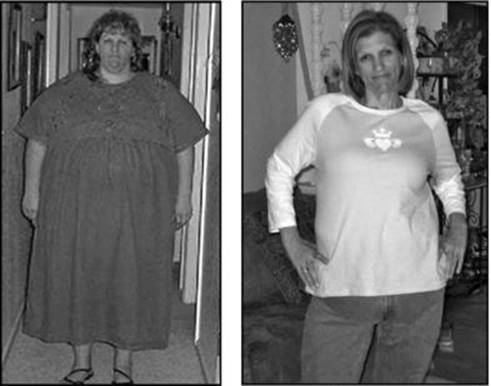
Kim's Story
(Left) Kim, pre-op, 401 pounds.
(Right) Kim, four years post-op, 183 pounds.
I'd always been overweight. I was over 200 pounds in high school. But I got to the point where I weighed 401 pounds at 5 feet, 5 inches, so my BMI was 66.7. 1 was able to carry my weight, no problem, and I was al ways very active. But I decided that my weight was too much and I needed to do something drastic and started looking into surgery.
Like everyone else, I tried weight-loss programs. I'd lose a little, then put back on twice as much. Phen/Fen® was the most successful for me, but they took that off the market. At the time, I decided on a surgeon who was doing the duodenal switch (DS). It's more drastic than the RNY. My surgeon told me DS is for people in the "super obese" category only because they fear people with less of a problem will lose too much weight, since the surgery leaves the patient with less absorption capability than the gastric bypass. My insurance would pay for the DS, so I went for it.
After my DS surgery in 2003, I dropped 150 pounds within a year. I didn't put in a lot of effort and found it almost unbelievable how fast the weight came off. It was an easy, easy loss. But one thing the DS didn't teach me was how to eat. Then after about a year and a half, my weight loss stopped. Basically I went on with life, but at 250 pounds instead of 400 pounds.
When I came up with a blockage from adhesions wrapped around my intestines, I went back to my surgeon. He asked me about my weight loss and suggested the band. He'd stopped doing the DS by then and was doing only band surgeries. I found that my insurance would pay for all of the band with a $5,000 deductible.
I thought it was a good idea, so when my surgeon went in to repair the adhesions in January of 2006, he added a band. I'm now down to 183 and am still losing. I'd like to be about 140 pounds.
If I had to do it again, I'd do the band first. I didn't learn anything from having the DS. The band has taught me what to put in my mouth and to choose good food. If I make a mistake, the feeling of it getting stuck and throwing up is unpleasant enough to motivate me to change. It's like Pavlov's dogs. When that happens, I think, "I'm not going to keep doing this to myself." As a consequence, I've learned to make better choices and learned to eat slowly. It keeps me in check with much faster feedback. For example, if I want cake, I have some, but just a couple of bites. When I had only the DS, I would eat the whole piece of cake. In a while it would make me sick, and in a few hours give me diarrhea.
I also found that my body had compensated for my eating behavior after the DS. My surgeon told me when he went in the second time, to place the band, that my stomach had stretched out and was normal size again. I was anemic and malnourished before my band surgery, so I was in serious trouble health-wise and didn't know it. Now I'm still struggling with anemia, but I make sure I eat better. I also take iron and vitamins every day, which I didn't do before.
One thing I'm excited about is that I have a job I could have never had when I was 400 pounds. I work at a health spa as a youth services director. I exercise daily as part of my workday. This would never have happened three years ago. Back then I was director over a chain of preschool programs, so I was doing pretty well in life. But it's more fun now.
Give Yourself Support
All of this group stuff sounds great, but what about the rest of the time, those hours when you are alone? It is important to recognize that as you go through the personal changes demanded by the AGB you will frequently have to be your own support. To do so requires that you first take ownership of the process. In other words, make this "your" weight-loss program and take pride in what you are doing and in each goal achieved. You also must be completely honest with yourself.
I have seen patients who carry this self-support to the extreme. These are the ones who spend countless hours on the Internet, researching every little detail of the AGB. Each revelation received from cyberspace results in a modification of their approach, attempting to match what someone else said worked for them. Ultimately, this approach leads to the creation of a whole new set of excuses. Don't fall into that trap.
The best way to get started supporting yourself is to have a written plan, outlining your specific goals, your strengths, and your known weaknesses. In the business world there are countless statements about planning, such as "Plan your work and work your plan," and "Failing to plan is a plan to fail." But the one that I think is most true for supporting your weight-loss effort is "A plan that is not written down is no plan at all."
So write down your plan. You will also need to include the particular methods you intend to use to maximize positive areas of your life and minimize situations that present the greatest challenges. For example, if you know you have difficulty resisting chocolate, your written plan should list chocolate as a weakness, along with a plan to eliminate that temptation by not keeping it in your house. Likewise, if you own a dog and enjoy the dog's company, write that down as a strength and make walking the dog part of your plan for getting regular exercise.
As the weeks and months go by you will want to add to your plan as you identify newfound strengths and new challenges. You may even be able to move something that started out as weakness into the strength category, which can have a huge impact on your psychological growth. As you progress you may even feel comfortable sharing your plan and your successes with friends and family. Once you reach the point of being comfortable sharing your personal accomplishments with others, you will also have achieved significant social growth.
Dealing with Head Hunger
G. Dick Miller, Psychologist
Head hunger is a common term among people struggling with weight loss. It refers to a condition in which you think you need food but your body is not actually the one demanding energy. Something else is triggering you to respond with food.
I believe that anxiety is the number one issue with head hunger. What happens when you're anxious is that your body triggers the same gastrological response as when you're hungry. Enzymes get secreted in the stomach, so the feeling is the same as hunger. And hunger causes pain. What further reinforces this is that eating can make you feel better-you can mix those enzymes with food, and the pain goes away. So essentially, you've treated your anxiety with food.
There are several ways to handle head hunger. For example, you can dilute the enzymes in your stomach by sipping water. Another option is simply to wait it out, promise yourself 10 minutes before you take some other action, which is how long it takes for the enzymes to be reabsorbed. You can do exercises to calm yourself, such as walking around the block, working out, or doing a few stretches right where you are. You can also practice calming relaxation techniques such as slowing your breathing and letting your breaths come in and out from deep in your stomach instead of your chest. Or you might choose an area of your body and become aware of how it feels, such as the cloth against your skin on your right arm, or the way your left foot feels in your shoe. Another option is that you can simply tell yourself the feeling will pass. Or you can eat a little bit of something nutritious, instead of a substantial amount of anything, to feel better. Limit your intake and wait to see if you still feel hungry.
Being aware of the self, how you're feeling, is the biggest help. Personal honesty is the key. If you call it what it is, either stress or anxiety, then you've opened the door in your thinking to treat it in another way. Once you correctly identify the uncomfortable feeling, all of these options for treating anxiety become available to you. And this change in thinking allows you to make a better decision for yourself.
Checklist: Seven Ways to Handle Head Hunger
1. Take a sip of water.
2. Wait it out (about 10 minutes).
3. Exercise-walk, stretch, etc.
4. Concentrate on deep, slow breathing.
5. Focus on how various parts of your body feel, such as the clothing on your arm or your left foot in your shoe.
6. Tell yourself that the hungry feeling will pass.
7. Eat a little bit of something nutritious.
Change Your Daily Activities
Now that you are armed with your own plan, success is just a matter of time, right? Well, maybe. I don't mean to sound negative, but just a word of caution. Our society and our individual lives move at an incredibly fast pace. The "newness" of AGB surgery wears off rather quickly, and you'll soon find that nothing has really changed. The stresses of daily life are still there. Virtually everyone has a "to do" list, but rarely if ever are we able to get all the things on our list done. So, out of necessity we prioritize, focusing on those problems that represent immediate needs, usually our job, our family, or a particular relationship.
However, we tend to procrastinate when it comes to our list of self-improvements. As we've discussed, many personal behaviors become more or less programmed responses. The keys to unprogramming your responses are, first, make yourself, and in particular your health, a priority on your "to do" list, and second, embrace the idea of change. In the next chapter we will discuss how to implement these keys to changing your lifestyle.