
 HAILEY–HAILEY DISEASE (BENIGN FAMILIAL PEMPHIGOID)
DESCRIPTION Autosomal dominant skin disease arising from mutations of the ATP2C1 gene. The appearance begins as a flaccid vesicle or bulla with associated itching, irritation, and a possible odor. The lesions may erupt and leave crusted erosions, and some may have a dry center and inflammatory periphery. The onset usually occurs within the 2nd–3rd decades of life, and lesions are seen in intertriginous areas (ie, axillary fold, groin, and perianal areas). Lesions heal without scarring. Treatment involves antibiotics for superinfection, steroids, and dermabrasion.
REFERENCE
McKibben J, Smalling C. Hailey-Hailey. Skinmed. 2006;5(5):250–252.
HALD–BRADLEY CLASSIFICATION OF VOIDING DYSFUNCTION
DESCRIPTION Based on the anatomic location of the neurologic lesion, voiding dysfunction is broken down into 5 classes: (1) Suprasacral, (2) suprasacral spinal, (3) infrasacral, (4) peripheral autonomic neuropathy, and (5) muscular lesions. Examples include coordinated voiding with hyperreflexia in suprasacral lesions, whereas muscular lesions may be a decompensated bladder from long-standing bladder outlet obstruction.
REFERENCE
Hald T, Bradley WE. The neurogenic bladder. In The Urinary Bladder, Neurology and Urodynamics. Baltimore, MD: Williams and Wilkins; 1982.
HAND FOOT SYNDROME
DESCRIPTION Many oncologic medications have been implicated (such as capecitabine, fluorouracil, others), but this condition appears to be a relatively common problem with multikinase inhibitors such as sunitinib and sorafenib, which are used to treat tumors such as metastatic renal cell carcinoma (RCC). Symptoms include tingling or burning, redness, flaking, swelling, and small blisters and sores on the palms of the hands or soles of the feet. Some patients experience eventual skin hardening (Image  ).
).
SYNONYMS
• Palmar–plantar erythrodysesthesia (PPE)
• Plantar–palmar toxicity
• Palmoplantar keratoderma
TREATMENT
• Reduce exposure of hands and feet to friction and heat (ie, hot water, avoid pressure on feet, avoid using tools, cool hands and feet with an ice pack, moisturizing creams).
• Stopping the medication temporarily reduces the symptoms. The drug can often be restarted at a lower dose.
REFERENCE
Hutson TE, Figlin RA, Kuhn JG, et al. Targeted therapies for metastatic renal cell carcinoma: An overview of toxicity and dosing strategies. Oncologist. 2008;13(10):1084–1096.
HAUTMANN POUCH
DESCRIPTION This ileal neobladder is created from 70 cm of ileum, starting 15 cm from the ileocecal junction. The bowel is opened up along the antimesenteric border, and is arranged into an M or W shape. The limbs are sutured to each other with absorbable suture material to form a broad ileal plate. A preselected segment is anastomosed to the urethra, and the ureters are implanted in a LeDuc fashion. The plate is then closed into a pouch and anastomosed to the urethra.
REFERENCE
Hautmann RE, Egghart G, Frohneberg D, et al. The ileal neobladder. J Urol. 1988;139(1):39–42.
HEIKEL–PARKKULAINEN REFLUX CLASSIFICATION SYSTEM
DESCRIPTION Described by Heikel and Parkkulainen in 1966, this system is used to grade vesicoureteral reflux based on ureteral diameter and pelvicalyceal dilatation. It gained much popularity in Europe. Later, features of this system were used to create the International Classification System, which is now the standard.
REFERENCE
Heikel RE, Parkkulainen KV. Vesico-ureteric reflux in children: A classification and results of conservative treatment. Ann Radiol. 1966;9:37–40.
HEMATOCELE
DESCRIPTION Collection of blood within the layers of the tunica vaginalis. Hematocele can present as scrotal swelling and may be asymptomatic. It may be difficult to distinguish from tumor, in which case transcrotal ultrasound (US) is helpful. Causes include trauma, infection, bleeding disorders, tumor, and rarely uremia. (See also Section I: “Scrotum and Testicle, Mass”; Section I: “Scrotum and Testicle, Trauma.”)
TREATMENT
Conservative management if patient asymptomatic and diagnosis confirmed. Often, diagnosis by surgical exploration
REFERENCE
Chaudhary S, Bhullar JS, Subhas G, et al. Hematocele after laparoscopic appendectomy. JSLS. 2012;16(4):660–662.
HEMATURIA, ATHLETIC (RUNNERS’ HEMATURIA)
DESCRIPTION Described mostly in adults after strenuous exercise. The phenomenon of gross or microscopic hematuria can occur in contact or noncontact sports. The RBCs seen in the urine may be glomerular or nonglomerular in shape. The cause of the hematuria can be from trauma of the posterior bladder wall hitting against the bladder base. Nontraumatic causes are hypothesized to be from hypoxic changes secondary to the vasoconstriction of the splanchnic and renal vessels or to constriction of the efferent glomerular arteriola resulting in increased filtration pressures in the kidney. The hematuria should be distinguished from myoglobinuria and hemoglobinuria.
SYNONYMS
• Sports hematuria
• Athletically induced hematuria
TREATMENT
• Should be self-limited and provoked by strenuous exercise.
• Co-existing urologic pathology should be ruled out if history or physical exam is suspicious.
REFERENCE
Abarbanel J, Benet AE, Lask D, et al. Sports hematuria. J Urol. 1990;7143:65887–65890.
HEMATURIA–DYSURIA SYNDROME
DESCRIPTION Hematuria–dysuria syndrome is the most common reported complication of gastrocystoplasty. The syndrome of dysuria and hematuria is defined as 1 or a combination of the following symptoms: Bladder spasm or suprapubic, penile or periurethral pain, coffee brown or bright red hematuria without infections, skin irritation or excoriation, and dysuria without infections.
REFERENCE
Chadwick PJ, Snodgrass WT, Grady RW, et al. Long-term follow-up of the hematuria-dysuria syndrome. J Urol. 2000;164(3 Pt 2):921–923.
HEMATURIA–LOIN PAIN SYNDROME
DESCRIPTION A cause of recurrent gross hematuria that may be confused with IgA nephropathy, loin pain-hematuria syndrome generally affects young women and is characterized by recurrent episodes of gross hematuria associated with dull unilateral or bilateral loin pain and sometimes low-grade fever. BP and renal function are usually normal. The syndrome has been associated most often with the use of oral contraceptive agents and generally resolves when these agents are discontinued. Renal autotransplantation has been described as a treatment modality.
REFERENCE
Chin JL, Kloth D, Pautler SE, et al. Renal autotransplantation for the loin pain-hematuria syndrome: Long-term followup of 26 cases. J Urol. 1998;160(4):1232–1235.
HEMIZONA ASSAY
DESCRIPTION This assay assesses the ability of sperm to bind to the zona pellucida of the egg. It is performed by dividing intact zona pellucida and incubating it separately with donor sperm and the patient’s sperm. A hemizona index is derived by dividing the number of bound donor sperm by the number of bound patient sperm. An index <0.60 is seen in males who failed IVF. Its use is limited by the availability of human ova. Since this technique potentially bypasses the step of zona binding, men whose sperm cannot bind may be good candidates for these procedures.
REFERENCE
Yao YQ, Yeung WS, Ho PC. The factors affecting sperm binding to the zona pellucida in the hemizona binding assay. Hum Reprod. 1996;11(7):1516–1519.
HEMORRHAGE, POSTOPERATIVE, UROLOGIC CONSIDERATIONS
DESCRIPTION Postoperative hemorrhages can occur after any urologic procedure, but are most common and significant with percutaneous procedures of the kidney. The risk of hemorrhage increases in patients with underlying coagulopathy, aberrant anatomy, multiple needle passages, tract dilation, or nephrostomy tube placement. Parenchymal bleeding can be persistent, and a large high-pressure balloon can be placed through the nephrostomy tube tract to promote tamponade and hemostasis. Not uncommonly, venous lacerations may occur and can be managed by placing a large nephrostomy tube and clamping the tube to allow for tamponade. If arterial bleeding is persistent, selective arterial embolization may be employed. Delayed bleeding can occur soon after surgery, or weeks to months later in the setting of renal pseudoaneurysms or arteriovenous fistulas. If these diagnoses are suspected, evaluation with angiography and treatment with selective embolization can be performed.
REFERENCE
Srivastava A, Singh KJ, Suri A, et al. Vascular complications after percutaneous nephrolithotomy: Are there predictive factors. Urology. 2005;66:38–40.
HEMORRHAGE, RETROPERITONEAL AND PERINEPHRIC
DESCRIPTION Retroperitoneal and perinephric hemorrhage are uncommon in the absence of trauma. Spontaneous retroperitoneal and perinephric hemorrhage is most commonly from the kidney. The most common renal causes are angiomyolipoma (AML) and renal cell carcinoma (RCC). Vascular diseases such as polyarteritis nodosa (PAN), renal artery aneurysm, infections of kidney such as cortical abscess, pyelonephritis, and renal cysts are occasional etiologic factors. Adrenal hemorrhage (AH) is seen with severe stress conditions (sepsis, burns, trauma), pheochromocytoma, adrenal carcinomas, myelolipoma, and cortical adenomas. Clinical presentation depends on the amount of bleeding ranging from mild flank pain to shock and oliguria. CT scan is considered the gold standard for diagnosis. (See also Section I: “Retroperitoneal Masses, Fluid and Cysts” and Section II: “Retroperitoneal Hematoma.”)
REFERENCE
Goyal A, et al. Spontaneous retroperitoneal haemorrhage: Diagnostic and therapeutic approach. Indian J Urol. 2001;18:70–73.
HEMOSIDERIN, URINARY
DESCRIPTION Hemosiderin occurs when hemoglobin is reabsorbed by the proximal tubular cells and then catabolized into ferritin and hemosiderin. Urinary hemosiderin can occur up to 2 days after an acute hemolytic episode, and is also demonstrated in chronic hemolytic states and hemochromatosis.
REFERENCE
McPherson R, Threatte G. Urine and other body fluids. In: McPherson RA, Pincus MR, eds. Henry’s Clinical Diagnosis and Management by Laboratory Methods. 21st ed. Philadelphia, PA: Saunders; 2006.
HENOCH–SCHöNLEIN PURPURA (HSP)
DESCRIPTION HSP is a form of purpura with an underlying pathologic feature of vasculitis, affecting mainly small blood vessels. The disease is predominately seen in children. Clinically, the purpuric skin lesions are typically located on the lower extremities. However, the hands, arms, and trunk can be affected. Joint pain, abdominal pain, and GI bleeding may be present. Hematuria denotes a renal lesion, which is usually reversible. HSP is similar to IgA nephropathy, but somewhat more severe, particularly in adults. Progressive renal failure occurs in at least 25%. Kidney biopsy reveals segmental glomerulonephritis with crescents and mesangial deposition of IgA and sometimes IgG. Lab tests reveal high ESR and normal to high platelet counts. If renal involvement is not severe, the disease will subside without sequelae within 6 wk.
TREATMENT
• Currently no effective treatment is available.
• Immunosuppressive (steroids, cytotoxics) drugs have shown some success in nephropathies caused by that disorder.
REFERENCE
Assadi F. Childhood Henoch-Schönlein nephritis: A multivariate analysis of clinical features and renal morphology at disease onset. Iran J Kidney Dis. 2009;3(1):17–21.
HEPATITIS A & B (HAV/HBV), UROLOGIC CONSIDERATIONS
DESCRIPTION HAV and HBV both belong to a family of 5 hepatropic viruses. HAV is a picornavirus and is mostly enterically transmitted by fecal–oral routes. Transmission has been noted in men who have sex with men and with oral–anal contact regardless of sexual preference. No significant transmission occurs through semen or vaginal secretions, but transmission through blood products is rare but possible. Extrahepatic manifestations include vasculitis, cardiac abnormalities, Guillain–Barré (transverse myelitis), and renal failure. HBV is a double-shelled hepadnavirus and is mostly transmitted parenterally, which can take place from mother to fetus, through blood products, and through cutaneous and mucosal exposure to infectious blood or bodily fluid. Unlike HAV, HBV has a chronic phase that may lead to hepatocellular carcinoma.
REFERENCE
Curry M, Chopra S. Acute viral hepatitis. In: Mandell GL, Bennett JE, Dolin R, eds. Principles and Practice of Infectious Diseases, 6th ed. Philadelphia, PA: Churchill Livingstone; 2005.
HEPATORENAL SYNDROME
DESCRIPTION Known as progressive oliguric renal failure complicating the course of end-stage liver disease, the cause is thought to be functional, due perhaps to discharge of the sympathetic nervous system and/or metabolic imbalances, including endothelin and nitric oxide. The prognosis usually involves recovery of renal function and for survival overall. Urine is characteristically hyperosmolar, with a high creatine-to-plasma ratio and a very low sodium concentration.
TREATMENT
• A transjugular intrahepatic portosystemic shunt has been attempted in the past
• Orthotopic liver transplantation
REFERENCE
Lata J. Hepatorenal syndrome. World J Gastroenterol. 2012;18(36):4978–4984.
HEREDITARY LEIOMYOMA RENAL CELL CARCINOMA (HLRCC) SYNDROME
DESCRIPTION HLRCC syndrome is manifested by uterine leiomyomas, multiple cutaneous leiomyomas, and RCC (papillary cell carcinoma). The disorder results from an autosomal dominant germline mutation encoding for fumarate hydratase. The renal tumors have been found to be aggressive, leading to early metastases and death. (See also Section I: “Renal Cell Carcinoma, General.”)
TREATMENT
• Early diagnosis and close follow-up
• Nephrectomy (partial or radical) when indicated
REFERENCE
Hayedeh G, Fatemeh M, Ahmadreza R, et al. Hereditary leiomyomatosis and renal cell carcinoma syndrome: A case report. Dermatol Online J. 2008;14(1):16.
HEREDITARY PAPILLARY RENAL CELL CARCINOMA (HPRCC)
DESCRIPTION HRPCC is an autosomal dominant disorder associated with type 1 papillary RCC. Activation of a proto-oncogene, rather than inactivation of a tumor suppressor gene, is the inciting event. Missense mutations of the c-MET proto-oncogene on chromosome 7 at 7q31 have been described as the relevant genetic locus causing the disorder. A majority of the mutations were isolated on the tyrosine kinase domain of the c-MET gene. Tumors linked to these mutations are thought to be less aggressive than the sporadic type. (See also Section I: “Renal Cell Carcinoma, General.”)
REFERENCES
Sudarshan S, Linehan WM. Genetic basis of cancer of the kidney. Semin Oncol. 2006;33:544–551.
Vira MA, Novakovic KR, Pinto PA, et al: Genetic basis of kidney cancer: A model for developing molecular-targeted therapies. BJU Int. 2007;99:1223–1229.
HERNIA UTERINE INGUINALE
DESCRIPTION A cause of male pseudohermaphroditism, thought to be due to an isolated defect in the production of müllerian inhibition substance or the response to müllerian inhibiting factor (MIF). This is a rare syndrome of müllerian ducts persistence. Affected males are not ambiguous at birth and generally present later, most commonly with an inguinal hernia on 1 side and an impalpable contralateral testes. Hernia sac may contain the uterus. Karyotype is 46, XY. The gonadal tissue is exclusively testicular. Both wolffian and müllerian duct derivatives are present, with a vas and epididymis alongside an ipsilateral uterus, fallopian tube, and upper vagina. Testes have malignant potential. No uterine or vaginal malignancies have been reported.
TREATMENT
• Sex assignment as male
• Primary or staged orchidopexy
• Müllerian structures do not require removal, as the vas deferens may be damaged.
REFERENCE
Snyder HM. Intersex. Practical Cases in Urology. Series XIX, Course 4, 1996.
HERPES ZOSTER, GENITOURINARY
DESCRIPTION If the herpes zoster virus invades the sacral dorsal root ganglia and posterior nerve roots, then detrusor areflexia and urinary retention can result. These symptoms are usually noted days to weeks after the onset of primary viral symptoms, such as painful cutaneous lesions. The urologic symptoms usually spontaneously resolve in 4–8 wk. Cystoscopy may reveal bladder lesions similar to the cutaneous lesions.
REFERENCE
Broseta E, Osca JM, Morera J, et al. Urological manifestations of herpes zoster. Eur Urol. 1993;24(2):244–247.
HIDRADENITIS SUPPURATIVA (ACNE INVERSA), UROLOGIC CONSIDERATIONS
DESCRIPTION A chronic suppurative disease of the apocrine gland–bearing areas of the body, such as the axilla, buttocks, and groin. Not primarily infectious; caused by plugging of the follicles. Secondary infection can occur after the follicle plugs, with resultant inflammatory response. Lesions resemble boils and can resolve without scarring but more typically result in fibrosis, keloids, and sinus tract formation. Mild cases resemble simple boils (furunculosis). Diagnosed primarily by location and clinical course. Pain, fluctuation, discharge, and sinus tract formation are characteristic. In chronic cases, coalescence of inflamed nodules may cause palpable cordlike bands. The condition may become extensive and disabling; if the pubic and genital areas are severely involved, walking may be difficult.
TREATMENT
• Avoid irritants such as antiperspirants
• Conservative treatment with rest, moist heat, and prolonged antibiotics (tetracycline or erythromycin)
• Oral isotretinoin and intralesional corticosteroids may be effective
• Surgical excision and plastic repair of the affected areas may be necessary
REFERENCE
Goldberg JM, Buchler DA, Dibbell DG. Advanced hidradenitis suppurativa presenting with bilateral vulvar masses. Gynecol Oncol. 1996;160(3):494–497.
HINMAN SYNDROME (HINMAN–ALLEN SYNDROME) (NONNEUROGENIC NEUROGENIC BLADDER) (OCCULT NEUROPATHIC BLADDER)
DESCRIPTION 1st described in 1937 by Hinman and Bauman, this is a syndrome of vesicourethral dysfunction (dysfunctional voiding) that is associated with recurrent UTIs, vesical trabeculation, poor emptying, and hydronephrosis with possible progression to renal failure. Hinman syndrome is thought to occur from bladder sphincteric dysfunction with no signs of neurologic cause and may begin in the neonate or in the child around the time of toilet training.
SYNONYM
Nonneurogenic neurogenic bladder
TREATMENT
• Clean intermittent catheterization (CIC)
• Cutaneous vesicostomy
REFERENCE
Mosawi AJ. Identification of nonneurogenic neurogenic bladder in infants. Urology. 2007;70:356–357.
HISPAREUNIA (MALE DYSPAREUNIA)
DESCRIPTION Sling erosion/extrusion is a recognized complication after suburethral sling insertion to treat female stress urinary incontinence (SUI). Erosion occurs in up to 6% of patients. Female symptoms may include discharge, infections, postcoital bleeding, and alterations of the sexual function. Changes of male sexual function and particularly pain after sling insertion in their female partners may be due to sling exposure and has been termed “hispareunia.” Sexual interest and drive may be negatively influenced. Male dyspareunia is a complaint that appears to be effectively treated by correcting the sling exposure in the female partner.
REFERENCE
Mohr S, Kuhn P, Mueller MD, et al. Painful love-”hispareunia” after sling erosion of the female partner. J Sex Med. 2011;8(6):1740–1746.
HISTOPLASMOSIS, GENITOURINARY
DESCRIPTION Histoplasma capsulatum grows in soil enriched by bird guano, with outbreaks reported in caves, construction sites, and on bird farms. Disseminated virulent disease is seen in AIDS, children, and immunosuppressed individuals. GU involvement is a manifestation of systemic disease and can result in sloughed papilla, prostatic obstruction, or prostatic abscess. Epididymitis can resemble sperm granulomas. Up to 7% can experience adrenal insufficiency from adrenal destruction. (See also Section I: “Fungal infections, Genitourinary.”)
TREATMENT
2 g of amphotericin B with maintenance therapy with itraconazole to prevent relapse
REFERENCE
Wise GJ, Freyle J. Changing patterns in genitourinary fungal infections. AUA Update. Vol. XVI, Lesson 1, 1997.
HIV NEPHROPATHY
DESCRIPTION HIV nephropathy (HIVAN) is the most common cause of chronic renal failure among HIV seropositive patients. It can occur in both the chronic and acute phase of the illness. Presentation may include nephrotic syndrome, hypertension, hematuria, and renal insufficiency. Pathologically, there is a focal segmental glomerulosclerosis, collapsing nephropathy with podocyte hypertrophy, and hyperplasia. (See also Section I: “HIV/AIDS, Urologic Considerations.”)
TREATMENT
• Highly active antiretroviral therapy
• Steroids
• ACE inhibitor
REFERENCE
Audard B, Avouac J, Wirden M, et al. HIV-related nephropathies associated with changes in blood and kidney tissue virus load. Kidney Int. 2008;73:651–655.
HODGKIN DISEASE, UROLOGIC CONSIDERATIONS
DESCRIPTION Hodgkin disease is a type of lymphoma differentiated from other lymphomas partially on the basis of the presence of Reed–Sternberg cells. It has become 1 of the most curable forms of malignancy. It has many urologic associations, and an association with a higher incidence in RCC patients has been proposed. Treatment with radiation for Hodgkin may predispose to bladder cancer. The kidney and bladder have been reported to be primary sites of Hodgkin disease. Extensive retroperitoneal lymphadenopathy may cause ureteral obstruction. Renal radiation-induced arterial stenosis can be a treatment effect. (See also Section II: “Lymphoma, Urologic Considerations.”)
REFERENCE
Jones MW. Primary Hodgkin’s disease of the urinary bladder. Br J Urol. 1989;63(4):438.
HODGSON TYPES I, II, III HYPOSPADIAS REPAIR
DESCRIPTION Type I: Chordee is repaired. A longitudinal tube along the urethral axis is formed on the inner surface of the prepuce, which is then transferred to the ventrum through a buttonhole incision at the base of the tube. The proximal neourethra is anastomosed to the proximal native urethra, and the distal neourethral tube is used to create the meatus.
Type II: Hodgson modified type I for the very distal hypospadias where no chordee exists, and the native urethral plate remains intact. The inner surface of the prepuce is again transferred to the ventrum via a buttonhole at the base. In this repair, the prepuce flap is sutured onto the urethral plate.
Type III: This is modified for the more proximal hypospadias repair. Here, the buttonhole is created at the base of the penis, and a longer tubular neourethral is created, based on preputial and shaft skin.
REFERENCE
Devine CJ, Horton CE. Repair of hypospadias and epispadias. In: Novick AC, Streem SB, Pontes JE, et al., eds. Stewart’s Operative Urology. Baltimore, MD: Williams & Wilkins; 1989:689–714.
HONEYMOON CYSTITIS
DESCRIPTION Urinary tract infection which affects young sexually active women. It accounts for 4% of UTIs and for 75–90% of episodes in young sexually active women. The pathogenesis of this disorder involves transmission of bowel flora from the perineum into the female’s introitus during sexual intercourse. The proximity of the bladder to the perineum enables the development of an ascending infection through the female’s short urethra. Spermicide use, independent of sexual frequency, increases the risk of UTIs. (See also Section I: “Urinary Tract Infection [UTI], Adult Female”; Section II: “Postcoital Prophylactic Antibiotics.”)
TREATMENT
• High fluid intake
• Postcoital voiding (controversial if useful)
• Identify any triggers (Spermacide, positioning during sexual activity, etc.)
• Consider single dose of antibiotic before or after intercourse if >3 symptomatic UTIs/yr (eg, Trimethoprim/sulfamethoxazole, trimethoprim, nitrofurantoin, cephalexin, ciprofloxacin, others)
REFERENCE
Nicolle LE. Uncomplicated urinary tract infection in adults including uncomplicated pyelonephritis. Urol Clin North Am. 2008;35(1):1–12.
HORSESHOE KIDNEY
DESCRIPTION The most common fusion anomaly, present in 1 in 400 births, with a male predominance. Usually, this represents a true fusion of the lower poles, which may be composed of thick functioning parenchyma or merely a fibrous band. Associated anomalies are seen in 1/3 of patients and include multisystem disturbances of the skelet al and cardiovascular systems and GI tract, as well as GU abnormalities, such as an increased frequency of ureteral duplication, reflux, and dysplasia. Usually asymptomatic, a horseshoe kidney may be associated with urolithiasis and UPJ obstruction. Radiographic diagnosis can be made with IVP or CT, which reveals deviation of the axis of the kidneys. Renal scan may be helpful in surgical decision making, if necessary. The condition is caused by fusion of poles during ascent of the kidneys. (See also Section I: “Renal Fusion Anomalies.”)
TREATMENT
• Pyeloplasty and ureteral implantation may be required for proven UPJ obstruction or severe reflux, respectively
• Can affect management of many other disease conditions, such as neoplasm, aortic aneurysm, and transplantation
REFERENCE
O’Brien J, Buckley O, Doody O, et al. Imaging of horseshoe kidneys and their complications. J Med Imaging Radiat Oncol. 2008;52(3):216–226.
HORTON-DEVINE “FLIP-FLAP” HYPOSPADIAS REPAIR
DESCRIPTION The distal ventral skin over the urethra is mobilized, and the distal urethra is also mobilized. Parallel incisions are made in the glans to create a urethral plate, and the proximal flap is flipped over and sutured onto the urethral plate. The wings of the glans are then approximated over this distal repair.
REFERENCE
Devine CJ, Horton CE. Repair of hypospadias and epispadias. In: Novick AC, Streem SB, Pontes JE, et al., eds. Stewarts Operative Urology. Baltimore, MD: Williams & Wilkins; 1989:689–714.
HOUNSFIELD UNITS
DESCRIPTION Named after Sir Godfrey Newbold Hounsfield, the inventor of the CT scanner, this is an arbitrary scale created to compare density of different substances seen on CT. Water is represented by 0 HU. Air is –1,000 HU. Bone is 1,000 HU. Fat is in the range of –100 to 0 HU, whereas water with electrolytes is slightly above 0 HU. Soft tissue is in the range of 35 HU.
REFERENCE
Miraldi F. Imaging principles in computed tomography. In: Haaga JR, Alfidi RJ, eds. Computed Tomography of the Whole Body. 1st ed. St. Louis, MO: Mosby; 1983.
HPC-1 (HEREDITARY PROSTATE CANCER 1 LOCUS)
DESCRIPTION A locus found on chromosome 1q24–25, which has been potentially linked to inherited prostate cancer. Families in which this altered gene is found were determined to have a lower age at diagnosis, a higher grade of cancer, and more cases of advanced disease than normal.
REFERENCE
Gronberg H, Isaacs SD, Smith JR, et al. Characteristics of prostate cancer in families potentially linked to the hereditary prostate cancer 1 (HPC1) locus. JAMA. 1997;278(15):1251–1255.
HPV (HUMAN PAPILLOMA VIRUS), UROLOGIC CONSIDERATIONS
DESCRIPTION This family of viruses, with double-stranded DNA, causes various warts, papillomas, and cervical cancer. Types 6, 11, 42, and 44 are associated with condyloma acuminatum. Types 16, 18, 31, 33, 35, and 39 have an association with cancer. Types 6 and 11 have been associated with Buschke–Lowenstein tumor. Subclinical condyloma can be detected with application of 5% acetic acid and inspection with a magnifying glass. HPV is associated also with Bowenoid papulosis and squamous cell carcinoma of the penis and urethra. Bladder cancer association is controversial. (See also Section I: “Condylomata Acuminata [Venereal Warts]”; “Penis, Lesion, General”; and Section II: “Buschke-Lowenstein Tumor.”)
TREATMENT
• Podophyllin or trichloroacetic acid for condyloma
• Laser therapy is also effective
REFERENCES
Abol-Enein H. HPV Infection: Is it a cause of bladder cancer? Scand J Urol Nephrol Suppl. 2008;(218):79–84.
Kayes O, Ahmed HU, Arya M, et al. Molecular and genetic pathways in penile cancer. Lancet Oncol. 2007;8(5):420–429.
HUMAN GROWTH HORMONE (hGH), UROLOGIC CONSIDERATIONS
DESCRIPTION Use of hGH has been approved for children with short stature. There are multiple off-label uses; hGH has also been used in the aging patient to increase energy and possibly libido, and to add muscle mass in athletes. These therapeutic applications are not supported by evidence-based studies. There have been some concerns expressed that the use of hGH may increase the risk of germ cell tumors (GCT’s) anywhere in the body; vigilant monitoring is mandatory in treated GCTs who are hGH replaced.
REFERENCES
Allen DB, Fost N. hGH for short stature: Ethical issues raised by expanded access. J Pediatrics. 2004;144(5):648–652.
Chung, TT, Drake WM, Plowman PN, et al. No clear evidence for an association between GH replacement and relapse of intracranial germ cell tumours: single centre and KIMS experience. Eur J Endocrinol. 2010;163:357–358.
HUNNER ULCER
DESCRIPTION Cystoscopic finding of ulceration of the bladder mucosa in patients with interstitial cystitis/painful bladder syndrome (IC/PBS). This fulfills 1 of the NIH criteria for IC/PBS. Found in a variable number of patients with IC/PBS, it was 1st described by Hunner in 1918, when he noted the ulcer in association with the constellation of clinical findings of IC/PBS. (See also Section I: “Interstitial Cystitis.”)
REFERENCE
Hillelsohn JH, Rais-Bahrami S, Friedlander JI, et al. Fulguration for Hunner ulcers: Long-term clinical outcomes. J Urol. 2012;188(6):2238–2241.
HUTCH DIVERTICULUM
DESCRIPTION Herniation of the bladder mucosa through the weakest point of the hiatus, in the detrusor above the intramural ureter, producing a Hutch diverticulum and reflux. The condition is usually due to a chronic increase in intravesical pressure as a result of bladder outlet obstruction. (See also Section I: “Vesicoureteral Reflux, Adult” and “Vesicoureteral Reflux, Pediatric.”)
REFERENCE
Hutch JA, Ayres RD, Loquvam GS. The bladder musculature with special reference to the uretero vesical junction. J Urol. 1961;85:531.
HYDATID CYST (HYDATID DISEASE)
DESCRIPTION Infection occurs after ingestion of the dog parasite, Echinococcus granulosus (tapeworm). Sheep are the intermediate hosts. Cases occur in the Middle East, Australia, and Argentina. The hydatid is the larval form of E. granulosus, and the cysts represent a thick parasitic membrane that is enveloped in fibrous tissue. The cysts are fluid filled and contain the parasites. They grow slowly over many years and typically involve the kidney (2% incidence with echinococcus), with cases of seminal vesical involvement also reported. 3% affect the kidneys. Large cysts form that can be asymptomatic or present with flank pain. Renal cysts may cause pressure and chronic pain but do not affect renal function. They may rupture, causing new metastatic cysts. A peripheral eosinophilia is seen with a positive hydatid complement-fixation test. X-rays and CT show a thick-walled, fluid-filled spherical cyst with a calcified wall. (See also Section II: “Echinococcus, Renal.”)
TREATMENT
• Medical therapy is with albendazole.
• Where surgical excision is indicated, cysts can be 1st sterilized with formalin or alcohol. Praziquantel is also recommended preoperatively or if cyst contents are spilt (which can cause systemic anaphylaxis).
REFERENCE
Kaya K, Gokce G, Kaya S, et al. Isolated renal and retroperitoneal hydatid cysts: A report of 23 cases. Trop Doct. 2006;36(4):243–246.
HYDROCALYCOSIS
DESCRIPTION A relatively rare cystic dilation of a major calyx. A calyceal diverticulum is distal to a minor calyx, whereas the hydrocalyx is a dilation of a major calyx. Caused by a congenital anomaly secondary to acquired intrinsic obstruction from a parapelvic cyst or crossing vessel causing infundibular stenosis. Differential diagnoses includes megacalycosis, ureteral obstruction and hydronephrosis, calyceal clubbing due to pyelonephritis or medullary necrosis, renal TB, or calyceal diverticulum. Patients may complain of flank pain, hematuria, or infection. Dismembered pyeloplasty or percutaneous treatment of the narrowed infundibulum is curative.
REFERENCE
Craver R, Boyd R, Ward K, et al. Renal hypertrophic infundibular stenosis. Fet al Pediatr Pathol. 2004;23(4):285–292.
HYDROCELE OF THE SPERMATIC CORD
DESCRIPTION A loculated fluid collection along the spermatic cord, the process is caused by a failure of the process vaginalis to close during development. The hydrocele can be in communication with the peritoneum at the internal inguinal ring (funicular) or may be encysted, where the fluid collection does not communicate with the peritoneum or the tunica vaginalis. Patients usually present with groin swelling and should be evaluated with US, which will exhibit an oval anechoic mass in the groin along the spermatic cord and above and separated from the testis and the epididymis. (See also Section I: “Hydrocele, Adult and Pediatric”; Section I: “Spermatic Cord Mass.”)
REFERENCE
Rathaus V, Konen O, Shapiro M, et al. US features of spermatic cord hydrocele in children. Br J Radiol. 2005;74:818–820.
HYMENAL SKIN TAGS
DESCRIPTION A polypoid lesion of the hymenal ring. A normal variant and rarely symptomatic (ie, bleeding, irritation), treatment involves observation or excision when symptomatic or to exclude malignancy.
REFERENCE
Rink RC, Kaefer M. Surgical management of disorders of sexual differentiation, cloacal malformation and other abnormalities of the genitalia in girls. In: Wein AJ, et al., eds. Campbell-Walsh Urology. 10th ed. Philadelphia, PA: Saunders, 2012:3629–3666.
HYPERBARIC OXYGEN, UROLOGIC CONSIDERATIONS
DESCRIPTION This therapy involves use of oxygen at higher than atmospheric level. A variety of uses have been reported. Mainly, hyperbaric oxygen has been used to aid in wound healing. Reports of its efficacy in healing after radiation-induced wounds and iatrogenic debridement following necrotizing fasciitis of the genitourinary tract (Fournier gangrene) have been described. Hyperbaric oxygen has also been reported in the treatment of hematuria from radiation cystitis. (See also Section I: “Fournier gangrene”; “Cystitis, Hemorrhagic [Infectious, Noninfectious, Radiation”] and Section II: “Cystitis: Radiation.”)
REFERENCES
Jallali N, Withey S, Butler PE. Hyperbaric oxygen as adjuvant therapy in the management of necrotizing fasciitis. Am J Surg. 2005;189:462–466.
Neheman A, Nativ O, Moskovitz B, et al. Hyperbaric oxygen therapy for radiation-induced haemorrhagic cystitis. BJU Int. 2005;96:107–109.
HYPERCALCEMIA, UROLOGIC CONSIDERATIONS
DESCRIPTION In urology, hyperuricemia is generally the result of metastatic lesions to bone, hydrochlorothiazide therapy, hyperparathyroidism, or chronic renal failure. Symptoms include anorexia, weakness, somnolence, polyuria, and coma. This condition may also occur as a paraneoplastic syndrome from RCC and can lead to hypercalciuria, which can increase chances of urolithiasis.
TREATMENT
• Initial therapy involves diuresis by nonthiazide diuretics and IV saline.
• Inorganic phosphate and EDTA may be used for an emergency.
• Mithramycin, steroids, and etidronate disodium have also been used.
REFERENCE
Assadi F. Hypercalcemia: An evidence-based approach to clinical cases. Iran J Kidney Dis. 2009;3(2):71–79.
HYPERCALCIURIA (ABSORPTIVE, RENAL, AND RESORPTIVE)
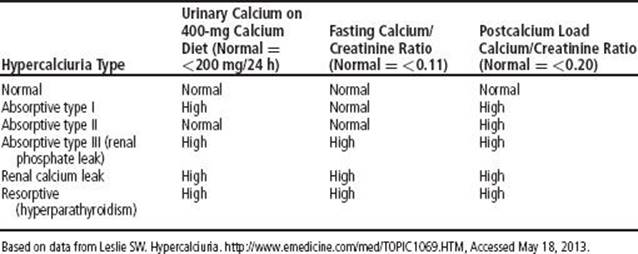
DESCRIPTION Hypercalciuria is the most commonly encountered metabolic abnormality in patients with calcium nephrolithiasis. Defined as urinary excretion of >275–300 mg of calcium per day in men or >250 mg of calcium per day in women on a regular unrestricted diet. An alternative definition in patients on a calcium-restricted diet (400 mg calcium, 100 mEq sodium) is a urinary calcium level of >4 mg/kg/d or with a urinary level >200 mg calcium/L of urine. Hypercalciuria consists of several types:
• Absorptive hypercalciuria. Caused by the intestinal hyperabsorption of calcium. Hypercalciuria results from the increased filtered load and reduced renal tubular reabsorption of calcium, caused by parathyroid suppression. Absorptive hypercalciuria type I is a severe, uncommon form; type II is mild–moderate and the most common form of this condition. Type III, sometimes called renal phosphate leak, is uncommon.
• Renal hypercalciuria. Also called renal calcium leak, this is caused by impairment in the renal tubular reabsorption of calcium. There may be excessive mobilization of calcium from bone and an enhanced intestinal absorption of calcium because of the parathyroid hormone excess and the stimulation of the renal synthesis of 1,25–(OH)2D. Unlike primary hyperparathyroidism, serum calcium is normal and the hyperparathyroidism is secondary.
• Resorptive hypercalciuria. The hypercalciuria is due to primary hyperparathyroidism with excessive resorption of bone resulting from hypersecretion of PTH. Intestinal absorption of calcium is frequently elevated because of the PTH-dependent stimulation of the renal synthesis of 1,25–(OH)2D.
As a guide to testing for hypercalciuria, calcium load usually consists of 1 g of oral calcium gluconate.
TREATMENT
• General recommendations include increased urine volume to >2 L/d, do not use calcium-restricted diet, but avoid excessive intake of dairy products, salty foods, and red meat protein. (Note: A low calcium intake increases intestinal oxalate absorption, with a subsequent increase in urinary oxalate stone formation.) Patients may be at risk for osteoporosis and osteopenia.
• Absorptive hypercalciuria:
– Thiazide is not a selective therapy for absorptive hypercalciuria, since it does not decrease intestinal calcium absorption. However, this drug is used because of its hypocalciuric action and the high cost and inconvenience of alternative therapy (sodium cellulose phosphate).
• Absorptive hypercalciuria type I:
– Thiazide does not correct the basic, underlying physiologic defect in absorptive hypercalciuria.
– Potassium supplementation (as potassium citrate), should be employed when using thiazide therapy to prevent hypokalemia and hypocitraturia (eg, potassium citrate 15–20 mEq BID)
– Amiloride in combination with thiazide may be more effective than thiazide alone in reducing calcium excretion.
– Potassium supplementation should be used with caution in patients taking amiloride.
– Thiazides may lose their hypocalciuric effect over time and cause hypokalemia, hypocitraturia, and increased uric acid.
– Recent data suggest bisphosphonates (eg, alendronate [Fosamax], risedronate [Actonel], and ibandronate [Boniva] increase bone deposition of calcium and reduce urinary calcium levels.
• Absorptive hypercalciuria type II:
– No specific drug treatment may be necessary since the physiologic defect is not as severe as in absorptive hypercalciuria type I. Low calcium intake (400–600 mg/d) and high fluid intake (sufficient for a minimum urine output >2 L/d) is helpful. Normo-calciuria can be restored by dietary calcium restriction alone, and increased urine volume has been shown to reduce urinary saturation of calcium oxalate.
• Absorptive hypercalciuria type III (renal phosphate leak) is treated with slow-release neutral potassium phosphate (Neutra-Phos K) that corrects the hyperphosphatemia.
• Renal hypercalciuria:
– Thiazide diuretic augments calcium reabsorption in the distal tubule, causes extracellular volume depletion, and stimulates proximal tubule reabsorption of calcium. Agents include hydrochlorothiazide 50 mg BID, chlorthalidone 50 mg/d, or indapamide 1.25–2.5 mg/d. Potassium supplementation (∼40 mEq/d) is required to prevent hypokalemia and attendant hypocitraturia. Potassium citrate has been shown to be effective in averting hypokalemia and in increasing urinary citrate when administered to patients with calcium nephrolithiasis taking thiazide.
– Triamterene is contraindicated because of the risk of triamterene renal stone formation.
• Resorptive hypercalciuria: Parathyroidectomy is the optimum treatment.
REFERENCE
Pak CY. Pharmacotherapy of kidney stones. Expert Opin Pharmacother. 2008;9(9):1509–1518.
HYPERCARBIA DURING LAPAROSCOPY
DESCRIPTION CO2 is the most abundantly used insufflant in the United States for laparoscopic surgery. CO2 has the ability to diffuse easily into body tissues and out of the peritoneum during surgery. This can lead to increases in blood levels or hypercarbia that can stimulate the sympathetic nervous system, leading to increases in vascular resistance, tachycardia, and impaired cardiac contractility. Patients who have pulmonary compromise (ie, COPD, fibrosis) may have difficulty compensating for the increased CO2 levels. Rarely a CO2 gas embolism may occur.
REFERENCE
Bandi G, Gomella LG. Basic principles of laparoscopy: Transperitoneal, extraperitoneal and hand-assisted techniques. In: Graham S, Keane T, eds. Glenn’s Operative Urology. 7th ed. Philadelphia, PA: Lippincott Williams & Wilkins; 2009.
HYPERCONTINENCE
DESCRIPTION A condition described in the literature referring to the increased likelihood that females are more likely to require intermittent catheterization than men following continent urinary diversion such as orthotopic neobladder. Hypercontinence is reported in up to 31% of females and is much less common in men.
REFERENCE
Rouanne M, Legrand G, Neuzillet Y, et al. Long-term women-reported quality of life after radical cystectomy and orthotopic ileal neobladder reconstruction. Ann Surg Oncol. 2014;21(4):1398–1404.
HYPERKALEMIA, UROLOGIC CONSIDERATIONS
DESCRIPTION Hyperkalemia usually occurs in urologic patients as a result of renal insufficiency, addisonian crisis, trauma, shock, and diabetic acidosis. It can also be a consequence of small bowel substitution used in urinary diversion. ECG changes are characteristic, including peaked T waves, long PR interval, long QRS complex, and absent P wave.
TREATMENT
• Monitor patient on ECG if symptomatic or if K+ is >6.5 mEq/L; discontinue all K+ intake, including IV fluids; order a repeat stat K+ to confirm.
• Pseudohyperkalemia should be ruled out. If doubt exists, obtain a plasma K+ in a heparinized tube; the plasma K will be normal if pseudo-hyperkalemia is present.
• Rapid correction: These steps only protect the heart from K+ shifts, and total body K+ must be reduced by 1 of the treatments shown under slow correction:
– Calcium chloride, 500 mg, slow IV push
– Alkalinize with 50 mEq (1 amp) Na+ bicarbonate (causes intracellular K+ shift)
– 50 mL D50W, IV push, with 10–15 units regular insulin, IV push (causes intracellular K+ shift)
• Slow correction:
– Sodium polystyrene sulfonate (Kayexalate) 20–60 g PO with 100–200 mL of sorbitol or 40 g Kayexalate with 40 g sorbitol in 100-mL water given as an enema. Repeat doses QID as needed.
• Dialysis (hemodialysis or peritoneal):
– Correct underlying cause, such as stopping K-sparing diuretics, ACE inhibitors, mineralocorticoid replacement for hypokalemia
REFERENCE
Fluids and electrolytes. In: Gomella LG, Haist SA, eds. Clinician’s Pocket Reference. 11th ed. New York, NY: McGraw-Hill; 2007.
HYPERMAGNESEMIA, UROLOGIC CONSIDERATIONS
DESCRIPTION Hypermagnesemia (Mg >2.5 mEq/L [mmol/L]) usually results from excessive intake (including laxatives, enemas, antacids), renal failure, hypothyroidism, or adrenal insufficiency. Symptoms include nausea and vomiting, weakness, and hyporeflexia. At higher serum levels, cardiac arrhythmias and severe cardiovascular abnormalities can result.
TREATMENT
• Stop administration of any magnesium containing medications.
• Maximize excretion of magnesium—for patients with normal renal function diuretics are used and for patients in renal failure dialysis should be initiated.
• Calcium gluconate can be administered as a cardioprotective agent.
REFERENCE
Fluids and electrolytes. In: Gomella LG, Haist SA, eds. Clinician’s Pocket Reference. 10th ed. New York, NY: McGraw-Hill; 2007.
HYPERNATREMIA, UROLOGIC CONSIDERATIONS
DESCRIPTION Hypernatremia in the urologic patient can result from iatrogenic causes and various disease states. Classified according to the mechanisms described below, the symptoms depend on the absolute level and also how rapidly the Na+ level has changed. Symptoms may include confusion, irritability, lethargy, stupor, coma, muscle twitching, and seizures. Signs can include hyperreflexia and mental status changes:
• Combined sodium and water losses (hypovolemic hypernatremia): Water loss in excess of Na+ loss results in low total body Na+. Due to renal (diuretics, osmotic diuresis due to glycosuria, mannitol, post-obstructive diuresis, etc.) or extrarenal (sweating, GI [vomiting, NG suction], respiratory) losses.
• Excess water loss (isovolemic hypernatremia): Total body Na+ remains normal, but total body water is decreased. Caused by diabetis insipudus (DI) (central and nephrogenic), excess skin losses, respiratory loss, others.
• Excess sodium (hypervolemic hypernatremia): Total body Na+ increased. Caused by iatrogenic Na+ administration (ie, hypertonic dialysis, hypertonic saline enemas, Na-containing medications) or other exogenous sources (seawater ingestion, salt tablets) or adrenal hyperfunction (Cushing syndrome, hyperaldosteronism).
TREATMENT
• Check the serum Na+ levels frequently while attempting to correct hypernatremia:
– Hypovolemic hypernatremia. Determine if the patient’s volume is depleted by determining if orthostatic hypotension is present; if volume is depleted, rehydrate with NS until patient is hemodynamically stable, then administer hypotonic saline (1/2 NS).
– Euvolemic/isovolemic (no orthostatic hypotension): Calculate the volume of free water needed to correct the Na+ to normal as follows:
Body water deficit = Normal total body water - Current TBW
Normal TBW = 0.6 - Body weight in kg
– Give free water as D5W, 1/2 the volume in the 1st 24 hr and the full volume in 48 hr. (Caution: The rapid correction of the Na+ level using free water (D5W) can cause cerebral edema and seizures.)
– Hypervolemic hypernatremia: Avoid medications that contain excessive Na+ (carbenicillin, etc.). Use furosemide along with D5W.
REFERENCE
Fluids and electrolytes. In: Gomella LG, Haist SA, eds. Clinician’s Pocket Reference. 11th ed. New York, NY: McGraw-Hill; 2007.
HYPEROXALURIA, UROLOGIC CONSIDERATIONS
DESCRIPTION The greatest significance of hyperoxaluria is the increased risk of urolithiasis, which is more significant than calcium in the formation of most kidney stones. Oxalate and calcium form an insoluble compound that can result in urolithiasis. The normal upper level of urinary oxalate excretion is 40 mg (440 μmol)/24 hr. Hyperoxaluria is caused by dietary excess, bowel disorders such as extensive ileal resection, and primary hyperoxaluria. Primary hyperoxalurias are disorders associated with a congenital defect in the oxalate pathway. (See also Section I: “Urolithiasis, Calcium Oxalate/Phosphate.”):
• Enteric hyperoxaluria: Accounts for a relatively small number of cases of hyperoxaluria (5%). Caused by chronic diarrhea and malabsorption (colitis or jejunoileal bypass), through the reduced GI calcium availability to bind oxalate and keep it from being absorbed systemically.
• Dietary hyperoxaluria: Caused by increased intake of foods high in oxalates (eg, nuts, chocolate, tea, spinach, rhubarb, beets, wheat bran, strawberries, and other plant products). Reduced dietary calcium intake can also result in hyperoxaluria due to reduced intestinal binding of oxalate and increased oxalate absorption.
• Idiopathic: The most common cause; may be due to increased dietary absorption or due to increased intrinsic production of oxalate, with some suggestions of a genetic predisposition.
• Primary hyperoxaluria type I (also called glycolic aciduria): A form of primary hyperoxaluria caused by an enzymatic deficiency of glyoxylate carboligase transmitted as an autosomal recessive trait. Caused by a deficiency of the peroxisomal liver-specific alanine-glyoxylate aminotransferase (AGT) gene. Pyridoxine (vitamin B6) is a cofactor in this pathway that normally converts glyoxylic acid to glycine. With a block in this conversion, because of deficiency or absence of this enzyme, high levels of glycolic and oxalic acids result that are converted to oxalate that is then excreted in the urine. This causes extensive nephrocalcinosis with kidney failure common in childhood. Most patients die at <30 yr. The condition often presents with stone disease in childhood. Type I can be associated with ESRD secondary to stones and interstitial deposits of calcium oxalate.
• Primary hyperoxaluria type II: Less common than type I hyperoxaluria, this entity is caused by deficiency of D-glyceric dehydrogenase that causes the conversion of glyoxylate to oxalate. Type I and II primary hyperoxaluria result in about the same degree of hyperoxaluria, with renal failure slightly less common in patients with type II disease. Pyridoxine is generally not effective in type II primary hyperoxaluria.
• Other: Increased hepatic conversion, due to pyridoxine deficiency, type I glycol ingestion, and methoxyflurane anesthesia
TREATMENT
• Primary hyperoxaluria: Oral phosphates and dietary oxalate restriction are usually unsuccessful. Increase urine flow. Prescribe high-dose pyridoxine (vitamin B6) 150–500 mg/d. Liver–kidney transplantation is often required at end stage.
• Enteric hyperoxaluria: Calcium citrate without vitamin D, potassium citrate 40–60 mEq/d in divided doses (increases urinary pH and citrate). Dietary restriction of oxalate with low fat and reduced meat protein diet.
• Idiopathic hyperoxaluria: Increase urine flow. Avoid excess Vitamin C (can be converted to oxalate). Prescribe high-dose pyridoxine (vitamin B6) 150–500 mg/d.
REFERENCE
Beck BB, Hoyer-Kuhn H, Göbel H, et al. Hyperoxaluria and systemic oxalosis: an update on current therapy and future directions. Expert Opin Investig Drugs. 2013;22(1):117–129.
HYPERPARATHYROIDISM, UROLOGIC CONSIDERATIONS
DESCRIPTION Hyperparathyroidism can cause a variety of urologically related conditions and problems, including nephrolithiasis, hypercalciuria, nephrocalcinosis, chronic renal insufficiency, and abnormalities in renal tubular function (decreased concentrating ability). Also associated in the MEN1 syndrome. About 5% of new stone formers have hyperparathyroidism, whereas up to 20% of patients with hyperparathyroidism will have stones (most common calcium oxalate). These patients usually exhibit elevated serum and urine calcium with an inappropriately normal or elevated serum PTH level and elevated calcitriol level. Treatment is through parathyroidectomy and workup for MEN when appropriate. (See also Section II: “Hypercalciuria and Multiple Endocrine Neoplasia.”)
REFERENCE
Reinmark L, Vestergaard P, Mosekilde L. Nephrolithiasis and renal calcifications in primary hyperparathyroidism. J Clin Endocrinol Metab. 2011;96(8):2377–2385.
HYPERPHOSPHATEMIA, UROLOGIC CONSIDERATIONS
DESCRIPTION Hyperphosphatemia (>1.6 mmol/L) can result from hypoparathyroidism, osteomalacia, medications, and chronic renal failure. Signs include muscle cramps, tetany, perioral numbness, renal osteodystrophy, and secondary hyperparathyroidism.
TREATMENT
Dietary restriction, stopping medications that include phosphate, and binding agents are the mainstays of therapy.
REFERENCE
Prie D, Beck L, Urena P, et al. Recent findings in phosphate homeostasis. Curr Opin Nephrol Hypertens. 2005;14:318–324.
HYPERSPERMIA AND HYPOSPERMIA
DESCRIPTION Hyperspermia is a poorly studied condition characterized by an excessive volume of ejaculate defined in studies as >5.5–6.5 mL/semen analysis. Hypospermia is generally defined as a total ejaculate of <1.5 mL. (See also Section II: “Semen Analysis, Abnormal Findings and Terminology”; Section II: “Semen Analysis, Technique and Normal Values.”)
REFERENCE
Cooke S, Tyler JP, Driscoll GL. Hyperspermia: The forgotten condition? Human Reprod. 1995;10(2):367–368.
HYPERTENSION, UROLOGIC CONSIDERATIONS
DESCRIPTION Primary hypertension is the most common form of this disease, but when significant findings on evaluation are present or if the hypertension is refractory to intensive multiple-drug therapy or requires hospitalization, a secondary cause should be sought. Common urologic considerations are primary aldosteronism, congenital adrenal hyperplasia (CAH), Cushing syndrome, pheochromocy-toma, and renovascular disease. Workup entails physical exam, endocrinologic workup, and imaging.
REFERENCE
Victor G. Arterial hypertension. In: Goldman L, ed. Cecil Medicine. 23rd ed. Philadelphia, PA: Saunders; 2007.
HYPERURICOSURIA
DESCRIPTION Hyperuricosuria refers to the uric acid excretion in the urine of >800 mg/d in men and >750 mg/d in women. Uric acid, the end product of purine metabolism, is relatively insoluble in water and can lead to the formation of uric acid calculi. Overproduction and over-excretion of uric acid can be due to excess dietary intake of purine-rich foods and in patients with malignancies (such as lymphoma, leukemia, myeloproliferative disease) especially after chemo or radiation induces rapid cell lysis (tumor lysis syndrome). Inherited enzyme defects can also lead to hyperuricosuria and hyperuricemia such as hypoxanthine-guanine phosphoribosyltransferase deficiency (Lesch–Nyhan syndrome) and glucose-6-phosphatase deficiency (glycogen storage disease, type I). Hyperuricosuria can be associated with hyperuricemia. The term “gouty diathesis” refers to the formation of urinary stones in persons with gout. These patients may present with other manifestations of gout such as “gouty arthritis.” These high levels of uric acid can predispose to urolithiasis that can be uric acid, calcium or a combination of both. Uric acid stones are more likely with a low urine pH (ie, <6) where the solubility of uric acid is low. Allopurinol and febuxostat reduce urinary levels of uric acid. Urate crystals in the urine tend to be needle-shaped or appear as flat, square plates. (See also Section I: “Urolithiasis, Uric Acid.”)
REFERENCE
Mehta TH, Goldfarb DS. Uric acid stones and hyperuricosuria. Adv Chronic Kidney Dis. 2012;19(6):413–418.
HYPOCITRATURIA
DESCRIPTION Citrate is a urinary inhibitor of crystal formation. Hypocitraturia is defined as urinary citrate excretion of <320 mg/d, but the absolute value can vary. It is a common cause of calcium urolithiasis, because citrate combines with calcium to form a nondissociable soluble complex with less calcium to combine with oxalate. Citrate also inhibits crystal agglomeration, in which individual calcium oxalate crystals combine to form a stone. Hypocitruria may develop from distal renal tubular acidosis (type I), chronic diarrhea, thiazide use, very high animal protein diet, and gastrocystoplasty, or it may be idiopathic.
TREATMENT
• Correction of acidosis in RTA
• Replacement therapy with potassium citrate (powder: 1 packet in water after meals and at bedtime; adjust dose to urinary pH; solution: 15–30 mL after meals and at bedtime; adjust dose based on urinary pH)
REFERENCE
Pak CY. Pharmacotherapy of kidney stones. Expert Opin Pharmacother. 2008;9(9):1509–1518.
HYPOGONADISM, SOCIETY DEFINITIONS
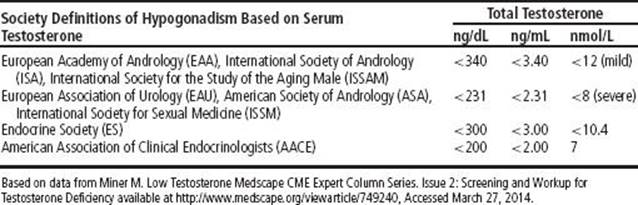
DESCRIPTION The lab diagnosis of testosterone/androgen deficiency is a challenge. The Endocrine Society defines male hypogonadism as a clinical syndrome that results from failure of the testis to produce physiologic levels of testosterone (androgen deficiency) and the normal number of spermatozoa caused by disruption of 1 or more levels of the hypothalamic–pituitary–gonadal (HPG) axis. Unfortunately there is no consensus among specialists (endocrinologists, urologists, pathologists) as to what lab values defines a “low” testosterone level. Serum testosterone levels are subject to many variables including diurnal, seasonal, and age-related variations. Illness and medications (opiates, glucocorticoids), may impact testosterone levels. In addition testosterone levels are impacted by alterations in sex-hormone binding globulin (SHBG). Further there are a variety of assays that differ in their measurement of testosterone levels leading to a wide variety of normal ranges reported by different labs. The Food and Drug Administration (FDA) uses a cut-off value of 300 ng/dL to define hypogonadism for clinical trial development and enrollment. Society definitions of testosterone levels and hypogonadism are summarized in the table. (See also Section I: “Andropause [Late Onset Male Hypogonadism],” “Testosterone, Decreased [Hypogonadism],” “Sex-Hormone Binding Globulin,” and ”Testosterone [Free and Total] Lab Testing.”)
REFERENCE
Paduch D, et al. The Laboratory Diagnosis of Testosterone Deficiency: AUA White Paper available at http://www.auanet.org/common/pdf/education/clinical-guidance/Testosterone-Deficiency-WhitePaper.pdf, Accessed March 27, 2014.
HYPOKALEMIA, UROLOGIC CONSIDERATIONS
DESCRIPTION Hypokalemia (K+ of <3.6 mEq/L [mmol/L]) can result from excessive upper GI losses, diarrhea, diuretic therapy, steroid administration, and hyperaldosteronism. Metabolic alkalosis is often associated and causes an intracellular redistribution of potassium. Other high-renin states, such as renin-secreting tumors, have been reported as a cause. A serum K+ level of 2 mEq/L (mmol/L) probably represents a deficit of at least 200 mEq (mmol) in a 70-kg adult; to change K+ from 3–4 mEq/L (mmol/L) takes about 100 mEq (mmol) of K+ in a 70-kg adult.
TREATMENT
• Treat underlying cause.
• Hypokalemia potentiates the cardiac toxicity of digitalis. In the setting of digoxin use, hypokalemia should be aggressively treated.
• Treat hypomagnesemia if present. It will be difficult to correct hypokalemia in the presence of hypomagnesemia.
• Rapid correction: Give KCl IV. Monitor heart with replacement at >20 mEq/h; IV KCI can be painful and damaging to veins:
– Patient <40 kg: 0.25 mEq/kg/h × 2 hr
– Patient >40 kg: 10–20 mEq/h × 2 hr
– Severe [<2 mEq/L (mmol/L)]: Maximum 40 mEq/h IV in adults. In all cases, check a stat K+ following each 2–4 hr of replacement.
• Slow correction: Give KCl PO:
– Adult: 20–40 mEq BID or TID
– Pediatric patients: 1–2 mEq/kg/d in divided doses. Potassium supplementation either with PO or IV forms
REFERENCE
Fluids and electrolytes. In: Gomella LG, Haist SA, eds. Clinician’s Pocket Reference. 10th ed. New York, NY: McGraw-Hill; 2007.
HYPOMAGNESEMIA, UROLOGIC CONSIDERATIONS
DESCRIPTION Hypomagnesemia (Mg of <0.7 mEq/L [mmol/L]) can result from inadequate magnesium intake, malabsorption, chronic diarrhea, stress, alcoholism, and medications such as diuretics. Symptoms of hypomagnesemia include weakness, muscle cramps, muscle tetany, confusion, hallucinations, hypertension, and arrhythmias. Often accompanied by hypokalemia.
TREATMENT
Replacement can be either oral for patients with mild symptoms or parenterally for more severe symptoms.
• Tablet (Mag-Ox): 1–2 tablets PO daily or capsule (Uro-Mag): 4–5 capsules PO daily
• Parenteral replacement: Mild 1 g IM q6h × 4 doses; More severe: 5 g IV over 3 hr
• Changing diuretics to agents such as amiloride (a potassium-sparing diuretic with mild hypocalciuric activity) reduces the magnesium loss caused by thiazides.
REFERENCE
Fluids and electrolytes. In: Gomella LG, Haist SA, eds. Clinician’s Pocket Reference. 10th ed. New York, NY: McGraw-Hill; 2007.
HYPONATREMIA, UROLOGIC CONSIDERATIONS
DESCRIPTION Hyponatremia is a sodium/Na+ level of <136 mEq/L (mmol/L). Many causes exist, but an acute cause in urology is a result of excessive nonelectrolyte irrigant absorption during endourologic procedures. As the fluid is absorbed, volume expansion and dilutional hyponatremia occur. Known as transurethral resection (TUR) syndrome, nausea, mental confusion, and sensory disturbances are seen, and, if allowed to progress, blindness, convulsions, hypotension, coma, oliguria, and death can occur. Other causes include nephrotic syndrome, renal failure, SIADH, adrenal insufficiency, diuretics, renal tubular acidosis (RTA), GI losses, and mineralocorticoid insufficiency. (See also Section I: “Transurethral Resection [TUR] Syndrome.”)
TREATMENT
• Treat the underlying cause.
• Therapy is based on determination of volume status. Evaluate volume status by physical exam: HR and BP lying and standing after 1 min, skin turgor, and edema, and by determination of the plasma osmolality. It is not necessary to treat hyponatremia from pseudo-hyponatremia (increased protein or lipids) or hypertonic hyponatremia (hyperglycemia); treat underlying disorder (see above):
– Life-threatening (seizures, coma): 3–5% NS can be given in the ICU setting. Attempt to raise the Na to at least 125 mEq/L with 3–5% NS.
– Isovolemic hyponatremia (SIADH): Restrict fluids (1,000–1,500 mL/d). Demeclocycline can be used in chronic SIADH.
– Hypervolemic hyponatremia: Restrict Na and fluids (1,000–1,500 mL/d). Treat with furosemide.
– Hypovolemic hyponatremia: Give D5NS or NS.
 Arginine vasopressin antagonists are indicated to raise serum sodium in hospitalized patients with euvolemic and hypervolemic hyponatremia
 Conivaptan (Vaprisol) Load: 20 mg IV infusion over 30 min the 20 mg IV continuous infusion over 24-hr period for 2–4 days
Tolvaptan (Samsca) Initial: 15 mg PO daily followed by maintenance. Increase dose PRN after >24 hr to 30 mg qDay; may increase further 60 mg/d maximum dose. Not to exceed 30 days.
REFERENCE
Fluids and electrolytes. In: Gomella LG, Haist SA, eds. Clinician’s Pocket Reference. 11th ed. New York, NY: McGraw-Hill; 2007.
HYPOPHOSPHATEMIA, UROLOGIC CONSIDERATIONS
DESCRIPTION Hypophosphatemia (<1.0 mmol/L) can result from inadequate intake, malabsorption, alcohol abuse, and hyperparathyroidism. It may manifest as muscle weakness, or mental status changes. More severe states can produce problems at the cellular level leading to white blood cell dysfunction or anemia.
TREATMENT
Replacement can be either oral for patients with mild symptoms or parenterally for more severe symptoms.
• Potassium phosphate/sodium acid phosphate (K-Phos Neutral, Neutra-Phos) 1–2 tablets PO QID; also lowers urinary calcium level in idiopathic hypercalciuria
• Parenteral: KPO4 Phos or Na PO4 (mixed 15 mmol/250 mL) 0.25 mmol/kg IBW infused over 4–6 hr
REFERENCE
Felsenfeld AJ, Levine BS. Approach to treatment of hypophosphatemia. Am J Kidney Dis. 2012;60(4):655–661.
HYPOSPADIAS, FREE GRAFT REPAIR
DESCRIPTION When local skin is not available or the quality of the preputial flap is poor during planned hypospadias repair, the use of free grafts from the bladder (1st introduced in 1947 by Memmelaar) or buccal mucosa tissue is generally employed. From a historical perspective, genital skin or bladder mucosa was commonly utilized during free graft repair. However, buccal mucosa has now become the graft of choice in the modern era. The preferred harvesting area is the inner cheek, taking care to avoid Stensen’s duct. Multiple small incisions are then made in the harvested graft to prevent hematoma formation after placement. Excellent results have been reported in both the single and 2 step stages utilizing free buccal mucosa graft for repair.
REFERENCES
Gargollo P, Borer J. Two-stage repair of hypospadias. In: Smith J, Howards S, Preminger G, eds. Hinman’s Atlas of Urologic Surgery. Philadelphia, PA: Elsevier Saunders; 2012.
Zhao M, Li Y, Tang Y, et al. Two-stage repair with buccal mucosa for severe and complicated hypospadias in adults. Int J Urol. 2011;18(2):155–161.
HYPOSPADIAS, TUBULARIZED INCISED PLATE (TIP) REPAIR
DESCRIPTION For distal hypospadias repairs, the most commonly performed operation is the tubularized incised plate or TIP repair. The penis is degloved and a midline incision of the urethral plate is made from within the meatus to the end of the plate without entering the glans. This incision allows for easier tubularization of the tissue and creates less tension on the ventral reconstruction. Urethral plate tubularization is then performed from the end of the plate to create a rounded meatus. Subepithelial running is used to complete a 2-layer closure. A dartos flap is then created and rotated ventrally to cover the neo-urethra. Glansplasty and shaft skin closure and reconstruction complete the procedure. Sponge bathing and antibiotic therapy are advised until the urethral catheter is removed. Oxybutynin is also provided to older patients to reduce bladder spasms. As with other hypospadias techniques, the most common complications from TIP urethroplasty is fistula formation, which can be low as 2% in the hands of an experienced surgeon. It has proven to be a versatile procedure used in both distal and midshaft hypospadias repairs.
REFERENCE
Snodgrass WT. Snodgrass technique for hypospadias repair. BJU Int. 2005;95(4):683–693.
HYPOSPADIAS, 2-STAGE REPAIR
DESCRIPTION The basic tenet of the 2-stage hypospadias repair is to create a new urethral plate with a graft of alternative tissue in the 1st stage and then tubularize this tissue to create a neo-urethra in the 2nd stage. The main grafts for the 1st-stage repair can be categorized into the following:
• Byars’ flap—pedicled flaps of the dorsal hood foreskin rotated ventrally
• Mesh free skin graft in an onlay fashion
• Buccal mucosa free graft in an onlay fashion
• Bracka graft—a free partial-thickness skin graft
The choice of graft depends on a multitude of factors including surgeon experience or preference, availability of preputial skin, and history of previous surgeries.
During the 1st stage, an orthoplasty is performed and a chosen graft is placed on the ventral penis. The next stage is generally performed 6 mo or more after completion of the 1st stage where the main goal is to create a neo-urethra that corrects the hypospadias. Tubularization of local skin proceeds in a Thiersch–Duplay fashion. This step is followed by reapproximation of the glans over the newly formed urethra and 2nd layer coverage with local subcutaneous tissue or a tunica vaginalis flap. Finally, urinary diversion with either a urethral or suprapubic catheter should be done for 1–2 wk postoperatively. Daily meatal dilation for 6 mo is recommended to prevent meatal stenosis. Complications include urethrocutaneous fistula, bleeding, infection, meatal stenosis, urethral stricture, and partial or complete breakdown of the repair.
REFERENCE
Gargollo P, Borer J. Two-stage repair of hypospadias. In: Smith J, Howards S, Preminger G, eds. Hinman’s Atlas of Urologic Surgery. Philadelphia, PA: Elsevier Saunders; 2012.
HYPOSPADIAS, URETHRAL ADVANCEMENT FOR SUBGLANULAR AND MIDSHAFT DEFECTS
DESCRIPTION The meatal advancement and glanuloplasty incorporated (MAGPI) procedure was 1st described by Duckett in 1981 as an option for patients with a glanular or subcoronal hypospadias. A dorsal meatotomy with glanulopasty is performed to advance the neo-urethra distally. This was later modified by Zaontz in 1989 for patients with a coronal or glanular hypospadias with a deep glanular groove and a fish mouth meatus as the glans approximation or “GAP procedure". For midshaft defects, rolled mid-line tube techniques based on the initial reports of Thiersch–Duplay in the 1800s have gained renewed popularity. The Snodgrass incised plate procedure (TIP), a variant of the Thiersch-Duplay technique, is now among the most popular methods of hypospadias repair. Other techniques include meatal based flap procedures (eg, Mathieu) and on-lay flap repairs with native tissue or free grafts.
REFERENCE
Belman A. Hypospadias. In: Graham S, Glenn J, Keane T, eds. Glenn’s Urologic Surgery. Philadelphia, PA: Lippincott Williams & Wilkins; 2004:792–801.
HYSTERECTOMY, UROLOGIC CONSIDERATIONS
DESCRIPTION Hysterectomy is among the most frequent surgeries performed on female patients and has been reported to contribute to up to 54% of all ureteral injuries. The reported rates of ureteral injury vary between 0.5 and 14% during laparoscopic hysterectomy. Whereas at least 1/3 of ureteral injuries are recognized intraoperatively during open operations, fewer are identified during laparoscopy. Therefore, a high index of suspicion with intimate knowledge of anatomy is critical during gynecologic surgery. Repair of the ureter is determined by location and extent of injury and can include ureteroureterostomy, ureteroneocystostomy with or without a Boari flap or psoas hitch, or even more extreme examples such as kidney autotransplantation or bowel interposition.
Nearly half of all bladder injuries result from iatrogenic causes, mainly obstetric or gynecologic complications during surgery. Again, a high index of suspicion along with knowledge of the anatomy is crucial in recognizing these injuries. Tests with indigo carmine can be utilized to assist in identification of either ureteral or bladder injuries. In addition, blood or gas (during laparoscopic surgery) in the foley bag can be a sign of a potential injury. When identified, intraperitoneal bladder injuries during hysterectomy should repaired in the same operative setting.
REFERENCE
Leonard F, Fotso A, Borghese B, et al. Ureteral complications from laparoscopic hysterectomy indicated for benign uterine pathologies: A 13-year experience in a continuous series of 1,300 patients. Hum Reprod. 2007;22:2006–2011.