
 WAGR SYNDROME (WILMS TUMOR-ANIRIDIA-GENITAL ANOMALY RETARDATION)
DESCRIPTION WAGR is one of the Wilms tumor–associated syndromes, presenting in children <3 yr. It causes mental retardation and GU manifestations in the form of renal hypoplasia, ectopia, fusions, duplications, cystic disease, hypospadias, cryptorchidism, and pseudoher-maphroditism. Physical exam may also reveal ear deformities, umbilical/inguinal hernias, and aniridia.
REFERENCE
Kirsch AJ, Snyder HM III. What’s new and important in pediatric urologic oncology. AUA Update Series. 1998;17:83.
WALLACE URETERAL ANASTOMOSIS
DESCRIPTION A surgical procedure used in urinary diversion in which the spatulated ureters are laid adjacent and the apex of each is sutured to the other. The medial and lateral walls of the ureters are then sutured together in either an interrupted or running fashion. The Y configured ureters are then anastomosed to the end of the small bowel segment used for the reservoir.
REFERENCE
McDougal WS. Use of intestinal segments and urinary diversion. In: Walsh PC, Retik AB, Vaughan ED, et al., eds. Campbell’s Urology. 7th ed. Philadelphia, PA: Saunders; 1998:3137–3144.
WALTER REED STAGING SYSTEM, TESTIS CANCER
DESCRIPTION Lymphangiographic criteria used to evaluate the presence and location of testicular neoplasm metastases. The following lymphangiographic patterns were found to be useful in assessing metastatic disease: Filling defects, lymph node enlargement and masses, lymphatic obstruction and collateral vessel formation, and an increase or decrease in the number of lymph nodes.
REFERENCE
Maier JG, Schamter DT. The role of lymphangiography in the diagnosis and treatment of malignant testicular tumors. AJR. 1972;114:482.
WATERHOUSE URETHRAL STRICTURE REPAIR
DESCRIPTION Through a combined abdominal and perineal approach, a wedge of pubis is resected with a Gigli saw. The membranous stricture is identified and excised. The distal urethra is mobilized off the corporal bodies, and the spatulated urethral edges are reanastomosed.
REFERENCE
Devine CJ, Devine PC. Operations for urethral stricture. In: Novick AC, Streem SB, Pontes JE, eds. Stewarts Operative Urology. Baltimore, MD: Williams & Wilkins; 1989:650–680.
WATERHOUSE–FRIDERICHSEN SYNDROME
DESCRIPTION Acute adrenocortical insufficiency in children suffering from septicemia with Pseudomonas or meningococcemia, leading to acute hemorrhagic destruction of both adrenal glands.
REFERENCE
Rao RH, Vagnucci AH, Amico JA, et al. Bilateral massive adrenal hemorrhage: Early recognition and treatment. Ann Intern Med. 1989;116:227.
WEDDELLITE
DESCRIPTION Mineralogic name for renal calculi composed of calcium oxalate dihydrate. (See Section I: “Urolithiasis, Calcium Oxylate/Phosphate.”)
WEGENER GRANULOMATOSIS, UROLOGIC CONSIDERATIONS
DESCRIPTION Systemic granulomatous vasculitis, most commonly affecting the upper and lower respiratory tracts and the kidneys, involving small arteries and venules. Respiratory infiltrates or sinusitis are commonly the presenting symptoms, as well as constitutional symptoms (weight loss, fever, etc.). Renal involvement is usually vasculitis-induced chronic renal failure, but acute fulminant glomerulonephritis and occasional interstitial nephritis can be present. Red cells, red cell and other casts, and proteinuria are noted. Other urologic manifestations include granulomatous necrotizing prostatitis, urethritis, or epididymoorchitis. Hemorrhagic cystitis is common, but usually iatrogenic secondary to cyclophosphamide treatment. Progressive renal insufficiency with ESRD occurs in up to 25% of patients.
DIAGNOSIS
• Granulomatous necrotizing vasculitis: Lung biopsy
• Focal necrotizing glomerulonephritis: Renal biopsy
• Red cell casts in voided urine: Glomerulonephritis
• Antineutrophil cytoplasmic antibodies: Useful for follow-up
TREATMENT
• Cyclophosphamide
• Corticosteroids
• Other cytotoxic and immunosuppressive agents: Methotrexate, cyclosporine, FK-506
• Surveillance cystoscopy when cyclophosphamide used
REFERENCE
Aasarød K, Iversen BM, Hammerstrøm J, et al. Wegener’s granulomatosis: Clinical course in 108 patients with renal involvement. Nephrol Dial Transplant. 2000;(155):611–618.
WEISS CRITERION
DESCRIPTION Most commonly used histopathologic system to provide diagnostic criteria for malignant adrenocortical tumors. Originally proposed in 1984, it has since undergone 1 revision. Original Weiss Criteria requires ≥3 of the following:
• Fuhrman nuclear grade III or IV
• 5+ mitotic figures/HPF on 10+ fields
• Atypical mitotic figures (spindles)
• Clear or vacuolated cells <25% or tumor
• Diffuse architecture >1/3 of tumor (patternless organization)
• Microscopic necrosis
• Venous invasion
• Sinusoidal invasion
• Capsular invasion
Modified Weiss Criteria using “1" if factor is present in tumor, 0 otherwise:
• 2× mitotic rate + 2× clear cytoplasm + abnormal mitoses + necrosis + capsular invasion
• Score total of ≥3 suggests malignancy
REFERENCE
Aubert S, Wacrenier A, Leroy X, et al. Weiss system revisited: A clinicopathologic and immunohistochemical study of 49 adrenocortical tumors. Am J Surg Pathol. 2002;26(12):1612–1619.
WHEWELLITE
DESCRIPTION Mineralogic name for renal calculi composed of calcium oxalate monohydrate. (See also Section I: “Urolithiasis, Calcium Oxylate/Phosphate.”)
WHITAKER TEST
DESCRIPTION An antegrade pressure–flow study to assess for renal obstruction. It is used to determine if pelvocaliectasis or hydronephroureterosis seen radiographically represents functional obstruction or anatomic dilation. This is a technically difficult, invasive test, requiring placement of a percutaneous antegrade catheter into the renal pelvis, with simultaneous monitoring of bladder and renal pelvic pressures during set flow rate of 10 mL/min. Elevation of renal pelvic pressure over bladder pressure indicates some degree of renal obstruction. A Foley catheter must be in the bladder.

SYNONYMS
• Urodynamic antegrade pyelogram
• Ureteral perfusion test
• Pressure–flow Whitaker exam
REFERENCE
Whitaker RH. The Whitaker test. Urol Clin N Am. 1979;6(3):529–539.
WHITLOCKITE
DESCRIPTION Mineralogic name for renal calculi composed of tricalcium phosphate. (See Section II: “Urolithiasis, Calcium Oxylate/Phosphate.”)
WHO 2004 HISTOLOGIC CLASSIFICATION OF TUMORS OF THE URINARY TRACT
DESCRIPTION This is the 2004 World Health Organization classification of tumors of the urinary tract. It primarily covers the renal pelvis, ureter, bladder and urethra. See Section II: WHO/ISUP classification of urothelial neoplasms (1998 and 2004) for an analysis of the changes in the specific bladder/urothelial classification.

REFERENCE
Eble JN, et al. Pathology and Genetics. Tumors of the Urinary System and Male Genital Organs. Lyon: IARC Press; 2004.
WHO/ISUP CONSENSUS CLASSIFICATION OF UROTHELIAL NEOPLASMS (1998, 2004, AND 2010)
DESCRIPTION At a consensus conference of the World Health Organization (WHO) and the International Society of Urologic Pathologists (ISUP) in 1998, the WHO/ISUP classification of urothelial neoplasms of the bladder was developed. The innovations of this consensus included the elimination of grades of dysplasia, with high-grade dysplasia equated with carcinoma in situ, as well as a condensation of cytologic grading of urothelial carcinoma (ie, grades 1–3) into low- and high-grade carcinoma. In addition, a new entity was recommended for low-grade papillary lesions, entitled papillary urothelial neoplasm of low malignant potential (PUNLMP) in 2004. The most recent update adopted the use of the term urothelial instead of transitional to describe urothelium. The WHO/ISUP classification:
• Normal urothelium
• Flat urothelial hyperplasia
• Papillary urothelial hyperplasia
• Dysplasia (low-grade intraurothelial neoplasia)
• Carcinoma in situ (high-grade intraurothelial neoplasia)
• Reactive urothelial atypia
• Papilloma
• PUNLMP
• Papillary carcinoma, low-grade
• Papillary carcinoma, high-grade
• Invasive neoplasms
• Lamina propria invasion
• Muscularis propria (detrusor muscle) invasion
REFERENCE
Epstein JI. Diagnosis and classification of flat, paillary, and invasive urothelial carcinoma: The WHO/ISUP consensus. Int J Surg Pathol. 2010;18(3):106S–111S.
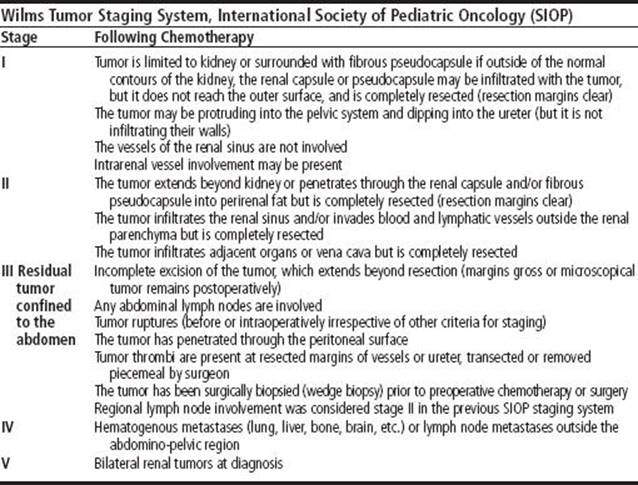
WILMS TUMOR STAGING SYSTEM, INTERNATIONAL SOCIETY OF PEDIATRIC ONCOLOGY (SIOP)
DESCRIPTION Developed by the International Society of Pediatric Oncology, this staging system is based on postchemotherapy surgical evaluation. It is used extensively in Europe. The National Wilms Tumor Staging System is based upon surgical evaluation before chemotherapy. It is used throughout the United States and Canada (see table below). (See also Section I: “Wilms Tumor”; Section II: “Wilms Tumor Staging System, National NWTS”; “Wilms Tumor Staging System, International Society of Pediatric Oncology SIOP.”)
REFERENCES
Ahmed HU. An update on the management of Wilms’ tumour. J Surg Oncol. 2007;33(7):824–831.
Metzger ML, Dome JS. Current therapy for Wilms’ tumor. Oncologist. 2005;10(10):815–826.
WILMS TUMOR STAGING SYSTEM, NATIONAL (NWTS)
DESCRIPTION A unified system developed to aid in the conduct of clinical trials now widely used for clinical staging treatment decisions (see table). The National Wilms Tumor Study (NWTS) system is based upon surgical evaluation prior to the administration of chemotherapy. It is used throughout the United States and Canada. The SIOP system is based upon postchemotherapy surgical evaluation and is used extensively in Europe. (See also Section I: “Wilms Tumor”; Section II: “Wilms Tumor Staging System, International Society of Pediatric Oncology [SIOP].”)
REFERENCES
D’Angio GJ, Breslow N, Beckwith JB, et al. Treatment of Wilms’ tumor: Results of the Third National Wilms’ Tumor Study. Cancer. 1989;64:349–360.
Metzger ML, Dome JS. Current therapy for Wilms’ tumor. Oncologist. 2005;10(10):815–826.
WINTER CORPORAL SHUNT
DESCRIPTION A shunt between the corpora and glans penis created to treat priapism. A Tru-Cut biopsy needle is inserted through the tip of the glans and into the corpora, and a core of tissue is removed. Through the same glans puncture site, the Tru-Cut can be reinserted in order to create 2 fistulas at the end of both corpora. It is also referred to as a percutaneous glanducavernous shunt.
REFERENCE
Thomas AJ. Surgery for priapism. In: Novick AC, Streem SB, Pontes JE, eds. Stewarts Operative Urology. Baltimore, MD: Williams & Wilkins; 1989:826–832.
WOLFFIAN DUCT REMNANTS
DESCRIPTION Normally, an embryo develops 2 sets of paired (müllerian and wolffian mesonephric) ducts. In females, virilization of the molffian system fails to occur, and wolffian vestiges may persist as the epoophoron, Gartner duct, or the appendix vesiculosa, commonly forming paraovarian cysts. In males, virilization of the wolffian duct gives rise to the epididymis, vas deferens, ejaculatory duct and seminal vesicles. The rostral end of the wolffian duct occasionally persists as a vestigial remnant, the appendix epididymis. Remnants of the mesonephric tubules may persist as a cystic structure, the paradidymis. (See also Section I: “Torsion, Testis; Testicular Appendages.”)
SYNONYMS
• Paradidymis
• Appendix epididymis
REFERENCE
Wilson JD, Griffin JE, George FW, et al. The role of gonadal steroids in sexual differentiation. Recent Prog Horm Res. 1981;37:1–39.
WOUND DEHISCENCE, UROLOGIC CONSIDERATIONS
DESCRIPTION Development of a postoperative gap or defect in the peritoneal suture line, with or without evisceration. Prevalence is in 1–3% of patients and carries a risk of mortality as high as 44%. Risk factors include anemia, hypoalbuminemia, advanced age, male gender, chronic lung disease, malnutrition, wound infection, and emergent procedure. Surgical variables include suture type, use of prosthetic material, incision location, hypothermia, perfusion, and oxygenation. Primary repair of initial dehiscence carries a 56% success rate with sutures and/or retentions, whereas the use of an interposition mesh confers an initial 100% success rate.
REFERENCE
Abbott DE, Dumanian GA, Halverson AL. Manage-ment of laparotomy wound dehiscence. Am Surg. 2007;73(12):1224–1227.
WOUND INFECTION, POSTOPERATIVE, UROLOGIC CONSIDERATIONS
DESCRIPTION Surgical site infections and postoperative UTIs are common causes of patient morbidity, complicating 5% and 20% of clean cases, respectively. Patient-related risk factors include advanced age, anatomic urinary anomalies, poor nutrition, tobacco use, corticosteroid use, immunodeficiency, external/indwelling catheters, distant infection, and prolonged hospitalization. The need for periprocedural antimicrobial prophylaxis has been well documented. Antibiotics should be given within 60 min of procedure start time, and selected based on patient history, as well as anticipated procedure. (See Section II: “Prophylactic Antibiotics, AUA Guidelines”; Section VII: “Antibiotic Prophylaxis: AUA Guidelines.”)
TREATMENT
• Cellulitis: Antimicrobial therapy and local wound care
• Superficial abscesses: Opening of the surgical wound, drainage and local wound care
REFERENCE
Wolf JS Jr, Bennett CJ, Dmochowski RR, et al. Best practice policy statement on urologic surgery antimicrobial prophylaxis. J Urol. 2008;179:1379–1390.
WUNDERLICH SYNDROME
DESCRIPTION Clinical condition classically described as spontaneous renal bleeding of nontraumatic origin, confined to the subcapsular and perirenal space. Presentation may be insidious, but the Lenk triad (flank pain, palpable mass, and deterioration with hypovolemic shock) has been described in the event of an acute onset.
CAUSES
• Angiomyolipoma
• Cysts (pancreatic, etc.)
• Idiopathic
• Tumor urothelial carcinoma, renal cell carcinoma
• Vasculitis and/or inflammation
REFERENCE
Albi G, del Campo L, Tagarro D. Wunderlich syndrome: Causes, diagnosis and radiologic management. Clin Radiol. 2002;57:840–845.