
Q. What percentage of urothelial malignancies does cancer of the renal pelvis and ureter constitute?
A. Urothelial cancer of the renal pelvis and ureter is an uncommon finding accounting for 5% of urothelial malignancies and <10% of renal malignancies.
Q. A 65-year-old woman presents to your haematuria clinic with macroscopic haematuria. Her cytology shows high-grade malignant cells and flexible cystoscopy is normal. A CT urogram has been performed which shows a filling defect in the right renal pelvis and right ureter. She has no other co-morbidities and a normal glomerular filtration rate (GFR). How would you assess this patient?
A. I am concerned that this woman has a TCC of her renal pelvis and ureter. A full urological history including cigarette-smoking exposure is required. The case should be discussed at the local multidisciplinary team meeting (MDT) seeking the opinion of a radiologist.
The need for pre-operative histological diagnosis of upper tract urothelial TCC prior to nephroureterectomy is still under debate. A review of the BAUS nephroureterectomy database revealed 81% of nephroureterectomies were performed without pre-operative histological diagnosis, from which malignancy was found in 96.2% [33]. Although the incidence of benign histology is low in patients whether a pre-operative biopsy was performed or not, diagnosis ureteroscopy should be considered. EAU guidelines [4] recommend performing diagnostic ureteroscopy and biopsy where there is diagnostic uncertainty, if kidney-sparing treatment is considered or in a solitary kidney.
Q. What are the risk factors and genetics for the development of ureteric cancer?
A. The aetiology is similar to bladder cancer including exposure to cigarethe smoking, industrial carcinogens, phenacetin and cyclophosphamide. Smoking has a long latent period of up to 20 years whereas cyclophosphamide has a much shorter latent period of around 12 years. Phenacetin is a historically used non-steroidal anti-inflammatory agent. Its use with cocaine has been reported.
Aristolochic acid, which is commonly used in Chinese herbal medicine, is also associated with upper tract urothelial cancer. Mutation in the p53 gene occurs with derivatives of aristolochic acid.
The genetic aberrations for ureteric cancer are similar to bladder cancer, i.e. chromosome 9, chromosome 17 (p53 loci), and chromosome 13 (retinoblastoma gene loci). However, in upper ureteric TCC a higher level of microsatellite instability compared to bladder tumours is reported.
Q. What treatment options does the patient have?
A. Treatment options for this woman include open or laparoscopic radical nephroureterectomy (RNU) with excision of a cuff of bladder tissue at the ureteric orifice. This is essential as a high rate of ipsilateral ureteric recurrence occurs with nephrectomy alone due to the whole of the urothelium being susceptible to recurrent lesions.
The traditional approach for the open technique is the loin incision. A second Pfannenstiel or lower midline incision can be used to facilitate excision of the bladder cuff. The entire renal unit and collecting system can be removed through a midline abdominal incision.
A laparoscopic RNU can be performed with either a transperitoneal or retroperitoneal approach. Hand-assisted and robotic-assisted laparoscopic techniques are recognised.
Both approaches must tackle the distal ureter, ureteric orifice and bladder cuff. This can be performed through a variety of incisions. The ureter can be dissected free either with an intravesical or extravesical technique. With the extravesical approach care must be taken to complete the ureteric resection to the UO. The intravesical approach is the most precise in terms of ureteric resection but requires an extra cystotomy.
In addition to formal open ureteric excision, the ‘rip and pluck’ technique is also described. This involves the resection or cystoscopic dissection of the distal ureter to perivesical fat. The ureter is then ‘plucked’ during the distal ureteric dissection. Concern remains over tumour cells extravasating into the retroperitoneum. The approach avoids the morbidity of a second incision.
Laparoscopic and open RNU have been shown to be comparable in outcome and safety in a prospective randomised trial [34]. In T3 and/or high-grade upper tract urothelial carcinoma (UTUC), open RNU was shown to have better oncological outcomes over the laparoscopic approach. Due to insufficient data on the robotic-assisted laparoscopic approaches, no recommendations have been made on its use.
As the risk of lymph node positivity is low in Ta/T1 disease, lymphadenectomy is recommended by EAU in invasive tumours. There is no evidence to support routine lymph node dissection in all UTUCs.
The rate of bladder recurrence after RNU has been reported to be 22%-47%. The ODMIT-C trial analysed the effect of a single post-operative administration of Mitomycin C after RNU, and reported a relative risk reduction in bladder tumour recurrence within the first year after RNU of 40% [35]. Based on such data, offering a post-operative bladder instillation to lower risk of bladder tumour recurrence is included in the EAU guidelines [4].
Q. Do you know of any kidney-sparing treatment options for upper tract transitional cell carcinoma?
A. Kidney-sparing surgery should be offered in all low-risk cancers as it avoids the morbidity associated with RNU. Where there is risk of renal insufficiency or solitary kidney, kidneysparing surgery can be considered in high-risk tumours.
The ureteroscopic approach involves tissue sampling with cold cup biopsy forceps or a stone basket. Fulguration of the tumour base can then be achieved with either the Holmium:YAG laser (0.5 mm tissue penetration) or neodymium:yttrium aluminum garnet YAG laser (5 mm tissue penetration). Retrograde stenting is required as part of the procedure. The perforation rate is less than 10% in large series and can be treated with the placement of a retrograde ureteric stent. The stricture rate is also in the region of 10%.
The percutaneous approach is more invasive and disrupts urothelial integrity. It does however allow excellent access to the renal pelvis with a 30 Fr sheath and the use of biopsy forceps, loop resection and base sampling to fully stage the lesion resected. The tract can also serve as a conduit for delivering adjuvant therapy following initial resection. Complications from this approach include bleeding, infection and injury to adjacent organs or pleura and potentially seeding along the tract.
For both approaches, patients must be counselled for the need for long-term surveillance after treatment with imaging and direct visual inspection with repeated ureteroscopy.
Using these approaches recurrence rates of 33% for pelvic tumours and 31% for ureteric tumours are reported. The most common site of recurrence is in the bladder.
EAU guidelines outline the indications for kidney-sparing treatment:
Low-risk tumours and two functional kidneys
Solitary kidney and/or impaired renal function
High risk distal ureteric tumours in imperative cases (solitary kidney and/or impaired renal function)
Note that low-risk tumours classified as
Unifocal tumour
Tumour <1 cm
Low-grade tumour
Non-invasive disease on CTU
Adjuvant instillation of bacillus Calmette-Guérin (BCG) or Mitomycin C antegrade via percutaneous nephrostomy after kidney-sparing treatment has been shown to be a feasible treatment option [36].
Q. What options are available for an isolated distal ureteric tumour (Figure 4.3)?
A. The gold standard for this lesion would be either an open or laparoscopic RNU with excision of a cuff of bladder tissue. However, segmental resection has a role in high-risk tumours where renal preservation is paramount (e.g. solitary kidney of renal insufficiency) or in an elderly patient with significant co-morbidity. This can be performed as a direct excision and spatulated tension-free uretero-ureteral anastomosis or in the lower one-third of the ureter with a Boari flap and psoas hitch. Comparable oncological failure rates to RNU are reported.
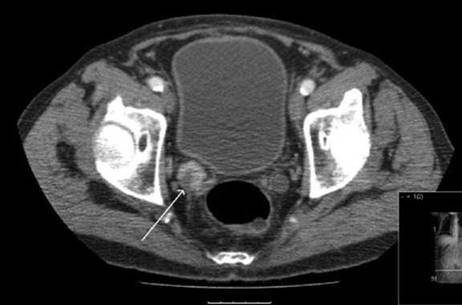
Figure 4.3 CTU (axial view) demonstrating right ureteric tumour
Q. The 65-year-old patient mentioned previously is treated with an uncomplicated laparoscopic NU with open excision of a cuff of bladder urothelium. The pathologist reports that the lesion is a grade 3 transitional cell carcinoma invading into the renal parenchyma, and the nodes removed are negative for tumour spread. The surgical margins are clear of tumour. What is the TNM stage for this patient?
A. The tumour, node and metastasis (TNM) stage for this patient is pT3N0Mx. The TNM staging of renal pelvic and ureteric cancer is reproduced in Table 4.16.
Table 4.1 TNM classification for upper tract urothelial carcinoma 2017 (8th edition)
|
Tx |
Tumour not assessed |
|
T0 |
No tumour |
|
Ta |
Non-invasive papillary carcinoma |
|
Tis |
Carcinoma in situ |
|
Tl |
Invades subepithelial connective tissue |
|
T2 |
Tumour invades muscularis propria |
|
T3 |
Renal pelvis - tumour invades beyond muscularis into peripelvic fat or renal parenchyma Ureter - tumour invades beyond muscularis into periureteric fat |
|
T4 |
Tumour invades into adjacent organs or through kidney into perinephric fat |
|
Nx |
Lymph nodes not assessed |
|
N0 |
No nodes |
|
N1 |
Metastasis in a single lymph node 2 cm or less in the greatest dimension |
|
N2 |
Metastasis in a single lymph node more than 2 cm, or multiple lymph nodes |
|
Mx |
Distant metastasis not assessed |
|
M0 |
No distant metastasis |
|
Ml |
Distant metastasis |
Q. What is the prognosis of TCC of the renal pelvis?
A. Hall et al. have reported the 5-year survival rates for upper tract TCC [37]. The results can be seen in Table 4.17.
Table 4.1 Actuarial disease-specific 5-year survival rates by grade
|
Stage |
Actuarial disease specific 5-year survival rates (%) |
|
Ta/CIS |
100 |
|
Tl |
91.7 |
|
T2 |
72.6 |
|
T3 |
40.5 |
|
T4 |
<5 |
Q. How does upper tract TCC differ from bladder cancer at presentation and what percentages of patients develop bladder cancer following upper tract TCC?
A. The majority of UTUCs are invasive at presentation (60%) unlike bladder tumours (15%- 25%). Bladder tumour recurrences after treatment of UTUC occur in 22%-47% of patients [38]. If high-grade upper tract malignancy is resected then the patient has a higher chance of high-grade bladder cancer at recurrence.
Concurrent bladder tumour is seen in 17% of UTUC patients [39]. Although synchronous bladder tumours are uncommon, 46% were found to be invasive [40].
Q. What percentage of patients develop synchronous and metachronous upper tract TCCs?
A. Synchronous tumours of the upper tract have been reported in 2%-3% of patients.
Metachronous upper tract TCC has been reported in approximately 2%-6% of patients. This highlights the importance of cystoscopic, ureteroscopic and radiological surveillance of these patients following definitive treatment.
Q. Is there a role for adjuvant chemotherapy in invasive upper tract urothelial tumours?
A. No randomised trials on the effect of adjuvant chemotherapy for UTUC have been published to date. A recent meta-analysis observed a beneficial effect of adjuvant chemotherapy with cisplatin-based adjuvant chemotherapy on both overall survival and disease-free survival (51% risk reduction) [41]. The POUT trial is a multicentre, randomised controlled trial that aims to determine the effect of adjuvant chemotherapy after radical nephroureterectomy, which is currently ongoing.
Q. How would you follow up a patient after an upper tract TCC had been treated (with nephroureterectomy)?
A. Close follow-up of upper tract TCC is essential to monitor for metachronous bladder and contralateral ureteric recurrence. Flexible cystoscopy, urine cytology and radiological imaging are the main surveillance investigations.
EAU guidelines [4] suggest surveillance protocols for at least 5 years based on tumour invasiveness and type of treatment undertaken.
Flexible cystoscopy and urine cytology are suggested 3 months after RNU, and then annually. CT urogram should be performed annually for non-invasive tumours and every 6 months for 2 years and then annually for invasive tumours.
For those patients treated with kidney-sparing surgery, a more intense surveillance regime is required. Urine cytology and CT urogram at 3 and 6 months, and then annually should be performed along with ureteroscopy at 3 and 6 months, and then every 6 months for 2 years, and then annually.
Q. Several years later this woman returns with weight loss, anorexia and loin pain. A repeat CT scan is performed and shows a local recurrence in the renal bed (Figure 4.4).
How would you assess this patient?
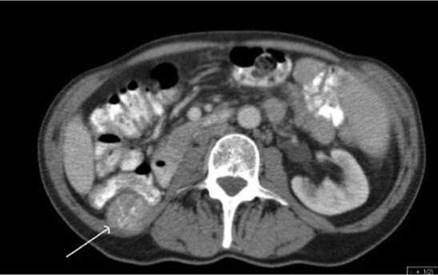
Figure 4.4 CT (axial view) showing recurrence of tumour in right renal bed.
A. This woman needs re-staging with a CT scan of her chest, abdomen and pelvis. In addition a bone scan is required. She is symptomatic and clearly needs further treatment. Palliative chemotherapy with cisplatin and gemcitabine should be discussed at the MDT meeting. Palliative care involvement will aid symptom control and support for this patient through this phase of her illness.
Most of the data concerning the use of chemotherapy in upper ureteric and renal pelvic TCC have been translated from bladder cancer TCC trials such as the ABC meta-analysis group. Chemotherapy is occasionally used in high-risk patients after consideration of the patient at the MDT as well as patients with symptomatic recurrent and metastatic disease.
No randomised controlled trials have reported on using chemotherapy in this setting. Trial design is limited by the low numbers of patients developing this disease.
Acknowledgement
With thanks to Mr DMA Wallace for his help and advice with the preparation of this chapter.
References
1. Tomson C et al. Asymptomatic microscopic or dipstick haematuria in adults: Which investigations for which patients: A review of the evidence. BJU Int 2002; 90: 185-198.
2. Sutton JM. Evaluation of hematuria in adults. JAMA 1990; 263: 2475-2480.
3. Khadra MH et al. A prospective analysis of 1,930 patients with hematuria to evaluate current diagnostic practice. J Urol 2000; 163: 524-527.
4. European Association of Urology (EAU). http://uroweb.org/wp-content/uploads/EAU- Guidelines-on-Non-muscle-Invasive-BC_TaT1-2017.pdf
5. Rodgers M et al. Diagnostic tests and algorithms used in the investigation of haematuria: Systematic reviews and economic evaluation. Health Technol Assess 2006; 10: iii-v, xi-259.
6. Edwards TJ et al. A prospective analysis of the diagnostic yield resulting from the attendance of 4020 patients at a protocol-driven haematuria clinic. BJU Int 2006; 97: 301-305.
7. Albani JM et al. The role of computerized tomographic urography in the initial evaluation of haematuria. J Urol 2007; 177: 644-648.
8. Britton JP et al. A community study of bladder cancer screening by the detection of occult urinary bleeding. J Urol 1992; 148: 788-790.
9. Messing EM et al. Long-term outcome of haematuria home screening for bladder cancer in men. Cancer 2006; 107: 2173-2179.
10. Steiner H et al. Early results of bladder-cancer screening in a high-risk population of heavy smokers. BJU Int 2008; 102: 291-296.
11. Sylvester RJ et al. A single immediate postoperative instillation of chemotherapy decreases the risk of recurrence in patients with stage Ta T1 bladder cancer: A meta-analysis of published results of randomized clinical trials. J Urol 2004; 171: 2186-2190.
12. Kausch I et al. Photodynamic diagnosis in non-muscle invasive bladder cancer: A systematic review and cumulative analysis of prospective studies. Eur Urol 2010; 57: 595-606.
13. Neuzillet Y et al. Assessment of diagnostic gain with hexaminolevulinate (HAL) in the setting of newly diagnosed non-muscle invasive bladder cancer with positive results on urine cytology. Urol Oncol 2014; 32: 1135-1140.
14. Burger M et al. Photodynamic diagnosis of non-muscle invasive bladder cancer with hexaminolevulinate cystoscopy: A meta-analysis of detection and recurrence based on raw data. Eur Urol 2013; 64: 846-854.
15. Sylvester RJ et al. Predicting recurrence and progression in individual patients with stage Ta T1 bladder cancer using EORTC risk tables: A combined analysis of 2596 patients from seven EORTC trials. Eur Urol 2006; 49: 466-475.
16. Parmar MK et al. Prognostic factors for recurrence and followup policies in the treatment of superficial bladder cancer: Report from the British Medical Research Council Subgroup on Superficial Bladder Cancer (Urological Cancer Working Party). J Urol 1989; 142: 284-288.
17. Sylvester RJ et al. Systematic review and individual patient data meta-analysis of randomized trials comparing a single immediate instillation of chemotherapy after transurethral resection with transurethral resection alone in patients with stage pTa-pT1 urothelial carcinoma of the bladder: Which patients benefit from the instillation? Eur Urol 2016; 69: 231-244.
18. Sylvester RJ et al. Intravesical bacillus Calmette-Guérin reduces the risk of progression in patients with superficial bladder cancer: A meta-analysis of the published results of randomized clinical trials. J Urol 2002; 168: 1964-1970.
19. Sylvester RJ et al. Bacillus Calmette-Guérin versus chemotherapy for the intravesical treatment of patients with carcinoma in situ of the bladder: A meta-analysis of the published results of randomized clinical trials. J Urol 2005; 174: 86 -91.
20. Morales A et al. Intracavitary bacillus Calmette-Guérin in the treatment of superficial bladder tumors. J Urol 1976; 116: 180-183.
21. Malmstrom PU et al. An individual patient data meta-analysis of the long-term outcome of randomised studies comparing intravesical Mitomycin C versus bacillus Calmette-Guérin for non-muscle invasive bladder cancer. Eur Urol 2009; 56: 247-256.
22. Sylvester RJ et al. Long-term efficacy results of EORTC genito-urinary group randomized phase 3 study 30911 comparing intravesical instillations of epirubicin, bacillus Calmette- Guérin, and bacillus Calmette-Guérin plus isoniazid in patients with intermediate- and high-risk stage Ta T1 urothelial carcinoma of the bladder. Eur Urol 2010; 57: 766-773.
23. Lamm DL et al. Maintenance bacillus Calmette-Guérin immunotherapy for recurrent TA, T1 and carcinoma in situ transitional cell carcinoma of the bladder: A randomized Southwest Oncology Group Study. J Urol 2000; 163: 1124-1129.
24. Oddens J et al. Final results of an EORTC-GU cancers group randomized study of maintenance bacillus Calmette-Guérin in intermediate- and high-risk Ta, T1 papillary carcinoma of the urinary bladder: One-third dose versus full dose and 1 year versus 3 years of maintenance. Eur Urol 2013; 63: 462-472.
25. Brausi M et al. Variability in the recurrence rate at first follow-up cystoscopy after TUR in stage Ta T1 transitional cell carcinoma of the bladder: A combined analysis of seven EORTC studies. Eur Uol 2002; 41: 523-531.
26. Herr HW et al. A re-staging transurethral resection predicts early progression of superficial bladder cancer. BJU Int 2006; 97: 1194-1998.
27. Grimm MO et al. Effect of routine repeat transurethral resection for superficial bladder cancer: A long-term observational study. J Urol 2003; 170: 433-437.
28. Shelley MD et al. Surgery versus radiotherapy for muscle invasive bladder cancer. Cochrane Database Syst Rev 2002; 1: Cd002079.
29. Tarin TV et al. Lymph node-positive bladder cancer treated with radical cystectomy and lymphadenectomy: Effect of the level of node positivity. Eur Urol 2012; 61: 1025-1030.
30. Bruins HM et al. The impact of extent of lymphadenectomy on oncologic outcomes in patients undergoing radical cystectomy for bladder cancer: A systematic review. Eur Urol 2014; 66: 1065-1077.
31. Wright JL et al. The association between extent of lymphadenectomy and survival among patients with lymph node metastases undergoing radical cystectomy. Cancer 2008; 113: 2401-2408.
32. Advanced Bladder Cancer (ABC) Meta-analysis Collaboration. Neo-adjuvant chemotherapy in invasive bladder cancer: Update of a systematic review and meta-analysis of individual patient data. Eur Urol 2005; 48: 202-205.
33. Malki M et al. The role of pre-operative histology in nephroureterectomy: The UK experience. BJU Int 2015; 115(S7): 45.
34. Simone G et al. Laparoscopic versus open nephroureterectomy: Perioperative and oncologic outcomes from a randomised prospective study. Eur Urol 2009; 56: 520-526.
35. O’Brien T et al. Prevention of bladder tumours after nephroureterectomy for primary upper urinary tract urothelial carcinoma: A prospective, multicentre, randomised clinical trial of a single postoperative intravesical dose of mitomycin C (the ODMIT-C Trial). Eur Urol 2011; 60: 703-710.
36. Giannarini G et al. Antegrade perfusion with bacillus Calmette-Guérin in patients with non-muscle invasive urothelial carcinoma of the upper urinary tract: Who may benefit? Eur Urol 2011; 60: 955-960.
37. Hall MC et al. Prognostic factors, recurrence, and survival in transitional cell carcinoma of the upper urinary tract: A 30-year experience in 252 patients. Urology 1998; 52: 594-601.
38. Seisen T et al. A systematic review and meta-analyses of clinicopathologic factors linked to intravesical recurrence after radical nephroureterectomy to treat upper tract urothelial carcinoma. Eur Urol 2015; 67: 1122-1133.
39. Cosentino M et al. Upper urinary tract urothelial cell carcinoma: Location as a predictive factor for concomitant bladder carcinoma. World J Urol 2013; 31: 141-145.
40. Palou J et al. Multivariate analysis of clinical parameters of synchronous primary superficial bladder cancer and upper urinary tract tumor. J Urol 2005; 74: 859 - 861.
41. Leow JJ et al. A systematic review and meta-analysis of adjuvant chemotherapy and neoadjuvant chemotherapy for upper tract urothelial carcinoma. Eur Urol 2014; 66: 529-554.
FURTHER READING
European Association of Urology (EAU). http://uroweb.org/wp-content/uploads/EAU-Guidelines-on- Non-muscle-Invasive-BC_TaT1-2017.pdf
Lamm DL et al. Maintenance bacillus Calmette-Guérin immunotherapy for recurrent TA, T1 and carcinoma in situ transitional cell carcinoma of the bladder: A randomized Southwest Oncology Group Study. J Urol 2000; 163: 1124-1129.
Sylvester RJ et al. A single immediate postoperative instillation of chemotherapy decreases the risk of recurrence in patients with stage Ta T1 bladder cancer: A meta-analysis of published results of randomized clinical trials. J Urol 2004; 171: 2186-2190.
Sylvester RJ et al. Systematic review and individual patient data meta-analysis of randomized trials comparing a single immediate instillation of chemotherapy after transurethral resection with transurethral resection alone in patients with stage pTa-pT1 urothelial carcinoma of the bladder: Which patients benefit from the instillation? Eur Urol 2016; 69: 231-244.