
Q. What is ADT and how does it work?
A. ADT refers to any treatment that lowers androgen activity. Prostate cells are physiologically dependent on androgens to function, stimulate growth and proliferate. Testosterone, although not tumourigenic, is essential for the growth and perpetuation of tumour cells. When androgen deprivation occurs, androgen-sensitive prostate cancer cells undergo apoptosis.
Q. Can you briefly outline the physiology behind androgen secretion?
A. Approximately 90%-95% of androgens are produced by the Leydig cells of the testes, with only 5%-10% being derived from the adrenal cortex. Testosterone secretion is regulated by the hypothalamic-pituitary-gonadal axis as shown in Figure 1.4.
the hypothalamic gonadotropin-releasing hormone (GnRH) stimulates the anterior pituitary gland to release luteinizing hormone (LH) and follicle-stimulating hormone (FSH). LH stimulates the Leydig cells of the testes to secrete testosterone. Within prostate cells, testosterone is converted by the enzyme 5-alpha reductase into dihydrotestosterone (DHT), which is approximately 10 times more active biologically. Once bound to the androgen receptor in the cytoplasm the androgen-receptor complex enters the nucleus where it interacts with DNA to influence cell growth and division. Peripheral aromatisation of testosterone into oestrogens, together with circulating androgens, exerts negative feedback control on hypothalamic LH secretion.
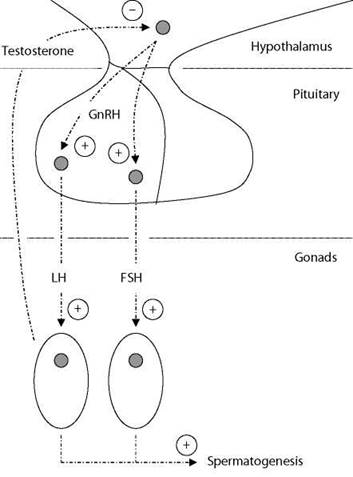
Figure 1.4 Hypothalamic-pituitary-gonadal axis.
Q. What are the different mechanisms used to induce androgen deprivation and what hormone treatment options are available for each?
A. Androgen deprivation can be induced by suppressing the secretion of testicular androgens, either medically or surgically, or by inhibiting their action at the androgen receptor using anti-androgens. Some, including oestrogen and steroidal anti-androgens have more than one mechanism of action. These actions are summarised in Table 1.14.
Both surgical and medical forms of castration have equivalent efficacy.
Table 1.14 The actions of hormonal manipulation in prostate cancer
|
Reduced androgen production |
|
|
Surgical castration |
Removes Leydig cells |
|
Medical castration |
Reduces LH production |
|
• LHRH agonists |
Down-regulates pituitary GnRH receptors |
|
• LHRH antagonists |
Inhibits GnRH receptor |
|
Blocks androgen effect |
|
|
Non-steroidal anti-androgens (e.g. bicalutamide, flutamide) |
Blocks androgen at receptor level |
|
Combined effect |
|
|
Oestrogen |
Down-regulates LHRH secretion |
|
Inactivates androgen |
|
|
Suppresses Leydig cells |
|
|
Steroidal anti-androgens (e.g. cyproterone acetate) |
Down-regulates LHRH secretion |
|
Blocks androgen at receptor level |
|
Q. What are LHRH agonists and how do they work?
A. LHRH agonists are long-acting synthetic analogues of GnRH. Chronic exposure to LHRH agonists eventually results in down-regulation of GnRH receptors with subsequent suppression of pituitary LH and FSH secretion and testosterone production. The level of testosterone decreases to castrate levels usually within 2 to 4 weeks. The two main types are goserelin and leuprorelin. They are delivered as depot injections on a 1 or 3 monthly basis.
Over 70%-80% of patients will respond to ADT. However, the development of androgen independence is inevitable with a mean time to disease progression of 14-36 months after commencement of treatment.
Q. What are the side effects of LHRH agonists?
A. Typical side effects of LHRH agonists include
Flushing (vasomotor) 80%
Erectile dysfunction
Osteoporosis
Hyperlipidaemia
Gynaecomastia
Cognitive decline
Diabetes
Anaemia
Loss of muscle mass Reduced quality of life
Q. What are the two types of anti-androgens and how do they differ?
A. The two classes of anti-androgens are steroidal (cyproterone acetate) and non-steroidal (bicalutamide, flutamide). Non-steroidal anti-androgens act purely as competitors of androgens at the receptor level, enabling the testosterone level to be maintained or increased. Steroidal anti-androgens also compete at the receptor level but have additional progesterogenic activity which causes central inhibition of pituitary gland LH secretion and hence a reduced testosterone level.
Q. The patient denies any urinary symptoms and has a good quality of life. He asks you if there are any benefits to starting the hormone treatment early.
A. Hormone treatment tends to be reserved for patients with symptomatic metastatic disease. One argument against early hormones is their associated side effects, particularly in patients who are clearly asymptomatic from their disease. However, studies have suggested that in locally advanced and metastatic disease, early hormone treatment results in slower disease progression and reduced disease morbidity. These issues There fore need to be discussed with the patient and the risk-benefit ratio assessed for each individual.
Q. The patient enjoys an active sex life and asks if there is any treatment that can be given which does not affect this.
A. In those men wishing to avoid ED and reduced libido, bicalutamide 150 mg od, has been shown to be an alternative to LHRH agonists although its equivalence has not been proven [43].
Q. The patient is commenced on bicalutamide treatment and his PSA falls to less than 0.1 ng/mL. He returns to your clinic 6 months later distressed about the painful breast swellings that he has developed. He would like to know if anything can be done for this.
A. Approximately 75%-80% of patients develop gynaecomastia when taking non-steroidal antiandrogens and 50% develop pain. It occurs due to the peripheral aromatisation of testosterone to oestradiol. Prevention of gynaecomastia can be achieved with radiotherapy (8-10 Gy to each breast) but it does not prevent pain or tenderness. An alternative is tamoxifen 20 mg od
particularly if there is no response to RT. However, once gynaecomastia has already developed or in the presence of severe pain the most effective treatment is a bilateral mastectomy.
Q. The patient has a successful bilateral mastectomy. When he returns to your clinic 18 months later his PSA has increased on several occasions and is now 1.2 ng/mL. What do you do now?
A. The patient has developed androgen-independent disease. Having been on anti-androgens alone I would commence an LHRH agonist and reduce his bicalutamide to 50 mg daily.
Q. What is the aim of maximum androgen blockade (MAB)?
A. MAB aims to prevent all androgen stimulation by blocking both the production of androgens by the testis and inhibiting the androgens produced by the adrenals at the receptor level.
Q. What is the role of intermittent hormone treatment?
A. Intermittent ADT is becoming an increasingly popular way of treating patients with localised disease, particularly in those patients who wish to limit the side effects of treatment.
The primary aim of intermittent ADT is to delay the development of an androgen- independent state. Androgen independence may begin early after the initiation of hormonal treatment, due to the arrest of androgen-induced differentiation of the prostatic epithelium.
If ADT is stopped prior to the progression of androgen-independent cells, any subsequent tumour growth may remain androgen dependent, which potentially will be susceptible once again to androgen withdrawal. Although superiority has not been proven over continuous ADT it does have three clinical benefits including reduced side effects during the off-therapy periods, decreased bone loss and reduced cost. Side effects may, however, be slow to resolve after stopping treatment as the serum testosterone level can take up to 9 months to recover.
Q. A 75-year-old man is referred to your clinic with an elevated PSA of 62 ng/mL and an abnormal DRE. TRUS biopsy confirms Gleason 4 + 4 disease. Figure 1.5 is an investigation this patient went on to have. What does Figure 1.5 show and what is it demonstrating?
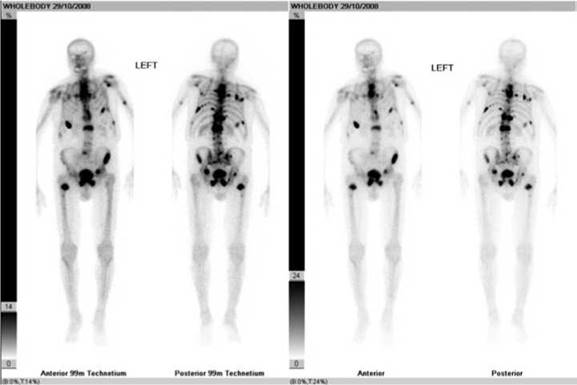
Figure 1.5
A. Figure 1.5 is a radionuclide whole-body isotope bone scan. It demonstrates several scattered hot spots within the ribs, thoracic spine, iliac bone and proximal long bones which given the history are consistent with bone metastases.
Q. me patient asks what treatment options are available.
A. me mainstay of treatment for metastatic prostate cancer is ADT, i.e. medical castration (with anti-androgens or LHRH analogues) or surgical castration (orchidectomy). In advanced disease this is best given at the time of diagnosis rather than at the time of symptomatic progression as it has been shown to reduce both disease progression and its complications [44]. Clinical disease progression after androgen deprivation will tend to occur after a median interval of about 12-18 months. Recent randomised trials have evaluated the role of upfront docetaxel chemotherapy and most, such as STAMPEDE [46] have shown a survival benefit for using upfront chemotherapy in such men, if they accept the side effects and can tolerate the regimen.
Q. What is tumour flare and how do you prevent it?
A. When first given, LHRH agonists stimulate the pituitary LHRH receptors, resulting in a transient rise in LH and FSH release. Consequently testosterone levels are temporarily increased, which is referred to as a testosterone ‘surge’ or ‘flare’. me flare occurs within 2 or 3 days after the first injection and continues for approximately 1 week. mis flare can have severe consequences such as spinal cord compression. To prevent this flare anti-androgens are given for 1 week before and 2 weeks after the first dose of the LHRH agonist.
Q. Who is at risk of tumour flare and what are its consequences?
A. me patients at risk of clinical flare are those with high-volume, symptomatic, bony disease, which accounts for only 4%-10% of metastatic patients. me typical consequences include spinal cord compression, fatal cardiovascular events due to hypercoagulation, ureteric obstruction, acute bladder outlet obstruction and increased bone pain.
Q. How can tumour flare be prevented?
A. Concomitant therapy with an anti-androgen, commencing on the same day or preferably a week before the first depot injection of LHRH agonist and continued for 2 weeks following it, can prevent tumour flare by blocking the androgen receptor. An alternative option in patients at high risk is to use LHRH antagonists, although this has been associated with significant side effects from histamine release. Surgical castration (subcapsular orchidectomy) has the benefit that no concomitant therapy is required (i.e. there is no tumour flare with surgical castration) and it is extremely effective in rapidly reducing circulating testosterone levels, which is useful in emergency situations.
Q. ’Шє patient would like to know what his prognosis is.
A. With asymptomatic disease the average survival is 2-3 years, which reduces to 12 months with symptomatic disease. me overall 5-year survival rate for a patient with metastatic disease is approximately 25%. These figures are historical and with contemporary interventions patients are clearly living longer.
Q. me patient responds to ADT initially but 22 months later his PSA starts to increase. His latest PSA is 54 ng/mL and he is now complaining of severe pain in his ribs. What options are available for the management of bone pain secondary to metastases?
A. In addition to analgesia, alternative options include
Radiotherapy, which is particularly useful when the pain is localised
Radioisotopes (i.e. strontium-89), which is useful for widespread disease
Bisphosphonates (i.e. zoledronic acid), which can both reduce pain and the incidence and time to skeletal-related complications
Oestrogens/steroids
Bisphosphonates act by inhibiting osteoclast mediated bone resorption. Saad et al. studied the role of bisphosphonates in 643 men with hormone-resistant prostate cancer and bone metastases [47]. Men were randomised to receive either zoledronic acid for 15 consecutive months or placebo. At 15 months and 24 months follow-up, there was a significant reduction in skeletal-related events in the zoledronic acid treated group compared to the placebo group (33% versus 44%) and the frequency of pathological fractures (13.1% versus 22.1%). Furthermore, zoledronic acid significantly prolonged the time to first skeletal-related event.
Q. What are the complications associated with metastatic prostate cancer?
A. The complications include
Spinal cord compression Ureteric obstruction/renal failure Sepsis
Hypercalcaemia Anaemia Hepatotoxicity Skeletal fractures Urinary retention
Q. An 82-year-old man is admitted as an emergency complaining of increasing lethargy and difficulty passing urine. Abdominal examination confirms an enlarged palpable bladder. DRE reveals a non-tender, malignant feeling prostate, cT3/4. What is your diagnosis?
A. This patient has chronic urinary retention, likely to be due to prostate cancer. His history of lethargy in association with this would raise concerns about associated renal failure.
Q. After completing a basic assessment, you insert a catheter and 1.5 L of urine is drained. His renal function results are as follows: urea of 18.1 mmol/L, creatinine of 364 p,mol/L, potassium 5.2 mmol/L. Six months ago his renal function was normal. What is the diagnosis and how will you manage this patient now?
A. This patient has acute renal failure which may be secondary to high pressure chronic urinary retention or ureteric obstruction. Given his large residual and renal impairment he is at risk of a post-obstructive diuresis and There fore I would monitor his urine output every hour, and perform 4 hourly observations including blood pressure measurements to assess for postural hypotension. I would also check his weight and renal function on a daily basis.
An ultrasound study of his renal tract will confirm the presence of hydronephrosis and exclude any other renal pathology. In order to confirm the diagnosis of prostate cancer he needs to have his PSA repeated (it may be artificially elevated secondary to retention) and a biopsy performed. If the PSA is very high (>100 ng/nL) then a biopsy may not be necessary and a bone scan can be requested instead.
If his renal function does not return to normal and the hydronephrosis persists despite catheter insertion then ureteric obstruction must be considered and percutaneous nephrostomy tubes inserted.
Q. A 78-year-old man on ADT for metastatic prostate cancer who has been complaining of back pain for the last 2 months is admitted to the accident and emergency department with a sudden exacerbation of his pain, ‘off legs’ and difficulty in passing urine? What is the likely diagnosis? How will you confirm this?
A. The likely diagnosis is spinal cord compression. A thorough history and clinical examination needs to be performed to assess for signs of cord compression and determine its level. The diagnosis is confirmed with an urgent MRI.
Q. What does Figure 1.6 demonstrate?
A. Figure 1.6 is an MRI of the spine. It demonstrates compression of the spinal cord at the level of L5. In fact, spinal cord compression occurs most commonly in the thoracic or upper lumbar regions of the spine. It is due to either vertebral collapse secondary to tumour invasion or from extradural tumour growth. Symptoms include radicular pain and peripheral neurological symptoms such as motor or sensory loss or both, including urinary retention.
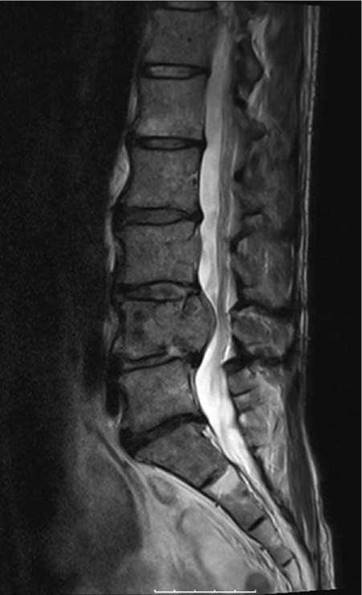
Figure 1.6
Q. How do you manage spinal cord compression?
A. Spinal cord compression is an acute surgical emergency. Steroid treatment should be administered immediately followed by definitive treatment with either radiotherapy or surgical decompression depending upon the patient and nature of cord compression. ADT should also be started on an urgent basis with anti-androgen cover to prevent tumour flare.
Q. What is the role of chemotherapy in androgen-independent prostate cancer?
A. Systemic chemotherapy is indicated in men with androgen-independent prostate cancer with proven metastatic disease. It is contraindicated in patients with significant renal, haematological or bone disease and poor performance status. Docetaxel-based regimens have been shown to give a 10 months median survival advantage if used upfront but only 2-3 months if used at time of castrate resistance [48].
Q. What is castrate resistance or hormone-relapsed prostate cancer?
A. Castrate-resistant prostate cancer (CRPC) or hormone-relapsed prostate cancer (HRPC) is defined by disease progression despite androgen-deprivation therapy and may present as one or any combination of a continuous rise in serum levels of PSA, progression of pre-existing disease, or appearance of new metastases. ttere are numerous agents which might be used in this setting such as abiraterone, enzalutamide, docetaxel or cabazitaxel chemotherapy and immunotherapies. Some are approved by NICE but many are under active investigation within randomised clinical trials. These cases are best managed under the care of a multidisciplinary team of urologists, medical oncologists and/or clinical oncologists.
REFERENCES
1. Oesterling JE et al. Serum prostate-specific antigen in a community-based population of healthy men. Establishment of age-specific reference ranges. JAMA 1993; 270: 860-864.
2. Sun L et al. Prostate-specific antigen (PSA) and PSA velocity for prostate cancer detection in men aged <50 years. BJUInt 2007; 99: 753-757.
3. Catalona WJ et al. Comparison of digital rectal examination and serum prostate specific antigen in the early detection of prostate cancer: Results of a multicenter clinical trial of 6,630 men. J Urol 1994; 151: 1283-1290.
4. Tompson IM et al. Prevalence of prostate cancer among men with a prostate-specific antigen level < or = 4.0 ng per milliliter. N Engl J Med 2004; 350: 2239-2246.
5. Gerstenbluth RE et al. The accuracy of the increased prostate specific antigen level (greater than or equal to 20 ng/mL) in predicting prostate cancer: Is biopsy always required? J Urol 2002; 168: 1990-1993.
6. Carter HB et al. Longitudinal evaluation of prostate-specific antigen levels in men with and without prostate disease. JAMA 1992; 267: 2215-2220.
7. Trapasso JG et al. The incidence and significance of detectable levels of serum prostate specific antigen after radical prostatectomy. J Urol 1994; 152: 1821-1825.
8. Benson MC et al. Prostate specific antigen density: A means of distinguishing benign prostatic hypertrophy and prostate cancer. J Urol 1992; 147: 815-816.
9. Djavan B et al. Prostate specific antigen density of the transition zone for early detection of prostate cancer. J Urol 1998; 160: 411-418.
10. Lee R et al. A meta-analysis of the performance characteristics of the free prostate-specific antigen test. Urology 2006; 67: 762-768.
11. Doherty AP et al. Undetectable ultrasensitive PSA after radical prostatectomy for prostate cancer predicts relapse-free survival. Br J Cancer 2000; 83: 1432-1436.
12. The Internal Medicine Clinic Research Consortium. Effect of digital rectal examination on serum prostate-specific antigen in a primary care setting. Arch Intern Med 1995; 155: 389-392.
13. Hessels D et al. DD3(PCA3)-based molecular urine analysis for the diagnosis of prostate cancer. Eur Urol 2003; 44: 8-15.
14. Bill-Axelson A et al. Radical prostatectomy versus watchful waiting in early prostate cancer. N Engl J Med 2005; 352: 1977-1984.
15. Bill-Axelson A et al. Radical prostatectomy or watchful waiting in early prostate cancer. N Engl J Med 2014; 370: 932-942.
16. Wilt TJ et al. Radical prostatectomy versus observation for localized prostate cancer. N Engl J Med 2012; 367: 203-213.
17. Hamdy FC et al. 10-year outcomes after monitoring, surgery, or radiotherapy for localized prostate cancer. N Engl J Med 2016; 375: 1415-1424.
18. Stanford JL et al. Urinary and sexual function after radical prostatectomy for clinically localized prostate cancer: The Prostate Cancer Outcomes Study. JAMA 2000; 283: 354-360.
19. Thompson IM et al. The influence of finasteride on the development of prostate cancer. N Engl J Med 2003; 349: 215-224.
20. Grover S et al. Do the benefits of finasteride outweigh the risks in the prostate cancer prevention trial? J Urol 2006; 175: 934-938.
21. Andriole GL et al. Effect of dutasteride on the risk of prostate cancer. N Engl J Med 2010; 362: 1192-1202.
22. Pareek G et al. Periprostatic nerve blockade for transrectal ultrasound guided biopsy of the prostate: A randomized, double-blind, placebo controlled study. J Urol 2001; 166: 894-897.
23. Djavan B et al. Prospective evaluation of prostate cancer detected on biopsies 1, 2, 3 and 4: When should we stop? J Urol 2001; 166: 1679-1683.
24. Ahmed HU et al. Diagnostic accuracy of multi-parametric MRI and TRUS biopsy in prostate cancer (PROMIS): A paired validating confirmatory study. Lancet 2017; 389: 815-822.
25. Ben Shlomo Y et al. The risk of prostate cancer amongst black men in the United Kingdom: The PROCESS cohort study. Eur Urol 2008; 53: 99-105.
26. Gleason DF et al. Prediction of prognosis for prostatic adenocarcinoma by combined histological grading and clinical staging. J Urol 1974; 111: 58-64.
27. Partin AW et al. Combination of prostate-specific antigen, clinical stage, and Gleason score to predict pathological stage of localized prostate cancer. A multi-institutional update. JAMA 1997; 277: 1445-1451.
28. Oesterling JE et al. The use of prostate-specific antigen in staging patients with newly diagnosed prostate cancer. JAMA 1993; 269: 57-60.
29. Albertsen PC et al. Competing risk analysis of men aged 55 to 74 years at diagnosis managed conservatively for clinically localized prostate cancer. JAMA 1998; 280: 975-980.
30. van As NJ et al. Active surveillance with selective radical treatment for localized prostate cancer. Cancer J 2007; 13: 289-294.
31. Epstein JI et al. Pathologic and clinical findings to predict tumor extent of nonpalpable (stage T1c) prostate cancer. JAMA 1994; 271: 368-374.
32. Klotz L. Active surveillance with selective delayed intervention is the way to manage ‘good- risk’ prostate cancer. Nat Clin Pract Urol 2005; 2: 136-142.
33. Holmberg L et al. A randomized trial comparing radical prostatectomy with watchful waiting in early prostate cancer. N Engl J Med 2002; 347: 781-789.
34. Pound CR et al. Natural history of progression after PSA elevation following radical prostatectomy. JAMA 1999; 281: 1591-1597.
35. Dearnaley D et al. Conventional versus hypofractionated high-dose intensity-modulated radiotherapy for prostate cancer: 5-year outcomes of the randomised, non-inferiority, phase 3 CHHiP trial. Lancet Oncol 2016; 17: 1047-1060.
36. Bolla M et al. Long-term results with immediate androgen suppression and external irradiation in patients with locally advanced prostate cancer (an EORTC study): A phase III randomised trial. Lancet 2002; 360: 103-106.
37. Shipley WU. PSA following irradiation for prostate cancer: The upcoming ASTRO symposium. Int J Radiat Oncol Biol Phys 1996; 35: 1115.
38. Roach M, III et al. Defining biochemical failure following radiotherapy with or without hormonal therapy in men with clinically localized prostate cancer: Recommendations of the RTOG-ASTRO Phoenix Consensus Conference. Int J Radiat Oncol Biol Phys 2006; 65: 965-974.
39. Donaldson IA et al. Focal therapy: Patients, interventions, and outcomes - A report from a consensus meeting. Eur Urol 2015; 67: 771-777.
40. Sternberg CN. Apples and oranges. Re: 7.4-year update of the ongoing bicalutamide Early Prostate Cancer (EPC) trial programme. BJUInt 2006; 97: 435-438.
41. Bolla M et al. Postoperative radiotherapy after radical prostatectomy: A randomised controlled trial (EORTC trial 22911). Lancet 2005; 366: 572-578.
42. Parker C et al. Radiotherapy and androgen deprivation in combination after local surgery (RADICALS): A new Medical Research Council/National Cancer Institute of Canada phase III trial of adjuvant treatment after radical prostatectomy. BJU Int 2007; 99: 1376-1379.
43. McLeod DG et al. Bicalutamide 150 mg plus standard care vs standard care alone for early prostate cancer. BJU Int 2006; 97: 247-254.
44. The Medical Research Council Prostate Cancer Working Party Investigators Group. Immediate versus deferred treatment for advanced prostatic cancer: Initial results of the Medical Research Council Trial. Br J Urol 1997; 79: 235-246.
45. Messing EM et al. Immediate hormonal therapy compared with observation after radical prostatectomy and pelvic lymphadenectomy in men with node-positive prostate cancer. N Engl J Med 1999; 341: 1781-1788.
46. James ND et al. Addition of docetaxel, zoledronic acid, or both to first-line long-term hormone therapy in prostate cancer (STAMPEDE): Survival results from an adaptive, multiarm, multistage, platform randomised controlled trial. Lancet 2016; 387: 1163-1177.
47. Saad F et al. Long-term efficacy of zoledronic acid for the prevention of skeletal complications in patients with metastatic hormone-refractory prostate cancer. J Natl Cancer Inst 2004; 96: 879-882.
48. Tannock IF et al. Docetaxel plus prednisone or mitoxantrone plus prednisone for advanced prostate cancer. N Engl J Med 2004; 351: 1502-1512.
49. Wilson JMG and Junger G. Principles and practice of screening for disease. J R Coll Gen Pract 1968; 16: 318.