
PART 3 The Intermediate Series of Asanas (Postures)
FIRST CONNECTIVE SECTION
Pashasana
NOOSE POSTURE
Drishti Over your shoulder
OVERVIEW: Pashasana exercises the oblique abdominis muscles by combining trunk flexion and twisting. It increases the vayu apana and thus improves elimination.4 The left sides of the posture is performed first, and no vinyasa is performed between the left and the right sides of the posture, since the vinyasa movement has a lifting and thus pranic effect that counteracts the apanic effect of this posture.
Pashasana is one of the first postures to be dropped from the Intermediate Series when the practitioner is pregnant or when a beginner’s version of the posture must be used.5 (The majority of students performing this posture for the first time do not get anywhere and are not sure how to begin the process of improving.)
Pashasana is an energetic continuation of Utkatasana in the Primary Series.
CONTRAINDICATION: It is advisable to not perform intense twists during pregnancy.
Vinyasa Count
Vinyasa One
We begin standing in Samasthiti after completing Parshvottanasana, the last standing warm-up posture.
Inhaling, raise your arms and look up.
Vinyasa Two
Exhaling, fold forward, placing your hands on either side of your feet.
Vinyasa Three
Inhaling, straighten your arms, flatten out your back, and look up.
Vinyasa Four
Exhaling, jump back into Chaturanga Dandasana and lower slowly.
Vinyasa Five
Inhaling, transit into Upward Dog.
Vinyasa Six
Exhaling, transit into Downward Dog.
These first six vinyasas are identical with those of Surya Namaskara A.
Vinyasa Seven
Jump the feet up to land between the hands, as you do in Utkatasana, and squat down.6 If you are unable to squat and balance while keeping the knees together, it may be due to tight and shortened calf muscles, shortened Achilles tendons, and/or hypomobility of the ankle joint. The most common predisposing factor in females is the frequent wearing of high heels; high muscle tension is often involved in males.7 To rectify this problem, place a folded towel underneath your heels. The use of a folded towel or blanket is preferred to tilting forward and balancing on your toes, since with padding under your heels you can still ground down through your heels and lengthen the calf muscles and Achilles tendons. This lengthening is essential to perform drop-backs (dynamic movement from Samasthiti to Urdhva Dhanurasana and return) while keeping the heels down and your feet parallel.
Turn now to the left (the opposite direction to all other twists so far), and place your right arm outside your left knee. Ideally you would go into the posture on one breath. If you find that difficult, access the posture as was taught in Marichyasana D (see Ashtanga Yoga: Practice and Philosophy, p. 85). Exhaling, contract your external and internal obliques to let your arm slide outward on your knee. Inhaling, press your arm firmly into your knee to prevent it from sliding back out as your chest expands. On the next exhalation, contract your obliques further to again reach deeper. Repeat this until your right shoulder is on the outside of your left knee.
Once your shoulder is outside of your knee, internally rotate your right arm and, flexing the elbow, reach around both knees and interlock your hands (called “binding”). If you tend to fall over backward once bound, you can lift your sit bones higher away from the floor to shift your weight toward your toes. With a gradual increase in flexibility, you will be able to sit back down.
With increasing flexibility and the shedding of any extra pounds, you may eventually take the left wrist with your right hand. Straighten your left arm and lift your left shoulder back over your legs, using your rhomboids and latissimus dorsi muscles on the left.
Breathe deeply into the chest, drawing the inhalations all the way up to the manubrium (top part of the sternum).
Use your arms as a lever to work deeper into the posture and your breath to progress deeper into the twist. Let your sit bones descend as the sternum and the back of the head reach away from the sit bones and the spine lengthens.
Please note that twisting trunk flexion is also involved in bringing your shoulder toward the opposite knee. This action is performed by the external and internal oblique abdominis muscles and in combination with the rectus abdominis muscle. Pashasana requires as much strength as it requires flexibility; in fact, it is one of the prime generators of abdominal strength in the Intermediate Series. Do not attempt any further intermediate postures before you can bind Pashasana on both sides without the help of a teacher.
Look over your left shoulder and take five deep breaths. On the last exhalation, come out of the posture.
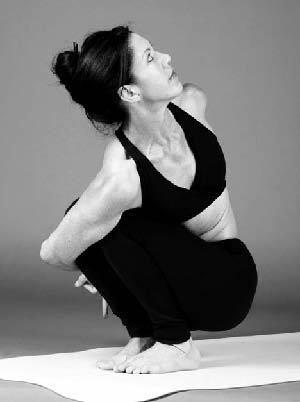
Pashasanan
Vinyasa Eight
Inhaling, repeat Pashasana on the right side. Take five breaths, and exhaling, place your hands down on either side of your knees.
Vinyasa Nine
Inhaling, lift up into an arm balance. Ideally this is done without pushing off with your feet but rather using your arms, abs (rectus abdominis), and the power of the inhalation. This is the same movement that is used for exiting Utkatasana in the Primary Series, but lifting is more challenging here since we are squatting much lower.
Vinyasa Ten
Exhaling, float back into Chaturanga Dandasana, making sure that your forearms stay perpendicular to the floor, your hands are beside your waist, and your feet are dorsiflexed. In Ashtanga Yoga: Practice and Philosophy, this vertical-forearm approach was presented as the advanced version of Chaturanga Dandasana. The beginner’s version, when the hands of the practitioner are placed under the shoulders, should no longer be necessary for a practitioner of the Intermediate Series. We might use the beginner’s version in the initial months of practice, but if done year after year without being corrected, it will lead to a front/back imbalance of the shoulder muscles.
THE PARADOX OF ACTIVE RELEASE
When performing any posture, the actions that have brought us into the posture must be halted, and the opposite actions must be employed to capture the posture and hold us in it. We work isometrically (that is, the muscles stay the same length: iso = same, metric = length). To maintain the posture, one must cultivate a harmonious relationship between the agonist and antagonist muscles. This enables the practitioner to maintain the posture while continually exploring its depths, playing the opposing actions of the muscles toward increased flexibility and strength. (For a more detailed description of the “active release principle,” see Ashtanga Yoga: Practice and Philosophy, p. 73).
The beginner’s version places too much emphasis on both pectoralis muscles and fails to bring the latissimus dorsi and the lower trapezius sufficiently into play. An imbalance of the shoulder musculature predisposes the practitioner to shoulder injuries.
Vinyasa Eleven
Inhale into Upward Dog.
Vinyasa Twelve
Exhale into Downward Dog.
ACTIVE RELEASE TECHNIQUE: Use your oblique abdominis muscles and your pectoralis major and minor gently, as if you are trying to pull yourself out of the twist, but resist this action using your arms, your latissimus dorsi, and your rhomboid on the right side. You will find that your abs and pectoralis muscles will stretch and your chest will open more, which will be most beneficial in backbending.
Practice Exercise
If you do not seem to progress in this posture, try this simple practice exercise.8
Lie on your back and, inhaling, bend your left knee and lift your right shoulder off the floor; bring them as close together as possible. Exhaling, lie back down. On the next inhalation, repeat the exercise using your right knee and your left shoulder. Continue alternating sides until you feel your abdominal muscles fatigue. Perform this exercise daily and feel how range of motion and endurance significantly increase. The muscles performing this movement are the same muscles used in Pashasana (the external and internal oblique abdominis), which form the second and third layer of the abdominal muscle group. Become aware of their function when performing this exercise and then carry this awareness into your asana practice.
OBSTACLES TO BINDING IN PASHASANA
If you are unable to clasp your wrist with the opposite hand (“binding”) in this posture, consider the following possible reasons and remedies:
· Weak abdominal muscles:
Perform the practice exercise and put more effort into your vinyasas.
· Excess deposits of adipose tissue on thighs and abdomen:
Exercise more and eat less. The so-called bad fat around the waist has been a long-standing joke in Ashtanga circles. Biomedical science today considers fat around the waist to be a better indicator of the likelihood of cardiovascular disease than body mass index (BMI). In other words, it matters more where you deposit fat rather than whether or not you have excess adipose tissue. There is “bad fat around the waist,” after all.
· Short femur (thighbone) compared to length of spine:
If you have to bend down in this posture much more than other students, a relatively short femur is likely the cause. You will have to train your abs more and gain more flexibility than students who don’t have this condition. If it is any consolation, you will find jumping through without touching down, jumping through with straight legs, lifting into Upavishta Konasana B without letting go of your feet, and doing drop-backs without lifting your heels all easier to learn than those students who have longer femurs. In Pashasana, you may wish to increase the height of the padding under your feet to accommodate your short femur.