
PART 3 The Intermediate Series of Asanas (Postures)
FIRST CONNECTIVE SECTION
BACKBEND SEQUENCE
Parshva Dhanurasana
SIDE BOW POSTURE
Drishti To the side and to the nose
OVERVIEW: A continuation of the theme explored in Dhanurasana. Here we take the stretch slightly more into the chest, as we don’t have to work against gravity.
Vinyasa Count
Vinyasa Four
Exhaling, lower into Chaturanga Dandasana.
Vinyasa Five
Take hold of your ankles and lift again into Dhanurasana, expanding fully into the posture with your inhalation.
Vinyasa Six
Exhaling, roll onto your right side, maintaining the backbend. Keep the same distance between the knees and feet as you had in Dhanurasana. There is no point in touching the knees together here if your knees do not touch in Samasthiti. Rishi Vamana explains the drishti here as parshva, which means to the side and not up to the ceiling looking over your shoulder. If the focal point were meant to be up to the ceiling, the rishi would have called it urdhva (upward). It is anatomically unsound to turn your head in backbending, as you can easily put your neck muscles into spasm doing so, especially if you have scoliosis or a lateral muscle imbalance in which your neck muscles are shorter and tighter on one side. If you overuse these muscles by twisting your neck in a backbend, especially by holding the neck’s weight against gravity as in Parshva Dhanurasana, you might upset your existing compensatory pattern and manifest whiplash symptoms. Simply maintain the position of your head in relation to the spine that you had in the previous posture without attempting any contortions.
Lying on your side, work on straightening your legs, and breathe deeply into your chest. Draw your shoulder blades down your back and roll your shoulders far back to stretch your pectoralis muscles. Continue all actions performed in Dhanurasana.
The focus in Dhanurasana and Parshva Dhanurasana is on stretching the hip flexor group, with special emphasis on the psoas. Additionally, in Parshva Dhanurasana the body weight borne on each shoulder helps to stretch the pectoralis muscles and open the shoulders laterally across the chest.
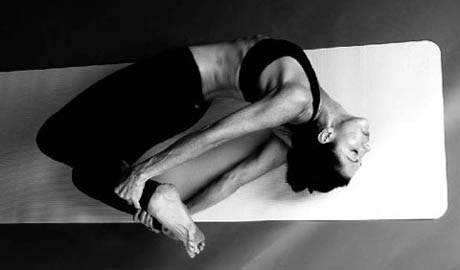
Parshva Dhanurasana
WARM-UP AND RESEARCH POSTURE: Again, experiment with holding the shins rather than the ankles, as close to the knees as possible, to gain more flexibility.
ACTIVE RELEASE TECHNIQUE: Use the strength of your quadriceps to straighten your legs. Slightly engage your psoas to work against the quadriceps. You can now carry the stretch deeper into the psoas by alternately engaging quadriceps and psoas.
Engage pectoralis minor and major as if you were trying to come out of the posture. Use the strength of your legs to open your chest further and stretch both pectoralis muscles.
Vinyasa Seven
Inhaling, roll back up into Dhanurasana.
Vinyasa Eight
Exhaling, roll over on your left side and repeat Parshva Dhanurasana on the left.
Vinyasa Nine
Inhaling, roll back up to the middle and hold Dhanurasana for five more breaths. It will be tiring, but nevertheless work intensely. The gaze here is again to the nose.
Exhaling, lower into Chaturanga Dandasana.
Vinyasa Ten
Inhale into Upward Dog.
Vinyasa Eleven
Exhale into Downward Dog.