
PART 3 The Intermediate Series of Asanas (Postures)
SECOND CONNECTIVE SECTION
Bakasana
CRANE POSTURE
Drishti Nose
OVERVIEW: Bakasana is an important counter-posture to the just completed backbending sequence. It activates your trunk flexors and counteracts excessive back extension. It also sets the tone and prepares for the upcoming leg-behind-head sequence.
Vinyasa Count — A Version
Vinyasa Seven
Inhaling, jump forward into a semi-squat with your feet landing just in front of your hands. Bend your arms and, going up onto your toes, place your knees up into your armpits. Make sure that you use the fronts of your knees rather than your shins and that you place them all the way up into the armpits rather than halfway down on the arms. The feeling is more of wrapping the arms around the knees as opposed to climbing the knees up onto the arms. This action will activate the shoulder-stabilizing muscles and provide strong support for this arm-balancing posture. Because you lift your entire body weight with your shoulder and arm muscles, the stabilization of the shoulder joint is essential. Draw the shoulder blades toward each other, draw them down the back, and suck them onto the back of the chest. These actions engage the shoulder-stabilizing muscles, the rhomboids and middle trapezius, the lower trapezius and latissimus dorsi, and the serratus anterior and subscapularis, respectively. Make sure that you consciously engage those muscles a split second before your shoulders bear weight. Do not expect that they will work miraculously or through divine intervention. Take responsibility for your shoulders. If you do not use these stabilizing muscles enough, you are likely to develop a front/back imbalance — that is, you will use the pectoralis muscles too much. Doing so may lead to shoulder injuries, as covered in detail on pages 74–77.
Still inhaling, shift your weight forward toward the roots of your fingers, and lift your feet off. Touch your big toes together and tuck up your heels tight under your sit bones. Now straighten your arms and, using breath and bandhas, lift your sit bones as high as you can. This movement strongly relies on the anterior deltoid, latissimus dorsi, and lower trapezius muscles. It improves your ability to anchor and stabilize the shoulder blades on the back.
To lift your sit bones that high while keeping the knees in the armpits takes a considerable amount of trunk flexion. You will need to develop your abdominal muscles here, which will also benefit your jump-backs and jump-throughs. You will be surprised how beneficial the effect of this posture is if you lift high and straighten your arms.
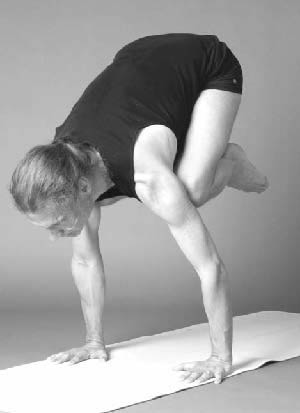
Bakasana
Hold Bakasana A for five breaths and look toward your nose.
Vinyasa Eight
While inhaling, lift your knees even higher up your arms, if possible.
Exhaling, float back into Chaturanga Dandasana.
Vinyasa Nine
Inhale into Upward Dog.
Vinyasa Ten
Exhale into Downward Dog.
Vinyasa Count — B Version
Vinyasa Seven
Inhaling, jump forward and, without touching the floor, land straight with your knees in your armpits. The synchronization of breath and movement is important here. In Downward Dog, bend your legs with the exhalation and jump with the beginning of the inhalation. Aim the fronts of your knees right at your armpits, and do not just land with your shins on your arms. Land in the middle of your inhalation, with your arms bent slightly as you land. Imagine that the inhalation creates a vacuum in your armpits into which the knees get sucked. With the remainder of the inhalation, intensify that suction, straighten your arms, and lift as high as possible. The most common reason one does not achieve this important transition is that the inhalation is completed before one lands on the arms. Land with your lungs still half-empty; otherwise, your puffed-up chest will be in the way, and you will not be able to utilize the elevating quality of the inhalation upon landing.
This is a very important posture and should not be treated lightly. If your feet keep touching down, you have not developed adequate shoulder, abdominal, and/or bandha control. You also need to make sure that you jump not forward but rather up, as if you were jumping into a handstand. Focus on the trajectory that your sit bones make and not that of your feet. First go way up, and only after your sit bones are almost over your hands, consider landing. At this point you bring trunk flexion into play, which sucks your knees, thighs, and feet toward your abdomen. In other words, the landing is not a function of gravity or dropping down but of shoulder and abdominal strength. As soon as you hand the landing over to gravity, you will do nothing but drop down.
Another cause of failing to keep the feet off the floor is carrying the weight too far back in your hands upon landing in your armpits. In the moment of landing, you need to carry the weight somewhere between your fingertips and the roots of your fingers. You fade out the movement by pressing your fingertips firmly into the ground. You will be able to do that if you exercise your hands strongly in postures like Bhekasana and Supta Vajrasana. If you hold your weight between the heels of your hands and the roots of your fingers, you will fall backward and touch your feet down. Bringing your weight forward can produce the fear of falling forward. If you feel that you are about to fall, rapidly bend your elbows backward to drop your sit bones and place the crown of your head or forehead down as in Bhujapidasanarather than landing disgracefully on your face.
You will also make this transition more easily if you initially choose a short stance in Downward Dog. This will make the jumping and catching of your weight less risky. After you have learned the transition with a short Downward Dog, slowly extend your stance.
You may also temporarily abandon the official focal point of the nose with a temporary practice drishti. Look toward a point on the mat that is about twelve inches (thirty centimeters) in front of your hands. If you tend to fall back to your feet after landing on your arms, then shift your gaze forward a couple of inches (about five centimeters) more and try again. The more you lift your gaze, the more your weight will distribute from the heels of your hands toward your fingertips, thus making it more likely that you will catch and balance your weight upon landing.
If after all attempts you can’t shift the weight forward in your hands, you might need some extra training for your hands and deltoid muscles.
Do not go on to the next posture before you have learned this important transition.
Vinyasa Eight
Inhaling, lift up and off your arms.
Exhaling, float back into Chaturanga Dandasana.
Vinyasa Nine
Inhale into Upward Dog.
Vinyasa Ten
Exhale into Downward Dog.