
PART 3 The Intermediate Series of Asanas (Postures)
THIRD CONNECTIVE SECTION
Tittibhasana
INSECT POSTURE
Drishti Nose
OVERVIEW: With this posture the focus shifts from flexibility to strength and endurance. Tittibhasana, with its strong focus on engagement of the bandhas, creates a link between the upper and lower extremities. It is essential to establish this link before commencing the arm balances.
CONTRAINDICATIONS: Hamstring and/or low back injuries.
Vinyasa Count
Vinyasa Seven
Inhaling, jump around your arms as you did in Bhujapidasana and Dvipada Shirshasana. By now you will be proficient at doing so without touching your feet down. Jump off early in the inhalation and keep inhaling while the feet transit around the arms. Upon landing, you will still have some inhalation left to do; otherwise, your feet will drop down.
After you land, check that your knees are high up near your shoulders and not somewhere lower down on your arms. Your inner thighs need to be touching the sides of your rib cage, without any gap. If this is not the case, do not hesitate to place your feet on the floor, straighten your legs as much as possible, and lever your shoulders under your knees one at a time. This is not an elegant choice, but the posture is inefficient if your knees are down around your elbows.
Once your thighs fit snugly against the sides of your torso, place your hands down, straighten your arms, and lift your feet off. Straighten your legs and plantar flex (point) your feet until your toes arrive at eye height. While in the posture, work your lumbar extensor muscles as if you were trying to re-create the natural lordotic curve in your low back. This action is immensely strengthening for the low back and counteracts the lack of lumbar extensor strength that results from prolonged sitting, especially with poor posture. Keep the legs strong and straight; engage the quadriceps by pulling up on the kneecaps and press your legs down onto your arms. This action deepens the forward flexion at your hip joint, while at the same time strengthening and protecting the hamstring muscles.
Gaze toward your nose and hold Tittibhasana A for five breaths.

Tittibhasana A
Vinyasa Eight
Exhaling, keeping your legs as straight as possible, place your feet on the floor and lift your sit bones up, so that you come into a standing forward bend with your chest between your legs. Continue to exhale and draw your shoulders further under your knees, flexing your spine. Reach around your back and interlock your fingers or, better, take one wrist. Straighten your legs, and against their resistance extend your trunk as much as possible. Hold the posture for five slow breaths, gazing toward the tip of the nose. Make sure you contract your quadriceps strongly and breathe into your hamstrings to encourage their release.

Tittibhasana B, standing
Inhaling, lift your right foot, step forward and, exhaling, place it down. Repeat this movement four times, alternating between the left and right feet. Then take five steps backward, synchronized with your breath, alternating between the left and right feet. Keep your hands bound throughout the process.
Both parts together constitute Tittibhasana B.
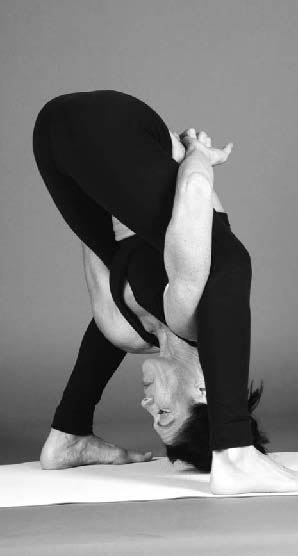
Tittibhasana B, walking
Vinyasa Nine
Exhaling, bring your heels together, ideally until they touch. Turn your feet out as much as possible. Pull your head and chest through, so that your calves touch your shoulders from behind. Now reach around your ankles and interlock your fingers. Attempt to straighten your legs again as much as possible until your quadriceps fatigue. This will help to improve the access to these important muscles in other postures.
Breathe into your chest, keep your abdomen firm, and release your hamstrings. Tittibhasana C is the most challenging part of the posture; it provides a mixture of forward bend and external rotation of the femurs. Gaze toward the nose and take five deep breaths.
ACTIVE RELEASE TECHNIQUE: This happens automatically in versions B and C.
Vinyasa Ten
Inhaling, place your hands down, lift your legs off the floor, and return to Tittibhasana A for the length of the inhalation.
Exhaling, fold your legs and transit toward Bakasana.
Vinyasa Eleven
Inhaling, lift as high as you can, straighten your arms, bring your big toes together, and tuck your heels up under your sit bones. If you want to make it more challenging, you can try to lift your knees off your arms into an arm balance.
Vinyasa Twelve
Exhaling, jump back into Chaturanga Dandasana.
Vinyasa Thirteen
Inhale into Upward Dog.
Vinyasa Fourteen
Exhale into Downward Dog.
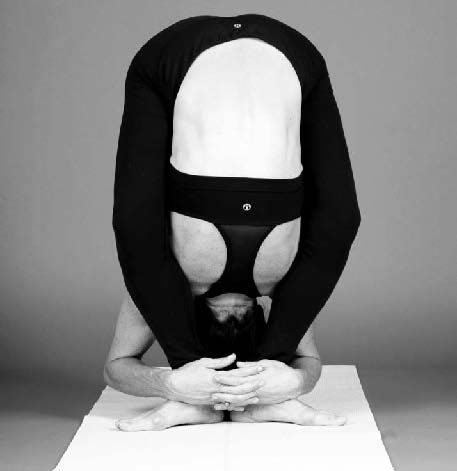
Tittibhasana C