
PART 3 The Intermediate Series of Asanas (Postures)
FOURTH CONNECTIVE SECTION
Parighasana
IRON CAGE POSTURE
Drishti Upward
OVERVIEW: After the excitement of the backbends, leg-behind-head, and arm balances, the calming effect of a forward bend continues the winding down of the series.
Vinyasa Count
Vinyasa One
Standing in Samasthiti, inhale, raise your arms, and look up.
Vinyasa Two
Exhaling, fold forward, placing your hands on either side of your feet.
Vinyasa Three
Inhaling, straighten your arms, flatten out your back, and look up.
Vinyasa Four
Exhaling, jump back into Chaturanga Dandasana.
Vinyasa Five
Inhaling, move into Upward Dog.
Vinyasa Six
Exhaling, move into Downward Dog. These first six vinyasas are identical with those of Surya Namaskara A.
Vinyasa Seven
Inhaling, jump through to sitting and assume a posture similar to Triang Mukha Ekapada Pashimottanasana in the Primary Series, only here draw your right knee 90 degrees out to the side. You may, as inKrounchasana, jump straight into the posture. Place your hands on your hips and square your torso toward the folded right leg.
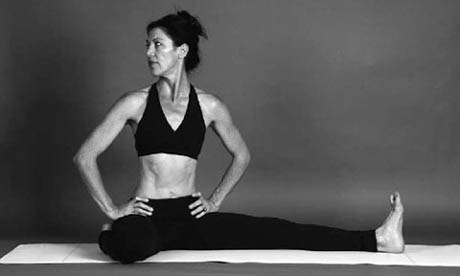
Parighasana, vinyasa seven
Vinyasa Eight
Exhaling, twist your torso laterally and fold down with the left side of your torso along your straight left leg, while your chest keeps facing your folded right leg. Take the inside of your left foot with your left hand and, bending your arm, place your left shoulder against the inside of your left leg. Reach now over your head with your right arm and take the outside of your left foot. Use both arms to twist more deeply, lifting the right shoulder back over the left one. Draw both shoulder blades down your back, turn your head, and look up to the ceiling. Take your left elbow off the floor.
Work both legs as if you were doing Triang Mukha Ekapada Pashimottanasana. Pull up on the left kneecap and draw the left heel into the floor. Extend out through the bases of all toes against the pull of both hands. Make sure that you do not actively flex (dorsi flex) your left foot, as this would put strain on the cruciate ligaments of your knee.
Unless your hamstrings on the left are extremely long, there will be a strong tendency to externally rotate your left thigh to escape the stretch of the two inner hamstrings (semimembranosus and semitendinosus). If this tendency is present, counteract it by vigorously rotating your left thigh internally.
Now strongly externally rotate your right thigh and work on grounding your right sit bone. This will lead to a formidable stretch of the right low back, particularly the quadratus lumborum on the right. The quadratus lumborum may tighten during backbending and leg-behind-head postures, especially when they are performed with excess fervor and lack of finesse.
Assist the stretching of the right low back by breathing into and elongating the right waist. The ability to elongate the waist is paramount not only in forward bending and backbending but also in leg-behind-head postures. It can be learned right here.
Look upward, past your right elbow, and take five deep breaths.
ACTIVE RELEASE TECHNIQUE: Draw your left heel into the floor by gently engaging your hamstrings, which will tend to lift you back out of the posture. Vigorously counteract and annul this tendency by using the iron cage of your arms to draw and twist your chest deeper into the posture.
Vinyasa Nine
Inhaling, let go of your foot and return to the upright position, placing both hands on your hips as in vinyasa seven, and exhale.
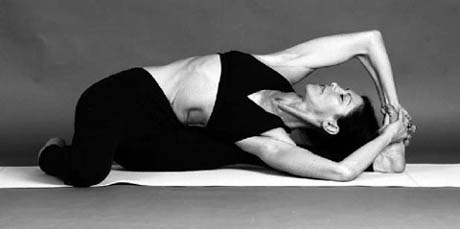
Parighasana
Vinyasa Ten
Place both hands on the floor and, inhaling, lift up.
Vinyasa Eleven
Exhaling, jump back into Chaturanga Dandasana.
Vinyasa Twelve
Inhaling, move into Upward Dog.
Vinyasa Thirteen
Exhaling, move into Downward Dog.
Vinyasas Fourteen to Twenty
Repeat Parighasana on the left side.