
PART 1 Roots
Chapter 4
The Mythology of the Intermediate Postures
The postures of the Intermediate Series have been given names with spiritual or mythological significance to stir devotion in the heart of the yogi. When you study the myths related to each posture, you deepen your practice of yoga and thereby develop a personal relationship to the divine powers and ancient sages of yoga.
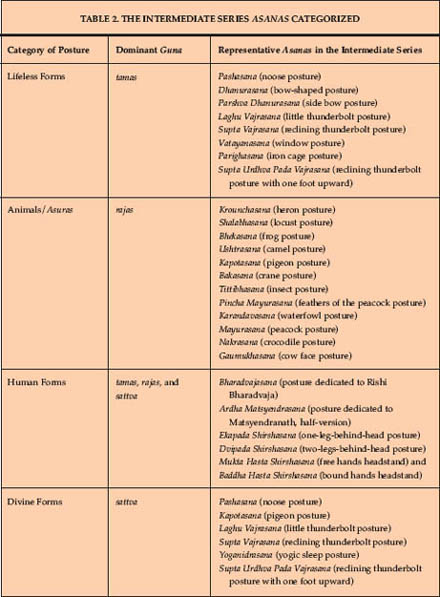
In this chapter I first explain the various categories of posture names and provide a table (see p. 31) that shows which category each Intermediate Series posture falls into. (You may notice that a few postures fall into more than one category, which reflects the richness of Indian mythology, wherein many terms have more than one meaning or connotation.) Then I provide some mythological context for each of the postures of the Intermediate Series.
The Categories of Postures
There are four categories of posture names: postures dedicated to lifeless forms, postures representing animals, postures representing human forms, and postures representing divine forms. Each category has its own unique gunic makeup, as explained below. Postures of the Primary Series tend to represent tamas guna (mass particle), those of the Intermediate Series are generally an expression of rajas guna (energy particle), and Advanced Series postures appear to be permeated by sattva guna (intelligence particle).
POSTURES DEDICATED TO LIFELESS FORMS
Lifeless forms are primarily made up of tamas guna. Most of the postures of the Primary Series are dedicated to lifeless forms, while the Intermediate Series (consisting of twenty-seven postures) includes eightasanas that fall into this category. Seven of these represent ancient forms of weaponry: the noose (Pashasana), the weapon of Yama (the Lord of Death) and Varuna (the Lord of the Ocean); the thunderbolt (three variations of Vajrasana), the weapon of Indra; the iron beam (Parighasana), a weapon used by Lord Hanuman; and the bow (Dhanurasana and Parshva Dhanurasana). Only Vatayanasana (window posture) represents a lifeless form that is not a weapon.
POSTURES REPRESENTING ANIMALS
This category is the dominant one in the Intermediate Series, with twelve postures. Animals tend to be rajasic.1 Many of the animals from which postures take their names are related to asuras (demons) of the same name. For example, Krounchasana takes its name from krouncha, the Sanskrit word for heron, but Krouncha is also the name of an asura. Both animals and demons are thought to identify primarily with the body (whereas humans have the capacity to access and identify with their divine selves). Like animals, asuras are primarily of rajasic nature. In animals the rajas tend to manifest as fear, whereas the asurastend to make anger their downfall.
POSTURES REPRESENTING HUMAN FORMS
A third category of yoga postures includes those dedicated to human forms. We find in this category postures named after parts of the human anatomy and after ancient human masters. Human beings are at various times under the sway of tamas, rajas, or sattva. For this reason, asanas are named only after those humans who have gone beyond their animalistic and demonic natures and have awakened to their inherent divinity. These are typically Vedic rishis or in some cases illustrious Tantric yoga masters. The purpose of this category of postures is to remind us of the sacred exploits of these masters and also to remind us of the divine potential inherent in every human. There are six postures in the Intermediate Series that fall into this category, with two of them named for sages (Bharadvajasana and Ardha Matsyendrasana), but we will find many more in later sequences.
LIGHT ON ASURAS
Although the Sanskrit word asura is generally translated as “demon,” this is, of course, problematic. Alternative translations are demigod, titan, and devil. Like the so-called gods (devas) and humans, the asuras, or anti-gods, are subject to the law of karma. Not all asuras cast negative figures; some of them have been outstanding spiritual beings. The asura king Prahlada, for example, was a great devotee of the Supreme Being in the form of Lord Vishnu, and the asura Vibhishana was a devotee of Lord Rama. The asura Baka was a devotee of the Supreme Being in the form of the Lord Krishna. The asura Ghattotkatcha, son of Bhima, was one of the greatest fighters on the side of the Pandavas during the Mahabharata war, and consequently shed his life for them.2
The Ramayana’s description of the asura fortress Lanka reads like that of a modern, sophisticated metropolis: Lanka is described as incredibly wealthy, beautiful, clean, and orderly, and its citizens learned, intelligent, and brave. The demons of Lanka, however, tend to make the wrong choices and follow a corrupt leader.
We need to understand asura metaphorically as having the potential for negative traits; for us humans it is important to recognize asura as our own dark side, our shadow that is always there. Conversely, deva is the light within us. We should not smirk at the naïveté of ancient societies and their talk about demons; instead we should consider that our own demonic potential can surface in many ways in the course of one day. There is no point in seeing the dark side only in others, either. Each human being has in each moment the choice to follow his or her demonic or divine potential. Only if we can acknowledge our own asuric potential can we overcome it. If we deny our dark side, it will only get stronger and stronger and surface in the most unlikely and most unwanted situations.
POSTURES REPRESENTING DIVINE FORMS
The final category of postures is those named after divine forms. No postures in the Intermediate Series are named directly for a divine form, but several postures are related to celestial beings. These includePashasana (the noose being the weapon of Varuna and Yama), Kapotasana (Kapota being one of the hundred names of Lord Shiva), the three Vajrasanas (the thunderbolt or vajra being the weapon of Lord Indra), and Yoganidrasana (which refers to the child form of the Lord Vishnu during the great deluge, Mahapralaya). There are many postures named after divine forms in the later, more advanced sequences.
Table 2 summarizes the categories and locates each Intermediate Series posture within its category.
Next we will take a closer look at the mythology behind the name of each posture.
Mythology of Posture Names
PASHASANA (NOOSE POSTURE)
The Sanskrit term pasha means “noose.” Noose refers here to the position of the arms, which are thrown like a noose around the legs. Pasha is also one of the thousand names of the Lord Shiva, who is also called Pashaye, Lord with the noose.3 The Hatha Yoga Pradipika starts with the assertion that it was the Lord Shiva (known in this case as Adinatha, or “primeval master”) who first taught yoga.4 What could be more befitting than to start the Intermediate Series with an homage to the moon-crested Lord who is held to be the author of yoga?
THE UNFATHOMABLE DIVINE
Divine forms, also known as devas or celestials, are sometimes called gods, but as mentioned in chapter 2, this term is slippery and simplistic. As the Upanishads and Brahma Sutra convincingly state, there is only one Brahman. However, this abstract, formless Brahman is difficult to understand. For this reason, the pragmatic approach of the Vedic teaching is to form a close, intimate, personal relationship with one of the aspects or manifestations of the Divine.
Divine forms are meditation images of the Supreme, but their function and importance do not end there. They are also aspects of our higher nature. Here deities are not so much independent beings but rather forces within ourselves that determine our actions as aspects of ourselves. By meditating on a divine image we invoke its qualities. This process of bringing forth the divine qualities within us is very different from what is depicted in today’s mass media, which continually portray the more demonic aspects of human nature and thereby provoke the audience to enact further demonic behavior.
Divine forms, of course, are ruled by sattva. However, as our demonic side is not always evil, our divine side is not necessarily always noble. The downfall of divine forms or celestials can be their attachment to pride and pleasure, as has been the downfall of many a noble human being.
Deities also represent forces of nature. Indra, for example, represents thunder and rain; Varuna represents the ocean; and Agni represents fire. Last but not least, they also often represent celestial bodies, such as Brihaspati representing Jupiter, or Varuna representing Uranus. Divine forms can also be much more than just deities; they can be Brahman with form. This is particularly true of Lord Shiva in his many manifestations, Lord Vishnu and his avataras (incarnations), and Devi, the Goddess.
Vedic divine images are so complex that we need to admit that we don’t know exactly what they are, and we can only learn more about them as we go along. The list of characteristics given of the phenomenon deva is by no means complete. Everything that I have said so far about the Divine says more about my ignorance than about the Divine.
The term pasha is derived from the Sanskrit verb root pash, meaning “to bind.” According to the nineteenth-century American linguist William Dwight Whitney, pash is inferable from the noun pashu, which is again listed as one of the thousand names of the Lord Shiva.5 Monier Monier-Williams, a nineteenth-century linguist noted for compiling one of the most widely used Sanskrit-English dictionaries, translated pashu as “animal,” but he pointed out that the term can also be applied derogatively to humans who are unevolved in sacred matters. He explained that the Pashupatas (an ancient school of Shiva worshipers) used the term pashu to refer to the individual consciousness or self, distinct from the consciousness of the Supreme Being. Human beings were labeled beasts (pashus) because they were commonly enmeshed in conditioned existence and unaware of their higher divine nature. The Pashupatas professed that those who do not evolve from this conditioned state are still “animals in sacred matters.”6
The Pashupatas called the Supreme Being Pashupati, which is commonly translated as “Lord of the Beasts.” The so-called Pashupati seal, a terracotta seal that was excavated on a site related to the Indus-Sarasvati culture, supplies us with the oldest known archaeological evidence of yoga. The seal depicts an ithyphallic figure with a bovine head, sitting in Siddhasana, surrounded by animals. The figure is thought to represent the Lord Shiva, the bovine head representing his vahana (vehicle), the bull Nandi.
In Kathmandu, Nepal, an ancient Shiva temple called Pashupati Nath still exists today. Pashupatism is thought by some to be the oldest religion on Earth. Although this religion is generally thought to be extinct, there are still sadhus in India who regard themselves as Pashupatas.
In the Mahabharata we find numerous references to the term pashupata. Pashupata is an adjective meaning “belonging to Pashupati” (Shiva). It is also the name of the most terrible weapon of the Lord, called the Pashupata missile, the arrow that he unleashed from his bow to destroy the three aerial demon cities, called Tripura.
The Puranas describe this most destructive of all missiles as having Vishnu (the Supreme in its function as sustainer) as its shaft, Agni (the Supreme in its function as fire) as its tip, and Vayu (the Supreme in its function as wind) as its feathers. The Skanda Purana states that the Pashupata missile was created from the backbone of the Rishi Dadhicha, who also gave his skull for the manufacturing of the vajra, the weapon of the Lord Indra.
In the Mahabharata, Arjuna realizes that he needs this missile to win his brother’s empire back. He performs austerities in the forest and finally receives the Pashupata missile as a boon from Lord Shiva.
Similarly, the performance of this first posture in the Intermediate Series must be seen (if the practitioner is of devotional character) as asking a boon of the trident-bearing Lord (Shiva). The boon being requested is, as usual, immortality — not the immortality of the body, however, but that of recognizing oneself as consciousness, which is eternal and uncreated and therefore immortal. The Lord Shiva is a personification of infinite consciousness.
Pashasana also symbolizes the noose that the Lord throws around the yogi to save him from the fangs of Yama, the Lord of Death. Apart from Lord Varuna, Lord Yama is the other famous carrier of the noose. He is thought to cast the noose at the moment of death to usher the spirit of the departing away.
KROUNCHASANA (HERON POSTURE)
Krouncha means “heron.” A pair of herons figure prominently in the incident that not only gave rise to Indian poetry but also triggered the composition of the oldest epic, the Ramayana.
At the outset of the Ramayana we find sage Valmiki accompanied by his disciple Bharadvaja in the forest.7 When Valmiki wants to take a bath, he suddenly becomes aware of two krounchas engaged in love play. Just then a hunter appears and strikes down the male krouncha with an arrow. As the male bird lies on the ground in his blood, the female cries out in agony at the loss of her mate. Valmiki is intensely touched by this tragedy and in the midst of his passion curses the hunter for killing the bird. He then realizes that his outcry was spontaneously forged into metrical quarters, each containing the same number of syllables. Because it was produced by the sentiment grief (shoka), he calls his creation shloka. Later on, Valmiki is visited by Lord Brahma, who explains that what the seer discovered was in fact poetry, and he assigns him to cast into verse the entire tragedy of the life of Rama (the king of Ayodhya and sixth avatara of Lord Vishnu), which today we know as the Ramayana, the first and foremost of all poems.
Krouncha also refers to a famed asura who is the antagonist in a tale about the Rishi Agastya, who brought the eternal teaching (sanatana dharma) to South India and Indonesia. The story commences with Agastya visiting Mount Kailasha in order to obtain a boon from Lord Shiva. Agastya asks for the boon to install a tirtha (sacred bathing site) in South India. For this purpose, the Lord turns the goddess Kaveri, who is attending him at the time, into a river and places her in Agastya’s water pot (kumbha) for easy transport.
On his way to South India, Agastya finds a huge mountain obstructing his way. After several attempts to walk around the mountain, which are thwarted by the mountain repositioning itself, Agastya eventually realizes that the mountain is the asura Krouncha. Krouncha wants to prevent Agastya from installing the sacred site, because it would block Krouncha from further defiling the country.
Agastya curses the asura to forever remain a mountain, called Krouncha Mountain, until a divine force frees him. This divine force would eventually arise in the form of Lord Shiva’s second son, Skanda, the Lord of War, who splits open Mount Krouncha with an arrow.
Agastya, upon finding the correct location for his sacred site, releases the waters of his vessel, and the River Kaveri is born. This river is still well known today, as it flows through the entire Indian state of Karnataka. The ashrama of the rishi is said to have been located at the source of the Kaveri, in the Western Ghats. The Kaveri is considered so sacred that even the goddess Ganga, whose material manifestation is the River Ganges, bathes there once a year to cleanse herself from the degradation she has to absorb as a bathing site.
SHALABHASANA (LOCUST POSTURE)
Shalabha means “locust” or “grasshopper.” The term is derived from the root shal, which is an exclamation denoting suddenness, the kind of movement typical of a locust.
In the Adi Parva of the Mahabharata, the asura Shalabha is listed as the previous embodiment of the demon emperor Prahlada.8 After Shalabha breathed his last breath, he was reborn with the name Prahlada, son to the mighty demon king Hiranyakashipu.
Hiranyakashipu is a very prominent figure in the Puranas. He was a son of the Rishi Kashyappa, of Kashyappasana fame. Kashyappa himself was a son of the Rishi Marichi, to whom as many as eightMarichyasanas are dedicated. We met the Rishi Kashyappa already in Ashtanga Yoga: Practice and Philosophy, as the father of Garuda, the king of the eagles.
Hiranyakashipu had a brother named Hiranyaksha, and as the sons of Kashyappa and his wife, Diti, they were born with an extraordinary destiny. To understand the significance of the two brothers we have to go back many, many millennia to a fateful day, the events of which not only triggered the two greatest wars of India’s ancient history but also caused a conflict that spanned three world ages.
Jaya and Vijaya were both gatekeepers at Vaikuntha, the celestial abode of Lord Vishnu. Both were absorbed in Bhakti Yoga, the yoga of devotion to their master. One day the rishis Sanaka and Sanatkumara, along with other rishis, approached the gate wishing to address the Lord. Jaya and Vijaya were in an arrogant mood that day and, wishing to keep the Lord’s glory to themselves, refused entry to the rishis.
The group of rishis pronounced a terrible curse on Jaya and Vijaya, condemning them to spend their lives roaming the Earth as asuras (demons) engaged in acts of hatred against their master, the Lord Vishnu.
In despair, Jaya and Vijaya turned to Lord Vishnu and asked him to modify the curse of the rishis. Lord Vishnu pointed out that he could not do so and didn’t want to as they had acted wrongly, but he told them that since all their thoughts had always been bent only on him, from now on they would practice Krodha Yoga. Krodha Yoga is the practice of reaching an intense state of concentration on a chosen object, not through love but through hatred. (Krodha Yogis, like Bhakti Yogis, eventually become what they focus on, with the important difference that during the process Krodha Yoga bestows incredible pain, whereas Bhakti Yoga bestows bliss.) Lord Vishnu then promised his two devotees that they would hate him with such fervor that inevitably they would be drawn toward him like moths into the flame of a candle, only to be killed by his hand and thus again become one with him.
The curse ran its course, and the words of the rishis came true as Jaya and Vijaya were born as fierce demons in three consecutive ages. The wars and conflicts that arose through their insatiable hatred of the Lord stimulated the latter to manifest ever-greater avataras to quell the activities of his former devotees. They also gave rise to the greatest Indian tales and epics, the Bhagavata Purana, the Ramayana, and theMahabharata.
The point of this story about Jaya and Vijaya is that the brothers Hiranyaksha and Hiranyakashipu were Jaya and Vijaya reborn. Both grew up into very powerful warriors and lived for the sole desire of destroying the Lord. Hiranyaksha eventually challenged the Lord when the latter lifted the Earth from the bottom of the primordial ocean, assuming his mighty Varaha (celestial boar) avatara.9 After an arduous fight, Hiranyaksha met his end at the tusks of the Varaha.
Hiranyakashipu did not take very well to the news of his brother being killed by his archenemy. His hatred grew even stronger. He performed intense austerities to such an extent that eventually Lord Brahma had to descend from heaven and ask him which boon he wanted to obtain.10 Like every true demon before him, Hiranyakashipu asked for his present body to be immortal, since identification with the body is known as the demonic teaching.11 Significantly, Lord Brahma answered that he could not bestow this boon since even he himself was not immortal.
Hiranyakashipu then asked for the second best boon he could think of: to be killable neither by man nor by beast, neither during day nor at night, neither in a house nor outside a dwelling, neither on the ground nor up in the air, and by no weapon of any kind. Brahma happily granted this boon, since although quite comprehensive it was still finite.
With renewed vigor, Hiranyakashipu then tackled the pursuit of the Lord’s peril. Since he was invincible, he easily became the king of the asuras and amassed a mighty army. He soon embarked on his various campaigns of looting and ransacking the three worlds (earth, heavens, and netherworld) with the aim of finally meeting and challenging his chosen enemy, Lord Vishnu.
One day when Hiranyakashipu was away, his own city was attacked and looted by Lord Indra and his army of devas (the Indian devas are not averse to the pastime of ransacking and pillaging). Hiranyakashipu’s wife, Kayadhu, was dragged away as booty but subsequently rescued from Indra’s humiliation by the celestial Rishi Narada. Narada is described as having the gifts of eternal youth and flattering speech and being most handsome and a great musician and singer. It is said that by the time Kayadhu left Narada’s ashrama and returned to Hiranyakashipu, the love-smitten demon queen was pregnant.
Hiranyakashipu was too engaged in wreaking destruction to notice that his first son, Prahlada, who was none other than a reincarnation of the asura Shalabha, nevertheless had many traits unworthy of a demon and was rather like a celestial. While Hiranyakashipu was abroad to practice pillaging and ransacking, Prahlada was trained in the demonic arts to be a worthy successor to the demon king. On returning, Hiranyakashipu inquired about Prahlada’s progress, only to find his son spontaneously bursting into praises of the much-despised Lord Vishnu. Hiranyakashipu at this point developed serious stomach ulcers. After several attempts to retrain Prahlada in the demonic arts failed — he tried to get him to devour pious devotees of the Lord, roast people on spits, and defile sacred sites through strategic placement of chunks of roasted meat — he decided to have his son killed.
He first ordered his palace guards to chop him to bits. But the guards found their blades went right through Prahlada with no effect. Hiranyakashipu then had him bitten by venomous cobras, trampled on by his biggest elephants, thrown into a furnace, attacked by his most terrible demon warrior, submerged in the ocean, and finally thrown off the highest peak in his empire, all to no avail. While Prahlada remained in samadhi, the cobras’ fangs fell out, the elephants’ tusks broke off, the fire died down, the terrible demon warrior ran away, the ocean spat him out, and from his fall from the highest peak he landed lightly like a feather on a bed of lotus flowers.
Hiranyakashipu finally lost his temper and decided to finish off this unworthy son himself. He committed his final mistake on the stairs at the entrance to his palace when he dared Prahlada to invoke his mighty Lord on the spot and let him burst forth from one of the entrance pillars of the palace to prevent Hiranyakashipu from finally killing his son.
Prahlada only smiled and, closing his eyes, invoked the Lord. At that moment a huge cloud darkened the sky so much that there was hardly any daylight anymore; it was neither day nor night. With a clap of thunder, the huge pillar split apart and the Lord came forth in his terrifying Narasimha man-lion form, his fifth avatara. In this form he was neither man nor beast, but in between. He grabbed Hiranyakashipu on the stairs of the entrance to his palace, where he was neither inside nor outside of a dwelling. He lifted him up and placed him on his lap, where he was neither in the air nor on the ground. Without using any weapon at all — thus following the boon granted by Lord Brahma to the letter — the Lord in the form of the terrible Narasimha then tore Hiranyakashipu to shreds. (Here is a frequently occurring theme of Indian mythology: If we are in the position to ask a boon of a celestial, we should choose the wording of this boon very, very carefully.)
Whereas everybody else ran away in terror when Narasimha appeared, Prahlada just looked on, smiling, for he recognized the Lord Vishnu even in this terrifying form. The Lord then reverted to his benevolent four-armed form, placed Prahlada on the throne, and made him emperor of the demons.
Thus ends the story of Prahlada, the incarnation of the demon Shalabha. His father, the demon Hiranyakashipu, formerly Vijaya, the jealous doorkeeper of the Lord, had to go through two more demonic incarnations before becoming one with his master.
BHEKASANA (FROG POSTURE)
The term bheka denotes a frog. In Indian mythology, the frog is a metaphor for sweat and its inherent power of creation. We can see the basis for this metaphor in the following myths.
The Katha Sarit Sagara informs us how the frogs derived their strange voices and in so doing demonstrates the connection among frogs, water, and Agni, Lord of Fire.12 Lord Shiva and his consort Uma were once engaged in love play. Since their activities were extremely long lasting and they were the most powerful beings in the universe, the entire world was excessively heated by the friction they created. The devas, lead by Lord Brahma, were concerned that the entire world would be destroyed as a result. So they singled out Lord Agni to interrupt Shiva and Uma’s love play. Agni became very concerned, for he knew that when Kama (cupid) had dared to disturb the Lord’s meditation with his flower arrows, he had been reduced to ashes by a mere glance from the mighty Lord’s third eye. Agni therefore resolved to hide underwater in a lake rather than take up his task. But Agni’s fire brought the water in the lake close to a boil. The frogs living in the water were in such unbearable pain that they revealed Agni’s location to the devas. For this treason Agni cursed the frogs, and their voices turned into croaking.
The Shatapatha Brahmana also contains a passage that connects Agni to frogs.13 It first describes the construction of the fire altar, and then the consecration and oblation thereof. A priest is advised to draw a frog on the central part of the altar. The story goes on to explain that in the beginning the rishis sprinkled Agni with water. When the water dripped off him, the drops became frogs. The drawing of the frog on the altar is used to appease Agni, who appears on the altar as fire to consume the oblations.
Agni represents the inner fire in yoga. Accordingly, the sushumna, visualized red, is called the fire nadi. Inner fire is created through ritualistic practice (tapas) such as asana. The term tapas is derived from the verb root tap, to cook. Inner heat, produced by correct forms of exertion, is used to burn toxins and impurities. Any such activity brings about sweat, which is the water produced by the heated body.14 Sweat has an important function in yoga. Shri B.N. S. Iyengar repeatedly instructed me that “sweat goes to the next life.” This means, on one hand, that the fruit produced by right exertion is not lost when the mortal body is shed; and on the other hand, that creative power is ascribed to the sweat itself. In the Puranas there are several incidences of procreation happening when a drop of sweat falls off the brow of a celestial or rishi, and a new powerful being springs up from it. Procreation in the Golden Age (Satya Yuga) was thought to be possible without intercourse; the father merely wiped the sweat off his brow and rubbed it on the skin of his wife. Finally, the medieval Hatha texts inform us that the sweat produced by practice should not be wiped off but rubbed back into the skin. By this method, inner glow (tejas) is restored. Tejasis another form of Agni.
DHANURASANA (BOW-SHAPED POSTURE) AND PARSHVA DHANURASANA (SIDE BOW POSTURE)
Dhanu means “bow” and dhanur means “bow-shaped.” The bow is highly significant in Indian culture and mythology because it was the chosen weapon of India’s aristocracy. The following myths are just a few of the many in which a bow figures prominently.
The Rishi Bharadvaja had two students, Drona and Drupada. Both were very competitive, and hatred arose between them. At one point, Drona, who was a great warrior, humiliated Drupada. Drupada thought of revenge. He performed a ritual that gave him two divine children. The son was Drishtadyumna, who would eventually succeed in killing Drona, and the daughter was the beautiful Draupadi. Draupadi would become the wife of Arjuna and his four brothers and become the empress of India. At this early point, however, it looked as if Arjuna had succumbed to attempts of his uncle and cousins to murder him. It was not known if he was in fact dead or simply in hiding.
Drupada had meanwhile become king of the Panchalas. He was worried how he could make Draupadi the wife of Arjuna, for it looked as if Arjuna were dead. Drupada’s court priest suggested that he hold a tournament to determine who was the greatest archer, with Draupadi’s hand as the prize. Draupadi was thought to be the most beautiful woman on Earth, so this tournament would surely get Arjuna out of hiding.
In his capital city, Kampilya, Drupada erected a huge palatial hall. Kings, great heroes, and the greatest archers from all over India and faraway countries were invited. They all came to try to win the hand of Draupadi. On the ceiling of the hall was mounted a rotating target in the form of a fish that could be felled only with five arrows. The celestial bow Kindhira, which possessed a bowstring of steel, was brought. Many kings tried to string the bow and failed. Others managed to string it but missed the target. Eventually Arjuna, disguised as a brahmin (a member of the priest caste), got up, strung the mighty bow Kindhiraeffortlessly and hit the rotating fish with all five arrows. Thus he won the hand of Draupadi.
Arjuna later used his bow Gandiva to vanquish his many enemies and win the Mahabharata war. The Virata Parva of the Mahabharata tells the story of Arjuna, who spent twelve years in exile in the forest and a thirteenth year in disguise, after which he reclaimed his hidden bow. When an onlooker asked him to explain the magic that the bow Gandiva exuded, Arjuna explained that it was famed throughout the entire world; it was the only one of its kind. Whoever possessed it would obtain eternal fame. Lord Brahma owned it for one thousand years, and after him Lord Indra for five thousand years. Lord Soma then held it for an eternity before he passed it on to Varuna, the Lord of the Ocean. From him Agni, Lord of Fire, obtained it, and he passed it on to Arjuna for the burning of the Khandava forest. Shortly thereafter, when Arjuna was attacked by the army of his enemies for the first time after the exile, the mere twanging of Gandiva’s bowstring sent terror into the hearts of those in the opposing army.
Bows also feature prominently in the Ramayana.15 The two biggest and most powerful bows in the world were said to be those of Lord Shiva and Lord Vishnu.
Lord Shiva was wedded to Sati, who was the daughter of Daksha. Daksha did not approve of the marriage, so he arranged a yagna, or ritualistic sacrifice, to humiliate Sati and mock Shiva. Although uninvited, Sati attended the sacrifice but could not bear her father’s insults to Shiva, so she immolated herself on the spot. Shiva became enraged and manifested Virabhadra (of Virabhadrasana fame) to enact revenge on Daksha. Virabhadra killed all participants of the sacrifice, although Shiva later revived them in an act of grace. In the meantime, Lord Shiva gave his bow to the kings of Mithila to keep safe while he granted the penances. The bow came into King Janaka’s possession when he ascended the throne. Nobody had ever been able to string this mighty bow or even lift it off the floor. King Janaka promised that whoever was able to string this bow would get the hand of his daughter Sita.
Rishi Vishvamitra then brought the two young princes Rama and Lakshmana to Mithila, after they had defeated some demons who had defiled the site of Vishvamitra’s rituals by holding barbecues there. Vishvamitra introduced Rama to the king, who was happy that someone was trying to gain his daughter’s hand, as many kings had failed. The bow was brought to the palace on an eight-wheeled cart and had to be unloaded by five thousand strong men. Meanwhile a huge audience congregated to watch the spectacle. Encouraged by Vishvamitra and King Janaka, the young Rama lifted the bow effortlessly, strung it, and under the eyes of the breathless crowd fixed an arrow and drew it back. He bent the bow to such an extent, however, that it snapped into two pieces, accompanied by an earthquake and tremendous thunder. After everybody had recovered, King Janaka happily gave his daughter Sita as wife to prince Rama.
USHTRASANA (CAMEL POSTURE)
Ushtra means “camel.” In this posture the back is arched, giving the body a rounded shape like the hump of a camel. The Skanda Purana uses the word ushtra metaphorically to suggest camel-like qualities.16 It categorizes listeners of scripture according to the merit they derive from the activity. The listeners are first categorized as either superior or inferior; then those groups are divided into several subcategories. Among the inferior ones is a category called Ushtra. As the camel picks out bitter fruit and shuns the sweet varieties, so do listeners of the Ushtra type fail to take on the sweet and joyful aspects of scripture and instead focus on its bitter parts.
The Harivamsha Purana mentions an asura called Ushtra.17 Ushtra participated in an epic battle between the celestials and demons. He was a follower of the one-hundred-headed king of the demons, Kalanemi, who fell only after his heads and arms were severed by the fiery Sudarshana disc of the Supreme Being in the form of the Lord Vishnu.
The following story is from the Katha Sarit Sagara.18 On a hunting excursion, the King Pushkaraksha sees a camel that is about to swallow two snakes entwined in love play (entwined snakes are often a metaphor for the twin nadis, ida and pingala). Feeling grief for the snakes (similar to Rishi Valmiki’s feelings for the krouncha birds), he shoots the camel with an arrow. Immediately the camel changes into the form of a Vidyadhara (a lower class of celestial being, often mentioned together with Gandharvas and Yakshas). Surprised, the king asks the Vidyadhara how he came to be entombed in the body of the camel. The Vidyadhara relates the story of how he had flown across the hermitage of a sage and spotted the beautiful Vinayavati, whom the sage had found in the forest as a little girl and had raised. The Vidyadharawas inflamed by lust and, descending, he attempted to drag Vinayavati away by force. The sage then appeared, attracted by his foster daughter’s cries, and cursed the Vidyadhara to live in the body of an ugly camel until released by a king, who in turn would then marry Vinayavati. (The tale continues with numerous twists but does not involve any more camels.)
LAGHU VAJRASANA (LITTLE THUNDERBOLT POSTURE), SUPTA VAJRASANA (RECLINING THUNDERBOLT POSTURE), AND SUPTA URDHVA PADA VAJRASANA(RECLINING THUNDERBOLT POSTURE WITH ONE FOOT UPWARD)
Vajra means “hard, mighty, adamantine, impenetrable one.” Patanjali lists vajra as a quality of the body of the yogi.19 He suggests acquiring, through samyama, a form of objective samadhi that bequeaths adamantine stability of the body.
The mythological vajra is the thunderbolt, the weapon of Lord Indra. The following tale involving vajra is one of the oldest Indian tales and is mentioned in the Rigveda. Lord Indra had become very proud of being the king of heaven. He was sitting on his throne, attended to by thousands of dancers, musicians, celestial nymphs, and the other devas, when his preceptor Brhaspati entered the throne hall. Indra thought so greatly of himself that he did not deem it necessary to get up and bow to his preceptor. Brhaspati just looked at Indra, basking in his pride, and left. After Brhaspati had left, Indra realized that he was in trouble, for he would not be able to defeat the demon armies without his teacher’s help. He looked for his teacher to apologize but could not find him, as Brhaspati had made himself invisible.
Indra, who now needed a new preceptor, then chose the service of Vishvarupa, son of Tvashtr. After initially staging rituals and sacrifices that helped Indra keep the demons (asuras) at bay, the two had a falling out, and Indra killed Vishvarupa. Vishvarupa’s father, Tvashtr, decided to avenge the killing of his son and performed a powerful ritual. Out of the sacrificial fire an invincible demon was born, one that made the worlds tremble. His name was Vrtra. Vrtra, emitting a terrible cry and brandishing a trident, jumped out of the sacrificial fire with the words, “What is your command?” to which Tvashtr said, “Go and kill Indra!”
Vrtra amassed a huge army of frightening demons, with whom he defeated the devas led by Indra. He humiliated Indra, who found that all his weapons bounced off Vrtra’s body, unable to penetrate his skin. Indra then took refuge with Lord Brahma and from him learned that only a weapon formed from the adamantine bones of the Rishi Dadhicha could kill Vrtra, as Dadhicha’s body was made from the essence of the world.
Dadhicha was a son of the Rishi Brighu and had an ashrama on the banks of the Sarasvati River. Dadhicha had been one of the few righteous ones who spoke out when Lord Shiva was insulted at Daksha’s sacrifice. The devas went to Dadhicha’s ashrama and found it to be a place where cats and mice, lions and elephants, mongooses and snakes were playing peacefully next to each other, having lost any intention to do harm in the vicinity of that great sage. (A peaceful coexistence such as this is described by Patanjali as a result of yoga practice.)20 Dadhicha greeted the devas with the words, “Whatever you came here for shall be given to you.” The devas described the situation and asked Dadhicha to surrender his body for the good of the world. Dadhicha, being a true saint, did not hesitate. He called those close to him and told them of his undertaking. Then in the presence of the devas he entered intense samadhi, cast aside his body, and attained the Brahman (infinite consciousness).
The devas then fabricated from his adamantine bones various weapons. The vajra was manufactured from Dadhicha’s backbone; the extremely destructive celestial weapon the Brahma shirsha astra, or Brahma’s head missile, was made from his skull;21 other bones were made into other terrible weapons; his tendons formed nooses for Varuna, Lord of the Ocean, and Yama, Lord of Death.
The devas, led by Indra, then amassed a great army and challenged the asuras. The asuras appeared quickly, led by Vrtra, and hostilities intensified to such an extent that the three worlds were shaking.After the fight had claimed many casualties on both sides, the Lord of Heaven (Indra) met the leader of the asuras, the terrifying Vrtra, on the battlefield. Indra struck him with many weapons, which all seemed to bounce off the asura. Even the mighty vajra could not penetrate his skin. After the combat had gone on for a long time, Vrtra yawned. At this point, Indra hurled the vajra, which entered Vrtra’s body through his open mouth and cut him in half.
KAPOTASANA (PIGEON POSTURE)
Kapota means “pigeon.” The name Kapota in the shastras refers to three different figures. The Mahabharata tells of a Kapota who was a son of Garuda, the king of eagles.22 The Kalika Purana informs us of the clandestine exploits of a sage named Kapota, to whom we return shortly. Most important, however, Kapota appears as one of the hundred names of Lord Shiva and as one of Lord Shiva’s one thousand names. To chant the hundred or thousand names is itself a form of devotional practice (chanting the one thousand names is, of course, more time consuming and comprehensive).
The Skanda Purana informs us how Lord Shiva received the name Kapota.23 He once undertook severe tapas (ascetic practices) in the form of living only on air and avoiding all pairs of opposites. Although he was the master of the eight forms (five elements, moon, sun, and Lord), he shrank to the size of a pigeon. Henceforth, he was known to his devotees by the name of Kapota.
Kapota is also the name of a sage who plays an important role in a tale described in the Kalika Purana.24 Lord Shiva is at one point cursed to beget sons through intercourse with a mortal woman. He hatches a complicated plot so that he can fulfill this curse without violating the vows he made to his wife Parvati.
An old king, wishing for a son, asks Lord Shiva for the boon of progeny. Shiva grants the king his wish and makes himself be born as the king’s son under the name Chandrashekara (which means “he who wears the moon as a crown,” another name of Shiva). At the same time, Parvati incarnates herself as the princess Taravati, who marries Chandrashekara once he succeeds his father to the throne.
One day Taravati bathes at a secluded spot on a river. She thinks herself well concealed, when in fact the sage Kapota observes her. Kapota, who is supposed to sit blissfully and beyond all earthly attachment in samadhi, is overcome with immense lust for Taravati as soon as he sees her. Kapota approaches her and tells her that she is so beautiful that she can only be Parvati or the queen of heaven. Taravati is actually both, but she is completely unaware of this fact. So she tells Kapota that she is the wife of King Chandrashekara (who is Lord Shiva in another form, again without being aware of it). Kapota then reveals to her how much he desires her and promises her that she will beget two strong and healthy sons if she yields to his advances. Taravati rebukes the sage for his illicit behavior, but Kapota then threatens to curse her if she does not consent.
Taravati manages to save herself by sending her younger sister Chidrangada, dressed as herself, to Kapota. After sage Kapota enjoys himself, he takes Chidrangada, posing as Taravati, to his ashrama, where later she bears the two promised sons. Not realizing that he has been cheated, Kapota resolves — now that he has had his way — to purify the queen from the sin of adultery through the power of histapas.
After some months pass, Taravati makes the mistake of again bathing in the same spot at the river. At the same time, Kapota decides to get some fresh air and goes down to that lovely river spot. When he sees the beautiful Taravati, he realizes that he has been cheated. In anger he curses her to be raped by Lord Shiva in the form of a stinking, repulsive Kapalika (a fierce form of ascetic who bears the skull of Brahma as a begging bowl) and to give birth to two monkey-faced sons. To counter the curse, she swears by her marriage vows and the vows of her father (who begot her as a manifestation of Parvati) that she will never have intercourse with anybody but her husband, Chandrashekara (Shiva).
THE ORIGIN OF YOGA
The Supreme Being in the form of Lord Shiva is credited with the authorship of yoga (in the Mahabharata, Shiva is called Yogeshvara, Lord of Yoga) because many myths about the origin of yoga start with a dialogue between him and the mother of the universe, Uma Parvati, often called Shakti.25 On one occasion when the Lord was teaching, the serpent of infinity, Ananta, was hiding close by and eavesdropped on the secret teaching. (Of course, Ananta is yet another aspect of the same Supreme Being, manifesting for the promulgation of the eternal teaching.) After he had heard enough, Ananta tried to slither away undetected, but Shiva apprehended him, having been aware of his presence all along. For his transgression, he sentenced Ananta to the task of relating this secret teaching (yoga) to the human beings. Ananta, the one-thousand-headed celestial cobra, then approached the next human village in his newfound role as ambassador of yoga. However, the Indian villagers — who didn’t take too kindly to the appearance of normal, one-headed cobras, much less one-thousand-headed ones — pelted Ananta with stones. Ananta returned to Lord Shiva for advice, and the Lord suggested he take on a human form. After doing so, he succeeded in teaching yoga to human beings. This incident is still remembered today in the second pada of the opening prayer of the Ashtanga Vinyasa practice. It says, “abahu purushakaram,” which means, “to him who is of human form from the arms upward.” It also says, “sahasrashirasam shvetam,” which means “one thousand white heads.” This is to acknowledge the fact that Ananta, the one-thousand-headed serpent of infinity, took on a human form and was called Patanjali. To reflect this, Patanjali is depicted as a human torso placed on the coils of a serpent.
Kapota returns home and gets in some quality meditation time. In samadhi, he sees the true nature of Taravati and Chandrashekara as Parvati and Shiva, and from then on he honors Chidrangada as his wife.
When Taravati one day performs her worship of Lord Shiva, she becomes so engrossed that she no longer recognizes him as different from her husband, who is in fact only a manifestation of Shiva. Shiva then appears together with his wife Parvati. Shiva assumes the appearance of a horrible Kapalika and takes Taravati by force. Immediately afterward she gives birth to the two monkey-faced sons. Shiva and Parvati then reveal their identities to Taravati. When Chandrashekara returns, a mystical experience is bestowed on both Chandrashekara and Taravati, in which they see themselves as Shiva and Shakti, father and mother of the universe.
This tale has an important implication. The Lord Shiva does not hesitate to receive and fulfill a curse even though avoiding it would be within his power. Why does he take this course of action? He does it to achieve certain outcomes. Note that the unfolding of the curse’s fulfillment results in the following: both Taravati’s and Chandrashekara’s fathers, previously childless, are able to beget children by propitiating Shiva and Parvati, respectively; the sage Kapota, who veers from his path to violate a woman, learns to honor and respect each woman as the cosmic mother Parvati. Taravati learns that displacing her problem to her sister does not solve it; both Chandrashekara and Taravati learn that they are representations of the cosmic pair Shiva and Parvati. The listener of the tale comes to understand that the meeting of each human pair is nothing but a manifestation of the union of the cosmic father and mother, Shiva and Parvati (or Shakti).
BAKASANA (CRANE POSTURE)
Baka is the name of a demon who figures prominently in the Mahabharata. The Mahabharata, being seven times the length of Homer’s Iliad and Odyssey together, is the largest piece of literature composed by humankind. It is a dharma shastra, meaning it inquires into what is right action, or dharma. Its main protagonists are the five Pandavas — the five sons of King Pandu — who find themselves coping with exceedingly difficult situations and thereby provide examples for right action.
The tale that revolves around the demon Baka begins after the still-juvenile princes and their mother, Kunti, have escaped from a death trap. Enemies of the princes built a house that appeared to be soundly constructed but was in fact painted with layers and layers of highly flammable paint. Supporters of the princes warned them of the trap, and the princes escaped, while some of their assailants perished in the fire they set. The princes and their mother then hid in the Ekachakra forest.
While in hiding, Kunti hears of the terrible demon Baka who terrorizes the nearby villagers. To placate Baka, the villagers pay him tribute in the form of food and animals, but even this does not prevent the insatiable demon from swallowing the villagers who deliver the tribute to him. Kunti promises that her second son, Bhima, a son of the wind god, Vayu, will deliver the tribute for them and vanquish the demon. The villagers supply Bhima with the usual cartload of food for the demon, but Bhima happily shoulders it all without making use of the cart. While walking through the forest on the way to the demon’s cave, he starts singing, pleased by the beautiful sunny day. It is a long distance to the cave, so he becomes hungry and starts to eat the food that was intended for the demon himself. He has just gulped down the last bite of his extensive meal when he arrives at the entrance to the demon’s cave. Bhima yells into the cave and begins to taunt Baka with the news that he has eaten all of Baka’s food. Baka does not remain idle for long. Eyes glowing red with anger, he emerges from the cave, tears out the nearest tree, and hurls it at Bhima. Bhima dodges the projectile and throws an even bigger tree back. This exchange goes on until all the trees in the vicinity of the cave are gone. The huge demon then charges at Bhima and starts to wrestle him. Bhima greatly enjoys this struggle. Finally, when he has had enough, he presses Baka down on the ground and crushes the life out of him.
We meet another demon with the name Baka in the Bhagavata Purana, a scripture consisting exclusively of the tales related to the Supreme Being in the form of the Lord Vishnu, particularly Vishnu’s seventh avatara, Krishna.
In the tale that involves Baka, Krishna is a little boy who has been taken to the countryside to be protected from the wrath of his uncle, the demon king Kamsa. Kamsa has tried to kill Krishna many times, as it was prophesied that Krishna would one day kill Kamsa. After several thwarted attempts, Kamsa sends the demon Baka — who can take on the form of a giant crane — to kill Krishna.
At this time, Krishna is herding the cows with his brother Balarama (an incarnation, like Patanjali, of the serpent of infinity) on the banks of the Yamuna. They suddenly see a mountainous creature sleeping by the river. They inquisitively draw closer, at which point the creature, who is Baka in crane form pretending to be asleep, rises and swallows Krishna. Thinking that his job has been fulfilled, Baka suddenly feels a terrible burning pain in his throat and can do nothing but spit out Krishna. Outraged at the failure of his first attempt, he attacks Krishna, threatening to spear him with his huge beak.
Krishna waits calmly for Baka’s approach, and just before Baka strikes him he grabs Baka by the two parts of his open beak, lifts him up into the air, and tears him into two pieces. When Krishna and Balarama return home, the villagers all marvel at the strength of the boy. Little do they know that he is no one else but the Supreme Lord. (Krishna takes great care not to display too much of his ability and to appear as human as everybody around him.)
Much later in the life of the grown-up Krishna it is revealed that the demon Baka was in truth a devotee who practiced Krodha Yoga, the yoga of hatred. By focusing on destroying the Lord, Baka had been drawn toward him and eventually found death at the hands of his master. In this way he became one with him.
BHARADVAJASANA (POSTURE DEDICATED TO RISHI BHARADVAJA)
Bharadvajasana is the first of a two-part sequence of twisting postures. It is deeply symbolic that in previous postures the gaze is mainly directly ahead or backward, whereas these twists give the practitioner a lateral view and encourage “lateral thinking.” It is also significant that both twisting postures are dedicated to human masters — and are in fact the only postures in the Intermediate Series or the Primary Series that represent human masters.
The two masters for whom these postures are named were very different. Bharadvaja was a Vedic rishi, while Matsyendranath — to whom the subsequent posture is dedicated — was a Tantric siddha. The juxtaposition of Bharadvajasana and Ardha Matsyendrasana is representative of the two roots of the Ashtanga Vinyasa system: Veda and Tantra. For a discussion of the difference between Veda and Tantra, see the sidebar “Veda and Tantra: The Twin Roots of the Ashtanga System.”
Bharadvaja was one of the Saptarishis (seven rishis), the most prominent group of Vedic rishis. The Ramayana lists the Saptarishis as Vishvamitra, Jamadagni, Bharadvaja, Gotama, Atri, Vasishta, and Kashyappa.26
Bharadvaja was a son of the Rishi Atri and a disciple of the Rishi Valmiki, who authored the Ramayana. Bharadvaja is the author of large segments of the Rigveda, the oldest scripture of humankind. He is also the author of a Dharma Sutra, a Shrauta Sutra, and a Sanskrit grammar that is mentioned by the grammarian Panini but is no longer extant. Bharadvaja is also said to be one of the authors of the original Ayurveda. The Brahma Purana states that he taught this original Ayurveda to the king of Benares, but unfortunately this treatise also has been lost.27
According to the Ayodhya Kanda of the Ramayana,28 Lord Rama went into exile and first visited the ashrama of Bharadvaja to seek his blessings. The ashrama is thought to have existed in what is now the Indian city of Allahabad, at the confluence of the Yamuna and Ganges rivers.
Bharadvaja was one of the fathers of Indian culture. His erudition represents in many ways the quintessence of Indic thought. As a young man, Bharadvaja set out to study the entire Sanatana Dharma (the eternal teaching of the Vedic sciences). Realizing that he was making slow progress, he commenced tapas (austere practices) to extend his life expectancy. As he continued to study, he came to learn about more and more areas of knowledge of which he was still completely ignorant. So he intensified his tapas to buy himself more time. Each of the Vedic deities to whom Bharadvaja propitiated eventually appeared before him and, pleased with his tapas, granted him boons for a longer life span. At one point he asked Lord Indra for further extension of his lifetime. Lord Indra appeared before him and told him that what he had learned so far amounted to a handful of sand, whereas what still lay ahead equated to the huge mountain close by. Unperturbed, Bharadvaja took a further extension of his life and recommenced his study.
Bharadvaja’s story exemplifies the determination and devotion of the founders of Indian culture and Vedic society. When we modern practitioners of yoga perform Bharadvajasana, we can ponder the path laid out by Bharadvaja and the other rishis as an inspiration for what is possible in this tradition. All of us who pursue any ancient sadhana (practice) — asana, pranayama, meditation, ritual, chanting of mantra, study of Sanskrit, and so on — are standing on the shoulders of the ancient sages of India.
ARDHA MATSYENDRASANA (POSTURE DEDICATED TO MATSYENDRANATH, HALF-VERSION)
Matsyendranath probably lived in Bengal or Assam. Legend has it that he was a fisherman who one day hooked a giant fish. The fish dragged him into the water and swallowed him. The fish subsequently traveled a long distance and came to rest exactly at the place in the ocean where Lord Shiva had chosen to impart the most secret teachings of yoga to his spouse, Shakti. By listening, Matsyendranath came into possession of the secret teachings, and then Lord Shiva ordered him to impart the teachings to suitable students. Matsyendranath practiced the Lord’s teachings inside the fish; after many years another fisherman hooked the fish and Matsyendranath was freed.
He immediately set about to fulfill the Lord’s order by founding the tradition of Hatha Yoga. This origin of Hatha Yoga is reflected in its most popular text, the Hatha Yoga Pradipika. It states that Adinatha (Lord Shiva) is the first Siddha, and Matsyendranath is the second.29
VEDA AND TANTRA
The Twin Roots of the Ashtanga System
During the times of the Veda, humans were able to stop their thinking process and listen, which allowed them to spontaneously realize the true nature of reality with their hearts (“heart” is a metaphor for consciousness). Listening to a simple sentence or a hymn from the Vedas could bring about a deep understanding. The time when Vedic dharma (teaching) was at its peak was India’s golden age. Then as history and its various ages unfolded, entropy (disorder) increased, the knowledge of humankind dwindled and weakened, and people lost the ability to directly comprehend the knowledge of the Vedas. During each of those ages, new types of scriptures were revealed in an attempt to reconnect people with that original knowledge. The scriptures that are designed to fulfill this purpose in the current age (Kali Yuga) are the Tantras.
Tantra is a very generic term that means “scripture” or “teaching.” The term Tantra is derived from the root tan, “to spread or stretch,” and from the root tra, “to save or to protect.” Since allTantras accept the Vedas as their authority and reference point, the term Tantra refers to treatises that spread or propagate the “saving” knowledge, which is the knowledge of the Vedas. The Tantrasdo not introduce anything new; they simply present the ancient knowledge of the Vedas in a new way, designed for modern humanity.
The Tantras emphasize technique and precise method rather than intuitive wisdom, philosophical speculation, and direct insight. There are Shaivite, Vaishnavaite, Shaktaite, Buddhist, and JainaTantras. All these systems at some point in their history “went Tantric” so modern humans could understand them more easily.
The movement away from abstract philosophical teaching and intuitive metaphysical insight and toward simple “how-to” manuals has been most obvious in the yoga tradition. Whereas the former themes were covered in the ancient Yoga Sutra and Upanishads, Tantric yoga treatises such as the Hatha Yoga Pradipika and the Gheranda Samhita generally contain instructions on how to practiceasanas, bandhas, mudras, and kumbhakas correctly. They also introduce the idea that if these methods are not practiced meticulously according to instruction, any higher realization will be impossible.
The Tantric approach differs from that of the Vedas in other respects as well. In particular, Tantric teaching’s stance toward gender and sensuality is very different from that of Vedic teaching. While in the Vedic pantheon, female deities often play second fiddle, in Tantra they are considered at least as important as male deities and often more important. This reflects the Tantric view that the cosmic female principle (that is, the female energy that is in everything — not just women but also God and the universe in general) is essentially sacred. Whereas Vedic rishis are exclusively male, Tantric siddhas (those who have achieved the power of realization) can be of either gender.
To raise the awareness of their disciples, Tantric siddhas employ methods that are unorthodox compared to the methods of the Vedic tradition. For example, a liberated female siddha may use intercourse to initiate a suitable male student and thereby confer mental freedom on the student. Many of the great Tantric gurus were initiated in this way. The female adept is then seen not as a mortal woman but as a priestess representing the Cosmic Godmother, Shakti. The qualifications required of male students include many years of celibacy, the ability to be completely unwavering in concentration if encountering sensual thoughts, and a thorough training in asana, pranayama, and meditation. (These stringent requirements are usually cast aside in the commercialized version of Tantra that is popular in Western societies today.)
Tantric ritual follows the rationale that anything that can lead to your fall can also be used to lift you up. There is thus no wrong teaching in Tantra but rather teachings that may be unsuitable for some students but right for others. Methods in Tantra are judged not according to whether they hold up to a moral code but based on whether they produce results, namely siddhi, and awakening in the practitioner. Although Westerners welcome Tantra as importing sensuality into spirituality, the traditional Indian view is that Tantra introduces sensual people to spirituality.
Matsyendranath was a prolific and influential teacher. He is said to have authored the Matsyendra Samhita, the Akula Vira Tantra, the Kaula Jnana Nirnaya, and the Kulananda Tantra. Most of these are Shaktaite Tantras (dedicated to worship of the Goddess) written in Bengali rather than Sanskrit. According to the Sanskrit scholar Agehananda Bharati, Matsyendranath is also the author of Gheranda Samhita, which would make Gheranda another name for Matsyendranath.30
We know of Matsyendranath mainly through the fame of his student Gorakhnath. Gorakhnath made Hatha Yoga and the order of the Nathas popular. He authored many texts, such as the Gorakshataka, theGoraksha Samhita, Siddha Siddhanta Paddhati, Yoga Martanda, Yoga Chintamani, Goraksha Sahasra Nama, and many more. Swatmarama, the author of Hatha Yoga Pradipika, states that he learned Hatha Yoga through the grace of Matsyendranath and Gorakhnath.31
The Tantric scholar A. K. Banerjea argues that Matsyendra’s and Goraksha’s yoga techniques were later elevated to Upanishadic status — that is, viewed as official mystical doctrines of the upper echelons of Indian culture.32 According to Banerjea, the group of Upanishads referred to as the Yoga Upanishads (the Nadabindu Upanishad, Dhyana Bindu Upanishad, Tejo Bindu Upanishad, Yoga Tattva Upanishad, Yoga Chudamani Upanishad, Yoga Kundali Upanishad, and so on) only repeat the teachings of Matsyendranath and Gorakhnath without referring to their compilers by name.
As the progenitors of some of Hatha Yoga’s most quintessential texts, both Matsyendranath and Gorakhnath are of significance for modern Ashtanga practitioners. The Hatha Yoga Pradipika, which was authored by a student of Gorakhnath’s, and the Gheranda Samhita, which was possibly authored by Matsyendranath himself, are the texts that place the most emphasis on the performance of the bandhas. Thebandhas are a distinctly Tantric influence in the Ashtanga system, and even though they may predate Matsyendranath, he is nevertheless remembered for them, especially in the performance of Ardha Matsyendrasana.
EKAPADA SHIRSHASANA (ONE-LEG-BEHIND-HEAD POSTURE) AND DVIPADA SHIRSHASANA (TWO-LEGS-BEHIND-HEAD POSTURE)
Leg-behind-head postures represent the destruction of the ego. It is easy to imagine the leg as a heavy sacrificial sword (kadga) ready to cut off the ego-containing head. The cutting off of the head as a symbol of reducing or destroying a bloated ego repeatedly occurs in Indian myth, such as in the beheading and subsequent resurrection of Daksha at the hands of Lord Shiva or the self-beheading of the goddess Chinamasta.
The symbolism of cutting off the head is powerfully displayed in the conflict between Lord Shiva and Lord Brahma. The Kurma Purana informs us that Brahma, the five-headed deity, once proclaimed that he was Ishvara, the Supreme Lord, and Brahman, the infinite consciousness, titles that more often than not refer to Lord Shiva or Lord Vishnu but not to Brahma.33 When the four Vedas then materialized and informed him that Lord Shiva was the Supreme Being, Brahma argued that this could not be the case, since Shiva had a wife and was therefore displaying attachment, which he felt must surely disqualify Shiva. The sacred syllable Om then became audible, and out of it manifested the Supreme Being, the Lord Shiva. He informed Brahma that his wife, the goddess Uma, was nobody but himself, a manifestation of his ecstasy. Brahma refused to acknowledge this, and to make matters worse, through his fifth head he ordered Shiva to bow down to him. At this point Lord Shiva raised his trident and cut off the fifth head of Brahma. As soon as the head was gone, Brahma could see that the Lord and the Great Goddess were in fact one and the same, the Supreme Being. Cured of his infatuation with himself and his obstinate ego, Brahma took refuge in the Lord.
By cutting off one of Lord Brahma’s heads, however, Shiva had committed the sin of slaying a brahmin (brahmahatya). According to the law books, this was the worst of all sins, comparable to the murder of one’s parents or one’s spiritual teacher. The skull of Brahma’s head attached itself to Lord Shiva’s hand, and thus he became a Kapalin, a skull carrier. He would have to carry the skull until he had expiated himself from this sin.
To do this, Lord Shiva had to perform the mahavrata (great vow). The great vow includes living for twelve years in the forest, scantily clad and smeared in ashes, sustaining oneself only through roots and berries while carrying a skull. One is to use the skull not only as a begging bowl but also for consuming one’s food and drink. The idea of the mahavrata is to make the sinner clearly visible as a slayer of abrahmin. This provokes the censorship and noncompassion of society, making the performer an outcast. Lord Shiva performed this penance symbolically. Since he is omnipotent, it was of course in his power to expiate himself from this sin. Nevertheless he undertook the penance willingly to show that nobody should deem himself above the law. He also showed that he did not have an ego since he did not hesitate to descend to the lowest social rung, that of a murderer.
Shiva’s act of performing the mahavrata led to the formation of the order of the Kapalikas (skull bearers).34 The Kapalikas emulate Shiva’s penance by carrying human skulls, from which they eat and drink. They wear their hair matted, go naked, and smear themselves in ashes. They usually live alone in the forest, but if entering human habitations they act in a way that attracts the censorship of society; by performing obscene gestures and making rude comments in the presence of women, they become outcasts and thus emulate Lord Shiva. They believe that the more society looks down on you, the closer you get to the Lord. They do this as an act of bhakti to Lord Shiva, spending their lives in exactly the same harsh conditions as he did during his mahavrata. The rationale behind the actions of the Kapalikas is that since Lord Shiva is omnipotent, liberation from conditioned existence can be had only through his grace. By emulating his mahavrata, the Kapalika seeks to attract the Lord’s grace.
Because of their beheading symbolism, Ekapada Shirshasana and Dvipada Shirshasana remind us not to hold our heads too high and not to think too greatly of ourselves. Humility is one of the great qualities conveyed by leg-behind-head postures. If we think in terms of the penance Shiva performed for cutting off Lord Brahma’s fifth head — and the order of the Kapalikas that arose from it — these two postures teach us not to judge too quickly those who stand outside society, because they could be in that position for valid reasons that are outside our understanding.
YOGANIDRASANA (YOGIC SLEEP POSTURE)
Patanjali lists nidra as one of the five fluctuations of mind. He calls nidra the state in which both the dreaming and waking states are negated, which makes it a third state of mind.35 This third state and the fourth state, turiya (consciousness), are similar in the sense that in both the flame of the mind is not fanned by the wind of prana, meaning the mind is steady. Nidra and turiya are different from each other, however, because awareness is present in turiya but not in nidra. In yogic sleep (yoga nidra) one combines the awareness of turiya with the mind-steadiness of nidra. There is absolutely no movement of the mind, yet awareness of this stillness is present. According to Monier-Williams, yoga nidra, or yogic sleep, is a state halfway between meditation and sleep.36
The tale that gave rise to the name of this posture is related to Lord Vishnu, who assumes the state of yoga nidra at the end of each Mahayuga. A Mahayuga, or great yuga, is the period the world takes to go through one whole cycle of the four ages.
Mrkandu, a grandson of the Rishi Bhrigu, remained childless for a long time. Eventually he started to perform tapas dedicated to Lord Shiva. When Shiva was pleased with him, he gave him the choice of having either a long-lived but evil and dim-witted son or a noble, erudite, and virtuous son who would die when completing his sixteenth year. Mrkandu chose the latter. When Mrkandu’s son, Markandeya, was approaching the age of sixteen Mrkandu informed him of his fate. Markandeya sat down in front of an image of Lord Shiva and fell into deep contemplation. When in due time Yama, the Lord of Death, appeared, he had to cast his noose around both the divine image and Markandeya to catch his victim. This enraged Shiva who, manifesting from the image, killed Yama and blessed his devotee, Markandeya, so that he would remain eternally at the age of sixteen years and thus continue to elude death.
Markandeya then spent several world ages in deep meditation without having any awareness of the change of ages that happened outside him. One day while he was meditating, a strong wind started to blow and soon turned into a hurricane. Torrential rain commenced, and quickly the rivers left their beds and submerged everything. Markandeya was thrown around by mountainous waves, when suddenly he saw a huge banyan tree on top of a king wave. He was attracted to the tree by the great effulgence that seemed to exude from it. Drawing closer he noticed a light stemming only from one branch. Coming even closer, he could see that this light came from only one leaf of the tree. On this leaf he saw a shining infant lying on its back, sucking on its big toes.
Markandeya was sucked by an inhalation into the body of the infant. There he could see, to his great amazement, the entire universe with its galaxies, suns, planets, oceans, continents, mountains, rivers, trees, and so on. He saw the whole creation passing before his eyes, powered by time. As he watched, ages drew past in fast succession. Then, suddenly, an exhalation of the infant threw him out. When he saw the infant lying there in its golden light on the leaf of the banyan tree with the entire creation suspended in its body, he realized that this was the Lord Vishnu and that this was the time of the great deluge Mahapralaya, when the entire creation was drowned in water at the end of the Mahayuga.
Lord Vishnu, the sustainer of the universe, inhales the creation at the end of each world age and enters the state of yogic sleep. In this state the universe and time remain suspended in the infant body of the Lord until Vishnu breathes it forth at the beginning of the next new world age.
The posture Yoganidrasana symbolizes the posture of the infant form of the Lord Vishnu on a leaf of the world tree on the king wave in the primordial ocean during the grand dissolution at the end of time.
TITTIBHASANA (INSECT POSTURE)
Tittibha means “insect.” In assuming this posture, one resembles the shape of an insect with its wings raised.
In the Katha Sarit Sagara we learn the story of a pair of tittibhas living by the sea.37 It is time to lay eggs, so the female tittibha suggests that they move to a different location, as the sea could carry away the eggs at any time. The male tittibha refuses to budge, however, and assures the female that whatever happens, he can take care of it. The sea listens to this boastful talk and decides to teach the tittibha a lesson by washing the eggs away. Hurled into action by the wailing of the female, the male tittibha calls a meeting of his relatives and relates the insult meted out against him at the hands of the sea. The clan of tittibhasdecides to take the issue further and send a petition to Garuda, the king of all airborne beings. Garuda takes up their cause and approaches his master, the Lord Vishnu, who resides in the ocean. Lord Vishnu, always inclined toward his vehicle Garuda, threatens to burn up the sea, and the sea has to return the eggs to the shore.
In this same text we also learn of an encounter between the louse Mandavisarpini and a flea named Tittibha.38 Mandavisarpini leads a luxurious life in the bed of a king, and since she bites the king only at night and in a clandestine way, she is not discovered. Then Tittibha appears, wanting to share Mandavisarpini’s royal host. Although initially ill disposed to the new arrival, Mandavisarpini assents to Tittibha’s moving in because Tittibha has never drunk the blood of a king. Mandavisarpini allows Tittibha to stay, on the condition that he never bite the king in a way that wakes him up. Tittibha, however, cannot help himself, and as soon as the king enters the bed, he starts to gorge himself on the king’s blood. In the morning, the king orders his servants to search the bed. Sure enough, they find the louse Mandavisarpini and she is killed, whereas Tittibha escapes.
PINCHA MAYURASANA (FEATHERS OF THE PEACOCK POSTURE) AND MAYURASANA (PEACOCK POSTURE)
Mayura means “peacock.” Peacocks are thought to be immune to snakebite venom and other poisons, a quality that connects them — through the following myth — to Lord Shiva.
When the devas and demons churned the primordial ocean to obtain the elixir of immortality, the great world poison Kalakuta appeared. As it threatened to destroy the entire world, the devas asked Lord Shiva to swallow it, knowing that he would never refuse a request. When he put the poison into his mouth, his spouse, Uma, stepped up from behind and wrung his neck to prevent him from swallowing it and being killed. The poison thus remained in his throat and colored it blue, earning him the name Nilakantha, the blue-throated Lord. As the peacock is also blue throated, the Skanda Purana assigns to the Lord Shiva epithets such as Mayuresha and Mayureshvara, both meaning “Lord of the Peacock.”39
Appropriately, Mayurasana and Pincha Mayurasana are both believed to expel toxins from the abdominal organs and cure abdominal diseases such as duodenal and stomach ulcers.
Peacocks have further significance in Indian mythology. The peacock Mayura is thought to be the son of the mythical eagle Garuda, who created him from his feathers. The Skanda Purana tells us that Garuda gave Mayura to Lord Skanda to use as his vehicle upon his installation as commander-in-chief of the celestial army.40 One of Skanda’s names is thus Mayuraketu, which means “having a peacock as one’s banner.” The peacock is also the vehicle (vahana) of Devi Sarasvati, the goddess of learning, art, and speech.
KARANDAVASANA (WATERFOWL POSTURE)
Descriptions of celestial lakes in the shastras are usually replete with three waterbirds: chakravaka (ruddy sheldrake), hamsa (swan), and the bird for which this posture is named, karandava (goosander or merganser).41 (The other two birds have lent their names to asanas as well, although they are not practiced in Ashtanga Vinyasa Yoga.) This posture was named after the karandava because in the final version of the posture, the practitioner’s forearms resemble this bird’s large feet.
There are several passages in the Ramayana that mention karandavas. One concerns Sita, King Janaka’s daughter, who was wedded to Prince Rama of Ayodhya, the sixth avatara of Lord Vishnu. Rama was forced into forest exile by his ill-disposed stepmother, Kakeyi. Along with Rama’s brother, Lakshmana, Sita followed Rama into exile. The demon king Ravana then abducted Sita and brought her to the island fortress Lanka. Rama enlisted the help of Hanuman to search for Sita. When scanning Lanka in search of Sita, Hanuman saw karandavas.42
In another passage of the Ramayana, the sky is likened to a large lake or ocean, with the sun resembling a lake full of karandavas.43 A third passage likens the beauty of the women in the demon king Ravana’s harem to rivers covered by hamsas and karandavas.
Karandavas are also mentioned several times in the Skanda Purana.44 In all three passages they are mentioned together with swans, a metaphor for the soul. In the first and second passages, the presence of swans and karandavas is used to enhance the natural beauty of two sacred sites. The third passage describes the destruction of the three demonic cities (Tripura) by the Lord Shiva. As the cities are engulfed in fire, their usually calm and clear lotus ponds are stirred up by the swans and karandavas, adding to the destructiveness of the image.
NAKRASANA (CROCODILE POSTURE)
The crocodile, or nakra, is frequently employed as a metaphor in Indian mythology and scripture. The Skanda Purana, for example, likens our present age, the dark age of Kali Yuga, to a crocodile.45 It gives instructions to those “who are in the fangs of the crocodile of Kali.” This metaphor is used because the Kali Yuga has the tendency to drag us down into the lower recesses of our animalistic and demonic nature, much as a crocodile gets hold of its prey and drags it under water to drown it.
Despite its aggressive nature, the crocodile is accorded a protected status in scripture. The Devi Bhagavata Purana contains a passage that describes the various hells that await those who transgress divine law; Nakra Kunda (crocodile hell) is reserved for killers of sharks and crocodiles.46 After having roasted in that hell for some time, says the Purana, the assailants of crocodiles will then have to be born in the form of their victims for some time — possibly several lifetimes — until purification is complete.
In the Mahabharata, we hear of Arjuna in a close encounter with crocodiles.47 While on a tirtha yatra (pilgrimage to sacred sites) to expiate a sin, Arjuna travels through South India. Here he learns of a group of five famous tirthas (sacred bathing sites) that are considered very sacred and powerful but cannot be used because anyone who tries to bathe in them is taken by crocodiles. Arjuna decides to put himself to some good use and rid the sacred sites of the crocodiles. He proceeds to the first lake and takes his ritual bath, only to be grabbed by a huge crocodile and dragged under water. However, being Arjuna, he is able to lift the crocodile out of the water and drag it ashore. At this moment the crocodile disappears in a puff of smoke, and Arjuna finds himself embracing a beautiful apsaras (celestial nymph).
Dumbfounded, Arjuna asks this most beautiful of all apsarases how she came to be hiding in the lake in the form of a crocodile. The apsaras replies that from their heavenly abode, she and four friends had once spotted a young, handsome sage in deep contemplation in the forest. Through the power of his mantras and samadhi, the young sage shone more brilliantly than the sun. As it is in the nature of an apsarasto distract sages from their austerity through erotic exploits and thereby restore the balance of the cosmos, the five celestial nymphs descended into the forest and started singing, dancing, and cavorting in front of the saint, all the while being covered only by the most skimpy of attires, revealing their shapely forms at their every move. However, this sage did not react at all to their advances. After they had danced before him for some time, he turned toward them and cursed them to live as crocodiles under water. They were to sustain themselves by eating visitors to the sacred sites until a man came along who was strong enough to drag them out of the water, at which point they were to regain their original forms.
After Arjuna learns all this, he goes on to the other four lakes in the vicinity and drags the other four crocodiles out of the water. After he thus rids the tirthas of their plague and reinstates the celestial nymphs to their respective forms, he continues his tirtha yatra.
VATAYANASANA (WINDOW POSTURE)
Vata means “wind” and yana means “path,” so vatayana means “wind path.” As such, the word commonly refers to a window, which provides the path for the wind in a house. Vatayanasana, then, simply means “window posture.” The original sense of vatayana as an opening through which the wind blows is still present in the modern English word window.
The window in Vatayanasana is the space between the knee of the leg in half-lotus and the foot of the supporting leg. The goal in the posture is to bring both close together. When the foot and the knee are touching, the window is considered closed.
PARIGHASANA (IRON CAGE POSTURE)
Parigha means “iron bar” and can refer to the bar used to shut a gate or door. The Sanskrit prefix pari, however, means “around,” and for this reason I translate Parighasana as “iron cage posture.” The torso in this posture is firmly enclosed by the “cage” formed by the arms and the straight front leg.
The term parigha features prominently in the Ramayana. After Lord Hanuman finds Sita, who had been held captive in the demon fortress Lanka, he decides to destroy the pleasure grove of the demon king Ravana and thus challenge the demons to a fight. Outraged, Ravana sends the Kimkara demons to kill Hanuman. Hanuman, who has not brought any weapons to Lanka, simply tears a huge iron beam (parigha) from a gateway and uses it to bludgeon the demons to death.48 Next, Ravana dispatches one hundred palace guards, whom Hanuman defeats by means of a column that he rips out of a palace. Ravana then sends the demon Jambumalin into battle. Jambumalin attacks by hitting Hanuman with many arrows. Hanuman then hurls a huge rock at the demon, which Jambumalin manages to destroy in midair by hitting it with his arrows. Hanuman then uproots an enormous tree and throws it at the demon, but again Jambumalin destroys it with his arrows. Hanuman finally wields the same parigha he used previously to kill the Kimkara demons. He hits Jambumalin on the chest, at which point the demon’s body crumbles to dust.49
GAUMUKHASANA (COW FACE POSTURE)
Go means “cow” and mukha means “face.” The term gaumukha can be used for anything odd or randomly shaped, such as an unevenly built house. Even an odd-shaped hole that thieves would create to enter a house can be called a cow face.50 The posture’s name is derived from these connotations of gaumukha. Also, Gaumukh is the name of the source of the Ganges, a place said to resemble a cow’s mouth.
In the symbolic realm, the cow in India is rich with significance. For example, it is a symbol for motherhood and all those who freely give much and take little. Kamadhenu, the cow of plenty, is a metaphor for abundance. Govinda, which means “cowherd,” is a name of the Lord Krishna, reminding us of the fact that he spent the first part of his life in Brindavan, tending the cows. The cow is regarded as sacred in India and is not to be killed. The Shatapatha Brahmana states that the flesh of the cow and the ox should not be eaten, as they support everything on Earth.51
The following myth demonstrates the importance of the cow. After a long time of lawlessness and famine, Prithu became emperor. His subjects complained that the herbs, grains, and vegetables had all been withdrawn into the Earth and there was nothing to eat. Prithu took his bow and arrows and went in pursuit of the Earth Goddess. The Earth Goddess took the form of a cow and ran away. After a long pursuit, the cow/Earth eventually consented to be milked by Prithu, and through this act all the Earth’s fertility and abundance returned. The cow is thus a symbol of the abundance the planet provides us with.
Nowhere is the importance of the Earth’s abundance clearer than in the conflict between the Rishi Vasishta and the great king Kaushika.52 As was common with Vedic kings, Kaushika visited the ashramaof the Rishi Vasishta when he was passing by with his army on the way to battling his foes. The king and the sage exchanged pleasantries and grew fond of each other, so that eventually Vasishta invited Kaushika, together with his entire army, to be his guests for the night. Kaushika tried to prevent this, as he did not want to be a strain to the ashrama kitchen, but Vasishta insisted. Vasishta then instructed his wish-fulfilling cow, Kamadhenu, to provide everything that was needed. The cow (again symbolizing the abundance of the Earth) manifested mountains of steamed rice, rivers of curd, and uncountable delicacies of all varieties.
At the end of the meal, Kaushika pointed out to the sage that the cow was truly a jewel, and since by law all jewels belonged to the king, Vasishta should hand her over. When the sage refused, Kaushika offered him first a hundred thousand cows, then fourteen thousand elephants, and then additionally eight hundred golden chariots. But Vasishta remained steadfast and refused. Eventually the king told his soldiers to drag the cow away by force. Kamadhenu, however, managed to tear herself away. She ran to Vasishta and asked him to protect her. Vasishta pointed out to her that as a brahmin he had no power over the king who was a member of the warrior caste (kshatriya) and commanded a huge army. Kamadhenu then told Vasishta that no kshatriya in the whole world could withstand the power of a brahmin. She offered to take care of the situation if only Vasishta would order her to manifest destructive forces instead of benevolent ones.
Vasishta ordered the cow to manifest an army to destroy Kaushika’s army. After Kaushika’s men withstood the first onslaught, the cow manifested a bigger army consisting of more bloodthirsty and demonic warriors. Eventually, all of Kaushika’s men and also his hundred sons lay slain on the battlefield. At this point, Kaushika realized that the military might of a kshatriya could not face up to the spiritual power of a brahmin. He abdicated as king and retired to the forest in the hope of acquiring by means of asceticism the spiritual power of a brahmin.
MUKTA HASTA SHIRSHASANA (FREE HANDS HEADSTAND) AND BADDHA HASTA SHIRSHASANA (BOUND HANDS HEADSTAND)
One challenge of a headstand posture is that once you begin falling out of it, you cannot reverse the fall. Thus it is recommended that you not go into a headstand unless you can sustain it. In the broader world, this translates into an important principle: Never unleash a force unless you can withdraw it.
This lesson is taught in a tale from the Mahabharata that involves, quite appropriately, the head of Lord Brahma.53 In the days of the Mahabharata, the main weapon of the great warriors was the astra. Anastra was an arrow released with a magical incantation that turned it into a destructive missile. There were many types of astras, the destructive power of which could be released only by those warriors who had mastered their incantations through tapas and initiation. The most terrible of these astras was the Brahma shirsha astra54 or “missile of Brahma’s head,” which contained the destructive power of Lord Shiva tearing off Lord Brahma’s fifth head. The Skanda Purana states that this astra was manufactured from the adamantine skull of the Rishi Dadhicha, who also gave his backbone for forming Lord Indra’s Vajra. The Brahma shirsha astra was never meant to be used against humans but only against demons.
Lord Shiva gave the Brahma shirsha astra to the Rishi Agastya. After a long time Agastya passed it on to Drona, Arjuna’s martial arts guru. Drona passed it on to Arjuna, since he knew of Arjuna’s strongtapas and self-mastery. Drona’s son, Ashvatthama, grew jealous of Arjuna’s achievement and coaxed his father, against Drona’s better knowledge, to reveal to him the incantation for this terrible weapon. Drona finally assented but not without obtaining from his son the promise that he would never use this weapon against human beings.55
Later, during the Mahabharata war, Ashvatthama was an opponent of Krishna and Arjuna. Bhima, Arjuna’s older brother, challenged Ashvatthama to a fight. Since Bhima was a great warrior, Ashvatthama decided to take no risks and released the Brahma shirsha astra at Bhima, with the words, “May the world be Pandava-less.” Arjuna then entered the battlefield. He realized that to protect himself and his brother he had to counteract Ashvatthama’s astra by releasing the Brahma shirsha astra himself.
As the two astras raced toward each other, mountains started to shake and oceans began to boil. It became apparent that the combined force of the astras would destroy the whole world. The two celestialrishis Vyasa and Narada appeared between the two astras to prevent them from colliding. They each raised their hands, and with the power of their accumulated tapas, stopped the astras in midair. The rishiscalled upon Arjuna and Ashvatthama to recall their astras, explaining that a weapon of this magnitude should not be used at all on the fragile planet Earth nor against fellow humans. Arjuna obeyed, and with great concentration and under great strain, he recalled his astra by the power of his accumulated tapas.
Ashvatthama, however, could not recall his astra. He had never learned to recall it, and he never showed any interest in recalling any destructive force that he sent out. He was interested only in destroying and reaching his goals. Since Arjuna and his brothers were protected by the rishis, Ashvatthama directed the astra against all the unborn children of the Pandavas, to fulfill his curse of making the world Pandava-less. By the power of Lord Krishna, one of the unborn children, Parikshit, was saved. After Emperor Yudhishthira’s death, Parikshit ascended the throne and ruled for sixty years. Lord Krishna cursed Ashvatthama to wander the world alone, stinking, infested by diseases, and without friends or love for thousands of years.
1 There are exceptions. The cow, for example, as a manifestation of the cosmic feminine giving principle, is considered sattvic.
2 The Pandavas were the five sons of King Pandu: Yudhishthira, Bhima, Arjuna, Sahadeva, and Nakula.
3 S. Sorensen, An Index to the Names in the Mahabharata (Delhi: Motilal Banarsidass, 1904), p. 522.
4 Pancham Sinh, trans., The Hatha Yoga Pradipika (Delhi: Sri Satguru, 1991), p. 1.
5 William Dwight Whitney, The Roots, Verb-Forms and Primary Derivatives of the Sanskrit Language (Delhi: Motilal Banarsidass, 1963), p. 95.
6 Monier Monier-Williams, A Sanskrit-English Dictionary (Delhi: Motilal Banarsidass, 2002), p. 611.
7 Robert P. Goldman, trans., The Ramayana of Valmiki, vol. I (Delhi: Motilal Banarsidass, 2007), pp. 127ff.
8 The Mahabharata has eighteen chapters. Since many of these chapters are hundreds of pages long, they are called parvas (books). The first chapter is the Adi Parva, Book of the Beginning.
9 The Supreme Being in the form of the Lord Vishnu comes down to Earth in the form of eight avataras. Varaha is the Lord Vishnu’s third avatara. The others are Matsya (fish), Kurma (turtle), Narasimha (man-lion), Parushurama (Rama with the axe), Lord Rama (from theRamayana epos), Lord Krishna (from the Mahabharata epos), and Lord Kalki (yet to come). Lord Buddha is also sometimes listed as an avatara of Lord Vishnu; so is Dattatreya.
10 Do not mistake Lord Brahma, a finite being, with the Brahman of the Upanishads, which is thought to be infinite, eternal, unmanifest consciousness.
11 Lord Brahma, the present giver of the boon here, is the very same deva who, under the name of Prajapati, taught the demon king Vairochana that identification with the body is the true self. Since the demon accepted this corrupt teaching, it became henceforth known as the demonic teaching.
12 C. H. Tawney, trans., Somadeva’s Katha Sarit Sagara, vol. 2 (New Delhi: BRPC, 2001), p. 101.
13 Shatapatha Brahmana, ninth Kanda, first Adhyaya, second Brahmana.
14 Wendy Doniger O’Flaherty, Shiva: The Erotic Ascetic (London and New York: Oxford University Press, 1981), p. 41.
15 Goldman, Ramayana of Valmiki, vol. 1, p. 251.
16 Skanda Purana II.vi.4.19.
17 Bhumipati Dasa, trans., The Harivamsha Purana, vol. 1 (Vrindaban: Rasbihari Lal & Sons, 2005), p. 327.
18 Tawney, Somadeva’s Katha Sarit Sagara, vol. 6, p. 15.
19 Yoga Sutra III.46.
20 Yoga Sutra II.35.
21 Skanda Purana I.17.4–5. See more about Brahma shirsha astra under Mukta Hasta Shirshasana.
22 Kisari Mohan Ganguli, trans., The Mahabharata, vol. 4 (New Delhi: Munshiram Manoharlal, 2001), p. 208.
23 G. V. Tagare, trans., The Skanda Purana, vol. 5 (Delhi: Motilal Banarsidass, 1994), p. 83.
24 Quoted in O’Flaherty, Shiva, p. 56.
25 S. Sorensen, An Index to the Names in the Mahabharata, p. 777.
26 Ramayana 7.1.5.
27 Brahma Purana II.37.
28 The Ayodhya Kanda is the first of the seven books of the Ramayana.
29 Sinh, Hatha Yoga Pradipika, I.5, p. 1.
30 Agehananda Bharati, The Tantric Tradition (New York: Anchor Books, 1970), p. 250.
31 Sinh, Hatha Yoga Pradipika I.4, p. 1.
32 Akshaya Kumar Banerjea, Philosophy of Goraknath (Delhi: Motilal Banarsidass, 1983), p. 26.
33 G. V. Tagare, trans., The Kurma Purana, vol. 2 (Delhi: Motilal Banarsidass, 1982), p. 512. Lord Brahma is the name not of a deity but of an office. The first being that arises in each world age due to its past subconscious impressions becomes its Lord Brahma. Since this being is the first one, its subconscious impressions are not obstructed by those of others and it can create the universe according to its ideas. According to Indian tradition, the Lord Brahma of our world age is called Prajapati. He is thought to be almost omnipotent when compared to a human but mortal and of limited power when compared to the Supreme Being, who is usually identified with Lord Shiva, Lord Vishnu, or the goddess Uma.
34 The Kapalika order has been immortalized in the Ashtanga system through Krakachasana, a posture in the Advanced C series. Krakacha was one of the leaders of the Kapalika order and at home in the Mysore state.
35 Yoga Sutras I.6 and I.10.
36 Monier-Williams, A Sanskrit-English Dictionary, p. 857.
37 Tawney, Somadeva’s Katha Sarit Sagara, vol. 5, pp. 56–57.
38 Ibid., p. 52.
39 Tagare, Skanda Purana, vol. 11, p. 25.
40 Tagare, Skanda Purana, vol. 2, p. 257.
41 Robert P. Goldman and Sally J. Sutherland Goldman, trans., The Ramayana of Valmiki, vol. 5 (Delhi: Motilal Banarsidass, 2007), p. 363.
42 Ramayana, Sundara Kanda, Sarga 2, Shloka 9–13.
43 Ramayana V.55.1–3.
44 Tagare, Skanda Purana, vol. 15, pp. 7, 97, 110. (V.III.2, 26 and 28).
45 Tagare, Skanda Purana, vol. 6, p. 287.
46 Devi Bhagavata Purana XXXIII.86–103.
47 Kisari Mohan Ganguli, trans., The Mahabharata, Adi Parva, sec. 215, vol. 1 (New Delhi: Munshiram Manoharlal, 2001), pp. 416ff. The same episode is retold in Tagare, Skanda Purana, vol. 2, p. 2.
48 Ramayana V.4.31.
49 Ramayana V.42.14–17.
50 Monier-Williams, Sanskrit-English Dictionary, p. 366.
51 Max Mueller, ed., The Shatapatha Brahmana III. I 2.21, pt. II (Delhi: Motilal Banarsidass, 1963), p. 11.
52 Goldman, Ramayana of vol. 1, p. 224.
53 Ganguli, Mahabharata, Sauptika Parva, sec. 14, vol. 7, pp. 34ff.
54 An alternative spelling is Brahma-shiras, which has the same meaning, according to Monier-Williams (p. 740).
55 The use of the Brahma shirsha astra was permitted against powerful foes such as rakshsasas and asuras (classes of demons). In ancient days, warriors had to adhere to a code of conduct according to which certain weapons were not to be unleashed against one’s own kind even if they were one’s foes. Modern humanity unfortunately has lost all such restraint.