

As with any kind of exercise, before beginning a core training regimen, it is important to stretch and warm up your muscles. This preparation will help you avoid injury and optimize your results, guaranteeing an effective and safe workout.
Stretching is most effective after the muscles have heated up a bit, so performing a quick five-minute cardio workout, such as running, jumping rope, bicycling, or rowing, is an ideal way to prepare for these exercises. Then moving on to these warm-up stretches will target the muscles you will be using for your core stability and strengthening workouts.
NECK FLEXION
STRETCHES
 Placing one hand on your head, slowly pull your chin toward your chest until you feel the stretch in the back of your neck.
 Hold for fifteen seconds, and repeat three times.

DO IT RIGHT
LOOK FOR
• Your shoulder muscles to be relaxed.
AVOID
• Pulling too hard with your hand—this is a gentle stretch.
BEST FOR
• splenius
• trapezius
ANNOTATION KEY
Bold text indicates active muscles
Gray text indicates stabilizing muscles
* indicates deep muscles

NECK SIDE BEND
Gently grasp the side of your head with your hand.


Reach toward the small of your back with your other hand, bending at the elbow.
 Tilt your head toward your raised elbow until you feel the stretch in the side of your neck. Hold for fifteen seconds, and repeat three times on each side.
BEST FOR
• scalenus
• sternocleidomastoideus
• trapezius
ANNOTATION KEY
Bold text indicates active muscles
* indicates deep muscles

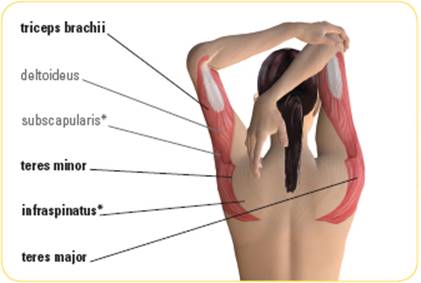
TRICEPS STRETCH
STRETCHES
 While standing, raise your right arm and bend it behind your head.

 Keeping your shoulders relaxed, gently pull on the raised elbow with your left hand.
 Continue to pull your elbow back until you feel the stretch on the underside of your arm. Hold for fifteen seconds, and repeat three times on each arm.

BEST FOR
• triceps brachii
• infraspinatus
• teres major
• teres minor
ANNOTATION KEY
Bold text indicates active muscles
Gray text indicates stabilizing muscles
* indicates deep muscle
LATISSIMUS DORSI STRETCH

Clasp your hands together above your head, your palms turned upward toward the ceiling.

Reach your hands outward as you make a circular pattern with your torso.

Slowly make a full circle. Repeat sequence three times in each direction.
BEST FOR
• latissimus dorsi
• obliquus internus
DO IT RIGHT
LOOK FOR
• Your arms and shoulders to be elongated as much as possible.
AVOID
• Leaning back as you come to the top of the circle.
ANNOTATION KEY
Bold text indicates active muscles
* indicates deep muscles

SHOULDER STRETCH
STRETCHES

Stand up straight, with your right arm drawn across your body at chest height. With your left hand, apply pressure to your right elbow.

Hold for fifteen seconds, release, and repeat three times. Repeat three times on left arm.
BEST FOR
• deltoideus
• triceps brachii
• obliquus externus
• teres minor
• infraspinatus
DO IT RIGHT
LOOK FOR
• Your elbow to remain straight while you apply pressure with your hand.
AVOID
• Allowing your shoulders to lift toward your ears.
ANNOTATION KEY
Bold text indicates active muscles
Gray text indicates stabilizing muscles
* indicates deep muscles

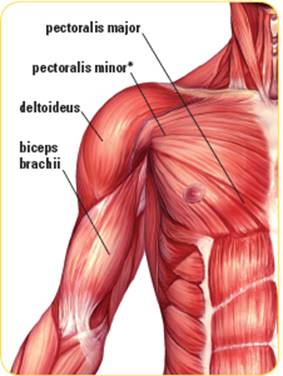
PECTORAL STRETCH

Stand straight with your arms behind your back and your hands clasped together.

Pinch your shoulder blades together as you reach and lift your arms away from your body, making sure to keep your elbows straight.
Hold for fifteen seconds before returning your arms back to the starting position. Repeat three times.
DO IT RIGHT
LOOK FOR
• Your elbows to remain straight during the movement.
• Your palms to be turned outward while you lift your arms. This will intensify the stretch.
AVOID
• Leaning your trunk too far forward while stretching—this can be harmful to your back.
BEST FOR
• pectoralis major
• pectoralis minor
• deltoideus
• biceps brachii
ANNOTATION KEY
Bold text indicates active muscles
* indicates deep muscles
QUADRICEPS STRETCH
STRETCHES

Stand with your feet together. Bend your left leg behind you, and grasp your foot with your left hand. Pull your heel toward your buttocks until you feel a stretch in the front of your thigh. Keep both knees together and aligned.
Hold for fifteen seconds. Repeat sequence three times on each leg.
DO IT RIGHT
LOOK FOR
• Both knees to remain pressed together.
AVOID
• Leaning forward with your chest.
BEST FOR
• rectus femoris
• vastus lateralis
• vastus medialis
• vastus intermedius
ANNOTATION KEY
Bold text indicates active muscles
Gray text indicates stabilizing muscles
* indicates deep muscles

ILIOTIBIAL BAND STRETCH

Standing, cross your left leg in front of your right.

Bend at the waist while keeping both knees straight, and reach your hands toward the floor.
Hold for fifteen seconds. Repeat sequence three times on each leg.
BEST FOR
• tractus iliotibialis
• biceps femoris
• gluteus maximus
• vastus lateralis
ANNOTATION KEY
Bold text indicates active muscles
Gray text indicates stabilizing muscles

ADDUCTOR STRETCH
STRETCHES

Standing, separate your feet wider than hip width, so that you are in a straddle position. Bend your knees.
Place your hands on your knees and bend at your hips, keeping your spine in neutral and your shoulders slightly forward.

Keeping your torso in the same position and your hips behind your heels, shift your weight to one side, bending your knee while extending your opposite leg. Hold for ten seconds and repeat on other side.
DO IT RIGHT
LOOK FOR
• Your trunk to remain aligned as you move from side to side.
• Your neck and shoulders to remain relaxed.
• Your hand placement on your thighs to assist your posture.
AVOID
• Rounding your spine.
• Allowing your feet to shift or lift off the floor.
• Allowing your knees to extend over your toes while bending.
BEST FOR
• adductor longus
• adductor magnus
• peroneus
• biceps femoris
• semitendinosus
• semimembranosus
• piriformis
ANNOTATION KEY
Bold text indicates active muscles
Gray text indicates stabilizing muscles

HIP-TO-THIGH STRETCH

Kneeling on your left knee, place your right foot on the floor in front of you so that your right knee is bent less than 90 degrees.
Bring your torso forward, bending your right knee so that your knee shifts toward your toes. Keeping your torso in neutral position, press your right hip forward and downward to create a stretch over the front of your thigh. Raise your arms up toward the ceiling, keeping your shoulders relaxed.

Bring your arms down and move your hips backward. Straighten your right leg, and bring your torso forward. Place your hands on either side of your straight leg for support.
 Hold for ten seconds, and repeat the forward and backward movement five times on each leg.
DO IT RIGHT
LOOK FOR
• Your shoulders and neck to remain relaxed.
• Your entire body to move as one unit as you go into the stretch.
AVOID
• Extending your front knee too far over the planted foot.
• Rotating your hips.
• Shifting the knee of the back leg outward.
BEST FOR
• iliacus
• iliopsoas
• biceps femoris
• rectus femoris
ANNOTATION KEY
Bold text indicates active muscles
Gray text indicates stabilizing muscles
* indicates deep muscles

MODIFICATION
More difficult: During the backward movement, raise your back knee off the floor and straighten your back leg. Keep your hands on the floor.

SPINE STRETCH
STRETCHES

 Lie on your back with your left leg straight and the right leg bent, placing your right foot on your left shin.

 Keeping both shoulders on the floor, slowly bring your right leg across your body until you feel the stretch in the area between your lower back and hips. Stretch only as far as your shoulders will allow without one of them rising from the floor.
 Hold for fifteen seconds, and repeat sequence three times on each side.
DO IT RIGHT
LOOK FOR
• Your lower back to remain relaxed.
AVOID
• Allowing your shoulders to lift off the floor.
BEST FOR
• quadratus lumborum
• erector spinae
• vastus lateralis
• tractus iliotibialis
• tensor fasciae latae
ANNOTATION KEY
Bold text indicates active muscles
Gray text indicates stabilizing muscles
* indicates deep muscles

LUMBAR STRETCH

Lie flat on the floor with both feet and knees together, your knees bent.

Slowly rock knees from side to side until you feel a stretch along your lower back through the hips or until your knees reach the floor. Repeat ten times.
BEST FOR
• quadratus lumborum
• erector spinae
• obliquus externus
ANNOTATION KEY
Bold text indicates active muscles
Gray text indicates stabilizing muscles
* indicates deep muscles

PIRIFORMIS STRETCH
STRETCHES
Lie on your back with your knees bent.
Bring your left ankle over your right knee, resting it on your thigh. Place both hands around your right thigh.
Gently pull your right thigh toward your chest until you feel the stretch in your buttocks. Hold for fifteen seconds and switch sides. Repeat sequence on your left leg.

DO IT RIGHT
LOOK FOR
• Your hips to be relaxed so that you can go deeper into the stretch.
• The stretch to be performed slowly.
BEST FOR
• piriformis
• gluteus maximus
• gluteus medius
ANNOTATION KEY
Bold text indicates active muscles
Gray text indicates stabilizing muscles
* indicates deep muscles

HIP STRETCH
In a seated position, extend your left leg straight in front of you, and bend your right knee. Cross your bent knee over the straight leg, and keep your foot flat on the ground.
Wrap your left arm around the bent knee so that you are able to apply pressure to your leg to rotate your torso. Place your right hand on the floor for stability.
Keeping your hips aligned, rotate your upper spine as you pull your chest in toward your knee.
 Hold for thirty seconds. Slowly release, and repeat five times on each side.

DO IT RIGHT
LOOK FOR
• Your neck and shoulders to remain relaxed.
• Your active hand to apply even pressure to your leg.
• Your torso to remain upright as you pull your knee and torso together.
AVOID
• Rounding your torso.
• Lifting the foot of your bent leg off the floor.
• Straining your neck as you rotate.
BEST FOR
• obliquus internus
• obliquus externus
• quadratus lumborum
• multifidus spinae
• tractus iliotibialis
• gluteus maximus
• gluteus medius
• piriformis
ANNOTATION KEY
Bold text indicates active muscles
Gray text indicates stabilizing muscles
* indicates deep muscles

HAMSTRING STRETCH
STRETCHES
Lie on your back with both knees bent and your feet flat on the floor.
Grasp your left leg behind the knee, and draw your knee in toward your chest.

Keeping your knee pulled into your chest, flex your toes and contract your quadriceps, so that you begin to straighten your leg.
Release your leg into the stretch, and pull it closer toward your chest. Repeat ten times on each leg.

DO IT RIGHT
LOOK FOR
• Your knee to be pulled in toward the chest throughout the movement.
• Your neck and shoulders to remain relaxed.
• Your toes to be flexed.
AVOID
• Rounding your shoulders and lifting your head.
• Rolling your stabilizing leg out of neutral position.
BEST FOR
• semitendinosus
• semimembranosus
• biceps femoris
• gluteus maximus
ANNOTATION KEY
Bold text indicates active muscles
Gray text indicates stabilizing muscles
* indicates deep muscles

MODIFICATION
More difficult: Straighten the base leg so that it lies flat on the floor before drawing your other knee to the chest.
