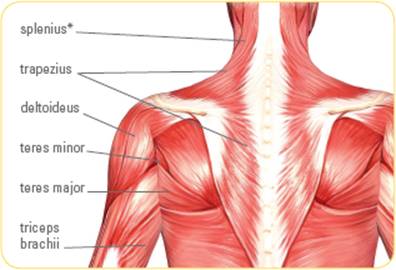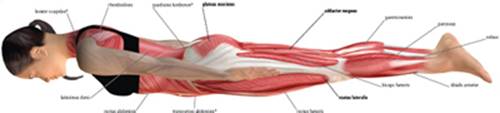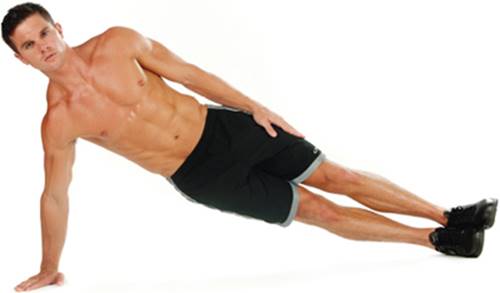
The terms core stability and core strength are often used interchangeably when discussing the training of core muscles. Yet, core stability and core strength are quite distinct from each other. Training for core stability requires resisting motion at the lumbar spine through the activation of the abdominal musculature and deep stabilizers. This means that the spine does not move with these exercises—the goal is to stay in neutral position. Training for core strength allows for motions to occur through the lumbar spine in an attempt to work the abdominal musculature and deep stabilizers, often in an isolated fashion, as when performing crunches. When strengthening for core stability, you are essentially trying to improve the strength and endurance of the core, as well as gain the muscle control required to perform each exercise correctly.
TINY STEPS
CORE STABILITY
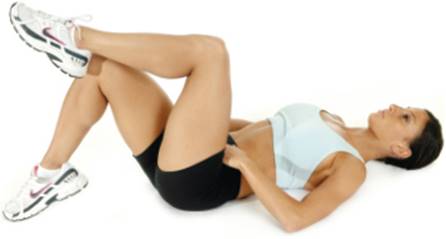
 Lie in supine position with your knees bent and feet flat on the floor.
 Place your hands on your hip bones to feel if you are moving your hips from side to side.
 Raise your right knee to your chest while pulling your navel toward your spine. Hold the position at the top.
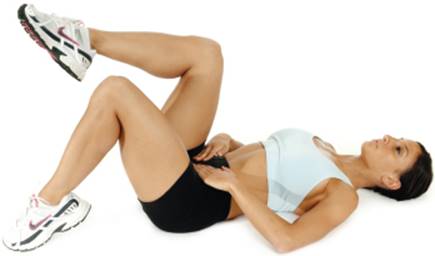
 As you continue to pull your navel toward your spine, lower your right leg onto the floor while controlling any movement in your hips.
 Alternate legs to complete the full movement. Repeat six to eight times.
DO IT RIGHT
LOOK FOR
• Your navel to be pulled in toward your spine throughout the exercise.
AVOID
• Allowing your hips to move back and forth while legs are mobilized.
BEST FOR
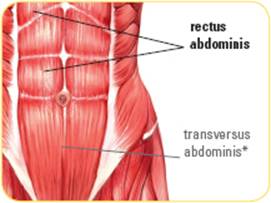
• rectus abdominis
• rectus femoris
• tensor fasciae latae
• gluteus maximus
• transversus abdominis
• obliquus internus
QUICK GUIDE
TARGET
• Lower abdominals
BENEFITS
• Develops lower-abdominal stability, protecting your hips and lower back
NOT ADVISABLE IF YOU HAVE
• Sharp lower-back pain that radiates down the legs
ANNOTATION KEY
Bold text indicates active muscles
Gray text indicates stabilizing muscles
* indicates deep muscles

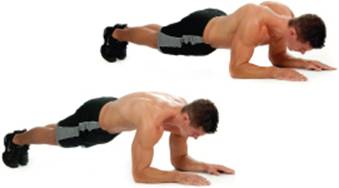
PLANK ROLL-DOWN
CORE STABILITY
Stand tall with your weight equally distributed between your feet.
Relaxing your neck, bend from your waist and bring your hands down toward the floor. Place them in front of your feet so that they are flat on the floor.

Walk your hands away from your feet until your body reaches a plank position, forming a straight line from your shoulders to your heels.

Keeping your arms straight, dip your shoulders three times while maintaining the plank position.
Walk your hands back to your feet, and return to an upright position. Repeat ten times at a rapid pace.

DO IT RIGHT
LOOK FOR
• Your spine and legs to remain straight.
• A slow, steady movement.
• Your abdominals to remain up and in.
AVOID
• Bending your knees or spine.
• Allowing your elbows to bend.
BEST FOR
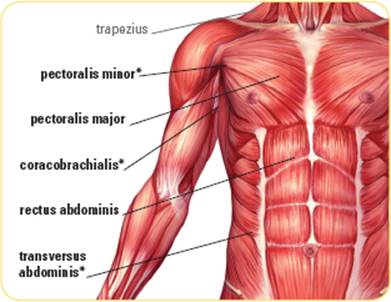
• pectoralis major
• pectoralis minor
• rectus abdominis
• coracobrachialis
• biceps brachii
• triceps brachii
• deltoideus
• vastus lateralis
• transversus abdominis
• obliquus externus
• rectus femoris
• tibialis anterior
• brachialis
• serratus anterior
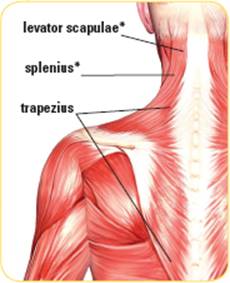
• trapezius
QUICK GUIDE
TARGET
• Pectoral muscles
• Upper-arm muscles
BENEFITS
• Stabilizes core
• Strengthens abdominals
NOT ADVISABLE IF YOU HAVE
• Wrist pain
• Shoulder issues
• Lower-back pain
ANNOTATION KEY
Bold text indicates active muscles
Gray text indicates stabilizing muscles
* indicates deep muscles

MODIFICATION
Easier: Roll down to a plank position on your elbows, rather than on your hands. Supporting your torso with your forearms and maintaining the plank position, dip up and down three times.
SPINE TWIST
CORE STABILITY
Sit on the floor, with your back straight. Extend your legs in front of you, slightly more than hip-width apart.
Lift yourself as tall as you can from the base of your spine. Ground your hips into the floor.

Lift up and out of your hips as you pull in your lower abdominals. Twist from your waist to the left, keeping your hips squared and grounded.
Slowly return to the center.

Lift up and out of your hips again, twisting in the other direction.
 Return to the center. Repeat three times in each direction.

DO IT RIGHT
LOOK FOR
• Your torso to rotate along the central axis of your body.
• Your arms to remain parallel to the floor.
AVOID
• Allowing your hips to rise off the floor.
BEST FOR
• transversus abdominis
• obliquus externus
• biceps femoris
• gluteus maximus
• tensor fasciae latae
• latissimus dorsi
• teres major
• quadratus lumborum
• deltoideus
• rectus femoris
QUICK GUIDE
TARGET
• Back flexibility
BENEFITS
• Strengthens and lengthens the torso
NOT ADVISABLE IF YOU HAVE
• Back pain. If your hamstrings are too tight to allow you to sit up straight, place a towel under your buttocks, and bend your knees slightly.
ANNOTATION KEY
Bold text indicates active muscles
Gray text indicates stabilizing muscles
* indicates deep muscles

SINGLE-LEG CIRCLES
CORE STABILITY
Lie flat on the floor, with both legs and arms extended.
Bend your right knee toward your chest, and then straighten your leg up in the air. Anchor the rest of your body to the floor, straightening both knees and pressing your shoulders back and down.

Cross your raised leg up and over your body, aiming for your left shoulder. Continue making a circle with the raised leg, returning to the center. Add emphasis to the motion by pausing at the top between repetitions.
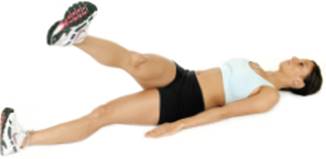
Switch directions so that you aim your leg away from your body. Repeat with the other leg. Complete full movement five to eight times.

DO IT RIGHT
LOOK FOR
• Your hips and torso to remain stable while your legs are mobilized.
• Your raised leg to be elongated from your hip through your foot.
AVOID
• Making your leg circles too big to maintain stability.
BEST FOR
• rectus abdominis
• obliquus externus
• rectus femoris
• biceps femoris
• triceps brachii
• gluteus maximus
• adductor magnus
• vastus lateralis
• vastus medialis
• tensor fasciae latae
QUICK GUIDE
TARGET
• Pelvic stability
• Abdominals
BENEFITS
• Lengthens leg muscles
• Strengthens deep abdominal muscles
NOT ADVISABLE IF YOU HAVE
• Snapping hip syndrome. If this is an issue, reduce the size of the circles.
ANNOTATION KEY
Bold text indicates active muscles
Gray text indicates stabilizing muscles
* indicates deep muscles

THIGH ROCK-BACK
CORE STABILITY
Kneel with your back straight and your knees hip-width apart on the floor, your arms by your sides. Pull in your abdominals, drawing your navel toward your spine.
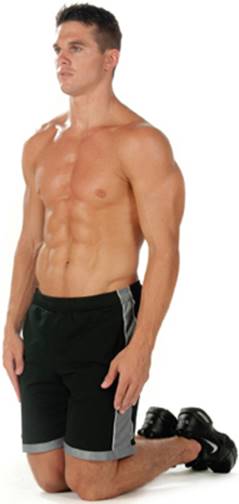
Lean back, keeping your hips open and aligned with your shoulders, stretching the front of your thighs.
Once you have leaned back as far as you can, squeeze your buttocks and slowly bring your body back to the upright position. Repeat four to five times.

DO IT RIGHT
LOOK FOR
• A straight line to form between your torso and your knees.
• Your abdominals to work to control the movement.
• Your buttocks to be tight.
AVOID
• Rocking so far back that you cannot return to the starting position.
• Bending in your hips.
BEST FOR
• rectus abdominis
• rectus femoris
• vastus intermedius
• vastus medialis
• tensor fasciae latae
• gluteus maximus
• adductor magnus
• sartorius
• biceps femoris
• obliquus internus
QUICK GUIDE
TARGET
• Quadriceps
• Abdominals
BENEFITS
• Stretches thighs
• Strengthens abdominals
• Increases range of motion of anterior ankle
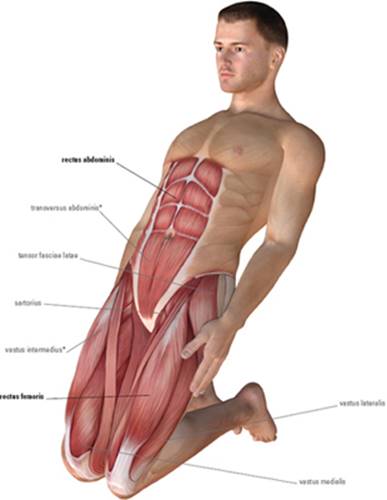
ANNOTATION KEY
Bold text indicates active muscles
Gray text indicates stabilizing muscles
* indicates deep muscles

QUADRUPED LEG LIFT
CORE STABILITY
Kneeling on all fours, connect with your abdominals by drawing your navel up toward your spine.
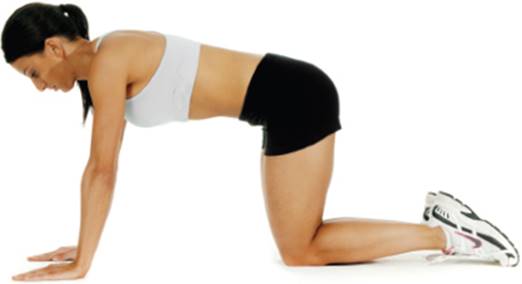
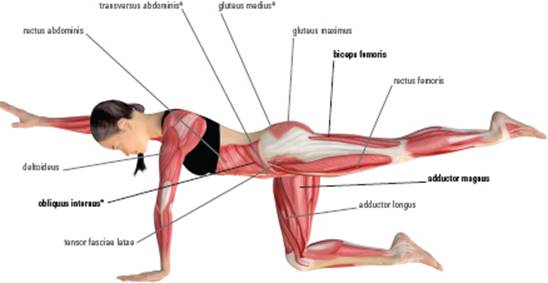
Slowly raise your right arm and extend your left leg, all while keeping your torso still. Extend your arm and leg until they are both parallel to the floor, creating one long line with your body. Do not allow your pelvis to bend or rotate.
Bring your arm and leg back into the starting position.
Repeat sequence on the other side, alternating sides six times.

DO IT RIGHT
LOOK FOR
• Your movement to be slow and steady to decrease pelvic rotation.
AVOID
• Tilting your pelvis during the movement—slide your leg along the surface of the floor before lifting.
• Allowing your back to sink into an arched position.
BEST FOR
• gluteus maximus
• biceps femoris
• gluteus medius
• deltoideus
• adductor magnus
• rectus abdominis
• transversus abdominis
• obliquus internus
• tensor fasciae latae
• adductor longus
• rectus femoris
QUICK GUIDE
TARGET
• Core stability
• Pelvic stabilizers
• Hip extensor muscles
• Oblique muscles
BENEFITS
• Tones arms, legs, and abdominals
NOT ADVISABLE IF YOU HAVE
• Wrist pain
• Lower-back pain
• Knee pain while kneeling
• Inability to stabilize the spine while moving limbs
ANNOTATION KEY
Bold text indicates active muscles
Gray text indicates stabilizing muscles
* indicates deep muscles
MODIFICATION
More difficult: Instead of kneeling, press into a plank position to begin, and then raise the opposite arm and leg.

SIDE-BEND PLANK
CORE STABILITY
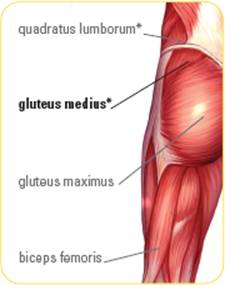
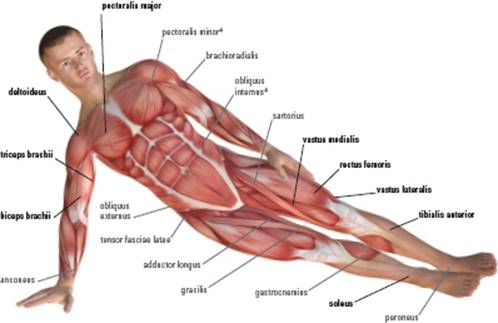
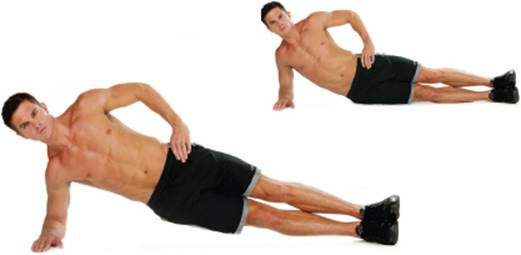
Lie on your right side with one arm supporting your torso, aligning the wrist under your shoulder. Place your left arm on top of your left leg. Your legs should be strongly squeezed together in adduction, with legs parallel and feet flexed. Draw your navel toward your spine.
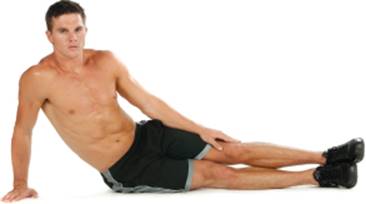
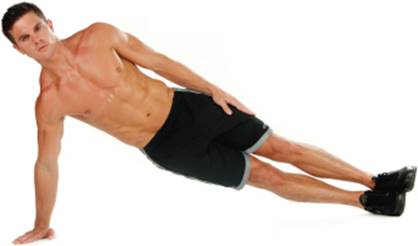
Press into the palm of your right hand, and lift your hips off the floor, creating a straight line between your heels and head.
Slowly lower your hips, returning to the starting position. Repeat sequence five to six times, keeping your legs tight and buttocks squeezed. Repeat on other side.
DO IT RIGHT
LOOK FOR
• Your hips to be lifted high to take some weight off your upper body.
• Your limbs to be elongated as much as possible.
AVOID
• Allowing your shoulders to sink into their sockets or lift toward your ears.
BEST FOR
• rectus abdominis
• obliquus internus
• obliquus externus
• adductor magnus
• pectoralis major
• pectoralis minor
• triceps brachii
• gluteus medius
QUICK GUIDE
TARGET
• Leg abductors and adductors
• Latissimus dorsi
BENEFITS
• Stabilizes the spine in neutral position with the support of the shoulder girdle
NOT ADVISABLE IF YOU HAVE
• Rotator cuff injury
• Neck issues
ANNOTATION KEY
Bold text indicates active muscles
Gray text indicates stabilizing muscles
* indicates deep muscles
MODIFICATION
Easier: Rather than supporting your torso with your arm straight, bend your elbow so that it is aligned below your shoulder.
Press into your forearm to lift your body into the side plank position.
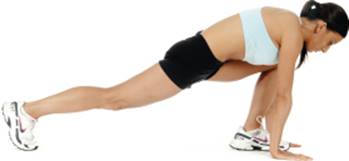
HIGH LUNGE
CORE STABILITY
Standing tall, move your right foot forward and bend at the hips, bringing your hands down to either side of your foot.

Step back with the left foot, keeping your legs in line with your hips. Keep the ball of your right foot in contact with the floor.
Press the ball of your right foot on the floor, contract your thigh muscles, and press up to maintain your left leg in a straight position. Hold for five to six seconds.
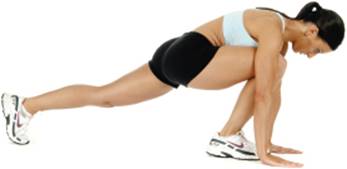
Slowly return to standing position, and then repeat on the right side. Repeat ten times on each side.
DO IT RIGHT
LOOK FOR
• Your spine to be lengthened by maintaining the proper position of your shoulders and whole upper body.
AVOID
• Dropping your back-extended knee to the floor.
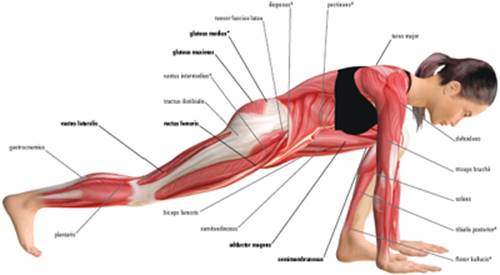
BEST FOR
• biceps femoris
• adductor longus
• adductor magnus
• gastrocnemius
• tibialis posterior
• iliopsoas
• biceps femoris
• rectus femoris
QUICK GUIDE
TARGET
• Legs
• Abdominals
BENEFITS
• Stretches groins
• Strengthens abdominals, legs, and arms
NOT ADVISABLE IF YOU HAVE
• Hip injury
• High or low blood pressure
ANNOTATION KEY
Bold text indicates active muscles
Gray text indicates stabilizing muscles
* indicates deep muscles
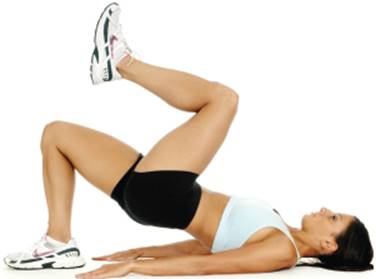
BRIDGE WITH LEG LIFT
CORE STABILITY
Lie in supine position on the floor, your arms by your sides and lengthened toward your feet. Your legs should be bent, with your feet flat on the floor.
Lift your hips and spine off the floor, creating one long line from your knees to your shoulders. Keep your weight shifted over your feet.

Keeping your legs bent, bring your left knee toward your chest.
Lower your left leg until your toe touches the mat. Be sure to keep your pelvis level.
Bring your left knee toward your chest again. Repeat sequence four to five times.
Lower your left leg to the floor, switch legs, and repeat the exercise with your right leg. Repeat sequence four to five times.
DO IT RIGHT
LOOK FOR
• Your hips and torso to remain stable throughout the exercise. If necessary, prop yourself up with your hands beneath your hips once you are in the bridge position.
• Your buttocks to remain tightly squeezed as you scoop in your abdominals for stability.
AVOID
• Allowing your back to do the work by extending out of your hips.
• Lifting your hips so high that your weight shifts onto your neck.
BEST FOR
• gluteus medius
• gluteus maximus
• rectus abdominis
• transversus abdominis
• quadratus lumborum
• biceps femoris
• iliopsoas
• rectus femoris
• sartorius
• tensor fasciae latae
• pectineus
• adductor longus
• gracilis
QUICK GUIDE
TARGET
• Hip extensor muscles
• Abdominals
BENEFITS
• Improves pelvic and spinal stability
• Increases hip flexor endurance
NOT ADVISABLE IF YOU HAVE
• Neck issues
• Knee injury
ANNOTATION KEY
Bold text indicates active muscles
Gray text indicates stabilizing muscles
* indicates deep muscles

PUSH-UP
CORE STABILITY
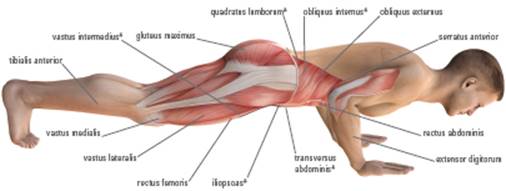
Stand straight, inhale, and pull your navel to your spine.
Exhale as you roll down one vertebra at a time until your hands touch the floor in front of you.
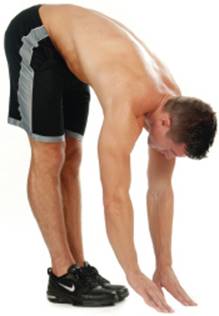
Walk your hands out until they are directly beneath your shoulders in the plank position.
Inhale, and set your body by drawing your abdominals to your spine. Squeeze your buttocks and legs together and stretch out of your heels, bringing your body into a straight line.
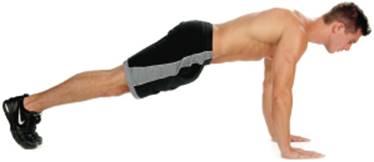
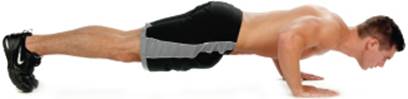
Exhale and inhale as you bend your elbows and lower your body toward the floor. Then push upward to return to plank position. Keep your elbows close to your body. Repeat eight times.
Inhale as you lift your hips into the air, and walk your hands back toward your feet. Exhale slowly, rolling up one vertebra at a time into your starting position. Repeat the entire exercise three times.
DO IT RIGHT
LOOK FOR
• Your neck to remain long and relaxed as you perform the push-up.
• Your buttocks to remain tightly squeezed as you scoop in your abdominals for stability.
AVOID
• Allowing your shoulders to lift toward your ears.
BEST FOR
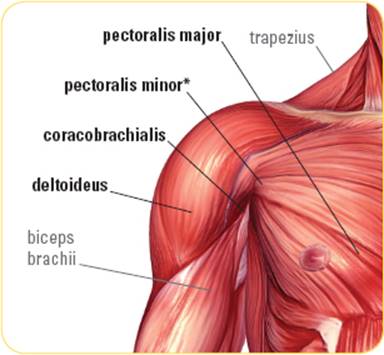
• triceps brachii
• pectoralis major
• pectoralis minor
• coracobrachialis
• deltoideus
• rectus abdominis
• transversus abdominis
• obliquus externus
• obliquus internus
• trapezius
QUICK GUIDE
TARGET
• Pectoral muscles
• Triceps
BENEFITS
• Strengthens the core stabilizers, shoulders, back, buttocks, and pectoral muscles
NOT ADVISABLE IF YOU HAVE
• Shoulder issues
• Wrist pain
• Lower-back pain
ANNOTATION KEY
Bold text indicates active muscles
Gray text indicates stabilizing muscles
* indicates deep muscles
MODIFICATIONS
Easier: Kneel with your hands on the floor in front of you, supporting your torso. Keeping your hips open, bend and straighten your elbows as if you were going to perform a push-up.
More difficult: Place your hands shoulder-width apart on an exercise ball. With the balls of your feet on the floor behind you, complete the push-up movement while maintaining stability on the ball.
More difficult: Place the balls of your feet on top of an exercise ball, while supporting your body with your hands on the floor in front of you. Use your abdominals to keep your body in a straight line and balance as you complete the push-up.

CHAIR DIP
CORE STABILITY
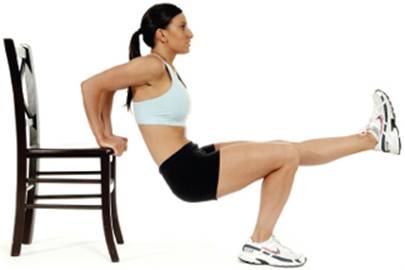
 Sit up tall near the front of a sturdy chair. Place your hands beside your hips, wrapping your fingers over the front edge of the chair.
 Extend your legs in front of you slightly, and place your feet flat on the floor.
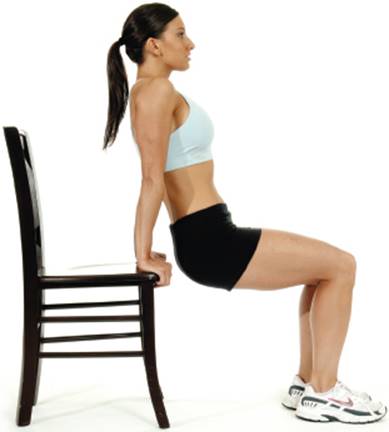
 Scoot off the edge of the chair until your knees align directly above your feet and your torso will be able to clear the chair as you dip down.
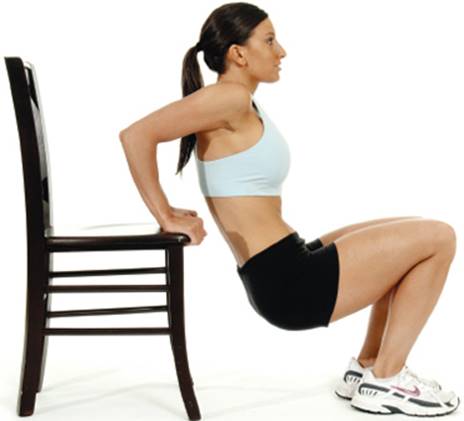
 Bending your elbows directly behind you, without splaying them out to the sides, lower your torso until your elbows make a 90-degree angle.
 Press into the chair, raising your body back to the starting position. Repeat fifteen times for two sets.
DO IT RIGHT
LOOK FOR
• Your body to remain close to the chair.
• Your spine to remain neutral throughout the movement.
AVOID
• Allowing your shoulders to lift toward your ears.
• Moving your feet.
• Rounding your back at your hips.
• Pushing up solely with your feet, rather than using your arm strength.
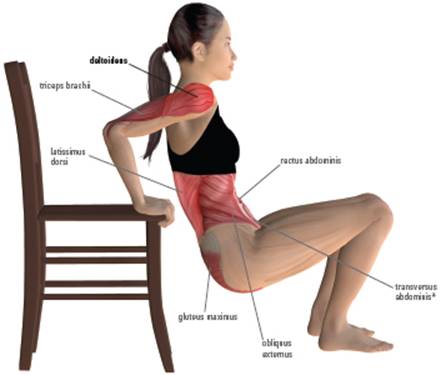
BEST FOR
• rectus abdominis
• triceps brachii
• deltoideus
• pectoralis major
• pectoralis minor
• latissimus dorsi
QUICK GUIDE
TARGET
• Triceps
• Shoulder and core stabilizers
BENEFITS
• Strengthens the shoulder girdle
• Trains the torso to remain stable while the legs and arms are in motion
NOT ADVISABLE IF YOU HAVE
• Shoulder pain
• Wrist pain
ANNOTATION KEY
Bold text indicates active muscles
Gray text indicates stabilizing muscles
* indicates deep muscles

MODIFICATION
More difficult:
Keeping your knees squeezed together, perform the dips with one leg lifted straight out, parallel to the floor. Repeat fifteen times on each side.
TOWEL FLY
CORE STABILITY
Place a towel on the floor in front of you. Assume the plank position, with your elbows fully extended, and the towel under your hands.
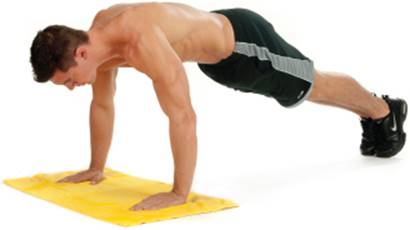
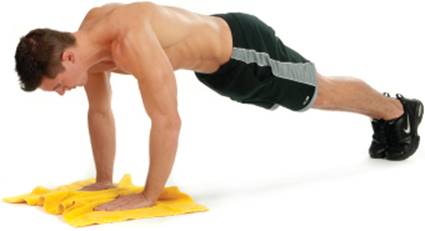
Maintaining a rigid plank position and putting your weight into your heels, move your hands together. The towel should bunch together below your sternum.
Straighten out the towel by pressing outward with your arms, returning to the starting position. Repeat ten times.
DO IT RIGHT
LOOK FOR
• Your hands to remain aligned directly below your shoulders.
• Your weight to be distributed evenly between your heels.
AVOID
• Allowing your hips to sag.
• Lowering your head as you open and close your hands.
• Bending your elbows.
BEST FOR
• deltoideus
• pectoralis major
• pectoralis minor
• coracobrachialis
QUICK GUIDE
TARGET
• Pectoral muscles
• Upper-arm muscles
BENEFITS
• Develops trunk and pelvic stability
• Strengthens upper torso muscles
NOT ADVISABLE IF YOU HAVE
• Shoulder pain
• Neck pain
• Lower-back pain
ANNOTATION KEY
Bold text indicates active muscles
Gray text indicates stabilizing muscles
* indicates deep muscles


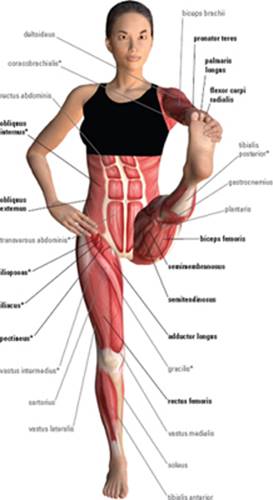
HAND-TO-TOE LIFT
CORE STABILITY
Stand with both feet equally balanced on the floor, your shoulders relaxed but retracted back. Shift your weight onto your right foot.

Raise your left leg toward your chest by bending your left knee. Grasp your toes with your left hand. Rest your right hand on your right hip.
Extend your left leg, straightening it while pulling your foot inward as your extended leg moves to come in line with your torso.
Gaze at a single spot on the floor about a body’s length in front of you. Flex your foot so that your toes curl back toward you. Hold for five seconds.
Lower your foot to the floor, and repeat five times on each side.

DO IT RIGHT
LOOK FOR
• Your hips to be squared, facing forward—even when you raise your leg.
• Your torso to be lifted.
AVOID
• Moving the raised leg’s hip up toward the lower ribs, so that your hips are no longer aligned.
BEST FOR
• rectus femoris
• vastus lateralis
• vastus medialis
• pronator teres
• flexor carpi radialis
• palmaris longus
• biceps femoris
• semitendinosus
• semimembranosus
• quadratus lumborum
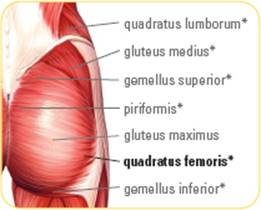
• piriformis
• gemellus superior
• gemellus inferior
• tibialis anterior
• gracilis
• gluteus maximus
QUICK GUIDE
TARGET
• Leg stability
• Abdominals
BENEFITS
• Strengthens legs and ankles
• Stretches backs of the legs
• Improves sense of balance
NOT ADVISABLE IF YOU HAVE
• Ankle injury
• Lower-back injury
ANNOTATION KEY
Bold text indicates active muscles
Gray text indicates stabilizing muscles
* indicates deep muscles
MODIFICATION
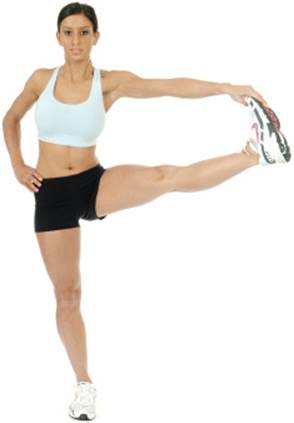
More difficult:
Follow steps 1 through 4, and then swing your left leg out to the side, maintaining your grasp on your toes. Breathe steadily, and hold for about five seconds. Swing your left leg back to center. Lower your foot to the floor. Repeat five times on each side.
WALL SITS
CORE STABILITY
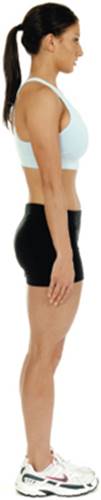
Stand with your back facing a wall. Lean against the wall, and walk your feet out from under your body until your lower back rests comfortably against it.
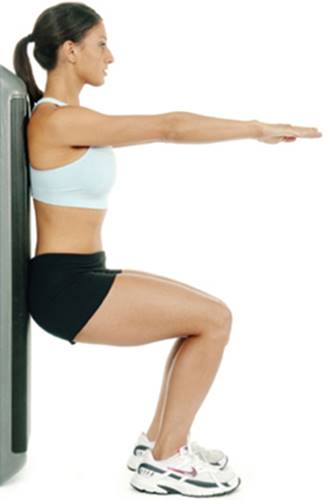
Slide your torso down the wall, until your hips and knees form 90-degree angles, your thighs parallel to the floor.
Raise your arms straight in front of you so that they are parallel to your thighs, and relax the upper torso. Hold for one minute, and repeat five times.
DO IT RIGHT
LOOK FOR
• Your body to remain firm throughout the exercise.
• Your shoulders and neck to remain relaxed.
• Your hips and knees to form 90-degree angles to receive maximum benefit from the exercise.
AVOID
• Sitting below 90 degrees.
• Pushing your back into the wall to hold yourself up.
• Shifting from side to side as you begin to fatigue.
BEST FOR
• vastus medialis
• vastus lateralis
• vastus intermedius
• rectus femoris
• semitendinosus
• semimembranosus
• biceps femoris
• gluteus maximus
QUICK GUIDE
TARGET
• Quadriceps
• Gluteal muscles
BENEFITS
• Strengthens quadriceps and gluteal muscles
• Trains the body to place weight evenly between the legs
NOT ADVISABLE IF YOU HAVE
• Knee pain
ANNOTATION KEY
Bold text indicates active muscles
Gray text indicates stabilizing muscles
* indicates deep muscles
FRONT PLANK
CORE STABILITY
Sit with your legs parallel and stretched out in front of you. Place your hands behind you with your fingers pointed toward your hips.
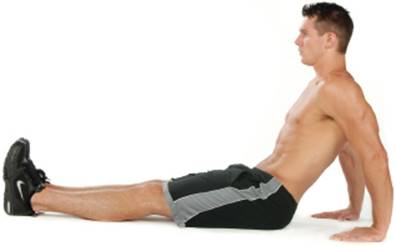
Press up through your arms and lift your chest up, squeezing your buttocks and lifting your hips while pressing your heels into the floor. Continue lifting your pelvis until your body forms a long line from your shoulders to your feet.

Without allowing your pelvis to drop, raise your right leg, straightened, in the air.
Slowly lower your leg to the floor, and switch to the left leg. Repeat four to six times on each side.

DO IT RIGHT
LOOK FOR
• Your pelvis to remain elevated throughout the exercise.
AVOID
• Allowing your shoulders to sink into their sockets. If your legs do not feel strong enough to support your body, slightly bend your knees.
BEST FOR
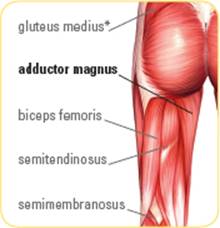
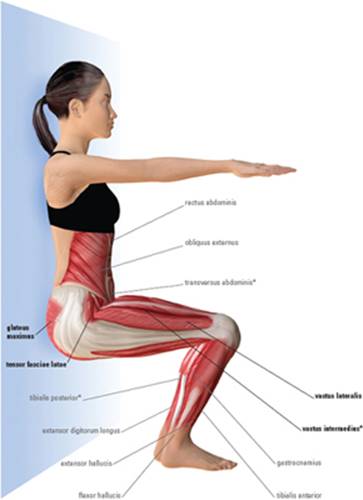
• gluteus maximus
• biceps femoris
• deltoideus
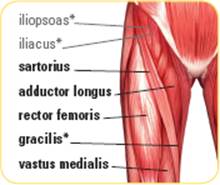
• rectus femoris
• adductor magnus
• tensor fasciae latae
• rectus abdominis
• transversus abdominis
• adductor longus
• obliquus externus
• latissimus dorsi
• triceps brachii
QUICK GUIDE
TARGET
• Hip extensor muscles
• Core stabilizers
• Arm muscles
• Leg muscles
NOT ADVISABLE IF YOU HAVE
• Wrist pain
• Knee pain
• Shoulder injury
• Shooting pains down leg
ANNOTATION KEY
Bold text indicates active muscles
Gray text indicates stabilizing muscles
* indicates deep muscles

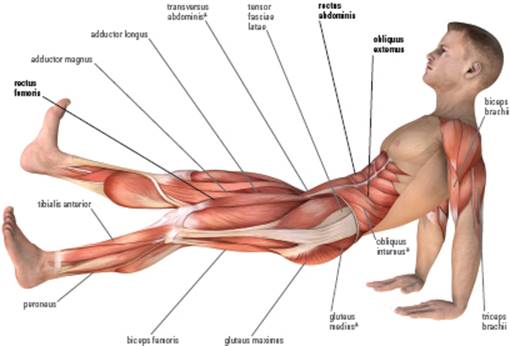
SCISSORS
CORE STABILITY
Lie with your back on the floor, your arms by your sides and your legs raised in a tabletop position. Inhale, drawing in your abdominals.
Reach your legs straight up, and lift your head and shoulders off the floor. Hold the position while lengthening your legs.

Stretching your right leg away from your body, raise your left leg toward your trunk. Hold your left calf with your hands, pulsing twice while keeping your shoulders down.

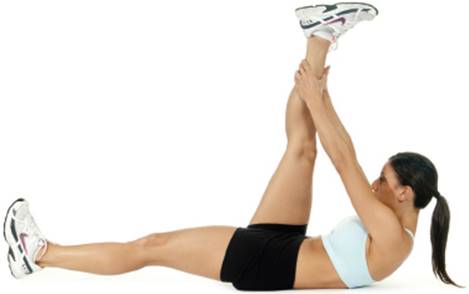
Switch your legs in the air, reaching for your right leg. Stabilize your pelvis and spine. Repeat sequence six to eight times on each leg.
DO IT RIGHT
LOOK FOR
• Your legs to be as straight as possible.
• Your navel to be drawn into your spine.
AVOID
• Bending your leg.
BEST FOR
• biceps femoris
• rectus femoris
• tensor fasciae latae
• rectus abdominis
• obliquus externus
• deltoideus
QUICK GUIDE
TARGET
• Abdominals
BENEFITS
• Increases stability with unilateral movement
• Increases abdominal strength and endurance
NOT ADVISABLE IF YOU HAVE
• Tight hamstrings. If this is an issue, you may bend the knee that is moving toward your chest.
ANNOTATION KEY
Bold text indicates active muscles
Gray text indicates stabilizing muscles
* indicates deep muscles

SWIMMING
CORE STABILITY
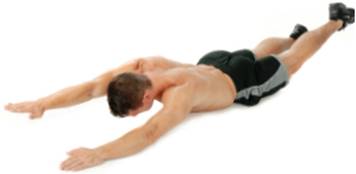
Lie prone on the floor with your legs hip-width apart. Stretch your arms beside your ears on the floor. Engage your pelvic floor, and draw your navel into your spine.
Extend through your upper back as you lift your left arm and right leg simultaneously. Lift your head and shoulders off the floor.
Lower your arm and leg to the starting position, maintaining a stretch in your limbs throughout.

Extend your right arm and left leg off the floor, lengthening and lifting your head and shoulders.
Elongate your limbs as you return to the starting position. Repeat six to eight times.
DO IT RIGHT
LOOK FOR
• Your limbs to extend as long as possible in opposite directions.
• Your buttocks to remain tightly squeezed and your navel to be drawn into your spine throughout the exercise.
• Your neck to remain long and relaxed.
AVOID
• Allowing your shoulders to lift toward your ears.
BEST FOR
• gluteus maximus
• biceps femoris
• erector spinae
• quadratus lumborum
• rhomboideus
• latissimus dorsi
QUICK GUIDE
TARGET
• Spinal extensors
• Hip extensors
BENEFITS
• Strengthens hip and spine extensors
• Challenges stabilization of the spine against rotation
NOT ADVISABLE IF YOU HAVE
• Lower-back pain
• Extreme curvature of the upper spine
• Curvature of the lower spine
ANNOTATION KEY
Bold text indicates active muscles
Gray text indicates stabilizing muscles
* indicates deep muscles

MODIFICATION
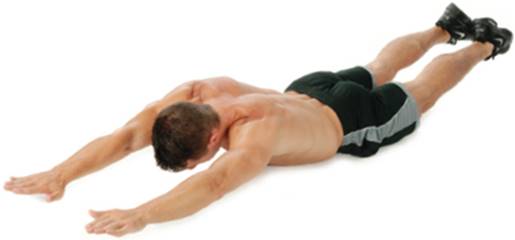
More difficult: Instead of lifting the opposite leg and arm, lift both arms and legs simultaneously, continuing to draw your navel into your spine. This version of the exercise is commonly known as the Superman.
DOUBLE-LEG AB PRESS
CORE STABILITY
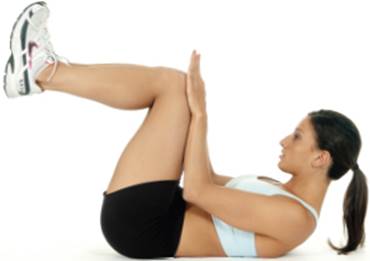
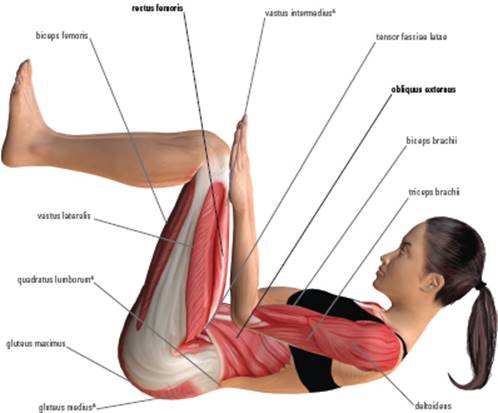
Lie on your back with your knees and feet lifted in tabletop position, your thighs making a 90-degree angle with your upper body. Place your hands on the front of your knees, your fingers facing upward, one palm on each leg.

Flex your feet and, keeping your elbows bent and pulled into your sides, press your hands into your knees. Create resistance by pushing back against your hands with your knees. Hold for one minute, and repeat five times.
DO IT RIGHT
LOOK FOR
• Your elbows to be pulled in toward your sides.
• Your shoulders and neck to remain relaxed.
• Your feet to be flexed and your knees pressed together.
• Your tailbone to be tucked up toward the ceiling.
AVOID
• Holding your breath while performing the exercise.
BEST FOR
• rectus abdominis
• transversus abdominis
• triceps brachii
• iliacus
• iliopsoas
• vastus medialis
• vastus lateralis
• vastus intermedius
• rectus femoris
QUICK GUIDE
TARGET
• Total body
BENEFITS
• Strengthens core, hip flexors, and triceps
NOT ADVISABLE IF YOU HAVE
• Back pain
• Hip pain
ANNOTATION KEY
Bold text indicates active muscles
Gray text indicates stabilizing muscles
* indicates deep muscles

CLAMSHELL SERIES
CORE STABILITY
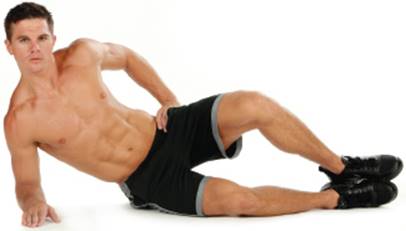
Lie on your right side with knees bent and stacked on top of each other. Bend your left elbow, placing it directly underneath your shoulder so that your forearm is supporting your upper body. Place your left hand on your hip.

Without moving your hips, open your left knee upward, and then return to the starting position. Repeat ten times.
Lift both ankles off the floor, making sure to maintain a straight line with the torso.
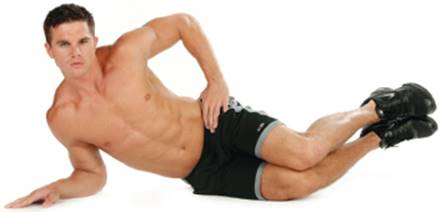
While your ankles are still lifted, lift and lower your left knee to open and close your legs. Repeat ten times.


The final part of this series begins with both ankles elevated. Lift your left knee to separate your legs, and then straighten your left leg, being careful not to move the position of your thigh. Bend your knee and return to the starting position. Repeat ten times, switch sides, and start from the beginning.
DO IT RIGHT
LOOK FOR
• Your hips to be stacked and pulled forward slightly.
• Your shoulder and forearm to press into the floor throughout the exercise.
• Your neck and shoulders to be relaxed.
AVOID
• Allowing your hips to move while lifting your knee.
BEST FOR
• rectus abdominis
• obliquus internus
• obliquus externus
• tensor fasciae latae
• adductor magnus
• adductor longus
• iliopsoas
• iliacus
• gluteus medius
• quadratus lumborum
QUICK GUIDE
TARGET
• Abdominals
• Abductor and adductor muscles
• Rotator cuff
BENEFITS
• Improves pelvic stability
• Strengthens abductor muscles
• Targets the shoulder stabilizers for strengthening and endurance
NOT ADVISABLE IF YOU HAVE
• Shoulder injury
• Lower-back pain
ANNOTATION KEY
Bold text indicates active muscles
Gray text indicates stabilizing muscles
* indicates deep muscles
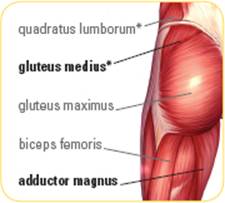
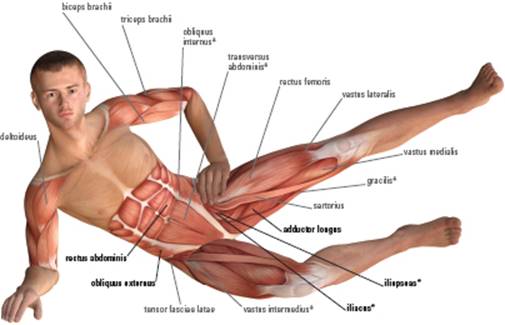
PRONE HEEL BEATS
CORE STABILITY
Lie facedown with your arms lifted off the floor by your hips, palms up. Draw your shoulders down away from your ears. Turn your legs out from the top of your hips and pull your inner thighs together.
Pull your navel off the mat and toward your spine, pressing your pubic bone into the mat. Lengthen your legs and lift them off the mat, tightening your thigh muscles.

Press your heels together and then separate them in a rapid but controlled motion.
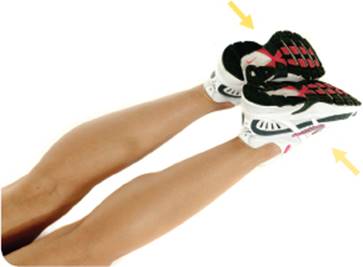
Beat heels together for eight counts, then return to the starting position. Repeat sequence six to eight times.
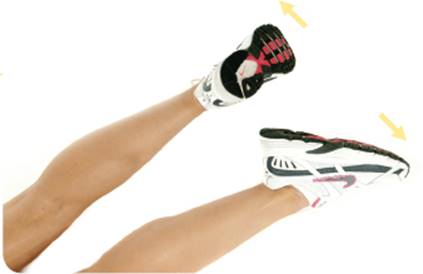
DO IT RIGHT
LOOK FOR
• Your buttocks and your abdominals to be squeezed while beating your heels.
• Your breathing to remain steady.
AVOID
• Tensing your shoulders.
BEST FOR
• trapezius
• latissimus dorsi
• teres major
• teres minor
• deltoideus
• gluteus maximus
• biceps femoris
• adductor magnus
• soleus
• vastus lateralis
QUICK GUIDE
TARGET
• Core stabilizers
BENEFITS
• Encourages muscles from the entire body to work together
• Lengthens extension muscles
NOT ADVISABLE IF YOU HAVE
• Back pain
ANNOTATION KEY
Bold text indicates active muscles
Gray text indicates stabilizing muscles
* indicates deep muscles