The nervous system is divided into the central nervous system, which consists of the brain and spinal cord, and the peripheral nervous system composed of cranial and spinal nerves and their associated ganglia. The central and peripheral parts each have somatic and autonomic components; the somatic are concerned with the innervation of skeletal muscle (along efferent pathways) and the transmission of sensory information (along afferent pathways), and the autonomic are concerned with the control of cardiac muscle, smooth muscle and glands (also involving efferent and afferent pathways). The term autonomic nervous system is applied collectively to all autonomic components.
Neurons and nerves
The structural and functional unit of the nervous system is the nerve cell or neuron. It consists of a cell body containing the nucleus, and a variable number of processes commonly called nerve fibres. A single cytoplasmic process, the axon (often very long), conducts nerve impulses away from the cell body, and may give off many collaterals and terminal branches to many different target cells. Other multiple cytoplasmic processes, the dendrites (usually very short), expand the surface area of the cell body for the reception of stimuli.
Pathways are established in the nervous system by communications between neurons at synapses, which are sites on the cell body or its processes where chemical transmitters enable nerve impulses to be handed on from one neuron to another. Transmission between neurons and cells outside the nervous system, for example muscle cells (neuromuscular junctions), is also effected by neuro-transmitters. The small number of ‘classic’ transmitters such as acetylcholine and noradrenaline (norepinephrine) has been vastly supplemented in recent years by many substances. These include monoamines, amino acids, nitric oxide and neuropeptides.
Cell bodies with similar function show a great tendency to group themselves together, forming nuclei within the central nervous system and ganglia outside it. Similarly processes from such aggregations of cell bodies tend to run together in bundles, forming tracts within the central nervous system and nerves outside the brain and spinal cord.
Apart from neurons the nervous system contains other cells collectively known as neuroglial cells (neuroglia or glia), which have supporting and other functions but which do not have the property of excitability or conductivity possessed by neurons. The main types of neuroglial cell are astrocytes and oligodendrocytes, which like neurons are developed from ectoderm of the neural tube. A third type of neuroglial cell is the microglial cell (microglia) which is the phagocytic cell of the nervous system, corresponding to the macrophage of connective tissue, and is derived from mesoderm.
Nerve fibres may be myelinated or unmyelinated. In the central nervous system myelin is formed by oligo-dendrocytes, and in peripheral nerves by Schwann cells (neurolemmocytes). In myelinated fibres, the regions where longitudinally adjacent Schwann cells or oligodendrocyte processes join one another are the nodes (of Ranvier). The white matter of the nervous system is essentially a mass of nerve fibres and is so called because of the general pale appearance imparted by the fatty myelin, in contrast to grey matter which is darker and consists essentially of cell bodies.
Peripheral nerve fibres have been classified in relation to their conduction velocity, which is generally proportional to size, and function:
• Group A—Up to 20 μm diameter, subdivided into:
α:12–20 μm. Motor and proprioception (Ia and Ib)
β:5–12 μm. Touch, pressure and proprioception (II)
γ:5–12 μm. Fusimotor to muscle spindles (II)
δ:1–15 μm. Touch, pain and temperature (III)
• Group B—Up to 3 μm diameter. Myelinated. Preganglionic autonomic
• Group C—Up to 2 μm diameter. Unmyelinated. Postganglionic autonomic, and touch and pain (IV).
The widest fibres tend to conduct most rapidly. Unfortunately, as can be seen from the above, it is not possible to make a precise prediction of function from mere size. Thus the largest myelinated fibres may be motor or proprioceptive and the smallest, whether myelinated or unmyelinated, are autonomic or sensory.
Spinal nerves
There are 31 pairs of spinal nerves: 8 cervical, 12 thoracic, 5 lumbar, 5 sacral and 1 coccygeal. Each spinal nerve is formed by the union of an anterior (ventral) and a posterior (dorsal) root which are attached to the side of the spinal cord by little rootlets. The union takes place within the intervertebral foramen through which the nerve emerges immediately distal to the swelling on the posterior root, the posterior root ganglion; most of these are also within the foramen. The anterior root of every spinal nerve contains motor (efferent) fibres for skeletal muscle; those from T1 to L2 inclusive and from S2 to S4 also contain autonomic fibres. The anterior root also contains a small number of unmyelinated afferent pain fibres which have ‘doubled back’ from their cells of origin in the posterior root ganglion to enter the spinal cord by the anterior root instead of by the posterior root. The posterior root of every nerve contains sensory (afferent) fibres whose cell bodies are in the posterior root ganglion. These are unipolar neurons, having a single process that bifurcates to pass to peripheral receptors and the central nervous system. Unlike in autonomic ganglia there are no synapses in posterior root ganglia.
Immediately after its formation the mixed spinal nerve divides into a larger anterior and a smaller posterior ramus. The great nerve plexuses—cervical, brachial, lumbar and sacral—are formed from anterior rami; posterior rami do not form plexuses.
Connective tissue binds the fibres of spinal nerves together to form the single nerve. Delicate loose connective tissue, the endoneurium, lies between individual fibres. Rounded bundles of fibres, or fascicles, are surrounded by the perineurium, a condensed layer of collagenous connective tissue. Fascicles are bound together into a single nerve by a layer of loose but thicker connective tissue, the epineurium. In the largest nerve, the sciatic, only about 20% of the cross-sectional area is nerve, so 80% is connective tissue, but in smaller nerves the amount of neural tissue is proportionally greater. The larger nerves have their own nerves, the nervi nervorum, in their connective tissue coverings.
Peripheral nerve trunks in the limbs are supplied by branches from local arteries. The sciatic nerve in the buttock and the median nerve at the elbow each have a large branch from the inferior gluteal and common interosseous arteries respectively. Elsewhere, however, regional arteries supply nerves by a series of longitudinal branches which anastomose freely within the epineurium, so that nerves can be displaced widely from their beds without risk to their blood supply.
General principles of nerve supply
Once the nerve supply to a part is established in the embryo it never alters thereafter, unlike the vascular supply. However far a structure may migrate in the devel-oping fetus it always drags its nerve with it. Conversely, the nerve supply to an adult structure affords visible evidence of its embryonic origin.
Skeletal muscles are innervated from motor neuron ‘pools’—groups of motor nerve cell bodies in certain cranial nerve nuclei of the brainstem and anterior horns of the spinal cord. The pool supplying any one muscle overlaps the pools of another, e.g. the anterior horn cells of spinal cord segments C5 and C6 that supply deltoid are intermixed with cells of the same segments supplying subscapularis and other muscles. The only exceptions to the overlapping of neuronal pools are the brainstem nuclei of the fourth and sixth cranial nerves, as they are the only motor nerve cell groups supplying only one muscle (superior oblique and lateral rectus of the eye respectively).
Nerve supply of the body wall
The body wall is supplied segmentally by spinal nerves (Fig. 1.5). The posterior rami pass backwards and supply the extensor muscles of the vertebral column and skull, and to a varying extent the skin that overlies them. The anterior rami supply all other muscles of the trunk and limbs and the skin at the sides and front of the neck and body.
|
|
|
Figure 1.5 Course of a typical intercostal nerve along the neurovascular plane of the body wall, between the middle and innermost of the three muscle layers. |
Posterior rami
In the trunk, all the muscles of the erector spinae and transversospinalis groups that lie deep to the thoracolumbar fascia, and the levator costae muscles of the thorax are supplied by the posterior rami of spinal nerves (Fig. 1.6). In the neck, splenius and all muscles deep to it are similarly supplied.
|
|
|
Figure 1.6 Distribution of posterior rami. On the right, the cutaneous distribution is shown (medial branches down to T6, to clear the scapula, and lateral branches below this); the stippled areas of skin are supplied by anterior rami. On the left, the muscular distribution is shown, to erector spinae and to splenius and the muscles deep to it. |
Each posterior ramus divides into a medial and a lateral branch (Fig. 1.5). Both branches of the posterior rami supply muscle, but only one branch, either medial or lateral, reaches the skin. In the upper half of the thorax the medial branches, and in the rest of the body the lateral branches, of the posterior rami provide the cutaneous branches (Fig. 1.6).
C1 has no cutaneous branch, and the posterior rami of the lower two nerves in the cervical and lumbar regions of the cord likewise fail to reach the skin. All 12 thoracic and five sacral nerves reach the skin. No posterior ramus ever supplies skin or muscle of a limb.
Anterior rami
The anterior rami supply the prevertebral flexor muscles segmentally by separate branches from each nerve (e.g. longus capitis and colli, scalene muscles, psoas, quadratus lumborum, piriformis). The anterior rami of the lower four cervical and the first thoracic nerves supply muscles in the upper limb via the brachial plexus. The anterior rami of the 12 thoracic nerves and L1 supply the muscles of the body wall segmentally. Each intercostal nerve supplies the muscles of its intercostal space, and the lower six nerves pass beyond the costal margin to supply the muscles of the anterior abdominal wall. The first lumbar nerve (iliohypogastric and ilioinguinal nerves) is the lowest spinal nerve to supply the anterior abdominal wall. Muscles supplied by anterior rami below L1 are no longer in the body wall; they have migrated into the lower limb.
C2, 3 and 4 supply skin in the neck by branches of the cervical plexus. C5, 6, 7 and 8 and T1 supply skin of the upper limb via the brachial plexus.
In the trunk the skin is supplied in strips or zones in regular sequence from T2 to L1 inclusive. The intercostal nerves each have a lateral branch to supply the sides and an anterior terminal branch to supply the front of the body wall (Fig. 1.5). The lower six thoracic nerves pass beyond the costal margin obliquely downwards to supply the skin of the abdominal wall (Fig. 1.7).
|
|
|
Figure 1.7 Overlap of dermatomes on the body wall. On the right side, the supraclavicular and thoracic nerves are shown. On the left, the anterior axial line is indicated; this marks the boundary on the chest wall between skin supplied by the cervical plexus and by intercostal nerves. Adjacent dermatomes overlap and thereby, for instance, the dermatomes of T6 and T8 meet each other, completely covering T7, explaining why division of a single intercostal nerve does not give rise to anaesthesia on the trunk. |
Neurovascular plane
The nerves of the body wall, accompanied by their segmental arteries and veins, spiral around the walls of the thorax and abdomen in a plane between the middle and deepest of the three muscle layers (see p. 181 and Fig. 1.5). In this neurovascular plane the nerves lie below the arteries as they run around the body wall. But the nerves cross the arteries posteriorly alongside the vertebral column and again anteriorly near the ventral midline, and at these points of crossing the nerve always lies nearer the skin. The spinal cord lies nearer the surface of the body than the aorta, and as a result the spinal nerve makes a circle that surrounds the smaller arterial circle. The arterial circle is made of the aorta with its intercostal and lumbar arteries, completed in front by the internal thoracic and the superior and inferior epigastric arteries. As a part of the same arterial pattern the vertebral arteries pass up to the cranial cavity. The spinal nerves, as they emerge from the intervertebral foramina, pass laterally behind the vertebral artery in the neck, behind the posterior intercostal arteries in the thorax, behind the lumbar arteries in the abdomen and behind the lateral sacral arteries in the pelvis. The anterior terminal branches of the spinal nerves similarly pass in front of the internal thoracic and the superior and inferior epigastric arteries (Fig. 1.5).
The sympathetic trunk runs vertically within the arterial circle. From the base of the skull to the coccyx the sympathetic trunk lies anterior to the segmental vessels (vertebral, posterior intercostal, lumbar and lateral sacral arteries).
Sympathetic fibres
Every spinal nerve without exception, from C1 to the coccygeal, carries postganglionic (unmyelinated, grey) sympathetic fibres which ‘hitch-hike’ along the nerves and accompany all their branches. They leave the spinal nerve only at the site of their peripheral destination. They are in the main vasoconstrictor in function, though some go to sweat glands in the skin (sudomotor) and to the arrectores pilorum muscles of the hair roots (pilomotor). In this way the sympathetic system innervates the whole body wall and all four limbs. This is chiefly for the function of temperature regulation. The visceral branches of the sympathetic system have a different manner of distribution (see p. 19).
Nerve supply of limbs
The body wall has been seen to be supplied segmentally by spinal nerves (Fig. 1.5). A longitudinal strip posteriorly is supplied by posterior rami, a lateral strip by the lateral branches of the anterior rami, and a ventral strip by the anterior terminal branches of the anterior rami. In the fetus the limb buds grow out from the lateral strip supplied by the lateral branches of the anterior rami and these lateral branches, by their anterior and posterior divisions, form the plexuses for supply of the muscles and skin of the limbs. The posterior divisions supply extensor muscles and the anterior divisions supply flexor muscles. Both divisions supply skin of the limbs.
Each limb consists of a flexor and an extensor compartment, which meet at the preaxial and postaxial borders of the limb. These borders are marked out approximately by veins. In the upper limb the cephalic vein lies at the preaxial and the basilic vein at the postaxial border. In the lower limb, extension and medial rotation, which replace the early fetal position of flexion, have complicated the picture. The great saphenous vein marks out the preaxial and the small saphenous vein the postaxial borders of the limb.
The spinal nerves entering into a limb plexus come from enlarged parts of the cord, the cervical enlargement for the brachial plexus and the lumbar enlargement for the lumbar and sacral plexuses. The enlargements are produced by the greatly increased number of motor neurons in the anterior horns at these levels (see p. 487).
On account of the way nerve fibres become combined and rearranged in plexuses, any one spinal nerve can contribute to more than one peripheral nerve and peripheral nerves can receive fibres from more than one spinal nerve. It follows that the area of skin supplied by any one spinal nerve or spinal cord segment is not the same as the area supplied by a peripheral spinal nerve. Two kinds of skin maps or charts are therefore required, one showing segmental innervation and the other showing peripheral nerves. The segmental supplies are reviewed below; the peripheral nerves of the upper and lower limbs are summarized on pages 91 and 162.
Segmental innervation of the skin
The area of skin supplied by a single spinal nerve is called a dermatome. On the trunk, adjacent dermatomes overlap considerably, so that interruption of a single spinal nerve produces no anaesthesia (Fig. 1.7); the same applies to the limbs, except at the axial lines. The line of junction of two dermatomes supplied from discontinuous spinal levels is demarcated by an axial line, and such axial lines extend from the trunk on to the limbs. In the upper limb (Fig. 1.8) the anterior axial line runs from the sternal angle across the second costal cartilage and down the front of the limb almost to the wrist. The dermatomes lie in orderly numerical sequence when traced distally down the front and proximally up the back of the anterior axial line (C5, 6, 7, 8 and T1) and these dermatomes are supplied by the nerves of the brachial plexus. In addition, skin has been ‘borrowed’ from the neck and trunk to clothe the proximal part of the limb (C4 over the deltoid muscle, T2 for the axilla).
|
|
|
Figure 1.8 Approximate dermatomes and axial lines of the right upper limb. See text for explanation. |
Considerable distortion occurs to the dermatome pattern of the lower limb (Fig. 1.9) for two reasons. Firstly the limb, from the fetal position of flexion, is medially rotated and extended, so that the anterior axial line is caused to spiral from the root of the penis (clitoris) across the front of the scrotum (labium majus) around to the back of the thigh and calf in the midline almost to the heel. Secondly, a good deal of skin is ‘borrowed’ from the trunk on the cranial side (from T12, L1, 2 and 3). As in the upper limb, the dermatomes can be traced in numerical sequence down in front and up behind the anterior axial line (L1, 2, 3, 4, 5 and S1, 2, 3).
|
|
|
Figure 1.9 Approximate dermatomes and axial lines of the right lower limb. See text for explanation. |
A practical application of the anterior axial line arises in spinal analgesia. A ‘low spinal’ (caudal) anaesthetic anaesthetizes the skin of the posterior two-thirds of the scrotum or labium majus (S3), but to anaesthetize the anterior one-third of the scrotum or labium L1 must be involved, an additional seven spinal segments higher up.
It must be remembered that a single chart cannot indicate individual variations or the differing findings of several groups of investigators, and that such charts are a compromise between the maximal and minimal segmental areas which experience has shown can occur. Original charts, such as those made by Sherrington, Head and Foerster, are being modified by the continuing accumulation of new information. Thus T1 nerve, for example, is not usually considered to supply any thoracic skin but has sometimes been considered to do so, and L5 and S1 have been reported to extend to buttock skin although this is not usually expected. It is probable that posterior axial lines do not exist, but evidence for anterior axial lines is more convincing. Difficulty in investigation arises in the main from the blurring of patterns due to overlap from adjacent dermatomes. A chart of dermatomes must therefore be interpreted with flexibility. The following summary offers selected guidelines that are clinically useful:
|
C1 |
No skin supply |
|
C2 |
Occipital region, posterior neck and skin over parotid |
|
C3 |
Neck |
|
C4 |
Infraclavicular region (to manubriosternal junction), shoulder and above scapular spine |
|
C5 |
Lateral arm |
|
C6 |
Lateral forearm and thumb |
|
C7 |
Middle fingers |
|
C8 |
Little finger and distal medial forearm |
|
T1 |
Medial arm above and below elbow |
|
T2 |
Medial arm, axilla and thorax |
|
T3 |
Thorax and occasional extension to axilla |
|
T4 |
Nipple |
|
T7 |
Subcostal angle |
|
T8 |
Rib margin |
|
T10 |
Umbilicus |
|
T12 |
Lower abdomen, upper buttock |
|
L1 |
Suprapubic and inguinal regions, penis, anterior scrotum (labia), upper buttock |
|
L2 |
Anterior thigh, upper buttock |
|
L3 |
Anterior and medial thigh and knee |
|
L4 |
Medial leg, medial ankle and side of foot |
|
L5 |
Lateral leg, dorsum of foot, medial sole |
|
S1 |
Lateral ankle, lateral side of dorsum and sole |
|
S2 |
Posterior leg, posterior thigh, buttock, penis |
|
S3 |
Sitting area of buttock, posterior scrotum (labia) |
|
S4 |
Perianal |
|
S5 and Co Behind anus and over coccyx. |
|
Segmental innervation of muscles
Most muscles are supplied equally from two adjacent segments of the spinal cord. Muscles sharing a common primary action on a joint irrespective of their anatomical situation are all supplied by the same (usually two) segments. Their opponents, sharing the opposite action, are likewise all supplied by the same (usually two) segments and these segments usually run in numerical sequence with the former. For a joint one segment more distal in the limb the spinal centre lies en bloc one segment lower in the cord.
Thus there are in effect spinal centres for joint movements, and these centres tend to occupy continuous segments in the cord. The upper one or two segments innervate one movement, and the lower one or two innervate the opposite movement (although sometimes the same segment may innervate both movements, but of course from different anterior horn cells). Thus the spinal centre for the elbow is in C5, 6, 7, 8 segments; biceps, brachialis and brachioradialis (the prime flexors of the elbow) are supplied by C5, 6 and triceps (the prime extensor of the elbow) is supplied by C7, 8.
The segments mainly responsible for the various limb joint movements are summarized in Figures 1.10 and 1.11. Flexion/extension at the hip, knee and ankle are the easiest to remember, for each movement involves two segments in logical sequence for each joint, and for each more distal joint the segments concerned are one segment lower: 
|
|
|
Figure 1.10 Segmental innervation of movements of the lower limb. |
|
|
|
Figure 1.11 Segmental innervation of movements of the upper limb. |
The above pattern enables the segmental innervation of a muscle to be determined, e.g.:
• iliacus (flexes hip) L2, 3
• biceps femoris (flexes knee) L5, S1
• soleus (plantarflexes ankle) S1, 2.
The above are simple flexion–extension movements and, indeed, cover all knee- and ankle-moving muscles. At the hip, however, movements other than flexion and extension are possible, but all are innervated by the same four segments. Thus:
• adduction or medial rotation (same as flexion) L2, 3
• abduction or lateral rotation (same as extension) L4, 5.
For inversion and eversion of the foot the formulae are:
• invert foot L4
• evert foot L5, S1.
Tibialis anterior and tibialis posterior invert the foot and both are innervated by L4 segment. Tibialis anterior is also a dorsiflexor and L4, 5 (from the formula already given for dorsiflexion) is its correct segmental supply. Tibialis posterior, however, lies deep among the plantar flexors of the ankle (S1, 2), but its main action is inversion of the foot (it is the principal invertor) and, although it assists plantar flexion, its segmental innervation is L4, 5.
The upper limb movements, with the segments involved (Fig. 1.11), are as follows:
|
Shoulder |
Abduct and laterally rotate C5 |
|
Adduct and medially rotate C6, 7, 8 |
|
|
Elbow |
Flex C5, 6 |
|
Extend C7, 8 |
|
|
Forearm |
Supinate C6 |
|
Pronate C7, 8 |
|
|
Wrist only |
Flex C6, 7 |
|
Extend C6, 7 |
|
|
Fingers and thumb |
Flex C7, 8 |
|
(long tendons) |
Extend C7, 8 |
|
Hand |
T1. |
|
(intrinsic muscles) |
In the upper limb the two-and-two segment pattern is not as regular as in the lower limb, probably because in the upper limb much more precise movements are constantly being employed, and the spinal centres have broken up into separate nuclei to control these. Thus, below the elbow the plan does not conform to the basic pattern of four spinal segments for each joint. Flexion and extension share the same two segments; these are C6, 7 for the wrist and C7, 8 for the digits. But the rule holds that the more distal joints are innervated from lower centres in the cord.
As a guide to the level of spinal cord injury it is useful to be aware of a muscle and a movement for which a particular spinal cord segment is mainly responsible:
|
C4 |
Diaphragm. Respiration |
|
C5 |
Deltoid. Abduction of the shoulder |
|
C6 |
Biceps. Flexion of the elbow. Biceps jerk (see below) |
|
C7 |
Triceps, Extension of the elbow. Triceps jerk (see below) |
|
C8 |
Flexor digitorum profundus and extensor digitorum. Finger flexion and extension |
|
T1 |
Abductor pollicis brevis representing small hand muscles. Abduction of the thumb |
|
T7–12 Anterior abdominal wall muscles. Guarding. Abdominal reflex (see below) |
|
|
L1 |
Lowest fibres of internal oblique and transversus abdominis. Guarding |
|
L2 |
Psoas major. Flexion of the hip |
|
L3 |
Quadriceps femoris. Extension of the knee. Knee jerk (see below) |
|
L4 |
Tibialis anterior and posterior. Inversion of the foot |
|
L5 |
Extensor hallucis longus. Extension of the great toe |
|
S1 |
Gastrocnemius. Plantarflexion of the foot. Ankle jerk (see below) |
|
S2 |
Small muscles of the foot |
|
S3 |
Perineal muscles. Bladder (parasympathetic). Anal reflex (see below). |
It is important to note that the term ‘root’ as used in root injuries may be taken to mean either the nerve root proper, i.e. from the side of the spinal cord to the intervertebral foramen, or the roots of the plexuses, i.e. anterior rami distal to the foramen. In lesions of the nerve roots proper, sweating in the distribution of the appropriate nerves is normal, but in more peripheral lesions sweating is reduced, because the postganglionic sympathetic fibres from the sympathetic trunk join the roots of plexuses distal to the nerve roots proper (Fig. 1.12C).
|
|
|
Figure 1.12 Examples of spinal reflex pathways: A the two neurons of a stretch reflex (tendon jerk), which is monosynaptic; B a multisynaptic reflex arc—only one interneuron is shown but there may be several; C the three neurons of a sympathetic reflex, the body of the preganglionic cell is in the lateral horn of the spinal cord and that of the postganglionic cell in a sympathetic ganglion (the preganglionic fibre runs in the white ramus communicans, the more distal connection of the ganglion, and the postganglionic fibre in the proximal grey ramus); D the fusimotor neuron loop; the γ efferent neuron, under the influence of higher centres, stimulates the muscle spindle from which afferent fibres pass back to the spinal cord to synapse with the α motor neuron. |
Spinal reflexes
What is commonly called the ‘knee jerk’ and similar tendon reflexes are typical examples of spinal myotatic or stretch reflexes (deep tendon reflexes). They illustrate the simplest kind of reflex pathway and involve only two neurons with one synapse (monosynaptic reflex arc, Fig. 1.12A); indeed the tendon reflexes are the only examples of monosynaptic reflex arcs, for all other reflexes involve two or more synapses (multisynaptic, Fig. 1.12B, C).
Tapping the tendon momentarily stretches the spindles within the muscle and this stimulates the afferent (Ia) fibres of the nerve endings surrounding the intrafusal fibres, which pass into the spinal cord by the posterior nerve root. These afferents synapse directly with the α motor neurons of the anterior horn whose axons form the efferent side of the arc, so causing the extrafusal fibres to contract and produce the ‘jerk’ at the joint.
For most practical purposes the segments mainly concerned with the reflexes most commonly tested may be taken as: biceps jerk—C6; triceps jerk—C7; knee jerk—L3; ankle jerk—S1.
Diminution or absence of the jerk usually indicates some kind of interruption of the arc or muscular defect, but exaggeration of the tendon reflexes is taken as evidence of an upper motor neuron lesion due to alterations in the supraspinal control of the anterior horn cells which are rendered unduly excitable. In this case the γ motor neurons of the anterior horn are stimulated by such fibres as the reticulospinal and vestibulospinal. The pathway (Fig. 1.12D) is from the γ motor neuron to the intrafusal muscle fibres of the spindle, then from the afferent fibres of the spindle to the α motor neuron and so to the extrafusal fibres. This is the γ reflex loop or fusimotor neuron loop.
In addition to the above deep tendon reflexes, there are superficial skin reflexes which are multisynaptic. Those most commonly tested are the plantar, abdominal and anal reflexes.
Firm stroking of the lateral surface of the sole of the foot (as with the end of a key) to elicit the plantar reflex normally causes plantarflexion of the great toe and probably of the other toes as well. Extension of the great toe—the extensor response (Babinski's sign)—indicates an upper motor neuron lesion. In infants under 1 year old the extensor response is the normal response; only with myelination of the corticospinal tracts during the second year does the normal plantar reflex become flexor.
The abdominal reflex is elicited by lightly stroking across each quadrant of the anterior abdominal wall. Normally there is contraction of the underlying muscles, but the reflexes are absent in upper motor neuron lesions. Patients with paraplegia who are lying down may exhibit Beevor's sign: when trying to lift the shoulders, the umbilicus is displaced upwards, due to weakness of the muscles below the umbilicus.
The anal reflex (‘anal wink’) is a visible contraction of the external anal sphincter following pinprick of the perianal skin and depends on intact sacral segments of the cord (mainly S3).
Autonomic nervous system
The motor part of the somatic nervous system is concerned with the innervation of skeletal muscle. The cell bodies are either in the motor nuclei of cranial nerves or the anterior horn cells of the spinal cord, and the nerve fibres which leave the central nervous system run uninterruptedly to the muscles, ending as motor endplates on the muscle fibres. The motor part of the autonomic nervous system is concerned with the innervation of cardiac and smooth muscle and glands, and the great difference between this and the somatic system is that the pathway from nerve cells in the central nervous system to the target organ is interrupted by synapses in a ganglion. There are thus two sets of neurons, which are logically called preganglionic and postganglionic. The preganglionic cell bodies are always within the central nervous system. If sympathetic, they are in the lateral horn cells of all the thoracic and the upper two lumbar segments of the spinal cord; this is the thoracolumbar part of the autonomic nervous system (the ‘thoracolumbar outflow’). If parasympathetic, they are in certain cranial nerve nuclei and in lateral horn cells of sacral segments of the spinal cord; this is the craniosacral part of the autonomic nervous system (the ‘craniosacral outflow’).
The postganglionic cell bodies are in ganglia in the peripheral nervous system. If sympathetic, the ganglia are either in the sympathetic trunk or in autonomic plexuses situated in the abdomen and pelvis (such as the coeliac ganglia). If parasympathetic, the ganglia are usually within the walls of the viscera concerned, while in the head there are four ganglia which are some little distance from the structures innervated.
Sympathetic nervous system
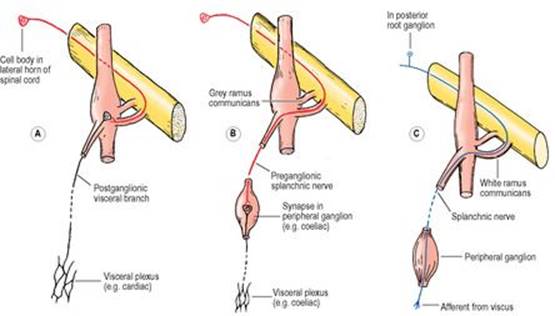
Having reached a sympathetic trunk ganglion, the incoming preganglionic fibres have one of three possible synaptic alternatives. The most common is for them to synapse with cell bodies in a trunk ganglion, either in the one they entered (Fig. 1.13A) or to run up or down the trunk to some other trunk ganglion. The second alternative is to leave the trunk ganglion without synapsing and to pass to a ganglion in an autonomic plexus for synapse (Fig. 1.13B). The third possibility (which applies only to a small number of fibres) is that they leave the trunk (without synapsing) to pass to the suprarenal gland, where certain cells of the medulla can be regarded as modified ganglion cells.
|
|
|
Figure 1.13 Visceral connections of sympathetic ganglia: A efferent pathway with synapse in a sympathetic trunk ganglion; B efferent pathway with synapse in a peripheral ganglion; C afferent pathway for pain fibres, passing through the trunk ganglion and into the spinal nerve by the white ramus communicans. |
Because there is no sympathetic outflow from the cervical part of the cord, nor from the lower lumbar and sacral parts, those preganglionic fibres which are destined to synapse with cell bodies whose fibres are going to run with cervical nerves must ascend in the sympathetic trunk to cervical ganglia, and those for lower lumbar and sacral nerves must descend in the trunk to lower lumbar and sacral ganglia.
The segmental levels of the preganglionic cell bodies concerned with the innervation of the different regions of the body (via postganglionic neurons) are indicated in Figure 1.14. In general the body is represented upright from head to perineum but with overlaps and individual variations.
|
|
|
Figure 1.14 Spinal cord levels of sympathetic preganglionic cells. There may be considerable individual variations, especially for the upper limb. |
The sympathetic trunk extends alongside the vertebral column from the base of the skull to the coccyx. Theoretically there is a ganglion for each spinal nerve, but fusion occurs, especially in the cervical region where the upper four unite to form the superior cervical ganglion, the fifth and sixth form the middle cervical ganglion, and the seventh and eighth fuse as the inferior cervical ganglion (and often with the first thoracic ganglion as well to form the cervicothoracic or stellate ganglion). Elsewhere there is usually one ganglion less than the number of nerves: 11 thoracic; 4 lumbar; and 4 sacral.
The fibres from the lateral horn cells of each segment of the spinal cord leave in the anterior nerve root (with the axons of anterior horn cells) to reach the spinal nerve and its anterior ramus. The connecting links from here to the sympathetic trunk and its ganglia are the rami communicantes. There are normally two rami; the white ramus communicans is the more distal of the two, and this is the one containing the preganglionic fibres (which are myelinated, hence called white). The other, the grey ramus communicans, contains efferent postganglionic fibres (which are unmyelinated, hence grey). The fibres in the grey ramus are those that are distributed via the branches of the spinal nerve to blood vessels, sweat glands and arrector pili muscles (i.e. they are vasomotor, sudomotor and pilomotor). Every spinal nerve receives a grey ramus. All the thoracic and the upper two lumbar nerves have both white and grey rami connecting them to sympathetic ganglia. But the cervical, lower lumbar and sacral nerves do not have white rami; the ganglia they are connected with receive preganglionic fibres from the thoracolumbar outflow through the chain. Because of the fusion of ganglia, the superior cervical ganglion gives off four grey rami, and the other cervical ganglia two each. Occasionally rami (both grey and white) may be duplicated.
Each sympathetic trunk ganglion has a collateral or visceral branch, usually called a splanchnic nerve in the thoracic, lumbar and sacral regions, but in the cervical region called a cardiac branch because it proceeds to the cardiac plexus. The visceral branches generally arise high up and descend steeply to form plexuses for the viscera (Fig. 1.13). Thus cardiac branches arise from the three cervical ganglia to descend into the mediastinum to the cardiac plexus, which is supplemented by fibres from upper thoracic ganglia. From the fifth and lower thoracic ganglia three splanchnic nerves pierce the diaphragm to reach the coeliac plexus and other pre-aortic plexuses, which are also joined by lumbar splanchnic nerves from the upper lumbar ganglia. Fibres from these plexuses, and splanchnic nerves from the lower lumbar ganglia, descend to the superior hypogastric plexus and thence to the left and right inferior hypogastric (pelvic) plexuses.
The sympathetic visceral plexuses thus formed are joined by parasympathetic nerves: vagus to the coeliac plexus; and pelvic splanchnics (S2–4) to the inferior hypogastric plexuses. The mixed visceral plexuses reach the viscera by direct branches and by branches that hitch-hike along the relevant arteries.
In addition to the visceral branches, which supply not only the smooth muscle and glands of viscera but also the blood vessels of those viscera, all trunk ganglia give off vascular branches to adjacent large blood vessels. The cervical ganglia give branches to the carotid and vertebral arteries, including (from the superior cervical ganglion) the internal carotid nerve, running upwards on the artery of that name to form the internal carotid plexus on the artery as it enters the skull. The thoracic and lumbar ganglia give filaments to the various aortic plexuses and from there to aortic branches including the common iliac arteries, continued along the internal and external iliac arteries as far as the proximal part of the femoral artery. Branches from the sacral ganglia pass to the lateral sacral arteries. Limb vessels get their sympathetic innervation mainly from nerve fibres that run with the adjacent peripheral nerves before passing to the vessels; the fibres do not run long distances along the vessels themselves. Thus the nerve filaments to the vessels of the tip of a finger or toe run not with the digital arteries but with the digital nerves, and only leave the nerves near the actual site of innervation.
Afferent sympathetic fibres
Many afferent fibres hitch-hike along sympathetic efferent pathways. Some form the afferent limb for unconscious reflex activities; others are concerned with visceral pain. All have their cell bodies in the posterior root ganglia of spinal nerves (not in sympathetic ganglia), at approximately the same segmental level as the preganglionic cells (Fig. 1.14). The afferent fibres reach the spinal nerve via the white ramus communicans (Fig. 1.13C) and then join the posterior root ganglion, from which central processes enter the spinal cord by the posterior nerve root (like any other afferent fibres). Visceral pain fibres enter the posterior horn of the spinal cord, and thereafter the pain pathway is the same as that for spinal nerve pain fibres. Others concerned with reflex activities may synapse with interneurons in the cord or ascend to the hypothalamus and other higher centres by pathways that are not defined.
Sympathectomy
For the control of excessive sweating and vasoconstriction in the extremities of the limbs, parts of the sympathetic trunk with appropriate ganglia can be removed to abolish the normal sympathetic influence. In upper thoracic ganglionectomy for the upper limb the second and third thoracic ganglia with their rami and the intervening part of the trunk are resected; alternatively, the trunk is divided below the third ganglion and the rami communicantes to the second and third ganglia are severed. The first thoracic ganglion is not removed, as the preganglionic fibres for the upper limb do not usually arise above T2 level (see above), and its removal would result in Horner's syndrome (see p. 408). Upper thoracic ganglionectomy is described further on page 211.
For lumbar sympathectomy the third and fourth lumbar ganglia and the intervening trunk are removed. The first lumbar ganglion should be preserved otherwise ejaculation may be compromised. Lumbar sympathectomy is described further on page 282.
Parasympathetic nervous system
Although all parts of the body receive a sympathetic supply, the distribution of parasympathetic fibres is wholly visceral and not to the trunk or limbs. However, not all viscera are so innervated: the suprarenal glands and the gonads appear to have only a sympathetic supply.
The preganglionic fibres of cranial origin have their cell bodies in the accessory (Edinger–Westphal) oculomotor nucleus, the superior and inferior salivatory nuclei of the seventh and ninth cranial nerves respectively, and the dorsal motor nucleus of the vagus. The fibres of the first three nuclei synapse with cells in the four parasympathetic ganglia, described below; the vagal fibres synapse with postganglionic cell bodies in the walls of the viscera supplied (heart, lungs and gut).
The preganglionic fibres of sacral origin arise from cells in the lateral grey horn of sacral segments 2–4 of the spinal cord, and constitute the pelvic splanchnic nerves. Leaving the anterior rami of the appropriate sacral nerves near the anterior sacral foramina, they pass forwards to enter into the formation of the inferior hypogastric plexuses. From there they run to pelvic viscera and to the hindgut as far up as the splenic flexure, and synapse around postganglionic cell bodies in the walls of these viscera.
Cranial parasympathetic ganglia
The four ganglia—ciliary, pterygopalatine, submandibular and otic—are very similar in plan. Each has parasympathetic, sympathetic and sensory roots, and branches of distribution. The roots and branches are described in general terms below and illustrated in Figure 1.15; the topographical details of each ganglion are dealt with in the regions concerned.
|
|
|
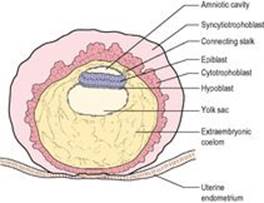
Figure 1.16 An embryo at the beginning of the second week. The trophoblast has differentiated into an inner layer of cells with single nuclei (the cytotrophoblast) and an outer layer with multiple nuclei but without distinct cell boundaries (the syncytiotrophoblast). |
The parasympathetic root carries the preganglionic fibres from the cells of origin in a brainstem nucleus. This is the essential functional root of the ganglion; its fibres synapse in it, whereas the fibres of all other roots simply pass through the ganglion without synapse.
The sympathetic root contains postganglionic fibres from the superior cervical ganglion, whose preganglionic cell bodies are in the lateral grey horn of cord segments T1–3.
The sensory root contains the peripheral processes of cell bodies in the trigeminal ganglion.
The branches of each ganglion carry the postganglionic parasympathetic fibres to the particular structure(s) requiring this kind of localized motor innervation: ciliary muscle and sphincter pupillae from the ciliary ganglion, salivary glands from the submandibular and otic ganglia, and lacrimal, nasal and palatal glands from the pterygopalatine ganglion. The other fibres in the branches are sympathetic fibres to the same structures (mainly for their blood vessels) and afferent fibres.
Ciliary ganglion (see p. 403)
Parasympathetic root. From the Edinger–Westphal part of the oculomotor nucleus by a branch from the nerve to the inferior oblique muscle from the inferior division of the oculomotor nerve.
Sympathetic root. From the superior cervical ganglion by branches of the internal carotid plexus.
Sensory root. From a branch of the nasociliary nerve, with cell bodies in the trigeminal ganglion.
Branches. Short ciliary nerves to the eye.
Pterygopalatine ganglion (see p. 370)
Parasympathetic root. From the superior salivary nucleus by the nervus intermedius part of the facial nerve, the greater petrosal nerve and the nerve of the pterygoid canal.
Sympathetic root. From the superior cervical ganglion by the internal carotid plexus, the deep petrosal nerve and the nerve of the pterygoid canal.
Sensory root. From branches of the maxillary nerve, with cell bodies in the trigeminal ganglion.
Branches. To the lacrimal gland via the zygomatic and lacrimal nerves, and to mucous glands in the nose, nasopharynx and palate via maxillary nerve branches. A few fibres (not shown in Fig. 1.15) are taste fibres from the palate, which run in the greater petrosal nerve and have cell bodies in the geniculate ganglion of the facial nerve.
|
|
|
Figure 1.15 Connections of the four parasympathetic ganglia of the head and neck. |
Submandibular ganglion (see p. 338)
Parasympathetic root. From the superior salivary nucleus by the nervus intermedius part of the facial nerve, the chorda tympani and the lingual nerve.
Sympathetic root. From the superior cervical ganglion by fibres running with the facial artery.
Sensory root. From a branch of the lingual nerve, with cell bodies in the trigeminal ganglion.
Branches. To the submandibular and sublingual glands via branches of the lingual nerve.
Otic ganglion (see p. 366)
Parasympathetic root. From the inferior salivary nucleus by the glossopharyngeal nerve, its tympanic branch, the tympanic plexus and the lesser petrosal nerve.
Sympathetic root. From the superior cervical ganglion by fibres running with the middle meningeal artery.
Sensory root. From the auriculotemporal nerve with cell bodies in the trigeminal ganglion.
Branches. To the parotid gland via filaments of the auriculotemporal nerve.
Unlike the other three ganglia, the otic ganglion has an additional somatic motor root, from the nerve to the medial pterygoid; the fibres pass through (without synapse) to supply the tensor tympani and tensor palati muscles.
Parasympathetic afferent fibres
As in the sympathetic nervous system, afferent fibres often accompany the parasympathetic supply to various structures. Such fibres that run with the glossopharyngeal and vagus nerves have their cell bodies in the inferior ganglia of those nerves, and their central processes pass to the nucleus of the tractus solitarius, through which there are connections with other parts of the brainstem and higher centres for the reflex control of respiration, heart rate, blood pressure and gastrointestinal activity.
The pelvic splanchnic nerves also carry afferent fibres. Their cell bodies are in the posterior root ganglia of the second to fourth sacral nerves and the central processes enter the cord by the posterior nerve roots. Some make local synaptic connections, e.g. for bladder reflexes, but others are pain fibres from pelvic viscera, which often seem to use both sympathetic and parasympathetic pathways for pain transmission, e.g. from bladder and rectum.