The proportions of the newborn child differ markedly from the form of the adult. Some of its organs and structures are well developed and even of full adult size (e.g. the internal ear), while others have yet to develop (e.g. corticospinal tracts to become myelinated, teeth to erupt, secondary sex characters to appear).
General features of the newborn
In comparison with the adult the neonate is much more fully developed at its head end than at its caudal end. The large head and massive shoulders stand out in marked contrast to the smallish abdomen and poorly developed buttocks.
Due to the shortness of the newborn baby's neck, its lower jaw and chin touch its shoulders and thorax. Gradually the neck elongates and the chin loses contact with the chest. The head thus becomes more mobile, both in flexion–extension and in rotation.
The abdomen is not prominent at birth but becomes gradually more and more so. The ‘pot-belly’ of the young child is due mainly to the large liver and the small pelvis; the pelvic organs lie partly in the abdominal cavity. In later childhood the pelvic organs and much of the intestinal tract sink into the developing pelvic cavity and the rate of growth of the abdominal walls outpaces that of the liver. In this way, the disposition of the viscera and the contour of the abdominal wall become as in the adult, and the bulging belly flattens.
Some special features of the newborn
Skull
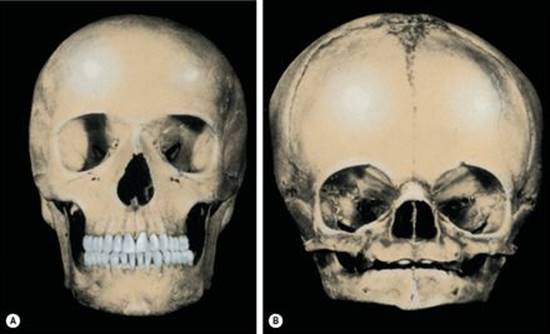
The most striking feature of the neonatal skull is the disproportion between the cranial vault and facial skeleton; the vault is very large in proportion to the face. In Figure 1.28 the photograph of a full-term fetal skull has been enlarged to the same vertical projection as a normal adult skull and this procedure shows in striking manner the disproportion between the two. In the fetal skull the vertical diameter of the orbit equals the vertical height of maxilla and mandible combined. In the adult skull the growth of the maxillary sinuses and the growth of alveolar bone around the permanent teeth has so elongated the face that the vertical diameter of the orbit is only one-third of the vertical height of maxilla and mandible combined.
|
|
|
Figure 1.28 Normal adult and fetal skulls. The fetal skull (B) is projected to the same vertical height as that of the adult. Note the disproportion of the vertical extent of the face. The distance from the lower margin of the orbit to the lower border of the mandible in the adult is three times the diameter of the orbit; in the fetal skull it is equal to the diameter of the orbit. |
Most of the separate skull and face bones are ossified by the time of birth but they are mobile on each other and are fairly readily disarticulated in the macerated skull. The bones of the vault do not interdigitate in sutures, as in the adult, but are separated by linear attachments of fibrous tissue and, at their corners, by larger areas, the fontanelles.
The anterior fontanelle lies between four bones. The two parietal bones bound it behind, the two halves of the frontal bone lie in front. It overlies the superior sagittal dural venous sinus. The anterior fontanelle is usually not palpable after the age of 18 months.
The posterior fontanelle lies between the apex of the squamous part of the occipital bone and the posterior edges of the two parietal bones. It is closed by the age of 3 months.
At birth the frontal bone consists of two halves separated by a median metopic suture; this is obliterated by about 8 years. The metopic suture may persist in up to about 8% of individuals, depending on ethnic origin, and must not be mistaken for a fracture line in a radiograph of the skull.
The petromastoid part of the neonatal temporal bone encloses the internal ear, middle ear and mastoid antrum, all parts of which are full adult size at birth. But the mastoid process is absent and the stylomastoid foramen is near the lateral surface of the skull, covered by the thin fibres of sternocleidomastoid—the issuing facial nerve is thus unprotected and vulnerable at birth. The mastoid process develops with the growth of the sternocleidomastoid muscle and the entry of air cells into it from the mastoid antrum. The process becomes palpable in the second year.
The tympanic part is present at birth as the C-shaped tympanic ring, applied to the undersurface of the petrous and squamous parts and enclosing the tympanic membrane, which is slotted into it. The external acoustic meatus of the newborn is wholly cartilaginous. The tympanic membrane is almost as big as in the adult, but faces more downwards and less outwards than the adult ear drum; lying more obliquely it seems somewhat smaller when viewed through the otoscope. The tympanic ring elongates by growth from the lateral rim of its whole circumference, the tympanic plate so produced forming the bony part of the external acoustic meatus and pushing the cartilaginous part of the meatus laterally, further from the ear-drum. As the tympanic plate grows laterally from the tympanic ring the tympanic membrane tilts and comes to face rather more laterally and less downwards than in the neonate.
The mandibular fossa (which forms part of the temporomandibular joint) is shallow at birth and facing slightly laterally; with development the fossa deepens and faces directly downwards.
The maxilla, between the floor of the orbit and the gum margin, is very limited in height and is full of developing teeth. The maxillary sinus is a narrow slit excavated into its medial wall. Eruption of the deciduous teeth allows room for excavation of the sinus beneath the orbital surface, but the maxilla grows slowly until the permanent teeth begin to erupt at 6 years. At this time it ‘puts on a spurt’ of growth. The rapid increase in size of the sinus and the growth of the alveolar bone occur simultaneously with increased depth of the mandible. These factors combine to produce a rapid elongation of the face.
The hard palate grows backwards to accommodate the extra teeth; and forward growth of the base of the skull continues at the spheno-occipital synchondrosis (see p. 512) until 18 to 25 years of age.
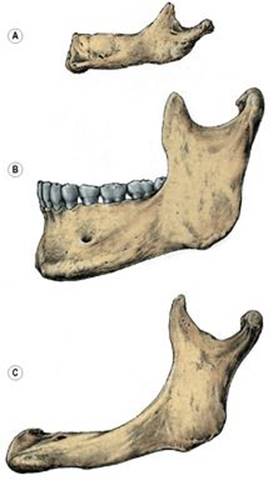
The mandible is in two halves at birth and their cartilaginous anterior ends are separated by fibrous tissue at the symphysis menti. Ossification unites the two halves in the first year. At first the mental foramen lies near its lower border. After eruption of the permanent teeth the foramen lies higher, and is halfway between the upper and lower borders of the bone in adults. In the edentulous jaw of the elderly, absorption of the alveolar margin leaves the mental foramen nearer the upper border of the mandible (Fig. 1.29). Forward growth of the mandible changes the direction of the mental foramen. At birth the mental neurovascular bundle emerges through the foramen in a forward direction. In the adult the mental foramen is directed backwards. At birth the angle is obtuse and the coronoid process lies at a higher level than the condyle. With increase in the length and height of the mandible, to accommodate the erupting teeth, the angle diminishes. In the adult the angle approaches a right angle, and the condyle is at the same level or higher than the coronoid process. In the edentulous mouth of the elderly the angle of the mandible increases again and the neck inclines backwards, lowering the level of the condyle.
|
|
|
Figure 1.29 Age changes in the mandible: A birth; B adult; C old age. |
Neck
The newborn baby has a very short neck. The subsequent elongation of the neck is accompanied by positional changes in the covering skin; an incision over the lower neck in an infant usually results in the scar lying over the upper sternum by later childhood.
The left brachiocephalic vein crosses the trachea so high in the superior mediastinum that it encroaches above the jugular notch into the neck, especially if it is engorged and the head extended; this should be remembered by the surgeon performing tracheotomy on the young child.
The shortness of the neck of the newborn involves a higher position of its viscera. The larynx is nearer the base of the tongue and the upper border of the epiglottis is at the level of the second cervical vertebra. From these elevated positions their descent is slow and they reach their adult levels only after the seventh year. The larynx and trachea are of small bore at birth. The vocal cords are about 5mm long by the end of the first year. Laryngitis and tracheitis in infancy thus carry far more risk of respiratory obstruction than they do in later years. Up to the age of puberty there is no difference between the male and female larynx. At puberty the male larynx increases rapidly in size and the median angle of the thyroid cartilage moves forwards (laryngeal prominence). Consequently the vocal cords elongate from 8 to 16mm within a year, resulting in the characteristic ‘breaking’ of the voice. Castration or failure of testicular hormone prevents this change taking place.
Thorax
The thoracic cage of the child differs from that of the adult in being more barrel-shaped. A cross-section of the infant thorax is nearly circular; that of the adult is oval, the transverse being thrice the length of the anteroposterior diameter. The large thymus extends from the lower part of the neck through the superior into the anterior mediastinum; it regresses at puberty. The ribs lie more nearly horizontal, so the cage is set at a higher level than in the adult. The high thorax involves a higher level of the diaphragm, with consequent increase of abdominal volume.
Abdomen
At birth the liver is relatively twice as big as in the adult and its inferior border is palpable below the coastal margin. The kidneys are always highly lobulated at birth with very little perinephric fat; grooves on the surface of the adult organ frequently persist as visible signs of the original fetal lobulation. The suprarenal is enormous at birth, nearly as large as the kidney itself. The caecum is conical and the appendix arises from its apex in the fetus; this arrangement is usually still present at birth. During infancy and early childhood the lateral wall of the caecum balloons out and the base of the appendix comes to lie posteriorly on the medial wall. The appendiceal mucous membrane is packed with massed lymphoid follicles in the child. These become much more sparse in later life. The pelvic cavity is very small at birth and the fundus of the bladder lies above the pubic symphysis even when empty.
Upper limb
The upper limb is more fully developed than the lower limb at birth. The grasping reflex of the hand is very pronounced. Growth in length occurs more at the shoulder and wrist than at the elbow. Amputation through the humerus in a young child requires a very generous flap of soft tissue lest the growing bone should later protrude through the stump.
Lower limb
At birth the lower limb is not only poorly developed, but occupies the fetal position of flexion, a position which is maintained for 6 months or more. In preparation for standing and walking the limb not only becomes more robust, but undergoes extension and medial rotation that carry the flexor compartment around to the posterior aspect of the limb. The inverted foot of the newborn gradually becomes everted harmoniously with the changes in position of the knee and hip joints. Growth of the limb proceeds more rapidly at the knee than at the hip or ankle. It is not symmetrical across the lower epiphysis of the femur, and ‘knock knee’ (genu valgum) is normal in the child.
Vertebral column
Until birth the column is C-shaped, concave ventrally. This is imposed by constriction in utero. After birth the column is so flexible that it readily takes on any curvature imposed by gravity. The cervical curve opens up into a ventral convexity when the infant holds up its head, and the lumbar curve opens up into a ventral convexity when the infant walks. The extension of the hip that accompanies walking tilts the inlet of the pelvis forwards, so that the axis of the pelvic cavity is no longer in line with that of the abdominal cavity. This forward tilt of the pelvis necessitates forward curvature (lordosis) of the lumbar spine in order to keep the body vertical in the standing position.
The spinal cord extends to the third lumbar vertebra at birth and does not ‘rise’ to the L1/L2 junction until adult years.