The interior of the cranium is lined with dura mater, the surface of the brain is covered with pia mater. Between the two, in contact with the dura mater, lies the arachnoid mater, which is connected to the pia by many fine filamentous processes (hence the name arachnoid: spider-like). These three tissue layers constitute the meninges. The cranial meninges are described here; their continuations around the spinal cord as the spinal meninges are considered on page 453.
Pia mater
The pia mater invests the brain and spinal cord as periosteum invests bone. Like periosteum it contains blood vessels, and nowhere does any structure intervene between pia mater and the underlying nervous tissue. It closely invests the surface of the central nervous system to the depths of the deepest fissures and sulci. It is made of thin vascular fibrous tissue and can be stripped away from the brain surface. It is prolonged out over the cranial nerves and spinal nerve roots to fuse with their epineurium, and it is invaginated into the substance of the brain by the entering cerebral arteries. The arteries lie loose in these sheaths of pia, surrounded by a narrow perivascular space containing cerebrospinal fluid.
The region between the pia and the arachnoid is the subarachnoid space, filled with cerebrospinal fluid.
Arachnoid mater and subarachnoid space
The arachnoid mater consists of an impermeable delicate membrane that everywhere is supported by the inner surface of the inner layer of the dura mater with only a thin film of tissue fluid between them in the subdural space. Vessels and nerves pierce the dura and arachnoid mater both at the same place; they cross the subdural space, but do not run along between the two membranes.
In certain areas the arachnoid herniates through little holes in the dura mater into the venous sinuses. Such herniae are the arachnoid villi; through their walls the cerebrospinal fluid ‘oozes’ back into the blood. The arachnoid villi are most numerous in the superior sagittal sinus and its laterally projecting blood lakes. In the child the villi are discrete; as age progresses they become aggregated into visible clumps, the arachnoid granulations (Pacchionian bodies) (see Fig. 7.16, p. 474). These latter leave indentations on the inner table of the cranial vault mainly alongside the superior sagittal sinus, at the site of the blood lakes.
Between the base of the brain and the base of the skull several larger spaces exist as a result of the incongruities in the contours of bone and brain. These spaces form the subarachnoid cisterns.
The cerebellomedullary cistern (cisterna magna) is the largest. It occupies the angle between the undersurface of the cerebellum and the posterior surface of the medulla. Cerebrospinal fluid flows into it from the midline aperture (foramen of Magendie) in the roof of the fourth ventricle (see p. 482). The lateral part of the cistern contains the vertebral artery and its posterior inferior cerebellar branch on each side (see Fig. 7.19, p. 475). The cisterna magna can be tapped in the midline by a needle passed above the posterior arch of the atlas, through the posterior atlanto-occipital membrane and spinal dura.
The pontine cistern lies between the clivus (see p. 510) and the front of the pons and medulla. Cerebrospinal fluid flows into it from the lateral apertures (foramina of Luschka) of the fourth ventricle (see p. 483). The cistern contains the basilar artery and its pontine and labyrinthine branches and the fifth to twelfth cranial nerves.
The interpeduncular cistern lies between the dorsum sellae of the sphenoid and the cerebral peduncles; it is roofed in by the floor of the third ventricle (mamillary bodies and posterior perforated substance). The floor of the cistern, on the dorsum sellae, is formed by the arachnoid membrane passing across, in contact with the dura mater, between the right and left temporal lobes. The cistern contains the terminal branches of the basilar artery (including the posterior part of the circle of Willis), the stalk of the pituitary gland, and the third and fourth cranial nerves (see Fig. 7.19, p. 475).
The chiasmatic cistern lies above the optic chiasma, beneath the rostrum of the corpus callosum (see Fig. 7.3A, p. 457). It contains the anterior communicating artery.
Dura mater
The dura mater consists of an outer endosteal layer, and an inner meningeal layer. The two layers are united except where they separate to enclose the venous sinuses of the dura. The outer layer is the periosteum which invests the surface of any bone, and blood vessels pass through it to supply the bone. Around the margins of every foramen in the skull it lies in continuity with the periosteum on the outer surface of the cranial bones (pericranium). It is not prolonged into the dura mater of the vertebral canal nor is it evaginated by any cranial nerve. The inner layer consists of a dense, strong fibrous membrane, which is really the dura mater proper. Over the vault of the skull the fused layers are easily stripped away from the bone as a single sheet, a fact which makes removal of the vault relatively easy. Over the base of the skull the fused layers are so firmly attached that they can only be stripped off with difficulty. Although theoretically structures such as the middle meningeal vessels (see p. 442) lie between the two layers, they appear to be on the outer surface of this single sheet (as when the bone of the skull vault is removed leaving the dura intact), and so are usually described as being extradural. The vessels are thicker than the outer layer and so bulge out to make impressions on the bone with a negligible amount of intervening tissue. Haemorrhage from these vessels is described as extradural (see p. 447).
Folds of the inner layer project into the cranial cavity. One such fold, the tentorium cerebelli, roofs in the posterior cranial fossa; another forms the falx cerebri, lying in the midline between the two cerebral hemispheres. The falx cerebelli and diaphragma sellae are smaller derivatives of the inner dural layer. These fibrous flanges or septa minimize rotary displacement of the brain. Concussion is caused more readily by rotary movement of the brain rather than by mass displacement of the head. At the foramen magnum the inner layer leaves the outer layer and is projected down the vertebral canal as the spinal dura mater (see p. 453). The inner layer is likewise evaginated around the cranial nerves and spinal nerve roots.
The tentorium cerebelli is a flange of the inner layer which projects from the margins of the transverse sinuses and the margins of the superior petrosal sinuses (Fig. 6.101). It is attached to the posterior clinoid processes, along the upper borders of the petrous temporal bones, and horizontally along the inner surface of each side of the skull to the internal occipital protuberance; this is the attached margin of the tentorium. Its upper and lower layers are separated at their bony attachments by the superior petrosal and transverse sinuses, but elsewhere are intimately fused with each other. The free margin of the tentorium is U-shaped and lies at a higher level than the bony attachment. The large central gap is the tentorial notch (incisure), through which passes the upper part of the brainstem (midbrain). The membrane slopes concavely upwards as it converges from the attached to the free margin, in conformity with the shape of the upper surface of the cerebellum and the undersurface of the posterior part of the cerebral hemisphere. The concave free margin is traceable forwards to the anterior clinoid process on each side. At the medial end of the superior petrosal sinus it overlies the attached margin, and from this point forwards to the anterior clinoid process it lies as a ridge of dura mater on the roof of the cavernous sinus. To the medial side of the ridge is the concave triangular roof of the cavernous sinus (see p. 443), which is pierced by the third and fourth nerves.
|
|
|
Figure 6.101 Cranial fossae. The dura mater has been removed on the left side. |
The midline attachment of the falx suspends the tentorium and the straight sinus lies in the midline at the junction of the two.
The falx cerebri is a sickle-shaped flange of the inner layer in the midline between the cerebral hemispheres. Its anterior margin is attached to the crista galli of the ethmoid bone and to the cavity of the foramen caecum (see p. 508), into which it projects like a peg, an enlarged Sharpey's fibre. The posterior margin is attached to the upper surface of the tentorium cerebelli in the midline, from the attached to the free margin of the tentorium; here its layers separate to enclose the straight sinus. Its convex upper border is attached alongside the midline to the whole length of the concave inner surface of the skull, from the foramen caecum to the internal occipital protuberance. Its two layers are separated a short distance above the foramen caecum to accommodate the superior sagittal sinus, which becomes progressively broader from this point to the internal occipital protuberance. The concave lower border of the falx cerebri is free and contains the inferior sagittal sinus within its two layers; this border lies just above the corpus callosum (see Fig. 7.15, p. 473). Between superior and inferior sagittal sinuses the two layers of the falx are firmly united to form a strong inelastic membrane.
The falx cerebelli is a low elevation of the inner layer in the midline of the posterior cranial fossa, extending from the internal occipital protuberance along the internal occipital crest to the posterior margin of the foramen magnum. It lodges the small occipital sinus between its layers, and it projects a little into the sulcus between the cerebellar hemispheres.
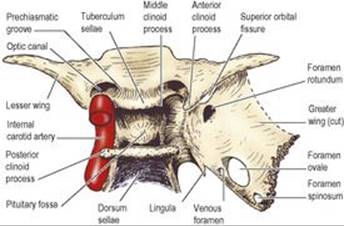
The diaphragma sellae is a horizontal sheet of the inner layer that forms a roof for the pituitary fossa (see p. 448). The dura of the floor of the fossa is prolonged up the sides of the fossa, to be attached to the middle and posterior clinoid processes, forming an intervening flange between the fossa and the cavernous sinus. From this the dura extends medially to form the diaphragma, which is perforated centrally for the passage of the pituitary stalk, and is continuous laterally with the roof of the cavernous sinus.
Blood supply
The inner layer of the dura mater requires very little blood to nourish it. The outer layer, on the other hand, is richly supplied, with the adjacent bone. In the supratentorial part it is supplied by the middle meningeal artery. The dura is supplied, in the anterior cranial fossa, by meningeal branches of the ophthalmic and anterior and posterior ethmoidal arteries and a branch of the middle meningeal artery, in the middle cranial fossa by the middle and accessory meningeal arteries and by meningeal branches of the internal carotid and ascending pharyngeal arteries and in the posterior cranial fossa by meningeal branches of the vertebral artery (Fig. 6.109). All these meningeal arteries are chiefly distributed to bone.
The middle meningeal artery, a branch of the maxillary, arises in the infratemporal fossa and passes upwards between the two roots of the auriculotemporal nerve to enter the foramen spinosum. It thus enters the middle cranial fossa, accompanied by its own plexus of sympathetic nerves. It is accompanied throughout all its ramifications by veins which lie between it and bone. It courses laterally on the floor of the middle cranial fossa and turns upwards and forwards on the greater wing of the sphenoid, where it divides into anterior and posterior branches.
The frontal (anterior) branch courses up towards the pterion (see p. 504) and then curves back to ascend towards the vertex, lying over the precentral gyrus. Haemorrhage from the vessel thus causes pressure on the motor area. In the region of the pterion the artery frequently lies in a tunnel in the parietal bone for a centimetre or more.
The parietal (posterior) branch courses horizontally backwards, on a groove in the squamous part of the temporal bone, and ramifies over the posterior part of the skull. It lies alongside the superior temporal gyrus; haemor-rhage here may cause contralateral impaired hearing through pressure on the auditory area (see p. 463).
The main purpose of the middle meningeal artery is to supply the bones of the vault of the skull; it does not supply the brain. These bones receive very little blood from the vessels of the scalp; scalping produces no necrosis of the underlying bones. Only where the bones give attachment to muscles (temporal fossa and suboccipital region) is any substantial supply received from the exterior.
Much of the blood from the marrow is drained by large diploic veins, which emerge on the exterior. Other diploic veins drain into the venous sinuses, especially the superior sagittal. The remaining blood drains into the middle meningeal veins.
The middle meningeal veins are sinuses in the dura mater and accompany the branches of the artery. They lie between the artery and the bone, grooving the latter. Some converge to two veins which leave the skull through the foramen spinosum and foramen ovale to join the pterygoid plexus. Some join the sphenoparietal and superior sagittal sinus.
The surface marking of the middle meningeal artery as it enters the skull lies just above the midpoint of the zygomatic arch. The frontal branch can be surgically approached through a burr hole made in the region of the pterion, about 3cm above the zygomatic arch and 3cm behind the zygomatic process of the frontal bone; a position that is above the midpoint of the zygomatic arch and behind the palpable frontozygomatic suture. The posterior branch runs backwards parallel with and above the upper border of the zygomatic arch and the supramastoid crest; it is usually exposed vertically above the mastoid process on a level horizontal with the upper margin of the orbit.
Nerve supply
Most of the supratentorial part of the dura mater is supplied from the ophthalmic division of the trigeminal nerve; the tentorial nerves course up and back from the anterior end of the cavernous sinus to supply the falx, the dura of the vault, and the upper surface of the tentorium cerebelli.
The anterior cranial fossa is supplied by the anterior and posterior ethmoidal nerves and receives some twigs from the maxillary nerve. The middle fossa is supplied, in its anterior portion by a branch of the maxillary nerve, and in its posterior part by the meningeal branch of the mandibular nerve (nervus spinosus). The posterior fossa is supplied by meningeal branches of the vagus and hypoglossal nerves; these are C1 and C2 fibres carried by the cranial nerves. They innervate the undersurface of the tentorium cerebelli and the upper part of the bony fossa. The dura around the foramen magnum is supplied directly by the second and third cervical nerves. Clinical experience suggests that this cervical supply extends farther afield than the posterior cranial fossa; cervical spondylosis, for example, may be associated with supra-orbital pain, presumably referred from spinal nerves.
Venous sinuses of the dura mater
All the venous sinuses, except the inferior sagittal and straight sinuses, lie between the inner and outer layers of the dura. They receive all the blood from the brain, and with the above exceptions they receive blood also from the adjacent bone. Several of them have important communicating branches (emissary veins) with veins outside the skull. Like all vascular channels the venous sinuses are lined by endothelium. They do not contain valves.
The superior sagittal sinus lies between the two layers of the falx cerebri along the convexity of its attached margin. It commences just above the foramen caecum and grows progressively larger as it passes back to the internal occipital protuberance. It grooves the bones along the midline of the vault of the skull. Three or four lakes of blood project laterally from it, between the inner dura and the endosteum; into these lakes arachnoid granulations project to return cerebrospinal fluid to the bloodstream (see Fig. 7.16, p. 474).
The superior sinus does not drain the frontal pole of the hemisphere, but receives veins from the upper and posterior parts of both medial and lateral surfaces of both hemispheres. These superior cerebral veins enter the sinus obliquely, against the flow of the bloodstream (see Fig. 7.15, p. 473). The superior sagittal sinus turns at the internal occipital protuberance, generally to the right, and becomes the transverse (lateral) sinus.
The inferior sagittal sinus begins some little distance above the crista galli and lies between the folds of the free margin of the falx cerebri. It drains the lower parts of the medial surface of each hemisphere. At the attachment of falx cerebri and tentorium cerebelli it flows into the straight sinus (see Fig. 7.15, p. 473).
The straight sinus lies between the folds of the fibrous dura at the junction of falx cerebri and tentorium cerebelli. It commences anteriorly by receiving the inferior sagittal sinus and the great cerebral vein (of Galen) (see p. 474). The straight sinus also receives veins from the adjoining occipital lobes and from the upper surface of the cerebellum. It slopes down steeply and ends at the internal occipital protuberance by turning into the transverse (lateral) sinus, generally the left (see Fig. 7.15, p. 473).
The transverse sinus commences at the internal occipital protuberance and runs laterally between the two layers of the attached margin of the tentorium cerebelli (Fig. 6.101). It courses horizontally forwards, grooving the occipital bone and the mastoid angle of the parietal bone. Reaching the junction of petrous and mastoid parts of the temporal bone it curves downwards, deeply grooving the inner surface of the mastoid bone, as the sigmoid sinus. One sinus is larger than the other, namely that which receives the superior sagittal sinus; this is usually the right.
The two transverse sinuses communicate at their commencement at the internal occipital protuberance (confluence of the sinuses). Each receives tributaries from the nearby surfaces of cerebral and cerebellar hemispheres and, at its termination at the commencement of the sigmoid sinus, the superior petrosal sinus enters.
The surface marking of the transverse sinus is a horizontal line from the external occipital protuberance to the top of the mastoid process, that is, at the upper limit of the neck muscles where they are attached to the skull, along the superior nuchal line.
The sigmoid sinus commences as the termination of the transverse sinus, deeply grooving the inner surface of the mastoid part of the petrous bone. It curves downwards and then forwards to the posterior margin of the jugular foramen, through which it passes, and expands into the superior jugular bulb, from which emerges the internal jugular vein (see p. 343). The sigmoid sinus is connected with the exterior in its upper part by the mastoid emissary vein which joins the posterior auricular vein, and in its lower part by a vein which passes through the posterior condylar foramen (when present) to join the suboccipital plexus of veins.
As the superior petrosal sinus drains into the termination of the transverse sinus, it could be said that the sigmoid sinus receives the superior petrosal sinus at its upper end and the occipital sinus at its lower end. Cerebellar veins drain to it, and it receives veins also from the mastoid air cells. Thrombophlebitis in these veins may lead to cerebellar abscess from mastoid infection.
The occipital sinus runs downwards from the beginning of the transverse sinus to the foramen magnum, skirts the margin of the foramen and drains into the sigmoid sinus. Along the attachment of the falx cerebelli this sinus is often a single trunk. Around the margins of the foramen magnum a pair of sinuses communicate with the veins outside the spinal dura (the internal vertebral plexus). The occipital sinus receives tributaries from the cerebellum and medulla and drains the choroid plexus of the fourth ventricle.
The basilar plexus consist of a network of veins, lying between the two layers of the dura, on the clivus (see p. 510). They connect the two inferior petrosal sinuses and receive veins from the lower part of the pons and from the front of the medulla. Thrombosis in this plexus is therefore usually fatal.
No veins accompany the vertebral and basilar arteries; the vertebral vein itself commences outside the skull below the occipital bone (see p. 430).
Cavernous sinus
The cavernous sinus lies alongside the body of the sphenoid bone in the middle cranial fossa. Each contains the internal carotid artery (Figs 6.102 and 6.103) and transmits some cranial nerves; each receives blood from three sources (orbit, vault bones, and cerebral hemisphere); each drains by the superior and inferior petrosal sinuses to the transverse sinus and internal jugular vein respectively, and each is connected to the pterygoid plexus by emissary veins.
|
|
|
Figure 6.102 Pituitary fossa, from above. |
|
|
|
Figure 6.103 Pituitary fossa and cavernous sinuses in coronal section. Reproduced from Williams: Gray's Anatomy 38th edition, 1999, Churchill Livingstone, with permission. |
The cavernous sinus lies in a space between the periosteum of the body of the sphenoid (outer layer of the dura mater) and a fold of the inner layer of the dura, which forms the upper part of the medial wall, the roof and the lateral wall of the sinus (Fig. 6.103). Medially the roof is continuous with the diaphragma sellae. At its lower edge the lateral wall is continued laterally as the inner layer of dura across the middle cranial fossa (Fig. 6.101). Anteriorly the roof is attached to the anterior and middle clinoid processes of the sphenoid bone; it is perforated between these processes by the emerging internal carotid artery. Posteriorly the roof has a triangular depression between the attached edge of the tentorium cerebelli (to the posterior clinoid process) and the ridge raised by the free edge of the tentorium, as it extends forwards to the anterior clinoid process. The third and fourth cranial nerves invaginate the roof here (Fig. 6.101), and then run forwards in the lateral wall (i.e. between the dura and the endothelial lining) above the ophthalmic and maxillary branches of the fifth nerve. Further back the lateral wall is medial to the anterior parts of the trigeminal ganglion and the trigeminal (Meckel's) cave (see p. 450). The rest of the cave and ganglion are posteroinferior to the lateral wall. The floor of the sinus is a narrow strip of periosteum along the base of the greater wing of the sphenoid.
|
|
|
Figure 6.104 Longitudinal section through the right orbit and middle cranial fossa, viewed from the right (lateral) side. |
The cavernous sinus extends from the apex of the orbit back to the apex of the petrous temporal bone. Each end is pointed, so that the sinus is spindle-shaped in lateral view. It is about 2cm long and 1cm wide. Despite its name, the cavernous sinus is usually a plexus of veins and not a trabeculated venous space, like the corpora cavernosa of the penis.
Medial to the sinus lies the fibrous lateral wall of the pituitary fossa and the body of the sphenoid, with the sphenoid air sinus within it (Fig. 6.103). The air sinus lies towards the front of the pituitary fossa at a lower level; its extent is very variable and tends to increase posteriorly with advancing years. Lateral to the cavernous sinus lies the medial surface of the temporal lobe of the hemisphere. Superiorly, the emerging internal carotid artery lies in contact with the forepart of the roof of the sinus as the artery passes backwards a little before turning up towards the anterior perforated substance of the brain (Fig. 6.102). Further back and somewhat above the roof lies the uncus of the temporal lobe.
The contents of the cavernous sinus include the structures lying within the cavity (the internal carotid artery and sixth nerve) and those embedded within the lateral wall (the third and fourth nerves and the ophthalmic and maxillary branches of the fifth nerve) (Fig. 6.103).
The internal carotid artery curves upwards from the foramen lacerum to enter the posterior part of the sinus and runs forwards within the sinus, deeply grooving the body of the sphenoid and the base of its greater wing. The artery then curves upwards again to pierce the roof of the sinus, medial to the anterior clinoid process, and turns backwards (Figs 6.102 and 6.105). The artery is accompanied by a plexus of postganglionic sympathetic fibres from the superior cervical ganglion.
|
|
|
Figure 6.105 Part of the posterior and middle cranial fossae seen from behind after sectioning the skull coronally through the mastoid process. All dura mater has been removed except for that over the superior and inferior petrosal sinuses, the dura around the opening of the trigeminal cave and the cut edge of the tentorium cerebelli at its attachment to the petrous temporal bone. |
The abducens nerve (see p. 451) enters the back of the cavernous sinus after passing over the apex of the petrous part of the temporal bone. It may, however, enter the inferior petrosal sinus beside the clivus and run along this sinus into the cavernous sinus within which it runs forwards on the inferolateral side of the internal carotid artery (Fig. 6.105). At the anterior end of the sinus it enters the superior orbital fissure (Fig. 6.49).
The oculomotor nerve (see p. 449) enters the roof between the free and attached margins of the tentorium cerebelli (Fig. 6.101), and then passes forward in the lateral wall. As it does so it inclines downwards medial to the other nerves, namely, the trochlear nerve and the branches of the ophthalmic nerve (Fig. 6.104), and at the anterior end of the sinus it breaks into its superior and inferior divisions which enter the superior orbital fissure. In its course it picks up sympathetic fibres from the internal carotid plexus; these are for the smooth muscle part of levator palpebrae superioris.
The trochlear nerve (see p. 450) enters the roof of the sinus behind the oculomotor nerve, alongside the ridge raised by the free margin of the tentorium, and courses horizontally forwards in the lateral wall of the sinus to enter the superior orbital fissure at a higher level and lateral to the oculomotor nerve.
The trigeminal ganglion, in its anterior part, lies forward of Meckel's cave. Its mandibular division passes downwards to the foramen ovale and does not come in contact with the lateral wall of the cavernous sinus (Fig. 6.101). The maxillary division runs horizontally forwards in the lateral wall and leaves the middle fossa through the foramen rotundum. The ophthalmic division runs forwards above the maxillary division and divides into its three branches towards the anterior end of the lateral wall; these enter the orbit through the superior orbital fissure. At the anterior end of the sinus the ophthalmic division gives off its tentorial branches to the dura mater (see p. 442). In its course through the sinus the ophthalmic division picks up sympathetic fibres from the internal carotid plexus; these eventually enter the long ciliary nerves to reach the dilator pupillae muscle.
Veins of the cavernous sinus
Although it is customary to think of venous blood as entering the cavernous sinus at the front and leaving from behind and below, blood can flow in either direction in the sinus, depending on local venous pressures. There are no valves in the cavernous sinus or its connected veins.
The superior ophthalmic vein passes back directly into the anterior end of the sinus at the superior orbital fissure. The inferior ophthalmic vein drains into both the pterygoid plexus and the cavernous sinus.
The superficial middle cerebral vein traverses the subarachnoid space and drains into the sinus by piercing its roof near the emerging carotid artery. Some inferior cerebral veins also drain through the roof of the sinus.
The sphenoparietal sinus runs just beneath the edge of the lesser wing of the sphenoid, lying between the two layers of the dura mater, and enters the sinus through its roof.
The superior petrosal sinus leaves the top of the posterior end and, bridging the groove made by the underlying trigeminal nerve, runs back along the upper border of the petrous bone between the two layers at the attached margin of the tentorium cerebelli (Fig. 6.105). It enters the termination of the transverse sinus at the commencement of the sigmoid sinus.
The inferior petrosal sinus is larger and empties the bulk of the blood from the cavernous sinus. It leaves the posterior end of the sinus beneath the petrosphenoid ligament, a fibrous band stretched between the apex of the petrous part of the temporal bone and the side of the dorsum sellae (Fig. 6.105); it is occasionally partly ossified. The abducens nerve may enter the sinus and pass through it into the cavernous sinus. The inferior petrosal sinus runs down between the two layers of the dura along the suture between the apex of the petrous bone and the side of the clivus (occipital bone), enters the anterior compartment of the jugular foramen medial to the glossopharyngeal nerve, and joins the internal jugular vein as its first (highest) tributary.
The cavernous sinus communicates with the pterygoid venous plexus by emissary veins which usually pass through the foramen ovale and the foramen lacerum. When the venous foramen (of Vesalius) is present medial to the foramen ovale (Fig. 6.102), it too transmits a vein.
The cavernous sinuses communicate with each other through the intercavernous sinuses, which form a small plexus that lies between the two layers of the dura of the floor of the pituitary fossa. An anterior and a posterior intercavernous sinus lie also in the diaphragma sellae.
The cavernous sinus is in venous connection with the skin of part of the face whence infection may produce thrombosis (see p. 355). By the superficial middle cerebral vein such thrombosis can spread to the cerebral hemisphere. The ‘danger area of the face’ comprises the upper lip and nose and medial part of the cheek. It lies between the two veins which communicate with the cavernous sinus, namely, the angular vein (via superior ophthalmic vein) and the deep facial vein (via pterygoid plexus and emissary veins). Thrombosis of the cavernous sinus causes ophthalmoplegia from ocular nerve interruption. Spread of thrombosis to the inferior petrosal sinus and medullary veins is usually fatal.
Rupture of the internal carotid artery within the cavernous sinus, following a fracture of the skull base, produces a pulsating exophthalmos (bulging eyeball) from suffusion of the ophthalmic veins with arterial blood.
Extradural, subdural and subarachnoid haemorrhage
Fractures of the side of the skull may rupture the middle meningeal artery (especially its frontal branch) causing extradural haemorrhage which leads to the formation of a haematoma between the bone of the skull and the dura. The resultant swelling may cause (apart from the clinical features of raised intracranial pressure, namely headache, drowsiness and a slow pulse) pressure on the cerebral hemisphere in the region of the motor area (see p. 463), giving contralateral hemiparesis (commencing usually in the face and then spreading to the upper limb), and the medial edge of the temporal lobe may be displaced over the free edge of the tentorium, compressing the oculomotor nerve and causing dilatation of the pupil on the injured side.
Subdural haemorrhage may be caused by rupture of a superior cerebral vein as it crosses the subdural space to enter the superior sagittal sinus; the venous blood escapes into the (potential) space between the dura and arachnoid. There may be similar pressure symptoms to those caused by extradural haemorrhage, but because venous rather than arterial blood is involved they are slower to develop and less severe (chronic subdural haematoma). As the haematoma tends to be located near the vertex the contralateral hemiparesis usually commences in the lower limb.
Subarachnoid haemorrhage is usually caused by rupture of arteries that lie within the space, such as aneurysms of the arterial circle at the base of the brain (see p. 471). This causes blood to contaminate the cerebrospinal fluid.