
An asana, or yoga pose, is a container for an experience. An asana is not an exercise for strengthening or stretching a particular muscle or muscle group, although it might have that effect.
It is a form that we inhabit for a moment, a shape that we move into and out of, a place where we might choose to pause in the continuously flowing movement of life. In yoga poses, we experience a cross section of a never-ending progression of movement and breath, extending infinitely forward and backward in time.
Each asana is a whole-body practice where we can witness how things arise, how they are sustained, and how they dissolve or are transformed. We can see how we are affected by the experience of moving into the pose, being in the pose, and moving out of the pose, and how that might affect other places in our lives where we meet change. As long as we are in the matrix of space and time, we are never actually still.1
While we might choose different aspects of a pose to focus on, the asana itself is a composite of all the possible points of focus, and the whole experience is greater than the sum of its parts.
WHAT IS ASANA ANALYSIS?
How, then, can we possibly analyze the anatomy of an asana? Because we believe asana is more of a process than a final product, in the creation of this text it was a challenge to decide which moments to photograph and which parts of the anatomy to focus on.
For the purposes of this book, we tried to find the moments that capture the most recognizable parts of common asanas and analyzed them from the perspective of the musculoskeletal system and the breathing mechanism. We could just as well have chosen to focus on the organs or the endocrine system or the connective tissue and found something equally fascinating to discuss in every asana.
In each asana we chose a starting position and then determined the skeletal joint actions and muscular joint actions that could give rise to the asana.
STARTING POSITIONS AND THE BASE OF SUPPORT
In the first years of life, a baby learns fundamental movement skills: how to use different bases of support, how to negotiate a relationship to gravity, and how to move through space.
The base of support is the parts of the body that are on the ground and through which the weight-bearing forces are transmitted down to the earth, resulting in some supporting energy generated upward into the body. When we change our base of support, we change our experience of ourselves in relationship to gravity and space.
The feet—supporting the legs and pelvis—have evolved specifically to accomplish this for adult humans. The lessons you learn from standing on the earth can be applied to any other base of support you may experience. This is perhaps why simple standing poses are considered a starting point for asana practice by many yoga traditions.
The poses in this book are arranged by a starting position that is determined by the base of support. Any asana can arise from a variety of starting positions; we have tried to use the simplest entry points for each pose:
Standing—Supported on the soles of the feet (page 71)
Sitting—Supported on the base of the pelvis (page 125)
Kneeling—Supported on the knees, shins, and tops of the feet (page 163)
Supine—Supported on the back surface of the body (page 181)
Prone—Supported on the front surface of the body (page 211)
Arm support—Supported on the upper limbs (page 223)
SKELETAL JOINT ANALYSIS
After identifying the base of support for the asana, we analyze movement in the skeletal joints, asking the following questions:
In the axial skeleton
What is the spine doing?
Is it maintaining a shape and moving through space, or is it actually articulating?
If the spine is articulating, what is the joint action?
If the spine is not articulating and is moving through space, what is actually articulating?
In the appendicular skeleton
What joint is the focal joint (the point of focus)?
Is the focal joint articulating or moving through space, or both?
If the focal joint is articulating, what is the joint action?
If the focal joint is moving through space, what is actually articulating?
Please note, because the images are moments isolated from the full phrase of movement, there is no way to know the sequence in which the movements were made. The order in which things are listed is not any indication of what sequence is best, appropriate, or most effective. There is no single correct way to get into or out of these poses, and each choice you make will give rise to a different experience.
MUSCULAR SYSTEM ANALYSIS
Once it is clear what the main joint actions are, then we can consider the muscles. This is a more complex process because we have to take into account the relationship to gravity and other major points of resistance to determine which muscles to include as possibly being involved.
To narrow down the muscles to focus on, we ask the following questions:
In articulating joints
What is the joint action? What causes the joint action?
Is it going with gravity so that the weight of the body or the limbs creates the joint action? (If so, we’re looking for eccentric muscle actions to modulate the pull of gravity.)
Does the joint action involve lifting the weight of the body or the limbs away from the floor, or moving against another kind of resistance? (If this is the case, we’re looking for concentric muscle actions to overcome the pull of gravity.)
In joints that aren’t articulating but are instead maintaining a position or neutral alignment
Are there outside forces, such as the pull of gravity or the action of another body part, that would pull the joint away from that alignment if nothing were active? (If so, then even though there is not a change in the joint, changing muscle actions may be necessary to maintain the alignment as it moves through space.)
An understandable question that could arise at this point is: Since the poses are all static, why wouldn’t all the muscles just be doing isometric contractions?
We are describing how to come into the pose from a starting position, rather than how to be in the pose. Even if you maintain a pose for a period of time, the muscle actions that got you there from the starting point are likely still present.
The idea that we are ever not in movement is an illusion, one of the veils of maya (a Sanskrit word for the temporary truths that arise from the world of matter). On the most fundamental level, the actions of the breathing structures never cease. We might talk about a final position, but in fact the image we hold is a kind of snapshot in a never-ending progression of movement, extending infinitely forward and backward in time. As long as we are alive, we are never actually still.
INFORMATION FOR EACH POSE
With an occasional variation, each pose description includes the following sections:
Name—Each asana is presented with its Sanskrit name and its translated English name. Additionally, some descriptive text is added to clarify the meaning or context of the pose’s name.
Classification—Poses are classified by their symmetry, base of support, and general action (forward bending, twisting, balancing, etc.).
Skeletal joint actions—The main joints that are involved in the process of moving into the asana are identified according to their actions (flexion, extension, adduction, abduction, rotation, etc.).
Muscular joint actions—Muscles that create the joint actions are identified by the kind of contraction (concentric, eccentric, or isometric), their name, and their general actions.
Notes—From a certain perspective, yoga is the practice of uncovering and resolving obstructions in the human system. Practicing yoga asanas is a systematic way of illuminating those obstacles and learning from them. Presented are the most common opportunities for observing potential obstacles and suggestions for deepening your exploration.
Breathing—Specific shape-changing challenges to the respiratory mechanism are outlined.
DRAWINGS
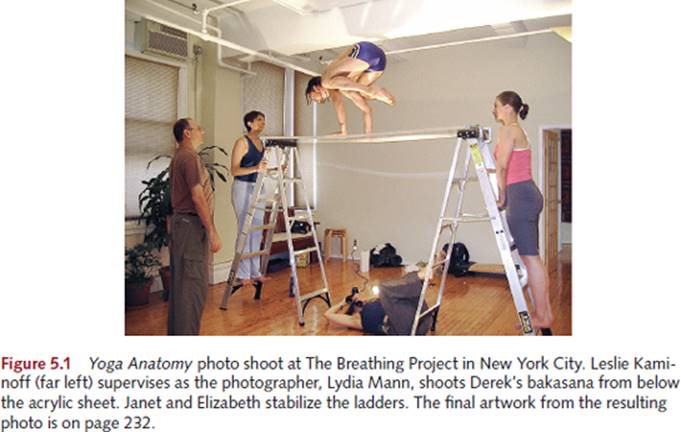
The asana images in this book are based on photographs of various models that were taken during several sessions (figure 5.1). Some of the perspectives are quite unusual because they were shot from below using a large acrylic sheet or from above using a ladder.
The photos were used as reference for the anatomical illustrator, who posed her skeleton in the various positions and sketched the bones by hand. After a round of corrections, the muscles and other structures were added using computer software, and several more rounds of corrections and adjustments were made to produce the final images.
The labeling of the structures in each drawing, as well as the various arrows and other indicators, were added last. Muscles are sometimes labeled in the drawings for reference purposes and may not be active in that particular asana. If you find a muscle in the text that is not labeled on the accompanying drawing, use the muscle index on page 270 to find an illustration of that muscle.
CONCLUSION
It was often a challenge to know what to say about the actions in the joints and muscles for each asana. Each body is unique. Each body has different ways of responding to gravity, different pathways for recruiting muscles, and a different amount of tone in the joint capsules and ligaments. Two people can use different muscles to create the same joint action and then have completely different sensations of the experience in the same asana. We each have our own way to distinguish between sensations of stretching and lengthening, working and holding, or pain and release.
In a few cases we list muscles that are lengthening but are not necessarily active—described as passively lengthening—to distinguish them from muscles that are actively lengthening in an eccentric contraction. For some people these muscles will have the sensation of stretching, but for others there will not be a sensation of stretching until far past an appropriate range of motion. For still others these muscles might actually be so easy to lengthen that they would do better to engage in an eccentric contraction and modulate the range of motion.
Our choices about how to move through an asana will depend on our starting condition. For example, if I have very open shoulders, then I might think about internally rotating the humerus relative to the scapula, while my neighbor with less mobility in the glenohumeral joint is rolling the arms open as much as she can. Both actions could be functional in adho mukha svanasana (downward-facing dog pose) because the point of the asana (on a body level) is not to do it right, but to find the relationship between all the parts of the body that will let the experience of the asana resonate throughout the whole body—cells, tissues, fluids, and systems.
The ways we initiate a movement, whether from the bones and muscles or from the endocrine system or the blood, have a tremendous impact on the quality of the movement. With practice and skillful observation we can see from the initiation how the movement will travel through the body and the effect it will have on the body systems. An understanding of what we are activating to move into an asana will help us understand the nature of the asana and the effect it has on the skeletal, muscular, nervous, and endocrine systems; the mind; and the spirit.
The asana is not just the final arrangement of the limbs and spine, but is the full process of coming into that arrangement. If we look at the process rather than the final product, we are able to develop variations that increase or decrease the challenge of the asana without feeling that we aren’t actually doing the asana until we get our head to our knee, our hands to the floor, or some other concrete goal. We are able to adapt the asana to the individual so that each person can find a unique embodiment of the asana.
Because yoga practice is fundamentally experiential, the information in this book is intended to be an inspiration to explore your own body. Perhaps you will understand more clearly something you’ve experienced as a result of reviewing this material. On the other hand, some anatomic detail may capture your interest and move you to investigate it through a pose that is being depicted. In either case, this book will have served its purpose if it supports you in these explorations.
Please take these ideas as a launching point for discussion and exploration, rather than as the final word on how to achieve the pose. And then, once you’ve found your own way in, try it the opposite way!
1 “Each bodily movement is embedded in a chain of infinite happenings from which we distinguish only the immediate preceding steps and, occasionally, those which immediately follow” (Laban 1966, p. 54).