
If the job of the skeletal system is to transfer weight and force by way of the ligaments through the bones in any arrangement the joints allow, then the task of the muscular system is to move the bones into place so that the bones can do their job. Muscles create movement, joints enable movement, and connective tissue translates movement from tissue to tissue. Bones absorb and transmit movement, and nerves coordinate and organize the whole gorgeous dance.
The muscles work together as a matrix of potential movement choices. This matrix affects every articulation in the body. Muscles do not work in isolation, and a single muscle never works without support and modulation from other muscles. Each muscle has an effect on every other muscle, whether they are nearby or far away.
Historically, muscles have been presented in a simplistic, linear paradigm, which leads to misconceptions such as:
• Muscles work as discrete units.
• For every body, the same muscles always create the same joint action.
• The more tone a muscle has, the better it can function.
• Muscles always relate to each other in the same way.
• There is a correct set of muscles for executing any movement.
To understand why these assumptions are incorrect, it is necessary to examine the basic anatomy of muscles.
Try this experiment: Lie down on your back. Open your arms to the sides at a comfortable level, palms facing up. Your legs can be bent or extended. Take some time to settle into this position. Then, starting with a very small movement, begin to wiggle your fingers.
Can you feel how the muscles in your forearms are activated as you wiggle your fingers? How about the muscles in your upper arms? The muscles in your shoulders and upper back? Can you feel the muscles around your spine respond to the wiggling of your fingers? How about the muscles in your jaw? Can you follow the movement to your feet?
If it feels as though the movement doesn’t travel anywhere, see if you can feel where it stops. Are you holding on to anything in your muscles that you don’t need to? What can you release so that the movement can travel with ease through the body?
BASIC MUSCLE ANATOMY
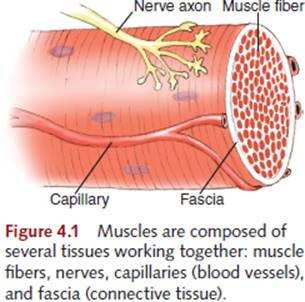
What we usually think of as a working muscle is actually an organ made up of at least four different tissues: muscle tissue, connective tissue, nerves, and blood vessels (figure 4.1, page 56). The muscle tissue itself has the ability to contract and create movement. The connective tissue communicates the power of that contraction to whatever the muscle is connected to, such as bones, organs, or skin. The nerves tell the muscle when to fire, for how long, and at what intensity, and the blood vessels provide the nourishment that allows the muscle tissue to be active.
Muscles are divided into three basic types: skeletal muscle, cardiac muscle, and smooth muscle.
Skeletal muscle is generally attached to bones and creates movement at the joints. It has alternating bands of light and dark fibers that give the tissue its striated appearance. Skeletal muscle is controlled by the somatic portion of the nervous system, which makes many of its functions voluntary, or under our conscious control. Cardiac muscle is in the heart, and smooth muscle is in the blood vessels, airways, and visceral organs. Cardiac tissue is also striated but is controlled by the autonomic nervous system and hormones from the endocrine system. Smooth muscle is not striated and, like cardiac muscle, is controlled by the autonomic nervous system and the endocrine system.
The skeletal muscle tissue that we see with the naked eye is made up of bundles of fascicles. The fascicles are made up of bundles of muscle fibers, which are the actual muscle cells. Inside the muscle cells are bundles of myofibrils (or myofilaments; see figure 4.2). Each of these bundles of myofibrils, muscle cells, and fascicles are wrapped in a layer of connective tissue, and all these layers of connective tissue come together at the ends of the muscles to create the tendons and other tissues that connect muscles to bones (figure 4.3).
The myofibrils are made up of thick and thin filaments that lie alongside each other and overlap. These filaments are twisted strands of molecules that create contractions.


MUSCLE CONTRACTIONS
When a muscle cell contracts, the molecules create and release bonds between the thick and thin filaments, which ratchet along each other and create a sliding movement that increases their overlap and draws the two ends of the myofibril toward each other. If enough myofibrils shorten, the whole muscle fiber slides shorter. As more and more muscle fibers contract, they attempt to shorten the entire muscle by sliding the attachment points at the two ends of the muscle toward each other.
Whether or not the entire muscle does actually shorten depends on outside factors, specifically how much resistance exists. If only a few filaments are sliding together inside the cells, they may not generate enough force to overcome the weight of whatever structure the muscle is attached to, such as the weight of the arm or the weight of the head. The weight of a body part is a product of the resistance created by gravity, which is a fundamental source of resistance for everything on this planet. We negotiate this force every time we lift an arm, stand up, roll over, or take a breath. Added resistance also comes from other forces, such as the weight of something being carried, an opposing muscle contraction, or even an emotional state (for example, tension, anger, or the effort not to cry will often create resistance, while relaxation, happiness, or relief will often decrease resistance).
Muscles do not contract in an all-or-nothing way. All of the fibers do not have to contract at the same time, meaning that a muscle can generate a precisely gradated amount of force, coordinated by the dialogue between the nervous system and the muscles. Because muscles work in this modulated way, they don’t always end up shortening, even though the fibers might be actively contracting. A muscle may in fact be active and lengthening when the outside force is greater than the force that the muscle is exerting.
The words concentric, eccentric, and isometric are used to describe muscle actions (figure 4.4, page 58). These terms actually describe the effects of the relationship between the muscle and the resistance it meets.
Concentric Contraction The muscle fibers contract and generate more force than the resistance that is present so that the ends of the muscle slide toward each other and the muscle shortens.
Eccentric Contraction The muscle fibers contract and generate less force than the resistance that is present so that the ends of the muscle slide apart and the muscle actually lengthens. The muscle is active as it lengthens, so this is not the same as relaxing the muscle.
Isometric Contraction The muscle fibers contract and generate the same amount of force as the resistance that is present so that the ends of the muscle neither move apart nor move together and the length of the muscle does not change. Isometric contractions can be distinguished further: There is a difference in experience between intending to hold still against the resistance of something else trying to move you and intending to move but not being able to overcome the resistance to movement. There is also a difference in experience between maintaining an isometric contraction following a concentric contraction and maintaining an isometric contraction following an eccentric contraction.
Muscles don’t actually flex or extend; these terms describe joint actions. To be accurate, muscles use contractions to create all joint actions, including flexion and extension.
A relaxed muscle generally means that there is not an intentional or voluntary contraction of the muscle fibers. If someone is conscious (even sleeping), however, there is always an underlying level of automatic activity in the muscle fibers to maintain the resting tone of the muscle. This resting tone keeps the muscles ready to respond and in postural muscles automatically adjusts for slight shifts in weight and balance when we sit, stand, and walk.

In the fields of fitness and movement training, the words lengthen and stretch are used in many different ways. It is important to understand that a muscle can lengthen and be active (an eccentric contraction), can lengthen and be inactive (a relaxed muscle), or can lengthen and gradually change from active to inactive or vice versa.
In any of these situations, the muscle lengthens because an outside force (such as the pull of gravity or the pull of another muscle) acts more strongly than the muscle being lengthened. Lengthening a muscle does not necessarily mean relaxing it.
The word stretch is sometimes used interchangeably with lengthen. If the term simply means to change the distance between the attachment points of the muscle in such a way that they move apart from each other, stretch is indeed interchangeable with lengthen.
If, however, stretch implies a particular quality of sensation in the muscle, then it is not interchangeable with lengthen. It is possible to lengthen a muscle without a stretching sensation—in fact, most of us do it all the time. Actions such as walking, talking, or picking up a cup all involve lengthening and shortening muscles, often without any particular muscular sensation at all.
ORIGIN AND INSERTION FALLACY
The places where muscles attach to the bones are often classified as being the origin and the insertion. The origin is the attachment that is closer to the torso or the center of the body, and the insertion is the attachment that is farther from the center, closer to the fingers, toes, skull, or coccyx. The underlying implication is that the origin is the fixed point and the insertion is the point that moves; however, this is only true for some of our movements. Any time we move the torso through space, we reverse the so-called origin and insertion points.
This classification of attachment points also implies that muscles develop from one point to another and they somehow grow from the origin toward the insertion. Embryologically, however, they do not do this. Instead, clusters of future muscle cells migrate to the area of their future home and organize themselves once they get there. It is not a linear point-to-point process at all.
MUSCLE RELATIONSHIPS
No muscle works in isolation; all muscles in the intricate web of the muscular system constantly engage with each other to balance, reinforce, modify, and modulate one another through the matrix of the connective tissue.
The relationships between muscles can be organized in a variety of ways. We can focus on how muscles balance each other around a single joint, how the layers of muscle have different effects as they shift from deep to superficial, or how kinetic chains of muscle and connective tissue integrate the limbs and torso.
Agonist–Antagonist Pairs
One of the common paradigms for organizing muscles is into agonist–antagonist muscle pairs. This perspective is oriented around specific joint actions and the muscles that create and modulate those joint actions.
The starting place is a specific joint, the focal joint, and a specific joint action. For every joint action there are muscles that create the movement and muscles that oppose the movement. The muscles that create the joint action are called the agonists, or prime movers, and the muscles that create the opposite joint action are called the antagonists.1 These pairs of agonist–antagonist muscles can have direct relationships in the nervous system at the level of the spinal cord. When one muscle of the pair acts, the other muscle receives a message to respond and modulate. This relationship is called reciprocal innervation or reciprocal inhibition. Not all agonist–antagonist muscle pairs have a relationship at the level of the spinal cord; some are paired together through repeated movement patterns that are recorded at higher levels in the brain rather than the spinal cord.

Agonist and antagonist roles are relative, and they change as the focal joint and the joint action change. These terms do not describe an absolute quality inherent in the muscle itself but something about its relationship to another muscle during a specific moment at a particular joint. Whether a muscle is an antagonist or an agonist depends on which joint and which joint action are the points of focus and where the main resistance to the movement is found (figure 4.5).
The muscles that support and modulate the action of the agonist or antagonist muscles are called synergistic muscles. The synergistic muscles also act to minimize excess movement at a joint or to stabilize one part of the body to support movement in another part. When synergists act to stabilize in this way, they are also called fixators. Alternatively, the term synergistic is used to describe a whole group of muscles that work together to create an action. Synergistic muscles are essential for maintaining balanced joint space and for the health of the joint.
Organizing muscles into agonist–antagonist pairs is very useful when looking at a specific action at a single focal joint. In order to consider how different joints relate to each other, it is important to examine other kinds of relationships between muscles.
Sometimes, even in a simple movement, the antagonist for the first part of the movement becomes the agonist in the second part of the movement. For example, when the arm is extended out to the side, parallel to the floor, and the elbow is flexed so that the hand moves toward the shoulder, in the first part of the movement (bringing the forearm perpendicular to the floor), the triceps brachii is an antagonist to the action of the biceps brachii. In the second part of the movement (bringing the forearm from perpendicular to the shoulder), the triceps brachii is the agonist, acting eccentrically.
One-Joint and Multi-Joint Muscles2
Muscle groups and individual muscles have layers. In the limbs the deepest layers are closest to the bones and the superficial layers are closer to the skin. In the torso, however, some of the deepest layers of muscle are deeper than the bones, and they are closest to the thoracic, abdominal, or pelvic cavities and organs.
Different muscles can cross different numbers of joints. Some can cross one joint, and some can cross two joints; some muscles in the hands and feet cross 8 or 9 joints, and some muscles in the spine cross12 to 15 joints. The diaphragm has an effect on over 100 joints. It crosses some of those directly and affects others by way of fascial and skeletal connections.
With a few exceptions, the deeper the layer of muscle or muscle tissue, the shorter it is.3 The shortest, deepest layers of muscle that cross one joint are called monoarticular, or one-joint muscles. These one-joint muscles have very specific actions and support articulation and discrimination at each joint. They are essential for the integrity and alignment of individual joints.
As the muscle layers get more and more superficial, they become longer and broader, and they cross more joints. If a muscle crosses more than one joint, every time it acts it has a direct effect on all of the joints it crosses as well as an indirect effect on all of the joints in the body. These longer muscles are called multi-joint muscles if they cross two or more joints. The multi-joint muscles connect all the parts of the limbs together, and they integrate the limbs into the torso. They give us the ability to negotiate large shifts of weight and movement of the whole body through space, or, in the diaphragm, to coordinate sophisticated shape changes in the torso.
Every joint has both one-joint and multi-joint muscles that surround it. Every joint has the possibility of discrete and specific movement, and the potential for being integrated into a flow of movement that travels through the whole body.
When we forget that we have the potential to move with specificity and articulation in every joint, we might never find some of the movement possibilities that are available to us. When we only use bigger and more superficial muscles, we work too hard. On the other hand, when we focus only on the deep one-joint muscles, we can forget to look at the whole picture of movement. All the layers are essential for healthy and efficient joint movement.
Kinetic Chains of Muscles
In addition to examining specific muscles around a single joint or the layers of muscles from deep to superficial, we can also consider how the muscles work together in kinetic chains.4 In this case we no longer consider individual muscles but the ways that they are linked together by connective tissue into long chains of dynamic action.
Whenever we engage a single muscle, it has an effect on the rest of the body by way of the connective tissue. From anywhere in the body, movement follows a kinetic chain from one muscle to another through the direct relationships of the connective tissues that link the individual muscles and through the sensory-motor pathways of the nervous system that sequence the firing of the muscles.
Never in life do we use a single muscle to do a task. In an efficient, integrated movement, we engage enough muscles to get sufficient power for the task without expending too much energy or recruiting so many muscles that we get in our own way.
FUNDAMENTAL PRINCIPLES OF SKELETAL MUSCLES
The following are basic ideas on how muscles work in relationship to the bones and nerves. Understanding these principles can help to cultivate an awareness of the complexity and sophistication of the muscular system. Also, this awareness might prevent the oversimplifying that is so limiting to our movement choices.
An enormous difference also exists between the weight traveling clearly through the bones and the weight passively hanging in the joints. In this case, when we hang in a joint, the ligaments around that joint must negotiate the weight, and the weight doesn’t translate clearly from bone to bone.
Bones support weight; muscles move bones. There is an enormous difference between how the muscles work when they are moving the bones into place to take weight and how they work when they are actually attempting to hold the weight themselves.
When the muscles take on a weight-bearing function, they overwork and become rigid and fixed. If the bones bear weight instead, the muscles can stay constantly moving and continuously make micro-adjustments to create efficient movement and dynamic stillness rather than disconnection and locking in the joints.
Muscles work best when they can calibrate tone. The basic definition of the word tone is readiness to respond. A tissue that has high tone needs less stimulation before a response is elicited because the tissue is more prepared to respond. On the other hand, a tissue with a lower tone needs more stimulation before a response happens.
Although it is related, this is not the same thing as sensitivity. A tissue can be very sensitive and have low tone. It might register a stimulus at a very fine level but not react until it receives a great deal of that stimulus. Alternatively, a tissue can have high tone and low sensitivity, where it is very ready to respond but not actually responding because it isn’t picking up any stimulus.
All tissues need to be able to change tone in response to changes in the environment, both internal and external. The important thing is not the absolute state of tone but the tissue’s ability to adapt.
If the tone of a muscle or group of muscles is too low, when a muscle is needed to participate in a task it might not be readily available and other muscles must compensate. This can lead to imbalances in the joint space, ligament sprains, and muscle strains.
On the other hand, if a muscle or group of muscles is too high in tone, the muscle tissue burns more energy than is necessary, is more likely to overwork, and creates imbalances in the joint space that lead to injury.
Because the muscles have a rich supply of nerve endings, they are able to calibrate their tone to a very sophisticated degree. This means that they can be incredibly efficient about using just enough effort to get the job done.
Muscles calibrate tone and cultivate awareness through negotiating resistance. The nervous system receptors in the muscle tissue are called spindles, a specialized kind of proprioceptor, or self-sensor. One of the things that they sense is what happens in the muscles when they meet resistance. These proprioceptive spindles then use that information to set the level of tone for the muscles so that each muscle can meet or match the resistance it encounters.
Muscles build tone by meeting greater and greater amounts of resistance. Resistance is an essential source of feedback for the proprioceptors and is based on sensing the relationship between the muscle tissue and the source of resistance (often gravity). When a muscle has the opportunity to engage with many different degrees of resistance, it learns to adapt and calibrate its level of tone.
When there is no resistance, the nerve endings in the muscles get no feedback, and the muscles don’t have the ability to use the nerves to sense changes in tone or to make finely tuned adjustments to the muscle tone.5
Muscles pull. In a concentric contraction, the pulling power of the muscle is greater than the resistance. In an eccentric contraction, the pulling power of the muscle is less than the resistance. In an isometric contraction, the pulling power of the muscle is exactly the same as the resistance.
In all of these cases the muscle is firing and the molecules in the myofibrils are ratcheting together to pull. The muscle is never actively pushing the fibers in a way that slides them apart—that happens because the resistance is greater than the pulling force being generated.
So, how is it that we can push something away? Any joint movement includes a part that is lengthening and a part that is shortening. Whether or not the joint is flexing, extending, or rotating, some muscles are lengthening and some are shortening. The shortening muscles are concentrically contracting; the lengthening muscles are in various degrees of relaxation or are eccentrically contracting.
Flexibility and strength are about the relationship between the nervous system and the muscles. A classic definition of flexibility is the ability of the muscle to lengthen, and a classic definition of strength is the ability of the muscle to generate force and speed. Both flexibility and strength in the muscles are functions of the nervous system as much as they are functions of the ability of the muscle fibers and connective tissues to adapt in length.
In the vast majority of situations, flexibility is not determined by the actual physical length of the muscle or of the muscle fibers that compose that muscle. The resting length of the muscle, its tone, and the amount it will lengthen are all set by the proprioceptive nerve endings in the muscle. This setting is established in the nervous system through previous experiences regarding what is appropriate, safe, and functional.
The amount of strength a muscle has is more dependent on its physical properties, including the actual number of muscle fibers. Muscle strength is also a product of the way that the nervous system recruits fibers and organizes the surrounding muscles and kinetic chains. When the nervous system is inefficient in the way it recruits and organizes muscles, it diminishes the functional strength of a muscle by creating a situation where the muscle has to exert effort to overcome resistance from other muscles in the body.
Increasing flexibility and strength is a process of reeducating the nervous system through conscious attention and practice as much as it is about stretching and repetitions.
CONCLUSION
Muscles surround joints and wrap around bones in incredibly sophisticated spiraling layers. Embryologically, muscles follow fluid pathways from the center of the body out into the limbs. The three-dimensionality of the pathways of the muscles allows them to have incredibly nuanced effects on the bones that they move.
In a three-dimensional paradigm, it is clear that for each individual, the muscles weave together into unique patterns of dynamic lengthening and shortening that create the movements of daily life, such as walking and talking, opening a bottle, or brushing teeth. What creates integrated movement for one person is not the same pattern that creates integrated movement for another.
When traditional ideas about muscles shape our movement choices, we end up with faulty generalizations and assumptions about the role of muscles in creating movement and support.
What happens when we expect that in any given situation every person will use his or her muscles in the same way? That there is a “correct” sequence of muscle actions to perform a movement? That this way works for every person? And, that working harder makes a person stronger?
When we assume that we can generate a final and complete analysis of the unique and complex sequences of muscular action that are expressed in each person’s movement choices, we create obstacles and limit the ways that new choices can arise. If we instead observe with a mind open to possibilities, examining each person’s pattern becomes an opportunity to witness the incredible variety of ways that we can successfully execute the simplest actions.
1 The word agonist comes from a Greek word meaning contender or contestant. Antagonist comes from the Greek word for opponent.
2 While the terms one-joint and multi-joint are not used exclusively by Body–Mind Centering (BMC), the approach to muscular repatterning in BMC is the most sophisticated use of these concepts that I have encountered.
3 Exceptions are as follows: the extensor digitorum brevis in both the hands and feet, which lies on top of the extensor digitorum longus, and the psoas minor in the torso, which runs along the surface of the psoas major. Also, the psoas major and the diaphragm are some of the deepest muscles in the body, and both cross many joints.
4 I first encountered the term kinetic chains in my study of Laban Movement Analysis and the Bartenieff Fundamentals, though it is used by a variety of therapeutic modalities.
5 The nervous system is not the only way that we get information about the body. Cells are able to communicate with each other directly and through the fluid systems of the body; juxtacrine, paracrine, and endocrine signaling are examples of this.