
MITOSIS AND MEIOSIS
Multiple Choice
Please select the single best answer for each of the following questions.
1. A human cell at prophase II of meiosis will normally have how many centromeres?
(a) 46,
(b) 45,
(c) 92,
(d) 23,
(e) none of the above.
link to answer
2. An individual carries a pair of homologous chromosomes, A and a. A cell at mitotic metaphase or at metaphase I of meiosis has
(a) one A and one a chromosome,
(b) two A and two a chromosomes,
(c) four A and four a chromosomes,
(d) none of the above.
link to answer
3. A cell from the same individual at metaphase II of meiosis has
(a) one A and one a chromosome,
(b) either one A or one a chromosome,
(c) two A and two a chromosomes,
(d) either two A or two a chromosomes.
link to answer
4. Bivalents are seen
(a) at prophase I of meiosis,
(b) at prophase II of meiosis,
(c) at prophase of mitosis,
(d) at prophase I of meiosis and at prophase of mitosis,
(e) at prophase II of meiosis and at prophase of mitosis,
(f) during the interphase just prior to the beginning of meiosis.
link to answer
5. Histone proteins are found in
(a) eukaryotes only,
(b) bacteria only,
(c) viruses only,
(d) both eukaryotes and bacteria, but not viruses.
link to answer
6. Centromeres associated with duplicated chromosomes (sister chromatids) do not divide during
(a) mitotic anaphase,
(b) anaphase I of meiosis,
(c) anaphase II of meiosis.
link to answer
7. A chromosome with a long arm and a short arm is called
(a) telocentric,
(b) egocentric,
(c) epicentric,
(d) metacentric,
(e) acrocentric,
(f) paracentric,
(g) chromocentric.
link to answer
8. A diploid organism has 10 pairs of chromosomes. These 20 chromosomes will all behave independently of each other during
(a) mitosis,
(b) meiosis,
(c) both mitosis and meiosis.
link to answer
9. The epidermal cells of a certain mouse have 32 chromosomes. This species therefore has how many linkage groups?
(a) 32,
(b) 64,
(c) 16,
(d) 31,
(e) none of the above.
link to answer
10. If parthenogenetic development of an unfertilized egg could produce a viable diploid child in humans, its sex would be
(a) female,
(b) male,
(c) either female or male.
link to answer
Diagrams and Definitions
1. Please draw and label the main parts of
(a) a cell at anaphase I and
(b) a cell at anaphase II, where 2n = 6 acrocentric chromosomes.
link to answer
2. Please define each of following terms briefly:
(a) Bivalent
(b) Synapsis
(c) Homologous chromosomes
(d) Chromatids
(e) Linkage group
link to answer
NUCLEIC ACIDS
Multiple Choice
Please select the single best answer for each of the following questions.
1. In double-stranded RNA, the nucleotides of each strand are connected to those in the other by
(a) hydrogen bonds,
(b) phosphodiester bonds,
(c) peptide bonds,
(d) none of the above.
link to answer
2. Each “rung” in the double-stranded “ladder” of nucleic acid contains how many nitrogenous rings:
(a) one,
(b) two,
(c) three,
(d) two or three,
(e) two, three, or four?
link to answer
3. A virus whose genetic material consists of single-stranded RNA has about 22 percent of its RNA nucleotides consisting of uracil. The frequency of adenine in this organism’s RNA is
(a) 22 percent,
(b) 28 percent,
(c) 78 percent,
(d) not ascertain-able from this information.
link to answer
4. In the Meselson and Stahl experiment of DNA replication, E. coli whose DNA was fully labeled with 15N were placed in a 14N medium and permitted to undergo a number of replications. After the fourth replication in 14N, the DNA should consist of
(a) one 14/14 to one 14/15 hybrid,
(b) three 14/14 to one 14/15 hybrid,
(c) seven 14/14 to one 14/15,
(d) none of the above.
link to answer
5. A virus that contains approximately 29.7 percent adenine and 29.3 percent uracil most likely has as its genetic material
(a) single-stranded RNA,
(b) single-stranded DNA,
(c) double-stranded RNA,
(d) double-stranded DNA.
link to answer
6. If a hybrid tobacco mosaic virus (TMV) is made by combining the RNA from strain I with the protein coat from strain II, and this hybrid TMV is used to infect a plant, then the progeny will be
(a) strain I in both RNA and protein,
(b) strain II in both RNA and protein,
(e) hybrid like the hybrid parent.
link to answer
7. RNA differs from DNA in the nucleotide bases it contains. To be specific, it differs in one of the
(a) purines,
(b) pyrimidines.
link to answer
8. Griffith, in 1928, and Avery, MacLeod, and McCarty in 1944 studied bacterial transformation in Diplococcus pneumoniae, where rough (R, nonvirulent) forms were transformed by DNA taken from smooth (S, virulent) forms. Is it possible to transform S forms to R forms by treating them with DNA extracted from R bacteria?
(a) yes,
(b) no.
link to answer
9. Experiments with labeled protein and labeled DNA in viruses helped confirm that DNA was the genetic material. These experiments were carried out by
(a) Watson and Crick,
(b) Hershey and Chase,
(c) Griffith,
(d) Avery, MacLeod, and McCarty.
link to answer
10. From Chargaff’s rule, we predict that
(a) (A + T)/(C + G) = 1,
(b) (A + C)/(T + G) = 1,
(c) (G + A)/(C + T) = 1,
(d) answers a and b only,
(e) answers b and c only,
(f) answers a, b, and c,
(g) none of the above.
link to answer
Diagrams and Definitions
1. Using the following symbols, diagram
(a) a purine nucleotide,
(b) a nucleoside of DNA.

link to answer
2. On the following diagrams designate the 5′ and the 3′ carbon positions, and identify the sugars.

link to answer
3. Please define each of the following terms briefly:
(a) Semiconservative replication
(b) Polymerase
(c) Transcription
(d) Replication
(e) Ligase
link to answer
BASIC MENDELIAN GENETICS 1
Multiple Choice
Select the single best answer for each of the following questions.
1. A married couple has children whose blood types include A, B, AB, and O. The blood types of the parents are
(a) AB and O,
(b) A and B,
(c) AB and AB,
(d) none of the above.
link to answer
2. Curly (Cy), a wing mutant in Drosophila, is dominant to the allele for normal (straight) wings and is lethal when homozygous. If two Curly flies are mated, the proportion of wild-type flies among the progeny would be
(a) 1/4,
(b) 1/2,
(c) 3/4,
(d) 1/3,
(e) 1/6,
((f)) 2/3.
link to answer
3. Two genetically different strains of recessive albino mice are crossed. The first strain, aaWW, is albino because of aa, whereas the second, AAww, is albino because of ww. The two loci assort independently. Assume that the dihybrid F1 mice are crossed with each other to produce the F2. The fraction of the F2 mice that is expected to be albino is
(a) 3/4,
(b) 1/2,
(c) 9/16,
(d) 3/16,
(e) 7/16,
(f) 1/4,
(g) 1/16.
link to answer
4. In a self-fertilizing plant, what proportion of a trihybrid F2 will breed true (that is, will not segregate for any of the three loci)?
(a) none,
(b) 1/64,
(c) 1/8,
(d) 1/4,
(e) 1/2.
link to answer
5. Camptodactyly (permanently stiff, bent fingers) is an autosomal dominant trait in humans. A normal woman marries an affected man whose father was normal. If the condition is expressed in only 60 percent of the carriers in a hypothetical population, what proportion of the children produced by these parents would be expected to carry the mutant?
(a) 100 percent,
(b) 60 percent,
(b) 50 percent,
(d) 30 percent,
(e) 25 percent,
(f) none of the above.
link to answer
6. A 9:3:4 phenotypic ratio for F2 in a dihybrid cross is the result of the action of
(a) a dominant epistatic gene,
(b) a recessive epistatic gene,
(c) an ecstatic gene,
(d) a dominant pleiotropic gene,
(e) a recessive pleiotropic gene.
link to answer
7. Assume that a dihybrid cross in the aardvark is made between the genotypes IiAa and IiAa. The i homozygote is lethal, preventing the embryo from implanting. The A allele permits pigmentation, whereas the a homozygote is albino. The two loci assort independently. The I–genotype is phenotypically normal. The baby aardvarks from this cross will segregate what ratio of pigmented to albino phenotypes?
(a) 3:1,
(b) 9:7,
(c) 13:3,
(d) 2:1,
(e) none of the above.
link to answer
8. Rh incompatibility between fetus and mother will be less likely to lead to problems for a future child if the ABO blood types of the fetus and the mother are, respectively
(a) O and AB,
(b) O and A, B, or AB,
(c) A and AB,
(d) AB and O,
(e) B and AB.
link to answer
9. Linkage is an exception to the Mendelian law of
(a) segregation,
(b) dominance and recessiveness,
(c) unit factor inheritance,
(d) independent assortment.
link to answer
10. In chickens, two pairs of genes are involved in the inheritance of comb type. One gene, P, produces pea-combs, whereas its recessive allele, p, produces a single-comb. The second gene, R, produces a rose-comb, whereas its recessive allele, r, also produces a single-comb. When R and P occur together (that is, R − P −), a walnut-comb is formed. Considering both loci together, the only genotype that can produce a single-comb is rrpp. Suppose that a walnut-comb chicken is crossed with a rose-comb chicken. They produce two walnut-comb, three rose-comb, one single-comb, and two pea-comb chickens. Which of the following are the genotypes of the parents
(a) rrPp × RrPp,
(b) RrPp × Rrpp,
(c) RrPp × RrPp,
(d) RRPP × RRpp,
(e) RRPp × Rrpp?
link to answer
MENDELIAN GENETICS 2
Multiple Choice
Select the single best answer for each of the following questions.
1. A woman with blood type B has a child with blood type O. She claims that a friend of hers is the child’s father. He denies it. His blood type is B. The fact that his parents are type A and type AB would be welcome information
(a) to the woman,
(b) to the man,
(c) to neither the woman nor the man.
link to answer
2. A true-breeding (homozygous) mouse strain with black hair is crossed to a true-breeding strain with white hair. The F1 are all black. When the F1 mice are crossed to each other, they give rise to an F2consisting of about 9 black: 3 brown: 4 white mice. This is an example of
(a) recessive epistasis,
(b) dominant epistasis,
(c) pleiotropy,
(d) duplicate genes.
link to answer
3. A woman with blood type B and a man with blood type A have a child with blood type A. The probability that their next child will be type B is
(a) either 0 or 1/4, depending upon the genotype of the father;
(b) either 1/4 or 1/2, depending upon the genotype of the father;
(c) either 0 or 1/4, depending upon the genotype of the mother;
(d) either 1/4 or 1/2, depending upon the genotype of the mother;
(e) 0;
(f) 1/4;
(g) 1/2.
link to answer
4. If you were to flip a coin twelve times, you would expect six heads and six tails (in any order), with a probability of about
(a) 23 percent,
(b) 26 percent,
(c) 30 percent,
(d) 34 percent.
link to answer
5. Two normal-sized rats are each heterozygous for a recessive gene d, causing dwarfism. The probability that any two of their progeny will include one normal and one dwarf rat is
(a) 1,
(b) 3/16,
(c) 3/8,
(d) none of the above.
link to answer
6. During the lifetime of a woman with the genotype CcHHTtUu, what proportion of the ova she produces will have the genetic makeup CHTU:
(a) all,
(b) 1/2,
(c) 1/4,
(d) 1/8,
(e) 1/16,
(f) none of the above.
link to answer
7. If both a husband and wife have the genotype given in question 6 (CcHHTtUu), what is the likelihood that their child will have the genotype CcHHttUU?
(a) 1/4,
(b) 3/4,
(c) 3/16,
(d) 3/32,
(e) 1/32,
(f) none of the above.
link to answer
8. Mendel interpreted his results with garden peas as demonstrating
(a) blending inheritance,
(b) particulate inheritance,
(c) chromosomal inheritance,
(d) cytoplasmic inheritance.
link to answer
9. The pedigree shown in the accompanying figure is for the ability to taste PTC, a dominant trait. The probability that a child of II-3 and II-4 will be a taster is
(a) 3/4,
(b) 1/2,
(c) 1/4,
(d) 1,
(e) none of the above.

link to answer
10. A rare dominant trait, when exhibited in men, is transmitted to half their sons and to half their daughters. The gene for this trait is carried on
(a) the X chromosome,
(b) an autosome,
(c) the Y chromosome,
(d) a cytoplasmic factor.
link to answer
11. In Drosophila, Dichaete is a gene with a dominant effect on the angle at which the wings are held relative to the body. Flies that breed true for Dichaete never occur. A cross between phenotypically Dichaete males and Dichaete females produces approximately twice as many Dichaete progeny as wild-type progeny. The number of progeny from such a cross is also invariably smaller than the number from a cross of Dichaete females or males to wild-type. These observations are consistent with the hypothesis that Dichaete is
(a) an epistatic gene,
(b) a hypostatic gene,
(c) a quantitative trait,
(d) a recessive lethal trait.
link to answer
12. What proportion of all six-child families in which one parent is a heterozygote showing polydactyly (a dominant trait) and the other is a normal individual will be expected to produce at least one child with polydactyly?
(a) 5/6,
(b) 1/64,
(c) 1/6,
(d) 1/2,
(e) none of the above.
link to answer
13. In a family, two phenotypically normal parents have a son who suffers from the X-linked form of hemophilia. What is the probability that both of their next two children will also have hemophilia?
(a) 1/4,
(b) 1/8,
(c) 1/16,
(d) extremely low likelihood of having two such children in a row.
link to answer
14. A man whose mother had blood type A and whose father had blood type O marries a woman with blood type AB. If the man has blood type A, how many different blood types can be expected among their children?
(a) 8,
(b) 3,
(c) 1,
(d) 2,
(e) 4.
link to answer
15. Assume that you are told that in the F2 a cross between tall and short plants there were 77.6 percent tall and 22.4 percent short plants. With this information you
(a) can,
(b) cannot test the results by chi-square.
link to answer
Problems
1. In humans, achondroplastic dwarfism and neurofibromatosis are both dominant conditions. An achondroplastic woman whose father also suffered from the condition marries a man with neurofibromatosis. Please define symbols for these conditions and then do the following:
(a) Determine what phenotypes their children could have, and in what ratios they would be expected.
(b) A son with both traits marries a normal woman, and their first child is normal. What is the probability that if they have a family of five children, three will be normal and two will show both traits?
link to answer
2. Answer the following questions after examining this pedigree which follows:
(a) What is the probable mode of inheritance of this trait?
(b) What characteristics of the pedigree led you to your answer in part (a)?
(c) What is the probability that the proband would have an affected child if mated with another individual from the population at large?
(d) What is the probability that individual III-4 is a carrier?

link to answer
MENDELIAN GENETICS 3
Multiple Choice
Select the single best answer for each of the following questions.
1. In a cross of RrBbeeFf × rrBbEEff, with complete dominance at all loci, independent assortment, and no gene interaction, the probability that the progeny will show all four dominant traits is
(a) 1,
(b) 1/2,
(c) 3/4,
(d) 1/4,
(e) 1/8,
(f) 3/8,
(g) none of the above.
link to answer
2. If the heritability of high milk yield in a dairy herd is 0.12, the dairy farmer should be advised to
(a) try soft music and better food to increase yield,
(b) try an intensive program of selected breeding with the herd.
link to answer
3. A dihybrid cross with codominance at each locus and with the two genes assorting independently and not interacting will give an F2 phenotypic ratio of
(a) 9:3:3:1,
(b) 12:3:1,
(c) 9:7,
(d) 9:3:4,
(e) 1:2:2:4:1:2:1:2:1.
link to answer
4. A dihybrid cross with incomplete dominance at each locus and with the two genes assorting independently and not interacting will give an F2 phenotypic ratio of
(a) 9:3:3:1,
(b) 12:3:1,
(c) 9:7,
(d) 9:3:4,
(e) 1:2:2:4:1:2:1:2:1.
link to answer
5. In a pedigree for polydactyly, some individuals have six phalanges on one appendage and five on the other three appendages; some have six phalanges on two appendages and five on the other two appendages; other individuals may have as many as seven phalanges on one or more appendages. This phenomenon is called
(a) variable penetrance,
(b) variable expressivity,
(c) discordance,
(d) phenocypying,
(e) cultural modification.
link to answer
6. A fruit fly that is a phenocopy for winglessness
(a) will,
(b) will not transmit this trait to its offspring.
link to answer
7.

The trait indicated in the accompanying pedigree is most likely inherited as
(a) an autosomal dominant,
(b) an autosomal recessive,
(c) a sex-linked recessive,
(d) a sex-linked dominant trait.
link to answer
8. In a paternity suit, the mother has blood type B and the child has blood type O. The innocent defendant has blood type B. He talks with his genetics instructor about blood type inheritance. From this information, he informs his attorney that his defense could be strengthened by knowing the blood type of his parents. Which of the following parental blood types would help him prove he is not the father?
(a) B and O;
(b) B and AB;
(c) AB and AB;
(d) A and B;
(e) none of this information would strengthen his defense.
link to answer
9. The transmission of information that is not coded for by DNA or RNA is seen in
(a) infectious heredity of CO2 sensitivity in Drosophila,
(b) inheritance of episomes in bacteria,
(c) inheritance of the suppressive petite condition in yeast,
(d) inheritance of cortical structure in paramecia.
link to answer
10. The accompanying pedigree is for a rare autosomal recessive trait; it also shows a consanguineous marriage. The probability that a child of IV-1 and IV-2 will be affected is
(a) 1/4,
(b) 1/8,
(c) 1/16,
(d) 1/64,
(e) 1/128.

link to answer
11. In the dihybrid cross IAIBMN to IAIBMN, the expected number of different phenotypes among the offspring is
(a) 4,
(b) 6,
(c) 8,
(d) 9,
(e) 16,
(f) none of the above.
link to answer
12. Assume a deleterious recessive trait (ee) with a penetrance of 0.6. In a cross of Ee × Ee, the expected proportion of normal to affected progeny is
(a) 3:1,
(b) 6:4,
(c) 45:55,
(d) 85:15,
(e) 90:10,
(f) none of the above.
link to answer
13. In the chi-square test, the larger the χ2 value, the
(a) better,
(b) worse the fit of the observed results to the expected results.
link to answer
14. A sample of ears of corn has a mean weight of 850 grams with a standard deviation of 40 grams. With this information we can predict that 34 percent of the ears will have weights ranging from
(a) 830 to 870 g,
(b) 810 to 890 g,
(c) 830 to 850 g,
(d) 850 to 890 g.
link to answer
15. What proportion of five-child families from marriages of one albino parent and one heterozygous parent would you expert to be composed of three albino and two normal children?
(a) 1/32,
(b) 3/32,
(c) 5/32,
(d) 1/2,
(e) 10/32,
(f) none of the above.
link to answer
Problems
1. The following questions refer to the accompanying pedigree.
(a) Assuming, when no evidence points otherwise, that all individuals marrying into the pedigree are homozygous normal, what is the probable mode of inheritance?
(b) What is the probability that the child shown as “?” will express the trait?

link to answer
2. A cross is made between a true-breeding shaggy llama strain and a true-breeding short-haired llama strain. The shaggy Ilamas are also homozygous brown; the short-haired ones are homozygous cream-colored. An F2 from their progeny gave the following distributions of phenotypes:
|
Shaggy brown |
35 |
|
Short cream |
31 |
|
Shaggy cream |
79 |
|
Short brown |
15 |
|
|
Propose a hypothesis to explain this pattern of phenotypes and determine
(a) The expected ratio
(b) Chi-square for goodness of fit to this hypothesis
(c) The interpretation of these results: (1) reject, (2) do not reject
link to answer
LINKAGE AND MAPPING IN DIPLOIDS
Multiple Choice
Select the single best answer for each of the following questions.
1. In a series of two-point testcrosses, the following crossover data were obtained (given in map distances). The distance from locus S to D is 2; R to S is 9; P to S is 8; D to R is 11; D to P is 6. The relative positions of these loci are
(a) D R S P,
(b) P D S R,
(c) R D S P,
(d) S D P R,
(e) none of the above.
link to answer
2. A three-strand double crossover will give rise to
(a) 3 double and 1 noncrossover strands,
(b) 2 double, 1 single, and 1 noncrossover strands,
(c) 3 single and 1 noncrossover strands,
(d) 1 double, 2 single, and 1 noncrossover strands,
(e) none of the above.
link to answer
3. In a certain plant, 28 percent of meioses have an exchange between the p and rpl loci. It therefore follows that in a p rpl / + + dihybrid, a + rpl chromosome is recovered with a frequency of
(a) 28 percent,
(b) 56 percent,
(c) 14 percent,
(d) 7 percent,
(e) none of the above.
link to answer
4. The pair of chromosomes shown in the following figure contains both genetic markers and cytologically detectable markers. In which region (or regions) will an exchange produce chromosomes that can be shown cytologically to be crossovers?
(a) region 1 only,
(b) region 2 only,
(c) either region 1 or region 2,
(d) neither region 1 nor region 2.

link to answer
5. Half-tetrad analysis of attached-X females of Drosophila provides evidence that crossing over occurs at the four-strand stage of meiosis. Females are heterozygous for white eyes (w) and forked bristles (f). In the genotype illustrated in the following figure, exchange between the forked locus and the centromere would be consistent with crossing over at the four-strand stage if which of the following types of progeny are produced?
(a) females with white eyes,
(b) females with forked bristles,
(c) females with white eyes and forked bristles,
(d) females with white eyes and females with forked bristles.
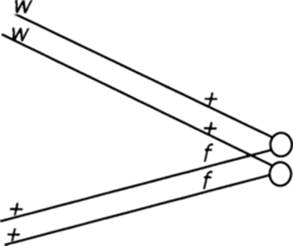
link to answer
6. In Drosophila, a large number of experiments have shown that the vermilion eye-color gene (v) and the miniature-wing gene (m) are separated by approximately 3 crossover map units. In a female that is vm / vm, the percentage of meioses that can be expected to have an exchange in the v—m region is
(a) approximately 3.0,
(b) approximately 1.5,
(c) approximately 6.0,
(d) not ascertainable in the absence of heterozygosity at the v and m loci.
link to answer
7. The attached-X chromosome of a female Drosophila, shown in the following figure, is drawn at the four-strand stage, and it is heterozygous for the recessive miniaturewing allele (m). A female with miniature wings can be produced by an exchange
(a) between the centromere and the m locus,
(b) between the m locus and the end of the chromosome,
(c) at any point along the chromosome as long as it involves the correct chromatids,
(d) none of the above.

link to answer
8. Genetic recombination can take place
(a) only between genes,
(b) only within genes,
(c) either between or within genes.
link to answer
9. Which of the following spore arrangements in Neurospora would result from first-division segregation in an ascus heterozygous for spore color at one locus?

link to answer
10. Three closely linked loci (X, Y, and Z) are separated by 2.5 and 1.2 map units, respectively. In mapping them, a total of 25 double recombinants were recovered in 100,000 scored progeny. The coefficient of coincidence is
(a) 1/6,
(b) 1/3,
(c) 1/2,
(d) 5/6,
(e) none of the above.
link to answer
Problems
1. Following is a sample of 1,000 gametes produced by a trihybrid individual. Please answer the following questions.
|
Gametes |
No. |
Gametes |
No. |
|
BRT |
74 |
BRt |
147 |
|
brt |
65 |
brT |
125 |
|
Brt |
255 |
BrT |
26 |
|
bRT |
288 |
bRt |
20 |
(a) Label the complementary types as parentals, single crossovers, or double crossovers.
(b) Diagram the chromosomes of the trihybrid, placing the genes in their proper order.
(c) Determine the map distances between the three loci.
(d) Calculate the coefficient of coincidence for the double crossovers. What does this value mean?
link to answer
2. The following data were obtained from a testcross of BbEeGg mice.
|
Gametes |
No. |
Gametes |
No. |
|
BEG |
310 |
BEg |
113 |
|
beg |
328 |
beG |
99 |
|
Btg |
52 |
BeG |
18 |
|
bEG |
60 |
bEg |
20 |
(a) What is the distance from B to E?
(b) What is the distance from E to G?
(c) What is the expected number of double crossovers?
link to answer
3. The following data were obtained in a mapping experiment that involved three loci. A plus (+) denotes the normal (dominant) allele for each locus.
|
Gametes |
No. |
Gametes |
No. |
|
+r+ |
359 |
w++ |
92 |
|
wr+ |
47 |
w+s |
351 |
|
wrs |
4 |
+++ |
6 |
|
+rs |
98 |
++s |
43 |
(a) Construct a map of the three loci, showing their relative distances.
(b) Is there any interference?
link to answer
CHROMOSOME NUMBER AND STRUCTURE
Multiple Choice
Select the single best answer for each of the following questions.
1. A hexaploid (6n) autopolyploid is derived from a diploid species that contains eight pairs of chromosomes. This hexaploid will have how many linkage groups?
(a) 2,
(b) 6,
(c) 8,
(d) 24,
(e) 48,
(f) none of the above.
link to answer
2. The chromosome aberration that requires breaks in at least two nonhomologous chromosomes is
(a) inversion,
(b) deletion,
(c) duplication,
(d) translocation,
(e) centric fusion.
link to answer
3. A person who has Klinefelter syndrome, Down syndrome, and cri du chat syndrome will have how many Barr bodies in each somatic-cell nucleus?
(a) 0,
(b) 1,
(c) 2,
(d) 3,
(e) 4,
(f) 5.
link to answer
4. A family history of Down syndrome is reason to suspect
(a) nondisjunction,
(b) highly mutable genes,
(c) chemical or drug sensitivity,
(d) inherited translocation.
link to answer
5. An amphidiploid allopolyploid is produced from diploid species A (n = 6) and diploid species B (n = 8). This allopolyploid will have how many bivalents formed during prophase I of meiosis?
(a) 7,
(b) 14,
(c) 28,
(d) none of the above.
link to answer
6. A woman who has no Barr bodies in her cell nuclei is
(a) aneuploid,
(b) euploid.
link to answer
7. A chromosome could be shortened by
(a) a deficiency and a pericentric inversion,
(b) a translocation,
(c) a pericentric inversion or a paracentric inversion,
(d) a duplication and a deficiency.
link to answer
8. Assume that a specimen of Drosophila melanogaster is found to have a chromosome constitution of XXYAAAA (where A refers to a complete haploid set of autosomes). This fly would be classified as a
(a) male,
(b) female,
(c) intersex,
(d) metamale,
(e) metafemale.
link to answer
9. Nondisjunction of sex chromosomes during spermatogenesis can result in the birth of children with
(a) either Klinefelter or Turner syndrome,
(b) Klinefelter but not Turner syndrome,
(c) Turner but not Klinefelter syndrome.
link to answer
10. If a woman with blood type AB has a child by parthenogenesis (only a hypothetical possibility in humans), the child will be expected to be
(a) a daughter with blood type AB,
(b) a son with blood type AB,
(c) a daughter with blood type A, B, or AB,
(d) a son with blood type A, B, or AB,
(e) either a son or a daughter with blood type AB,
(f) either a son or a daughter with blood type A, B, or AB.
link to answer
Problems
1. Assume that a nonsister-chromatid crossover occurs in the inverted region of the inversion heterozygotes in the two figures that follow.
(a) Diagram and describe the products of these crossover tetrads.
(b) Which inversion heterozygote, A or B, is more likely to produce a viable crossover strand that can be recovered in viable progeny? Please explain your answer.

link to answer
2.

Please describe the products from recombination between nonsister chromatids within the inversion loop in the preceding figure. First draw the chiasma for such a crossover event; then determine how many different chromosome aberrations are involved in this tetrad and how many genetically normal chromosomes will result from meiosis.
link to answer
MUTATION AND FINE STRUCTURE
Multiple Choice
Select the single best answer for each of the following questions.
1. Ultraviolet radiation is a mutagen for bacteria because it is absorbed and changes the energy state of
(a) proteins,
(b) DNA,
(c) RNA.
link to answer
2. Genes that are functionally allelic
(a) do,
(b) do not show complementation.
link to answer
3. At the present time, the total exposure of the population from atomic sources is
(a) much less than 1 percent,
(b) about 10 percent,
(c) about 50 percent,
(d) much more than 50 percent of the radiation from natural sources or from medical diagnoses and treatment.
link to answer
4. Current studies in mutagenesis indicate that
(a) both radiation and chemicals have a threshold,
(b) neither radiation nor chemicals have a threshold,
(c) radiation, but not chemicals, has a threshold,
(d) chemicals, but not radiation, have a threshold.
link to answer
5. In support of Benzer’s recon concept, crossovers in Escherichia coli have been demonstrated
(a) between cistrons,
(b) within a triplet codon,
(c) between pseudoallelic subregions.
link to answer
6. Mutants induced by the base analogue 5-bromouracil (5-BU) can be caused to revert by treatment with
(a) 5-BU, but not nitrous acid or acridine dyes;
(b) both 5-BU and nitrous acid, but not acridine dyes;
(c) nitrous acid, but not 5-BU or acridine dyes;
(d) acridine dyes, but not 5-BU or nitrous acid;
(e) 5-BU, nitrous acid, and acridine dyes.
link to answer
7. In his fine-structure analysis of the rII region of phage T4, Benzer wanted to cross rII mutants that were closely linked to each other. To facilitate finding such closely linked genes, Benzer used the techniques of
(a) deletion mapping,
(b) directed mutagenesis,
(c) recombinant DNA.
link to answer
8. Benzer’s work indicated that genetic recombination can occur between any two adjacent
(a) pseudoalleles,
(b) nucleotide pairs,
(c) cistrons,
(d) codons.
link to answer
9. Normal hemoglobin A has glutamic acid as the amino acid at position 6 in the beta chain. This is replaced by valine in sickle cell hemoglobin and by lysine in hemoglobin C. Considering the codons for these amino acids, one could conclude that the two mutants differ by a base change in
(a) the same codon,
(b) the same muton,
(c) neither of these.
link to answer
10. A mutation caused when a purine is replaced by a pyrimidine is called a
(a) frameshift mutation,
(b) transversion,
(c) transition,
(d) tautomeric shift,
(e) deletion.
link to answer
Problems
1. Please define each of the following terms:
(a) Position effect
(b) Complementation
(c) Suppressor mutation
(d) Tautomeric shift
(e) Pseudoalleles
link to answer
PROTEIN SYNTHESIS AND THE GENETIC CODE
Multiple Choice
Select the single best answer for each of the following questions.
1. The mRNA triplets UAG, UGA, and UAA
(a) bind to protein releaser factors,
(b) bind to “nonsense” tRNA molecules,
(c) do not bind to anything, and thus allow the completed protein to fall off the ribosome.
link to answer
2. Consider the ribosome shown in the accompanying figure, with the A and P binding sites indicated. The mRNA sequence in this diagram is moving to the
(a) left,
(b) right.

link to answer
3. Which corresponds to the 5′ end of mRNA, the amino terminal or the carboxyl terminal of a polypeptide?
(a) the amino terminal,
(b) the carboxyl terminal.
link to answer
4. If a particular polypeptide chain is 210 amino acids long, what is the minimum number of nucleotides in the mRNA molecule required for the synthesis of the chain?
(a) 70,
(b) 105,
(c) 210,
(d) 630,
(e) 840.
link to answer
5. A mutation in the gene coding for the sigma factor involved in RNA synthesis would yield a failure in RNA polymerase recognition of
(a) the initiation point,
(b) the termination point,
(c) the ribosorne.
link to answer
6. Assume that the anticodon for an unknown amino acid is 3′ AUG 5′. The DNA sequence that would be consistent with coding for this amino acid is
(a) 3′ TAC 5′,
(b) 5′ TAG 3′,
(c) 3′ UAC 5′,
(d) 5′ UAC 3′,
(e) 3′ AUG 3′,
(f) 5′ AUG 3′,
(g) 3′ ATG 5′,
(h) 5′ ATG 3′.
link to answer
7. Assume a regular copolymer AAGAAGAAGAAGAAG... Also assume that the genetic code is a four-base code, rather than a triplet code. The polypeptide that would be consistent with this hypothetical process would be composed of repeating units of how many different amino acids?
(a) 1,
(b) 2,
(c) 3,
(d) 4,
(e) 5,
(f) 6,
(g) 7,
(h) 8.
link to answer
8. A cistron coding for a polypeptide has a base change in a glycine (Gly) codon that results in a nonsense (terminator) mutation. The glycine triplet was
(a) GGG,
(b) GGA,
(c) GGC,
(d) GGU. (Feel free to refer to the table of genetic codes at the end of the book, Table R.3, if necessary.)
link to answer
9. Continuing with the example from question 8, this terminator triplet can back-mutate to code once more for glycine. It can also mutate to a missense codon that results in a different amino acid at that site. The number of different single amino acid substitutions that can occur here (with different single-base substitutions) is
(a) 1,
(b) 2,
(c) 3,
(d) 4,
(e) 5,
(f 6,
(g) 7,
(h) 8.
link to answer
10. The genetic code is said to be unambiguous, which means that
(a) each amino acid is coded for by one codon,
(b) each triplet codes for just one amino acid.
link to answer
Problems
1. Please identify the molecule in the accompanying figure and explain its importance in protein synthesis in prokaryotes.
link to answer
2. Consider the following nucleotide sequence and then answer the questions listed (please feel free to refer to Table R.3):
GCAACUGGCAUUCGACAC

(a) What is the DNA template sequence that coded for this segment of mRNA?
(b) For which amino acid sequence does it code?
(c)) A loss of the first DNA pyrimidine (1) would, (2) would not produce a chain-termination sequence somewhere along this segment.
link to answer
GENE REGULATION AND DEVELOPMENT
Multiple Choice
Select the single best answer for each of the following questions.
1. The biochemical defect in a mosaic patch of hair cells in a gopher cannot be compensated for by diffusion of material from surrounding cells. On this basis, the mutant in the mosaic patch would be classified as
(a) nonautonomous,
(b autonomous.
link to answer
2. Posttranslational control of gene expression involves
(a) masking of mRNA in the cytoplasm,
(b) modification of a newly synthesized polypeptide,
(c) synthesizing of mRNA under the control of an inducer substance,
(d) inactivation of ribosomes in the cytoplasm.
link to answer
3. The following diagram shows an operon and its regulator gene (i), where P is the promoter, O is the operator, and SG1 to SG4 are four structural genes. The operon is repressible. A mutation that causes the operon to function as a constitutive operon could be localized in
(a) i or P or O,
(b) P or O but not i,
(c) i but not P, or O,
(d) i or O but not P,
(e) i or P but not O,
(f) none of the above.

link to answer
4. In an inducible system, the repressor protein that is coded for by the i gene would be expected to have
(a) one,
(b) two,
(c) three recognition sites.
link to answer
5. Assume the indicated somatic exchange in Drosophila, where y (yellow body color) and f (forked bristles) are recessive to their normal (plus, +) alleles. Given the appropriate chromatid separation at anaphase, this exchange can generate
(a) a single yellow spot;
(b) a single yellow, forked spot;
(c) yellow and forked twin spots.

link to answer
6. Histones probably function in genetic regulation by
(a) binding to tRNA,
(b) acting as inducers,
(c) suppressing amino acid activation,
(d) binding to ribosomes,
(e) acting as a general suppressor of RNA synthesis,
(f) blocking mRNA as it is transcribed from the DNA.
link to answer
7. Polycistronic messages can be defined as messages
(a) with several ribosomes attached to them,
(b) that are from several operons combined together,
(c) that have information for several different polypeptides.
link to answer
8. The puffing of bands in polytene chromosomes of Diptera appears to be directly associated with
(a) gluttony,
(b) DNA synthesis,
(c) RNA synthesis,
(d) polypeptide synthesis.
link to answer
9. Mutation of the regulator gene of an inducible operon will most likely result in
(a) the absence of the enzymes, even in the presence of the inducer,
(b) a change to a repressible system,
(c) a change to a constitutive system,
(d) none of the above.
link to answer
10. Steroid hormones, such as ecdysone in insects, have been shown to exert their effects upon development by stimulating
(a) replication,
(b) translation,
(c) transcription.
link to answer
GENETIC MATERIAL IN POPULATIONS
Multiple choice
Select the single best answer for each of the following questions.
1. Which of the following changes allele frequencies in a population?
(a) migration,
(b) inbreeding,
(c) mutation,
(d) segregation,
(e) both inbreeding and mutation,
(f) both migration and mutation,
(g) migration, mutation, and segregation,
(h) all of the above.
link to answer
2. Assuming a Hardy–Weinberg equilibrium in a population with p = .2, what is the expected frequency of the heterozygote two generations later?
(a) .04,
(b) .8,
(c) .32,
(d) none of the above.
link to answer
3. The mean and variance in amount of spottedness are monitored in a strain of bean plants over many generations. It is found that the amount of spotting decreases steadily over time but the variance changes only slightly. It is likely that spotting in this plant is under what type of selection:
(a) directional,
(b) stabilizing,
(c) disruptive,
(d) cyclical.
link to answer
4. Assume that a certain gene affects gonadal development so that it results in a 20 percent loss of fertility. Selection against this gene will be least effective if it is
(a) an autosomal dominant with 100 percent penetrance,
(b) an autosomal dominant with 80 percent penetrance,
(c) a sex-linked recessive,
(d) an autosomal recessive,
(e) a sex-linked dominant with 80 percent penetrance.
link to answer
5. A sample of 100 people is tested for the trait “hitchhiker’s thumb,” and 64 of them are found to have this condition. If hitchhiker’s thumb is assumed to be dominant to normal straight thumbs (its actual mode of determination is probably more complex than this), what proportion of the sampled population is expected to be homozygous for hitchhiker’s thumb?
(a) 6 percent,
(b) 8 percent,
(c) 10 percent,
(d) 16 percent,
(e) none of the above.
link to answer
6. A population of one million Drosophila melanogaster contains 100 flies homozygous for an autosomal recessive mutation causing curled bristles. The chance of picking two homozygous normal flies out of the population is
(a) .0099,
(b) .9998,
(c) .0198,
(d) (.0198)2,
(e) none of the above.
link to answer
7. Assume that the A allele occurs with a frequency of .8 and the a allele with a frequency of .2 in three different plant populations. One population is a diploid, one is a triploid, and the third is a tetraploid. In samples of 1,000 from each of the three populations, it is more likely that the homozygous recessive phenotype will be found in
(a) the 2n population,
(b) the 3n population,
(c) the 4n population.
link to answer
8. In humans, a certain sex-linked recessive trait is found in females with a frequency of .09. The frequency with which this trait is expected to occur in males is
(a) .09,
(b) .03,
(c) .0081,
(d) .18,
(e) none of the above.
link to answer
9. If a population begins with 92 percent heterozygotes, what proportion of the population will be homozygous after two generations of self-fertilization?
(a) 23 percent,
(b) 46 percent,
(c) 77 percent,
(d) 54 percent,
(e) none of the above.
link to answer
10. Assuming that mating is random within a city and assuming that there is no selection or migration acting in the populations, the phenomenon of genetic drift would be more likely to occur in
(a) Muskogee, Oklahoma,
(b) Chicago, Illinois,
(c) London, England.
link to answer
