
Mitosis and Meiosis
Multiple Choice
1. (d) 23. Chromosome number was reduced during anaphase I. The centromeres will not replicate until late metaphase II or early anaphase II.
2. (a) One A and one a chromosome. You count chromosomes by counting centromeres. There are two A chromatids and two a chromatids but only one A chromosome and one a chromosome.
3. (b) Either one A or one a chromosome. The chromosome number has been reduced in anaphase I, so each cell has only one of the homologous chromosomes.
4. (a) At prophase I of meiosis.
5. (a) Eukaryotes only.
6. (b) Anaphase I of meiosis.
7. (e) Acrocentric.
8. (a) Mitosis.
9. (c) 16. A linkage group is composed of the genes on each kind of chromosome and is equal to the number of homologous pairs.
10. (a) Female. Since the egg is not fertilized, only the female’s original X chromosomes are present.
Diagrams and Definitions
1. (a) A cell at anaphase I: 2n = 6.

(b) A cell at anaphase II: 2n = 6.

2. The definitions for the terms can be found in the Glossary.
NUCLEIC ACIDS
Multiple Choice
1. (a) Hydrogen bonds. In double-stranded RNA and DNA, the bases of one strand are connected to the complementary bases of the other strand by hydrogen bonds.
2. (c) Three nitrogenous rings. Each ladder rung contains a purine (a double-ringed nitrogenous base) hydrogen bonded to a pyrimidine (a single-ringed nitrogenous base).
3. (d) Not ascertainable from this information. The ratios A = T (or U) and C = G apply only to complementary bases in double-stranded DNA or RNA.
4. (c) The experiment demonstrated that replication was semiconservative. The number of hybrid 15N14N double-stranded DNA molecules would not change after replication 1, so when 2 molecules of DNA replicate to 4 molecules, 2 will be hybrids and 2 pure 14N. When 4 double-stranded DNA molecules replicate to form 8, 2 will be hybrids, and 6 will be pure 14N. When the 8 molecules replicate to form 16, again 2 will be hybrids, and 14 will be pure 14N (a ratio of 1 hybrid to 7 pure 14N).
5. (c) Double-stranded RNA. Uracil is an RNA base. The ratio of adenine to uracil is almost 1:1, which would suggest pairing.
6. (a) Strain 1 in both RNA and proteins. Genetic information is carried by the nucleic acids.
7. (b) Pyrimidines. Uracil has replaced thymine.
8. (a) Yes. Transformation could occur either way, but it is easier to identify transformation from nonvirulence to virulence or to detect restored biosynthetic activity than loss of activity.
9. (b) Hershey and Chase. They radioactively labeled the phosphates in DNA and the sulfur in the proteins of the T2 virus. They then determined which of these was the infecting agent.
10. (e) Answers (b) and (c) only. Since A = T and C = G, then A + either C or G = T + either C or G.
Diagrams and Definitions
1. (a) Adenine or guanine:

(b) Either of these:

2.

3. The definitions for the terms can be found in the Glossary.
BASIC MENDELIAN GENETICS 1
Multiple Choice
1. (b) A and B. Both parents must be carrying a recessive O allele in order for them to have a child with type O blood.
2. (d) 1/3. Since the CyCy die, the Cy parents in this cross must be heterozygous. A cross between them will produce 1/4 CyCy, 1/2 Cy +, and 1/4 + +, but the CyCy die, so the only offspring available to count would be the heterozygous Cy and the wild-type. Of these, 2/3 should be Cy, and 1/3 should be wild-type.
3. (e) 7/16. The expected ratios in a dihybrid cross are 9:3:3:1, but these genes are not phenotypically independent of each other. Thus all genotypes that are homozygous recessive aa or ww are albino.
4. (c) 1/8. All genotypes that are homozygous will breed true. These genotypes are AABBCC (1/64), AABBcc (1/64), AAbbCC (1/64), AAbbcc (1/64), aaBBCC (1/64), aaBBcc (1/64), aabbCC (1/64), and aabbcc (1/64) = 8/64 or 1/8.
5. (c) 50 percent. Fifty percent would be expected to carry the mutation, whereas 30 percent would be expected to express the mutant.
6. (b) A recessive epistatic gene.
7. (a) 3:1. Since the genes assort independently, the only interaction would be the death of those A or a alleles that were associated with the homozygous i. This would be random assortment, so we are really considering a single gene in a heterozygous monohybrid cross.
8. (d) AB and O. The mother’s O blood has anti-A and anti-B antibodies that will lead to the destruction of fetal blood cells before an Rh immune reaction can be initiated in the mother.
9. (d) Independent assortment.
10. (b) RrPp × Rrpp. The only way the single comb could have been produced was for each parent to carry at least one recessive allele for each gene.
MENDELIAN GENETICS 2
Multiple Choice
1. (a) To the woman. Since the man’s AB parent would have to give an IA or IB allele, he got his IB allele from this parent. The other parent has type A blood and in this case also has the recessive allele i. The iallele is the one the man received, so his genotype is IBi. Although this is consistent with his being the father, it does not, of course, prove it.
2. (a) Recessive epistasis. Two loci (A and B) are needed to produce the color phenotypes in this cross. The 4/16 that are white are the result of one of the loci (aa) being homozygous recessive and masking segregation at the second locus (aaB– or aabb). In the presence of the dominant allele at the A locus, coat color can be either black (A–B–) or brown (A–bb).
3. (a) Either zero or 1/4, depending upon the genotype of the father. In the first child, the IA allele came from the father. The mother did not give a IB allele to the child, so her genotype must be IBi. However, from these data we cannot tell the father’s genotye. If he is homozygous IAIA, there is no chance; if he is a carrier of the i allele, there is a 1/4 chance.
4. (a) About 23 percent. Since the six heads and six tails can be obtained in numerous ways, one would thus use the formula

Here, n (the number of flips) = 12, s (the number of heads) = 6, t (the number of tails) = 6, p (the probability of heads) = 1/2, and q (the probability of tails) = 1/2.

5. (c) 3/8. The probability of a normal rat is 3/4. The probability of a dwarf rat is 1/4. There are two ways to obtain a normal and a dwarf rat in any two offspring, so 3/4 · 1/4 = 3/16, 3/16 + 3/16 = 3/8. This could also be done with the probability formula, as in problem 4.
6. (d) 1/8 (= 1/2[C] · 1[H] · 1/2[T] · 1/2[U]).
7. (e) 1/32 (= 1/2[Cc] · 1[HH] · 1/4[tt] · 1/4[UU]).
8. (b) Particulate inheritance. Mendel did not know about chromosomes.
9. (a) 3/4. The parents are heterozygous tasters.
10. (b) An autosome. If it were on the X chromosome, only their daughters would receive it; on the Y, only their sons; and if cytoplasmic, neither the sons nor the daughters would receive it from their father.
11. (d) A recessive lethal trait. All the Dichaete parents and offspring are heterozygous, since Dichaete homozygotes die.
12. (e) None of the above. The correct answer is 63/64. There is only one situation in which at least one child with polydactyly is not found: (1/2)6 or 1/64 is the probability for a family with all normal children. All the other families (1 − 1/64 = 63/64) have at least one affected child.
13. (c) 1/16. The mother is a carrier; hemophilia is sex-linked. Only her sons have a chance of expressing the gene. So there is 1/2 chance of the progeny’s being a boy and 1/2 chance of its being hemophiliac if a boy. The chance of its being a hemophiliac boy is 1/2 · 1/2 = 1/4. The chance of two such boys is 1/4 · 1/4 = 1/16.
14. (b) 3. The man’s genotype is IAi, so their children could be phenotypically A, AB, or B.
15. (b) Cannot. Chi-square cannot be applied to percentages.
Problems
1. (a) Suppose that A − = achondroplastic dwarf, aa = normal size, N − = neurofibromatosis, nn = normal skin. The cross is female A − nn × male aaN –. Assuming that the genes are relatively rare, these parents are probably heterozygous for the two dominant alleles, so the cross is Aann × aaNn. Half of the offspring will be dwarfs, and 1/2 will be normal size; 1/2 will have neurofibromatosis, and 1/2 will not. So the ratios are 1/2 · 1/2 = 1/4, dwarfs with normal skin; 1/2 · 1/2 = 1/4, normal size with neurofibromatosis; 1/2 · 1/2 = 1/4, normal; and 1/2 · 1/2 = 1/4, dwarfs with neurofibromatosis.
(b) The son is a heterozygote for both traits (AaNn). The cross is AaNn × aann. The probability of a normal child is 1/4. The probability of a child showing both traits is also 1/4. The probability of three normal and two with both achondroplastic dwarfism and neurofibromatosis is

(Note: One child is normal, so the probability only has to be calculated for the remaining four.)
2. (a) Recessive. There is no evidence to help one decide whether the trait is autosomal or sex-linked.
(b) No one in the pedigree expresses the gene until a consanguineous marriage occurs.
(c) Although we do not know the frequency in the population at large, if we assume that it is a rare trait the probability is essentially zero.
(d) 1/2. We know that III-4’s mother is a carrier, since III-3 is a carrier.
MENDELIAN GENETICS 3
Multiple Choice
1. (g) None of the above. Half will be Rr, 3/4 B−, all Ee, and 1/2 Ff, so 1/2 · 3/4 · 1 · 1/2 = 3/16 are dominant for all four traits.
2. (a) Try soft music and better food to increase yield. A heritability of 0.12 is low, so most of the variation is environmental.
3. (e) 1:2:2:4:1:2:1:2:1. Specifically, (1) AABB: (2) AABb: (2) AaBB: (4) AaBb: (1) AAbb: (2) Aabb: (1) aaBB: (2) aaBb: (1) aabb.
4. (e) 1:2:2:4:1:2:1:2:1. In both this question and the preceding one, all heterozygotes will be distinguishable from the homozygotes.
5. (b) Variable expressivity.
6. (b) Will not. Phenocopies are environmentally induced changes in somatic tissue.
7. (a) Autosomal dominant. Note that there are several examples of father-to-son transmission, so the trait cannot be X-linked.
8. Since the child has blood type O, it must have the genotype ii. The father must have blood type O or at least be heterozygous for the i allele. The only pair of parents that could exclude the innocent defendant is choice (c) AB and AB. A child of theirs with blood type B must be homozygous for the IB allele.
9. (d) Inheritance of cortical structure in paramecia. All the others involve DNA or RNA. The cortex of paramecia apparently does not contain nucleic acids, and preexisting structure appears to act as a guide or template for the structure of the offspring.
10. (c) 1/16. The probability that IV-1 is a carrier is 1/2, since III-2 must be Aa. The same is true for IV-2. If they are heterozygous, then the probability of an affected child is 1/4, so the total probability is 1/2 · 1/2 · 1/4 = 1/16.
11. (d) 9. A M, A N, A MN, B M, B N, B MN, AB M, AB N, AB MN.
12. (d) 85:15. Penetrance of 0.6 means the ee genotype would give an expectation of 25.0 · 0.6 (that is, 60 percent of 1/4 of 100 progeny) = 15 per 100 progeny. The rest have the dominant phenotype.
13. (b) Worse. Chi-square measures the deviation between the observed and the expected results.
14. (d) 850 to 890 g. This is one of two possible answers. One standard deviation below the mean would be the range from 810 to 850 g, but this was not listed.
15. (e) 10/32. The probability of an albino child is 1/2, as is the probability of a normal child. In a family of five, then

Problems
1. (a) Autosomal recessive.
(b) 1/24. Parent IV-1 has a probability of being a carrier, which is (2/3 · 1/2 · 1/2) = 2/12. Parent IV-2 is a heterozygote, since one parent was a homozygous recessive, and he himself is not a homozygote. The probability that the child will express the trait is thus 2/12 · 1 · 1/4 = 2/48, or 1/24.
2. From the phenotypes produced this would appear to be a dihybrid cross in which shaggy is dominant over short and cream is dominant over brown.
(a) The expected ratio: 9:3:3:1.
(b) Chi-square for goodness of fit: χ2 = 4.71, with 3 degrees of freedom.
|
Observed |
Expected |
(O − E)2/E |
|
|
Shaggy brown |
35 |
30 |
0.833 |
|
Short cream |
31 |
30 |
0.033 |
|
Shaggy cream |
79 |
90 |
1.344 |
|
Short brown |
15 |
10 |
2.500 |
|
χ2 = 4.710 |
(c) Since .2 > p > .1, do not reject the hypothesis. The answer is (2).
LINKAGE AND MAPPING IN DIPLOIDS
Multiple Choice
1. (b) PDSR.

2. (d) 1 double, 2 single, and 1 noncrossover strand.
3. (d) 7 percent. Fourteen percent of the chromosomes from these meioses will be + rpl and p +; therefore, one-half (or 7 percent) will be of each type. See the explanation given in the answer to problem set 12, question 2.
4. (d) Neither region 1 nor region 2. It would have been possible to identify the crossovers cytologically only if the cytological markers had been at different ends of the regions in question.
5. (d) Females with white eyes and females with forked bristles. The two resulting attached-X chromosomes would be

6. (e) Approximately 6 percent. Although these crossovers could not be detected, they could be predicted from the information given, so (d) is not correct.
7. (a) Between the centromere and the m locus. The resulting attached-X chromosomes would be

8. (c) Either between or within genes.
9. The answer is (a).
10. (d) 5/6. The coefficient of coincidence is the ratio of observed doubles (25 out of 100,000) to expected doubles (30 out of 100,000).
Problems
1. (a)

(b)

(c)


(d)
Observed = 46/1,000 = .046
Expected = .185 · .318 = .059
Coincidence = .046/.059 = .78
The crossover events are not independent; the occurrence of one event interferes with the occurrence of the second.
2. (a) B to E = (112 + 38)/1,000, or 15 percent.
(b) E to G = (212 + 38)/1,000, or 25 percent.
(c) Expected doubles = .0375(= .25 · .15) · 1,000 = 38.
3. Total count = 1,000
(a)


(b) The expected frequency of doubles is .20 · .10 = .02. The observed frequency of doubles is 10/1,000 = .01. Therefore, there is interference.
CHROMOSOME NUMBER AND STRUCTURE
Multiple Choice
1. (c) 8. Since the multiple-chromosome sets are derived from within the same organism, there will be 8 linkage groups, 6 chromosomes in each.
2. (d) Translocation. There has to be a break in both chromosomes because the telomeres are “nonsticky.” The other choices either can or must involve a single chromosome.
3. (b) 1. The presence of Barr bodies is associated with the sex chromosome and with Klinefelter syndrome. The other syndromes are associated with autosomal changes.
4. (d) Inherited translocation, involving chromosome 21.
5. (b) 14.
6. (a) Aneuploid. She would have lost an X chromosome and would have Turner syndrome.
7. (b) Translocation. All other choices include at least one aberration that would not reduce chromosome size.
8. (a) Male. The ratio of autosome sets to sex chromosomes determines the sex of the organism in Drosophila.
9. (a) Either Klinefelter syndrome or Turner syndrome.
10. (c) A daughter with blood type A, B, or AB. The offspring would be either homozygous at all loci or heterozygous like the mother, depending upon the type of parthenogenesis that produced the child.
Problems
1. (a) The products would be duplications and deficiencies of genes that are outside the inversion, and rearrangements of genes within the inversion.

(b) The larger inversion (A). The larger the inversion, the smaller the deficiency and duplications will be. If there is no position effect, one would be more likely to obtain a viable offspring from the large inversion. If the problem had not stipulated that the crossover occurred within the inverted region, however, the smaller inversion would be less severe. The smaller the inversion, the less often a random crossover occurs within the inversion. Crossovers outside the inversion produce no duplications or deficiencies.
2. Chromatids 1 and 3 are noncrossover products. The two chromosomes are heterozygous for a paracentric inversion. Either chromatids 1 and 2 are in normal sequence, or 3 and 4 are in normal sequence. In addition, the small distal loop indicates that either (a) chromatids 3 and 4 carry a small duplication, whereas 1 and 2 are normal, or (b) chromatids 1 and 2 carry a small deficiency, whereas 3 and 4 are normal. Chromatids 2 and 4 will give crossover products that include a dicentric bridge and an acentric fragment with associated duplication and deficiency. Depending on the reason for the small distal loop, either noncrossover chromatid 1 or 3 will be the only normal chromosome.

MUTATION AND FINE STRUCTURE
Multiple Choice
1. (b) DNA. Absorption of ultraviolet light in cells is confined primarily to compounds with organic rings, such as purines and pyrimidines. The genetic material in bacteria is DNA, not RNA.
2. (b) Do not show complementation. The cis–trans complementation test is one of the methods used to determine functional alleles.
3. (a) Much less than 1 percent.
4. (d) Chemicals, but not radiation, have a threshold.
5. (b) Within a triplet codon.
6. (b) Both 5-BU and nitrous acid. Mutations that are induced by base analogues can be induced to revert by base analogues. Both nitrous acid and 5-BU produce transitions and are bidirectional in their action.
7. (a) Deletion mapping.
8. (b) Nucleotide pairs. The term recon is used for the smallest unit of recombination.
9. (a) Codon. The codons for the three amino acids are glutamic acid–GAA, GAG; valine–GUA, GUG; and lysine–AAA, AAG. Different bases (mutons) are changed in these two mutants.
10. (b) Transversion. Transversions are believed to be caused by error-prone pathways of repair or by gaps resulting from replication before dimer repair can be accomplished.
Problems
1. Answers to the definitions can be found in the Glossary.
PROTEIN SYNTHESIS AND THE GENETIC CODE
Multiple Choice
1. (a) Protein releaser factors.
2. (b) Right.
3. (a) The amino terminal. The polypeptide grows carboxyl to amine, so the first amino acid has a free amino end.
4. (d) 630 (= 210 · 3 nucleotides per codon).
5. (a) The initiation point.
6. (g) 3′ ATG 5′. The sequence is

7. (c) 3.
8. (b) GGA. The first G is changed to U, forming nonsense codon UGA.
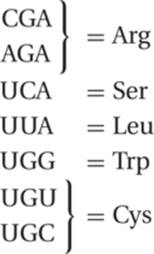
9. (e) 5. UGA GGA = back mutation to glycine
10. (b) Each triplet codes for just one amino acid.
Problems
1. The amino acid is N-formyl-methionine. Its codon represents the starting site for protein synthesis. New amino acids cannot attach to the amine end of this molecule.
2. (a) CGT TGA CCG TAA GCT GTG.
(b) Ala Thr Gly Ile Arg His.
(c) The answer is (2). It would not produce a termination sequence. The first pyrimidine is cytosine.
GENE REGULATION AND DEVELOPMENT
Multiple Choice
1. (b) Autonomous. The cells were not affected by the environment around them.
2. (b) Modification of a newly synthesized polypeptide. Note that the question asked for posttranslational, not posttranscriptional control.
3. (d) i or O but not P.
4. (b) Two: one for the operator and one for the inducer.
5. (c) Yellow and forked twin spots:

6. (e) Acting as a general suppressor of RNA synthesis.
7. (c) Messages that have information for several different polypeptides.
8. (c) RNA synthesis. Note: The phrase “directly associated” is important.
9. (c) An inducible changed to a constitutive system.
10. (c) Transcription.
GENETIC MATERIAL IN POPULATIONS
Multiple Choice
1. (f) Both migration and mutation. Inbreeding will only change genotype frequencies.
2. (c) .32. The stipulation of two generations can be ignored, since in equilibrium, frequencies are stable from one generation to the next.
3. (a) Directional selection.
4. (d) An autosomal recessive. In an autosomal recessive, the proportion of alleles expressed in the phenotype (for selection to act upon) is the smallest, and selection would thus be least effective.
5. (d) 16 percent. If 64/100 are phenotypically dominant, 36/100 are homozygous recessive, q2 = .36, q = .60, p = .40, and p2 = .16.
6. (e) None of the above. The answer is (.99)4, since the probability of one being a homozygote is p2 = (.99)2. The probability of two such independent events is the product of their likelihoods .992(.99)2 = .9606.
7. (a) The 2n population. Since each chromosome represents an independent event, the probability of being homozygous decreases as the number of homologues increases.
8. (e) None of the above. The answer is .3. The frequency in males is the square root of the frequency in females, since females have two X chromosomes, but males have only one.
9. (c) 77 percent. The proportion of homozygotes is 1 minus the proportion of heterozygotes. The heterozygotes will decrease by one-half each generation, being reduced to 23 percent after two generations.
10. (a) Muskogee, Oklahoma. Drift is greatest in the smallest population.
ANSWERS TO CROSSWORD PUZZLES


