
June M. Raine1 and Janet M. Nooney1
(1)
Medicines and Healthcare products Regulatory Agency, 151 Buckingham Palace Road, Victoria, SW1W 9SZ London, UK
June M. Raine
Email: June.Raine@mhra.gsi.gov.uk
Introduction
No effective medicine is without risk. Furthermore not all hazards can be known before a medicine is marketed, and knowledge of a medicine’s benefits and risks can and does change over time. Medicines regulatory systems exist in most, though not all, countries with the objective of promoting and protecting public health. Regulation generally achieves this objective via a legal framework controlling marketing of medicines according to standards of safety, quality and efficacy; with provision of information for healthcare professionals and patients on the benefits and risks to inform their decisions. Regulatory authorities also decide whether medicines can be safely supplied other than on a doctor’s prescription, when the safety profile of a medicine is sufficiently well known.
Since women’s lives tend to be more medicalised than other special populations, it is hardly surprising that the evolution of medicines regulation has been closely intertwined with the drug safety issues which have most affected women. Drugs affecting fertility, taken during pregnancy, to help manage the effects of the menopause and to treat cancers of the female reproductive system, all have significant public health as well as societal interest.
At the heart of regulatory decisions on how medicines may be accessed and used lies the challenge of balancing the available evidence on benefits and risks in order to provide up to date information which supports safe use. Robust decisions balancing benefits and risks are even more important when the population in which the medicine is used is essentially healthy or, in the case of pregnancy and lactation, when adverse effects may be sustained by the fetus or breast feeding infant.
This chapter aims to give a regulator’s perspective on the issues concerning women’s medicines which have most shaped and influenced regulation – in particular in the UK and Europe – while linking these with some of the principles which underpin medicines regulation, in the past, present and future. It considers how women, together with those clinicians and researchers concerned with women’s health, increasingly can contribute to strengthening regulation, optimising the benefits from medicines and minimising their risks.
Medicines Regulation and Women’s Medicines
The Beginning
The tragedy of thalidomide use by pregnant women in Europe, Australia and Japan during the late 1950s and early 1960s was the main precipitant for the introduction of the regulatory controls on marketing medicines which are in place in many countries today. When the link between thalidomide use in pregnancy and the associated limb deformity (phocomelia) in babies was identified (McBride 1961), politicians, healthcare professionals and the public awoke to the fact that anyone could commercialise a medicine without any independent review of its safety. Moreover, the extent of usage of thalidomide in many countries before the link was made with its effect in pregnancy ran to about 10,000 affected pregnancies.
Importantly for medicines regulation, the thalidomide tragedy reinforced the vital nature of having mechanisms to receive the observations of clinicians, to enable early detection of signals of potential drug hazard. This principle remains embedded in the notification systems (such as the Yellow Card scheme in UK and the WHO Programme for International Drug Monitoring) found in medicines regulation today. Nowadays, an unusual pattern of adverse effects associated with a medicine may be identified by notification systems from as few as four or five reports (MHRA 2011), and this means that regulatory action can be taken to protect the public much more quickly.
A second key learning point was that the animal studies conducted with thalidomide prior to marketing were only conducted in rodents, species which turned out to be incapable of identifying the specific type of thalidomide embryopathy in humans (Kim and Scialli 2011). Although debate continues on the precise mechanism by which thalidomide caused teratogenicity in pregnancy (WHO 2014), the nature of regulatory requirements for testing new medicines means that the potential for teratogenicity is thoroughly evaluated prior to marketing.
Thirdly, the belief that thalidomide was very safe compared with other sedatives and hypnotic agents then in use, led to its general availability without medical prescription in the UK and Germany. The lack of any controls on advertising of medicines at that time, together with the promotion’s focus on the safety of thalidomide in overdose and in children (see Fig. 15.1) further increased its use by pregnant women across Europe. As a result, central to the responsibilities of regulators today is control of medicines’ advertising to prevent misleading prescribers and the public, even in countries such as the USA and New Zealand where direct advertising of all medicines to consumers is allowed (see Chap. 14).

Fig. 15.1
UK advertisements for Thalidomide, c1961
The legal framework for medicines regulation introduced across Europe in 1965 built on the lessons learnt from thalidomide, and made provision for national decisions to take into account therapeutic practice in different countries. Most countries set up committees or other structures to involve independent expert pharmacologists and specialist healthcare professionals in their licensing and safety decisions. Despite the fact that thalidomide was by no means the only medicines safety issue to have profound implications for women over many years (other examples of these issues are detailed throughout this book), expert advice was sought and regulatory action taken on an ad hoc basis as each issue arose (Armitage and Nooney 2004). It was not until 2006 in the UK that a dedicated standing Expert Advisory Group on medicines for women’s health was established specifically to provide expert advice on medicines for women, and even then this has operated on an informal rather than a statutory basis.
Moving Forward: Developing Modern Regulatory Systems
Following the introduction of medicines regulation in Europe, in the 1970s regulators had to get to grips with medicines already in established use, for which in many cases the evidence of efficacy and safety were minimal. For some of these older products, the process of review was protracted because of “accepted” medical practice and an absence of systematic critical benefit risk review. For example, a medicine for management of menopausal flushing, veralipride, introduced in some EU countries in the 1960s was only removed from the market in 2007 after a review by the European Medicines Agency (EMA) of serious adverse reactions affecting the central nervous system (EMA 2007). The challenges of evaluating older medicines are still apparent in the continued availability of some medicines for which there is a relative absence of robust data. In 2013-14, European reviews of the evidence for use of the short acting beta agonists, including salbutamol, in the management of premature labour (EMA 2013a) and bromocriptine in the suppression of lactation (EMA 2014b) resulted in safety communications and prescribing restrictions across Europe.
As medical practice moves forward, new evidence is generated while medicines are in clinical use. For example, although hormone replacement therapy had been in use for prevention of osteoporosis since the 1980s or earlier, the Women’s Health Initiative trial was the first trial actually to demonstrate efficacy in prevention of fractures in post-menopausal women (Rossouw et al. 2002). European pharmaceutical legislation was updated in 2014 to make provision for post-authorisation efficacy studies in specific circumstances. Nonetheless, it seems that more drivers for change are needed. Here the informed voice of women, asking for information on benefits and risks of medicines on which to base their decisions, will be a key lever.
A key theme of medicines regulation over time, which is well illustrated by women’s medicines, is that “old” medicines may gain new therapeutic uses. Table 15.1 lists some medicines for which important new uses have been developed in women’s health.
Table 15.1
Medicines for women which have developed new uses
|
Drug |
Original use |
Extended/new use |
|
Thalidomide |
Nausea, insomnia |
Myeloma |
|
Prostaglandins |
Induction of labour |
Termination of pregnancy |
|
Levonorgestrel |
Oral contraception |
Emergency contraception |
|
Minoxidil |
Hypertension |
Male-pattern alopecia |
|
Bromocriptine |
Hyperprolactinaemia |
Post-partum cardiomyopathy |
|
Aspirin |
Analgesia |
Recurrent miscarriage |
|
Hydroxyprogesterone caproate |
Threatened miscarriage |
Risk of pre-term birth |
Not all of these new uses are licensed (at least in the UK) although evidence of efficacy and safety may be accepted by clinicians. For example, bromocriptine is not licensed for treatment of post-partum cardiomyopathy, but there is some evidence to support its use, including biomarker data (Haghikia et al. 2013; Halkein et al. 2013). For more general information about “off label” use of medicines, see Raine (2014).
Some of the key events in the history of medicines regulation in UK with implications for women’s medicines are shown in Fig. 15.2 which illustrates in a schematic picture the timeline from thalidomide onwards.

Fig. 15.2
Key events in UK medicines regulation related to women’s health
It is often said that regulation follows science, and what is striking from the diagram in Fig. 15.2 is not only the lengthy timescale for regulatory progress, but that concerns about “old” safety issues can re-emerge. In 2013 the European review of combined hormonal contraceptives was undertaken in response to media concerns in several EU member states about the risk of venous thromboembolism (see Chap. 6), which were much the same as the “Pill Scare” in UK in 1995 (see Chaps. 6 and 19). This major review resulted in better information for women and healthcare professionals on the nature of the risk of venous thromboembolism and on approaches to minimise it (EMA 2014b; summary tables including data from this report are included in other chapters). The aphorism that those who fail to learn from the past are condemned to repeat it seems particularly appropriate for women’s medicines.
Medicines Regulation Today: An Outline of Working Practice
Regulatory systems for medicines are built around the principle of granting a product licence once there is evidence to show that standards of safety, quality and efficacy have been met and that the balance of benefits and risks can be considered favourable.
What is a Medicine?
To be considered a medicine, a product needs to exert its effects by pharmacological, immunological or metabolic action. Thus levonorgestrel-releasing intrauterine systems (LNG-IUS, Mirena®) are regulated as medicines, since their contraceptive effect arises from the release of levonorgestrel into the uterus, whereas copper intrauterine devices (Cu-IUDs) are regulated as medical devices, since their contraceptive effect is considered to be largely due to their physical presence in the uterus.
Medicines and medical devices are regulated under different legislative systems in Europe and the USA. All medicines are subject to a detailed pre-authorisation review, with specific legal requirements for pre-licensing data, labelling and packaging, information that must be provided to the user, together with restrictions on their advertising. By contrast, medical devices need to conform to safety and performance requirements (CE marking in Europe). The requirements for demonstrating safety and performance are the same for all devices but the degree of intervention by a third party depends on the nature of the medical device and the inherent degree of risk it carries. For example, a breast implant would be subject to the highest degree of scrutiny, but a vaginal speculum would be subject to the lowest degree of scrutiny. Systems for reporting adverse incidents with devices may also differ.
Developing a New Medicine: Data Requirements
New medicines, whether a new chemical entity or a biological product (e.g. a monoclonal antibody; see Branch and Agranat 2014), are required to be supported by a full programme of non-clinical and clinical tests to establish the main safety profile and efficacy of the product for the intended indication (see next sections) and a pharmaceutical development programme that establishes the suitability of the formulation (quality) of the product. Figure 15.3shows a schematic outline of the key stages in development of medicines.

Fig. 15.3
Schematic outline of the key stages in development of medicines
The main data requirements for medicines are agreed through the International Conference on Harmonisation (ICH) which was established in 1990 to harmonise the technical requirements across the regulatory regions of Europe, USA and Japan. The ICH issues guidelines on safety, quality, efficacy and multidisciplinary topics (see www.ich.org), which are then adopted into the regulatory provisions of each region for implementation.
‘Generic’ versions of a medicine may be licensed and marketed after a period of data protection (during which the original manufacturer seeks to maximise the return on investment), provided the generic “copy” is manufactured by methods which do not contravene any remaining patents and is shown to be ‘equivalent’. Generic medicines are licensed on the basis that, if they are shown to be bioequivalent in terms of their pharmacokinetic profile, they will have the same safety and efficacy profile as the innovator medicine. However, bioequivalence is not suitable for some products, such as the LNG-IUS, where the product’s pharmacological action occurs locally to its site of administration. In such cases, applications for licences for ‘generic’ medicines need to be supported by clinical data to establish ‘therapeutic equivalence’.
If use of an active substance is ‘well established’ (i.e. medicines which contain it have been on the European market for at least 10 years) published scientific literature can be used to provide evidence of the non-clinical and clinical efficacy and safety of the product. Similarly, products which contain active substances that have been licensed for some time can rely on published data to satisfy some of the data requirements, with new clinical data to address the new features of the product (e.g. a new active ingredient in a combination, new combination of established active ingredients, new formulations, new indications or new patient populations). Thus medicines can evolve over time (see case study in Box 15.1).
Box 15.1: Case Study: Life Cycle of a Product: Levonorgestrel-Releasing Intrauterine System (LNG-IUS) in the UK
|
Life cycle of LNG-IUS use |
||
|
1995 |
Mirena® licensed in UK for contraception for 3 years use |
Risk: benefit assessments for different indications: the extension of indications for LNG-IUS use from contraception to heavy menstrual bleeding (HMB) and endometrial protection as part of HRT, involve different health status and risks, e.g. age, menopausal status, and gynaecological pathology Duration of use: level of LNG release over time in situ determines the duration that the product can be used for each of its licensed indications. However physical presence may play a role in the contraceptive effects in later years and LNG release may be more critical for post-menopausal endometrial protection. Extrapolation from data on contraceptive use is not appropriate in this situation, so Mirena is licensed for 5 years contraceptive use, but 4 years HRT use Pharmacoepidemiological approaches have been used to investigate risks of perforation and breast cancer Points to consider when evaluating data are switching indication, menopausal status and duration of use |
|
1998 |
Use for contraception extended from 3 to 5 years |
|
|
2001 |
Indications extended to include treatment of idiopathic menorrhagia for 5 years use |
|
|
2004 |
Indications extended to include protection from endometrial hyperplasia during oestrogen replacement therapy for 4 years use |
|
|
2012 |
1st generic LNG-IUS (Levosert®) licensed in UK for heavy menstrual bleeding for 3 years use |
|
|
2013 |
Reduced size LNG-IUS (Jaydess®) licensed in UK for contraception for 3 years use |
|
Non-clinical Testing of New Medicines
Non-clinical testing (i.e. animal and in vitro laboratory studies) of new medicines is designed to elucidate the mechanism of action, gain information on dose and predict likely safety issues in clinical use (Jacobs and Hatfield 2012). Most, though not necessarily all, of the non-clinical testing of a medicine occurs during the early stages of product development.
Pharmacokinetic (PK) and pharmacodynamic (PD) studies aim to establish both the desired (on-target) actions of the active component(s) and the undesired (off-target) actions of the active component(s). These help to identify both the selectivity of the product’s actions and potential areas of safety concerns due to the toxicological properties and/or excessive pharmacology of the medicine through the identification of the target organs of toxicity and undesirable pharmacodynamic effects on essential organ systems, (cardiovascular toxicity, CNS toxicity, immunotoxicity, haematological effects etc.). Evaluation of carcinogenic potential (genotoxicity and carcinogenicity), and adverse effects in pregnancy and lactation to the mother and infant (reproductive toxicity and teratogenicity) (ICH 2010) may also be required. The specific studies conducted and their design will vary depending on the individual properties and intended uses of the medicine. For instance, the potential of a new medicine to cause cancer will be explored in non-clinical tests for medicines intended for long-term use.
Assessment of Risks of Medicines During Pregnancy
Unintended effects on offspring are a potential concern with all new medicines. These can occur directly, via in utero exposure, or indirectly, via effects on sperm or oocytes. It is not possible, ethically or logistically, to test for these in humans. Consequently, reproductive toxicology data are needed from animal or in vitro studies on most new medicines (ICH 2010).
Reproductive toxicology studies include:
1.
2.
3.
Which of these studies is needed depends on the product and its intended clinical indication and patient population. For example, use for a male-only indication, or for a paediatric indication in a pre-pubescent population would require some, but not all studies. By contrast, use in women of child bearing potential would require all of the above studies, whereas use by post-menopausal women only would not require any of them.
Even with these studies, potential risks from exposure to a medicine of an unborn child are avoided during development of a new medicine by either excluding women of child-bearing potential, or requiring vigilant contraceptive use. Consequently, safety during pregnancy is largely unknown for most new medicines when they are first launched. Also, these methods are not appropriate for some medicines aimed specifically at women’s health, e.g. contraceptives, or products to support assisted reproduction.
In 2004, the FDA issued draft guidance on studying pharmacokinetics in pregnancy (FDA 2004) and as a result, more information is available on use of some medicines which is unavoidable during pregnancy. Nevertheless, information on use in pregnancy is commonly missing at time of licensing a new product.
Clinical Trials of New Medicines
Early clinical trials for a new medicine focus on establishing the pharmacokinetic properties of the new medicine, that the new medicine has the desired pharmacological action (proof of concept), the likely dose range to achieve the desired effect (dose-finding studies) and, finally, that the action translates into clinical usefulness (proof of efficacy). The latter trials (known as therapeutic confirmatory trials) also establish the main safety profile of the product, so that the benefit-risk balance may be assessed. As a general rule, for medicines to be used long term, around 100 subjects are studied for a year, and around a thousand subjects are included in studies overall (Duijnhoven et al. 2013).
To pass regulatory scrutiny, clinical trials must be conducted ethically, with due regard to patient safety (i.e. in accordance with Good Clinical Practice (GCP) standards as set out in ICH guideline E6 (ICH 1996)). Efficacy trials are expected to be comparative trials, in which comparison to a placebo or to an established treatment (or both) is blinded. Clinically relevant surrogate endpoints can be acceptable to establish efficacy, however clinical relevance may change as medical knowledge advances (e.g. bone mineral density is no longer acceptable in the EU as a surrogate endpoint for fracture reduction in patients with osteoporosis (EMA 2006)). In addition, key elements of the trial (e.g. primary endpoint(s) and their size, statistical analysis, data handling etc.) are required to be defined prior to the start, in the trial protocol.
Whilst efficacy expectations can be defined in advance (and measures of efficacy are usually the primary endpoints/outcomes for most clinical trials), safety issues are usually harder to predict. Safety is carefully monitored throughout clinical trials by a combination of asking about a subject’s well-being at regular intervals during the trial and monitoring of clinical parameters. Although the full safety data are often not included in papers published in the scientific literature, regulatory submissions include a full report (the final study report) of a trial which details the side effects of the treatment compared with those reported for placebo or the comparator treatment.
Specific anticipated side effects may be investigated as main outcomes if these have been identified earlier in the development programme, or due to experience with previously licensed medicines in the same class. For example, following observation of an increased risk of endometrial cancer with unopposed estrogens in post-menopausal women in the 1970s, endometrial safety needs to be actively investigated for new combined HRT products (EMA 1997).
Regulatory Assessment and Approval of New Medicines
Regulatory agencies (operating within government departments or in linked institutions) conduct pre-licensing assessments of data submitted from companies in order to grant approval of a product for use (“marketing”) in that regulatory authority’s jurisdiction (e.g. country or EU-wide). In addition to the data outlined above, in the EU, the applicant is also required to submit a summary of the safety issues, with proposals for investigating these further. Strategies for minimising risks, as appropriate, also have to be provided in Risk Management Plans (see below) for all products in the EU and for selected/high risk products in the USA. The Product Information (see below) and the packaging supplied with the product are both means of risk minimisation (e.g. by contraindicating use in particular circumstances; use of child-resistant packaging etc.). Consequently, proposed product information and packaging also needs to be submitted prior to licensing.
Within each regulatory agency, teams of toxicologists, pharmacists, physicians and statisticians rigorously review the data and produce a critical appraisal of benefits and risks. Regulators can also request further information from the applicant, as appropriate. In addition to the assessment performed by the regulator, expert opinion will usually be sought from advisory committees and sub-committees for specific areas (e.g. women’s health) before the product is approved (or declined).
Risk Management Plans
From 2005, EU legal requirements included the provision of Risk Management Plans (RMPs) for newly licensed products. The RMP provides a summary of the safety issues for the product and specifies the important gaps in knowledge at the time of licensing (Blackburn and Raine 2014). For example, information on use in pregnancy is a common feature of RMPs as an area of important missing information. Proposals for further investigations may include, for example, long-term follow-up via disease or pregnancy registries or studies on specific clinical endpoints.
Product Information
The term “labelling” is often used to describe a medicine’s licensed indication, posology, contraindications, warnings, precautions and side effects. In the EU, this information is captured in the Summary of Product Characteristics(SmPC) for prescribers and the package leaflet for patients.
The details in the product information and package leaflet are based initially on the results of the pre-licensing studies, but are updated as additional information becomes available (e.g. interactions with other new medicines). The product information thus sets the ‘terms of the licence’ and any use of the product outside of these terms constitutes ‘off-label’ use. In such cases, the responsibility for the safety, quality and efficacy of the product is considered to be with the prescriber. In the EU, the SmPC also provides the basis for advertising and promotion of the product, as this must be consistent with it. Thus companies are not allowed to promote uses (i.e. further indications and/or patient populations) that are not included in the SmPC; and these would require further clinical trials for their addition to the product licence.
The package leaflet plays an important role in conveying key information on the risks of that medicine and is intended both to support informed decision making and, increasingly, to support the use of the medicines to optimise benefit and minimise risks. This is particularly important for ‘over the counter’ medicines used without medical input (i.e. diagnosis or prescription).
Post Market Surveillance and Women’s Medicines
Clinical trials alone cannot be used to fully characterise all potential risks associated with a medicine. Some side effects only become apparent when medicines are used by large numbers of patients (because of the rarity of the side effect), for long durations (due to the slow onset of the side effect) or by wider ranges of patients than are typically included in clinical trials. In ‘real-world’ use, patients are more likely to have other medical conditions, to use other medicines concomitantly, to have differences in their genetic make-up, underlying disease or lifestyle, or to be younger or older than those included in trials.
Regulatory approaches to post market surveillance have evolved over time largely in response to some major public health challenges, many of which have been linked to medicines for women’s health (see Fig. 15.2 for some of the key examples). These safety issues have driven a shift from a reactive approach based on individual case reports (known as “spontaneous” reports) from healthcare professionals, to more proactive approaches. This shift has been facilitated by conceptual work based on an appreciation of what more robust forms of evidence are available (moving up the evidence hierarchy) coupled with proactive generation of further information to fill the gaps in knowledge which inevitably exist when a medicine is licensed (Waller and Evans 2003; Rawlins 2008).
The current methodology which regulators use to monitor and review the safety of medicines in clinical use generally relies on concurrent use of different data sources, some of which are outlined below. Regulators operate using a framework of legally based tools, ranging from requirements on pharmaceutical companies to report adverse events, to post-authorisation safety studies sometimes within risk management plans. Regulators also conduct formal benefit risk reviews usually driven by significant new safety data.
Adverse Reaction Reports: Spontaneous Reporting Schemes
Individual case reports of suspected adverse drug reactions which are sent to regulators spontaneously by health professionals, pharmaceutical companies and patients are used to detect “signals” and generate hypotheses of a link between a medicine and an adverse effect. The UK’s Yellow Card Scheme is an example of a spontaneous reporting system where reporting forms (available widely in paper form, in formularies and electronically via the MHRA website) may be completed by healthcare professionals, patients and carers with information on the suspected adverse drug reaction. Similar schemes are operated in most other countries. The Yellow Card forms collect details of the reporter, patient identifier, and suspect medicine (Foy et al. 2014). The information is regularly screened by teams of scientists, pharmacists and physicians, who may need to contact reporters for additional medical information about the cases. Good quality reports include information on relevant medical history (or its absence) and concomitant medications. This is facilitated by well-designed forms, for example to capture information on an adverse effect in a child following drug exposure during pregnancy (MHRA 2014a, in press). Information on the adverse reaction should also include, if appropriate, information on dechallenge (outcome when the medicine is withdrawn) and rechallenge (outcome when the medicine is re-administered at the same dose).
The spontaneous reporting “early warning” function remains the mainstay of pharmacovigilance world-wide. However, its role has been the subject of increasing debate as more sophisticated tools and larger databases have become available to identify reporting trends quickly. The limitations of spontaneous reporting include under-reporting (it is generally believed that only around 10 % of suspected adverse drug reactions are ever reported), biases in reporting (due to media interest in a medicine or the natural focus on newly introduced medicines), and importantly, the lack of a “denominator” (the number of patients who have received the medicine). Information on the number of patients exposed is needed in order to assess the frequency of an adverse reaction. This can be challenging to assess since, although prescription data may be readily accessible, these alone do not reflect whether prescriptions have been dispensed and/or the medicine actually taken. In addition, in some instances, it is necessary to know the background rates of events in the treated population in order to calculate the risk attributable to the medicine.
Most spontaneous reporting schemes make provision for reports of adverse reactions to be made by patients themselves. Initial concerns by some EU regulators, that reports from patients would lack sufficient detail to be scientifically valid, have proved to be unfounded. Research has shown that patient reports are of a similar level of seriousness as healthcare professional reports. Interestingly, substantially more reports are received for women than for men for both healthcare professional and patient reports (Box 15.2). A comprehensive review of patient reporting following its introduction in the UK (Avery et al. 2011; Hazell et al. 2013) demonstrated that patient reports may add valuable information, particularly on the impact of a medicine on quality of life. For example, a signal of hair loss associated with a combined hormonal contraceptive containing drospirenone, was detected from Yellow Card reports where the first report was from a patient. After confirmation, this resulted in updates to the product information for health professionals and patients.
Box 15.2: More Adverse Drug Reports Are Received for Women than Men
Review of all the data held in the Yellow Card database (approximately 750,000 UK reports in August 2014 accrued since 1964) has shown that 59 % reports of adverse drug reactions are for females compared with 38 % for males (in 3 % gender was not known). The breakdown of Yellow Cards according to gender and age group is shown in the figure below:
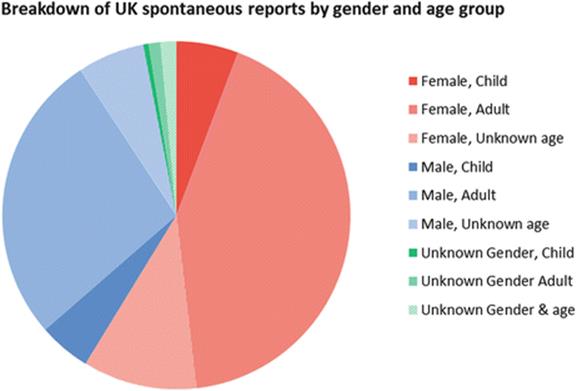
When evaluating only patient reports in the Yellow Card database, the proportion of ADRs reported for females is 64 %, compared with 35 % for males (with 1 % unknown gender) – an even more striking difference than for all reports. It is of interest to note that reports relating to pregnancy, puerperium and perinatal conditions amount to 1.2 % of all female Yellow Card reports, with congenital, familial and genetic disorders amounting to 0.4 % of reactions. These categories of ADRs alone therefore do not account for the differences between reports of ADRs for males and females. It should be emphasised again that great caution should be exercised in drawing conclusions from dynamic spontaneous data, whose function is detection of signals of new or changing drug safety issues.
Intensive Monitoring of New Medicines
For new medicines, there is more to learn to establish whether the safety profile reflects that seen in the clinical trials, and new knowledge to gain from ‘real life’ use. There is an added urgency when this involves rapid uptake of a new medicine into clinical practice. In the EU since 2013 an intensive monitoring system has been in place, using a ‘Black Triangle’ to identify those medicines for which all adverse reactions should be reported. These include new drugs, biological medicines and those for which specific risk management measures are in place. The ‘Black Triangle’ is a simple way to highlight to health professionals and patients where reports are especially encouraged for particular medicines. Signal detection is carried out more frequently on EU black triangle medicines compared with non-black triangle.
As discussed above, whilst spontaneous reporting schemes are very valuable, their use is limited because of the lack of information on patient exposure. Exposure data may be collected through prescription event monitoring programmes, such as operated by the Drug Safety Research Unit in UK (Layton et al. 2011) and formerly by the Intensive Medicines Monitoring Programme in New Zealand (Clark and Harrison-Woolrych 2006, Harrison-Woolrych, 2014). These active surveillance schemes have performed nationwide prospective cohort studies which have generated valuable safety evidence for many new medicines. The IMMP also conducted several studies of IUDs.
Additional Pharmacoepidemiological Approaches
Appreciation of the limitations of spontaneous reporting has led to regulators adopting additional pharmacoepidemiological tools and approaches. The enormous value of studying medicines in large populations has been demonstrated par excellence in relation to hormone replacement therapy. Large studies such as the Women’s Health Initiative in US (Rossouw et al. 2002) and the Million Women Study in UK (Beral et al. 2003) have characterised and quantified important risks, enabling evidence-based decisions with resulting public health benefit. These studies enabled quantification of important risks associated with HRT in real world use and supported regulatory action in Europe (Armitage and Nooney 2004; MHRA 2007a, b, see Chap. 11). Nonetheless, there remain important areas for further research including the risks of HRT in women with premature menopause.
Regulatory data sources for monitoring benefit and risk in clinical use include health record databases such as the UK’s Clinical Practice Research Datalink and for particular products or populations, formal registries. Pregnancy registries are of special importance for investigating possible links between medicines and congenital abnormalities. An example of a novel approach to networking registries was a Scandinavian study examining the risk of cardiac defects with SSRI antidepressants (Kieler et al. 2012).
Identifying the risks of medicines in large populations of users requires not only well-designed and robust methodologies, but prompt evaluation, especially when scientific studies reach the public domain rapidly via 24 h media coverage and internet access. This is particularly true for vaccines, where the success of mass immunisation depends on public confidence in safety. The availability in 2007 of Human Papilloma Virus (HPV) vaccines for teenage girls to prevent cancer of the cervix (see Chap. 9) required a step-change in regulatory surveillance approaches. As a result of careful planning and tailored statistical methods, new signals for HPV vaccines were assessed in real-time in the context of age-appropriate rates of expected events in this population. This approach demonstrated that the rate of reporting of chronic fatigue syndrome following vaccination was what would have been expected in this population of adolescent girls (Donegan et al. 2013). This enabled the signal to be refuted and the media scare on chronic fatigue syndrome in UK to be managed, thus enabling continuation of the vaccination programme.
Personalised Medicines for Women
The science of pharmacogenomics has taken an increasingly prominent role in regulation, supporting better targeting of medicines to the population most likely to benefit. A good example of this is trastuzumab (Herceptin®) and breast cancer, where Herceptin should only be used when the tumour has been demonstrated to over-express the HER2 protein – which is the case in about a quarter of breast cancers (EMA 2014c). Importantly, pharmacogenomics has increasingly contributed to risk minimisation strategies, by enabling exclusion of the population of patients most at risk of adverse reactions. Regulatory action may range from mandatory testing to raising awareness in safety bulletins. For instance, robust evidence from randomised clinical trial data of the genetic basis for abacavir and hypersensitivity reactions supported genetic testing (Mallal et al. 2008). By contrast, a single case report of codeine-related morphine toxicity in the breastfed infant of an ultra-rapid metaboliser (Koren et al. 2006), resulted in regulatory action to raise awareness of a potential risk of codeine as a post-partum analgesic. Growing experience in pharmacogenomics in pharmacovigilance has supported the production of EU regulatory guidance (EMA 2014d).
Continuous Monitoring of Benefits and Risks
One of the most important regulatory roles is continuously monitoring the benefits and risks of medicines in post-marketing clinical use, and assessing the impact of new information. A standard regulatory approach is to require the company to submit a regular report (known as a periodic safety update report or PSUR) at particular time points during the post-marketing period, generally every 6 months during the first 2 years on the market, then annually up to 5 years. Since 2012 in EU the requirements on companies have been specifically extended to data on the benefit of the medicine, so that PSURs have become periodic benefit risk evaluation reports. This has supported a shift in the regulatory approach from progressive addition of safety information to product labelling, to permitting an overall assessment of benefit risk balance, with the potential for major regulatory action. An example of a benefit risk assessment conducted in the context of a periodic safety update report was the review of strontium ranelate and increased risk of cardiovascular events, with the result that the use was restricted in the EU by excluding patients at high risk of cardiovascular disorders (EMA 2013b).
Regulatory Communications on Women’s Medicines
The regulatory approach to communicating information about medicines for healthcare professional and women has traditionally depended on statutory labelling – in the EU via the SmPC and package leaflet. The growing expectation of women to be involved in decisions concerning their health has encouraged a fundamental change in delivering comprehensible information on risk. Many aspects of risk communication relating to medicines for women are covered in Chaps. 18 and 19 of this book.
For regulators, communicating the availability of improved and updated information in a timely way is a prevailing challenge. There is now evidence to show that Direct Healthcare Professional Letters (letters containing drug safety information sent by marketing authorisation holders at the request of regulators) have often failed to make the desired impact (Plening et al. 2012). Information for prescribers (which patients may now access via the internet) and patient information leaflets remain long and complex. An EU requirement for companies to test leaflets with patients has supported a drive for improved user-friendliness (Raynor et al. 2007, Raynor 2013). The European Commission has undertaken to take further steps to address the shortcomings of product information (MHRA 2013).
A climate of increased transparency has resulted in regulators making available public assessment reports, which provide more details on regulatory decision making for a number of issues, including those affecting women’s health, for example the reviews of HRT (MHRA 2007a) and HPV vaccine safety (MHRA 2012).
Drug safety bulletins tailored to national needs and therapeutic context may have greater impact since these can provide useful prescribing advice and the supporting evidence. The impact may be enhanced by linking with other publications and the media. In UK, patient versions of the Drug Safety Update Bulletin have been well received, with one patient version for statins being the MHRA’s most viewed web-page for the month after publication.
Advertising of women’s medicines is subject to regulatory controls, as for all medicines. In the EU, as in many jurisdictions, this relies on a system of self-regulation by the industry. However, there are particular aspects relating to use of medicines in healthy people and where a therapeutic area contains many options, which merit a more interventionist regulatory approach. For example, claims made for effects of particular combined hormonal contraceptives on wellbeing in healthy women withdrawn after regulatory review, illustrate why proactive scrutiny is necessary to protect public health (see Fig. 15.4).

Fig. 15.4
Advertisement for Yasmin, c 2002
Regulatory Decisions on Access to Women’s Medicines in the UK
As the safety profile of a medicine becomes well understood, and its place in therapeutics established, regulators keep under review the level of medical supervision needed to ensure safe use. The level of supervision may vary from restriction to specialist prescription (for example, isotretinoin for resistant acne, where the known teratogenicity merits a robust pregnancy prevention plan) to pharmacy availability, where the pharmacist’s knowledge and skills ensure appropriate purchase (such as for orlistat for weight reduction in individuals of BMI equal to or greater than 28 kg/m2 in combination with a low calorie diet) and to general retail availability for analgesics for dysmenorrhoea.
The public health considerations of widening availability of medicines are particularly pertinent when prompt access and administration may impact on efficacy. In the UK, one of the earliest reclassifications from prescription-only to pharmacy availability in 1992 was for topical imidazole antifungals for vaginal candidiasis. The regulatory decision was that, following medical diagnosis, a woman with recurrent infection who recognises the symptoms may safely self-manage. Other examples where early access is important are tranexamic acid for menorrhagia (reclassified in the UK in 2007) and emergency contraception (EC) (reclassified in the UK in 2000). For levonorgestrel EC, although the licence permits use up to 72 h after unprotected intercourse, much of the evidence suggests that efficacy in preventing pregnancy is optimal the sooner it is taken (see Chap. 7).
The potential impact on public health was also a consideration when azithromycin was reclassified from prescription-only to pharmacy availability in UK in 2007 for the treatment of sexually transmitted chlamydia infection. The risk of antimicrobial resistance was considered small in light of the single dose administration. Given the potential for long-term sequelae from chlamydia infection leading to infertility, the change of legal classification therefore made provision for anonymous contact tracing and treatment.
Over time there have been calls by some healthcare professionals for non-prescription access to combined hormonal contraceptives for regular use, on the grounds that this would remove barriers to initiation and maintenance of safe and effective contraception (Grossman 2008). Given their efficacy in pregnancy prevention balanced against the extensive record of safety in use, and the widespread introduction of local systems for access via suitably skilled non-medical personnel, there seems to be a reasonable basis for this to be seriously considered by regulators. An important barrier to such a step would appear to be a lack of evidence that the deregulation would promote public health in the way predicted.
Complementary Therapies and Women’s Health
The increasing willingness of women to take a role in their own healthcare has not surprisingly resulted in a growing uptake of complementary therapies: herbal, homeopathic and other traditional therapies such as Ayurveda and Chinese medicines. Herbal medicines used by women are discussed in Chap. 13 of this book. A survey of the UK public in 2009 found that usage of herbal medicines is higher among women and among those from higher social groups AB (higher or intermediate managerial, administrative or professional occupations), compared with men and those in lower social groups D and E (semi and unskilled manual workers and those on a state pension) (MHRA 2009a).
Regulatory approaches to herbal medicines in the EU have been based on demonstration of quality and safety in the context of evidence of traditional use. Safety surveillance nonetheless needs to be conducted for complementary medicines to the same standard of public health protection. This was shown in relation to the interactions of St John’s Wort (widely used in the UK for mild depression) with a range of important medicines including oral contraceptives (Henderson et al. 2002). Reports of contraceptive failure were received in the UK from 2000 and continue to be received, both for concomitant use with oral contraceptives and with contraceptive implants, despite repeated regulatory communications (MHRA 2014b).
A public assumption that ‘natural’ means safe was abruptly, if temporarily, dispelled in 1999 when the effects of a Chinese herb, aristolochia, taken for skin conditions and known to have carcinogenic potential, was linked with renal failure in case reports (Lord et al. 1999). This herbal remedy has now been banned in most countries. Despite this, the assumption amongst the public that ‘natural’ means safe seems to persist. However, as detailed in Chap. 13, Black Cohosh, a product commonly used to relieve menopausal symptoms, is known to cause abnormal liver function, jaundice and hepatitis, and herbal products for the treatment of eczema have been found to contain corticosteroids (MHRA 2009b). In addition, Chinese herbal medicines have been reported to have effects on fertility, including reversible ovarian failure (Edmonds and Montgomery 2003), which should be borne in mind when investigating premature menopause.
Importantly, whilst 67 % of respondents in the UK survey quoted above who used herbal medicines in the last 2 years agreed that it was necessary to tell your GP if you are taking herbal medicine, 22 % of this group felt that telling their GP was not necessary. A key message for healthcare professionals is therefore to always to ask about self-treatment with any natural or herbal remedies.
Special Regulatory Challenges for Women’s Medicines
There are a number of special regulatory challenges relating to women’s medicines.
Medicines in Pregnancy
It is widely recognised that a key priority for regulators is to strengthen the regulatory provisions for monitoring drug safety in pregnancy. Existing registries have shown capability particularly in the area of anti-epileptics, and collaborative initiatives such as EuroCAT have facilitated identification of teratogenic exposures (Dolk 2005). In the 50th anniversary year of medicines regulation in Europe the time is right to refocus on improving detection of medicine harms in pregnancy. This is particularly important for women who need medicines for long-term conditions, such as multiple sclerosis, epilepsy, rheumatoid arthritis and psychiatric illness, which persist during pregnancy. Conversely, better information is needed on the safety of medicines to manage conditions which occur during pregnancy and the puerperium.
Use of Medicines by Healthy Women
For many medicines, the assessment of benefits and risks relate to use by healthy women wishing to manage or control normal aspects of their reproductive life. In such circumstances, medicines need to be very safe; their risks appropriately quantified and clearly communicated; and risk minimisation steps need to be supported by good evidence of their effectiveness. Such evidence must be comprehensibly expressed to support joint decision-making between women and their advisers. Moreover, the growing willingness by regulators to involve women in decisions about benefits and risks needs to be supported.
Quantifying Benefit Versus Risk
When medicines are used prophylactically and especially in the long term, regulation needs better tools to quantify benefit:risk, including in the context of duration of exposure. A step forward in communicating risk was achieved in the UK in 2002, relating to quantifying potential harms associated with long-term use of HRT, which expressed the risks in terms of baseline and excess risk over a period of use (MHRA 2007b). The main challenge now is in expressing benefit as well as risk. The work of the European Innovative Medicines Initiative PROTECT consortium has made important progress in expressing risk and benefit not only quantitatively but using visual and graphic tools (Mt-Isa et al. 2014).
Impact of Regulation of Women’s Medicines
To date, the impact of regulation on women’s medicines has not been assessed systematically. Questions such as “how are regulatory decisions affecting women using medicines in real life?” need to be evaluated in order to maintain confidence that the systems for identification, investigation, management, communication and monitoring of risk in the context of benefit are robust and demonstrably promote and protect public health. There have been some efforts to evaluate the impact of widening access to emergency contraception without prescription, both in UK (Marston et al. 2005), and internationally (Raymond et al. 2007). A good example of outcomes measurement was the collaboration between regulators and public health scientists following the introduction in the UK of pertussis vaccine in the third trimester of pregnancy to tackle an emerging problem of whooping cough in infants. Using robust regulatory approaches to monitor the main safety questions of interest, including premature labour and stillbirth, it was possible to demonstrate a favourable benefit risk of the vaccine and a sharp decline in neonatal infection and deaths followed introduction of pertussis vaccination in pregnancy (Amirthalingam et al. 2014; Donegan et al. 2014).
Future Regulatory Prospects for Women’s Medicines
The discipline of regulation has been profoundly shaped and influenced by women’s medicines, and there seems no reason to suppose that this will not continue to be the case in the future. The dynamic evaluation of benefits and risks of medicines in women together with prompt and proportionate regulatory action, are essential for public health promotion and protection. The understanding by healthcare professionals and women of the working of regulation and how they can interact with regulation effectively is of fundamental importance to optimise the benefits of the medicines they use and to minimise risks.
Involvement of Women in Regulatory Decisions
Regulatory efforts to incorporate women’s perspectives into decision-making have progressed but need to go further. The European review of combined hormonal contraceptives undertaken in 2013 gained insight into expression of the risk of venous thromboembolism associated with combined hormonal contraceptives from the involvement of patient and consumer groups. The routine involvement of women in regulatory decisions which affect their health is the logical next step.
Improving Access to Innovative Medicines
Finally, the recognition that regulatory demands for new medicines can inadvertently hinder the introduction of new medicines, has lead to new approaches to advance the licensing of innovative new medicines. These include the Breakthrough Medicines programme in USA, Adaptive Licensing scheme in the EU and the Early Access to Medicines scheme in the UK. These schemes are all at an early stage, but have the potential not only to facilitate access to new treatments for patients with unmet medical need, but also to change the face of medicines’ regulation.
Take Home Messages
· Regulators serve public health by taking evidence-based actions to optimize benefit:risk and providing up to date information to support decisions by healthcare professionals and women on medicines taking.
· Benefit:risk evaluations take into account clinical use. As no medicine is without risk, benefits of medicines used by healthy people are must be clearly favourable and risks minimal.
· Evidence on benefit:risk of medicines in “special” populations, in particular in pregnancy, is limited prior to authorisation.
· Healthcare professionals and women can play an important part by reporting suspected adverse drug reactions to regulatory authorities without delay – every suspected adverse reaction report can make a difference.
· Healthcare professionals should always ask about self medication including any complementary therapies.
· As regulatory systems develop in the future, it is hoped that there will be routine involvement of women in regulatory decisions which affect their health.
Acknowledgements
Our thanks go to Akosua Adjei, Linda Anderson, Paul Barrow, Rob Higgins, Tahira Jan, Beryl Keeley and Jan MacDonald for helpful comments and suggestions.
References
Amirthalingam et al (2014) Effectiveness of maternal pertussis vaccination in England: an observational study. Lancet, Early Online Publication, 16 Jul 2014. doi:10.1016/S0140-6736(14)60686-3Cite or Link using doi:http://www.thelancet.com/journals/lancet/article/PIIS0140-6736(14)60686-3/abstract
Armitage M, Nooney JM (2004) Advice from the Committee on Safety of Medicines on hormone replacement therapy. In: Critchley H, Gebbi A, Beral V (eds) Menopause and hormone replacement. RCOG Press, London, pp 325–335
Avery AJ et al (2011) Evaluation of patients reporting of adverse drug reactions to the UK ‘Yellow Card Scheme’: literature review, descriptive and qualitative analyses, and questionnaire surveys. Health Technol Assess. MHRA HTA programme. www.hta.ac.uk
Beral V et al (2003) Million Women Study Collaborators. Breast cancer and hormone-replacement therapy in the Million Women Study. Lancet 362:419–427. Erratum in: Lancet 362:1160
Blackburn SCF, Raine JM (2014) The principles behind risk management in the European Union. In: Andrews EB, Moore N (eds) Mann’s pharmacovigilance, 3rd edn. Wiley Blackwell, New York, pp 153–169CrossRef
Branch SK, Agranat I (2014) “New Drug” designations for new therapeutic entities: new active substance, new chemical entity, new biological entity, new molecular entity. J Med Chem. doi:10.1021/jm402001w
Clark DW, Harrison-Woolrych M (2006) The role of the New Zealand Intensive Medicines Monitoring Programme in identification of previously unrecognised signals of adverse drug reactions. Curr Drug Saf 1(2):169–178PubMedCrossRef
Dolk H (2005) EUROCAT: 25 years of European Surveillance of congenital anomalies. Arch Dis Child Fetal Neonatal Ed 90:F355–F358. doi:10.1136/adc.2004.062810
Donegan K et al (2013) Bivalent human papillomavirus vaccine and the risk of fatigue syndromes in girls in the UK. Vaccine 31:4961–4967PubMedCrossRef
Donegan K et al (2014) Safety of Pertussis vaccination in pregnant women in UK: observational study. BMJ 349. http://dx.doi.org/10.1136/bmj.g4219 (published 11 Jul 2014)
Duijnhoven RG et al (2013) Number of patients studied prior to approval of new medicines: a database analysis. PLOS Med 10(3):e1001407PubMedCentralPubMedCrossRef
Edmonds SE, Montgomery JC (2003) Reversible ovarian failure induced by a Chinese herbal medicine: lei gong teng. BJOG 110:77–78
European Medicines Agency (1997) Guideline on clinical investigation of medicinal products for hormone replacement therapy of oestrogen deficiency symptoms in postmenopausal women. EMEA/CHMP/021/97 Rev. 1. http://www.ema.europa.eu.ema/index.jsp?curl=pages/regulation/general/general_content_000399.jsp&mid=WC0b01ac0580034cf1
European Medicines Agency (2006) Guideline on the evaluation of medicinal products in the treatment of primary osteoporosis. CPMP/EWP/552/95 Rev. 2. http://www.ema.uropa.eu/ema/index.jsp?curl=pages/regulation/general/general_content_000409.jsp&mid=WC0b01ac0580034cf1. Accessed 22 Aug 2014
European Medicines Agency (2007) European Medicines Agency recommends withdrawal of national products containing Veralipride. EMEA/299873/2007
European Medicines Agency (2012) Alli (orlistat) EPAR summary for the public EMA/307667/2012. EMEA/H/C/000854
European Medicines Agency (2013a) Assessment report for short acting beta agonists (SABAs) containing medicinal products authorised in obstetric indications. EMA/664276/2013
European Medicines Agency (2013b) PSUR assessment report for Protelos/Osseor. EMA/PRAC/136656/2013
European Medicines Agency (2014a) PRAC recommends restricted use of bromocriptine for stopping breast milk production. EMA/409529/2014
European Medicines Agency (2014b) Assessment report for combined hormonal contraceptives containing medicinal products. EMA/739865/2013
European Medicines Agency (2014c) Herceptin (trustuzumab) EPAR summary for the public. EMA/981900/2011, EMA/H/C/000278
European Medicines Agency (2014d) Guideline on key aspects for the use of pharmacogenomics methodologies in the pharmacovigilance evaluation of medicinal products (Draft). EMA/281371/2013
FDA (2004) Guidance for industry pharmacokinetics in pregnancy – study design, data analysis, and impact on dosing and labelling. http://www.fda.gov/ScienceResearch/SpecialTopics/WomensHealthResearch/ucm133348.htm#_Toc82327337. Accessed 22 Aug 2014
Foy M, Barrow P, Raine JM (2014) Spontaneous reporting: United Kingdom. In: Andrews EB, Moore N (eds) Mann’s pharmacovigilance, 3rd edn. Wiley Blackwell, New York, pp 185–201CrossRef
Grossman G (2008) Should the contraceptive pill be available without prescription? Yes. BMJ 337:a3044PubMedCrossRef
Haghikia A et al (2013) Phenotyping and outcome on contemporary management in a German cohort of patients with peripartum cardiomyopathy. Basic Res Cardiol 108:366PubMedCentralPubMedCrossRef
Halkein J et al (2013) Micro RNA –146a is a therapeutic target and biomarker for peripartum cardiomyopathy. J Clin Investig 123(5):2143–2154PubMedCentralPubMedCrossRef
Harrison-Woolrych M (2014) Prescription event monitoring in New Zealand. In: Andrews EB, Moore N (eds) Mann’s pharmacovigilance, 3rd edn. Wiley Blackwell, New York, pp 385–402CrossRef
Hazell L et al (2013) How do patients contribute to signal detection? A retrospective analysis of spontaneous reporting of adverse drug reactions in the UK’s Yellow Card Scheme. Drug Saf. doi:10.1007/S40264-013-0021-2
Henderson L et al (2002) St John’s Wort (Hypericum perforatum): drug interactions and clinical outcomes. Br J Clin Pharmacol 54(4):349–356PubMedCentralPubMedCrossRef
ICH (1996) Guideline for good clinical practice E6(R1). http://www.ich.org/products/guidelines/efficacy/article/efficacy-guidelines.html. Accessed 22 Aug 2014
ICH (2010) Guideline on non-clinical safety studies for the conduct of human clinical trials and marketing authorization for pharmaceuticals M3(R2). http://www.ich.org/products/guidelines/multidisciplinary/article/multidisciplinary-guidelines.html. Accessed 22 Aug 2014
Jacobs AC, Hatfield KP (2012) History of chronic toxicity and animal carcinogenicity studies for pharmaceuticals. Vet Pathol 50(2):324–333PubMedCrossRef
Kieler H et al (2012) Selective serotonin reuptake inhibitors and risk of persistent pulmonary hypertension in the newborn: population based cohort study from the five Nordic countries. BMJ 344:d8012. doi:10.11.36/bmj.d8012
Kim JH, Scialli AR (2011) Thalidomide: the tragedy of birth defects and the effective treatment of disease. Toxicol Sci 122(1):1–6
Koren G et al (2006) Pharmacogenetics of morphine poisoning in a breastfed neonate of a codeine-prescribed mother. Lancet 368(9536):704PubMedCrossRef
Layton D et al (2011) Modified prescription-event monitoring studies: a tool for pharmocovigilance and risk management. Drug Saf 34(12):e1–e9PubMedCrossRef
Lord GM et al (1999) Nephropathy caused by Chinese herbs in UK. Lancet 354(9177):481–482PubMedCrossRef
Mallal S et al (2008) 2008 HLA-B* 5701 screening for hypersensitivity to abacavir. N Engl J Med 358:568–579PubMedCrossRef
Marston C et al (2005) Impact on contraceptive practice of making emergency oral contraception available over the counter in Great Britain. BMJ 331:271PubMedCentralPubMedCrossRef
McBride WG (1961) Thalidomide and congenital abnormalities. Letter to the Editor. Lancet 278(7216):1358CrossRef
MHRA (2007a) UK public assessment report hormone replacement therapy: safety update. http://www.mhra.gov.uk/home/groups/pl-p-documents/websiteresources/con2032228.pdf
MHRA (2007b) Hormone replacement therapy: updated advice. Drug Saf Update 1(2) September 2007
MHRA (2009a) Ipsos Mori report shows that 77 % adults agree that it is important that herbal medicines are regulated. http://www.mhra.gov.uk/NewsCentre/Pressreleases/CON036071
MHRA (2009b) Unlicensed eczema creams found to contain steroids, March 2009. www.mhra.gov.uk
MHRA (2011) Yellow Cards which made a difference. Drug Saf Update 5(4), November 2011
MHRA (2012) MHRA Public Assessment Report Cervarix HPV vaccine: update on UK safety experience at end of 4 years use in the HPV routine. http://www.mhra.gov.uk/home/groups/pl-p/documents/websiteresources/con213228.pdf
MHRA (2013) Review of the shortcomings of product information for medicines – UK Government view www.mhra.gov.uk
MHRA (2014a) Guidance on reporting suspected adverse drug reactions in infants and children following maternal administration in pregnancy (in press)
MHRA (2014b) St John’s Wort: interaction with hormonal contraceptives, including implants – reduced contraceptive effect. Drug Saf Update 7(8), March 2014
Mt-Isa S et al, on behalf of the IMI-PROTECT Benefit Risk participants (2014) Balancing benefit and risk of medicines: a systematic review and classification of available methodologies. Pharmacoepidemiol Drug Saf. doi:10.1002/pds.3636
Plening S et al (2012) Impact of safety-related regulatory action on clinical practice – a systematic review. Drug Saf 35(5):373–385CrossRef
Raine June M (2014) Off-label use of medicines: legal aspects. In: Thomsen HS, Webb JAW (eds) Contrast media. Springer, Berlin
Rawlins M (2008) De testimonio. On the evidence for decisions about the use of therapeutic interventions. Lancet 372:2152–2161PubMedCrossRef
Raymond E et al (2007) Population effect of increased access to emergency contraceptive pills: a systematic review. Obstet Gynaecol 109(1):181–188CrossRef
Raynor DK (2013) User testing in developing patient medication information in Europe. Res Soc Adm Pharm 9(5):640–645CrossRef
Raynor DK et al (2007) A systematic review of quantitative and qualitative research on the role and effectiveness of written information available to patients about individual medicines. Health Technol Assess 11:5. www.hta.ac.uk
Rossouw JE, Anderson GL, Prentice RL, LaCroix AZ, Kooperberg C, Stefanick ML et al (2002) Writing Group for the Women’s Health Initiative Investigators. Risks and benefits of estrogen plus progestin in healthy postmenopausal women: principal results from the Women’s Health Initiative randomized controlled trial. JAMA 288:321–333PubMedCrossRef
Waller PC, Evans SJ (2003) A model for the future conduct of pharmacovigilance. Pharmacoepidemiol Drug Saf 12:17–29PubMedCrossRef
WHO (2014) Thalidomide embryopathy – report of a meeting of experts, Geneva, 24–25 Feb 2014 (draft)