
Sue Bagshaw1
(1)
University of Otago, 2986, Christchurch, 8140, New Zealand
Sue Bagshaw
Email: bagshaw@clear.net.nz
Introduction
This chapter will cover some information about young people’s development, how that affects the ability to consent to treatment, how that can be judged, and how it affects the ethics of prescribing. Following this, the practical applications of prescribing to adolescent women will be discussed using two key examples: contraceptive products and treatments for mental health disorders, specifically depression.
What’s So Different About Adolescent Women?
It is important to define who we are talking about when considering the topic of prescribing for adolescent women. There are many ways to consider human development. There are cultural definitions such that in some cultures a child undergoes some sort of ceremony and then they are an adult: adolescence lasts all of a few minutes. In Western culture it may even last up to 20 years if the concept of young adulthood is included in the definition of adolescence, as outlined by Arnett in 2006 (Arnett 2006).
There are various social markers such as leaving school, gaining employment, leaving university, or leaving home, all of which are very variable and dictated by family social standing and cultural norms, more than any other factor.
In terms of marking a difference between adults and children, physiological definitions may be more helpful, in deciding how we treat people who are not children but not adults. If we think about children we think about people who are dependent and need nurturing as they develop. In the past it was thought that the end of puberty marked the end of a child’s development. When MRI scans became available it was realized that much of the ongoing brain development that occurs takes place for a long time after the end of puberty (Pujol et al. 1993). Shakespeare recognized this when he wrote in the Winter’s Tale:
I would there were no age between sixteen and three and twenty or that youth would sleep out the rest; for there is nothing in the between but getting wenches with child, wronging the ancientry, stealing, fighting…. (The Shepherd, Act III, Scene III, The Winter’s Tale)
More recently, MRI scans have revealed that around the time of puberty there is an extra burst of developmental activity. This consists of a large number of connections occurring connecting the cortex with the hind and mid brains, shown in Fig. 3.1 as the blue areas covering the brain. The myelin sheaths of the neural connections show up as blue.
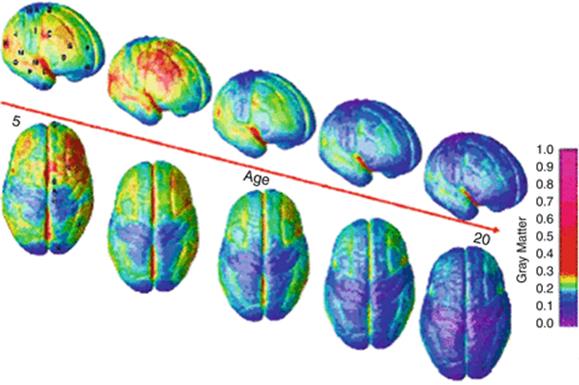
Fig. 3.1
MRI scans of the changing brain
It is now known that not only is there a burst of connections, but also a pruning of neural pathways that aren’t being used. There is a rearrangement of dopamine receptors, changes in hormonal levels, including a rise in oxytocin in addition to the sex hormones androgen, oestrogen and progesterone. Changes occur in the levels of leptin, insulin, growth hormone and then finally the frontal lobes, where the ability to make fine judgments, and understand consequences are linked in to the rest of the brain (Paus 2005; Sowell et al. 2001)
During adolescence there is a lot going on in the brain, with the prefrontal lobes gradually taking control of the rest of the brain functions (Yurgelun-Todd 2007) and of course that is reflected in big changes in the body. There is often a 25–50 % change in height and weight to reach adult size, secondary sexual characteristics develop, hair distribution changes and for women ovulation and menstruation begins and also changes in fat distribution occur. In young men there are changes in voice, muscle size and the ability to have erections and ejaculation.
No wonder adolescents are so tired. Not only do they have to cope with all this, but they also have to cope with a big change in the way adults treat them. More expectations are placed on behaviour, but at the same time parental support is being withdrawn, and there are big pressures to be independent, even though they are often disciplined like children.
It is well recognized that society generally defines adolescence by chronological age. The World Health Organisation (WHO) defines the ages of 10–19 years as adolescents, 15–24 as youth and 10–24 as young people. The Ministry of Youth Development in New Zealand (NZ) defines ‘Young people’ as from 12 to 24 years and states that in the 2006 census there were 757,000 people in this age group.
The ages at which physiological changes take place are not uniform. Pubertal changes may start as young as 8 years and as old as 16 years. It is well accepted that boys start this development later than girls, but what initiates the changes is not as well defined. As puberty can take as long as 3 years, the age of completing puberty can again range from 11 to 19 years, depending on what age it started at. The age at which the end of brain development occurs is also ill defined and has the same wide range of age at which it may be taking place, as puberty. It may take as long as four years to take place and range from 18 to 28 years before it is complete (Stiles and Jernigan 2010). In this chapter people between the ages of 12–24 will be referred to as ‘young people’, whereas many people think of adolescence as the teenage time, and of course issues of consent and capacity concern teenagers more than the wider group.
Thus how do we decide to treat people who have still got developing brains and bodies? There are a variety of legal definitions and countries vary around the world as to when the age of majority or adulthood is reached. In New Zealand, the age at which a person is no longer under legal guardianship is 18 years but they can leave home without the consent of their parents at 16 years and they are made to leave the guardianship of the State on their 17th birthday. The legal ages for various activities of children and young people in New Zealand are found in Fig. 3.2.
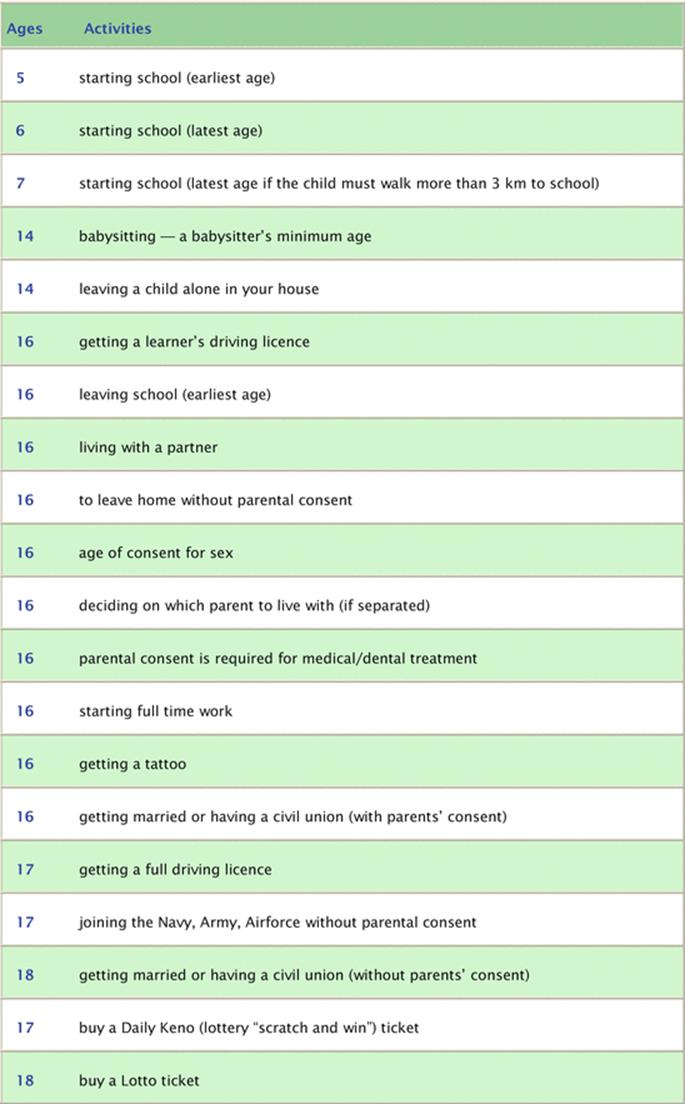
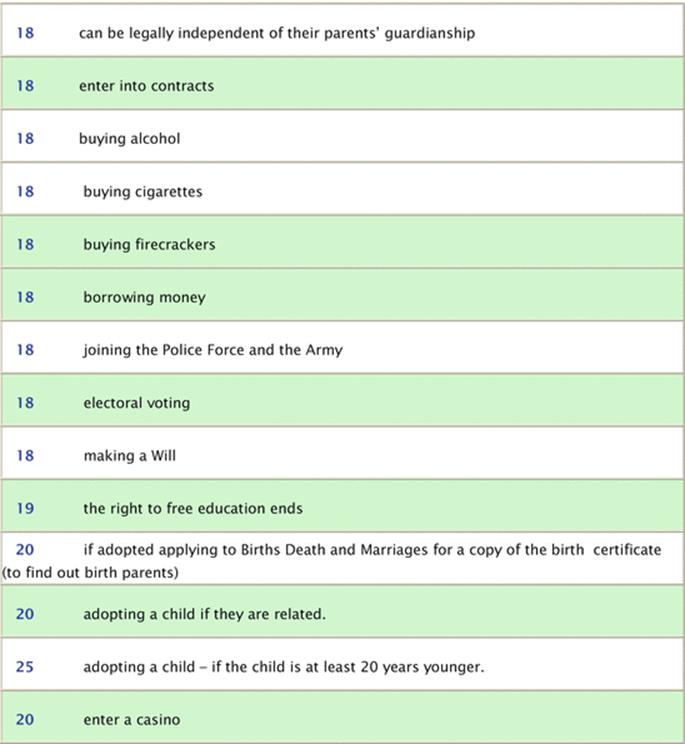
Fig. 3.2
Legal ages for activities of children and young people in NZ (Source: Youth Law: http://www.kiwifamilies.co.nz/articles/legal-age-guidelines/)
The latest age to dictate behaviour is 24 years, after 24 the young person is no longer assessed on their parent’s income for a student loan.
The ages in Fig. 3.2 do not necessarily correspond to the ages at which the body and brain are developing in different individuals, but the law finds it necessary to use chronological age of young people for practical reasons.
The table in Fig. 3.2 refers to the age of 16 as when consent can be given to medical and dental treatment, but in fact in New Zealand it is widely accepted that consent to treatment is based on competency not age. These issues will now be discussed in more detail.
Consent
No health or disability service can be provided to a consumer without his or her informed consent in most countries in the western world. The right to make an informed choice and give informed consent is fundamental to individual autonomy, and is one of the central elements in the Code of Health and Disability Services Consumers’ Rights in NZ (http://www.hdc.org.nz/the-act--code/the-code-of-rights/the-code-(full)). The law tends to refer to people under 18 years as ‘children’ in keeping with the United Nations Convention on the Rights of the Child (UNCROC). The Health and Disability Commissioner’s Code of Health and Disability Services Consumers’ Rights Regulation 1996 is helpful in defining the right to informed choice and informed consent. It underlines the principle that informed consent is related to capacity not to age. Capacity to consent is presumed unless shown to be otherwise.
The rights as described in Fig. 3.3 sound simple enough until consideration is given to how to decide competence.
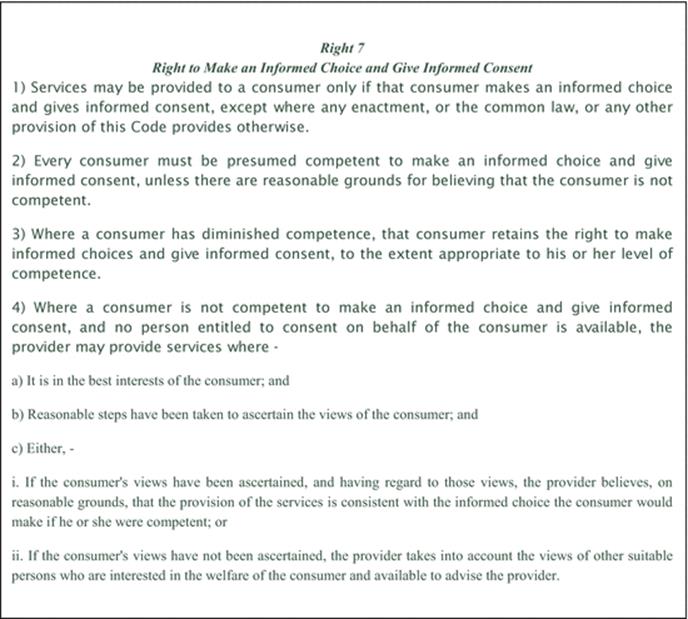
Fig. 3.3
Code of health and disability services consumers’ rights in NZ: right 7 on informed consent
In NZ the law is unclear on how to decide competence. Section 36(1) of the Care of Children’s Act (which replaced the Guardianship Act of 1968) states that children over 16 are able to give and refuse consent in the same way as an adult patient, but the child must be competent. If the child is not competent then s36(3) states that consent can be given by the parent or guardian, or someone standing in place of a parent or guardian, or a District Court Judge or the chief executive if neither of the former are available (http://legislation.govt.nz/act/public/2004/0090/latest/DLM317233.html). The law does not say whether or not a competent child under 16 can give and refuse consent to treatment (Grimwood 2010).
The New Zealand Bill of Rights Act 1990, s11 (BORA), dictates “everyone has the right to refuse to undergo any medical treatment”. This right is further embodied in the Health and Disability Code. (Health and Disability Commissioner (Code of Health and Disability Services Consumers’ Rights) Regulations 1996, Sch 2, Right 7(7)) “Every consumer has the right to refuse services and to withdraw consent to services”.
Other pieces of legislation that are relevant in NZ (Hedly 2014) are:
· Consent to abortion by a girl of any age : consent, or refusal to consent, to termination of pregnancy has the same effect as if the female was of full age (s 38 C of C Act)
· Blood transfusions in urgent situations : there is some immunity from liability for health practitioners who provide blood transfusions to children in certain urgent situations (s 37 Care of Children Act 2004)
· Operation for sterilisation: no person can consent to an operation of sterilisation on another person if that person lacks capacity to consent on her own behalf by reason of age only (s 7 Contraception Sterilisation and Abortion Act)
· Treatment for mental disorder: The consent of a parent or guardian to assessment and treatment for a mental disorder shall not be sufficient if person has attained 16 years of age (s 87 MH(CAT) Act)
· Crimes Act: Duties to provide necessaries of life. Medical examination of children in public schools (s125 Health Act)
· Medical examination if suspicion of ill treatment or abuse by court order (s 49 CYPF Act)
· Presumption of competence in the Code of Rights applies to all patients (right 7(2)) Even patients with diminished competence retain a right to be involved with decision making as appropriate (right 7(3))
The above details relate to NZ law and the details of legislation relating to age and consent will vary from country to country. It is important to be familiar with the law operating in the country or State in which you practice. The Guttmacher Institute published an excellent summary of the ages for consent in the different States in March 2014 (Guttmacher Institute 2014).
Competence: Gillick, Scarman and Fraser
New Zealand has no legislation specifically describing the threshold of children’s consent to medical treatment. Grimwood points out in a paper submitted to the Victoria University Law Review in 2010 (Grimwood 2010) that practitioners may assume that because people under 16 years can give their own consent in terms of abortion, then they can extrapolate this to other situations, which of course is not necessarily true.
In place of statute law New Zealand follows the common law principles of the United Kingdom in this circumstance, namely the case of Gillick v West Norfolk and Wisbech Area Health Authority and the Department of Health and Social Security.
In this case Mrs Gillick pursued the interests of her right to have to give permission for her under 16 year old daughter to receive contraception as her legal guardian. The outcome was some guidelines for giving permission to give contraception to minors (Gillick v West Norfolk Area Health Authority 1986). These did not really include any other treatment. Even so, the case is now often quoted and a phrase has emerged called “Gillick competence” which will be discussed later in this chapter.
The UK House of Lord’s decision on the Gillick case delivered a number of statements and guidelines or tests of competency. For example, Lord Scarman’s test describes how the rights of the parents over the child decline as the child increases in understanding and maturity:
… the parental right to determine whether or not their minor child below the age of 16 will have medical treatment terminates if and when the child achieves a sufficient understanding and intelligence to enable him or her to understand fully what is proposed. (Guttmacher Institute 2014)
The problem with this test is the phrase “fully understand”. For decisions about complicated treatments even some adults would find it hard to fulfill the requirement. However, Lord Scarman did establish that parental guardianship is not necessarily a right but more a responsibility and duty to assist the child’s development.
Fraser’s Guidelines on Providing Contraceptive Advice or Treatment to Young Patients Without Parental Consent
Lord Fraser’s guidelines describe the steps a health professional should go through to determine whether to give contraceptive advice or treatment to a minor without parental consent (Gillick v West Norfolk Area Health Authority 1986):
The health professional should be satisfied “on the following matters:
1.
2.
3.
4.
5.
Lord Fraser remarked that a minor is competent “provided the patient, whether a boy or a girl, is capable of understanding what is proposed, and of expressing his or her own wishes”.
This still does not distinguish between judging the young person’s capacity to understand versus understanding the proposed treatment. The latter principle is implied by the importance of the right to informed consent no matter what the capacity. In NZ, the Health and Disability Commissioner states “Before making a choice or giving consent, every consumer has the right to the information that a reasonable consumer, in that consumer’s circumstances, needs to make an informed choice or give informed consent.” (Code of Health and Disability Services Consumers’ Rights 1996)
The decision to provide advice and/or prescribe a contraceptive then comes down to testing the capacity of the young person to understand and whether that can be over ridden by an adult (parent, guardian, doctor or judge) in the best interest of the young person, even though they have capacity. The problem here is not what is in the best interests of the young person, but who decides what is in the best interest of the young person.
Thresholds for Deciding ‘Best Interests’ of Young People
One of the major principles of the NZ Children, Young Persons and Their Families Act 1989 is that the safety and best interests of the child are paramount (Care of Children Act 2004, s 4). Section 12 of the United Nations Convention on the Rights of the Child (UNCROC), in relation to the right to freely express their views, states:
the views of the child being given due weight in accordance with the age and maturity of the child.
The best interests of the child should take into account the best interests as the child sees them, as well as the adults around him or her.
The question arises as to what is the threshold to decide when an adult can decide best interests and when the child/young person can decide. South Australian legislation decrees that children (those under 16) can give consent to treatment if the medical practitioner who is to administer treatment is of the opinion that the child is capable of understanding the nature, consequences and risks of the treatment and that the treatment is in the best interest of the child’s health and well-being (The Consent to Medical Treatment and Palliative Care Act 1995).
British Columbia uses similar guidelines for health practitioners who need to ensure that the minor “understands the nature and consequences and the reasonably foreseeable benefits and risks of the health care” (Infants 1996)
When deciding whether or not the young person has capacity to decide, the guide lines used in Canada for mental capacity may be helpful:
..... a patient is capable with respect to treatment if the patient is, in the health practitioner's opinion, able
(1)
(2)
Grimwood suggests that this guideline for determining the threshold of capacity is the most appropriate because it requires a minor to have understood the proposed treatment and it requires an understanding of the relevant information about the treatment being offered and the reasonably foreseeable consequences of that treatment. The threshold, therefore, prevents an investigation into moral and familial questions, which have little relevance to the minor’s capacity. Instead, it focuses more on a realistic cognitive ability to comprehend the information given by the health professional under their duty to facilitate an informed choice.
The reasonable foreseeability component also accords with the sliding scale approach of Gillick, that with the increasing gravity of the procedure the greater the appreciation the minor must have of the consequences of a decision. The sliding scale idea has already been adopted by New Zealand statute, as the duties of guardians include “determining for or with the child, or helping the child to determine, questions about important matters affecting the child”, which recognizes the developing maturity and understanding of minors, which was central to the majority judgment in Gillick (Care of Children Act 2004, s 16).
Privacy
In NZ, the Privacy Act 1993 is applicable to any person no matter what their age, but can be superseded by other legislation if there is a conflict. It governs the collection, use and storage of personal information under 12 principles. The most relevant section for the purposes of deciding whether or not information about the health of young people should be given to their parents, in terms of the giving of consent for treatment, is principle 11 (see Fig. 3.4). This governs the limits on disclosure of information. The issue at stake is that if the young person has the capacity to consent to their own treatment then their information should be kept private to them. They can be assured confidentiality from any adult they talk to.

Fig. 3.4
Principle 11 of the Privacy Act 1993
This is the legislation that requires health practitioners to explain to young patients that everything is confidential unless there is the potential for serious harm to themselves, or other people. It is often helpful to increase understanding of the importance of this exception, to add that to tell someone else is important as it will get them more assistance.
Cognitive Development: Communication
The various legal guidelines discussed above should assist health practitioners to be able to judge whether or not a young person can consent to treatment, without the consent of their parent or guardian. However it is still difficult to make that judgment, unless there is an understanding of cognitive development.
Future Thinking
Alongside all the anatomical changes in the brain of the child and young person, the way the brain functions is also changing. At 2 years old a child does not have the capacity to understand what tomorrow means. If a much loved adult promises to see them tomorrow, they still cry at departure time as for them there is no such concept as tomorrow and effectively, in their understanding, the person is leaving forever. The capacity to understand what tomorrow means extends to “yesterday, a week, or a month” but at early puberty it may not have extended beyond more than a month. This is important to judge because if the conversation extends beyond their capacity, the “glazed look” appears and it is hard to get their attention again. A young person’s ability to understand those reasonably unforeseeable circumstances so important for capacity to consent, is also affected.
Abstract Thinking
Another important change in cognitive ability that occurs at this age is the ability to think about abstract concepts i.e. to think about thinking. Children think in concrete terms, the symbolism of fairy tales is often lost on them unless it is explained. Risks and consequences of receiving or refusing treatment are difficult to comprehend unless they are presented in very concrete terms. Thus judging where a young person is on the concrete abstract continuum, is vital to sufficiently explaining choices, without getting the “glazed look”, accompanied by smiling, and nodding agreement just to get out of the room as fast as possible.
Complex Thinking
In addition, the growing number of linkages between all the parts of the brain (see MRI in Fig. 3.1) leads to the ability to think about more complex subjects and to take into account different ideas and thoughts at the same time. If the linkages are just starting to develop then this ability to handle many choices at the same time is limited. This is of course very important to judge when trying to decide if a young person understands the choices before them. It is also important to limit explanation to a very few choices until an understanding is gained of which stage of development the young person’s brain has reached.
Unfortunately until we are able to have hand-held MRI scanners or other brain function detection equipment in our clinic rooms, all this remains a matter of clinical judgment. The importance of listening to how questions are answered as much as to the content of what is said cannot be overstated.
The difficulty in making these judgments is compounded by the fact that all these different parts that are developing are doing so at different rates and times in different individuals. Even in the same individual progress may be made in one area, but then because of stress or strain produced by life circumstances, that progress may regress and go back to an earlier stage. It is important to recognize how life circumstances, genetics and epi-genetics can affect the way the brain develops to a great extent. This can even be in terms of structural changes but may also affect the speed of development.
Gender Differences in Brain Structures
In a newsletter put out by the Columbia Consultancy in the USA, Ginny O’Brien notes that there are several differences in brain structure brought about by hormones. For example, the amygdala which is often seen as the emotion centre and which influences the production of adrenaline in the “flight, fight or freeze” reaction to danger is bigger in men. Anxiety and anger both make the body ready to fight or run. Some postulate that men are more likely to respond with anger. It may be an evolutionary construct to assist men in the protective role.
The prefrontal cortex is the decision-making executive center of the brain. It oversees emotional information and puts a check on the amygdala. The prefrontal cortex is larger in women and matures faster in women than in men. The anterior cingulate cortex, which is another part of the rational decision making centre of the brain that weighs options, is also larger in women, and has been labeled as the “worrywart” centre of a woman’s brain. Again in evolutionary terms this makes sense for women to be worrying about their children. It is probably too early in our knowledge to draw conclusions about how that affects behaviour in current social norms (O’Brien 2007).
Gap Between Biological and Social Adulthood
In the Western World there is without doubt a big gap between the age of biological adulthood when young people can physically reproduce and the age of social adulthood, when it is deemed responsible (by society) to have children,. The range of biological adulthood or the end of puberty could be 11–14 years for girls but this varies between individuals as a result of many different influences, Including level of nutrition and genetics (Ellis 2004; Zacharias et al. 1970).
The median age of first birth is now 28 years according to the 2012 census in NZ. In Afghanistan it is 20, Bangladesh and the Niger 18, 24.5 in Russia, 31.2 in Greece and 25.4 in the USA (http://www.nationmaster.com/country-info/stats/Health/Births-and-maternity/Average-age-of-mother-at-childbirth). This is taken as a mark of the efficacy of Family Planning programmes by the WHO.
In past centuries the age of biological adulthood has often coincided with the age at which society recognizes the young person as an adult. According to Gluckman in ‘hunter gatherer’ times and even in agricultural settlements, every member of the family or community unit had a proscribed role fitting to their stage of development, and reproductive biology coincided with social aspirations (Gluckman and Hanson 2006). When children are seen as the property of their parents and assets of the family, it could be seen as a benefit to them because as assets they are nurtured. Figure 3.5 illustrates Gluckman’s concept of ‘mismatch’, where in the last 20,000 years the age of menarche in young women has risen and then fallen, whilst psychosocial maturation has steadily increased, resulting in a mismatch between these two markers of development in the present day.
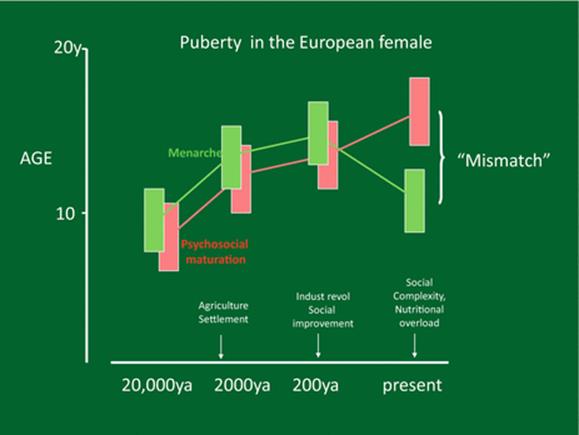
Fig. 3.5
From Gluckman “Mismatch: Why our world no longer fits” (Gluckman and Hanson 2006)
In the so called “technical revolution” of the last 50 years the gap between biological and social adulthood has widened considerably. Is this because society considers that more nurturing is required, or is it because parents in Western culture are more afraid to let go? Or is it that brain development is taking longer and young people should not be allowed more adult roles in their own interests?
The role of culture in consent is important. Western culture is now accepting of individualism and more understanding and accepting about the rights of children after UNCROC. However, in many cultures children are still seen as being in need of control, and developmental needs are subsumed in the need of the parent to be seen as “in charge”. This is easier to accept when there is a marker of the change from having someone else in charge to being in charge yourself. It is not easy to accept when there is no marker.
Ethics of Prescribing or Not Prescribing
The principles of consent and capacity, and the effect of development, as outlined in this chapter have clearly outlined the major differences between prescribing for a child and prescribing for an adolescent and an adult. In children the major concern is the suitability of any medication to a child’s metabolism and especially the correct dose for weight and height. In adolescents although the body is changing a lot, the major issue is the changing brain function and capacity and social standing in society, in addition to the suitability of the treatment. In adults although the ability to consent to treatment is still relevant, it is not nearly as common or difficult.
A dilemma about whether to treat is created for almost every adolescent patient if the ethics of consent are considered. There may be harm done, for instance, if the young woman is prescribed contraception when full capacity to understand and therefore consent on their own behalf has not been demonstrated. However, if she persists in sexual activity without contraception, there is even more potential for harm. Occasionally parents insist on the young woman being given contraception when it may be against her consent. If she has the capacity to consent or refuse consent whose wishes are uppermost? Who decides what is in the best interests of the “child”. This presents another ethical dilemma.
It must be remembered that the capacity to consent is also affected by substance use. This always needs to be taken into account for adults, but adolescents and in particular youth (aged 15–24 years) also partake of a wide variety of substances as they learn by experience and explore adult behaviour. Alcohol is particularly important, not just because it is widely available and its use is culturally acceptable, but because it affects the adolescent developing brain in a different way to the adult brain. It is also important as the earlier the brain is exposed to alcohol the more likely it is that problems with the use of alcohol will arise in adulthood (Witt 2010).
Research in mice shows that there may be a gradual tolerance of the cerebellum to the affects of alcohol before it plateaus off at adulthood, which means that their co-ordination is less affected than adults (Karaçay et al. 2008). In contrast the memory of an adolescent is easily disrupted, but for adults to have “blackouts” they usually need to have consumed quite large quantities (Silveri 2012).
Churchwell et al. found that cannabis affects impulsivity and decreases future thinking, and this seemed to be correlated with age of first initiation (Churchwell et al. 2010).
The question of whether legal advice or court action is necessary for prescribing (or not prescribing) will always be a matter of individual judgment. However, the following factors may be ‘red flags’ that indicate situations of risk where legal advice or even court action may be appropriate (Hedly 2014):
· Where the course of action proposed has permanent, long term or serious consequences, or is experimental or high risk
· Where there is a conflict between clinicians and a child’s guardians about the treatment that should (or shouldn’t) be provided
· Where there is a conflict between the child and the guardians (particularly where a child is under 16 but appears to be competent to make their own decisions)
· Where there is a conflict between a child’s guardians
· Where there is clinical uncertainty or disagreement about what treatment is necessary or appropriate
· Where there is doubt about the child’s or the guardian’s competence to give (or refuse) consent
· In situations of urgency
Court action is rare for contraception but may be more relevant for operations or treatment of mental illness and behavioural disorders.
Practical Application
So how does all this affect how you prescribe to teenage women? The following section will look at applying some of these principles to two common areas for prescription: contraception and mental health. In particular the oral contraceptive pill and antidepressants will be considered in some detail.
Many teenage women will have capacity to consent below 16 years, but obviously it would be important to establish that capacity and to establish how far along the continuums of concrete to abstract thought, future thinking and complexity of thought, they have progressed. If in doubt, it is often best to start from using communication that is about now, is concrete and one or two thoughts at a time.
Contraception
Fraser’s guidelines – as mentioned earlier in this chapter – are useful here. If the young woman has already started having sexual intercourse and has come for contraception, the important concept to establish is that she can understand how contraception works. The use of diagrams is helpful and an example is shown in Fig. 3.6.
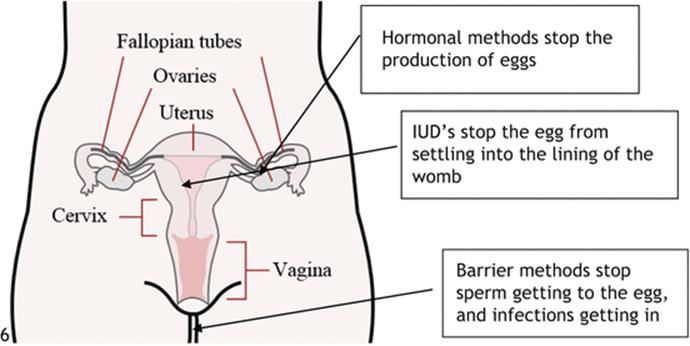
Fig. 3.6
Diagram of how contraception methods work
Use of simple but effective diagrams may assist in limiting the number of choices to avoid information overload. The diagram in Fig. 3.6 also helps discussion and understanding of why one method might be better than another, and why condoms may be useful to use whatever else they choose.
Intra-uterine devices (IUDs) can be used in young women as is discussed in some detail in Chap. 8 (contraceptive devices) and may be a valuable option in adolescents for whom compliance with oral contraceptive methods may be difficult. Recent research now shows that having an IUD does not increase the risk of infertility, but having a Chlamydia infection does, whether an IUD is in situ or not (Hubacher et al. 2001; Rivera and Best 2002).
One disadvantage however, is that it may be more difficult to insert because of the tighter cervical os in nulliparous women.
A major risk for failure of any contraception is of course the ability of the user to comply with using it correctly. Thus methods which do not involve much input from the user may be ideal for many young women: IUDs, progestogen implants such as Jadelle or Implanon (see Chap. 8), or injectable methods such as Depo Provera. However young women often do not like needles or the “thought of something inside them”, which may well be linked to their level of development, in which emotional thinking is much stronger than logical thought until the frontal lobes are well connected.
Communicating Benefits and Risks of Contraceptives to Adolescent Women
It is probably a mistake to describe hormonal contraception by telling the young woman that it makes it seem like they are pregnant. For concrete thinkers the simile is taken literally. It is important to stress that if the level of hormone in the body goes down because they haven’t taken any pills, then eggs will be produced again and they could get pregnant. Never tell any young woman that her chances of becoming pregnant are low because she has polycystic ovarian syndrome (PCOS) endometriosis or pelvic inflammatory disease (PID). They will assume that they can’t get pregnant and not use contraception, only to become pregnant in a few months.
When trying to explain risks it is even more important to estimate cognitive development. Some young women are innate worriers and emotional thinking enhances the anxiety even more. A discussion on the risks of thrombosis, increased blood pressure and breast cancer is important (see Chaps. 5 and 6) but take care to find out what the young person has understood, as it may mean that she takes the prescription but does not take the pills because of her anxieties. It is sometimes helpful to compare the extent of risk to something that is more tangible like the risk of being run over by a bus, which may not be accurate but is at least understandable. Research has shown that teenage women think more with their amygdalas (i.e. their emotions) than with their frontal lobes as the connection of the frontal lobes is not fully developed (Yurgelun-Todd 2007). This means that emotions are heightened and worry is more intense.
One small study on communicating the risks and benefits of contraceptives showed that explanation by another young person was more effective than a doctor or nurse. A review of strategies showed that further research is needed, but this finding may be more to do with the nature of the explanation than the development of the young person (Halpern et al. 2013).
Recent research has shown that many of the more minor side effects that were attributed to the use of contraceptive hormones are also attributable to many other causes and whilst it may be helpful to outline the standard list of headaches, acne, emotional changes and weight gain, none of these effects has been definitely causally associated with COCs (see Chap. 5) and this may also lead to problems including non-compliance (Grimes and Schulz 2011).
When this kind of symptom occurs the pill will be blamed and then use may cease. Irregular bleeding may also lead to non-compliance so this is very important to explain and reassure, that if bleeding occurs it will most likely settle. It is advisable to use a 30 ug pill at first to avoid the risk of irregular bleeding (Akerlund et al. 1993)
When prescribing the OCP explain how it works, the importance of taking it every day, explain risks but also emphasize the advantages: – the decrease in risk of ovarian and uterine cancer, regular and lighter periods, and missing periods if desired (see Chap. 5). The ‘7 day rule’ is not as important as it once was thought to be and is often quite confusing. If the young woman is likely to find it difficult to remember to take the pills then encourage her to take it continuously as this is much more effective. This advice should also be accompanied by the warning that irregular bleeding may occur and if it does, to come back to see you, and have a 3 day break instead of 7 days (Cho et al. 2014).
There is a lot of information to take in when first starting to use contraception. It is advisable to perhaps provide a short prescription at first and encourage her to return to see you so that explanations can be repeated and understanding reinforced. It is also helpful to provide written explanation in the form of pamphlets to take away, but there is no guarantee that this will be read. Make sure that they have been tested with a teenage audience (most FPA pamphlets have been).
If the young woman is living at home it is important to encourage her to inform her parents about her medication so that if complications or side effects do arise the parent will be able to assist. There are many reasons why young people don’t want to tell their parents amongst them may be:
· fear of getting into trouble,
· they do not want to share private information that they consider is no business of their parents,
· they are concerned about not adding to the worries their parents already have,
· they may have had experience of their parent/carer then telling everyone else their private information, which of course they do not want.
If you are going to be successful in persuading a young woman to tell her parents, then addressing the concerns for her is the first step. Sometimes role playing how she might tell her parents can be useful, so that the dread of telling is removed.
Mental Health
This section will not cover prescribing of all medications for mental illness, but it is important to note that much mental illness begins in the under 25 year old age group. Many of the illnesses are not diagnosed or treated but they can often be traced back to starting at this age. One of the factors that may lead to lack of diagnosis may be due to the fact that many symptoms are attributed to “adolescent moodiness”. This section will first discuss clinical assessment of adolescents presenting with possible mental health disorders and then discuss medicines used for these conditions.
Clinical Assessment of Adolescents with Mental Health Issues
Whilst it is true that mood control is being learnt by teenagers just as behaviour control is being learnt by the under fives, that does not mean that they are ill. When deciding how to treat low mood in teenagers the first thing to determine is their developmental stage but also to take a psychosocial history to find out the factors that might be affecting mood and anxiety. The HEADSS assessment tool (Home, Education, Employment, Exercise, Activities, Drugs, Sexuality, Suicide/mental health, Spirituality/Culture, Safety, Strengths) is an excellent tool to use (Klein et al. 2014). This is summarised in the Box 3.1 below as published by The Collaborative Trust in conjunction with Skylight resources (2011),
It is important to screen for the signs of depression as a defined illness. The Diagnostic and Statistical Manual of Mental Disorders Fifth edition DSM-V May 2013 says: “The common feature of all of these disorders is the presence of sad, empty, or irritable mood, accompanied by somatic and cognitive changes that significantly affect the individual’s capacity to function. What differs among them are issues of duration, timing, or presumed etiology.”
The HEADSS assessment will help discover aetiological issues such as family history, episodes of loss, sources of stress etc. as it is important to determine the difference between depression and other issues such as grief. In teenagers the grief response can be intense as a response to a loss, which adults feel is unwarranted. Medication is not a useful treatment for grief unless accompanied by depression (see below). Validation of the emotion and an empathetic response is much more effective, especially if parents can be encouraged to respond in this way too.
Another important distinction is between post-traumatic stress disorder (PTSD) in its chronic form and depression. Trauma in the past, especially when it occurred when the child was not verbal, can be an important stressor leading to low mood which may be thought to be depression unless careful enquiry is undertaken. Treatment in this situation is therapy for the trauma over and above medication.
However two Cochrane reviews on the use of psychological therapies in depression, grief and PTSD have shown that there are not enough studies to come to any conclusion as the relative merits of any particular therapy (Cox et al. 2012; Gillies et al. 2012).
Box 3.1: Summary of HEADSS Assessment Tool
Headss is a tool for engagement, a screening tool that helps gather information to form a picture of the context for the person and their presenting complaint. It is also a tool for planning what the next step should be, together with the young person.
Headss is not a recipe to follow. It is a framework upon which to weave a conversation which eventually forms a bigger picture. Thus the questions don’t stem from the letters in the order of the mnemonic, but from the answer given to the last question.
The aim is to gather information on parenting style, strengths such as sports, academic skills, artistic ability, people to talk to, groups to belong to and behaviours that may lead to harm such as unsafe sex, alcohol and other drug use, and mental health and abuse issues.
HOT TIPS – Avoid “Dunno” answers by asking for a description rather than an opinion
Use “I wonder”, and “how come” rather than why
Ask yourself two questions – how far along the journey towards adulthood is the young person, mentally, socially, economically and spiritually, and what stage of cognitive development are they at? Consider capacity to think abstractly, extent of future thinking, and ability to handle more than one idea/choice at a time
Home – Who lives with you at home? Who makes the rules and what happens when you break them? Do you have you own room? Do your parents get on? Do they shout at each other or at you or your siblings? Do they hit each other or you or your siblings? Is there anyone you can talk to if you are worried about anything?
Education – Do you go to school every day? Which school/what year? What subjects do you do? What do you do at lunch time? Have you been bullied/have you bullied? Are you involved in after school things? Do you do a sport? Is there anyone you can talk to if you are worried about anything?
Employment – do you have a job? If so what, how many hours? What do you do with the money you get? Is there anyone you can talk to if you are worried about anything? Do you volunteer?
Exercise – how do you get to school? Do you exercise for fun? What sort of exercise do you like
Eating – what’s your favourite take away? Who cooks at home and what? Does your family eat together? Do you worry about your weight? Do you control your eating?
Activities – do you do stuff with your family? What do you do with your friends? What music do you like? Do you belong to any groups? Do you go to parties?
Drugs – are you on any medication? Do you have any allergies? Do your parents smoke nicotine/ cannabis/drink alcohol? Do your friends? Do you? – If yes, how much/how often? Do you ever use party pills? (E, P, BZP, etc.) Have you ever used needles? Do you gamble?
Sexuality – What did you think of sex education at school? Are your friends having sex? Are you? OR If it is ok with you I’d like to ask you about sexuality in case I can take this opportunity to help with contraception or check for sexually transmitted infections? We know that some people are only attracted to the same sex, some people only attracted to the opposite sex and some can be attracted to both, but only have sex with the opposite sex. If you want to talk further about this sort of thing let me know. Have you ever been forced to have sex when you didn’t want to?
Suicide – should be Mental Health. Do you have good days and down days? Do you have more down days than good? How’s your sleep? Do you sleep more or less than you would like to? Do you lie awake worrying? Do you worry a lot about other things? Does worry stop you doing what you would like to do? How are your energy levels? Do you feel hungry? Do you eat more than you would like to or less? Do you ever have negative thoughts? Do you ever harm yourself? Have you ever thought of killing yourself? (if so do you have a plan? Have you tried? Do you know anyone who has?) Do you ever hear voices?
Spirituality – Does your family go to church/synagogue/temple/mosque? Do you? What do you think about it? For the older ones – Do you believe in something bigger than yourself? What culture do you identify with? (If Maori – Do you spend time on the Marae? Do you speak Te Reo? Do you know your whakapapa?)
Safety – summing up question if you haven’t asked already- Do you get bullied at school? Has anyone tried to have sex with you when you didn’t want to? Have you ever driven a car drunk? Do you always use a seatbelt / cycle helmet?
Strengths – summing up question Recap on who the young person can talk to. What groups do they belong to, what they are best at, what skills do they have, do they help other people? Helpful question – If I were to talk to your best friend how would they describe you. What would they say is the reason they are friends with you? OR what would your primary school teacher say about you?
Treatment Options
If depression is established then a decision needs to be made about treatment. The treatment for adolescents with depression study (TADS) team in 2004 undertook a study to investigate whether medication alone or cognitive behavioural therapy (CBT) alone, or a combination, was the most efficacious treatment for depression in adolescents (March et al. 2004). 439 patients between 12 and 17 years of age were randomized to four groups consisting of fluoxetine alone, CBT alone, CBT with fluoxetine and placebo, over 12 weeks of treatment. Overall, the combination of fluoxetine with CBT was the most effective using comparisons of the Children’s Depression Rating Scale and the Clinical Global Impression score at the end of the 12 weeks. The authors were careful to point out that during the study there were seven attempted and no completed suicides.
Another study in 2007 showed that CBT and SSRIs combined were no more effective than SSRIs alone in terms of depression and the CBT did not provide protection against an increase in suicidal thinking (Goodyer et al. 2007).
The use of e-therapy is now growing with the numbers of websites such as the Lowdown, Urge and Beyond Blue, all giving good advice. ‘Sparx’ is an avatar game that has just been launched from its own website. This was developed by Professor Sally Merry from the University of Auckland, is based on CBT principles and been shown to be effective in mild to moderate depression in both young men and women (Merry et al. 2012).
Substance use will also have an effect on mood so this needs to be enquired about, and behaviour problems arising in the context of poor mood control or a dysfunctional family also need to be differentiated, from depression the illness.
A similar study to the TADS was conducted in 2007 by Riggs et al. in which 126 adolescents aged 13–19 years recruited from the community and meeting Diagnostic and Statistical Manual of Mental Disorders (Fourth Edition) diagnostic criteria for current major depressive disorder, lifetime Conduct Disorder (CD), and at least 1 nontobacco Substance Use Disorder (SUD) were randomized to 16 weeks of fluoxetine hydrochloride, 20 mg/day with CBT, or placebo with CBT (Riggs et al. 2007). Fluoxetine combined with CBT had greater efficacy than did placebo and CBT according to changes on the Childhood Depression Rating Scale-Revised (effect size, 0.78) The study showed that there may have been a difference for those with substance use disorder in the CBT group. The proportion of substance-free weekly urine screen results was higher in the placebo-CBT group than in the fluoxetine-CBT group (mean difference, 2.10; 95 % confidence interval, 0.37–4.15).
For clinical purposes, in light of the fact that there are so many conflicting studies on the efficacy of CBT and SSRIs, and on the incidence of adverse reactions, that the best determination is to look for more studies. It may be that the new brain research on the development of the brain will reveal more.
SSRIs and Suicidality in Young People
The studies that have been done of selective serotonin reuptake inhibitors (SSRIs) and depression in young people have been confusing with regard to the possible increased risk of suicidality. The Cochrane review referred to above (Cox et al. 2012) found that young people on SSRIs had significantly more suicidal ideation than young people using psychological therapy. There were no completed suicides and the review pointed out that the studies all had size and methodological limitations.
As Steven Cuffe points out in his article in 2007, when the FDA issued a black box warning for the use of antidepressants in young people in 2004 it was based on data which showed a small increase in suicidal thinking from 2 % in the placebo group to 4 % in the medication group, when data from all trials were combined. There were no completed suicides in any of the studies and the warning was given despite data which showed that suicide rates were decreasing in response to medication (Steven 2014). Since then other studies have shown that the rate of suicide with antidepressants has not been shown to rise appreciatively (Gunnell and Ashby 2004). Most of the advice now seems to revolve around being cautious in the use of antidepressants in teenagers, to monitor carefully in the first few weeks and to combine with CBT if it is accessible.
Tricyclic antidepressants should be avoided because of their danger in overdose (Urban et al. 2013). Although they may be efficacious in some individuals, they should not be used as first line treatment in young people and not in those with suicidal ideation because of their cardiac toxicity in overdose.
None of the studies on antidepressant medication in young people appear to have examined gender differences. This may be an important area for further study in light of the gender differences in prevalence in young people.
Application
One way of explaining all this is found in a model of depression that frames depression as a result of oppression or a feeling of being pushed under by a lot of different factors.

How to Use This in Consultations with Young People
Draw the sad face and then show the main things that are pushing down, find out other things from the patient that might be strengths and giving a “push up”. Then show how the way they would want to react, they may often suppress and then how suppression and oppression lead to depression.
Talk about the difference between low mood and depression the illness. Then discuss how expression (talking about the problems that are pushing them under), eating brain food (fruit, vegetables, fish) and exercising to produce endorphins can all treat depression.
Medication can be explained on the lines that it helps to supply mental energy to do the other “E’s” when they have the illness. In other words it is a “whole package” approach that works. This seems to be a much more acceptable way to refer to a counselor, as the young person knows why they are going and what they are trying to achieve. Parents find it helpful as they know what the role of medication is and the whole family can be encouraged to improve their lifestyle.
It is important to explain about the increased risk of thoughts about suicide and the need for some supervision. If the young person can’t tell their parents, they need to tell another adult who can “keep an eye” on them daily. Prescribing 2 weeks of medication only at first and seeing again even sooner if it seems necessary, is advisable, especially if they are at an earlier cognitive developmental stage, and may be more likely to act on impulse.
The above model of care may be called for more often in adolescent women, as depression is more common in young women (Fortune et al. 2010). However, with this method there are no particular differences between managing young women and young men, other than tailoring treatment to each individual patient’s circumstances as required.
Conclusions
The prescribing of medication to young women is probably very similar to older women in terms of which and how medication is given. The main difference is in the nature of communication needed. To diagnose and to give instruction it is vital to form an assessment of stage of cognitive development and where the young person is on their journey to adulthood, in terms of being able to live independently and gain an income to support themselves. This then helps in forming a diagnosis, determining capacity to consent and in giving instructions on taking the medication.
Some medications are more relevant to young women (e.g. contraception). With others such as antidepressants, there does not seem to be an effect by gender on the medication, but symptoms of depression are more common in women and especially younger women.
Take Home Messages
· For young people consent for medical advice and/or treatment is based on competence not age
· Competence is based on the stage of cognitive development, determined by biological brain development which is affected by puberty, genetics, epigenetics and societal and family influences, not chronological age.
· If an adolescent has the capacity to consent then they have the right to confidentiality.
· Judge competency on the stage of cognitive development and where they are on the continuum of concrete to abstract thinking, how far ahead they can think, and the level of the complexity of their thought.
· ‘Gillick competence’ implies that the level of complexity of the decision also needs to be taken into account.
· When explaining a decision about medication to young people the use of diagrams, explaining the reasons for taking medication, how it works, what it does and risks or side-effects are all important.
· Be aware that girls start their cognitive development earlier than boys and may therefore be more advanced than boys in terms of their chronological age.
References
Akerlund M, Røde A, Westergaard J (1993) Comparative profiles of reliability, cycle control and side effects of two oral contraceptive formulations containing 150 micrograms desogestrel and either 30 micrograms or 20 micrograms ethinyl oestradiol. Br J Obstet Gynaecol 100(9):832–838PubMedCrossRef
Arnett J (2006) Emerging adulthood in Europe: a response to Bynner. J Youth Stud 9(1):111–123CrossRef
Care of Children Act 2004, s 4; Children, young persons, and their families act 1989 section 6
Care of Children Act 2004, s 16(1)(c)
Cho M, Atrio J, Lim AH, Azen C, Stanczyk FZ (2014) Pituitary and ovarian hormone activity during the 7-day hormone-free interval of various combined oral contraceptive regimens. Contraception 90(1):94–96. doi:10.1016/j.contraception.2014.01.021, Epub 3 Feb 2014PubMedCrossRef
Churchwell JC, Lopez-Larson M, Yurgelun-Todd DA (2010) Altered frontal cortical volume and decision making in adolescent cannabis users. Front Psychol 1:225PubMedCrossRef
Code of Health and Disability Services Consumers’ Rights (1996) Regulations 1996, Sch 2, Right 6(2)
Consent to Treatment and Health Care Directives Act 1988 (PEI), s 7(1)
Cox GR, Callahan P, Churchill R, Hunot V, Merry SN, Parker AG, Hetrick SE (2012) Psychological therapies versus antidepressant medication, alone and in combination for depression in children and adolescents. Cochrane Database Syst Rev 11, CD008324. doi:10.1002/14651858.CD008324.pub2PubMed
Ellis BJ (2004) Timing of pubertal maturation in girls: an integrated life history approach. Psychol Bull 130(6):920–958PubMedCrossRef
Fortune S, Watson P, Robinson E, Fleming T, Merry S, Denny S (2010) Youth’07: the health and wellbeing of secondary school students in New Zealand: suicide behaviours and mental health in 2001 and 2007. The University of Auckland, Auckland
Gillick v West Norfolk Area Health Authority (1986) 1 AC 112 (UKHL) (Gillick)
Gillies D, Taylor F, Gray C, O’Brien L, D’Abrew N (2012) Psychological therapies for the treatment of post-traumatic stress disorder in children and adolescents. Cochrane Database Syst Rev 12, CD006726. doi:10.1002/14651858.CD006726.pub2PubMed
Gluckman P, Hanson M (2006) Mismatch why our world no longer fits our bodies. Oxford University Press, New York. ISBN 9780192806833
Goodyer I, Dubicka B, Wilkinson P, Kelvin R, Roberts C, Byford S, Breen S, Ford C, Barrett B, Leech A, Rothwell J, White L, Harrington R (2007) Selective serotonin reuptake inhibitors (SSRIs) and routine specialist care with and without cognitive behaviour therapy in adolescents with major depression: randomised controlled trial. BMJ 335(7611):142PubMedCrossRef
Grimes DA, Schulz KF (2011) Nonspecific side effects of oral contraceptives: nocebo or noise? Contraception 83(1):5–9. doi:10.1016/j.contraception.2010.06.010, Epub 5 Aug 2010PubMedCrossRef
Grimwood T (2010) Gillick and the consent of minors: contraceptive advice and treatment in New Zealand. Vic Univ Wellingt Law Rev (NZ) 40(4):743–769
Gunnell D, Ashby D (2004) Antidepressants and suicide: what is the balance of benefit and harm. BMJ 329(7456):34PubMedCrossRef
Guttmacher Institute (2014) An overview of minor’s consent law. http://www.guttmacher.org/statecenter/spibs/spib_OMCL.pdf
Halpern V, Lopez LM, Grimes DA, Stockton LL, Gallo MF (2013) Strategies to improve adherence and acceptability of hormonal methods of contraception (review). Cochrane Database Syst Rev 10, CD004317PubMed
Hedly H (2014) Solicitor buddle Findlay from the courts: informed consent and providing treatment to children and young persons. A supplementary paper presented at the child health law and ethics seminar. Mar 2014, Wellington
Hubacher D, Lara-Ricalde R, Taylor DJ, Guerra-Infante F, Guzmán-Rodríguez R (2001) Use of copper intrauterine devices and the risk of tubal infertility among nulligravid women. N Engl J Med 345:561–567PubMedCrossRef
Infants Act 1996 (BC), s 17(3)(a))
Karaçay B, Li S, Bonthius DJ (2008) Maturation-dependent alcohol resistance in the developing mouse: cerebellar neuronal loss and gene expression during alcohol-vulnerable and -resistant periods. Alcohol Clin Exp Res 32(8):1439–1450. doi:10.1111/j.1530-0277.2008.00720.x, Epub 28 June 2008PubMedCrossRef
Klein DA, Goldenring JM, Adelman WP (2014) HEEADSSS 3.0: the psychosocial interview for adolescents updated for a new century fuelled by media. Contemp Pediatr 31:16–28
March J, Silva S, Petrycki S, Curry J, Wells K, Fairbank J, Burns B, Domino M, McNulty S, Vitiello B, Severe J (2004) Treatment for adolescents with depression study (TADS) team. Fluoxetine, cognitive behavioural therapy, and their combination for adolescents with depression: treatment for adolescents with depression study (TADS) randomized controlled trial. JAMA 292(7):807–820PubMedCrossRef
Merry S, Stasiak K, Shepherd M, Frampton C, Fleming T, Lucassen MFG (2012) The effectiveness of SPARX, a computerised self help intervention for adolescents seeking help for depression: randomised controlled non-inferiority trial. BMJ 344:e2598PubMedCrossRef
O’Brien G (2007) The Columbia Consultancy Newsletter Autumn. Vol #52 Massachusets. ginny@columbiaconsult.com?
Paus T (2005) Mapping brain maturation and cognitive development during adolescence. Trends Cogn Sci 9(2):60–68PubMedCrossRef
Privacy Act 1993 Part 2 Principle 11 f ii
Published by the collaborative for research and training in youth health and development trust 2011. www.collaborative.org.nz
Pujol J, Vendrell P, Junqué C, Martí-Vilalta JL, Capdevila A (1993) When does human brain development end? Evidence of corpus callosum growth up to adulthood. Ann Neurol 34(1):71–75PubMedCrossRef
Riggs PD, Mikulich-Gilbertson SK, Davies RD, Lohman M, Klein C, Stover SK (2007) A randomized controlled trial of fluoxetine and cognitive behavioural therapy in adolescents with major depression, behaviour problems and substance use disorders. Arch Pediatr Adolesc Med 161(11):1026–1034PubMedCrossRef
Rivera R, Best K (2002) Current opinion: consensus statement on intrauterine contraception. Contraception 65(6):385–388PubMedCrossRef
Silveri MM (2012) Adolescent brain development and underage drinking in the United States: identifying risks of alcohol use in college populations. Harv Rev Psychiatry 20(4):189–200. doi:10.3109/10673229.2012.714642PubMedCrossRef
Sowell ER, Thompson PM, Tessner KD, Toga AW (2001) Mapping continued brain growth and gray matter density reduction in dorsal frontal cortex: inverse relationships during postadolescent brain maturation. J Neurosci 21(22):8819–8829PubMed
Steven C (2014) American Academy of Child and Adolescent Psychiatry. https://www.aacap.org/AACAP/Medical_Students_and_Residents/Mentorship_Matters/DevelopMentor/Do_Antidepressants_Increase_the_Risk_of_Suicide_in_Children_and_Adolescents.aspx
Stiles J, Jernigan TL (2010) The basics of brain development. Neuropsychol Rev 20(4):327–348. doi:10.1007/s11065-010-9148-4, Published online 3 Nov 2010PubMedCrossRef
The Consent to Medical Treatment and Palliative Care Act 1995 (SA), s 12(a)(i)
Urban M, Navratil T, Pelclova D (2013) Trends in CNS affecting drugs in the calls to the Toxicological Information Center from 1997 to 2012. Neuro Endocrinol Lett 34(Suppl 2):25–30PubMed
Witt ED (2010) Research on alcohol and adolescent brain development: opportunities and future directions. Alcohol 44(1):119–124. doi:10.1016/j.alcohol.2009.08.011PubMedCrossRef
Yurgelun-Todd D (2007) Emotional and cognitive changes during adolescence. Curr Opin Neurobiol 17(2):251–257, Epub 26 Mar 2007PubMedCrossRef
Zacharias L, Wurtman RJ, Schatzoff M (1970) Sexual maturation in contemporary American girls. Am J Obstet Gynecol 108(5):833–846PubMed