Frank A. Chervenak
Laurence B. McCullough
MEDICAL ETHICS
Physicians in obstetric and gynecologic practice confront ethical concerns and issues that arise when the physician's judgment about what is in the patient's interest differs from the patient's judgment about what is in her or her fetus's interest. One way to manage such differences is to assert the primacy of the physician's judgment. This strategy has been discredited in medical ethics, because it leads to paternalism in the care of patients. Paternalism can occur when medical judgments fail to take account of the patient's values and beliefs regarding her own health and medical care. To avoid paternalism, one might opt for the alternative of the primacy of the patient's judgment. The problem with this approach is that it reduces the physician to the status of a mere technician and may require the physician to act in ways that contradict reasonable medical judgment.
In this chapter we apply the methods of ethics to the problem of differences between the obstetrician-gynecologist and the patient about what is in the patient's interest in a way that avoids these two extremes. We develop a framework for clinical judgment and decision making about the ethical dimensions of the obstetrician-gynecologist–patient relationship. To achieve this goal, we first define ethics, medical ethics, and the fundamental ethical principles of medical ethics, beneficence, and respect for autonomy. Second, we show how these two principles should interact in gynecologic clinical judgment and practice. Third, we show how these two principles should interact in obstetric judgment and practice, emphasizing the example of cesarean delivery. Fourth, we examine ethical issues in managed care, emphasizing the virtues of the physician as a professional. We emphasize a preventive ethics approach that appreciates the potential for ethical conflict and adopts ethically justified strategies to prevent those conflicts from occurring. Preventive ethics helps to build and sustain a strong physician–patient relationship.
ETHICS, MEDICAL ETHICS, AND ETHICAL PRINCIPLES
Ethics is the disciplined study of morality and draws on the disciplines of the humanities, especially philosophy. Medical ethics is the disciplined study of morality in medicine and concerns the obligations of physicians and health care organizations to patients, as well as the obligations of patients. It is important not to confuse ethics with the many sources of morality in a pluralistic society. These include, but are not limited to, law, our political heritage as a free people, the world's religions (most of which now exist in our country), ethnic and cultural traditions, families, the traditions and practices of medicine (including medical education and training), and personal experience. These sources of morality are useful reference points for ethical inquiry.
The traditions and practices of medicine, including education and training, constitute an obvious source of morality for physicians. They provide an important reference point for ethics in medicine, because they are based on the obligation to protect and promote the interests of the patient. This obligation tells physicians what morality in medicine ought to be, but in very general, abstract terms. Providing a more concrete, clinically applicable account of that obligation is the central task of medical ethics.
To make concrete the general obligation of protecting and promoting the interests of the patient, medical ethics focuses on the question of “How ought the physician conduct himself or herself with patients?” Among relevant tools of ethics for answering this question are ethical principles, because they help the physician to interpret and implement his or her general moral obligation to protect and promote the interests of the patient, which has been the traditional moral foundation of the physician–patient relationship.
Principle of Beneficence
The principle of beneficence requires one to act in a way that is expected reliably to produce the greater balance of goods over harms in the lives of others. To put this principle into clinical practice requires a reliable account of the goods and harms relevant to the care of the patient and of how those goods and harms should be reasonably balanced against each other when not all of them can be achieved in a particular clinical situation, such as a request for an elective cesarean delivery. In medicine, the principle of beneficence requires the physician to act in a way that is expected to produce reliably the greater balance of clinical goods over harms for the patient.
Beneficence-based clinical judgment has an ancient pedigree, with its first expression found in the Hippocratic Oath and accompanying texts. It makes an important claim: to interpret reliably the interests of the patient from medicine's perspective. This perspective is provided by accumulated scientific research, clinical experience, and reasoned responses to uncertainty. It is thus not the function of the individual clinical perspective of a particular physician and therefore should not be based merely on the clinical impression or intuition of an individual physician.
On the basis of this rigorous clinical perspective, which should be evidence based as often as possible, beneficence-based clinical judgment identifies the goods that can be achieved for the patient in clinical practice based on the competencies of medicine. The goods that medicine is competent to seek for patients are the prevention and management of disease, injury, handicap, and unnecessary pain and suffering and the prevention of premature or unnecessary death. Pain and suffering become unnecessary when they do not result in achieving the other goods of medical care, for example, allowing a woman to labor without effective analgesia.
There is an inherent risk of paternalism in beneficence-based clinical judgment. By this we mean that beneficence-based clinical judgment, if it is mistakenlyconsidered to be the sole source of moral responsibility and, therefore, moral authority in medical care, invites the unwary physician to conclude that beneficence-based judgments can be imposed on the patient in violation of her autonomy. Paternalism is a dehumanizing response to the patient and, therefore, should be avoided in the practice of obstetrics and gynecology.
The preventive ethics response to this inherent paternalism is for the physician to explain the diagnostic, therapeutic, and prognostic reasoning that leads to the clinical judgment about what is in the interest of the patient so that the patient can assess that judgment for herself. This general rule can be put into clinical practice in the following way. The physician should disclose and explain to the patient the major factors of this reasoning process, including matters of uncertainty. (Note that this does not require that the patient be provided with a complete medical education.) The physician should then explain how and why other clinicians might reasonably differ from this clinical judgment. The physician should then present a well-reasoned response to this critique. The outcome of this process is that beneficence-based clinical judgments take on a rigor that they sometimes lack, and the process of their formulation includes explaining them to the patient. It should be apparent that beneficence-based clinical judgment frequently will result in the identification of a continuum of clinical strategies that protect and promote the patient's interests, such as the choice of a particular method of contraception. Awareness of this feature of beneficence-based clinical judgment provides an important preventive ethics antidote to paternalism by increasing the likelihood that one or more of these medically reasonable, evidence-based alternatives will be acceptable to the patient. This feature of beneficence-based clinical judgment also provides a preventive ethics antidote to “gag” rules that restrict physician's communications with the managed care patient. All beneficence-based alternatives must be identified and explained to all patients, regardless of how the physician is paid, especially those that are well established in evidence-based obstetrics and gynecology.
The process of explaining beneficence-based clinical judgment enhances the patient's ability to understand and deal effectively with the technical aspects of medical care, an important consideration in obstetric-gynecologic practice (e.g., prophylactic oophorectomy at the time of hysterectomy or the nature and limits of obstetric ultrasonography). Data suggest the need for such enhancement. The Louis Harris survey prepared for the President's Commission on Ethics in Medicine presents an important finding: “The vast majority of physicians report that they address most aspects of the condition and treatment with their patients as a matter of course. This is substantiated by the large majority of the public, who report that their physicians usually discuss these matters with them.” This survey also reports a “large and reliable difference of approximately 15 to 25 percentage points” between the proportion of physicians who report themselves as discussing some aspects of medical care and the proportion of the public who report that their physicians discuss such matters as diagnosis and prognosis, nature and purpose of treatment, pros and cons of the treatment, and side effects. The process of disclosure described above, if adopted as a standard of care, could well close these significant gaps in the care of female and pregnant patients, especially in the managed care setting.
One advantage for the physician in carrying out this approach to communicating with the patient would be, we believe, to increase the likelihood of compliance. This is an especially pertinent consideration in gynecologic practice, in which the patient often must monitor herself for clinical changes (e.g., a woman at risk for ectopic pregnancy) and take an active role in preventive medicine (e.g., breast self-examination) as well as in obstetric practice (e.g., self-observation for unusual weight gain or bleeding). Another advantage would be to provide the patient with a better-informed opportunity to make a decision about whether to seek a second opinion. The approach outlined above should make such a decision less threatening to her physician, who already has shared with the patient the limitations on clinical judgment. A final advantage may be a reduction in the percentage (20%) of physicians who reportedly dismiss patients who disagree with them and in the high percentage (36%) of patients who report that they have stopped using physicians who disagree with them, as reported in the same Louis Harris survey.
Principle of Respect for Autonomy
In contrast to the principle of beneficence, there has been increasing emphasis in the literature of ethics in medicine on the principle of respect for autonomy. This principle requires one always to acknowledge and carry out the value-based preferences of others, unless there is compelling ethical justification for not doing so, (e.g., prescribing antibiotics for viral respiratory infections). The female or pregnant patient increasingly brings to her medical care her own perspective on what is in her interest. The principle of respect for autonomy translates this into autonomy-based clinical judgment. Because each patient's perspective on her interests is a function of her values and beliefs, it is impossible to specify the goods and harms of autonomy-based clinical judgment in advance. Indeed, it would be inappropriate for the physician to do so, because the definition of her goods and harms and their balancing are the prerogative of the patient. Not surprisingly, autonomy-based clinical judgment is strongly antipaternalistic in nature.
To understand the moral demands of this principle, we need an operationalized concept of autonomy to make it relevant to clinical practice. To do this, we identify the following three sequential autonomy-based behaviors on the part of the patient: (a) absorbing and retaining information about her condition and alternative diagnostic and therapeutic responses to it, (b) understanding that information (i.e., evaluating and rank ordering those responses and appreciating that she could experience the risks of treatment), and (c) expressing a value-based preference. The physician has a role to play in each of these. They are, respectively, (a) to recognize the capacity of each patient to deal with medical information (and not to underestimate that capacity), provide information (i.e., disclose and explain all medically reasonable alternatives, supported in beneficence-based clinical judgment), and recognize the validity of the values and beliefs of the patient, (b) not to interfere with but, when necessary, to assist the patient in her evaluation and ranking of diagnostic and therapeutic alternatives for managing her condition, and (c) to elicit and implement the patient's value-based preference.
The legal obligations of the physician regarding informed consent were established in a series of cases during the 20th century. In 1914, Schloendorff v. The Society of The New York Hospital established the concept of simple consent, that is whether the patient says “yes” or “no” to medical intervention. To this day in the medical and bioethics literature, this decision is quoted: “Every human being of adult years and sound mind has the right to determine what shall be done with his body, and a surgeon who performs an operation without his patient's consent commits an assault for which he is liable in damages.” The legal requirement of consent further evolved to include disclosure of information sufficient to enable patients to make informed decisions about whether to say “yes” or “no” to medical intervention. There are two legal standards for such disclosure. The professional community standard defines adequate disclosure in the context of what the relevantly trained and experienced physician tells patients. The reasonable person standard, which has been adopted by most states, goes further and requires the physician to disclose “material” information, what the lay person of average sophistication should not be expected to know. This second standard has emerged as the ethical standard, and we therefore urge obstetrician-gynecologists to adopt it. On this standard the physician should disclose to the patient her or the fetus's diagnosis (including a differential diagnosis when that is all that is known), the medically reasonable alternatives to diagnose and manage the patient's condition, and the short-term and long-term benefits and risks of each alternative.
A particularly important dimension of informed consent in practice involves what have come to be known as “advance directives.” Spurred by the famous case of Karen Quinlan in New Jersey in 1976, all states have enacted advance directive legislation.
The basic idea of an advance directive is that a patient, when autonomous, can make decisions regarding her medical management in advance of a time during which she becomes incapable of making health care decisions. The ethical dimensions of autonomy that are relevant here are the following:
1. A patient may exercise her autonomy now in the form of a request for or refusal of life-prolonging interventions.
2. Autonomy-based request or refusal, expressed in the past and left unchanged, remains in effect for any future time during which the patient loses autonomy.
3. That past autonomy-based request or refusal should, therefore, translate into physician obligations at the time the patient becomes unable to participate in the informed consent process.
4. In particular, refusal of life-prolonging medical intervention should translate into the withholding or withdrawal of such interventions, including artificial nutrition and hydration.
The living will is an instrument that permits the patient to make a direct decision, usually to refuse life-prolonging medical intervention in the future. The living will becomes effective when the patient is a “qualified patient,” usually terminally or irreversibly ill, and is not able to participate in the informed consent process as judged by her physician. Court review is not required. Obviously, terminally or irreversibly ill patients who are able to participate in the informed consent process retain their autonomy to make their own decisions. Some states prescribe the wording of the living will and others do not. The physician should become familiar with the legal requirements in his or her own jurisdiction. A living will, to be useful and effective, should be as explicit as possible. The legal basis for the living will is the legal right of self-determination, the right of any competent adult to determine what shall be done to her body. A number of state courts have made it clear that this right extends to the refusal of both hydration and nutrition. The reader should become familiar with hospital policies on advance directives, which should reflect applicable law.
The concept of a durable power of attorney is that any autonomous adult, in the event that that person later becomes unable to participate in the informed consent process, can assign decision-making authority to another person. The advantage of the durable power of attorney for health care is that it applies only when the patient has lost decision-making capacity, as judged by her physician. Court review is not required. It does not, as does the living will, require that the patient be terminally or irreversibly ill. However, unlike the living will, the durable power of attorney does not necessarily provide explicit direction, only the explicit assignment of decision-making authority to an identified individual or “agent.” Obviously, any patient who assigns durable power of attorney for health care to someone else has an interest in communicating her values, beliefs, and preferences to that person. The physician can play a facilitating role in this process. Indeed, in order to protect the patient's autonomy, the physician should play an active role in encouraging this communication process so that there will be minimal doubt about whether the person holding durable power of attorney is faithfully representing the wishes of the patient.
The main clinical advantages of these two forms of advance directives are that they encourage patients to think carefully in advance about their request for or refusal of medical intervention and that these directives, therefore, help to prevent ethical conflicts and crises in the management, especially of terminally or irreversibly ill, patients who have decision-making capacity. Unfortunately, the use of advance directives is not as widespread as it should be. The reader is encouraged to think of advance directives as powerful, practical strategies for preventive ethics for end-of-life care and to encourage patients to consider them carefully, especially patients with gynecologic disease—particularly gynecologic cancers—that could become or are life threatening.
INTERACTION OF BENEFICENCE AND RESPECT FOR AUTONOMY IN GYNECOLOGIC JUDGMENT AND PRACTICE
Beneficence-based and autonomy-based clinical judgments in gynecologic practice are usually in harmony (Fig. 58.1). A woman may have an adnexal mass of 10 cm. The gynecologist would explain this diagnostic finding and the potential for malignancy and torsion of the mass, as well as the unlikelihood of spontaneous resolution. In beneficence-based clinical judgment, surgical management provides a clear-cut greater balance of medical goods over harms for the patient, whereas nonsurgical management provides a clear-cut greater balance of medical harms over goods for the patient. Beneficence-based clinical judgment requires a careful explanation of these matters to the patient, with no restriction from managed care gag rules, and supports a definitive recommendation for surgical management. Respect for the patient's autonomy also requires explanation of these matters, but it goes further and obligates the physician to elicit the patient's value-based priorities for the management of the newly diagnosed condition, which almost always coincides with beneficence-based clinical judgment.
|
|
|
FIG. 58.1. Moral obligations in gynecologic care. |
Synergy between beneficence and respect for autonomy occurs when the physician's management plan is carried out in conjunction with the patient's informed consent.
Sometimes, beneficence-based and autonomy-based clinical judgments are in conflict. In situations of conflict, neither beneficence nor respect for autonomy in and of itself should be viewed as a “trump,” to borrow a term from the game of bridge. That is, beneficence does not always override respect for autonomy, nor vice versa.
Instead, both principles should be understood as theoretically equally weighted. Thus, their differences must be negotiated in clinical judgment and practice. The competing demands of both principles must be balanced and negotiated in the specific clinical case to determine which management strategies protect and promote the patient's interests. In the technical language of ethics, we are treating these principles as prima facie or potentially overridable in nature.
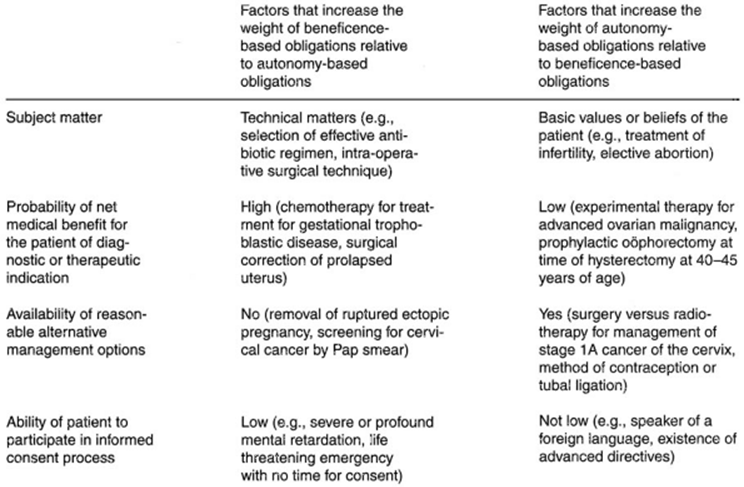
The process of negotiating conflict between the two principles is a function of the following several factors involved in gynecologic clinical judgment: Subject matter, probability of net medical benefit, availability of reasonable alternatives, and the ability of the patient to participate in the informed consent process (Fig. 58.2).
|
|
|
FIG. 58.2. Factors that influence the relative weight of beneficence-based and autonomy-based obligations to the gynecologic patient. |
When the subject matter is primarily technical in nature, such as the selection of an effective antibiotic regimen or intraoperative surgical technique, clinical judgment is justifiably beneficence based. This is because technical matters largely concern the evidence-based determination of medical goods and harms for aggregates of patients with a particular diagnosis and treatment plan. Such decisions are justifiably within the gynecologist's purview. The individual values and beliefs of a particular patient cannot readily be taken into account in this process. In contrast, when the patient's basic values and beliefs are at stake, such as the workup or treatment of infertility or elective abortion, clinical judgment is justifiably autonomy based. This is because particular diagnostic or treatment interventions can directly and adversely affect the basic values and beliefs of a particular patient, a matter that only an individual patient can decide. Such decisions are justifiably within the patient's purview.
When the probability of net medical benefit for the patient of diagnostic or therapeutic medical intervention is high, such as chemotherapy for some forms of gestational trophoblastic disease or surgical correction of a prolapsed uterus, beneficence-based clinical judgment is dominant. This is because, in such circumstances, the net benefit is clear-cut. The gynecologist is, therefore, justified in recommending interventions that have a high probability of net medical benefit. By contrast, when that probability is low, such as with experimental therapy for advanced ovarian malignancy or prophylactic oophorectomy at age 40 to 45 years, clinical judgment is justifiably autonomy based. This is because, when there is no clear-cut benefit and significant risks of intervention exist, the patient is in the best position to determine which trade-off makes the most sense. The gynecologist is, therefore, justified in offering these alternatives but not in recommending one as indisputably the best.
When there is no reasonable alternative to manage the patient's condition (e.g., removal of a ruptured ectopic pregnancy or screening for cervical cancer by Pap smears), clinical judgment is appropriately beneficence based, because there is no other alternative that to any degree protects and promotes the interests of the patient. The gynecologist is, therefore, justified in strongly recommending the intervention in question. By contrast, when there are reasonable alternatives, such as surgery versus radiotherapy for stage Ia cervical cancer or a method of contraception versus tubal ligation, clinical judgment is appropriately autonomy based. This is because reasonable alternatives all promote the patient's interests to a significant degree, and no one alternative can exclude any other as unreasonable. The gynecologist is justified in presenting or offering the reasonable alternatives.
When the ability to implement the informed consent process is low, as for a patient with severe or profound mental retardation or in a life-threatening emergency without time for consent, clinical judgment is justifiably beneficence based. This is because it is impossible to determine the patient's relevant values and beliefs because of either significant irreversible cognitive impairment or urgent lack of time. The gynecologist is, therefore, justified in basing clinical decision making primarily on beneficence. By contrast, when the ability of the patient to participate in the informed consent process is not low, as in a speaker of a foreign language or the existence of a legally valid advance directive, then clinical judgment is justifiably autonomy based. This is because the ability of the patient to participate in the informed consent process is presumed in the absence of compelling reasons to the contrary.
As a rule, the result of the informed consent process should be implemented. When the patient refuses to accept any of the alternatives supported in beneficence-based clinical judgment, the physician is ethically and legally obligated to engage in what is known as “informed refusal.” This legal and ethical obligation arises from the 1980 case of Truman v. Thomas from California. Dr. Thomas had delivered several of Mrs. Truman's babies and, during the delivery of her last child, recommended that she have a Pap smear. She refused to have this test until she could pay for it and did not accept Dr. Thomas's offer to perform it without charge. Mrs. Truman next visited Dr. Thomas with advanced cervical cancer, from which she died. During the malpractice action brought by her survivors, Dr. Thomas stated that, although they were of clinical concern to him in the management of Mrs. Truman, he did not tell Mrs. Truman of the risks of having detectable presymptomatic changes in her cervix indicative of cervical cancer or that he was concerned that she could die from such disease. The California Supreme Court ruled that, because risks were of clinical salience to Dr. Thomas—they were the motivation for his offering the Pap smear—he should have informed Mrs. Thomas about these risks so that her refusal would be informed. This case changed practice and introduced the concept of informed refusal into medical law and ethics.
The ethical and legal obligation of the physician in the matter of informed refusal is very clear and not difficult to fulfill. The patient should be informed in straightforward, but not harsh or hostile, terms the medical risks that she is taking in her refusal of a diagnostic or therapeutic intervention supported in beneficence-based clinical judgment. The risks to be disclosed are those that are salient in clinical judgment. If they are important to the physician, that is, motivating the offer or recommendation of the diagnostic test or therapy, they are salient and should be disclosed. This discussion should be documented thoroughly in the patient's chart. This is all that the law requires. Good ethical practice suggests strongly that this disclosure should be followed by a recommendation that the patient reconsider her refusal. As a matter of good ethical practice, the physician should respond, in the end, to adamant refusal by offering a trial of respect for the patient's refusal, asking her to return for an office visit, and to reconsider her refusal once she has had some experience with it. This preventive ethics approach avoids the need to abandon the patient, keeps lines of communication open, and sends a powerful signal of concern by the physician to the patient about the medical folly of her refusal.
Patients' demands for inappropriate management are the reverse side of this coin. We suggest the following preventive ethics strategy in response:
1. Is the intervention reliably expected to have its intended, usual anatomic or physiologic effect? If in reliable, especially evidence-based, beneficence-based clinical judgment it is not expected to do so, then the physician should not offer it. There is no obligation to offer or to perform medical interventions that are futile in this strict sense, such as providing a feeding tube for a patient with cachexia caused by cancer.
2. Is the intervention reliably expected to have some minimal clinical benefit, defined as maintaining some minimal level of ability to interact with the environment and thus grow and develop as a human being? Is the patient in a persistent or permanent vegetative state? If, in reliable beneficence-based clinical judgment, the intervention is not expected to have benefit, then the physician should offer it and then recommend against it. We suggest this approach to respect patients or surrogate decision makers who are vitalists, those who value the preservation of life at any cost. The physician should explain that this is not a value in medical ethics and never has been. Moreover, the intervention in question, whether it is initiated or continued, will just sustain a false hope of recovery.
3. If the patient or the patient's surrogate persists in the demand, then the physician should consult with colleagues and then the ethics committee, which should have a clear policy on response to demands by patients or their surrogates for futile intervention.
INTERACTION OF BENEFICENCE AND RESPECT FOR AUTONOMY IN OBSTETRIC CLINICAL JUDGMENT AND PRACTICE
The ethical principles of beneficence and respect for autonomy play a more complex role in obstetric clinical judgment and practice (Fig. 58.3). There are obviously beneficence-based and autonomy-based obligations to the pregnant patient. The physician's perspective on the pregnant woman's interests provides the basis for the physician's beneficence-based obligations to her, whereas her own perspective on those interests provides the basis for the physician's autonomy-based obligations to her. Because of an insufficiently developed central nervous system, the fetus cannot meaningfully be said to possess values and beliefs. Thus, there is no basis for saying that a fetus has a perspective on its interests. There can, therefore, be no autonomy-based obligations to any fetus. Hence, the language of fetal rights has no meaning and therefore no application to the fetus in obstetric clinical judgment and practice, despite its popularity in public and political discourse in the United States and other countries. Obviously, the physician has a perspective on the fetus's health-related interests, and the physician can have beneficence-based obligations to the fetus, but only when the fetus is a patient. Because of its importance for obstetric clinical judgment and practice, the topic of the fetus as a patient requires detailed consideration.
|
|
|
FIG. 58.3. Moral obligations in obstetric care. |
Two Senses of the Concept of the Fetus as a Patient
The concept of the fetus as a patient is essential to obstetric clinical judgment and practice. Developments in fetal diagnosis and management strategies to optimize fetal outcome have become widely accepted, encouraging the development of this concept. This concept has considerable clinical significance because, when the fetus is a patient, directive counseling (i.e., recommending a form of management) for fetal benefit is appropriate, and when the fetus is not a patient, nondirective counseling (i.e., offering but not recommending a form of management for fetal benefit) is appropriate. However, these apparently straightforward roles for directive and nondirective counseling are often difficult to apply in actual perinatal practice because of uncertainty about when the fetus is a patient. One approach to resolving this uncertainty would be to argue that the fetus is or is not a patient in virtue of personhood, or some other form of independent moral status. We now show that this approach fails to resolve the uncertainty and we, therefore, defend an alternative approach that does resolve the uncertainty.
Independent Moral Status of the Fetus
One prominent approach for establishing whether or not the fetus is a patient has involved attempts to show whether or not the fetus has independent moral status. This is the first sense of the concept of the fetus as a patient. Independent moral status for the fetus means that one or more characteristics that the fetus possesses in and of itself and, therefore, independently of the pregnant woman or any other factor, generate and therefore ground obligations to the fetus on the part of the pregnant woman and her physician.
A striking variety of characteristics have been nominated for this role, such as moment of conception, implantation, central nervous system development, quickening, and the moment of birth. It should come as no surprise that, given the variability of proposed characteristics, there is considerable variation among ethical arguments about when the fetus acquires independent moral status. Some take the view that the fetus has independent moral status from the moment of conception or implantation. Others believe that independent moral status is acquired in degrees, thus resulting in “graded” moral status. Still others hold, at least by implication, that the fetus never has independent moral status so long as it is in utero.
Despite ever-expanding theologic and philosophic literature on this subject, there has been no closure on a single authoritative account of the independent moral status of the fetus. This is an unsurprising outcome because, given the absence of a single method that would be authoritative for all of the markedly diverse theologic and philosophic schools of thought involved in this endless debate, closure is impossible. For closure ever to be possible, debates about such a final authority within and between theologic and philosophic traditions would have to be resolved in a way satisfactory to all, an inconceivable intellectual and cultural event.
We propose to abandon these futile attempts to understand the fetus as a patient in terms of independent moral status of the fetus and turn to an alternative approach that makes it possible to identify ethically distinct senses of the fetus as a patient and their clinical implications for directive and nondirective counseling. In its first sense, that of the independent moral status of the fetus, the fetus as a patient has no stable or clinically applicable meaning. We, therefore, consider a second sense of the concept of the fetus as a patient.
Dependent Moral Status of the Fetus
Our analysis of this second sense of the concept of the fetus as a patient begins with the recognition that being a patient does not require that one possess independent moral status. Rather, being a patient means that one can benefit from the applications of the clinical skills of the physician. Put more precisely, a human being without independent moral status is properly regarded as a patient when the following two conditions are met: that a human being (a) is presented to the physician, and (b) there exist clinical interventions that are reliably expected to be efficacious, in that they are reliably expected to result in a greater balance of clinical goods over harms for the human being in question. This is the second sense of the concept of the fetus as a patient, what we call the dependent moral status of the fetus.
The authors have argued elsewhere that beneficence-based obligations to the fetus exist when the fetus is reliably expected later to achieve independent moral status as a child and person. That is, the fetus is a patient when the fetus is presented for medical interventions, whether diagnostic or therapeutic, that reasonably can be expected to result in a greater balance of goods over harms for the child and person the fetus can later become during early childhood. The ethical significance of the concept of the fetus as a patient, therefore, depends on links that can be established between the fetus and its later achieving independent moral status.
Viable Fetal Patient
One such link is viability. Viability is not, however, an intrinsic property of the fetus because viability must be understood in terms of both biologic and technologic factors. It is only by virtue of both factors that a viable fetus can exist ex utero and thus achieve independent moral status. Moreover, these two factors do not exist as a function of the autonomy of the pregnant woman. When a fetus is viable, that is, when it is of sufficient maturity that it can survive into the neonatal period and achieve independent moral status given the availability of the requisite technologic support, and when it is presented to the physician, the fetus is a patient.
Viability exists as a function of biomedical and technologic capacities, which are different in different parts of the world. As a consequence, there is no worldwide, uniform gestational age to define viability. In the United States, we believe that viability occurs at approximately 24 weeks of gestational age.
When the fetus is a patient, directive counseling for fetal benefit is ethically justified. In clinical practice, directive counseling for fetal benefit involves one or more of the following: recommending against termination of pregnancy, recommending against nonaggressive management, or recommending aggressive management. Aggressive obstetric management includes interventions such as fetal surveillance, tocolysis, cesarean delivery, and delivery in a tertiary care center when indicated. Nonaggressive obstetric management excludes such interventions. Directive counseling for fetal benefit, however, must take account of the presence and severity of fetal anomalies, extreme prematurity, and obligations to the pregnant woman.
It is very important to appreciate in obstetric clinical judgment and practice that the strength of directive counseling for fetal benefit varies according to the presence and severity of anomalies. As a rule, the more severe the fetal anomaly, the less directive counseling should be for fetal benefit. In particular, when lethal anomalies such as anencephaly can be diagnosed with certainty, there are no beneficence-based obligations to provide aggressive management. Such fetuses are dying patients, and the counseling, therefore, should be nondirective in recommending between nonaggressive management and termination of pregnancy, but directive in recommending against aggressive management for the sake of maternal benefit. By contrast, third-trimester abortion for Down syndrome or achondroplasia is not ethically justifiable, because the future child has a high probability of growing and developing as a human being.
The strength of directive counseling for fetal benefit in cases of extreme prematurity of viable fetuses does not vary. In particular, this is the case for what we term just-viable fetuses, those with a gestational age of 24 to 26 weeks, for which there are significant rates of survival but high rates of mortality and morbidity. These rates of morbidity and mortality can be increased by nonaggressive obstetric management, whereas aggressive obstetric management may influence outcome favorably. Thus, it appears that there are substantial beneficence-based obligations to just-viable fetuses to provide aggressive obstetric management. This even more the case in pregnancies beyond 26 weeks of gestational age. Therefore, directive counseling for fetal benefit is justified in all cases of extreme prematurity of viable fetuses, considered by itself. Of course, such directive counseling is appropriate only when it is based on documented efficacy of aggressive obstetric management for each fetal indication. For example, such efficacy has not been demonstrated for routine cesarean delivery to manage extreme prematurity.
Any directive counseling for fetal benefit must occur in the context of balancing beneficence-based obligations to the fetus against beneficence-based and autonomy-based obligations to the pregnant woman (see Fig. 58.3). Any such balancing must take into account that a pregnant woman is obligated only to take reasonable risks of medical interventions that are reliably expected to benefit the viable fetus or child later. A unique feature of obstetric ethics is that the pregnant woman's autonomy influences whether, in a particular case, the viable fetus ought to be regarded as having been presented to the physician.
Obviously, any strategy for directive counseling for fetal benefit that takes account of obligations to the pregnant woman must be open to the possibility of conflict between the physician's recommendation and a pregnant woman's autonomous decision to the contrary. Such conflict is best managed preventively through the informed consent process as an ongoing dialogue throughout a woman's pregnancy, augmented as necessary by negotiation and respectful persuasion.
Previable Fetal Patient
The only possible link between the previable fetus and the child it can become is the pregnant woman's autonomy. This is because technologic factors cannot result in the previable fetus becoming a child. The link, therefore, between a fetus and the child it can become when the fetus is previable can be established only by the pregnant woman's decision to confer the status of patient on her previable fetus. The previable fetus, therefore, has no claim to the status of patient independently of the pregnant woman's autonomy. The pregnant woman is free to withhold, confer upon or, having once conferred, withdraw the status of patient from her previable fetus according to her own values and beliefs. The previable fetus is presented to the physician solely as a function of the pregnant woman's autonomy.
Counseling the pregnant woman regarding the management of her pregnancy when the fetus is previable should be nondirective in terms of continuing the pregnancy or having an abortion if she refuses to confer the status of patient on her fetus. If she does confer such status in a settled way, at that point beneficence-based obligations to her fetus come into existence, and directive counseling for fetal benefit becomes appropriate. Just as for viable fetuses, such counseling must take account of the presence and severity of fetal anomalies, extreme prematurity, and obligations owed to the pregnant woman.
For pregnancies in which the woman is uncertain about whether to confer such status, the authors propose that the fetus be provisionally regarded as a patient. This justifies directive counseling against behavior that can harm a fetus in significant and irreversible ways, such as substance abuse, especially alcohol, until the woman settles on whether to confer the status of patient on the fetus.
In particular, nondirective counseling is appropriate in cases of what we term near-viable fetuses, those that are 22 to 23 weeks of gestational age, for which there are anecdotal reports of survival. In our view, aggressive obstetric and neonatal management should be regarded as clinical investigation (i.e., a form of medical experimentation), not a standard of care. There is no obligation on the part of a pregnant woman to confer the status of patient on a near-viable fetus, because the efficacy of aggressive obstetric and neonatal management has yet to be proven.
In Vitro Embryo Patient
A subset of previable fetuses as patients concerns the in vitro embryo. It might seem that the in vitro embryo is a patient because such an embryo is presented to the physician. However, for beneficence-based obligations to a human being to exist, medical interventions must be reliably expected to be efficacious.
Recall that, in terms of beneficence, whether the fetus is a patient depends on links that can be established between the fetus and its eventual independent moral status. Therefore, the reasonableness of medical interventions on the in vitro embryo depends on whether that embryo later becomes viable. Otherwise, no benefit of such intervention can meaningfully be said to result. An in vitro embryo, therefore, becomes viable only when it survives in vitro cell division, transfer, implantation, and subsequent gestation to such time that it becomes viable. The process of achieving viability occurs only in vivo and is, therefore, entirely dependent on the woman's decision regarding the status of the fetus as a patient, should assisted conception successfully result in the gestation of the previable fetus. Whether an in vitro embryo will become a viable fetus, and whether medical intervention on such an embryo will benefit the fetus, are both functions of the pregnant woman's autonomous decision to withhold, confer upon or, having once conferred, withdraw the moral status of patient from the previable fetus that might result from assisted conception.
It, therefore, is appropriate to regard the in vitro embryo as a previable fetus rather than as a viable fetus. As a consequence, any in vitro embryo should be regarded as a patient only when the woman into whose reproductive tract the embryo will be transferred confers that status. Thus, counseling about preimplantation diagnosis should be nondirective. Preimplantation diagnostic counseling should be nondirective because the woman may elect not to implant abnormal embryos. These embryos are not patients, so there is no basis for directive counseling. Information should be presented about prognosis for a successful pregnancy and the possibility of confronting a decision about selective reduction, depending on the number of embryos transferred. Counseling about how many in vitro embryos should be transferred should be rigorously evidence based.
When to Offer, Recommend, and Perform Cesarean Section
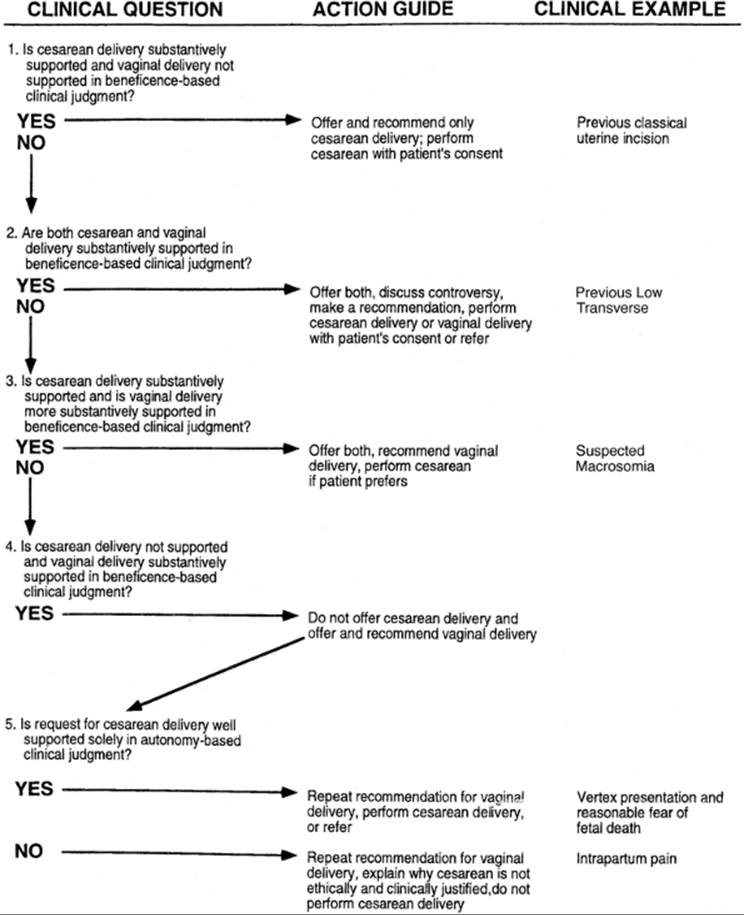
When to offer, recommend, and perform cesarean delivery is a common clinical ethical challenge in day-to-day obstetric practice, a challenge that will only increase with the growing influence of managed care and widespread quality assurance in hospitals. In this section we provide an ethically justified and clinically comprehensive algorithm for offering, recommending, and performing cesarean delivery, with particular reference to managed care, based on the ethical principles of beneficence and respect for autonomy and the concept of a fiduciary (Fig. 58.4 and Fig. 58.5).
|
|
|
FIG. 58.4. An ethically justified, clinically comprehensive algorithm for offering, recommending, and performing cesarean delivery. (From Chervenak FA, McCullough LB. Identification and management of ethical conflict in the patient–gynecologist relationship. J Reprod Med 1993;38:553–557, with permission.) |
|
|
|
FIG. 58.5. Principles guiding the physician acting as patient fiduciary. |
Our algorithm has five questions that define five clinical categories and begins by asking, “Is cesarean delivery substantively supported and vaginal delivery not supported in beneficence-based clinical judgment?” For example, when there is a previous classic incision in the uterus, cesarean is clearly preferable to vaginal delivery because cesarean prevents the fetal and maternal risk of a ruptured classic incision in up to 12% of cases. Vaginal delivery in these circumstances would result in a substantial increase in maternal and fetal morbidity and mortality. Because vaginal delivery involves unnecessary and preventable harms that are both quantitatively and qualitatively important, and cesarean prevents these harms, no well-founded beneficence-based clinical judgment could support offering vaginal delivery to a woman with a previous classic uterine incision. Only cesarean delivery should be offered and recommended to such patients. With the patient's consent, it should then be performed.
The second question concerns those clinical circumstances, such as previous low transverse uterine incisions, in which there is scientific controversy as to whether elective cesarean delivery is the better alternative. There are competing well-founded beneficence-based clinical judgments regarding how to balance the fetal benefit of preventing harm against the maternal risks associated with cesarean delivery. Whenever multiple management strategies are supported substantively in beneficence-based clinical judgment, all should be offered to the pregnant woman so that she can exercise her autonomy meaningfully. Such disclosure empowers the woman to emphasize her own perspective in balancing maternal and fetal risks. Not offering all management options substantively supported in beneficence-based clinical judgment is an unjustified form of paternalism. It is ethically appropriate to offer and perform either cesarean or a trial of vaginal delivery. A physician is justified in making a recommendation based on his or her evaluation of the controversy.
The third question concerns clinical circumstances when cesarean delivery is substantively supported in beneficence-based clinical judgment, but attempted vaginal delivery is supported more substantively. Attempted vaginal delivery is the better alternative but not the only one, as in the case of suspected macrosomia in the absence of certain factors such as diabetes. Clinical and sonographic prediction of macrosomia is not precise. Although cesarean is supported substantively in beneficence-based clinical judgment, trial of labor is supported more substantively. To avoid unjustified paternalism, both cesarean and a trial of vaginal delivery should be offered. Because a trial of vaginal delivery is the better option, it should be recommended. In addition, a cesarean is also supported substantively in beneficence-based clinical judgment, so it is justified to perform a cesarean if that is the patient's preference.
In the authors' view, in most remaining cases the woman should not routinely be offered cesarean delivery, because beneficence-based clinical judgment supports that vaginal delivery is appropriate and cesarean delivery is not appropriate (the fourth question). Cesarean delivery involves a quantitative increase of risks of unnecessary and preventable maternal morbidity and mortality, risks that are decreased by vaginal delivery. The qualitative nature of the unnecessary and preventable risks of cesarean delivery looms large in this beneficence-based calculus. As a consequence, it is not ethically justified to offer cesarean delivery, and only vaginal delivery should be offered and recommended routinely. If evidence accumulates that vaginal delivery poses a long-term risk to some women's health, such as damage to the pelvic floor, then it would be justified to offer and discuss cesarean delivery as a reasonable alternative. That is, this patient population should be managed under question three, even question two, depending on the strength of the evidence.
In rare cases (question five), patients request cesarean delivery not indicated on beneficence-based grounds, raising the challenging concept that autonomy-based indications in limited and rare circumstances can be well supported. For example, one of us (FAC) approved a cesarean delivery for a patient who expressed a legitimate fear of spontaneous fetal death and for whom there were no maternal contraindications to cesarean. She understood and accepted the maternal morbidity and mortality associated with cesarean delivery. An effort was made to dissuade the patient, but she considered and rejected it. A patient's preference that is based on deeply held values that are reaffirmed after a serious attempt to change her decision meets the test for being well supported in autonomy-based clinical judgment.
We can now answer a question that Feldman and Freiman asked more than 10 years ago: “If an informed patient opts for prophylactic cesarean section at term, can it be denied?” If such a request is well supported in autonomy-based clinical judgment, which will be rare, it should be carried out by the physician, or an appropriate referral should be made. Feldman and Freiman also suggested that patients should be informed of the “very real risks associated with the passive anticipation of vaginal delivery after fetal maturity has been reached.” However, we conclude that this obligation does not exist, because an affirmative answer makes the incorrect assumption that cesarean delivery is supported in beneficence-based clinical judgment.
Well-supported requests for cesarean delivery contrast with those that are not well supported in autonomy-based clinical judgment (i.e., when the goals expressed in the patient's preference for cesarean can be achieved without delivering by cesarean). For example, a woman who is in pain during labor may request cesarean delivery for relief of the pain. However, this goal can be achieved by administration of analgesia, whereas cesarean delivery for pain relief will result in more pain and unnecessary risk of morbidity and mortality. The preference is internally inconsistent and, therefore, not well supported in autonomy-based clinical judgment.
On the basis of our algorithm, there are four ethical indications for cesarean delivery as follows: (a) when it is the only reasonable alternative in beneficence-based clinical judgment, (b) when it is the more substantively supported in beneficence-based clinical judgment, (c) when it is substantively supported in beneficence-based clinical judgment and the patient prefers it, and (d) when it is well supported in autonomy-based clinical judgment, a purely autonomy-based but rare indication.
This algorithm underscores the importance of the professional integrity of the physician's role in the informed consent process. In some clinical situations, such as a previous low transverse uterine incision, there are advantages of elective repeat cesarean delivery for the physician, including time saved, convenience, and possibly increased remuneration. It is a clear and unacceptable violation of the professional integrity of the physician's role in the informed consent process for the physician to distort this process in pursuit of such personal, not professional, advantages.
One business strategy of managed care models is to impose shared economic risk on the physician and sometimes on the patient, with a view toward influencing both to use resources with economic efficiency. Strategies such as capitation for covered lives will put the economic interests of obstetricians and other physicians at risk every time they use a costly surgical intervention such as cesarean delivery. On the basis of our algorithm, the response of the physician always should be to offer a cesarean delivery when it is substantively supported in beneficence-based clinical judgment (i.e., when question one, two, or three in our algorithm of Figure 58.4 is answered in the affirmative). Gag rules, in contrast, are inconsistent with good ethical practice.
We believe the doctor and the patient should be insulated from shared economic risk when the first clinical question is answered in the affirmative because vaginal delivery would fall below standard of care, and managed care providers, like physicians, are fiduciaries of patients. As such, physicians are obligated ethically not to practice below standard of care, which is established by beneficence-based clinical judgment. Physicians who recommend cesarean delivery in response to clinical question two should negotiate payment plans that insulate them from risk when no one else is available to deliver breech-presenting infants vaginally. This is because economic attempts to resolve genuine clinical controversies in any specialty are scientifically arbitrary and, therefore, inconsistent with the integrity of medicine as a profession.
Payment for cesarean delivery in response to question three is ethically complex. Managed care organizations (MCOs) want the lowest possible rate of cesareans, yet an ethically more important consideration is that physicians have fiduciary obligations to be advocates for their patients. For example, some women are justifiably averse to a trial of vaginal delivery after low transverse cesarean delivery and cannot be persuaded to change their decision. Such factors justifiably influence the definition of the lowest acceptable rate of cesarean delivery. The imposition of shared economic risk is an ethically acceptable strategy only when physicians take the leading role in defining an acceptable cesarean delivery rate for this clinical circumstance. To do otherwise violates the integrity of medicine as a profession.
For cesarean delivery and other procedures that are performed in the clinical circumstances of question five (see Fig. 58.4), physicians should negotiate payment arrangements that require the patient to bear all the economic risk, because the indication for the procedure is solely autonomy based. Managed care plans and other payers have an ethical obligation as fiduciaries to provide care that is consistent with well-formed beneficence-based clinical judgment. Claims on resources that are based solely on autonomy and not on beneficence are, in principle, limited. It follows that patients have, at best, disputable claims on such resources when the indication for their use is purely autonomy based. In general, when the only justification for a procedure or other use of resources is autonomy based, physicians are justified in negotiating payment arrangements that shift some, or even all, economic risk to the patient.
Shared economic risk should have no effect on offering and recommending procedures that are substantively supported in beneficence-based clinical judgment. This aspect of the informed consent process should be kept immune from shared economic risk by managed care companies. The physician's role as the fiduciary of the patient in advocating ethically defensible degrees of shared economic risk cannot be overemphasized. In our view, the degree of shared economic risk should be nonexistent for clinical questions one through four and imposed entirely on patients who want cesarean delivery for question five (see Fig. 58.4).
MANAGED CARE AND THE VIRTUES OF THE OBSTETRICIAN-GYNECOLOGIST
In the previous sections we have made reference to managed care. In this section we provide a more detailed analysis of the ethics of managed care, with particular reference to the virtues of the obstetrician-gynecologist. The practice of obstetrics and gynecology is coming under managed care, which involves a set of strategies used by both private and public payers to control the cost of medical care. Two main business tools are used to achieve this goal, creating (a) conflicts of interest in how physicians are paid, diplomatically called sharing economic risk, and (b) increasingly strict control of clinical judgment and practice through such means as practice guidelines, critical pathways, physician report cards, and retrospective chart review. These business tools generate ethical challenges to obstetrician-gynecologists that seriously threaten the virtues that define the fiduciary character of medicine as a profession.
The physician-fiduciary, as a primary consideration, is expected as a matter of routine and habit to fulfill obligations to protect and promote patients' interests rather than pursue one's own interests. Virtues are those traits and habits of character that routinely focus the concern and behavior of an individual on the interests of others and thereby habitually blunt the motivation to act on self-interest as the physician's primary consideration. We believe that four virtues constitute the physician–patient relationship based on the physician as fiduciary.
The first virtue is self-effacement. This requires the physician not to act on the basis of potential differences between the patient and the physician such as race, religion, national origin, education, gender, manners, socioeconomic status, hygiene, or proficiency in speaking English. Self-effacement prevents biases and prejudices arising from these differences that could adversely impact on the plan of care for the patient.
The second virtue is self-sacrifice. This requires physicians to accept reasonable risks to themselves. As one example, physicians manifest this virtue in their willingness to care for patients with infectious diseases such as tuberculosis, hepatitis, and human immunodeficiency virus infection, all of which are a potential threat to the physician's health. In both fee-for-service and managed care, this virtue of self-sacrifice obligates the physician to turn away from economic self-interest and focus on the patient's need for relief when the two are in conflict.
The third virtue, compassion, motivates the physician to recognize and seek to alleviate the stress, discomfort, pain, and suffering associated with the patient's disease and illness. Self-effacement, self-sacrifice, and compassion provide the basis for a powerful ethical response to the business tool of conflicts of interest by the physician.
This response is strengthened by the fourth virtue, integrity. This virtue imposes an intellectual discipline on the physician's clinical judgments about the patient's problems and how to address them. Integrity prescribes rigor in the formation of clinical judgment. Clinical judgment is rigorous when it is based on the best available scientific information or, when such information is lacking, consensus clinical judgment and on careful thought processes of an individual physician that can withstand peer review. In settings that lack such quality control mechanisms, physicians confront a powerful incentive to make the pursuit of remuneration via fee-for-service the primary consideration. Integrity is thus an antidote to the pitfalls of bias, subjective clinical impressions, and unexamined clinical common sense that can undermine evidence-based practice. Integrity provides the basis for the physician's ethical response to the business tool of control of clinical judgment and practice.
None of these four virtues is absolute in its ethical demands. The task of medical ethics is to identify both the application and the limits of these four virtues. The concept of legitimate self-interest provides the basis for these limits. Legitimate self-interest includes protecting the conditions for practicing medicine well, fulfilling obligations to persons in the physician's life other than the patient, and protecting activities outside the practice of medicine that the physician finds deeply fulfilling.
Managed Care and the Physician as Fiduciary
Fee-for-service unconstrained by fiduciary obligations could and did lead to harm to patients from nonindicated over-utilization of resources. It is a violation of the standard of care to subject patients to unnecessary active intervention in order to achieve personal economic gain.
Managed care unconstrained by fiduciary obligations puts patients at risk of harm by denying access to the standard of care. This will occur if patients are subjected to unnecessary risk from withholding appropriate care and intervention in order to achieve economic efficiency. A primary goal of managed care is to achieve this economic efficiency through price competitiveness in order to retain and grow market share.
Financial incentives to the physician and supervision of clinician decision making with strict controls of utilization of services are the business tools managed care uses. Forms of payment by managed care plans, such as capitation and withhold, deliberately impose an economic conflict of interest on the physician. Every time the physician uses a resource, such as consultation, diagnostic testing, or surgical procedures, the physician pays an economic penalty. The ethical challenge occurs when the patient's interests are subordinated to the pursuit of financial rewards and thereby harmed by this under-utilization. This conflict of interest becomes actual when a physician signs such a payment contract.
The physician's decision in signing contracts is subject to considerations of legitimate self-interest. For example, failure to sign a contract with a plan that has captured 20% of one's patients will result in a significant loss of income that the physician may not be able to replace through other contracts. Because there is usually an excess of physician supply in large markets, physicians as suppliers who fail to sign contracts in a buyer's market do so at their economic peril. Therefore, rational calculation of one's legitimate concern to protect income from significant reduction may strongly incline a physician to sign virtually every contract presented as a matter of prudent protection of legitimate self-interest.
However, the virtue of self-sacrifice prohibits the physician from making the avoidance of such financial risk the primary consideration. Avoiding financial risk as one's primary consideration involves an ethically pathologic process that leads naturally and quickly to the abandonment of self-effacement (economically driven managed care for some patients but not for others), compassion (patients' health-related concerns do not matter but are only a means to maximize revenues), and integrity (the standard of care is sacrificed to maximize revenues). Importantly, physicians are not sanctioned by society to engage in the destruction of medicine as a fiduciary profession.
Adhering to the demands of the virtues provides the antidote to this unacceptable sequence of ethical failure. Physicians should negotiate changes in payment contracts to make economic conflicts of interest as manageable as possible. It is not realistic to call for elimination of conflict of interest, as some have done. It is important to recall that fee-for-service involves conflicts of interest that also cannot be eliminated.
Physicians should not assume that MCOs are unwilling to negotiate contracts to reduce the severity of economic conflicts of interest. Physicians should, therefore, make a good faith effort to negotiate these matters. If the MCO refuses to negotiate and the economic risk of not signing the contract is significant, then the physician should voluntarily accept the ethical responsibility to be alert to and manage these conflicts of interest well. First, integrity requires that the physician avoid the self-deception of underestimating any potential influence on clinical judgment and practice by the conflict of interest. Second, once these contracts are signed, the virtues add an important dimension to total quality management: diligent monitoring of conflicts of interest to prevent them from resulting in substandard care should be among the physician's “accountabilities.” Third, the realities of managed care mean that, for the near term at least, increasing financial sacrifice may be required to protect the integrity of medicine as a fiduciary profession. Fourth, in group practice, there should be a fair sharing of economic self-sacrifice. In particular, individual efforts to tune the system to one's economic advantage in a group, for example, avoiding the care of high-risk pregnancies, and to the disadvantage of colleagues should be avoided.
The second business tool of managed care, increasingly strict control of clinical judgment and practice, is a heterogeneous phenomenon. Some managed care plans are poorly capitalized and poorly managed. They compete by price, with little or no attention given to the quality of their services. A “bottom line” mentality dominates, with economic savings and net revenue maximization the overriding values. These poorly managed companies have little or no understanding of or interest in the fiduciary nature of medicine, so their controls of clinical judgment and practice are driven almost entirely by economic considerations.
Physicians subject to management controls by such companies face the very difficult challenge of trying to get such companies to constrain their economic interests by their fiduciary obligations, a daunting task but not, we believe, an impossible task. The concerns of ethics, especially to protect the integrity of the fiduciary enterprise, may be swept aside frequently when they are not ignored altogether. Nonetheless, physicians in such MCOs are the ultimate bulwark on which patients and society must be able to rely to protect patients from management's unbridled pursuit of economic self-interest. Physicians, therefore, should strenuously resist and seek to change management controls driven solely by economic considerations. Evidence-based medicine is a powerful tool for achieving this goal. If physicians refused to cooperate with such poorly managed companies, systematic dissociation would result in a loss of market share or, more optimistically, better management.
Antitrust legislation needs to be changed to permit group responses to this kind of MCO. We realize that this may not be a politically realistic proposal. Antitrust legislation may legally prevent physicians from banding together to deal with this problem. Thus, regulatory relief through state and federal governments becomes an ethically justified strategy to stop the abuse of these plans.
There is a contrast that provides a cause for optimism. Well-managed and well-capitalized plans can be as much concerned with quality as with economic efficiency. The trend of some large Fortune 500 employers to require National Committee on Quality Assurance certification will reinforce the importance of quality. The virtues, as we have shown above, have an important role to play in the definition of quality. The concept of quality should be expanded beyond the usual measures of morbidity, mortality, and customer satisfaction to include monitoring for and managing threats to the fiduciary character of medicine.
One approach to doing so concerns the development and use of practice guidelines, an important form of evidence-based medicine. It appears that well-managed plans will rely increasingly on this as their primary business tool rather than the strategy of creating conflicts of interest with its disruptive and demoralizing effects. Nonetheless, practice guidelines pose a number of ethical concerns.
First, guidelines have the potential to impede economic efficiency, an important value of all MCOs. Economically inefficient plans are threatened with significant loss of market share or even extinction through local market competition by MCOs competing solely by price.
Second, every step of a guideline absorbs monetary resources that would otherwise be available for, among other purposes, physician remuneration, or return to investors in the case of for-profit plans. An interest in job security and maximizing income could, therefore, subtly enter into physicians' judgments about the value of deleting, adding, or altering diagnostic and therapeutic steps to a guideline. As a consequence, uncertainty about whether a particular step of a guideline adds clinical value may lead to the elimination of that step if doing so increases economic efficiency. This subtle form of conflict of interest should be monitored closely so that the virtues of integrity and self-sacrifice are not unduly threatened.
Third, curtailment of steps in a guideline also might result in physicians concentrating only on the clinical care for which they have direct and immediate answers. The failure to pursue unanswered questions may result in less complete care and failure to develop new clinical competencies, a long-term negative effect on the standard of care.
The integrity of medicine as a fiduciary enterprise justifies, indeed requires, practice guidelines that acknowledge the heterogeneity of patients' conditions and the natural history of diseases and their management, to avoid inadvertent and preventable harm to patients' interests. In defense of such guidelines, which must be as scientifically rigorous as possible—integrity requires this, too—physicians will be obligated by the virtue of integrity to take the unpopular and, at times, antibusiness position of defending economic inefficiency as the necessary price of protecting medicine as a fiduciary profession. Failure to do so amounts to willful failure of the physician's fiduciary responsibilities.
Being a physician-controlled MCO provides no immunity against the ethical challenges of the business tools of managed care. These new physician-owned provider entities will not provide a solution in and of themselves to the ethical threats of conflict of interest and control of clinical judgment and practice. The virtue-based arguments we made will apply to these new entities, without exception.
There is no conclusive evidence that preserving medicine as a fiduciary profession is impossible, even given the enormous economic power of MCOs. Ethics teaches us that business and economic power are not absolute and should always be called to account for their consequences. Society has not given MCOs the moral authority or permission to destroy the fiduciary character of medicine as a consequence of the pursuit of economic interest and power. Nor has society given physicians moral authority or permission to cooperate willfully with this destruction. Quite the opposite, society counts on physicians, because ultimately society can count on no one else to preserve and advocate for the fiduciary character of the medical profession.
CONCLUSION
In this chapter we have provided a general ethical framework for both gynecologic and obstetric clinical judgment and practice. Implementing this framework on a daily basis is essential to creating and sustaining the physician–patient relationship in obstetrics and gynecology. This framework emphasizes preventive ethics, an appreciation that the potential for ethical conflict is built into clinical practice and the use of such clinical tools as informed consent and negotiation to prevent such conflict from occurring. We have provided guidelines for preventing conflict about futile management in gynecologic practice and about cesarean delivery in obstetric practice. We have also shown how the virtues provide a basis for a powerful and effective preventive ethics response to the business tools of managed practice.
SUMMARY POINTS
· In clinical decision making, the obstetrician-gynecologist should take account of both beneficence-based and autonomy-based obligations to the patient.
· The obstetrician-gynecologist should discuss the need for advance directives (living will and durable power of attorney) with patients with gynecologic diseases that could become or are life-threatening.
· The viable fetus is a patient, while the previable fetus is a patient as a function of the pregnant woman's decision to confer this status.
· Offering, recommending, and performing cesarean delivery should be based on the obstetrician-gynecologist's beneficence-based and autonomy-based obligations to the pregnant woman and fetal patient.
· The professional virtues of self-effacement, self-sacrifice, compassion, and integrity are essential for the obstetrician-gynecologist to fulfill fiduciary obligations to patients.
· Obstetrician-gynecologists should resist managed care that is driven solely by economic considerations and cooperate with managed care that is based on evidence-based processes and outcomes.
SUGGESTED READINGS
American College of Obstetricians and Gynecologists. Ethics in obstetrics and gynecology. Washington, DC: American College of Obstetricians and Gynecologists, 2002.
Annas GJ. Protecting the liberty of pregnant patient. N Engl J Med 1988;316:1213–1214.
Association of Professors of Gynecology and Obstetrics. Exploring medical-legal issues in obstetrics and gynecology. Washington, DC: APGO Medical Education Foundation, 1994.
Beauchamp TL, Childress JF. Principles of biomedical ethics, fifth ed. New York: Oxford University Press, 2001.
Callahan S, Callahan D, eds. Abortion: understanding differences. New York: Plenum Press, 1984.
Chervenak FA, Farley MA, Walters L, et al. When is termination of pregnancy during the third trimester morally justifiable? N Engl J Med 1984;310:501–504.
Chervenak FA, McCullough LB. An ethically justified algorithm for offering, recommending, and performing cesarean delivery and its application in managed care practice. Obstet Gynecol 1996;87:302–305.
Chervenak FA, McCullough LB. Identification and management of ethical conflict in the patient–gynecologist relationship. J Reprod Med 1993;38:553–557.
Chervenak FA, McCullough LB, Chez R. Responding to the ethical challenges posed by the business tools of managed care in the practice of obstetrics and gynecology. Am J Obstet Gynecol 1996;175:524–527.
Chervenak FA, McCullough LB, eds. Ethical dilemmas in obstetrics. Clin Obstet Gynecol 1992;35:707–853.
Chervenak FA, McCullough LB, Campbell S. Is third trimester abortion justified? Br J Obstet Gynaecol 1995;102:434–435.
Chervenak FA, McCullough LB, Rosenwaks Z. Ethical dimensions of the number of embryos to be transferred in in vitro fertilization. J Assist Reprod Genet2001;18:583–587.
Council on Ethical and Judicial Affairs of the American Medical Association. Ethical issues in managed care. JAMA 1995;273:330–335.
Council on Ethical and Judicial Affairs of the American Medical Association. Code of ethics: current opinions with annotations. Chicago: American Medical Association, 2002.
Elias S, Annas GJ. Reproductive genetics and the law. Chicago: Year Book Medical Publishers, 1987.
Emanuel EJ, Dubler NN. Preserving the physician–patient relationship in the era of managed care. JAMA 1995;273:323–329.
Engelhardt HT Jr. The foundations of bioethics, second ed. New York: Oxford University Press, 1995.
FIGO Committee for the Study of Ethical Aspects of Human Reproduction. Recommendations of ethical issues in obstetrics and gynecology. London. International Federation of Gynecology and Obstetrics, 1997.
Feldman GB, Freiman JA. Prohpylactic cesarean section at term? N Engl J Med 1985;312:1264–1267.
Fleischman AR, Chervenak FA, McCullough LB, eds. Ethical issues in perinatal medicine. Semin Perinatol 1998;22:183–240.
McCullough LB, Chervenak FA. Ethics in obstetrics and gynecology. New York: Oxford University Press, 1994.
Mahowald MB. Genes, women, equality. New York. Oxford University Press, 2000.
Minkoff H, Chervenak FA. Elective primary cesarean delivery. N Engl J Med 2003;348:946–950.
Morreim EH. Balancing act: the new medical ethics of medicine's new economics. Boston: Kluwer Academic Publishers, 1991.
Reich WT, ed. Encyclopedia of bioethics, second ed. New York: Mammalian, 1995.
Robertson JA. Children of choice: freedom and the new reproductive technologies. Princeton: Princeton University Press, 1994.
Strong C. Ethics in reproductive medicine: a new framework. New Haven: Yale University Press, 1997.
Woodhandler S, Himmelstein DS. Extreme risk—the new corporate proposition for physicians. N Engl J Med 1996;333:1706–1708.