
Christa Nadjafi-Triebsch1, 2, 3, 4
(1)
Foederatio Medicorum Helveticorum (F.M.H.), CH-3000, Bern, 15, Switzerland
(2)
Aerztekammer Nordrhein/Germany (A.E.K.N.O.), Tersteegenstr.9, D-40474 Düsseldorf/Golzheim, Germany
(3)
German Society of Anti-Aging Medicine e.V. (G.S.A.A.M.), Vallstedter Weg 114, D-38268 Lengede, Germany
(4)
Swiss Society for Anti Aging Medicine and Prevention (S.S.A.A.M.P.), Industriestrasse 3, CH-6345 Neuheim/Zug, Switzerland
An erratum to this chapter is available at http://dx.doi.org/10.1007/978-3-319-14385-9_15
An erratum to this chapter can be found at http://dx.doi.org/10.1007/978-3-319-14385-9_15
1 Introduction
Progesterone is the most basic of all steroid hormones. All other steroid hormones are produced physiologically by modifying the progesterone molecule into glucocorticoids, mineralocorticoids, estrogens and androgens. Progesterone acts by agonizing the progesterone receptor. It is known that numerous body organs have estrogen or androgen receptors, explaining the differences between both sexes. Sex differences are seen in behavior patterns, cyclic responses of the hypothalamus, hair production and distribution, in addition to the differences in the sex organs. Glucocorticoid receptors are also found in virtually all organs of the body. Therefore, it should be no surprise that progesterone receptors are widely distributed and that progesterone affects numerous organs in both sexes as well as the more well known effects of progesterone on the uterus and reproduction.
The discovery that men are also dependent on progesterone was exciting and piqued my interest. When a lack of progesterone is found in men, many conditions can be improved with progesterone supplementation. Two examples are prostate hyperplasia and erectile dysfunction. Indeed Lee [1] has reported the successful treatment of prostate cancer with progesterone and testosterone. In addition to progesterone being produced by the Leydig cells, it is also produced in the central nervous system by the glial cells of the brain and spinal cord [2] and in the Schwann cells [3] of peripheral nerves. Therefore, progesterone supplementation has been used successfully in depression, sleep disorders, multiple sclerosis, spinal cord neurodegeneration, brain trauma, CVA and epileptic seizures.
Both a gene defect or an age-related decrease may lead to a lack of progesterone.
Adequate substitution of progesterone for both prophylaxis and the correction of several deficiencies in the male and also in children and for a number of neurological disorders is not only justified, but highly desirable.
Since the late 1980’s a human identical form of progesterone has been available.
Micronization of progesterone has allowed the hormone to be administered orally rather than by deep intramuscular injection when dissolved in oil. As the objective of progesterone supplementation is to replace a lack of the physiological hormone, I only treat patients with bio-identical progesterone, and not synthetic progestogens.
However, as progesterone is not widely used outside of the accepted gynecological indications (described in other chapters in this book), appropriate control studies are urgently required.
I would like to dedicate this chapter to my patients, from whom I have learned what can be achieved when the lack of progesterone is corrected.
2 Progesterone in Males
Relatively little is known about normal values of hormones in men compared to the physiological levels in women. Although diminished levels of testosterone and DHEA are now often corrected with human identical hormones, the restoration of a healthy balance of hormones however, rarely achieves attention. As stated above the interaction of numerous hormones and enzymes is required in order to ensure an optimal hormone balance.
2.1 Biosynthesis of Sex Hormones
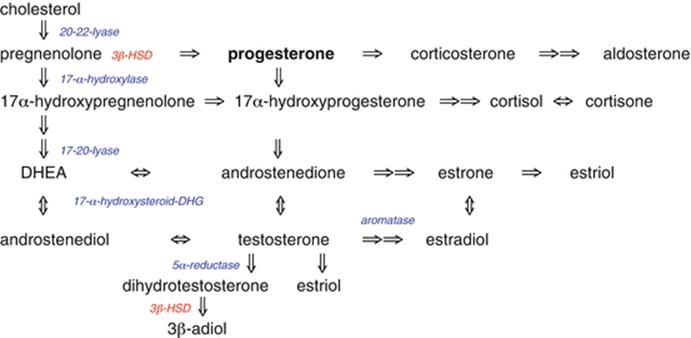
2.2 Progesterone Production in the Male
In men progesterone is produced in the Leydig cells of the testes, suprarenal gland, glial cells of the brain and the spinal cord [2] and in the Schwann cells [3] of peripheral nerves. Progesterone, Pregnenolone and their metabolites have been found in all of the above tissues. In the kidney, progesterone is metabolized to androgens.
2.3 Progesterone Receptors
The prostate is the male equivalent of the uterus and Skene’s glands. Since both develop from the distal part of the Müllerian duct and the surrounding glands, it is not surprising that the prostate has progesterone receptors as well as estrogen and testosterone receptors [4]. There are two isoforms of progesterone receptors: PR-A and PR-B. The PR-B isoform is a full-length receptor, the PR-A isoform has 164 amino acids fewer than the PR-B receptor. The ratio of PR-A and PR-B levels in the target cells determine the type and extent of the progesterone effect [5]. PR-A is responsible for progesterone-dependent reproduction and the PR-B for normal differentiating effects, e.g. the breast [6]. PR-B is more active than PR-A and is cell-specific. PR-A suppresses transcription activities of other steroid hormone receptors, including ERα and PR-B. Progesterone has similar effects as 3β-Adiol, the agonist of ERβ, which should rather be renamed the 3β-Adiol receptor, since 3β-Adiol is not an estrogen. Progesterone receptors have been identified in the heart, liver, sperm, epithelial cells of the eyes, brain and nerves and in the prostate. There are also two isoforms of 3β-hydroxysteroid dehydrogenase. Type I in the placenta and skin and Type II in the suprarenal gland, ovaries and testes. The progesterone receptor mediated suppression of gonadotropin reduces LH, FSH and thus testosterone in the male. It reduces pulsatile frequency and has little affinity for the androgen receptor [7].
The non-genomic effects of progesterone are regulated in men by intracellular receptors in the membrane. High concentrations influence the membrane liquid directly. Membrane-dependent progesterone effects are cell capacitation and LH receptor expression, leading to testosterone synthesis in the Leydig cells and interactions with the GABA receptor complex for sedation and anesthesia. Interactions also occur in fatty tissue and the kidneys.
2.4 Biological Activities of Progesterone
The highest levels of progesterone are found in the saliva of newborn infants. During the first month of life progesterone falls to one third of its previous level, and after 2 years the circadian rhythm has become established with high morning peaks and low evening values [8]. Progesterone displays a wide spectrum of biological activities in multiple tissues.
These effects can be stimulating or restraining, depending on the respective tissue, dose, point in time of application and progesterone receptor distribution.
2.5 Progesterone Prevents Prostate Cancer
Hereditary prostate cancer is associated with a defect in the 3β-hydroxysteroid dehydrogenase gene [9], which codes for the enzyme needed to metabolize progesterone from pregnenolone leading to a progesterone deficiency. The same enzyme is needed to metabolize 3β-Adiol from dihydrotestosterone (DHT). Hence the DHT level remains in excessive concentrations and 3β-Adiol, an important protective hormone, is reduced.
Additionally the age-related decrease of progesterone leads to a gradual decrease of testosterone and an increase of cell growth promoting estradiol [1, 9]. When hormone levels diminish in the aging male, markers of inflammation increase. These markers include C-reactive protein (CRP), interleukin-1β, interleukin-6, TNFα and total and free PSA levels and the quotient of both. In patients with prostate hyperplasia receiving progesterone, these parameters of inflammation decrease steadily back to the normal range. Micturition problems improve or even disappear with progesterone supplementation as the prostate shrinks. However, the process takes approximately 9–12 months.
Progesterone as the natural 5α-reductase inhibitor controls the metabolism of testosterone to DHT. The deficiency of 3β-hydroxysteroid-dehydrogenase (whether hereditary or age-related) leads to a decrease of progesterone, thus leaving DHT unopposed. Since 3β-Adiol cannot be metabolized from DHT, an excessive amount of DHT remains to promote prostate hyperplasia [10]. Progesterone is also the natural aromatase inhibitor controlling the effect of growth-promoting estradiol. The luminal cells of prostatic epithelia show high amounts of ERβ, whereas ERα is found primarily in the basal cells. In prostate cancer ERβ is down-regulated and ERα is spread to the luminal cells. ERβ is reduced 10 times and PR-A and PR-B are deficient, whereas ERα remains unchanged, leaving 17β-estradiol functions unopposed [11]. Theses mechanisms may explain why progesterone deficiency triggers the development of prostate cancer.
2.6 Other Important Effects of Progesterone in the Male
Progesterone is needed for fertility in men, since progesterone increases the volume of the ejaculate and improves sperm motility. The addition of progesterone to the Percoll medium in cases of assisted reproduction significantly increases sperm motility [12].
Progesterone improves sexual performance in rats [13]. Consequently, progesterone should also improve sexual performance in men due to similarities to human neuro-endocrine mechanisms. Indeed, patients receiving progesterone reported more frequent morning erections and distinctively improved sexual performance.
The anxiolytic effects of oral progesterone have been examined in a double-blind crossover study in 38 men. The Hamilton Anxiety Rating Scale was significantly reduced 4 h after progesterone administration and remained lower when examined after 9 and 24 h. Patients in the placebo arm of the trial only had a mild and non-significant reduction of the anxiety scale [14]. Additionally, the dose of antidepressants can be gradually reduced and often stopped completely [authors’s series, unpublished].
The sleep-inducing effects of progesterone are mediated by allopregnanolone and pregnanolone, the metabolites of progesterone [15]. Most of my patients report that sleep is improved with progesterone supplementation. Part of the mechanism whereby progesterone improves sleep patterns may be due to progesterone increasing pulmonary gas exchange and reducing alveolar CO 2 pressure, leading to improved respiration and therefore to undisturbed sleep [16, 17]. Under progesterone therapy, many patients snore less or stop entirely. Whether sleep apnoea is also due to progesterone deficiency requires further investigation.
Progesterone supplementation reduces cholesterol and returns the lipoprotein levels to normal. Normalization of cholesterol levels takes place especially quickly if in addition to progesterone supplementation, hypothyroidism is also corrected with a thyroid preparation (I personally use Novothyral, Merck Serono, Switzerland). After correction of the hormone profile, there are patients who could stop statins completely.
It has been reported that patients with asthma can stop their medication if substituted with progesterone [18]. I have only treated one patient with asthma, but the other medication could be stopped. However, trials are needed in asthma.
The anti-inflammatory effects of progesterone have been reported in men with active arthritis [19]. Intra-articular injection to one knee in 12 men produced a local anti-inflammatory effect, which lasted for 3 months. An especially impressive positive effect was observed in two men with polyarthritis, who did not respond to other therapies. The authors suggested either an immunosuppressive effect on lymphocytes or induction of immunosuppressive glycoproteins or binding of the glucocorticoid receptor, to explain the anti-inflammatory effect. Ginanneschi et al. [20] have treated 16 women with carpal tunnel syndrome by local injection of 17α-hydroxyprogesterone caproate. Progesterone therapy was compared to corticosteroids. Corticosteroid therapy was followed by a 1 month pain-free period. However, the pain-free period was six months after injection of the long acting progesterone derivative.
Other important effects of progesterone are anesthesia, immune suppression, mild diuretic, anti-hypertensive [21], anti-convulsive [22], anti-oxidant actions [23] and bone formation [24]. Progesterone enhances thyroid function, normalizes blood sugar, zinc and copper levels.
2.7 Standard Values of Progesterone in Men
At present, no laboratory has published normal values of progesterone in men. Lee used 5–8 mg progesterone transdermally and considered a level of 400 pg/ml in saliva as optimal [1]. Unfortunately, at present, no laboratory in Switzerland uses saliva levels to determine hormone levels. Rimkus [25] has used a progesterone level of 4–10 ng/ml in serum, and supplements progesterone levels if under 4 ng/ml. If the serum value increases to 10 ng/ml, it can be considered normal, but in my experience a progesterone level of 12 ng/ml is better. None of my patients had a normal value of progesterone. The progesterone levels are age-dependent lower with increasing age. Using a dose of 100 mg oral micronized progesterone (Utrogestan, Bessins International, Belgium) at night from day 6 of the month until the end of each month, (with a break from day 1–5 of the month, to prevent down-regulation of the receptor) [1] serum values of progesterone increased to 3.5 ng/ml up to 12 ng/ml. With substitution of DHEA or testosterone, the progesterone level increased to 6 ng/ml.
3 Progesterone, the Neurotrophic Hormone
Progesterone is not only produced in the Leydig cells of the testes, the ovary and adrenal cortex, but also in the glial cells in the brain and spinal cord [2] and in the Schwann cells of the peripheral nerves [3], (with especially high levels in the sciatic nerve). Consequently progesterone has many important effects on the brain and nerves. Some effects are described below.
3.1 Multiple Sclerosis (MS)
MS is an autoimmune inflammatory disease affecting the central nervous system, with demyelinization and neurodegeneration. The condition is characterized by relapses and remissions. Progesterone increases the number of oligodendrocytes [26] in the brain. Oligodendrocytes produce the protein myelin. Optimal levels of progesterone or pregnenolone lead to a statistically significant increase of myelin sheaths [27]. Progesterone suppresses matrix metalloproteinases [28], which maintain the inflammatory plaques in multiple sclerosis. Consequently in pregnancy under high progesterone levels exacerbation of MS does not occur. Post partum relapses are considered to be induced by the decreased levels of these steroids [29]. Progesterone has been shown to reduce the inflammatory reactions commonly seen in MS. This is due to the direct effect of progesterone on astrocytes and microglia [30]. I have one female patient, aged 62 with MS, who has received progesterone supplementation (200 mg micronized progesterone from day 6 until the end of the month) for the last 2 years. She has had improvement of her symptoms and can now use stairs more easily. Trials are urgently needed.
3.2 Brain Trauma and Stroke
Progesterone has been compared to placebo in rats within 24 h after brain trauma as long ago as 2002 [31]. The rats received 4 mg/kg progesterone over 3–5 days. Edema of the brain and behavioral abnormalities were only prevented when progesterone was administered for at least 5 days. In 2007 Wright and co-workers [32] reported protection against necrotic damage and behavioral abnormalities caused by traumatic brain injury in 77 of 100 patients receiving progesterone within 11 h after brain trauma. In this series progesterone was administered intravenously (5 mg/kg/h/3days). The 30-day mortality rate was lower, when compared to 23 patients receiving placebo. In moderate traumatic brain injury a moderate to good recovery of brain functions under progesterone compared to placebo was achieved. Xiao et al. [33] treated 82 of 159 patients within 8 h after brain trauma with a Glasgow Coma Score less than or equal to 8 within 8 h. Progesterone was administered intramuscularly in a dose of 1 mg/kg body weight every 12 h for 5 days. Treated patients had a moderate to good recovery of brain functions compared to placebo patients. Progesterone treated patients had a statistically significant lower 6-months mortality compared to the 77 patients receiving placebo. Additionally, the average intracranial pressure 72 h and 7 days post trauma was lower in the progesterone treated group. No side effects were observed with progesterone!
In 2009 three important studies were published demonstrating that progesterone leads to less brain damage, improves the blood–brain barrier and reduces markers of inflammation in rats with stroke [34]. If vitamin D3 was also administered immediately after the stroke together with the progesterone, recovery was even better [35, 36]. These important publications led to a large multi-center trial in patients with brain trauma or stroke. The trial commenced in 2010, and is recruiting patients from 17 hospitals in 15 US states. The patients receive progesterone in a 96-h (4 days) continuous intravenous infusion. The trial is scheduled to terminate in 2015. The results are eagerly awaited.
In my opinion, patients with stroke or brain trauma could have a better prognosis if they would be treated already now with an intramuscular injection of 1 mg per kg body weight every 12 h for 5 days.
3.3 Epilepsy
As long ago as 1995, Herzog [37] published, that progesterone reduces complex partial seizures (CPS) and secondary generalized motor seizures (SGMS) in women with low serum mid-luteal progesterone levels (less than 5 ng/ml). Twenty-five women with CPS and SGMS received progesterone supplementation for 3 months. 18 (72 %) experienced a decline in the frequency of seizures for CPS (p < 0.01) and SGMS (P < 0.02) compared to the 3 months prior to therapy. Since 1995, there have been an additional 11 publications regarding the effect of progesterone in epilepsy [38–48].
3.4 Parkinson’s Disease
The dopamine neurons of hemi-Parkinson rats displayed increased progesterone receptors A and B and a decrease in the estrogen receptor ERα, compared to initial pluri-potency during differentiation. Ninety-two per cent of the dopamine neurons had progesterone receptors [49]. It appears to be justified to use progesterone in Parkinson’s disease, since human chorionic gonadotropin (hCG) increases testosterone levels with concomitant alleviation of the symptoms of Parkinson’s disease [50]. Unfortunately progesterone was not assessed in that study.
3.5 Progesterone Protects the Spinal Cord from Neurodegeneration
Progesterone pellets were given to wobbler mice with pronounced neuro-degeneration. Progesterone led to reduction of the cell vacuoles and the mitochondrial structure remained intact. In treated mice the grip strength was improved and survival was prolonged compared to the untreated mice [51].
3.6 Progesterone in ADD, ADHD and Asperger Syndrome
It has been reported, that when progesterone is given to progesterone-deficient pregnant women, the children are more advanced at 1 year and have greater academic achievement at 9–10 years and 17–20 years. The best academic results were found when the mothers received progesterone before the 16th gestational week, for longer than 8 weeks and over 5 g in total [52]. In 2001 Trotter [53] reported that progesterone and estradiol supplementation in premature babies to the levels they would have received in utero, led to normal psychomotor development, higher bone mineralization and reduction of lung diseases.
Platt [18] is of the opinion that progesterone deficiency is the cause for attention deficit disorder, and that progesterone deficiency together with insulin excess and noradrenalin excess leads to ADHD, as lack of progesterone, too much insulin and noradrenalin. Platt has reported on a 9-year-old boy with ADHD who lost his behavior disturbances when progesterone was administered. In 6 months he became one of the best pupils in class. I have treated a 12-year-old boy with low values of progesterone and testosterone (according to the Tanner classification [54]. He was also deficient in vitamin D and iron and had several food intolerances. He received 100 mg progesterone before bedtime from day 6 until the end of each month and daily iron and 1,000 IE vitamin D3. The serum levels of progesterone, estradiol, testosterone, DHEA-S and noradrenalin decreased into the normal range according to the Tanner classification [54].
After 3 months this youth received better grades at school. In the meantime I have treated ten more patients with similar good results. One patient with ADHD was previously treated with Ritalin®. After progesterone supplementation, Ritalin® could be stopped immediately. The lack of progesterone is due to a gene defect of 3β-hydroxysteroid dehydrogenase [1], the enzyme needed to produce progesterone from pregnenolone, hence the progesterone deficiency. In children with suspected ADD or ADHD, I assess the following parameters: FSH, LH, pregnenolone, progesterone, testosterone, dihydrotestosterone (DHT), DHEA-S, serotonin, melatonin, TSH, T3 and T4 (as there is often concomitant hypothyroidism [55]), noradrenalin (reduced in ADD and increased in ADHD), vitamin D (required for progesterone absorption), ferritin (as iron deficiency often co-exists), glucose and insulin.
Dietary modification with a drastic reduction of carbohydrates may also be helpful. These children receive 100 mg oral progesterone before bedtime from day 6 of the month until the end of each month, with a break from day 1 to 5. After 3 months a significant improvement in concentration and academic achievement is evident. These children not only have values of progesterone that are too low, but also very low values of testosterone. With progesterone therapy testosterone levels increase as manifested by penile growth. With these changes height increases, as does self-esteem. Iron supplementation can usually be stopped after 3–5 months, as iron can be absorbed more easily when the hormone profile is corrected. In most ADD and ADHD children hypothyroidism is present due to a gene defect. Therefore thyroid hormones supplementation is required together with progesterone on a lifelong basis.
Hypothyroidism is often the cause for acne in ADD and ADHD children [55] and acne abates after approximately 4 months of treatment with thyroid hormones and progesterone.
Dr. Felix Horn [personal communication] has treated two children with Asperger syndrome (an autism spectrum disorder) using the same tests for ADD and ADHD as listed above. Progesterone values were found to be extremely low. With progesterone supplementation both patients improved considerably with regard to communication with other children.
References
1.
Lee JR. Hormone balance for men. What your doctor may not tell you about prostate health and natural hormone supplementation. One to One Inc. P.O. Box 84900 Phoenix, AZ 85071;2007, (800) 528–0559.
2.
Inue T, Akahira JL, Suzuki T, Darnel AD, Kaneko C, Takaha K, et al. Progesterone production and actions in the human central nervous system and neurogenic tumors. J Clin Endocrinol Metab. 2002;87(11):5325–31.CrossRef
3.
Koenig HL, Schuhmacher M, Ferzaz B, Do Thi AN, Ressouches A, Guennoun R, Jung-Testas I, Robel P, Akwa Y, Baulieu EE. Progesterone synthesis and myelin formation by Schwann cells. Science. 1995;268(5216):1500–3.CrossRefPubMed
4.
Srinivasan G, Cambell E, Beshirelahi N. Androgens, estrogens and progesterone receptors in normal and aging prostates. Microsc Res Tech. 1995;30(4):293–304.CrossRefPubMed
5.
Inue T, Akahira JL, Takeyama J, Suzuki T, Darnel AD, Kaneko C, Kurokawa Y, Satomi S, Sanano H. Spacial and topological distribution of progesterone receptor A and B isoforms during human development. Mol Cell Endocrinol. 2001;182(1):83–9.CrossRef
6.
Ariga N, Suzuki T, Moriya T, Kimura M, Inoue T. Progesterone receptor A and B isoforms in the human breast and its disorders. J Endocrinol Metab. 2004;89(3):1429–42.CrossRef
7.
Brady BM, Anderson RA, Kinniburgh D, Baird DT. Demonstration of progesterone receptor-mediated gonadotrophin suppression in the human male. Clin Endocrinol (Oxf). 2003;58(4):506–12.CrossRef
8.
Gröschl M, Rauh M, Dörr H-J. Circadian rhythm of salivary cortisol, 17α- hydroxy progesterone and progesterone in healthy children. Clin Chem. 2003;49:1688–91.
9.
Guerini V, Sau D, Scaccianoce E, Rusmini P, Ciana P, Maggi A, Martini PGV, Katzenellenbogen BS, Martini L, Motta M, Poletti A. The androgen derivative 5α-androstane-3β, 17β-diol inhibits prostate cancer cell migration through activation of the estrogen receptor β subtype. Cancer Res. 2005;65(12).
10.
Mauvais-Jarvis P, Kuttenn F, Baudet N. Inhibition of testosterone conversion to dihydrotestosterone in men treated percutaneously by progesterone. J Clin Endocrinol Metab. 1974;38(1):142–7.CrossRefPubMed
11.
Bonkhoff H, Fixemer T. Bedeutung der Östrogene und ihrer Rezeptoren für die Entstehung und Progression des Prostatakarzinoms. Der Pathologe. 2005;26(6):461. 46.CrossRefPubMed
12.
Andersen ML, Tufic S. Does male sexual behavior require progesterone? Brain Res Rev. 2006;51(1):36–43.CrossRef
13.
Witt DM, Young LJJ, Crews D. Progesterone modulation of androgen dependent sexual behavior in male rats. Physiol Behav. 1995;57(2):307–13.CrossRefPubMed
14.
De Lignieres B, Beausang A, Faltot M. Acute anxiolytic effect of oral administration of progesterone in men: a double-blind crossover study. Second international symposium of premenstrual, postpartum and menopausal mood disorders. September Kiahaj Island, SC, USA; 1987.
15.
Fries E, Tagaya H, Trachsel L, Holsboer F, Rupprecht R. Progesterone- induced changes in sleep in male subjects. Am J Physiol. 1997;272:E885–91.
16.
Saaressranta T, Polo-Kantola P, Irjala K, Helenius H, Polo O. Respiratory insuffiency in postmenopausal women: Sustained improvement of gas exchange with short-term medroxyprogesterone acetate. Chest. 1999;115(6):1581–87.CrossRef
17.
Saaressranta T, Polo-Kantola P, Rauhala E, Polo O. Medroxyprogesterone in postmenopausal females with partial upper airway obstruction during sleep. Eur Respir J. 2001;18:989–95.CrossRef
18.
Platt ME. The miracle of bio-identical hormones. Clancy Lane Publishing, Rancho Mirage, USA. ISBN 978-0-9776683-2-8.
19.
Cuchacovich M, Tchernitchin A, Gatica H, Wurgaft R, Valenzula C, Cornejo E. Intraarticular progesterone: effects of a local treatment for rheumatoid arthritis. J Rheumatol. 1988;15(4):561–65.PubMed
20.
Ginanneschi F, Milani P, Filippou G, Mondelli M, Frediani B, Melcangi RC, Rossi A. Evidences for antinociceptive effect of 17-alpha-hydroxy progesterone caproate in carpal tunnel syndrome. J Mol Neurosci. 2012;47(1):59–66.CrossRefPubMed
21.
Rylance PB, Brincat M, Lafferty K, De Trafford JC, Brincat S, Parsons V, Studd JW. Natural progesterone and antihypertensive action. BMJ. 1985;290:13–4.PubMedCentralCrossRefPubMed
22.
Reddy DS. Role of neurosteroids in catamenial epilepsy. Neurotherapeutics. 2009;6(2):392–401.PubMedCentralCrossRefPubMed
23.
Tranquilli AL, Mazzini L, Cugini AM, Cester N, Garzetti GG, Romanini C. Transdermal estradiol and medroxyprogesterone acetate in hormone replacement therapy are both antioxidants. Gynecol Endocrinol. 1995;9(2):137–41.CrossRefPubMed
24.
Burnett CC, Reddi AH. Influence of estrogen and progesterone on matrix-induced endochondral bone formation. Calcif Tissue Int. 1983;35:609–14.CrossRefPubMed
25.
Rimkus V (2000) Der Mann im Wechsel seiner Jahre. Arche Noah, Musik- und Buchverlag D-86971 Peiting. 3. Auflage ISBN 10:3-86733-000-X.
26.
Baulieu EE, Schuhmacher M. Neuro steroids, with special references to the effect of progesterone on myelination in peripheral nerves. Mult Scler. 1997;3:105–12.
27.
Schuhmacher M, Guennoun R, Robert F, Carelli C, Gago N, Ghoumari A, Gonzales Deniselle MC, Gonzales SL, Ibanez C, Labombarda F, Coirini H, Beaulieu EE, De Nicola AF. Local synthesis and dual actions of progesterone in the nervous system: Neuroprotection and myelination. Growth Horm IGF Res. 2004;14(Suppl A):S18–33.CrossRef
28.
Chen JL, Lin QH, Fang XL, Tao GS, Huang FY. Effect of progesterone on the secretion of matrix metalloproteinase-2 and matrix metalloproteinase-9 in human ectopic endometrial stromal cells. Zhong Nan Da Xue Bao Yi Xue Ban. 2005;30(3):307–11.
29.
Confavreux C, et al. Rate of pregnancy-related relapse in multiple sclerosis. N Engl J Med. 1998;339:285–91.CrossRefPubMed
30.
Garay LI, et al. Progesterone down-regulates spinal cord inflammatory mediators and increases myelination in experimental autoimmune encephalomyelitis. Neuroscience. 2012;226:40–50.CrossRefPubMed
31.
Shear DA, Galani R, Hoffman SW, Stein DG. Progesterone protects against necrotic damage and behavioral abnormalities caused by traumatic brain injury. Exp Neurol. 2002;178(1):59–67.CrossRefPubMed
32.
Wright DW, Kellermann AL, Hertzberg VS, et al. Pro TECT: a randomized clinical trial of progesterone for acute traumatic brain injury. Ann Emerg Med. 2007;49(4):391–402.CrossRefPubMed
33.
Xiao G, Wei J, Yan W, Lu Z. Improved outcomes from administration of progesterone for patients with acute severe traumatic brain injury: a randomized controlled trial. Crit Care. 2008;12(2):R61.PubMedCentralCrossRefPubMed
34.
Ishrat T, Sayeed I, Atif F, Stein DG. Effects of progesterone administration on infarct volume and functional deficits following permanent focal cerebral ischemia in rats. Brain Res. 2009;1257:94–101.PubMedCentralCrossRefPubMed
35.
Cekic M, Cutler SM, Valandingham JW, Stein DG. Vitamin D deficiency reduces the benefits of progesterone treatment after brain injury in aged rats. Neurobiol Aging. 2011;32(5):864–74.PubMedCentralCrossRefPubMed
36.
Wang J, Jiang C, Li X, et al. The protective mechanism of progesterone on blood–brain barrier in cerebral ischemia in rats. Brain Res Bull. 2009;9(6):426–30.CrossRef
37.
Herzog AG. Progesterone therapy in women with complex partial and secondary generalized motor seizures. Neurology. 1995;45:1660–2.CrossRefPubMed
38.
Bauer J, Hocke A, Elger CE. Katameniale Anfälle: Eine Analyse. Nervenarzt. 1995;66:760–9.
39.
Herzog AG. Three patterns of catamenial seizures. Epilepsia. 1997;38:1082–8.CrossRefPubMed
40.
Bauer J, Burr W, Elger CE. Seizure occurrence during ovulatory and anovulatory cycles in patients with temporal lobe epilepsy: a prospective study. Eur J Neurol. 1998;5:83–8.CrossRefPubMed
41.
Herzog AG. Progesterone therapy in women with epilepsy: a 3-year follow-up. Neurology. 1999;52(9):1917–8.CrossRefPubMed
42.
Edwards HE, Epps T, Carlen P, Mac Lusky N J. Progesterone receptors mediate progesterone suppression of epilepti form activity in tetanized hippocampal slices in vitro. Neuroscience. 2000;101(4):895–909.CrossRefPubMed
43.
Herzog AG, Friedman MN, Freund S, Pascal-Leone A. Transcranial magnetic stimulation evidence of a potential role for progesterone in the modulation of premenopausal corticocortical inhibition in a woman with catamenial seizure exacerbation. Epilepsy Behav. 2000;2(4):367–9.CrossRef
44.
Herzog AG, Frye CA. Seizure exacerbation associated with inhibition of progesterone metabolism. Ann Neurol. 2003;53(3):390–1.CrossRefPubMed
45.
Bauer J (2004) Warum treten epileptische Anfälle kurz vor der Periode auf? Informationspool Epilepsie. Dt. Gesellschaft für Epileptologie.
46.
Reddy DS. Role of neurosteroids in catamenial epilepsy. Epilepsy Res. 2004;62(2–3):99–118.CrossRefPubMed
47.
Harden CL, Herzog AG, Nokolov BG, Koppel BS, Christos PJ, Fowler K, Labar DR, Hauser WA. Hormone replacement therapy in women with epilepsy: a randomized, double-blind, placebo-controlled study. Epilepsy. 2006;47(9):1447–51.CrossRef
48.
Reddy DS, Rogawski MA. Neurosteroid replacement therapy for catamenial epilepsy. Neurotherapeutics. 2009;6(2):392–401.PubMedCentralCrossRefPubMed
49.
Diaz NF, Gueerra-Arraiza CH, Diaz NE, Salazar P, Molina-Hernandez A, Camacho-arroyo I, Velasco I. Changes in the content of estrogen α and progesterone receptors during differentiation of mouse embryonic stem cells to dopamine neurons. Brain Res Bull. 2007;73:75–80.PubMedCentralCrossRefPubMed
50.
Gomula A. Successful treatment of parkinsonism with HCG: preliminary findings. Presented at the 4th ISSAM conference in Prague. 2004.
51.
Gonzales Demiselle MC, Lopez Costa JJ, Gonzales SL, Labombarda F, Garay L, Guennounoun R, Schuhmacher M, De Nicola AF. Basis of Protection in spinal cord neurodegeneration. J Steroid Biochem Mol Biol. 2002;83(1–5):199–209.CrossRef
52.
Trotter A, Maier L, Pohlandt F. Management of the extremely preterm infant: is the replacement of estradiol and progesterone beneficial? Pediatr Drugs. 2001;3(9):629–37.CrossRef
53.
Trotter A, Bokelmann B, Sorgo W, Bechinger-Kornhuber D, Heinemann H, Schmücker G, Oesterle M, Köhntop B, Brisch KH, Pollandt F. Follow-up examination at the age of 15 months of extremely preterm infants after postnatal estradiol and progesterone replacement. J Clin Endocrinol Metab. 2001;86(2):601–3.CrossRefPubMed
54.
Tanner M. Variations in the pattern of pubertal changes in boys. Arch Dis Child. 1970;45(239):S13–23.CrossRef
55.
Stark M. Hypothyroidism Type 2: the epidemic. Revisedth ed. Columbia, MO: Mark Starr Trust; 2013.