
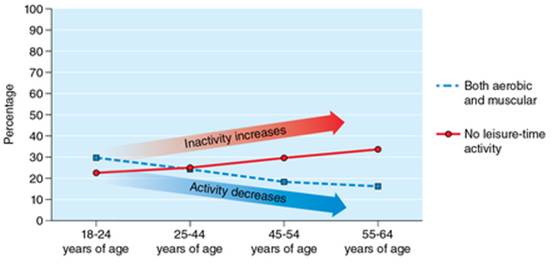
If you are a healthy adult between the ages of 18 and 64 years, this chapter is for you. (If you are between the ages of 50 and 64 years and have a chronic condition or functional limitation, then chapter 11 provides more appropriate guidance.) Adulthood should be a time of experiencing life to the fullest. With robust health and fitness, you can fully embrace your diverse roles within your family, community, and workplace. Unfortunately, throughout this age span, a shift toward sedentary behavior tends to occur (6). The tendency is to become more inactive in leisure time rather than pursue active recreational options (see figure 10.1). In addition, although ideally 100 percent of adults would engage in both aerobic activity and resistance training, the percentage of adults engaging in these activities decreases with age (6). Even though this is a bit discouraging, let’s focus on the positive side—and on you! By reading this book and applying the recommendations, you are taking steps to change your personal health path. By focusing on nutrition and physical activity, you can claim a healthier and more active life.
Figure 10.1 Percentage of American adults engaging in moderate aerobic activity and resistance training and those who are inactive in their leisure time.
Source: U.S. Department of Health and Human Services Office of Disease Prevention and Health Promotion.
Focus on Nutrition
Nutrition is the process of taking food into your body so your body can use that food to provide energy for daily activities and exercise. Too often the word “nutrition” brings to mind unappealing foods without taste. Healthy eating does not mean surviving on dry toast and celery sticks. A balanced diet should include a variety of appetizing foods that provide needed nutrients, as described in chapter 3. Food can have non–nutrition-related functions as well. For example, social celebrations, holiday get-togethers, and expressions of support for a family facing an illness or tragedy often include food. Food is part of everyday life. Rather than seeing nutrition as an obstacle, you can focus on positive food choices as part of your emphasis on a healthy lifestyle.
You may be asking yourself, does nutrition really have much of an impact? To drive home the importance of nutrition, consider that an estimated 16 percent of deaths in men and 9 percent of deaths in women have been attributed to missing the mark with regard to nutrition (4). The following sections will help sharpen your focus on optimizing your diet.
Physical activity is a key factor in maintaining health and fitness during adulthood.

Areas of the Diet to Increase
American adults consume sufficient amounts of most nutrients but are lacking in others (8, 9). Underconsumption of a number of nutrients has been highlighted as a particular public health concern; these include calcium, potassium, vitamin D, and dietary fiber. Iron is also underconsumed by women between the ages of 19 and 50 years (8). Fortunately, many foods contain these vitamins and minerals (7, 8). Table 10.1 lists some examples of good sources. Reflect on your own eating habits and consider small changes you can make to ensure that you consume adequate amounts of these nutrients.
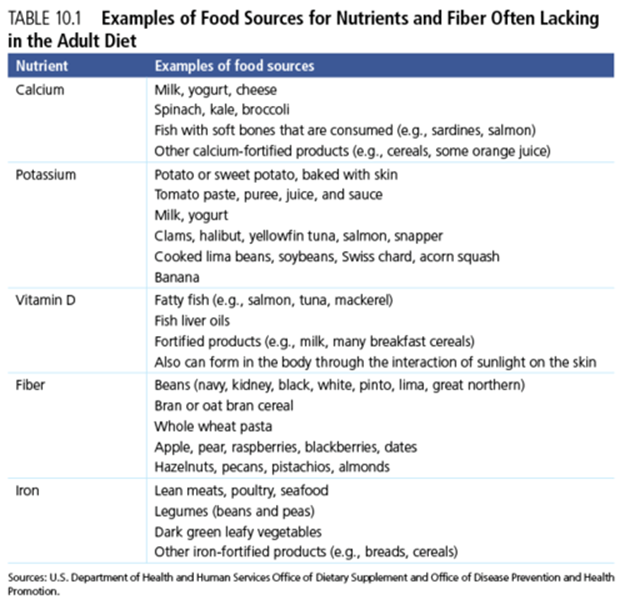
Falling short in regard to these nutrients as well as others (e.g., magnesium, choline, vitamins A, E, and C) is likely related to an inadequate consumption of vegetables, fruits, whole grains, and dairy (8). Take a second look at table 10.1 to identify a couple of items in each row that you could substitute for another less nutritious item in your diet. To ensure adequate iron status, premenopausal women should consume foods with heme iron (e.g., lean meats, poultry, seafood) as well as non-heme sources (e.g., legumes, dark green vegetables, fortified products). When consuming non-heme sources of iron, include foods rich in vitamin C (e.g., orange juice along with fortified cereal), which enhances the body’s ability to absorb the iron (8).
Q&A
What is the recommended intake of folic acid?
Folate is one of the B vitamins found naturally in many foods (e.g., beans and peas, fruits, dark green leafy vegetables, dairy products, poultry and meat). Folic acid is a synthetic form of the vitamin found in fortified foods and supplements (9). Fortification of grain products with folic acid was implemented in the United States to reduce the incidence of neural tube defects. It is recommended that all women capable of becoming pregnant consume 400 micrograms of folic acid daily (from fortified foods, supplements, or both) in addition to the amount of folate consumed as part of a healthy eating pattern (8).
Areas of the Diet to Reduce
Although adults may underconsume some nutrients, they often overconsume other nutrient and dietary components. The Dietary Guidelines reveals that most Americans exceed recommended intakes for added sugars, saturated fats, and sodium. In addition, caloric intake is higher than needed, resulting in weight gain over time. The key is to make shifts in the composition of current foods and beverages consumed in order to ensure adequate intake of needed nutrients within the caloric requirements and personal preferences for each individual (8).
Dietary sodium intake is recommended to be less than 2,300 milligrams per day (8, 10). Salt (or more technically, sodium) intake is linked with higher blood pressure (see chapter 12 for more information on how sodium can be related to high blood pressure). To decrease the risk of developing high blood pressure, keep a handle on your sodium intake and also ensure adequate intake of potassium (10) by checking on sources noted in table 10.1. Both naturally occurring sodium and added salt within the cooking process or at the table account for some of your total intake (12 and 11 percent, respectively). Most salt consumption (77 percent), however, is related to packaged and restaurant food (10). Snack favorites that typically are high in sodium include pretzels, potato or tortilla chips, and salsa. Some items vary in their sodium content among manufacturers. Soup is a good example of a product that can be very high in sodium or reasonable, in the case of some new lower-sodium options. Keep an eye on product labels. Low-sodium products have less than 140 milligrams of sodium, or less than 5 percent of the Daily Value for sodium (10).
Q&A
What can I do to reduce salt in my diet?
Consider the following ways to reduce salt consumption (10):
· Check the Nutrition Facts label and select lower-sodium options.
· Prepare your own food without salting during cooking, and limit adding salt at the table.
· Substitute herbs and spices for salt to flavor food (e.g., no-salt seasoning blends, pepper, rosemary, basil).
· Select fresh rather than processed products when possible.
· Examine sodium content of condiments like ketchup and salad dressings; select low- or no-sodium options and watch portions.
Saturated fat should account for less than 10 percent of total calories. Only about 29 percent of the U.S. population meets this target. Common sources of saturated fats include mixed dishes, especially those containing meat or cheese (e.g., burgers, sandwiches, pizza, pasta or rice dishes), as well as snacks and sweets, protein foods, and dairy products. Shifting from consuming food items high in saturated fats to products high in polyunsaturated and monounsaturated fats is recommended (8). Monounsaturated fat sources include olive and canola oils. Polyunsaturated fat sources include foods (e.g., nuts, fish) as well as various oils (e.g., soybean, corn, sunflower).
Among adults, intake of added sugars is also too high (8). Some common sources of added sugars are snacks and sweets (e.g., cakes, cookies, dairy desserts, candies, sweet toppings). A major source of added sugars is beverages, accounting for almost half of added sugars consumed by Americans. Consider how shifting from sugar-sweetened beverages such as soft drinks and sweetened fruit drinks to water or low-fat or fat-free milk provides benefits for calorie reduction (with water) or improved nutrient content (e.g., milk) (8).
Substitutions can be made in many aspects of one’s diet. Replacing refined grains with whole grains is recommended. Refined grains are found in breads, tortillas, mixed dishes using rice and pasta, snacks, chips, and crackers. Some examples of whole-grain products are whole-grain bread, whole wheat cereal, brown rice, and wild rice. In situations when a substitution is not available or desired, decreasing portion size could be considered as a way to reduce added sugars in the diet.
When considering areas of your diet that might be improved, focus on some areas to modify, making shifts in your diet where needed. Keep a healthy dietary pattern in mind rather than becoming solely focused on restriction. These are some suggestions (8):
· Adjust recipes, mixed dishes, and even sandwiches to reflect greater emphasis on fruits, veggies, and whole grains.
· Focus on including foods providing underconsumed nutrients (e.g., vegetables, fruits, whole grains, seafood, nuts, and dairy products).
· Replace saturated fats with polyunsaturated and monounsaturated options.
· Make water a preferred beverage choice.
One last area to think about related to overconsumption is caloric intake. To maintain body weight, the number of calories consumed in foods and beverages must equal the number of calories the body uses for basic functions as well as to provide energy for work, activities of daily living, and exercise. Shifts in this balance as a result of even small amounts of extra calories on a daily basis may contribute to the gradual increase in body weight often seen throughout adulthood. One of the benefits of a physically active lifestyle is the additional calories used on a daily and weekly basis. For more detailed information on weight management, see chapter 18.
Dietary Focus
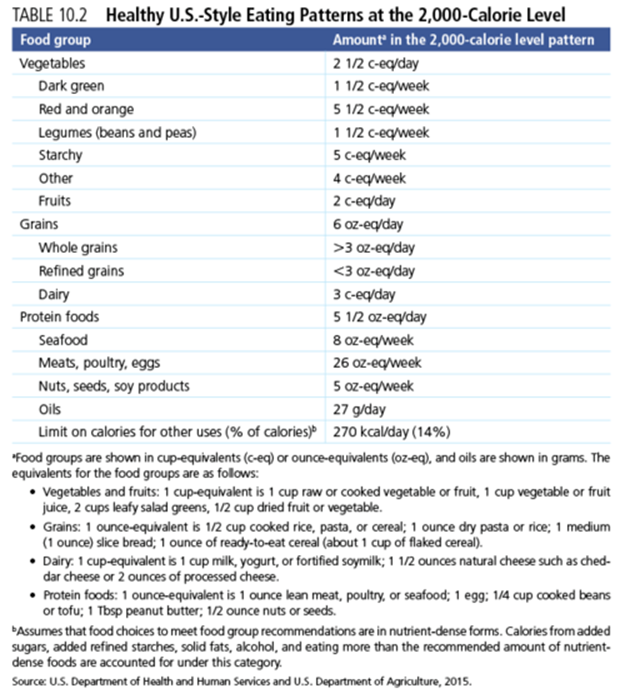
Adults should focus on an adequate intake of all vitamins and minerals and, in particular, those listed previously as often being underconsumed. The foods and beverages you consume create your eating pattern and should reflect your cultural and personal preferences (8). Meeting nutrient needs while staying within limits in some areas (e.g., saturated fats, added sugars, sodium, calories) is the focus. An example of the Healthy U.S.-Style Eating Pattern (2,000-calorie level) is shown in table 10.2.
Q&A
Does alcohol have any place in the dietary pattern of adults?
Alcohol should be consumed only by adults of legal drinking age, and there are situations in which alcohol is not recommended (e.g., during pregnancy, when one is taking certain medications, before driving). The Dietary Guidelines does not recommend that individuals start to drink alcohol; if they do, moderation is recommended (i.e., up to one drink per day for women and up to two drinks per day for men) (8). Alcohol contains about 7 calories per gram and thus should be accounted for within one’s overall dietary intake.
To keep a positive viewpoint on nutrition, focus on dietary patterns rather than a list of “good foods” and “bad foods.” Recommendations include these (9):
· Focus on a dietary plan that is rich in vegetables, fruit, whole grains, seafood, legumes, and nuts.
· Keep your dietary plan moderate for low- and nonfat dairy products.
· Dietary patterns should be lower for red and processed meat and low in sugar-sweetened foods and beverages as well as refined grains.
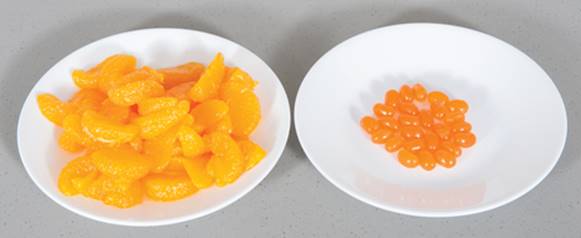
Simple changes can have an impact over time. Bringing an apple, orange, or a container of cut vegetables to work may help you avoid grabbing a less nutritious, high-calorie item from a vending machine. Ideally, food selections should be nutrient dense. This simply means that the food item packs the biggest punch possible with regard to vitamins, minerals, and fiber for the least number of calories (8). Compare 100 calories of jelly beans to 100 calories from orange slices. First, the orange offers a greater quantity (over a cup’s worth) for the same 100 calories (see figure 10.2). Second, the orange provides calcium, potassium, vitamin C, and folic acid among other vitamins and minerals. In contrast, 100 calories of jelly beans (about 25 pieces) provides some potassium and sodium along with added sugar. The potassium in the orange slices is over 375 milligrams compared to 10 milligrams in the jelly beans. This simple example clearly demonstrates the benefits of consuming natural, nutrient-dense foods.
Figure 10.2 Nutrient density: Compare 100 calories of jelly beans to 100 calories of orange slices.
With these guidelines in mind, you may realize that your current diet is right on track, or you may see that changes are needed. If some changes are desired, consider a series of substitutions rather than a sudden overwhelming overhaul. Food should be enjoyed, and with some attention, it can also be good for your health.
Focus on Physical Activity
Incorporating an exercise program into your busy day may seem impossible. Adulthood is full of responsibilities at home as well as at work. Time spent on exercise may feel frivolous or even selfish. In reality, a regular exercise program is one of the most important investments you can make for your future and that of your family. If you have been reading from the beginning of this book, you are aware of the impressive list of benefits from exercise—physical as well as mental. Your personal health is valuable, but it requires attention on a regular basis.
Each day you have the opportunity to make investments in your future health. As with a financially solid retirement plan, you need to start early and continue for the greatest benefit. You don’t need to spend hours per day to be healthy, but it does require a time commitment. Take a moment to reflect on the reasons you can benefit from including exercise in your weekly plan. This reflection is a process you will want to repeat in the future because your areas of focus will likely change over time. Chapters 2 and 4 offer additional guidance about formulating your personal expectations and goals, as well as hints for fitting exercise into your busy schedule.
The benefits of exercise for adults of all races and ethnicities, both males and females, have been clearly documented (1, 3, 5). As discussed in more detail in chapter 1, physical activity reduces the risk of premature death from heart disease as well as some cancers. If you improve your fitness with regular aerobic exercise, you can reap the rewards of lower blood pressure, better cholesterol levels, and a decreased risk of both heart disease and stroke. Regular exercisers can also lower the risk of developing type 2 diabetes, colon cancer, and breast cancer. In addition, adults who engage in a regular activity regimen have a healthier body weight and body composition as well as other benefits such as increased bone strength, improved sleep quality, and lower risk of depression. These benefits are impressive—and are yours for the taking!
In view of the numerous health benefits of regular exercise, it is surprising how many people are not active. Although the reasons vary widely, for some, fear of being injured or having a heart attack during physical activity overrides any potential benefits they might gain from being active. Risks of adverse events during physical activity are real, but for most people they are outweighed by the benefits (5).
To help minimize risks, begin at a low to moderate intensity and build your fitness slowly over time (1). Complete the preparticipation screening provided in chapter 2. If needed, consult with your physician or health care provider to determine whether you need to modify any general exercise guidelines because of your personal health history and current activity status.
Physical Activity Guidelines for Adults
Adults need to move beyond the usual light or even sedentary daily activities to include physical activity focused on aerobic fitness, muscular fitness, flexibility, and neuromotor fitness (1). The American College of Sports Medicine strongly supports the inclusion of these components to provide a complete and balanced physical activity program.
Aerobic Fitness
Aerobic fitness refers to your body’s ability to take in and use oxygen during physical activities. Assessment of aerobic fitness can require complex laboratory measurements, but chapter 5 outlines two simple ways to estimate your fitness (for more details on the one-mile walking test and the 1.5-mile run test). The final score from whichever test you complete is an estimate of your  O2max, or the maximal amount of oxygen your body can use during activity. The higher the value is, the better your aerobic fitness is. You can compare your score to those of others of your sex and age in table 5.1.
As you may have noted when looking up your score, O2max tends to decrease with age. Loss of fitness occurs as a result of the physical changes associated with aging, but it also is influenced by activity level. Sedentary, or inactive, lifestyles speed up the age-related decline in fitness. In contrast, maintaining a physically active lifestyle with focused attention on aerobic activities can help you retain your fitness. Although a balanced exercise program isn’t the elusive fountain of youth, maintaining (or beginning) an exercise program will provide a better quality of life.
The U.S. government’s Physical Activity Guidelines for Americans, as well as ACSM, recommends that adults engage in regular aerobic physical activity (1, 5). The following provide substantial health benefits:
· Moderate-intensity aerobic activity at least 30 minutes per day five days per week (or a weekly total of at least 150 minutes), or
· Vigorous-intensity aerobic activity at least 20 to 25 minutes per day three days per week (or a weekly total of 75 minutes), or
· A combination of moderate-intensity and vigorous-intensity aerobic activity at least 20 to 30 minutes per day three to five days per week
Moderate intensity refers to activities that noticeably increase your heart rate and breathing. An example is brisk walking. Vigorous-intensity activities substantially increase heart rate and breathing. Examples are jogging and running. For more details on aerobic fitness, see chapter 5.
For additional health benefits such as lowering the risk of colon and breast cancer, the Physical Activity Guidelines suggests a greater amount of physical activity, which can be achieved by one of the following targets (5):
· 300 minutes of moderate-intensity activity per week, or
· 150 minutes of vigorous-intensity activity, or
· A combination of moderate- and vigorous-intensity activity (e.g., approximately 40 to 60 minutes per day three to five days per week)
Exceeding these levels may provide even more benefits (e.g., a lower risk of premature death), although scientists have not yet determined what the upper limit is above which no additional health benefits accrue (5).
Muscular Fitness
Muscular fitness includes muscular strength (how much you can lift in one maximal effort), muscular endurance (maintaining a muscle contraction or contracting a muscle repeatedly without tiring), and power (rate of muscular action) (1). Muscular fitness is a vital component of an exercise program (5). Loss of muscle is a common result of aging and is technically referred to as sarcopenia. As muscle function is lost, the ability to generate force declines (2). This loss of muscle translates into difficulty lifting, pushing, pulling, and other activities of daily living. In addition, muscular fitness is vital for full participation in most recreational and sporting activities.
The Physical Activity Guidelines for Americans and ACSM both suggest resistance training a couple of days per week to maintain muscular fitness or improve your current fitness level (1, 5). You should resistance train each of the major muscle groups two to three times per week, ensuring that you have at least 48 hours of recovery time between these sessions (i.e., don’t resistance train the same body part two days in a row). Each session should include two to four sets of 8 to 12 repetitions and a rest between sets of 2 to 3 minutes (1). For more details on resistance training, see chapter 6, which includes assessments of muscular fitness and activity suggestions.
Flexibility
Flexibility is a fitness attribute that can influence your ability to perform activities in your day-to-day life. The ability to reach, bend, and turn provides freedom of motion. Many recreational activities and sports also benefit from a full range of motion (e.g., golf, tennis, and swimming). Therefore, stretching is recommended for all adults.
Stretching should target all of the major joints in the body and should be done when the muscles are warm in order to be most effective (1). ACSM recommends that adults stretch at least two to three days per week. When using static stretching, hold the stretch for 10 to 30 seconds and repeat this in order to complete a total of 60 seconds of stretching for each activity. For example, if you hold the stretch for 15 seconds, you would repeat this four times (i.e., 15 × 4 = 60). For dynamic stretching, be sure to use controlled movements and bring the targeted body part through its range of motion. More complete details on flexibility and stretching are found in chapter 7.
Neuromotor Fitness
Neuromotor fitness includes balance, coordination, gait, agility, and proprioception (this refers to your sense of body position as you move in your environment) (1). Although neuromotor training is more often a focus for older adults for fall prevention, younger adult athletes may find help with injury reduction due to improved balance and agility (1). Few research studies have examined benefits in adults, but consider the potential benefit for movements you engage in every day (3). Neuromotor fitness affects your ability to effectively function during routine physical activities—thus the alternative term often used is functional fitness (1). Unlike the situation with other components of fitness, precise recommendations are not yet established. You may want to consider including some of the activities from chapter 8 a couple of days per week.
Programs to Meet and Exceed the Physical Activity Guidelines for Adults
Chapters 5, 6, 7, and 8 provide detailed information on activities to promote aerobic fitness, muscular fitness, flexibility, and functional (neuromotor) fitness. Now it is time to put these components together into a weekly program.
As you begin an exercise program, be realistic. Reflect on the type of program that will work with your schedule. Remember, you can split your activity into several shorter bouts over the course of the day (each should be at least 10 minutes long). Including 10 minutes of brisk walking in the morning, at noontime, and in the evening is a way to meet the target for moderate-intensity aerobic activity. For others, one 30-minute period may work better. No one pattern is right or wrong. The best exercise program is one you enjoy and continue to follow for years to come.
Q&A
Can fitness be achieved on a budget?
Cost doesn’t need to be a barrier. You can include exercise for little to no cost. If your employer provides a fitness facility at the workplace, you may be able to adjust your schedule to take advantage of this opportunity. Outdoor activities like walking or hiking can provide great aerobic benefits. If the outdoors isn’t an option due to weather or safety concerns, consider walking at a shopping mall. Your own residence is another potential exercise location. You can include body weight exercises (e.g., push-ups, sit-ups) for free. For another no-cost option, check out workout DVDs at your local library to try some new activities like aerobic dance or power yoga. You could also purchase some inexpensive resistance bands to focus on muscular fitness.
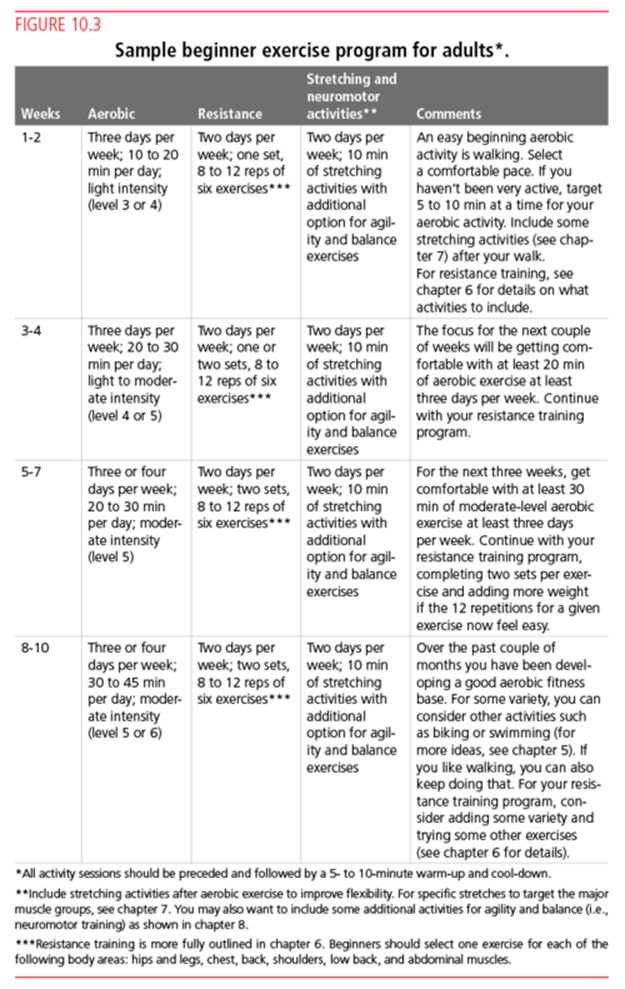
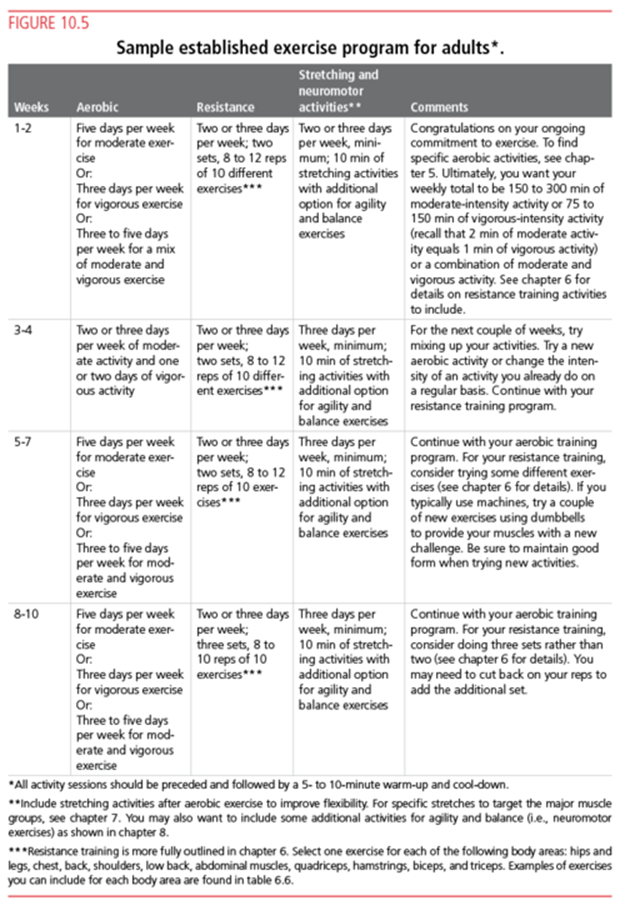
Easing into your exercise program is recommended to decrease your risk of injury and avoid muscle soreness, which can lead to discouragement. Figures 10.3, 10.4, and 10.5 offer sample activity programs for beginning exercisers, intermediate-level exercisers, and more established exercisers, respectively. Note that each program includes aerobic activity, resistance training, stretching, and optional neuromotor activity. You may find that you are able to easily progress through the levels of the program, or you may need to take an extra couple of weeks at each level. The ACSM recommends the following (1):
· Aerobic activity: Typically three to five days per week depending on the intensity of the activity
· Resistance training: Typically two to three days per week
· Stretching for flexibility: A minimum of two to three days per week
· Neuromotor training: Two to three days per week suggested
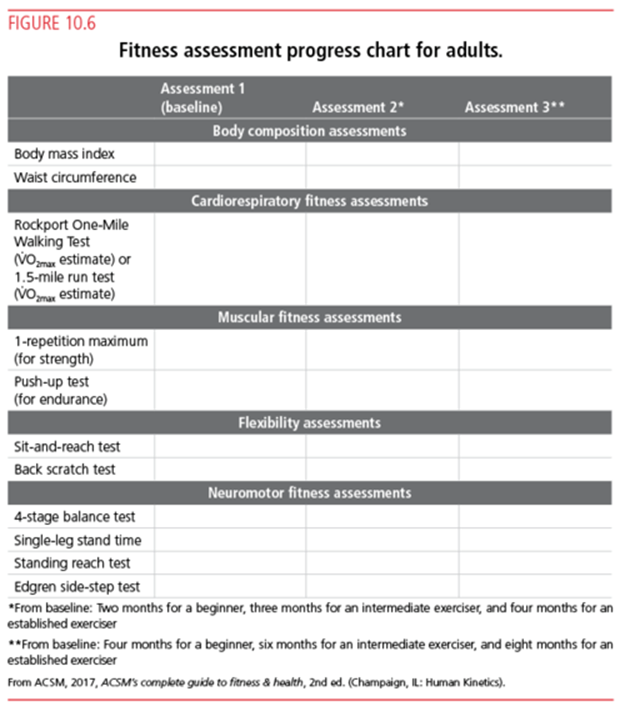
Each activity in figures 10.3 through 10.5 presents a range of days to match your goals as well as your strengths and weaknesses. The simple fitness assessments in chapters 5 through 8 can provide some insight into areas in which you may need to spend some additional time. Repeating the fitness assessments periodically (e.g., every three to six months) can be helpful for charting your progress. This is covered in the next section on tracking your progress.

Tracking Your Progress
No matter where you start (beginner, intermediate, established), advancing your fitness can provide additional health and fitness benefits. You can progress by manipulating the FITT components (frequency, intensity, time, and type of activity) in the sample activity programs in figures 10.3, 10.4, and 10.5. For aerobic activity, you could increase the number of days per week (frequency) or the number of minutes you spend in each exercise session (time). How hard you exercise (intensity) is another factor. Keep in mind that both moderate- and vigorous-intensity activities are ways to improve your health. If you find moderate-intensity activity more attractive, you will have to spend more time exercising than if you did vigorous-intensity activity. Similarly, you can improve your muscular fitness by manipulating the number of resistance training sessions you do per week, the amount of weight or resistance you use, and even the type of resistance activities you do.
As you adjust these FITT components, you can gauge your body’s response in a number of ways. If you are a beginner or intermediate exerciser, you can use the fitness assessments every two to four months. If you are an established exerciser, assessing every four to six months would likely provide sufficient feedback because changes will likely be less dramatic. The rate of improvement will naturally slow down the more fit you become because you will be getting closer to your maximal capacity. At this point, increasing the time between assessments to six months will still help you gauge your status without becoming an undue burden. Figure 10.6 is a chart for recording your scores or rankings.
By tracking your workouts, you can watch for signs of improving fitness. Between fitness assessments, you can note your progress in less objective ways, including the following for aerobic conditioning:
· Your resting heart rate is lower.
· When doing the same activity, your heart rate and perception of effort are lower.
· Your heart rate returns to resting levels faster following your workout.
· You are able to complete the same number of minutes of activity, but at a higher intensity.
· You are able to continue longer at the same intensity.
· You are increasing the total time you spend exercising each week.
For resistance training, you may observe the following as evidence of improvements:
· You are able to lift the same weight 12 times rather than just 8 before becoming fatigued.
· You are able increase the weight lifted or the resistance you overcome.
· You are able to complete more body weight exercises (e.g., push-ups, curl-ups).
· You increase the number of sets completed targeting a particular muscle group.
For flexibility, you may observe that you are able to reach farther or hold a position with less tension than you could earlier in your stretching program. With neuromotor fitness training, you may find that you are more stable when moving or have improved ability to respond to challenges to your balance or agility.
As you progress from week to week, ask yourself a couple of simple questions:
· Is the same workout easier than it was last week?
· Are you able to complete longer workouts or add additional exercises?
· Do you find you feel energized by your exercise program?
If you answer yes to the questions, you are right on track. If you answer no to any of the questions, you may need to slow the pace of your progress or adjust your workouts to ensure that your body has sufficient time to adapt. Because each person is unique, a cookie-cutter approach to exercise does not work. To improve, you need to provide your body with a new challenge, but you also need to allow your body enough time to respond and improve. This is why increases in time or intensity are done slowly over a number of weeks. When assessing the success of your exercise program, don’t forget the real key to a successful exercise program—enjoyment! Continue to look for activities that you enjoy doing so you can maintain your activity.
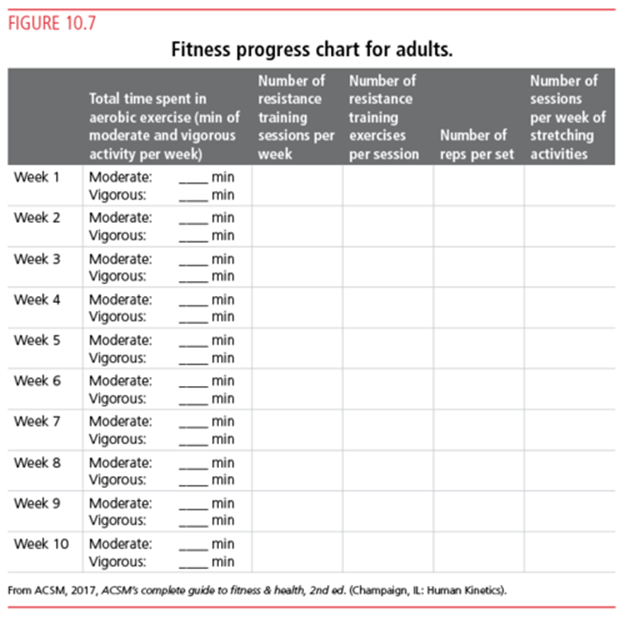
To keep an eye on your progress, consider tracking your weekly workouts. Figure 10.7 is a summary chart that may be helpful. Writing down your workouts can be helpful so you can look back on them. An activity chart provides a weekly accounting of how many sessions have targeted aerobic fitness, muscular fitness, flexibility, and neuromotor fitness (see figure 4.3 for an example).
Regardless of your current fitness level, recording your exercise and reflecting on your progress allow you to check off short-term goals (e.g., increasing the number of minutes per week, increasing the intensity, including different resistance training exercises) as you continue to move to your long-term goals (e.g., reaching the “good” category for aerobic fitness, losing weight, improving your flexibility).
Adulthood can be a hectic and busy time. Too often, personal health and fitness take a back seat just when you can least afford it. Taking charge of your diet and physical activity will provide many benefits (e.g., lower risk of heart disease and type 2 diabetes), as well as a better quality of life. Within your diet, keep a focus on fruits, vegetables, whole grains, and low-fat dairy products while avoiding the overconsumption of fat (especially saturated and trans fats), sodium, and sugar. Physical activity along with a solid nutritional plan will help you maintain your desired body weight as well as promote your overall fitness. Aerobic activities, resistance training, and stretching together provide a comprehensive program to maximize the benefits to your health.