
Weight management is a struggle for many people, but controlling body weight has many health benefits. The U.S. Centers for Disease Control and Prevention (CDC) has classified the American society as “obesogenic” due to the environmental factors that promote excessive intake of unhealthy, high-calorie foods coupled with physical inactivity. This combination has resulted in a culture primed to make its citizens gain body fat. This transformation toward overfatness has not occurred overnight. The number of overweight and obese Americans has gradually increased over the past 20 years. For adults 20 years of age and older, approximately 69 percent are overweight or obese; 35 percent of these adults are classified as obese (4).
Assessing Body Composition: Body Mass Index and Waist Circumference
The terms overweight and obesity are both used to refer to situations in which body weight is higher than recommended for optimal health (since being overweight or obese increases your risk of developing many diseases or health problems) (1). You are overweight if you weigh more than expected for someone of your stature (height), and you are obese if you weigh a lot more than expected. To be more specific, body mass index (BMI) is used to classify people into four subclasses: underweight, normal, overweight, and obese (3). To calculate your BMI, choose your unit of measurement and follow these instructions:
Pounds and Inches
Calculate BMI by dividing weight in pounds by height in inches squared and multiplying by a conversion factor of 703, as follows:
[weight in pounds / (height in inches)2] × 703
For example, if you weigh 150 pounds and are 5 feet 5 inches (65 inches), your BMI calculation would look like this:
[150 ÷ (65)2] × 703 = 25.0
Kilograms and Meters (or Centimeters)
With the metric system, the formula for BMI is weight in kilograms divided by height in meters squared. Because height is commonly measured in centimeters, divide height in centimeters by 100 to obtain height in meters, as follows:
weight in kilograms / (height in meters)2
For example, if you weigh 68 kilograms and are 165 centimeters (1.65 m) in height, your BMI calculation would look like this:
68 ÷ (1.65)2 = 25.0
You can also look up your BMI if you know your height in inches and your body weight in pounds using the calculator (see figure 18.1).

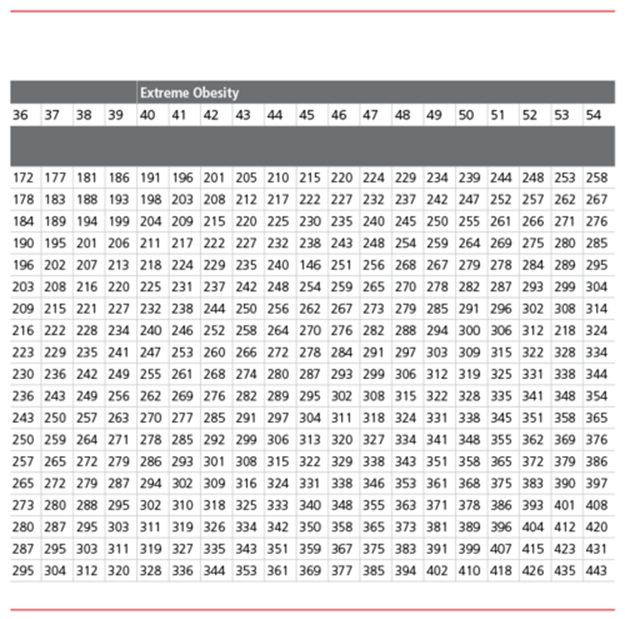
Body mass index is commonly used because it is very easy to measure and also correlates strongly with the percentage of body fat. Excess levels of body fat contribute to a number of health concerns including heart disease, hypertension, diabetes, stroke, and some cancers. Typically, body fat levels are higher as BMI increases. As shown in table 18.1, a BMI between 18.5 and 24.9 kg/m2 is considered normal or healthy (1); this is because BMI within this range is associated with the lowest risk of developing a chronic disease or of dying. People classified as overweight have an increased risk of disease and death, and those who are obese have the highest risk of developing a number of diseases (4, 5).
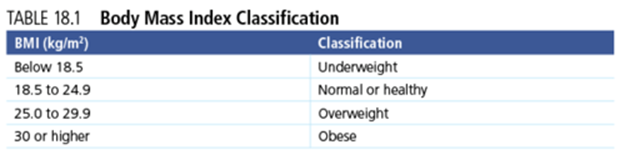
Calculating your BMI is a useful starting point for determining whether you would benefit from losing weight. One thing to keep in mind is that BMI does not distinguish between simply having a higher weight than expected and having excess fat. For example, because muscle is much denser than fat, a very muscular male athlete with low body fat could have a BMI that classifies him as overweight or obese. His weight would be higher than expected for his height, but he would not be overfat and thus not at a higher risk for disease based on body composition. If your BMI is 25 kg/m2 or greater, use your judgment to determine whether you should make weight loss your goal. If you are an athletic person with large muscles and defined musculature, then BMI may not be the best tool for determining your level of body fatness. In such situations, having body composition (percent body fat) measured may be of value, although these techniques require the assistance of a qualified fitness professional (5).
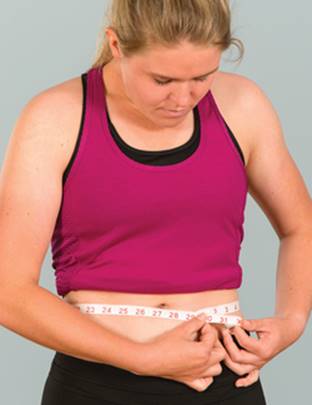
Body fat distribution is also a predictor of health risk associated with obesity. Accumulation of fat around the abdominal area, often referred to as an apple-shaped physique, carries a higher health risk than fat around the hips and thighs (pear-shaped physique). Taking a measurement of your waist circumference is one way to look more closely at abdominal obesity:
· In a standing position, place a tape measure horizontally near your belly button, just above your hip bones, as shown in figure 18.2.
· Make sure the tape is snug but not compressing the skin.
· Take the measurement once you have comfortably exhaled (1).
Waist measures of more than 35 inches (89 cm) for women or more than 39 inches (99 cm) for men classify people as being at increased risk for developing chronic disease (1). Use of both BMI and waist circumference can be helpful in tracking your success at managing your weight (5).
Figure 18.2 Site for measuring waist circumference.
Causes of Obesity
The shape and size of your body is due to a combination of genetic and environmental factors working in unison. Though our genes have not changed over the years, our environment has changed significantly. There is now an abundance of high-calorie, cheap foods and a decreased level of physical activity. In general, your genes create starting points and boundaries that shape how fat or muscular you are likely to become. Although these genetic limits are beyond your control, this does not mean that your body size is set. Environmental factors such as behaviors and lifestyle choices, including food selections and your level of physical activity, ultimately determine how close to your genetic potential you become (4).
Genetic Factors
Genetics play a role in determining a person’s height, weight, body fat distribution, and metabolism. Research studies of twins reared apart having similar body weights and adopted children resembling their biological parents in body type support the genetic influence. Determining the impact of genetic factors is difficult, but genetics may contribute from 50 to 90 percent of a person’s body weight. This means that somewhere between 10 and 50 percent of one’s body weight is a result of environmental factors and lifestyle choices. In addition to body fat, people also tend to inherit specific body types, such as tall and thin or short and stout. This is important to remember because some people may not be able to achieve a desired body shape no matter how hard they train or how diligent they are about food choices. For example, a very tall and thin person may never be able to put on enough muscle mass to look like a bodybuilder; a very muscular, stocky person may never achieve extreme thinness. Another factor out of your control is where body fat is deposited. Some people naturally gain body fat around the abdominal area whereas others accumulate fat in their hips and thighs (10).
Other areas of genetic research include the concept of a thrifty gene and the set point theory. The thrifty gene notion proposes that humans slow their metabolism and store more body fat in times of food scarcity. This may have been an important survival mechanism many years ago in times of famine, but is not so desirable today when one is restricting food consumption voluntarily to lower body weight. Whether there is actually a specific gene associated with this phenomenon is a question scientists continue to examine. In any case, your body’s attempt to protect you when you restrict calories can make it difficult to lose weight.
The set point theory proposes that the brain, hormones, and enzymes work in unison to regulate body weight at a genetically determined level. Any attempt to change your body weight from the set point initiates a series of body responses that ultimately result in a return to your genetically predetermined weight. These body responses may include becoming more efficient at storing fat or controlling metabolism, hunger, or feelings of fullness through the action of various hormones. As tempting as it may be, you should not use the set point theory as an excuse to conclude that weight control is impossible. You may not attain aesthetic perfection, but you can achieve and maintain a body weight and composition that are best for your health and well-being (10).
Q&A
What is a healthy body weight?
Sometimes the number is not the most important thing. People may have an unrealistic expectation about body weight (e.g., returning to their high school weight) that may not be achievable or desirable. A healthy body weight is one at which you are free of or are managing chronic disease, feel good, and can complete physical activities with ease. This may or may not be the number in a formula or a body weight maintained during early adulthood.
Environmental Factors
Your environment is another factor that determines your body weight. Although genetic factors limit what you can accomplish, healthy behaviors and choices, such as choosing the correct foods and portion sizes, getting sufficient quantity and quality of physical exercise, and learning behavioral modification techniques, certainly can help you reach your genetic potential. Overeating and underexercising are often learned behaviors that can become lifelong habits. Children who are not taught to eat a healthy diet and who are not encouraged to engage in voluntary physical activity begin their lives at a clear disadvantage when it comes to maintaining a healthy body weight. It is very difficult to break old habits when the new behaviors, although healthier, are perceived as comparatively unpleasant. Telling children who typically eat ice cream while watching television after school that they instead should eat an apple and then play outside may generate a less than enthusiastic response. Over time, new habits can be established by building on small positive changes. Behavior modification strategies are discussed later in the chapter.
Determining Energy Requirements
Establishing or maintaining a healthy body weight requires an understanding of how the body uses food to provide energy. In addition, when weight loss is desired, a plan of action is needed for long-term success.
Energy Balance
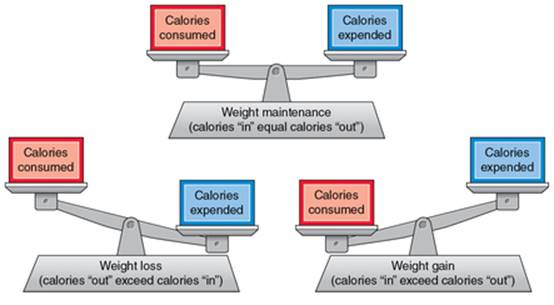
Understanding the concept of energy balance (EB) is critical if you want to understand how body weight is regulated in human beings. Energy balance in its simplest form is simply a comparison of the amount of energy consumed as food with the amount of energy expended through the combination of resting metabolism, activities of daily living, and voluntary physical exercise. The three possible states of EB are positive, negative, and neutral. Positive EB occurs when you consume more energy (calories) than you expend, resulting in weight gain. Negative EB occurs when you expend more calories than you consume, resulting in weight loss. Neutral EB occurs when the amount of calories you consume equals the amount that you expend as shown in figure 18.3 (10).
Figure 18.3 Energy balance: calories consumed versus calories expended.
Energy balance is most meaningful when it is measured over a reasonably long period of time. Being out of EB for one day has no discernible impact on body weight, but being out of EB over several weeks or months can cause significant weight gain or loss. Whereas the small daily positive EB is not discernible to the naked eye, being in positive EB for long periods is definitely noticeable. Unfortunately, most people notice that they are in positive EB only after they have gained weight.
Although the concept of EB is relatively straightforward, actually implementing a weight loss program is not quite as simple. Seeking the advice of qualified nutrition and exercise professionals, such as a Registered Dietitian or an ACSM-certified exercise professional (see chapter 2 for information on finding a certified professional), is a wise approach if you are unsure how to most effectively balance dietary intake with regular physical activity.
Many external factors control your food intake and physical activity patterns. Factors that influence food intake include cultural rituals; childhood experiences; educational and socioeconomic status; nutrition knowledge; convenience; and food flavor, texture, and appearance (10). Motivation, perceived lack of time, and lack of knowledge may contribute to the choice not to exercise. Qualified nutrition and exercise practitioners have the knowledge and skills to help you control the factors that determine whether you are in positive, negative, or neutral EB.
Energy Balance and Weight Loss
There are approximately 3,500 calories in a pound of body fat. This means that for each pound of body fat, the body must achieve a negative EB of 3,500 calories. For example, to lose 1 pound (0.45 kg) in the upcoming week, an energy deficit of about 500 calories per day (3,500 calories divided by 7 days) is needed. (Note that this is a general estimate; many physiological factors influence the precise rate of weight loss.) One can reach this caloric deficit by reducing calorie intake, increasing energy expenditure, or, ideally, combining the two. To achieve this short-term goal one could consider walking 3 extra miles (4.8 km) and drinking one less nondiet soda per day than normal, or walking only 1 extra mile (1.6 km) and drinking two fewer sodas. The most effective approach over the long term is to combine moderate calorie restriction with moderate daily exercise.
Components of Calorie Expenditure
The number of calories you burn on a daily basis is commonly referred to as total energy expenditure (TEE). Three major components contribute to TEE: the calories expended at rest; the calories expended during exercise; and the calories expended during the digestion, absorption, and storage of food after eating. The largest component, which accounts for about 60 to 70 percent of TEE, is the calories used while the body is resting comfortably, also known as resting metabolic rate (RMR) or basal metabolic rate (BMR).
The term resting metabolism is actually a misnomer because the body is never truly at rest. Inside your body a constant array of activity is occurring that must be fueled at all times. For example, your heart beats about 70 times per minute, your neurons fire at lightspeed 24 hours per day, and your white cells are constantly fighting invaders and replacing old or damaged tissue. All of these activities that keep you alive and allow you to look basically the same from one day to the next are exceedingly costly from an energy standpoint. So, your resting metabolism is essentially what makes you “you,” and the more of “you” there is, the greater your RMR is. Thus, it is not surprising that RMR is highly related to body mass, particularly the amount of muscle you have. Skeletal muscle is a highly active tissue that contributes a great deal to resting metabolism. The quantity of skeletal muscle in your body is something that you can control to some extent through resistance training, which is discussed further in the section on physical activity.
A second component of TEE includes all energy burned off during physical exercise. This is also known as the thermic effect of activity. It represents any movement your body performs above the resting level and includes fidgeting, doing chores, and participating in formal exercise. This component makes up 15 to 30 percent of the TEE in most people; however, it is the most variable. For example, it may be lower than 15 percent in a very sedentary person and more than 50 percent in a marathoner. As long as you do not have a physical disability, this is the component over which you have the most control. You can choose how many calories you burn through various forms of physical activity (1, 10).
The third component of TEE encompasses all the activities that occur in the body after consumption of food, including digestion, absorption, and the transport and storage of nutrients throughout the body. This incremental energy cost of eating, also known as the thermic effect of food, is a relatively small (5-10 percent) component of TEE. The thermic effect of food is not something you can control to any significant extent for the purpose of weight management. Some diet books claim that you can increase the thermic effect of food by exploiting the fact that more energy is required to digest and metabolize carbohydrates and proteins than fats, but the total number of extra calories burned using these techniques is not very high and probably not worth the effort.
Estimating Energy (Calorie) Needs and Expenditure
Probably the first question that comes to mind when contemplating your own body weight is how many calories you need. There are sophisticated laboratory techniques to estimate this, but these tests are not practical for most people. One simple way to estimate how many calories you need to maintain current body weight is displayed in table 18.2 (13). Simply find the column that best fits your activity level and you can see the estimated calorie requirements based on age and sex.

This method provides just an estimate and a value for maintaining your current weight. If you want to lose weight you need to reduce your calorie intake. An alternative, more accurate method is available from the Choose MyPlate website, devised by the U.S. Department of Agriculture (USDA) (www.choosemyplate.gov and then select the SuperTracker from the list of online tools). This website is completely free and maintained by the USDA. You can create a profile and have a password-protected account that you can use to calculate your energy needs and then track your food intake and energy expenditure over the long term. You will be asked to create a profile that includes your age, sex, physical activity level, height, and weight. Once you complete this you will be given your energy expenditure estimate and be directed toward suggested meal plans to help achieve your goals. If you are trying to lose weight, you can set your profile based on a weight loss goal or a daily calorie reduction. Once your profile is complete, you can look up the nutrition information for food items; track your weight, daily food intake, and physical activity; set goals; and even keep track of your favorite recipes.
Please be aware that this site is designed for people who are free of disease or medical conditions that could affect nutrient requirements. It does not replace the advice of a Registered Dietitian who is trained to address the unique needs of people with various medical conditions. Rather, the MyPlate website is a tool to help you get started in managing your body weight.
It is important to understand that these methods provide only estimates that should not be accepted as absolute values. The estimates are designed to meet the average requirements, but there are interindividual differences that cannot be ignored. You should use these estimates as a starting point but be prepared to adjust your food consumption if you are not progressing as expected. If you consume the suggested amount of calories and your body weight changes unexpectedly, then you will need to adjust your calorie intake up or down depending on your desired outcome.
Q&A
What is a safe rate of weight loss?
The effects of rapid weight loss can include a starvation response in which your metabolic rate is lowered more than with normal weight loss. This makes it even harder to maintain that weight loss. The National Institutes of Health recommends weight loss of 0.5 to 1 pound (0.2 to 0.45 kg) per week for those with a BMI 27 to 35, 1 to 2 pounds (0.45 to 0.9 kg) per week for those with a BMI greater than 35.
The MyPlate website can help you estimate energy expenditure during exercise. In addition, if you are using exercise equipment, many devices display the number of calories burned during an exercise session. If you plan to use such readings to help manage your body weight, be sure to enter your age, weight, and sex into the machine’s console to achieve the most accurate estimate of calories burned; otherwise, the estimate you receive will be based on the average person and may not be accurate for you. Also, try to use the machines as they were designed to be used. For example, hanging on to the side bars while walking on a treadmill produces erroneous calorie expenditure results because not all of your body weight is being supported throughout the exercise as is assumed in the calorie calculations.
Healthy Approaches to Weight Management
The most successful fat losers are the ones who shed body fat and keep it off over the long haul. Many people have experienced remarkable short-term weight loss only to see it all (or more) return in a few short months. For this reason, weight reduction programs need to be sustained efforts rather than all-at-once approaches. You don’t have to get back to your goal weight as fast as you can. Attempting to attain your goal weight as fast as possible will most likely jeopardize your long-term prospects.
Losing as little as 10 percent of your current body weight can be beneficial to health. Once you have met this initial goal, you should try to maintain that weight loss for three to six months before deciding whether an additional 5 to 10 percent weight loss is warranted. Weight maintenance between cycles of weight loss is believed to allow the body to adjust to its new weight and gives you time to master the behaviors it took to achieve it. Of course 10 percent is not a magic number, but the general idea is that once you’ve maintained a modest weight loss for a lengthy period of time, you have likely made permanent lifestyle changes that will support your new lower weight and allow you to attempt further weight loss without overwhelming your resolve. A recommended amount of weight loss is 0.5 to 1 pound (0.23 to 0.45 kg) per week if your BMI is between 27 and 35 kg/m2 and 1 to 2 pounds (0.45 to 0.9 kg) per week if your BMI is greater than 35 kg/m2. It is desirable to achieve a moderate weight loss of 5 to 10 percent over approximately six months. This slow and steady approach may be the best way to sustain weight loss and prevent regain (9).
Managing Your Weight After Weight Loss
Even after successful weight loss, the challenge remains to avoid regaining the weight. To more fully understand the difficulties associated with weight maintenance, researchers have taken a positive approach by looking at the characteristics of individuals who have lost weight and then successfully maintained the weight loss. The most comprehensive research data on weight management comes from the National Weight Control Registry. This is an ongoing research study that has monitored over 5,000 people who have lost an average of more than 60 pounds (27 kg) and have kept it off for an average of five years. Successful fat losers in this registry tend to do the following (8):
· Consume a low-calorie, low- to moderate-fat diet
· Limit consumption of fast food
· Eat breakfast every morning
· Have consistent food intake from day to day
· Eat smaller meals four or five times per day
· Weigh themselves regularly and take corrective action as needed
· Watch TV less than 10 hours per week
· Participate in moderate-intensity exercise for 60 to 90 minutes per day
Two key points to take away from these findings are the importance of regular physical activity and portion control. Portion control helps ensure that you do not consume excessive calories; this is actually more important than the relative distribution of carbohydrates, proteins, and fats in the diet.
Nutrition and physical activity together are important in weight management. The upcoming sections highlight how you can manage your body weight through dietary choices as well as exercise.
Fruits and vegetables are part of a healthy nutrition plan.

Focusing on Nutrition
Nutrition is an important part of the equation when one is managing weight. The foods and beverages you consume determine the calories you add to your body each day. Keeping the calories you consume in balance with the calories you expend helps you maintain your body weight.
Macronutrient Intake
As you learned in chapter 3, the macronutrients (carbohydrates, proteins, and fats) are required in the diet in relatively large amounts. On average, carbohydrates and proteins contain 4 calories per gram, whereas fats contain 9 calories per gram and thus are more energy dense. Keep in mind that all three macronutrients are required for optimal health. No single distribution of calories from carbohydrate, fat, and protein is widely accepted as the most effective for weight management (9). This is reflected in the percentage ranges for each of the macronutrients that are presented in the upcoming sections.
Carbohydrate’s Effect on Weight
The primary function of dietary carbohydrate is to fuel body activities. The simplest form of carbohydrate found in the human body is glucose (a sugar). Glucose is the sole fuel source for your brain and central nervous system, so it is absolutely critical in your diet. Glucose also powers skeletal muscle contractions, particularly during intense physical activity. Glucose essentially has three fates in the body: (a) It powers cellular activity; (b) it is stored in the muscles and liver in a different form of carbohydrate called glycogen; and (c) it is converted to fat and stored in adipose tissue throughout the body. Although all three fates occur simultaneously, the third tends to predominate only when carbohydrate ingestion exceeds the body’s energy needs. Thus, it is possible to gain fat tissue by overconsuming carbohydrates.
Insulin also has a role in promoting fat storage in the body. Insulin is a hormone released by the pancreas (a small organ located in your abdomen) that helps to store carbohydrate in body cells in response to eating carbohydrates. The higher the concentration of carbohydrate consumed, the greater the amount of insulin secreted into the blood. If you consume a diet high in carbohydrate but not in excess of your energy needs, you will not gain weight. However, a diet high in carbohydrate that exceeds your energy needs creates an environment in which insulin-facilitated fat storage is prominent. You should consume enough carbohydrates to allow your body to perform appropriate levels of physical activity, but not so much that it puts you into positive EB and results in fat storage (10).
The current adult recommendation for carbohydrate is 45 to 65 percent of total energy intake (7). Relatively sedentary people do well at the low end of the range, and very active people require higher amounts of carbohydrate to support elevated energy demands. Many diet books promote a low-carbohydrate diet for weight loss, but current scientific evidence does not support this approach. Most research using low-carbohydrate diets shows significant short-term weight loss, but the long-term success rate is not well established (9). The failure to exhibit sustained success probably is the result of a very restrictive diet coupled with insufficient lifestyle changes.
Protein’s Effect on Weight
Normally, dietary carbohydrate and fat supply the body with virtually all the fuel it needs, thereby sparing protein for its other important functions. Protein contributes significantly as a fuel source only when blood glucose drops to very low levels, such as during the late stages of very long-duration exercises. Adults should consume protein equal to 10 to 35 percent of their total energy intake (7). Because dietary protein tends to keep you feeling fuller longer, you should consume protein with each meal and snack in order to curb overeating (10).
Fat’s Effect on Weight
Similar to carbohydrates, dietary fat provides the body with fuel. The current recommendation for adults is to consume 20 to 35 percent of total energy intake in the form of dietary fat (1). Also like carbohydrate, fat consumed in the diet has three metabolic roles: (a) It is used to power the body’s activities, (b) it is stored in adipose tissue as body fat, and (c) it is converted to an entirely different form called ketones, which some cells can use in place of glucose. The first two roles are the most common; the third tends to occur only when dietary carbohydrate intake is too low and blood glucose levels fall below normal levels.
Because dietary fat is the most energy-dense macronutrient and is easily converted to body fat, consuming a low-fat diet seems to be an obvious approach to take to modify your body weight. Furthermore, reduced-fat diets may have beneficial effects on other health conditions such as high blood lipids (9). A low-fat diet can be a useful strategy as long as you are not overconsuming other macronutrients. For example, it is easy to find fat-free foods at the grocery store, but many of these foods contain an abundance of carbohydrates and calories. A word of caution about low-fat diets: Low fat does not mean no fat! Some dietary fats are absolutely essential to human life; without them, body cells would literally break apart. This is why current recommendations set a floor at 20 percent of total energy intake.
Obesity and Inflammation
Nutrition affects many aspects of health, including body weight and chronic diseases. Consider the choices you make and how they can promote better health.
· New scientific evidence suggests that there may be a relationship between obesity and inflammation.
· Anti-inflammatory eating is probably a good idea for the prevention and management of many chronic diseases.
· Anti-inflammatory eating includes choosing healthy fats like olive oil, canola oil, nuts, seeds, fatty fish, and omega-3–enhanced products and consuming whole grains, legumes, fruits, and vegetables.
Other Nutritional Strategies for Successful Weight Management
Successful weight management can be a challenge. In addition to the balanced approach to nutrition already discussed, additional considerations are to avoid fad diets, to set goals, and to pay attention to portion size.
Avoid Fad Diets
New diet books appear on the market regularly. If the diets were as easy as promised and resulted in weight loss and long-term maintenance, obesity would not be such a problem. Many of these efforts are just marketing gimmicks without any credible scientific research to support the claims. If the diet seems too good to be true, it probably is.
No single macronutrient distribution works best for everybody. If you find a plan that eliminates or severely limits one of the macronutrients, it is probably a fad diet that will likely fail in the long term. For example, some popular diets on the market advocate eating only foods that have a low glycemic index, which is basically a measure of the extent to which a food causes blood glucose levels to rise. As the body senses increases in blood glucose, insulin is released. The diet is based on the idea that insulin promotes fat storage, so eating only low glycemic index foods will minimize insulin’s effect. This sounds reasonable except that it doesn’t work (9). This oversimplified explanation of insulin’s action ignores many aspects of the process, including whether the person is in positive or negative EB and the effect that consuming various combinations of foods has on the glycemic index. See How to Identify a Fad Diet for information on recognizing a fad diet.
Focus on developing positive dietary habits that are sustainable for a lifetime, as quick fixes do not work. The following are components of sound weight management plans (10):
· They promote a reasonable rate of weight loss.
· They recognize a reduced or controlled energy intake as part of your regular mindset.
· They promote regular physical activity.
· They incorporate behavior management.
· They acknowledge the need for lifelong changes to maintain healthy weight.
· They provide flexibility for eating out or in social settings.
· They promote all aspects of health, not just weight loss.
· They include advice from qualified nutrition professionals such as Registered Dietitians.
How to Identify a Fad Diet
In general, fad diet plans have the following characteristics (10):
· They tend to advertise quick and easy weight loss.
· They have limited food selections or eliminate entire food groups altogether.
· They use testimonials instead of discussing and referencing sound scientific studies.
· They are promoted as a cure for many ailments.
· They may recommend expensive supplements.
· They are hard to plan for and follow since they require change in habits overnight.
· They ignore the need to make permanent lifestyle changes.
· They criticize credentialed health professionals or the scientific community.
Set Realistic Goals
Both weight loss and weight maintenance take work and planning, so be sure to set and regularly reevaluate your goals in order to succeed. When establishing your goals, refer to the discussion in chapter 4 of SMARTS goals, which reflect the characteristics of effective goals in that they are specific, measurable, action-oriented, realistic, timely, and self-determined (1). Instead of “I will try and make better food choices,” consider the specific goal “This week I will bring lunch from home three times.” To keep goals measurable, replace the general goal “I will drink less soda” with “I will replace my afternoon soda with plain iced tea.” An action-oriented and realistic goal might be “I will preplan three breakfasts, lunches, and dinners this week” rather than “I will eat perfectly for the next seven days without a mistake.” Maintaining a time line is also valuable. For example, instead of “I will search the Internet for recipes when I get a chance,” consider “I will find five healthy recipes that I will try over the next two weeks.” Determining the right goals for yourself will help you achieve success. Once you have met your SMARTS goals, you can establish new ones for future use, and eventually you will develop some positive habits.
Pay Attention to Portions
There is much evidence that portion control is an effective method for weight loss and maintenance (9). At first it may seem burdensome to weigh or measure items, but eventually it becomes a habit. A great place to start learning about portions is the Choose MyPlate website (www.choosemyplate.gov), which provides information about appropriate portion sizes for each food group. You should also pay attention to the portions (serving sizes) on food labels. A food item that looks like a single serving may actually comprise several portions. At home, weigh and measure for a while and use the same dishes consistently. With practice, you will be able to easily estimate the portions without the use of a scale or measuring device. Check your portion sizes over time because they tend to creep up.
Portion Control Made Practical
To gain a better understanding of portion control, try to master the skill of reading food labels and apply that knowledge to the amount of food you normally eat. Learn how many calories there are in a typical serving of the foods that you eat most often. Actually visualize what a standard serving of your favorite food looks like on the plates you have at home. You may be surprised at how small a single serving appears on your plate or in your bowl and realize that you are likely eating two or three servings instead of only one.
A couple of simple tips to help with portion control are to put food on your plate in the preparation area and bring only that serving to the table (box up the leftovers immediately for another day) and to serve meals using smaller plates or bowls. Both of these techniques will help you more accurately visualize the amount of food you consume.
Focusing on Physical Activity
Physical activity is important for overall health as well as for long-term weight management. This section highlights some differences from the general recommendations previously outlined in this book and points out specifically how much exercise is recommended as part of a weight management plan.
Precautions for Exercise
Before starting an exercise program, refer to the preparticipation screening process in chapter 2 and consult with your physician or health care provider as needed based on this screening (1).
Physical Activity Recommendations
For many years now, it has been widely accepted that physical activity is an important part of any weight management program; however, recent research suggests that more physical activity than previously thought may be required to modify body weight. In 2001 and again in 2009, the ACSM published landmark position stands that summarize scientifically supported strategies for weight loss, prevention of weight gain, and weight maintenance (6). Both publications stress the benefits of physical activity; the only question is precisely how much physical activity is needed.
Aerobic Exercise
People desiring simply to prevent weight gain over the long term should engage in moderate-intensity physical activity roughly 150 to 250 minutes per week. This is equal to about 1,200 to 2,000 calories per week. From a practical standpoint, this means exercising at a moderate intensity for 30 to 50 minutes five days per week, burning 240 to 400 calories in each session. Note that this level of physical activity prevents weight gain only if you are consuming the same amount of energy you are expending.
With respect to the goal of losing weight, a dose-response relationship exists between the quantity of exercise and the amount of weight loss exhibited. This means that the more exercise you do and the higher the intensity, the greater the weight loss. Physical activity of 150 minutes per week provides some benefit, but additional benefits can be realized with physical activity levels of 225 to 420 minutes per week. This is equal to about 1,800 to 3,360 calories per week. From a practical standpoint, this means exercising at a moderate intensity for 45 to 90 minutes five days per week, burning 360 to 720 calories in each session. If you tolerate higher-intensity exercise well, then you can burn the same number of calories by working harder for a shorter period of time; but there are risks associated with very strenuous efforts and you may want to consult with a certified fitness professional before engaging in more vigorous activity. Also, because weight loss requires that you be in a state of negative EB, your diet must provide fewer calories than you are expending. You can further enhance the rate of weight loss by combining physical activity with food restriction, but be careful not to consume too few calories, which makes it difficult to take in sufficient vitamins and minerals, does not give you the energy you need to fuel exercise, and may lower your metabolic rate. As a general rule, you should never consumer fewer calories than required to fuel your resting metabolism.
Finally, if your goal is to maintain your body weight after weight loss, approximately 200 to 300 minutes per week of physical activity is probably sufficient. This can usually be accomplished by walking about 60 minutes per day at a brisk pace. Remember, you must maintain neutral EB by eating only as many calories as you expend (6).
Physical activity is an important part of any weight management program.

Resistance Training
The physical activity guidelines discussed in this section pertain to aerobic activities, such as walking or cycling, but resistance training activities are a very important component of physical fitness that should not be ignored. Although a session of resistance training burns far fewer calories than a session of aerobic exercise does, resistance training has the potential to promote skeletal muscle growth, which contributes to resting metabolism. Although the addition of resistance training to dietary restrictions may not have a major impact, resistance training may improve your muscular strength and physical function, as well as conferring other health benefits as discussed in detail in chapter 6 (1, 6). The recommended amount of resistance training is not particular to weight management, so you should follow the guidance presented in chapter 6, performing resistance training two to three days per week.
Flexibility and Neuromotor Training
Flexibility training and neuromotor exercises have more to do with daily functioning than with weight management. Thus, following the general guidelines in chapter 7 and 8 will help you maintain or improve these fitness components.
Influence of Supplements and Medications
When you want to lose weight, it is easy to fall prey to quick-fix promises. Evaluate any weight loss plan or supplement and use your common sense before implementing a program. If a diet seems too good to be true, it will likely not result in long-term success. Successful weight management includes not only weight loss but also weight maintenance. A program that loudly proclaims rapid weight loss but mentions nothing about sustainability is probably one that you should avoid.
As with some diet plans, many promoters of dietary supplements promise easy weight loss. A dietary supplement is defined by the Food and Drug Administration (FDA) as “a product (other than tobacco) added to the total diet that contains at least one of the following: a vitamin, mineral, amino acid, herb, botanical, or concentrate, metabolite, constituent, or extract of such ingredients or combination of any ingredient described above” (11). Dietary supplements are regulated by the FDA and are considered foods, not food additives or drugs. This means that the tests for efficacy and public safety are not as extensive as they are for food additives or drugs. Food additives and drugs must be tested for years to prove that they work and are safe before they are approved by the FDA. In contrast, supplements are not approved before they are placed on the market for sale.
Whereas nutrient content and health claims must be approved by the FDA, structure–function claims do not. But how do you tell the difference between these claims? The only way to tell for sure is to read the label and package carefully. If the package bears the warning “This statement has not been evaluated by the Food and Drug Administration. This product is not intended to diagnose, treat, cure, or prevent any disease,” the claim has not been investigated and approved by the FDA. Be wary in this case because there may not be an extensive amount of research data to support the claims or promises made by the manufacturer (11, 12).
It would be amazing if you could lose body fat simply by swallowing a pill. If this were possible, the obesity epidemic would suddenly be history, the pill would be acclaimed worldwide, and the manufacturer would likely win a Nobel Prize. Because none of this has happened to date, you should be skeptical when evaluating the merits of any weight loss supplement. Even without an exhaustive review of every supplement on the market, it is pretty clear that no currently existing supplement definitively produces significant weight loss and long-term safe weight maintenance. Until sound scientific evidence supports the use of a particular weight loss supplement, you would do better investing in healthy foods and pursuing a physically active lifestyle.
Overweight and obesity is a growing problem. Both genetic and environmental factors contribute to body weight and body fat patterns. A key concept in weight management is energy balance—you must tailor your food intake to your energy expenditure to achieve your goals. No single macronutrient distribution is best for everyone trying to maintain or lose body weight. Carbohydrates, fats, and proteins are all important nutrients that play a role in health and wellness. Based on the current scientific data, the best strategy for successful long-term weight management is food portion control and regular physical activity. It is easy to say that you are going to eat less and exercise more, but it takes quite a bit of effort to make this part of a long-term lifestyle. Behavior modification involves restructuring your environment to reduce actions and habits that contribute to weight gain. Registered Dietitians with expertise and training in weight management, certified exercise professionals, and cognitive behavioral therapists are great resources to help you learn and use these strategies.