
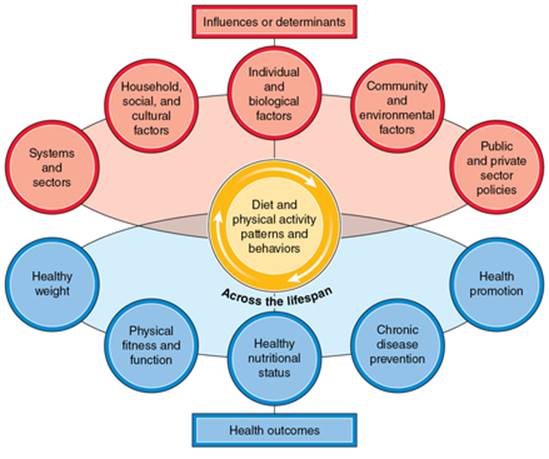
What you do really does matter when it comes to your health. Your level of physical activity along with dietary choices affects day-to-day function as well as your risk of a number of diseases, including heart disease and some cancers. Healthy lifestyle choices are made within the context of individual and biological factors, as well as your home, work, and community environments (to help visualize this, see figure 1.1). You are an individual and, as such, need an individualized plan of action to achieve your health and fitness goals.
Figure 1.1 Diet and physical activity, health promotion, and disease prevention across the lifespan.
Source: U.S. Department of Health and Human Services and U.S. Department of Agriculture, 2015.
Rather than viewing healthy choices as distinct, unrelated activities, consider how various influences in your life interact to promote, or challenge, your efforts to make healthy choices. As you opened this book and started to peruse the pages, you have already taken the first step toward improving your health and wellness. In the upcoming pages, you will find research-based recommendations for exercise and dietary choices, with chapters on many specific topics written by experts in their fields. The value of these recommendations can be realized only when placed within the context of your life and your experiences. Armed with this perspective, you can develop your action plan to begin, or improve, your wellness journey. Time to jump on board!
You: Living Well
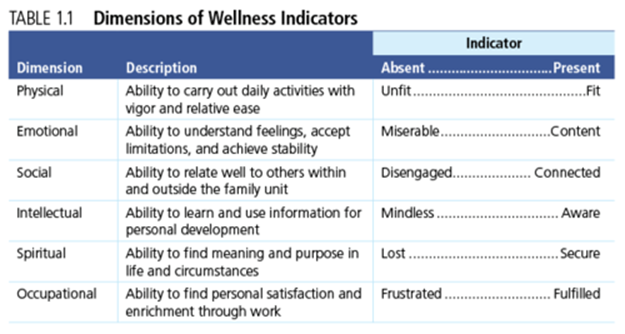
How do you define wellness? Your definition will reflect your personal experiences and perspectives. One way to consider the concept of wellness centers on engaging in activities in order to avoid negative consequences—for example, exercising in order to be free of disease and debilitating conditions, or substituting water for sweetened beverages to keep from gaining weight. To take a more positive viewpoint, contemporary approaches to wellness focus on balancing the many aspects, or dimensions, of life to promote health (8). Examples include exercising in order to develop a level of fitness that allows for full participation in recreational activities you enjoy, or consuming a balanced diet in order to provide your body with needed nutrients for optimal function. Outcomes may be similar, but the mindset is one of pursuing health rather than avoiding illness.
Wellness reflects physical, emotional, social, intellectual, spiritual, and occupational aspects (11). Wellness exists across a continuum between the presence and the absence of each dimension or aspect of life. Table 1.1 provides a brief definition and a pair of terms reflecting the presence or absence of each wellness dimension. Take a moment to consider where you fall on the continuum between two sample indicators listed for each dimension. Wellness isn’t a static or all-or-none situation but rather is dynamic and changing. At any time, you may find some dimensions to be more present than others in your life. By adopting healthy behaviors, you can have greater balance in each dimension and therefore a greater sense of well-being and health.
Wellness touches all aspects of life, and fully discussing all areas is beyond the scope of this book. The focus of this book is physical wellness, and the following sections introduce the benefits of physical activity and a healthy diet. In addition, insights into two areas that can affect physical wellness—sleep and stress management—are discussed.
Promoting Health and Wellness
Seeking better health involves many daily decisions and actions. This section explores the benefits of physical activity and exercise as well as dietary choices. In addition, taking steps to ensure adequate sleep and manage stress are integral to your pursuit of health and wellness.
Physical Activity and Exercise
Physical activity recommendations are not new, although the message has been clarified in recent years. In 1996, the U.S. Surgeon General’s Report on Physical Activity and Health was described as “a passport to good health for all Americans,” and the goal was to weave physical activity into the fabric of daily life as highlighted by these take-home points of the report (27):
· Americans can substantially improve their health and quality of life by including moderate amounts of physical activity in their daily lives.
· For those who are already achieving regular moderate physical activity, additional benefits may be gained by further increases in activity levels.
· Health benefits from physical activity are achievable for most Americans.
Q&A
What are current activity levels in the United States?
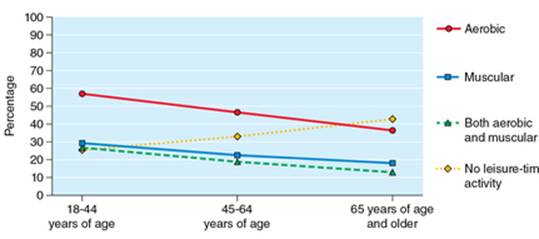
Although the Surgeon General’s report gave high-level attention to the importance of physical activity, it did not ultimately spark the increase in physical activity desired and needed. Figure 1.2 shows the percentage of adults who engage in aerobic and muscular activity and also the percentage who are not active during leisure time (26). In a perfect scenario, 100 percent of people would exercise (aerobically and with resistance training), and no one would remain inactive during leisure time. The most active age group is the youngest; unfortunately, activity decreases and inactivity increases with age. Currently, the percentages are far from ideal. Now is the time for everyone to increase physical activity and find enjoyable ways to be more active.
Figure 1.2 Percentages of Americans who engage in moderate aerobic activity and resistance training and those who are inactive in their leisure time.
Data from U.S. Department of Health and Human Services Office of Disease Prevention and Health Promotion, 2016.
Armed with increased awareness of the value of physical activity provided by the Surgeon General’s report, the U.S. Department of Health and Human Services provided clear recommendations on physical activity in its Physical Activity Guidelines for Americans (25). The Physical Activity Guidelines for Americans is based on hundreds of research studies conducted to examine the effects of physical activity on health. Following are some of the major findings:
· Regular physical activity reduces the risk of many unwanted health outcomes and diseases.
· Some physical activity is better than none. The greatest health risk comes from being totally sedentary. Getting up and moving is important to start reducing disease risk and claiming benefits. Some health benefits have been identified with as little as 60 minutes of activity a week.
· A target of 150 minutes per week of moderate-intensity activity provides significant health benefits (additional benefits accrue to those who do more). An example of moderate-intensity activity is brisk walking.
· If you are already active, additional benefits are possible for most health outcomes if you increase the amount of physical activity by exercising at a higher intensity, more often, or for a longer period of time.
· When one considers risks versus benefits, the benefits of physical activity outweigh possible adverse outcomes.
· Regular exercise, week after week and year after year, is the goal. Maintaining such a program can produce both short-term and long-term benefits. Starting early in life and continuing throughout the lifespan is recommended.
Current recommendations from the American College of Sports Medicine (ACSM) continue to support the value of a comprehensive exercise program (1, 10). The upcoming chapters reflect these research-based guidelines, providing more detail on the components of a balanced exercise program and the role that activity and nutrition play in promoting health and fitness throughout the lifespan, as well as when people are faced with special health conditions.
Both physical activity and exercise are valuable. Although similar in some ways, there is a subtle difference between these two terms (1). “Physical activity” is the appropriate wording to use to refer to movement of the body that takes effort and requires energy above that required at rest. Day-to-day tasks such as light gardening, household chores, and taking the stairs at work are examples of baseline physical activity. Including activities like these in your daily routine is helpful, but adding exercise to your schedule provides additional health and fitness benefits. Exercise is a specific, planned type of physical activity that is done in a structured manner to promote physical fitness. Going for a brisk walk with the purpose of increasing your aerobic fitness or lifting weights to improve muscular fitness are both physical activity options that fall under the category of exercise. Thus physical activity is a broader, umbrella term, and exercise is one category of physical activity (i.e., all exercise is physical activity but not all physical activity is exercise). Over the past few years, the value of both physical activity (see Sit Less, Move More) and exercise has been supported. The focus of this book is exercise, but realize that exercise is a type of physical activity and that the terms are often used interchangeably.
Sit Less, Move More
Reflect on the amount of time you spend sitting over the course of the waking hours of the day: sitting while commuting, when working at the computer, during television watching, and at other times throughout the day. One study reported the following averages for nonsleeping activity levels (19):
· Moderate to vigorous physical activity = 0.3 hours
· Light physical activity = 4.1 hours
· Sedentary = 10.2 hours
These averages display a high amount of time spent each day in inactivity, with little time spent being physically active at moderate or vigorous levels.
Research supports the recommendation to sit less as a means to promote health. All-cause death rate is higher for those who sit more, and that association was found regardless of how active a person was otherwise (20). Sitting time has been associated with higher risk for heart- and metabolic-related issues such as increased waist circumference, poorer insulin resistance (how the body handles glucose), and changes in cholesterol (sitting is detrimental to “good” cholesterol levels) (23). Thus, finding ways to infuse more activity into the day appears to be key. Here are some examples:
· Stand or walk while talking on the phone.
· Get up and move during commercials when watching TV.
· Include some movement time every half hour when working on the computer or doing desk activities.
· Go for a short walk after meals.
Keep looking for additional ways to infuse activity into your day!
Being active is one of the most important habits people of all ages can develop to improve their health (1, 25). Why are physical activity and exercise so important to your well-being? Children who are active are more likely to be at a healthy body weight, perform better in school, and have higher self-esteem (22). They are also less likely to develop risk factors for heart disease, including obesity (25). Adults who exercise are better able to handle stress and avoid depression, perform daily tasks without physical limitation, and maintain a healthy body weight; they also lower their risk of developing a number of diseases (10, 25). Exercise continues to be important for older adults by ensuring quality of life and independence; regular exercise boosts immunity, combats bone loss, improves movement and balance, aids in psychological well-being, and lowers the risk of disease (9). Physical activity and nutrition information for children and adolescents is found in chapter 9, for adults in chapter 10, and for older adults in chapter 11.
Although disabilities may affect one’s ability to be physically active, research supports the health benefits for avoiding inactivity and becoming as regularly active as possible within one’s ability. An appropriate physical activity level can be determined in consultation with a health care provider (25). Similarly, people with chronic medical conditions should consult with their health care providers regarding the appropriate types and amounts of activity (25). Chronic medical conditions encompass a wide range of situations, including arthritis, type 2 diabetes, and cancer. Within the limitations of their ability, adults with chronic medical conditions can obtain health benefits from regular physical activity (25). Chapters 12 to 17 include nutrition and physical activity recommendations unique to a number of chronic conditions, including heart disease, high blood pressure, high cholesterol, diabetes, cancer, Alzheimer’s disease, osteoporosis, and arthritis. In addition, the value of regular physical activity and healthy dietary choices is reviewed for weight management (chapter 18), pregnancy and postpartum (chapter 19), and depression (chapter 20).
The benefits of a regular exercise program extend into many areas of life. Improvements in body function as a result of exercise are well documented and are highlighted in this chapter. In addition to physiological benefits, psychological and mental health benefits can also be realized. Exercise appears to provide relief from symptoms of depression and anxiety; in addition, exercise enhances well-being and quality of life and is associated with a lower risk of dementia (10). Exercise also has the potential to enhance emotional well-being and improve mood (21). Researchers continue to explore why exercise promotes mental well-being. Potential reasons include offering a distraction, increasing self-confidence, providing physical relaxation, and promoting a positive body image (13).
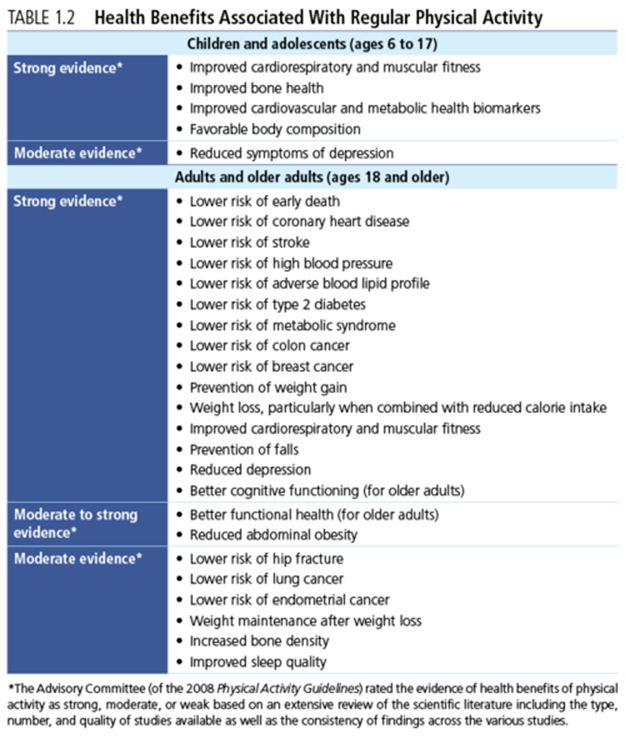
Stated simply, exercise is the best prescription! No other “product” can provide so many positive changes with so few side effects. To underscore this, take a moment to review the impressive summary list of health benefits related to physical activity, for all age groups, in table 1.2. The scientists working with the U.S. Department of Health and Human Services rated available evidence as strong, moderate, or weak based on the type, number, and quality of the research studies (25). Only the health benefits with at least moderate evidence are included in this table.
As a reader of this book, you can claim these benefits for yourself. Be encouraged! Regardless of your current level of physical activity, the information provided in the upcoming chapters will help you create a realistic, workable exercise plan that has the potential to change your life for the better. Fitness is multifaceted, including health-related and skill-related components. Health-related components include aerobic fitness, muscular fitness, flexibility, and body composition; skill-related components include agility, coordination, balance, reaction time, power, and speed (1).
Although skill-related components of fitness are clearly important in sport and athletic competitions, they are also involved directly or indirectly in your day-to-day activities. Consider your ability to navigate around children’s (or pets’) toys scattered on the floor while carrying a full basket of laundry. You need to be able to physically handle the weight of the basket while maintaining a stable and upright body position. Within this book, individual chapters are dedicated to aerobic fitness, muscular fitness, flexibility, and neuromotor exercise training. This latter category encompasses many of the aspects of skill-related fitness. Each component contributes to ensuring that your body is operating at its optimal level. This influences your ability to engage in exercise and also in activities of daily living. The following sections offer insights on specific health benefits related to given components of fitness.
Aerobic Fitness
The word “aerobic” means “with oxygen.” Your heart, lungs, and blood vessels work together to supply your muscles with needed oxygen during aerobic, or cardiorespiratory endurance, exercise. Examples of aerobic exercises are walking, jogging, running, cycling, swimming, dancing, hiking, and sports such as tennis and basketball.
Q&A
Why is it important to engage in aerobic exercise?
When you exercise so that your heart beats faster and you breathe at a quicker rate, you are providing a positive type of stress on your cardiorespiratory system as well as your entire body. This stress, or overload, is needed in order to improve fitness and health. An inactive lifestyle does not provide this positive stress and therefore leads to inactivity-related diseases such as heart disease. A sedentary lifestyle and obesity have been described as “parallel, interrelated epidemics in the United States” with reference to their contribution to the risk of heart disease (14). It is vital to find ways to fit physical activity into your daily life.
Regular activity is associated with lowering risk factors related to heart disease such as high blood pressure and unhealthy cholesterol levels (10). If you are already somewhat active, you can further reduce your risk by engaging in additional physical activity. Cardiovascular health, including heart disease, high blood pressure, and high cholesterol, is discussed in more depth in chapter 12, and weight management is discussed in chapter 18. Aerobic activity also reduces the risk of type 2 diabetes (10). Progression from prediabetes (elevated blood glucose levels that increase the risk of developing diabetes in the future) to diabetes can be delayed or even prevented by losing weight and increasing physical activity (2). Lifestyle modifications can have a definite impact. In addition, physical activity can also help control blood glucose levels in people diagnosed with either type 1 or type 2 diabetes (see chapter 13 for details). Chapter 5 explains more fully the recommendations on aerobic activity as well as how you can progress over time.
Muscular Fitness
Muscular fitness refers to how your muscles contract to allow you to lift, pull, push, and hold objects. Muscular fitness can be improved with resistance training. As with aerobic fitness, many exercise options are available, including lifting weights, using resistance bands or cords, and performing body weight exercises such as push-ups and curl-ups. The key is to find activities that you enjoy and that are available to you. Chapter 6 provides details on various types and modes of activity that can help strengthen your muscles, as well as specific exercises and how-to photos to help you get started or improve your current resistance training program.
When you consider muscular fitness, the first picture in your mind might be a competitive athlete with large muscles. Although increases in muscle size are possible with resistance training, for most people a more relevant reason to include resistance training is to improve muscle function in order to handle activities of daily living with less stress. For example, sufficient muscular fitness will allow you to complete yardwork with less relative effort or climb stairs more easily. Of course, improved muscular fitness will also make recreational sport and athletic endeavors more enjoyable and give you a competitive edge.
Muscular fitness is important for everyone throughout the lifespan. Children benefit from activities that strengthen muscles such as climbing and jumping as well as calisthenics (e.g., jumping jacks, push-ups, or other activities in which the body is moved without needing any equipment) and more organized resistance training (25). For adults, resistance training improves quality of life and limits the muscle losses typically seen with aging.
Q&A
What typically happens to muscle mass over the course of adulthood?
Adults have a real need to maintain resistance training because typically, over the course of adulthood, the amount of muscle decreases while the amount of body fat increases (9). Declines in muscle mass begin around age 40, and the decline accelerates after around age 65 to 70 (9).
In addition to promoting muscular strength, regular resistance training provides other health benefits, including improving body composition and blood pressure (10). Benefits of resistance training related to preventing or managing diabetes include improving glucose levels and the body’s sensitivity to insulin (10).
Another aspect of your health that benefits from resistance training is bone strength (1, 9). As muscles contract to lift, push, or pull a heavy object, a stress is placed on the bone by way of connections between muscles and bones called tendons. When a bone is exposed to this force, it responds by increasing its mass. This makes bones stronger over time. Bone health is outlined in more detail in chapter 16.
Not to be ignored is the way resistance training can make you look and feel. Firm, toned muscles can inspire confidence. Stronger muscles can give you a real boost as you accomplish daily activities with greater ease and improve in competitive sport as well. For all these reasons, resistance training is an important part of your weekly activity plan.
Flexibility
Flexibility refers to the ability to move a joint through a full range of motion. Whether you are focusing on your golf swing or more practical aspects of daily life such as reaching for a high shelf in your closet, maintaining flexibility is important. Loss of flexibility as a result of injury, disuse, or aging can limit your ability to carry out daily activities. Flexibility can be maintained or even improved through a comprehensive stretching program (1). Chapter 7 outlines stretches for all the muscle groups in the body and discusses the benefits of including activities focused on improving range of motion.
Conditions such as arthritis and joint pain can result in having difficulty moving the joints through their normal range of motion. Although activity is beneficial in the treatment of arthritis, 38 percent of people with arthritis report no leisure-time activity (compared with about 27 percent of people without arthritis) (7). Full details on flexibility as well as muscular and cardiorespiratory exercises for people with arthritis and joint pain are provided in chapter 17.
Neuromotor Exercise
Neuromotor exercise training, also referred to as functional fitness training, includes activities that improve balance, coordination, gait, agility, and one’s perception of physical location within space (i.e., proprioception) (1). Many activities include combinations of neuromotor, resistance, and flexibility, for example, yoga, tai ji (tai chi), and qigong (1).
Researchers have noted improvements in balance, agility, and muscular strength for older adults who engage in functional fitness training. In addition, older adults lower their risk of falling (1). Although most of the research studies have focused on older adults, younger adults likely can reap benefits as well. Regardless of your age, reflect on activities that occur over the normal course of the day when improved balance, coordination, or agility would be valuable—for example, sidestepping around a puddle on a busy sidewalk or juggling full bags of groceries when walking up stairs. Then, consider how all the facets of neuromotor exercise training can affect enjoyment in recreational activities or athletic endeavors. Examples are hiking with a loaded backpack, balancing on a surf- or skateboard, and playing basketball or soccer. It actually becomes hard to think of activities that are not affected by functional fitness! Chapter 8 unpacks this often overlooked aspect of fitness.
Body Composition
Body composition refers to the makeup of your body. The body is made up of lean tissue (including muscle) and fat tissue. Typically, the focus of body composition is the relative amounts of muscle versus fat. Although the bathroom scale can help you track your overall body weight, this measurement is general and does not reveal the amount of fat compared to muscle. Excessive amounts of body fat are related to poor health outcomes, and this is especially true for fat around the abdominal area (1). Chapter 18 discusses body weight management.
Whether you are looking to begin an exercise program or optimize the time you are already investing in exercise, the upcoming chapters show you what to include as well as how to track your progress. This book will help you balance the various fitness components so you can maximize the benefits from your personal exercise program.
Diet and Nutrition
Choices related to what to eat and drink are made over and over throughout the day. Determining what items to select can be a real challenge, even with the best of intentions. Unfortunately, many people associate good nutrition with a restrictive diet filled with unappealing options. This is unfortunate, as a healthy diet is one full of nutritious and delicious foods. Note that that the word “diet” in this context refers to what you eat, not a particular weight loss plan.
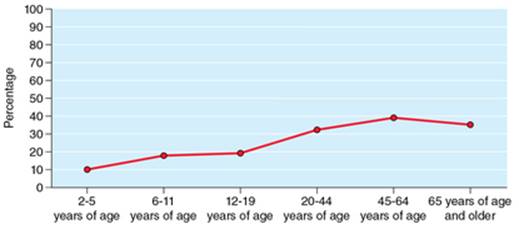
To help provide a foundation for nutritional choices, every five years the Dietary Guidelines for Americans is updated (28). Most recently, the 2015 Dietary Guidelines Advisory Committee reviewed the most current research and evidence in order to provide updates to the 2010 Guidelines. This review was guided by two realities (29). First, the committee noted that about two-thirds of American adults are overweight or obese and about half have at least one preventable chronic disease (see figure 1.3 for percentages of Americans who are obese [26], realizing that prevalence is even higher when one considers overweight in addition to obesity). Contributing factors include poor dietary patterns, calorie overconsumption, and physical inactivity. Second, the committee acknowledged the personal, social, organizational, and environmental context in which lifestyle choices—nutrition and physical activity—are made. Each person has a unique frame of reference, and, within that context, can develop optimal dietary patterns along with adequate physical activity to promote health (28).
Figure 1.3 Percentage of Americans classified as obese.
Data from U.S. Department of Health and Human Services Office of Disease Prevention and Health Promotion, 2016.
Q&A
Considering a typical eating pattern in the United States, what are areas of concern?
In comparison with recommendations, about 75 percent of Americans do not consume adequate vegetables, fruits, dairy, and oils. In contrast, added sugars, saturated fats, and sodium are overconsumed. Overall calorie intake is another area of concern, as many eating patterns include too many calories (28). Consuming more calories than needed results in weight gain over time.
Dietary patterns are linked to potential risk of obesity and chronic diseases, such as heart disease, high blood pressure, diabetes, and some cancers (29). Researchers are exploring potential relationships between dietary patterns and neurocognitive disorders and congenital anomalies (29). Thus, one’s diet really does matter! The key question is, What does a healthy diet look like? A healthy eating pattern includes vegetables, fruits, grains (with at least half being whole grains), fat-free or low-fat dairy, and a variety of protein foods (e.g., seafood, lean meats and poultry, eggs, legumes, nuts, seeds, soy products) while limiting saturated and trans fats, added sugars, and sodium (28). Rather than dictating a single, stringent diet pattern, these strategies can be individualized to fit within one’s health needs, dietary preferences, and cultural traditions. The focus is on flexibility and combining foods in a variety of ways to promote healthy dietary patterns (29).
Good nutritional choices are part of physical wellness.

Understanding the various components of a healthy diet is helpful in developing nutritional patterns that meet your body’s needs and promote optimal health. Chapter 3 provides an overview of the various nutrients and how each affects how your body functions.
Sleep and Stress Management
The previous sections have highlighted the myriad benefits that are possible when one embraces a physically active lifestyle and enjoys healthy food selections. In addition to these areas of physical wellness, sleep and stress influence health and, given the significant potential impact, are included here.
Influence of Sleep
If you struggle with getting a good night’s sleep, you are not alone. Chronic sleep loss or sleep disorders are estimated to affect up to 70 million people (15). Obtaining adequate sleep—in terms of both quantity and quality—contributes to how you feel and function. A restful night of sleep provides the energy and alertness necessary to handle daily challenges. In contrast, the lack of adequate sleep negatively affects productivity, relationships, and physical health.
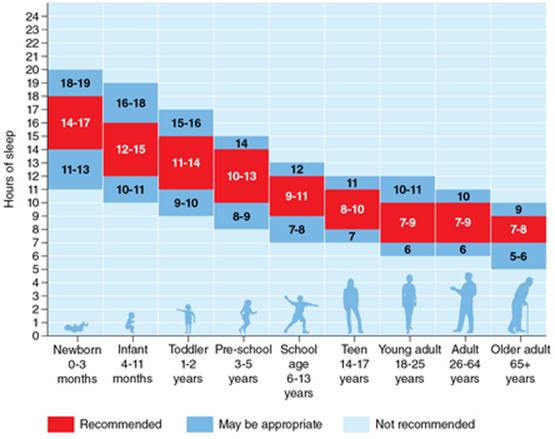
Sleep is important for many reasons and significantly affects many dimensions of wellness and quality of life. Sleep requirements vary from person to person, but in general, adults typically need between 7 and 8 hours per night to feel well rested (15). For a helpful visual on typical sleep requirements across the age spectrum see figure 1.4 (18). Although some adults can function normally on less sleep, others may require significantly more. How can you know if you are getting enough sleep? Sleepiness during the day is a simple but clear indicator that your body requires more sleep. Significant sleepiness during the day suggests the need for more or better sleep, or both. You may also benefit from tracking your sleep habits and trends (18).
Figure 1.4 Sleep duration recommendations.
Republished with permission of National Sleep Foundation.
Lack of sleep is more than just an annoyance. Sleep is important for the body to function as intended; such functions include the following (15):
· Heart rate and blood pressure naturally fluctuate during sleep to promote cardiovascular health.
· Cells and tissues are repaired as growth hormone is released during deep sleep.
· Immune function is promoted with the creation of cytokines that target infections.
· Hormones related to appetite change (leptin, which suppresses appetite, increases while ghrelin, which stimulates appetite, decreases).
In addition, inadequate sleep can make daily tasks like learning, concentrating, and reacting more difficult (15).
Changing behavior to obtain the sleep you need requires making a conscious health choice. Implementing good sleep practices is key (see Tips for Better Sleep). One common recommendation to promote better sleep is exercise. The National Sleep Foundation has stated, simply, “Exercise is good for sleep” (17). Although some recommendations in the past have suggested that exercise near bedtime is detrimental, newer recommendations encourage healthy adults to exercise without any limitation related to time of day, other than ensuring that exercise time is not replacing time needed for sleep (18).
Tips for Better Sleep
Consider these tips to help promote a good night’s sleep (18):
· Stick to a sleep schedule, even on weekends.
· Practice a relaxing bedtime ritual.
· Exercise daily.
· Evaluate your bedroom to ensure ideal temperature, sound, and light.
· Sleep on a comfortable mattress and pillows.
· Beware of hidden sleep stealers, like alcohol and caffeine.
· Turn off electronics before bed.
The National Sleep Foundation recommends consulting with your primary care physician or a sleep professional if you are experiencing symptoms such as sleepiness during the day or when you expect to be awake and alert; snoring; leg cramps or tingling; gasping or difficulty breathing during sleep; prolonged insomnia; or another symptom that is preventing you from sleeping well.
Influence of Stress
“I’m stressed out.” Likely this statement has crossed your lips or you have heard another person utter these words. The reality is that everyone experiences stress at various points in life. So, what is stress? At the most basic level, stress is defined as the brain’s response to demands (16). Not all stress is the same. Different types of stress have been identified, including acute stress, episodic acute stress, and chronic stress.
Acute stress stems from demands and pressures that result from recent events or even events anticipated in the near future (5). These stressors are short-term—for example, losing your car keys or handling a customer complaint at work. Common symptoms include irritability, anxiety, tension headache, muscular tensions, digestive system problems, and other physiological responses such as higher blood pressure, faster heart rate, sweating, and even shortness of breath or chest pain.
Exercising with a friend can be a great way to manage stress.

Episodic acute stress occurs when acute stress is experienced frequently (5). Picture the person who has taken on too many tasks, who is always late and rushing, who seems to move from one crisis directly into another, or who suffers from ongoing worry. Symptoms of episodic acute stress include persistent tension headaches, migraines, high blood pressure, chest pain, and heart disease.
Chronic stress is ongoing, grinding stress that is unrelenting for long periods of time (5). The health conditions that result from untreated chronic stress include anxiety, insomnia, muscle pain, high blood pressure, and a weakened immune system (6). In addition, stress can contribute to the development of heart disease, depression, and obesity (6).
Short-term stress reflects those situations in which you respond and then return back to a baseline state of relaxation. Long-term stress can be more troubling as the body has to continue in an alert state. This has been described as taking a “sprint” mechanism intended to occur for a brief time (see Fight-or-Flight Response) and forcing the body into a “marathon” or ongoing situation with resulting breakdown and system failure over time (12). Stress can affect almost every body system. Examples are muscular tension for the musculoskeletal system; diarrhea-constipation for the digestive system; elevated stress hormones and blood sugar levels for the endocrine system; and increased risk of high blood pressure, heart attack, or stroke for the cardiovascular system (3).
Fight-or-Flight Response
The fight-or-flight response is intended to be beneficial for survival when one is faced with a threat. The body gears up to act as needed, and in doing so, turns on some areas of the body while shutting down others that are not immediately needed. When confronted with an acute stress (e.g., being startled by a loud sound when walking on a darkened sidewalk), the body prepares to deal with the potential danger or to escape. The responses that prepare the body for action include these: the heart beats faster, blood pressure increases, breathing becomes heavy, pupils dilate, and muscles tense. At the same time the body increases the availability of glucose and fats to burn for fuel while shutting down areas not vital in the moment such as immune function, reproductive capacity, and digestion (12).
Chronic stress can bring feelings of being overloaded. Responses may be due to positive or negative changes, and can be real or perceived (16). Common sources of stress are money, work, the economy, family responsibilities, and personal health (4). Do any (or all) of these ring true? Symptoms of stress reported in a recent survey include feeling angry or irritated, feeling anxious or nervous, lacking motivation, feeling fatigued, being depressed or sad, or feeling overwhelmed (4). Can you picture yourself reacting in these ways?
Various approaches to dealing with stress have been proposed, including both prevention and management (12). Being prepared for life situations can be helpful in preventing stressors from having a negative impact. Of course, not all stressors can be avoided, so management of one’s reaction is also important. One valuable tool used routinely to help handle stress is regular participation in exercise (24). The role of exercise in stress reduction is not yet clear, but active people appear to be able to buffer stress more effectively than sedentary people do. In addition, healthy diets facilitate a healthy state (see chapter 3 for current recommendations on healthy dietary patterns).
In addition to being active and eating well, other tools can be used to prevent or manage stress. As you consider some of the following tips, realize that no one tool works for all people, or even within all situations.
· Plan your schedule. Being aware of and in charge of your schedule provides an empowering feeling that helps to reduce the impact of stressful situations. Planning promotes effective time management.
· Avoid procrastination. Consider how stress can be prevented when a work-related project is completed in advance of a deadline compared with procrastination that brings on a hectic rush to beat the cutoff date.
· Relax with deep breathing. The process of consciously slowing your breathing rate as you increase the depth of each breath helps to counteract the fast and shallow breathing that is common when experiencing stress.
· Limit alcohol consumption. Although alcohol may reduce stress temporarily, relying on alcohol to cope with stress has the opposite effect and produces more bodily stress.
· Talk to family and friends. Discussing stressful events with others you trust can be beneficial both because it helps you “get it off your chest” and because you might receive helpful recommendations.
If faced with stress that cannot be managed with basic techniques, consider getting help from a psychologist or other licensed mental health professional (6).
Making healthy lifestyle choices can be a challenge, but developing healthy habits is well worth the effort. Although some benefits have a long-term focus, such as promoting heart health, others can be realized more immediately, such as stress reduction. Including regular physical activity along with healthy nutrition promotes physical wellness.