
Muscular fitness is a global term that includes muscular strength, endurance, and power. Muscular strength refers to the ability to lift a heavy weight one time, muscular endurance is the ability to lift a lighter load several times, and muscular power refers to ability to exert maximum effort in a very short period of time. Muscle-strengthening activities that involve all the major muscle groups are recognized as an essential component of an overall fitness program for both adults and youth (1, 6).
Just as aerobic fitness is improved by stressing the heart and lungs, muscular fitness requires a stress, or resistance, to be placed on the muscles. Resistance training (also called strength training) involves the use of a variety of activities that include free weights (barbells and dumbbells), weight machines, elastic tubing, medicine balls, stability balls, and body weight. Resistance training does not refer to one specific mode of conditioning but rather to an organized process of exercising with various types of resistance to enhance muscular fitness.
When correctly performed and sensibly progressed over time, resistance training can be a safe, effective, and enjoyable method of exercise for people of a wide range of ages, fitness levels, and health conditions (1, 20). While resistance training has been a part of sport programs for many years, public health recommendations now aim to increase participation in muscle-strengthening activities for all youth and adults (28, 33). With instruction on developing proper exercise technique and guidance on sensibly progressing the exercise program, resistance training can offer observable health and fitness value.
Resistance Training Terminology
Following are definitions of some common terms used in the design of a resistance training workout:
Atrophy—A reduction in muscle fiber size.
Concentric—A type of muscle action that occurs when the muscle shortens.
Eccentric—A type of muscle action that occurs when the muscle lengthens.
Hypertrophy—An enlargement in muscle fiber size.
Muscular endurance—The ability to repeat or maintain muscle contraction.
Muscular strength—The ability to exert maximal force in a single effort.
Repetition—One complete movement of an exercise.
Repetition maximum (RM)—The maximum amount of weight that can be lifted for a predetermined number of repetitions with proper exercise technique.
Set—A group of repetitions performed without stopping.
Spotter—A training partner or fitness professional who can provide assistance in case of a failed repetition.
Health and Fitness Benefits of Resistance Training
To maintain your physical capacity, you must make a lifestyle choice to include resistance training on a regular basis. Unfortunately, physical capacity and muscle strength decrease dramatically with age in adults who do not engage in resistance training (3, 30). Resistance training results in stronger muscles and therefore an increased capacity for force production, which is not achievable with solely aerobic-based training. Because muscles function as the engine of your body, they must be used regularly to avoid disuse atrophy (i.e., a reduction in muscle size) and age-related declines in physical performance.
Q&A
What is the typical impact of aging on muscle and metabolism?
As a person ages, decreases in muscle along with a lower resting metabolic rate result in less than optimal changes in body composition. For example, consider a 160-pound (72.6 kg) male with 15 percent body fat at age 30. He therefore has 24 pounds (10.9 kg) of fat weight and 136 pounds (61.7 kg) of lean weight, which consists of muscle, bone, blood, skin, organs, and connective tissue. If he weighs the same (160 pounds) at age 50, his body composition will have changed by about 20 pounds (9 kg)—10 pounds (4.5 kg) less lean weight and 10 pounds (4.5 kg) more fat—and he will now be 21 percent body fat. Of course, this increase in percentage of body fat and decrease in lean weight would have a negative impact on his appearance, health, and fitness.
Muscular fitness is a part of recreational and daily activities.

You don’t need to be a competitive athlete to benefit from resistance training; it is equally important from a health and fitness perspective. The benefits of resistance training include favorable changes in body composition, metabolic health, and quality of life. Resistance training activities can increase lean muscle mass, reduce body fat, fortify bone, lower blood pressure, improve blood lipid and cholesterol levels, and enhance your body’s ability to use glucose (2, 12). These benefits can optimize your day-to-day functioning while limiting the development of chronic diseases such as diabetes, heart disease, and osteoporosis (30, 32). Of paramount importance, regular participation in a resistance training program can help adults preserve their muscle health to maintain independent physical functioning with advancing age (23, 27).
Skeletal muscle represents about 40 percent of one’s total body weight and influences a variety of physiological processes and disease risk factors (26). The increase in muscle tissue that results from resistance exercise is accompanied by an increase in resting metabolic rate; the decrease in muscle tissue that results from a sedentary lifestyle is accompanied by a decrease in resting metabolic rate. Muscle mass declines about 5 percent each decade after age 30, and this loss can reach 10 percent per decade after age 50 (15). This gradual decrease in muscle mass and metabolism is associated with the gradual increase in body fat that typically occurs with age. Calories that were previously used by muscle tissue (now smaller as a result of disuse) are stored as fat. On the other hand, resistance training raises resting metabolic rate and results in more calories burned on a daily basis. In theory, if you resistance train and gain 2 pounds (~1 kg) of muscle mass, your resting metabolic rate should increase by about 20 calories per day (29). Thus, performing resistance training throughout your life can help you recharge your metabolism, facilitate physical function, and maintain your health (30).
In addition to the effect of muscle on metabolism, another benefit of regular resistance training is an increase in bone mineral density that may reduce the risk of osteoporosis (8, 9, 11). On top of the direct effect of strength-building (and weight-bearing) exercises on bone, the act of muscles pulling on bones during resistance exercises may also be a potent stimulus for new bone formation in certain people. This potential benefit is of particular importance to women who are at increased risk of functional limitations as a result of age-related losses of bone mass.
Strong muscles serve as shock absorbers and balancing agents that help dissipate the repetitive landing forces from weight-bearing activities for active people and also reduce the risk of falling in older adults (3, 31). As such, a resistance training program that requires agility and balance may be the most effective way to enhance movement control and avoid injury (1, 10). Moreover, strength-building activities are particularly important for decreasing physical discomfort associated with low back pain, which is a growing health care concern (31).
Regular participation in resistance training activities that are consistent with your needs, goals, and abilities can improve muscle function, enhance quality of life, and lower the risk of premature all-cause mortality (18, 25). The health and fitness benefits are clear. You can also realize benefits linked to personal appearance. Firm, toned muscles are possible with regular resistance training. Whether you are seeking to improve in recreational or sport activities or just to look and feel better, resistance training should be part of your fitness program.
Assessments for Muscular Fitness
There is not one test of muscular fitness that is best. Rather, different tests can be used to safely and effectively assess muscular strength or muscular endurance in various age groups.. This section describes several assessments that can be used.
Assessing Muscular Strength
A common assessment of muscular strength is called the one-repetition maximum (1RM), in which the goal is to lift as much weight as possible on a strength exercise with proper technique for one repetition only. This test is time-consuming and should be performed under the supervision of a qualified fitness professional. Also, familiarization and practice sessions are critical to ensure that the test is safe and accurate (20).
Another option is to estimate your 1RM by lifting a submaximal weight multiple times. While different exercises can be used for this assessment, the use of multijoint exercises such as the leg press and chest press is common. With a few calculations you can estimate your 1RM and compare your performance to that of others of your age and sex.
First, multiply the number of repetitions you can perform on a given exercise by 2.5. Try to select a weight you can lift about 10 to 15 times with proper form (note that if you can lift the weight more than 20 times, the results will be more accurate if you rest and then repeat the test with a heavier weight). Subtract that number from 100 to determine the percentage of your theoretical 1RM. Then, divide that number by 100 to produce a decimal value. Finally, divide the weight you lifted by that decimal value to estimate your 1RM on that exercise.
For example, if a 35-year-old female can lift 60 pounds (27 kg) on the chest press exercise 10 times, then she can use the following steps to estimate her 1RM:
10 repetitions × 2.5 = 25
100 − 25 = 75
75 / 100 = 0.75
60 pounds / 0.75 = 80 pounds = estimated 1RM
To compare her performance with others of her same age and sex, the 1RM is divided by body weight. In the previous example, if the individual’s body weight is 145 pounds (66 kg), then she can complete the calculation (80 / 145 = 0.55) and use the result (0.55) to assess her performance with table 6.1 (and to assess lower body strength with table 6.2). Note that the ratio of weight lifted to body weight is the same whether you use pounds or kilograms. For a 35-year-old female, her upper body strength is in the “fair” category. With regular resistance training she will see her strength improve as she tracks her progress. A weight she could lift only 10 times will be lifted more often before fatiguing, or she will be able to lift a heavier weight for those same 10 repetitions.


Assessing Muscular Endurance
As with muscular strength, various assessments can provide insight into one’s muscular endurance status. This section describes the push-up test as well as some age-specific assessments for children and older adults.
Push-Up Test for Adults
The push-up test is commonly used to measure muscular endurance, which is the ability of a muscle or muscle group to exert force repeatedly over time. Many activities of daily life such as carrying groceries and household chores require repeated or sustained muscular actions. Like muscular strength, muscular endurance can be different in upper body and lower body muscles.
The goal of the push-up test is to perform as many push-ups as possible with proper form. Note that there are two different ways to perform this test for adults, one for males and one for females. For males the toes are the rear pivot point (see figure 6.1), but for females the knees are in contact with the ground (see figure 6.2). For both males and females, proper form includes keeping the back straight while pushing up to a straight-arm position and then lowering the body until the chin touches the floor. It is important to perform the push-up test as shown so you can accurately assess your performance using table 6.3.
Figure 6.1 Push-up for males.


Figure 6.2 Push-up for females.


Curl-Up and Push-Up Tests for Youth
FitnessGram includes healthy fitness zone ranges for curl-ups and push-ups (4, 5). For the curl-up test, the two pieces of tape used to help guide the extent of the curl-up are placed 3 inches (7.6 cm) apart for 5- to 9-year-olds and 4.5 inches (11.4 cm) apart for 10- to 19-year-olds. Heels must stay in contact with the mat, and no pauses or rest periods are allowed (see figure 6.3 for an example of a youth performing a curl-up). Movement should be controlled (about one curl every 3 seconds or a total of 20 per minute). If the heels come up, if the fingers do not touch the far tape, or if the child is unable to maintain a continuous cadence, the test is over and the final count should be recorded (a total of 75 curl-ups is considered maximal). Healthy ranges are shown in table 6.4.
Figure 6.3 Curl-up for youth.


For the push-up test, the hands are placed slightly wider than the shoulders and the legs are out straight (see figure 6.4). The back should remain in a straight line from head to toes throughout the test. The body is lowered until the elbows are at a 90-degree angle and the upper arms are parallel with the floor. Then, arms should be straightened fully to return to the starting position. The test is continued as long as these form requirements are met and the movement is continuous (no rest stops are allowed). Record the maximal number completed. Boys and girls follow the same protocol. Healthy ranges are found in table 6.4.
Figure 6.4 Push-up for youth.


Chair Stand Test for Older Adults
The chair stand test is used to assess lower body strength in older adults, which is important in daily activities such as climbing stairs; walking; and getting out of a chair, bathtub, or car. For the chair stand test, fold your arms across your chest and count the number of times that you can stand from a seated position in 30 seconds (see figure 6.5) (24). Normal ranges are shown in table 6.5; if your score is over the range listed, consider yourself above average and if your score falls short of the range listed, consider yourself below average.
Figure 6.5 Chair stand for older adults.


Arm Curl Test for Older Adults
An arm curl test is used to assess upper body strength in older adults, which is important for daily activities such as carrying groceries or small children. The arm curl assessment, as shown in figure 6.6, is used to determine upper body muscular fitness. This test involves counting the number of dumbbell curls you can complete in 30 seconds. Men should use an 8-pound (3.6 kg) dumbbell, and women should use a 5-pound (2.3 kg) dumbbell. Normal ranges are shown in table 6.5; if your score is over the range listed, consider yourself above average and if your score falls short of the range listed, consider yourself below average.
Figure 6.6 Arm curl for older adults.


Muscular fitness assessments that are consistent with each individual’s training experience and fitness goals can provide useful information. In addition to comparing performance to that of others of the same age and sex, periodic assessments can help to gauge the effectiveness of your resistance training program. For safety purposes, individuals with health concerns should seek consultation from a health care provider before performing any fitness test.
Fundamental Principles of Resistance Training
Improvements in muscular fitness occur only if the resistance training program is based on sound training principles and is prudently progressed over time (7, 21). Although factors such as your initial level of fitness, genetics, nutrition, and motivation will influence the rate and magnitude of adaptation that occurs, you can maximize the effectiveness of your resistance training by addressing three fundamental principles: progressive overload, regularity, and specificity.
Progressive Overload
The progressive overload principle states that to enhance muscular fitness, you must exercise at a level beyond the point to which your muscles are accustomed. This goes back to the idea of having to stress the muscle to get a positive response. Doing the same workout month after month will not maximize benefits. The principle of progression refers to consistently boosting the training stimulus or load at a rate that is compatible with the training-induced adaptations that are occurring (21). Following the principle of progressive overload requires that you provide your muscles with a new stimulus when they have adapted to the current overload. You can do this in a variety of ways:
· Increase the number of repetitions. Typically, 8 to 12 repetitions is recommended for muscular fitness (for middle-age and older adults starting exercise, 10 to 15 repetitions is recommended). People focusing on strength development may select fewer repetitions, whereas those focusing on muscular endurance may include up to 15 to 20 repetitions (1).
· Increase the number of sets for a given muscle group. You could do additional sets of the same exercise, or you could add another exercise that targets the same muscle group. For example, the chest muscles could be trained with two sets of the chest press or one set of the chest press and one set of the dumbbell fly.
· Increase the resistance. The increase in weight needed will vary depending on the exercise but is often prescribed according to the increments available (e.g., next-weight dumbbell, increasing by one plate on a weight machine).
When providing an overload, select one of these options at a time. Although you want to provide a new stress on the muscle, you do not want to overtax the muscle or supporting structures to the point of injury.
Although every training session does not have to be more intense than the last session, the principle of progressive overload states that the training program needs to be increased gradually over time to realize gains. For example, if you have been able to easily complete a given workout for a couple of exercise sessions, it may be time to make changes to provide an overload once again in order to keep the resistance training program fresh, challenging, and effective. If you are able to perform a given exercise for one or two repetitions over your target number for two training sessions in a row, this indicates that you are ready to increase the resistance while returning to the original target repetition range.
Regularity
The principle of regularity states that exercise must be performed several times per week on a habitual basis to enhance physical fitness. Although training once per week may maintain training-induced gains, more frequent workouts are needed to optimize gains in health and fitness (1). In short, the adage “use it or lose it” is true because you will lose strength gains if you do not progress your program over time and perform resistance training on a regular basis (21). Although consecutive days of heavy strength training for the same muscle groups are not recommended, regularly training each major muscle group two to three times per week, with at least 48 hours separating training sessions for the same muscle group, is recommended to enhance muscular fitness.
Specificity
The principle of specificity refers to the distinct adaptations that take place as a result of the training program. In essence, every muscle or muscle group must be trained to make gains in muscular fitness (see figure 6.7 for the location of the major muscle groups in the body). Exercises such as the squat and leg press can be used to enhance lower body strength, but these exercises will not affect upper body strength. What’s more, the adaptations that take place in a given muscle or muscle group will be as simple or as complex as the stress placed on them. For example, because tennis requires multijoint and multidirectional movements, it seems prudent for tennis players to perform resistance exercises that mimic the movements of the sport. For tennis players who need strong leg muscles to move across the court, lunges are unbeatable exercises to improve lower body performance. Lunges performed in different directions actually simulate steps used in game situations.
Figure 6.7 a Major muscle groups in the body: front view.

Figure 6.7 b Major muscle groups in the body: back view.

The specificity principle can also be applied to the design of resistance training programs for adults who want to enhance their abilities to perform activities of daily life such as stair climbing and household chores, which also require multijoint and multidirectional movements. For example, climbing stairs may be difficult as a result of poor lower body strength. By sensibly progressing from single-joint exercises such as leg extensions to multijoint exercises such as leg presses and dumbbell step-ups, you can improve your stair-climbing ability. These multijoint exercises specifically strengthen the quadriceps and gluteals, which are used in stair climbing.
Resistance Training Workout Components
The general format of an aerobic training session (as described in chapter 5) can be applied to resistance training as well. Before beginning a session, you should perform a warm-up to prepare your muscles for the conditioning phase of the workout. The conditioning phase is the main focus, and you should follow it with a cool-down.
Warm-Up
The warm-up for resistance training should include 5 to 10 minutes of low- to moderate-intensity aerobic activities and muscular endurance activities (lower resistance with a higher number of repetitions, such as 10 to 15 repetitions). These activities will increase your body temperature and prepare your body for the demands of the resistance training workout (1).
Muscle Conditioning Phase
Despite various claims about what constitutes the best resistance training program, it does not appear that one optimal combination of sets, repetitions, and exercises promotes long-term adaptations in muscular fitness in everyone. Rather, you can alter many program variables to achieve desirable outcomes provided that you follow the fundamental training principles as discussed in this chapter. The program variables to consider are choice of exercise, order of exercise, training weight (which determines the number of repetitions), number of sets, repetition velocity, and rest periods between sets and exercises (see Resistance Training Guidelines for Healthy Adults).
Resistance Training Guidelines for Healthy Adults
Following are a few guidelines for resistance training if you are a healthy adult (1):
· Select a weight that allows you to perform 8 to 12 repetitions per set (10 to 15 repetitions for middle-age and older adults who are starting exercise).
· Train each major muscle group for a total of two to four sets (beginners can benefit from one set, which may reduce soreness and enhance adherence).
· Perform each set to the point of muscle fatigue but not failure.
· Rest for 2 to 3 minutes between sets to improve muscular fitness.
· Perform 8 to 10 exercises with proper technique.
· Resistance train two to three days per week on alternate days (48 hours is recommended between sessions to allow the muscles to recover).
· Continually progress the training program to optimize long-term adaptations.
Exercise Choice
A limitless number of exercises can be used to enhance muscular fitness. Exercises can generally be classified as single joint (i.e., body part specific) or multijoint (i.e., structural). The dumbbell biceps curl and leg extension are examples of single-joint exercises that isolate a specific body part (biceps and quadriceps, respectively), whereas the chest press and squat are multijoint exercises that involve two or more joints. Although it is important to incorporate multijoint exercises into a resistance training program, be sure to select exercises that are appropriate for your exercise technique experience and training goals. When learning any new exercise, start with a light weight to master the technique of the exercise before increasing the weight. To maximize gains and minimize the risk of injury, all resistance training exercise should be performed with proper exercise technique in a controlled manner.
Your choice of exercise should also promote muscle balance across joints and between opposing muscle groups (e.g., quadriceps and hamstrings). Of particular importance is the inclusion of exercises for the abdominal and low back musculature. It is not uncommon for beginners to focus on strengthening the chest and biceps and not spend adequate time strengthening the abdominal muscles and lower back. Strengthening the midsection, or trunk area, may not only enhance body control during performance of free weight exercises such as the squat, but may also reduce the risk of injury (10). The resistance training program suggestions in this chapter promote muscle balance by including the appropriate muscle groups (see table 6.6 and figure 6.8).


Exercise Order
There are many ways to arrange the sequence of exercises in a resistance training session. Traditionally, large-muscle group exercises are performed before smaller-muscle group exercises, and multijoint exercises are performed before single-joint exercises. Following this exercise order allows you to use heavier weights on the multijoint exercises because fatigue will be less of a factor.
Perform more challenging exercises earlier in the workout when your neuromuscular system is less fatigued. In general, it seems reasonable to follow the priority system of training in which exercises that will most likely contribute to enhanced muscular fitness are performed early in the training session. The sample resistance training programs presented in this chapter include exercises that reflect this sequence (see table 6.6 and figure 6.8).
Number of Repetitions
One of the most important variables in the design of a resistance training program is the amount of weight used for an exercise (7). Gains in muscular fitness are influenced by the amount of weight lifted, which is inversely related to the number of repetitions you can perform. As the weight increases, the number of repetitions you can perform decreases. Although you should never sacrifice proper form, the training weight should be challenging enough to result in at least a modest degree of muscle fatigue during the last few repetitions of a set. If this does not occur, you will not achieve the desired gains from your resistance training program.
Because heavy weights are not required to increase the muscular strength of beginners, weights corresponding to about 60 to 80 percent of the 1RM for 8 to 12 repetitions are recommended for adults (10 to 15 repetitions for middle-age and older adults with limited resistance training experience) (1). Although weights that can be lifted more than 15 times are effective for increasing local muscular endurance, light weights rarely result in meaningful gains in muscular strength. If you are a beginner, the best approach is to first establish a target repetition range (e.g., 8 to 12), and then by trial and error determine the maximum load you can handle for the prescribed number of repetitions. If multiple sets of an exercise are performed, the first set may be performed for 12 repetitions before fatigue occurs whereas the last set may be performed for about 8 repetitions.
Although it may take two to three workouts to find your desired training weight on all exercises, keep in mind that the magnitude of your effort will determine the outcome of your strength training program. For example, training within an 8RM to 12RM zone means that you should be able to perform no more than 12 repetitions with a given weight using proper exercise technique. Simply performing an exercise for 8, 9, 10, 11, or 12 repetitions does not necessarily mean you are training within the 8RM to 12RM zone. You should be stopping because of the onset of muscle fatigue, not just because you have reached a predetermined number. However, regardless of the number of repetitions, it is important to maintain proper technique on every repetition to optimize adaptations and reduce the risk of injury.
Q&A
When should the weight lifted be increased?
Consider how many repetitions are currently possible. For example, initially it may be possible to lift a 20-pound (9 kg) barbell only eight times. As training continues and muscular fitness improves, this repetition number increases from 8 to 12 before fatigue (i.e., repetitions number 11 and 12 are a bit of a struggle to complete). Increasing the repetitions is one way to overload the muscle. When you are able to easily complete 12 repetitions in two consecutive training sessions, this is evidence that the muscles have adapted to the overload and now it is time to progress to a higher weight to provide greater resistance. The repetition number will drop back and the process of increasing number of repetitions from 8 to 12 will start over again.
Number of Sets
The number of sets performed in a workout is directly related to the overall training volume, which reflects the amount of time the muscles are being exercised. For beginners, even one set can provide benefits. Healthy adults should perform two to four sets for each muscle group to achieve muscular fitness goals (1). Although single-set protocols can enhance your muscular strength if you are a beginner, multiple-set protocols have proven more effective in the long term, with evidence of a dose response for the number of sets per exercise (14, 19). That is, greater gains in muscular fitness can be expected with additional sets per exercise (up to a point). What’s more, you do not need to perform every exercise for the same number of sets. As a general recommendation, perform more sets of large-muscle group exercises than of smaller-muscle group exercises.
You can use different combinations of sets and exercises to vary the training stimulus, which is vital for long-term gains. For example, if you complete one set of two different exercises for the same muscle group (e.g., leg press and leg extension), the quadriceps on the front of the thigh will have performed two sets. From a practical standpoint, your health status, fitness goals, and time demands should determine the number of sets you perform per muscle group.
Repetition Velocity
Strength-building exercises should be performed at a controlled, or moderate, velocity during the lifting and lowering phases. Movement control can be defined as the ability to stop any lifting or lowering action at will without momentum carrying the movement to completion. Uncontrolled, jerky movements not only are ineffective but also may result in injury. Intentionally slow velocities with a relatively light weight (e.g., a 5-second lifting phase and a 5-second lowering phase) may be useful to enhance muscular endurance, but this type of training is not recommended to optimize gains in muscular strength (20). Although different movement speeds have proven effective, if you are a beginner, you should perform each repetition at a moderate speed, with about 2 seconds for the lifting phase and 3 seconds for the lowering phase. A longer lowering phase places more emphasis on the eccentric muscle action, which is important for muscle growth and strength development (20).
Rest Periods Between Sets and Exercises
The length of the rest period between sets and exercises is an important but often overlooked training variable. In general, the length of the rest period influences energy recovery and training adaptation. For example, if your primary goal is muscular strength, heavier weights and longer rest periods of 2 to 3 minutes are needed, whereas if your goal is muscular endurance, lighter weights, higher repetitions, and shorter rest periods of 30 to 60 seconds are required (20). Obviously, the heavier the weight is, the longer the rest period should be if the training goal is to maximize strength gains.
Cool-Down
The cool-down brings the body systems back to resting levels. Just as the warm-up led into the conditioning phase, the cool-down helps to transition the body from the higher demands of the conditioning phase to the lower levels of physiological demand seen at rest. Shifting to moderate-intensity and then low-intensity aerobic and muscular endurance activity will lower your heart rate and blood pressure gradually and safely (1). See Safety First for additional ways to maximize safety when training.
Safety First
Your resistance training program should be based on your health status, fitness training experience, and goals. As discussed in chapter 2, you should assess your health status before participating in strength-building activities. In some cases, specialized exercise programs are needed for those with preexisting medical conditions such as high blood pressure, heart disease, or diabetes. Thus, if you have a medical concern or issue, you should consult with your health care provider before resistance training.
Recognizing that resistance training to improve general fitness is different from training to enhance sport performance will further promote the development of and adherence to safe, effective, and enjoyable programs. If you have little experience with resistance training, you are strongly encouraged to seek instruction from a qualified fitness professional, because most injuries are the result of improper exercise technique or excessive loading (13, 17). Qualified fitness professionals can provide instruction on proper warm-up procedures, offer advice on specific methods of progression, and monitor the magnitude of your effort, which in turn can have a positive impact on training adaptations (16, 22).
Knowing proper breathing techniques will help you avoid the Valsalva maneuver, which can occur if you hold your breath while lifting. Not exhaling can increase pressure in the chest cavity, which can increase blood pressure to harmful levels. To avoid this effect, continue to breathe normally by inhaling before you start the lift, exhaling during the lifting–exertion phase (as you lift against gravity), and then inhaling again as you return to the starting position. Using this technique will allow you to lift weight correctly and safely.
Following are general safety recommendations for designing and performing a resistance training program:
· Maintain a regular breathing pattern when lifting and lowering weights. Do not hold your breath; rather, inhale before you start the lift, exhale during the lift, and inhale as you return to the starting position.
· Make sure the exercise environment is well lit, clean, and free of clutter. Tripping or falling over resistance training equipment can be avoided by following this guideline.
· Learn proper exercise technique from a qualified fitness professional. If you have little experience with resistance training, have someone with appropriate qualifications show you how to do resistance training exercises and assist you with making any needed adjustments.
· Perform warm-up and cool-down activities. Taking time for warming up and cooling down helps your body to transition safely into and out of your workout.
· Move carefully around the strength training area. Resistance training by its nature is equipment intensive. Dumbbells, barbells, and weight plates are all potential tripping hazards.
· Do not use broken or malfunctioning equipment. Check for frayed belts or cables before using any resistance training machine. Fittings should be tight, and all belts and cables should be in good condition.
· Use collars on all plate-loaded barbells and dumbbells. Collars are devices placed on the ends of barbells and dumbbells to hold the individual weight plates in position. Without these fasteners in place, the weight plates could shift or even fall off, causing injury.
· Be aware of proper spotting procedures when using free weights. A spotter is a person who is in a position to assist you when you are using free weights. Because free weights are not supported by cables or any other devices, a spotter’s role is to help guide or lift a weight if you have difficulty with the resistance.
· Avoid jerky, uncontrolled movements while resistance training. Maintaining controlled movements maximizes the benefits of your workout and also helps you avoid injury.
· Periodically check all training equipment. Checking equipment for cleanliness as well as any signs of wear and tear (e.g., frayed cables or belts) and making needed corrections will help keep your resistance training sessions safe and enjoyable.
· Regularly clean equipment pads that come in contact with the skin. Pads become soiled with sweat; maintaining a routine of wiping off contacted surfaces promotes good hygiene.
Types of Resistance Training
Provided that you adhere to the fundamental principles of training, you can use almost any type of resistance training to enhance muscular fitness. Some equipment is relatively easy to use; other equipment requires balance, coordination, and high levels of skill. A decision to use a certain type of resistance training should be based on your health status, fitness goals, training experience, and access to professional fitness instruction if needed. Common types of resistance training involve the use of weight machines; free weights; body weight exercises; and a broadly defined category that involves the use of balls, bands, and elastic tubing (table 6.7 summarizes the advantages and disadvantages of various types of resistance training). These types of resistance training typically include dynamic movements that involve a lifting (concentric) and lowering (eccentric) phase through a predetermined range of motion.

Weight machines train all the major muscle groups and can be found in most fitness centers. They are relatively easy to use because the exercise motion is controlled by the machine. For this reason, weight machines are a good option if you have not done resistance training before, are relatively new to this type of training, or are out of shape or deconditioned. Also, weight machines are ideal for isolating muscle groups. As a result, they often do not mimic sport activities or activities of daily life as well as some free weight exercises do. For general health and convenience, however, they provide an effective method of resistance training. Although weight machines fit the typical male or female, smaller body size may require a seat pad or back pad to adjust body position to create a better fit.
Q&A
What would be a good circuit of exercises at a fitness center?
Depending on available equipment, you will want to select exercises that target the major muscle groups. The following is an example of a program for an established exerciser with 10 body areas targeted:
· Hips and legs: Machine leg press or dumbbell squat
· Quadriceps: Machine leg extension
· Hamstrings: Machine leg curl
· Chest: Machine or dumbbell chest press
· Back: Machine lat pull-down or machine seated row
· Shoulders: Machine overhead press or dumbbell lateral raise
· Biceps: Machine biceps curl or dumbbell biceps curl
· Triceps: Machine triceps press or dumbbell lying triceps extension
· Low back: Machine back extension
· Abdominal muscles: Machine abdominal curl
Free weights, such as barbells and dumbbells, are inexpensive and can be used for a wide variety of exercises that require greater balance and coordination. Although it may take longer to master proper exercise technique using free weights compared to weight machines, proper fit is not an issue because one size fits all. Free weights also offer a greater variety of exercises than weight machines because they can be moved in many directions. Another benefit of free weights is that they require the use of additional stabilizing and assisting muscles to hold the correct body position to perform an exercise correctly. As such, free weight training can occur in different planes of motion and is ideal for enhancing performance during activities of daily life. This is particularly true regarding the use of dumbbells because they train each side of the body independently. However, unlike weight machines, several free weight exercises, such as the bench press, require the aid of a spotter who can assist the lifter in case of a failed repetition. Spotters should be able to handle the weight lifted and should know when to intervene.
Body weight exercises such as push-ups, pull-ups, and curl-ups are among the oldest modes of strength training. Obviously, a major advantage of body weight training is that equipment is not needed and a variety of exercises can be performed. On the other hand, a limitation of body weight training is the difficulty in adjusting the body weight to the strength level of the person. Exercise machines that allow you to perform body weight exercises such as pull-ups and dips using a predetermined percentage of your body weight are available. Even if you do not have the strength to lift your entire body weight, these machines provide assistance, allowing participants of all abilities to incorporate body weight exercises into their strength training programs and feel good about their accomplishments.
Stability balls, medicine balls, and elastic tubing are inexpensive, safe, and effective alternatives to weight machines and free weights. Stability balls are lightweight, inflatable balls (about 45 to 75 centimeters in diameter) that add the elements of balance and coordination to any exercise. Medicine balls come in a variety of shapes and sizes (about 2 pounds to over 20 pounds, or 1 kilogram to over 9 kilograms) and stress muscles as you hold, catch, and throw them. Training with elastic rubber cords, or bands, involves generating force to stretch the cord and then returning the cord in a controlled manner to its unstretched state. The more the cord is stretched, the greater the force needed to move through the range of motion. Different colors of cords reflect different amounts of resistance.
Q&A
Can muscular fitness be improved without access to a fitness center?
Although membership at a fitness center has many advantages, you can also improve your muscular fitness at home. Resistance bands and ankle weights are relatively inexpensive purchases. In addition to exercises that use body weight, these can target the major muscle groups. For example, a beginner program with six exercises might look like this:
· Hips and legs: Ankle weight hip flexion and extension or band leg lunge
· Chest: Band seated chest press or modified push-up
· Back: Band seated row
· Shoulders: Band upright row
· Low back: Prone plank or kneeling hip extension
· Abdominal muscles: Curl-up
Your Resistance Training Program
Your resistance training program needs to take into account your current muscular fitness level. Beginner, intermediate, and more advanced sample programs are outlined in figure 6.8 (for a workout guide that groups exercises into the appropriate body areas, see table 6.6). If you have no resistance training experience or have not trained for several months or years, you should begin resistance training by following a general program in which weights are light to moderate and the focus is on learning proper exercise technique. Also, it is always a good idea for beginners to receive instruction on proper exercise technique and training guidelines from a qualified fitness professional.
Avoid the common mistake of doing too much too soon. Give your body a chance to adapt gradually to the physical stress of resistance training while making fitness gains. Use the initial weeks to increase your body’s ability to tolerate the stress of resistance training gradually to minimize muscle soreness. The aim is to develop healthy habits early on so that resistance training becomes an enjoyable, meaningful, and long-lasting experience. Regardless of how much weight others can lift, go slowly during the first few weeks as you build a foundation for more advanced training programs in the future.
As indicated in the sample programs in figure 6.8, if you are a beginner, you should perform one or two sets of six exercises with a moderate weight. Of course, regardless of your level of experience, you should use lighter loads when you are learning a new exercise or attempting to correct any flaws in your exercise technique. Also, keep in mind that you do not have to perform every exercise for the same number of sets. This preparatory period is designed to gradually enhance your physical abilities as you start the process of resistance training. If you have a very low level of fitness, you may need a longer period of time before you can participate in a resistance training program designed to maximize gains in muscular fitness. A major goal of this training phase is to learn correct form and technique for a variety of upper body, lower body, and midsection exercises while practicing proper training procedures.Table 6.6 outlines resistance training exercises that use weight machines, free weights (dumbbells), and your own body weight.
Once you are comfortable with the level of exercise at the beginner level, you are ready to move to the intermediate level. Typically, this takes around two to three months, although this time may be shorter or longer depending on your initial fitness level. The intermediate level begins once you have progressed through the beginner level, or you can start at this level if you are already engaging in some resistance training. The intermediate activities are broader in scope than the beginner activities and also increase the overall volume (increasing the number of exercises and sets). Depending on the consistency of your training, you may spend three months to a year or more at the intermediate level.
After 6 to 12 months of consistent training, you may appropriately be classified as “established.” At this point you can continue with the intermediate-level exercise format but increase the weight, or resistance, over time (recall the concept of progressive overload). Figure 6.8 includes a “more advanced” category for those looking to increase their focus beyond health-related levels of resistance training. More advanced resistance training can provide additional muscular fitness benefits and includes exercises for different body parts on separate days of the week (thus increasing the overall training volume and the time you spend training).
By varying the program variables such as the choice of exercise and number of sets, you will start to achieve specific goals in health and fitness. Although every workout does not need to be more intense than the previous one, varying your program helps to prevent boredom and training plateaus that eventually lead to a lack of adherence and dropout. As you perform additional sets, keep in mind that your effort determines your training outcomes. Thus, feelings related to exercise exertion should be an expected and welcome part of the training process. A major goal is to gain confidence in your ability to perform strength-building exercises while maximizing training adaptations.
After the first few months of resistance training, improvements in muscular fitness occur at a slower rate. People who started resistance training with great enthusiasm sometimes become disappointed when gains in muscle strength are less dramatic during the third month of training. You need to understand that a workout that was effective during the first few months may not be effective in the long term. Once your body adapts to the training program, no additional gains will take place unless the training program is altered. In short, to make continual gains in muscular fitness and achieve specific health and fitness goals, you need to work harder and engage in a more challenging training program. This is particularly important if you want to maximize gains in muscular fitness (21).
Because of the demands of training, you need to allow time for adequate recovery between workouts for a given muscle group. For example, more advanced lifters may perform a whole-body workout only twice per week or a greater number of sessions per week using a split routine in which only certain muscle groups are selected on a given day. For example, a lifter may train the lower body on Monday and Thursday and the upper body on Tuesday and Friday. In any case, all lifters should appreciate the importance of adequate recovery between demanding resistance training workouts.
For continued gains in muscular fitness, you must sensibly alter your resistance training program over time so your body is continually challenged to adapt to the new demands (21). To clarify, every workout does not need to be harder than the previous workout; rather, a systematic progression of the exercise program is needed for long-term gains in muscular fitness. Even though beginners will improve at a faster rate than more experienced lifters, manipulating the program variables every couple of weeks will limit training plateaus and reduce the likelihood that you become bored with your training program and lose your enthusiasm for resistance training.
Although improving at the same rate over the long term is not possible, you have to place greater demands on the musculoskeletal system gradually if you want to make steady gains in muscular fitness. In addition to increasing the amount of weight you lift, you can also progress your training program in other ways. You can perform additional repetitions with the current weight, add more sets to your program, and incorporate different exercises or types of equipment into the program to provide progressive overload. The key to long-term training success is to make gradual changes in the program to keep it effective, challenging, and fun.
Resistance training is an essential component of adult fitness programs and can offer observable health and fitness gains when properly performed and sensibly progressed over time. The importance of the training-induced changes from resistance training should not be underestimated because they can have a meaningful impact on your physical function and quality of life (20, 30). Although many exercise options are available, resistance training programs based on sound training principles and consistent with your needs, goals, and abilities are most likely to result in favorable adaptations. In general, perform resistance training two to three days per week (with 48 hours between sessions), do two to four sets of 8 to 12 repetitions of each exercise (10 to 15 repetitions for middle-age and older adults starting exercise), and target each of the major muscle groups.
Resistance Training That Works for You
A total-body resistance training workout is an effective way to improve muscular fitness and physical performance. Although resistance training programs that split the body into selected muscle groups are popular, a total-body workout performed two to three days per week on nonconsecutive days is appropriate for most people. Such a program gives you time to learn proper exercise technique and develop a fitness base for more advanced training. The idea is to start with a general resistance training program and gradually make it more specific as your strength and confidence improve.
Because the ultimate goal is the adoption of muscular fitness exercises as a lifestyle choice, your resistance training program should be consistent with your current fitness status and personal goals. In addition, you need to consider the time you have available for training, the equipment you can access, and your strength training experience. Consider the following questions before beginning a resistance training program:
· Do you have health concerns that may limit your participation in a resistance training program?
· Do you currently participate in an exercise program?
· How much resistance training experience do you have?
· What type of resistance training equipment is available at home or at your gym?
· How much time do you have for resistance training during the week?
· What are your specific training goals?
· Would individualized instruction from a qualified fitness profession be beneficial?
Once you have answered these questions, you are ready to design a safe, effective, and enjoyable resistance training program that is consistent with your goals. This chapter provides guidance whether you are just starting or are already doing resistance training and are looking for ways to continue to improve. To make continual gains in health and fitness, you must continue, progress, and modify your program.
Using a workout card to monitor your training progress can be very helpful. On the card, record the exercises, weight lifted, and number of repetitions and sets. It is also a good idea to exercise with a training partner or fitness instructor who can serve as a spotter on selected exercises and provide assistance when needed.
Resistance Training Exercises
Descriptions and photos for each of the exercises in the sample programs are included here (see table 6.6 for a guide showing you which exercises work specific body areas). In general, the photos depict the two ends of the range of motion for each exercise. Be sure to control your movement to reap the full benefits from each exercise.
Machine Leg Press


Adjust the machine so your knees are bent about 90 degrees, with feet flat on the foot pads (a). Your knees and feet should be in line with your hips. Exhale and push your feet and legs forward by pushing through your heels until your knees are nearly straight (b). Do not lock your knees.
Dumbbell Squat


Choose your desired or appropriate dumbbell weights. Spread your feet about shoulder-width apart; your knees and feet should be in line with your hips (a). Bend slightly at the hips and then bend your knees until your thighs are parallel to the floor (b). Your knees should not go beyond your toes. Pause briefly; then return to the starting position. Keep your chest up throughout the movement to avoid excessive forward lean.
Dumbbell Step-Up


Choose your desired or appropriate dumbbell weights. Stand with a dumbbell in each hand facing a step (or bench). Place one foot on the step (a) and then step up with the other foot while keeping torso upright (b). Step back down and return to the starting position. Repeat with opposite leg. Begin with body weight only to learn proper form.
Ankle Weight Hip Flexion


Ankle weights are needed for this exercise. Stand tall with one hand on the back of a chair for balance (a). Without leaning forward, lift one knee toward your chest in a marching motion (b), pause briefly, and then return your knee to the starting position and repeat on the opposite side.
Ankle Weight Hip Extension


Ankle weights are needed for this exercise. Stand about 12 inches (30.5 cm) from a chair with your feet slightly apart. Bend forward slightly and hold on to the back of the chair for balance (a). Lift one leg backward without moving your upper body forward or bending your knee (b). Pause briefly; then return to the starting position and repeat on the opposite side.
Band Leg Lunge


Start in a stride position with one foot in the middle of the band and the other foot extended behind your body. Pull the band tight by bending your elbows to allow your hands to be at shoulder height (a). Lower your body toward the floor while keeping your shoulders over your hips and your front knee over the ankle of your front foot (b). Return to the starting position and perform the desired number of repetitions. Repeat on the opposite side.
Machine Leg Extension


Adjust the machine so your knee joints are in line with the machine’s axis of rotation and the leg pads are just above your ankles (a). Straighten both knees until they are fully extended (b), pause briefly, and then return to the starting position and repeat.
Ankle Weight Knee Extension


Ankle weights are needed for this exercise. Sit tall in a chair with your feet flat on the floor (a). Lift one leg by straightening your knee until the leg is parallel to the floor (b). Pause briefly; then return your leg to the starting position and repeat on the opposite side.
Machine Leg Curl


Adjust the machine so your knees are in line with the machine’s axis of rotation and the roller pads are under your ankles (a). Grasp both handles. Pull the roller pad toward your hips until both knees are bent at least 90 degrees (b). Pause briefly; then return to the starting position and repeat.
Ankle Weight Knee Flexion


Ankle weights are needed for this exercise. While wearing ankle weights, stand tall behind a chair and grasp the chair back (a). Bend one knee and raise your foot toward your buttocks without moving your thigh (b). Pause briefly; then return to the starting position. Repeat on the other side.
Machine Chest Press


Adjust the seat so that the handles are aligned at midchest level. Sit with your back against the seat pads and grasp the bar handles with an overhand grip (a). Push the handles forward until your elbows are straight and fully extended but not locked (b). Pause briefly; then return the handles to the starting position and repeat.
Dumbbell Chest Press


Choose your desired or appropriate dumbbell weight. Lie on a bench with your knees bent and your feet flat on the floor. Your head, shoulders, back, and buttocks must maintain contact with the bench during the exercise. Hold the dumbbells at the side of your chest with your thumbs wrapped around the handles and your elbows bent about 90 degrees (a). Press the dumbbells upward over your chest until your arms are straight (b). Return to the starting position and repeat. A spotter should be nearby to assist you if needed.
Band Seated Chest Press


Choose a band color or thickness. Sit in a chair and wrap the band around the back of the chair. Hold the ends of the band at chest level with your elbows bent (a). The band tension should be tight. Press both arms straight out in front of your body (b). Pause briefly; then return to the starting position and repeat.
Modified Push-Up


Stand 2 to 3 feet (61-91 cm) from a wall and place your palms on the wall at shoulder height (a). Your palms should be placed slightly wider than your shoulders. Keeping your back straight, bend your elbows until your nose almost touches the wall (b). Pause briefly; then press away from the wall and return to the starting position. Moving your feet farther away from the wall increases the difficulty of this exercise. As you gain more strength in your upper body, progress to bent-knee push-ups on the floor (see figure 6.2) and finally to full push-ups (see figure 6.1).
Machine Lat Pull-Down

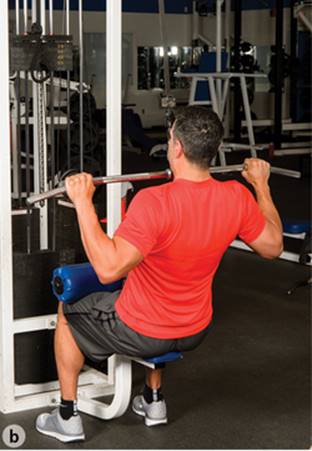
Adjust the seat height and extend your arms overhead to grasp the bar (a). Your palms should face forward with your hands slightly wider than shoulder width. Lean back slightly, and pull the bar downward to the top of your chest (b). Tuck your chin to allow the bar to freely pass in front of your face. Focus on pulling your elbows in toward your body. Return to the starting position and repeat.
Machine Seated Row


Move the seat so your shoulders are level with the machine handles and your chest is against the chest pad. Grasp the handles and sit tall with your chest up (a). Pull the handles backward while moving your shoulder blades together (b). Return to the starting position and repeat.
Dumbbell One-Arm Row


Choose your appropriate or desired dumbbell weight. Stand near the left side of the bench and place your right knee and the palm of your right hand on the bench, keeping your right arm straight and your torso almost horizontal. Hold the dumbbell in your left hand with your palm toward the bench (a). Pull the dumbbell toward the side of your chest by bending at the elbow and the shoulder (b). Return to the starting position and perform the desired number of repetitions. Repeat on the opposite side.
Band Seated Row


Choose a band color or thickness. Sit on the floor and wrap the band securely around both feet. The middle of the band should be placed at the center of your feet. Point your toes slightly forward to prevent the band from slipping. Fully straighten your elbows with your palms facing each other (a). The band tension should be tight in both your hands. Pull the band toward the sides of your body while keeping your back straight (b). Pause briefly; then return to the starting position and repeat.
Machine Overhead Press


Adjust the seat height so the handles are aligned with or slightly above your shoulders. Grasp the handles and sit up straight with your head, shoulders, and back against the pad and your feet flat on the floor (a). Push the weight up over your head until your arms are fully extended but not locked (b). Pause briefly and return to the starting position.
Dumbbell Lateral Raise


Choose your appropriate or desired dumbbell weight. Stand with your feet shoulder-width apart. Hold a dumbbell at the side of your body with your palms facing in and your elbows slightly bent (a). Raise both arms out to the sides until they are horizontal (b). Pause briefly; then return to the starting position and repeat.
Dumbbell Upright Row


Stand tall with your feet shoulder-width apart. Hold a dumbbell in each hand with your palms facing your thighs and your elbows pointing outward (a). Bend at the elbows and lift both dumbbells to shoulder level (b). Keep your elbows pointed outward during the upward movement. Pause briefly; then lower the weights to the starting position and repeat.
Band Upright Row


Choose your appropriate or desired band. Stand with both feet placed about shoulder-width apart on top of the band. Grasp one end of the band in each hand and stand erect (a). Your palms should be facing your thighs, and the band tension should be tight. Bend at the elbows and pull the band to shoulder level (b). Keep your elbows pointed outward during the upward movement. Pause briefly; then lower your arms to the starting position and repeat.
Machine Biceps Curl


Adjust the seat height so your upper arms are resting flat against the arm pad and your elbow is aligned with the machine’s axis of rotation. Grasp the handles firmly and position your body so your chest is up and your shoulders are back (a). Curl your hands toward your shoulders until your elbows are fully flexed (b). Return to the starting position and repeat.
Dumbbell Biceps Curl


Choose your appropriate or desired dumbbell weights. Stand tall with your feet shoulder-width apart. Hold the dumbbells with your palms facing forward and your elbows at the sides of your body (a). Raise both dumbbells by bending your elbows until they are fully flexed (b). Keep your elbows at your sides during the entire movement. Lower the dumbbells to the starting position and repeat. This exercise can also be performed in a seated position with alternating arms.
Band Biceps Curl


Choose a band thickness or color. Stand with both feet placed about shoulder-width apart on top of the band. Grasp one end of the band in each hand and stand erect (a). Your palms should be facing forward, and the band tension should be tight. Bend your elbows until they are fully flexed (b). Keep your elbows at your sides during the entire lift. Lower your arms to the starting position and repeat. This exercise can also be performed in a seated position with alternating arms.
Machine Triceps Press


Stand tall with hands placed approximately shoulder-width apart on the bar. Grasp the bar and position your body so your chest is up and shoulders are back (a). Move the bar from the starting position until your elbows are fully extended but not locked (b). Return to the starting position and repeat.
Dumbbell Lying Triceps Extension


Choose an appropriate or desired dumbbell weight. Lie on a bench with your knees bent and your feet flat on the floor. Your head, shoulders, back, and buttocks must maintain contact with the bench during this exercise. Hold a dumbbell in each hand with your thumb wrapped around the dumbbell and both arms fully extended above your shoulders (a). Bend your elbows and slowly lower the dumbbells toward (but not touching) the side of your head (b). Return to the starting position and repeat. A spotter should be nearby to assist you if needed.
Band Triceps Extension


Choose a band thickness or color. Stand straight with your feet about shoulder-width apart. Hold one end of the band in your left hand placed near your low back and the other end in your right hand placed behind your neck (a). Move your arm up so the right elbow straightens overhead without moving your left arm (b). Pause briefly; then slowly return your right hand to the starting position and perform the desired number of repetitions. Repeat on the opposite side.
Machine Back Extension


Adjust the seat so your navel is aligned with the machine’s axis of rotation. Sit with your back against the pad, your feet on the foot pad, and your arms folded across your chest (a). Slowly lean backward (extending the torso) with the back in contact with the pad (b). Pause briefly; then return to the starting position and repeat.
Prone Plank


Lie facedown on the floor with your feet behind your body. Support your weight on your knees and forearms (a). Keep your back flat and your head in line with your torso. Breathe normally as you hold the position for the desired number of seconds. To increase difficulty, lift your knees and support your weight on your toes and forearms (b).
Kneeling Hip Extension


Kneel down in the crawl position with your arms directly below your shoulders (a). Extend your right leg backward until it is parallel to the floor while keeping your shoulders and hips level (b). Pause briefly; then return to the starting position and repeat on the opposite side.
Machine Abdominal Curl


Adjust the seat so your navel is aligned with the machine’s axis of rotation (a). Curl your torso forward while fully flexing your trunk (b). Pause briefly; then return to the starting position and repeat.
Curl-Up


Lie on your back with your knees bent and your feet flat on the floor (a). Place your hands on your thighs. Curl your shoulders and upper back off the floor while sliding your hands up your thighs toward your kneecaps (b). Your low back should remain in contact with the floor. Pause briefly; then return to the starting position and repeat.
Diagonal Curl-Up


Lie on your back with your knees bent and your feet flat on the floor (a). Place your hands on your thighs. Curl your shoulders and upper back off the floor while sliding your left hand toward your right kneecap (b). Your low back should remain in contact with the floor. Pause briefly; then return to the starting position and repeat on the opposite side.
Regular participation in strength-building exercises that enhance muscular fitness can offer observable health and fitness value. Muscles and bones get stronger and activities of daily life become easier to perform. A well-designed resistance training program should target all the major muscle groups and should be sensibly progressed over time to optimize adaptations and maintain interest.