
Flexibility may not have the same health benefits as aerobic or muscular fitness, but it is an important part of your overall physical fitness. Many activities require flexibility (e.g., golfing, swimming, dancing), and daily activities are also affected by flexibility (e.g., reaching, bending, twisting) (2, 3). Flexibility varies between individuals and is affected by joint types, differing muscle lengths, ligaments, tendons, muscles, skin, and age (17). Understanding flexibility and its role in exercise programming is essential for a well-balanced exercise regimen.
Flexibility Factors
Flexibility is the ability of a joint and surrounding muscle to move through a full or optimal range of motion (6). Improving range of motion at a joint eliminates awkward and inefficient movements, allowing you to move more fluidly. You can appreciate this throughout your day-to-day activities and in any recreation or sports you may do. Maintaining or improving your range of motion through flexibility exercises helps you move more efficiently (3, 4, 7). For example, if you improve range of motion in your hips and hamstring muscle groups, which are located at the back of your thighs, you can ease the task of reaching down to pick up a grocery bag or bending over to tie your shoes, as well as increase your stride when jogging or running.
Several factors influence flexibility, including age, sex, joint structure, and physical activity level (4, 17). Females tend to have a slightly greater range of motion at most joints than males do. This is usually explained by differences in joint structure and is often observed in joints in the upper body (e.g., shoulders, elbows, wrists, neck), with the exception of the trunk, in which males tend to have a greater range of motion than females (9). Flexibility typically decreases with age, resulting in many significant changes in the neck, shoulder, and trunk region (9, 19). You can minimize these changes by adhering to a regular stretching program. Specific activities you can incorporate into your stretching routine are outlined in this chapter.
Q&A
How can routine activities affect flexibility?
Routine daily activities including desk work can cause slumped-forward shoulders (internally rotated humerus) as well as lower back pain. To combat this, it is important to include dynamic and static stretches of the chest, shoulders, neck, and hips.
Health and Fitness Benefits of Flexibility
Compared to less active people, active people have greater flexibility in the joints they use (14). For example, people who walk more tend to have greater flexibility in their hips and spine than people who walk less. And limited motion of a specific joint can lead to a loss in flexibility. If you spend several hours per day driving or sitting at a computer, you may find that your shoulders round forward as a result of decreased range of motion at your shoulder joints. A focus on stretching and body position can help you avoid such losses in flexibility and allow you to keep a strong upright posture.
In addition, improvements in flexibility may enhance performance in certain skills that require greater flexibility (e.g., dancing, golf) (8). However, unless you have poor flexibility at a specific joint, increasing flexibility beyond a normal range of motion does not benefit performance or decrease the risk of injury. Contrary to popular belief, there is not sufficient evidence to support the contention that preexercise stretching prevents all injuries (although there may be potential benefits related to acute injuries in repetitive activities like running [5]), or that pre- and postexercise stretching prevents muscle soreness (5, 13). However, you may experience relaxation or stress relief from participating in flexibility-focused exercises.
Q&A
Does stretching prevent or reduce muscle soreness?
Researchers have not proven that stretching before or after an exercise session adds benefits or protection against muscle soreness (11). Stretching has not been found to attenuate the structural mechanisms that contribute to soreness, including microtears to the muscle fibers, accumulation of calcium ions, cellular inflammation, or swelling.
Assessments for Range of Motion
Several tests can be administered for flexibility assessment if one has access to some rather simple pieces of equipment such as these:
· Masking tape
· Chair
· Measuring stick (yardstick or meter stick)
· Ruler
Flexibility testing is similar to stretching exercises in that a brief warm-up should be administered before attempting the assessment. On average, 5 minutes of brisk cardiovascular activity like a brisk walk, moderate cycling, or marching in place is typically enough to increase the heart rate and provide pliability to the muscle structures.
This chapter describes a small subset of tests that are available to assess flexibility. Each joint and body segment is unique. Two assessments covered in this chapter are the sit-and-reach and the back-scratch test. These tests provide a snapshot of flexibility in the trunk and hips as well as the upper arm and shoulder.
Sit-and-Reach Assessments
The sit-and-reach is one of the most common tests of flexibility and reflects hamstring flexibility (muscles on the back of the thigh) and possible low back flexibility as well (3). There are various versions of the assessment for adults, older adults, and children.
Sit-and-Reach Test for Adults
The setup for the adult sit-and-reach test requires a yardstick and masking tape. The following steps outline the setup and measurement (10):
· A yardstick is placed on the floor and tape is placed across it at a right angle to the 15-inch (38 cm) mark. Sit with the yardstick between your legs, with legs extended at right angles to the taped line on the floor. Heels of the feet (with shoes removed) should touch the edge of the taped line and be about 10 to 12 inches (25-30 cm) apart (see figure 7.1a).
· Slowly reach forward with both hands as far as possible, holding this position approximately 2 seconds (see figure 7.1b). Be sure that you keep the hands parallel and do not lead with one hand or bounce. Fingertips can be overlapped and should be in contact with the yardstick.
· The score is the most distant point (recorded in inches) reached with the fingertips. The best of two trials should be recorded. To assist with the best attempt, you should exhale and drop your head between your arms when reaching. Make sure that your knees stay extended. Do not bend the knees as you reach forward, but also, do not press the knees down. Breathe normally during the test; you should not hold your breath at any time.
· You can track your score over time, realizing that a higher score indicates improving flexibility.
Figure 7.1 Sit-and-reach assessment for adults.


Chair Sit-and-Reach Test for Older Adults
The sit-and-reach test for older adults can be done while sitting in a chair rather than on the floor (16). In addition to a sturdy chair, you will also need a ruler. Note that if you have pain when flexing, have severe osteoporosis, or have had recent knee or hip replacement, this assessment should not be attempted. The following steps outline the setup and results:
· Start in a sitting position on a chair placed securely against a wall. Move forward until you are sitting on the front edge of the chair. The crease between the top of the leg and the buttocks should be even with the edge of the chair seat.
· Keep your right leg bent and foot flat on the floor; the left leg is extended straight in front of the hip, with heel on floor and foot flexed (at approximately 90 degrees) (see figure 7.2a). With the left leg as straight as possible (but not hyperextended), slowly bend forward at the hip joint, reaching as far toward or past your toes on your left foot as possible (see figure 7.2b). Your hands should be one on top of the other with the tips of the middle fingers even. Continue breathing normally; do not hold your breath. Exhale as you reach forward and avoid bouncing or forcing the movement. Hold your reach for 2 seconds. Practice the movement twice.
· Now switch the position of your feet and keep your left leg bent and foot flat on the floor with the right leg extended straight in front of you. Repeat the test in this position.
· Whichever position results in the farthest reach is used for scoring purposes. Repeat the test two more times in this position. Using a ruler, record the number of inches short of reaching the toes (minus score) or beyond the toes (plus score). The tip of your toes at the end of your shoe represents a zero score.
· Use table 7.1 to interpret the results of your sit-and-reach test. Normal ranges are shown; if your score is over the range listed, consider yourself above average and if your score falls short of the range listed, consider yourself below average.
Figure 7.2 Chair sit-and-reach for older adults.


Sit-and-Reach Test for Youth
This version of the sit-and-reach test focuses mainly on hamstring flexibility. The sit-and-reach test used in the FitnessGram for youth requires a 12-inch-high (30.5 cm) box and a yardstick (18). The following steps outline the setup and results:
· The yardstick is placed on the box with the zero end of the yardstick facing the child and the 9-inch (22.9 cm) mark at the nearest edge of the box. One foot is placed against the box and the other is flat on the floor next to the knee of the straight leg (see figure 7.3).
· The child reaches forward with back straight and head up. After measuring one side, have the child reverse the position of the legs and repeat.
· Record the number of inches for both the right and left sides to the nearest half inch (1.3 cm).
· Rather than determining a range, the test establishes a standard score to be met (or not). For boys ages 5 to 17, this is 8 inches (20.3 cm). For girls the standard increases with age: For 5- to 10-year olds, the standard is 9 inches (22.9 cm), for 11- to 14-year olds it is 10 inches (25.4 cm), and for 15- to 17-year olds it is 12 inches (30.5 cm).
Figure 7.3 Sit-and-reach for youth.

Shoulder Flexibility Assessments
Shoulder flexibility can affect a person’s capability to perform activities of daily living such as brushing one’s hair or reaching for a seat belt. The most common test for shoulder flexibility is the back-scratch test. Note that this test should not be attempted by anyone with neck or shoulder injuries or problems such as pinched nerves or frozen shoulder.
Back-Scratch Test for Adults
The only equipment you will need is a ruler. The following steps outline the setup and results (15):
· In a standing position, place your preferred hand behind the same-side shoulder, palm toward back and fingers extended, reaching down the middle of the back as far as possible (elbow pointed up).
· Then place your other hand behind the back, palm out, reaching up as far as possible in an attempt to touch or overlap the extended middle fingers of both hands (see figure 7.4). Do not attempt to grab your fingers and pull.
· Practice for two trials before measuring.
· The distance of overlap or distance between the tips of the middle fingers is measured to the nearest 1/4 inch. A minus score (−) is given to represent a distance short of touching; a plus score (+) represents the amount of an overlap.
· You can track your score over time. If hands can touch (or overlap), shoulder flexibility is a strong point, but if hands are short of reaching, shoulder flexibility is an area in which to seek improvement.
Figure 7.4 Back-scratch for adults.

Back-Scratch Test for Older Adults
This test requires only a ruler. The following steps outline the setup and results (16):
· In a standing position, place your right hand behind your right shoulder, palm toward back and fingers extended, reaching down the middle of the back as far as possible (elbow pointed up).
· Then place your left hand behind the back, palm out, reaching up as far as possible in an attempt to touch or overlap the extended middle fingers of your right hand (see figure 7.5).
· Practice for two trials and then repeat with your hands in the opposite position: left hand behind your left shoulder, reaching down toward your right hand that is placed behind your back.
· Whichever hand placement results in the closest reach should be used for scoring. Repeat the assessment twice with your hands in this position. Be sure to breathe normally and avoid bouncing or abrupt movements.
· The distance of overlap or distance between the tips of the middle fingers is measured to the nearest 1/2 inch. A minus score (−) is given to represent a distance short of touching (record the distance separating the middle fingers of each hand); a plus score (+) represents the amount of an overlap.
· Check your score in table 7.2. Normal ranges are shown; if your score is over the range listed, consider yourself above average and if your score falls short of the range listed, consider yourself below average.
Figure 7.5 Back-scratch for older adults.


Shoulder Stretch Test for Youth
No equipment is needed for this assessment. The objective is to touch the fingertips of opposite hands by reaching over the shoulder and under the elbow (18). The following steps outline the setup and results:
· Reach with the right hand, palm toward the back, over the right shoulder and down the back while at the same time placing the left hand, palm facing out, behind the back, and reach up toward the fingers of the right hand (see figure 7.6). Do the fingers touch?
· Then repeat with hands in the opposite position. Again, do the fingers touch?
· The scoring for this assessment is a simple “yes” or “no” response. The scoring is considered for both the right and left positions.
Figure 7.6 Shoulder stretch for youth.

Flexibility Program Components
Flexibility, like resistance training, is specific to the muscle groups and joints that are stretched. Thus, it is important to target all the major muscle groups (see figure 6.7, a and b, for the locations of the major muscle groups in the body).
A flexibility routine should be completed after a thorough warm-up of at least 5 minutes or after a cardiorespiratory or resistance training session. Increasing the temperature of the muscle increases its ability to stretch (1). Warm muscles have a greater elastic response than cold muscles do (3). The FITT-VP principle can be applied to your flexibility program, including the frequency, intensity, time, type, volume, and pattern of stretching activities.
Flexibility does not have to reach this level to provide benefits.

Frequency
To improve flexibility, perform flexibility exercises at least two to three days per week for a minimum of 10 minutes (3). Note that this is considered a minimum; stretching on a daily basis as part of a warm-up or cool-down is effective in improving range of motion.
Intensity
The question of how far to stretch (i.e., the intensity of the stretch) is a common one. Typically, stretching exercises are done to the point of mild tightness without discomfort within the range of motion of the joint(s) (3). If a given stretch creates discomfort, release slightly—a stretch should not be painful. Over time, you may be able to move the joint farther as your flexibility improves, but the stretch should never cause pain. If it does, back off slightly.
Time
You should hold a single flexibility exercise for 10 to 30 seconds (3, 5). In general, longer hold times have not been found to provide additional benefits for improving joint range of motion (3). However, older adults may benefit from holding the stretch for 30 to 60 seconds (3).
Type
Two of the most common methods of stretching to improve flexibility are static and dynamic. Both methods involve moving a joint or joints to the end of the range of motion. With static stretching, the position is held, whereas dynamic stretching involves continuous movement of the joint(s). Static stretching is more commonly used after an activity because some activities requiring strength, power, or endurance may be impaired by static stretching before the activity (3). Dynamic stretching can be done before activity, following a general warm-up of the muscles (20).
Static
Static stretching is undoubtedly the most common method used to improve flexibility. Static stretching consists of slowly moving a joint to the point at which you feel tension and then holding that stretch for 10 to 30 seconds (3). Remember, do not place your joints in any position that causes pain. As you hold the stretch, the tension should lessen as the muscle lengthens. Each static stretch should be repeated two to four times to accumulate 60 seconds per stretch.
Dynamic
Dynamic stretching involves moving parts of your body through a full range of motion while gradually increasing the reach and speed of the movement in a controlled manner. An example of this is arm circles; you begin with small, slow circles and gradually progress to larger and faster circles until you reach the full range of motion of the shoulder joint. Many people think dynamic stretching involves bouncing or jerking motions—it does not! The goal is to move the joint in a controlled manner within a normal range of motion in order to minimize the risk of injury (4). To avoid the muscle soreness that often results from novel movements, introduce dynamic stretches into your stretching program gradually, particularly if you are not accustomed to this type of stretching. Dynamic movements are typically repeated 5 to 12 times within a time frame that varies depending on the motion (approximately 30 to 60 seconds).
Q&A
Should you perform static or dynamic stretches before or after a workout?
You may want to perform dynamic stretching before the workout, as these activities encourage large movements that raise the heart rate and increase blood flow to the muscles, tendons, and ligaments. Incorporating a dynamic warm-up has the potential to reduce injury as well as to prepare the body for the upcoming workout (12). But don’t forget the static stretches following the workout. The musculoskeletal system is warm and ready for these lengthening exercises.
Volume and Pattern
In order to improve joint range of motion over time, a total of 60 seconds of flexibility exercise per joint is recommended (3). This is accomplished by repeating shorter-duration stretches, for example, repeating a 30-second stretch twice or repeating a 15-second stretch four times. Typically a body-wide stretching routine can be completed in less than 10 minutes per session (3).
Your Flexibility Program
Stretching can be done any time a muscle is warmed up and should be included before sports or activities requiring a high degree of flexibility. Stretching can be included before or after the conditioning phase of general fitness activities. Although not conclusive, some research suggests that static stretching could interfere with sports that require muscular strength, power, or endurance (3). Thus, in the following sample programs, dynamic stretching follows the warm-up (before the conditioning phase of the workout), and static stretching is part of the cool-down.
Flexibility Stretches to Avoid
Many stretches that have been accepted in the past have been found to cause unnecessary strain on the joints and muscles. Although not everyone engaging in these activities will incur injury, it is sensible to avoid certain stretches and focus on those included at the end of this chapter. Table 7.3 lists a few stretches to avoid and suggested alternatives.
Also note that in some situations, stretching a muscle may not be appropriate. For example, if a muscle or joint has been injured, stretching exercises would typically be postponed unless prescribed as part of a treatment plan by a health care provider.

Sample Stretching Program After a Warm-Up
After a thorough warm-up, dynamic stretches can be performed to improve the efficiency of the movements you will do during your conditioning period of cardiorespiratory or resistance training. Dynamic stretches should begin with small ranges of motion and progress to larger ranges of motion. You should repeat each movement 5 to 12 times or move continuously for 30 to 60 seconds. Figure 7.7 outlines a dynamic stretching program you can use after a warm-up.

Sample Stretching Program After a Conditioning Period
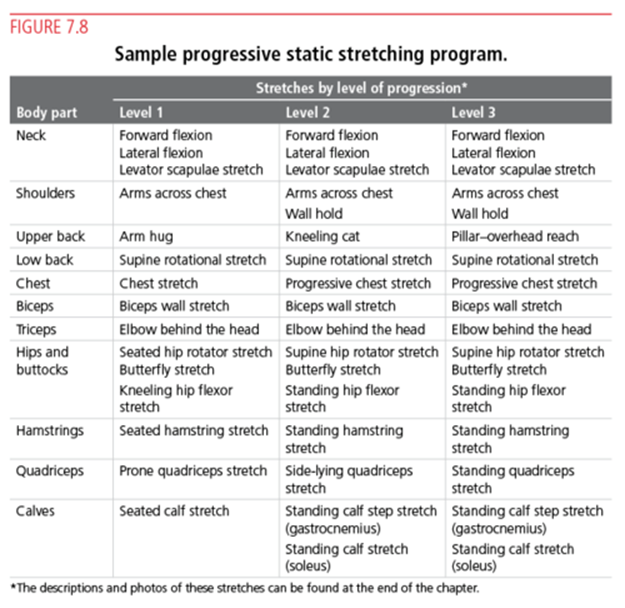
After a conditioning period, use static stretching to improve your flexibility. Figure 7.8 outlines a sample progressive static stretching program. When you begin a flexibility program, start with level 1 stretches, which are the most basic. Begin by holding static stretches for 10 seconds and slowly progress to holding the final position for up to 30 seconds, repeating each stretch two to four times. Once you are comfortable with level 1 stretches, progress to level 2 and then to level 3 stretches. The progression of certain stretching exercises (e.g., quadriceps) moves from a lying to seated to standing position. As you move through these levels, you will need more balance to perform the exercise.
If you are having trouble placing your body in the required positions, you can use a towel to provide some extension. For example, when doing the triceps stretch with the elbow behind the head later in this chapter, you could hold a towel in the hand of the arm you are stretching and provide assistance with the stretch by gently pulling on the towel with the other hand placed behind your back rather than on the elbow. When using a stretching aid, be careful not to jerk or pull your limb into an awkward or painful position.
Flexibility Stretches
The exercises to improve flexibility that have been listed throughout this chapter are provided here, organized by type—either static or dynamic. Each stretch includes a description and photos to help you perform it correctly.
Static Stretches
Static stretches, as discussed in detail previously in this chapter, are simple exercises that you can use to improve your flexibility. Remember to always warm up before stretching.
Neck
Forward flexion: Facing forward, move your head forward to tuck your chin into your chest; hold.

Lateral flexion: Facing forward, allow your head to tilt to the side so your ear moves toward your shoulder; hold. Repeat on the other side.

Levator scapulae stretch: Sit up straight on a chair. Put your hand up over your shoulder and bring your elbow back, pointing your elbow up to the ceiling. Use your left hand to pull your head forward and to the left; hold. Repeat on other side (6).


Shoulders
Arms across chest: Facing forward, straighten your right arm and draw it across your chest. Your arm should be as straight as possible, and you should feel gentle tension in your right shoulder. Grasp your right arm with your left hand and apply gentle pressure with your left hand to increase the tension in your right shoulder. Repeat on the other side.

Wall hold: Stand with your right side facing a wall. Place your hand on the wall at shoulder height with elbow straight and thumb pointing down (a). Turn your body away from the wall and maintain the rotation of your arm; hold (b). Repeat on the other side.


Upper Back
Arm hug: Cross your arms around your body with your elbows pointing forward. Let your upper body round, and squeeze your arms toward each other.

Kneeling cat: Adopt a crawl position on your hands and knees (a). Draw in your abdominal muscles and contract your buttocks, and then round your spine throughout its entire length (b).


Pillar–overhead reach: Facing forward, stand upright and extend your arms above your head, keeping your shoulders in a neutral position (in line with your hips). Interlock your fingers and use your palms to press upward. You can also involve your trunk muscles (torso) by slightly rotating to one side of your body and back. Hold when you feel tension in your torso on the side opposite the reach; repeat on other side.

Low Back
Supine rotational stretch: Lie face up on the floor and bend your knees so that your feet are flat on the floor. Straighten your arms out from your sides across the floor to stabilize your upper body (a). Slowly move both legs with your knees bent to the right side of your body while keeping your upper back against the floor and your abdomen oriented toward the ceiling (b). Repeat by moving your legs to the left side.


Chest
Chest stretch: In this stretch, your shoulders should be relaxed, not elevated. Straighten your arms toward your back, keeping them at or a little below shoulder height. A good cue for this stretch is “open arms wide.”

Progressive chest stretch: Place your arms against an open doorway and lean forward until you feel gentle tension across your chest. This exercise also stretches the biceps.

Biceps
Biceps wall stretch: Position your arm from your hand to your inner elbow against a wall and turn your body away from it, exhaling slowly. Repeat on the other side.

Triceps
Elbow behind the head: Facing forward, bring your right arm up, bend from your elbow, and drop your hand behind your head, trying to reach your left shoulder with your right hand. The left hand can be placed on the right elbow to assist with this stretch. Repeat on the other side.

Hips and Buttocks
Seated hip rotator stretch: Sit upright on a sturdy chair that won’t move. Cross your right ankle onto your bent left knee (a) and gently press down on your right knee until tension develops in the outer portion of your right thigh (b). Repeat on the other side.


Supine hip rotator stretch: Lie faceup on floor with your knees bent so your feet are flat on the floor and cross your right ankle onto your bent left knee (a). Lift your left foot off the floor and wrap your hands around your left leg and draw it into your body (b). Focus on opening up your right knee until tension develops in the outer portion of your right thigh. Repeat on the other side.


Butterfly stretch: Sit upright on the floor with the soles of your feet together. Draw your knees to the floor and lean forward from your hips and use your elbows to press your legs downward.

Kneeling hip flexor stretch: Kneel on both knees with your upper body lifted. Plant your left foot on the floor until you reach a 90-degree angle with both your front and back legs (a). Shift your weight forward while keeping your upper body lifted (b). Repeat on the other side.


Standing hip flexor stretch: Stand erect and keep your hands on your hips. Step forward with your left foot into a lunge position (a). Your left foot will be in front of your body and your right foot will be behind your body; your right heel may be elevated to facilitate this movement. Shift your hips forward and maintain this position, feeling tension develop in your hips, quadriceps, and buttocks (b). Repeat on the other side.


Hamstrings
Seated hamstring stretch: Sit upright on the floor with both legs straight and hands resting on your legs (a). Slowly walk your hands forward toward your feet, keeping your chest lifted (b).


Standing hamstring stretch: Standing upright, bring your right foot slightly ahead of your left foot. Slowly draw your hips back while slightly bending your left knee and straightening your right knee (a). Bring the toes of your right foot off the floor and toward your body (b). Hold and then return to the starting position. Repeat with the other leg.


Quadriceps
Prone quadriceps stretch: Lie facedown on the floor with your legs straight. Draw your right heel back toward your buttocks using your left hand. Be sure to keep your knees together.

Side-lying quadriceps stretch: Lie on the floor on your right side. Bend your left knee, keeping your knees and hips in a straight line (keep your knees together and do not twist your leg to the side). Draw your left heel back toward your buttocks with your left arm. Repeat on the other side.

Standing quadriceps stretch: While in a standing position (you can hold on to a chair for support), bend your right knee toward your buttocks. Grasp your right ankle with your left hand. Be sure to keep your knees close together and your ankle behind your buttock; do not twist your leg outward. Gently pull your thigh back slightly. Repeat on the other side.

Calves
Seated calf stretch: Sit upright with both legs straightened out in front of you (a). Draw your toes toward your upper body (b).


Standing calf step stretch: Stand with your legs extended on the edge of an immovable step and grasp a banister or handrail for support. Move your right foot so your heel back is off the edge of the step (a). Slowly drop your right heel until tension develops in your right calf (b). Repeat on the other side.


Standing calf stretch (gastrocnemius): Stand about 3 feet (0.9 m) from a wall and put your right foot behind you, ensuring that your toes are facing forward. Keep your heel on the ground and lean forward with your right knee straight. Rotating the toes in and out slightly will target the medial and lateral parts of this muscle separately. Repeat on other side.

Standing calf stretch (soleus): Stand away from a wall and put your right foot behind you and be sure your toes are facing forward. Lean forward at the ankle while bending the right knee and keeping your heel on the ground. Because the knee is flexed, tension is taken off the gastrocnemius and placed on the soleus. Repeat on other side.

Dynamic Stretches
Dynamic stretches, as discussed in detail previously in this chapter, are more active than static stretches. Remember to always warm up before any stretching activity.
Arms and Shoulders
Arm circle: Stand with your feet shoulder-width apart and your knees slightly bent. Raise both arms to the side at shoulder height with your palms out. Make small circles with your arms extended, gradually increasing the size of the circles.

Shoulder shrug: Lift both shoulders toward your ears (a) and then lower them away from your ears (b).


Hips and Buttocks
Pendulum leg swing (front to back): Place your right hand on the back of a chair for balance. Lift your left leg and swing it forward (in front of your body) (a) and back (behind your body) (b). Begin with small swings and progress to larger swings. Switch to the opposite leg.


Pendulum leg swing (side to side): Place both hands on the back of a chair for balance. Swing your left leg out to the left (a), and back across your body to the right (b). Begin with small swings and progress to larger swings. Switch to the opposite leg.


Internal hip rotation: Stand upright with your feet shoulder-width apart. Raise your left foot toward the side of your body and tap the outside of your left heel with your left hand. Allow your knee to rotate inward. Switch and tap the outside of your right heel with your right hand. Alternate tapping each foot. Progress to walking forward while alternating feet.

External hip rotation: Stand upright with your feet shoulder-width apart. Raise your left foot in front of your body and tap the inside of your left heel with your right hand. Allow your knee to point away from your body. Switch and tap the inside of your right heel with your left hand. Alternate tapping each foot. Progress to walking forward while alternating feet.

Hip circles: Place your hands on your hips and feet spread wider than your shoulders. Make circles with your hips in a clockwise direction for 6 to 10 repetitions. Then repeat in a counterclockwise direction.

Side shuffle: Stand with your feet shoulder-width apart, your knees slightly bent, and your hands on your hips. Take one step to the left with your left foot (a); then bring your right foot in to meet your left foot (b). Begin with small steps, progress to larger steps, and then progress to a shuffle. Switch to the opposite direction.


Quadriceps
Butt kick: Begin marching in place. Pull your heel in closer toward your buttock with each step. Progress to moving forward (walking or jogging) while kicking your buttocks.

Hamstrings
High knees: Begin marching in place. Raise your knees higher and higher with each step. Progress to moving forward (walking or jogging) with high knees.

Ankles
Dynamic foot range of motion: Sit upright in a chair with both legs together and straightened in front of you. Point your toes away from your body and pull your toes toward your body (a). Rotate your feet clockwise and counterclockwise (b).


Combined Movements
Soldier walk: Simultaneously rotate your right arm forward and raise your left leg (straight). Reach your right hand toward your left lower leg and toes. Switch to the opposite side. Progress to alternating to the opposite side and then to walking while alternating sides.

Wood chop: Stand with your feet wider than shoulder width. Reach both arms down toward the outside of your left foot while bending your knees slightly (a). Move your arms diagonally across your body and end by reaching above your right shoulder (b). Switch to the opposite side.


Power skip: Skip across the field using powerful explosive movements. Use big arm swings starting from the side of the body through the frontal plane and reaching for the sky. Use high knee lifts moving the opposite arm (i.e., as the left leg moves forward, the right arm reaches upward).

Stretching exercises are recommended as an essential component of any exercise training program due to the improvement in range of motion and physical functioning. Improving flexibility can be accomplished through various stretching techniques, for example static or dynamic methods. Stretching exercises can be incorporated into the warm-up to help prepare the body for more vigorous activity, or following the conditioning period of a workout to enhance flexibility. And while the research in flexibility training is still emerging, following the guidelines set forth in this chapter will help you to improve your flexibility in a safe and effective manner.