
The chronic disease epidemic is one of the most significant challenges humanity is facing today. This insidious, slow-motion plague is causing untold suffering for hundreds of millions of people around the world; leaving doctors and other healthcare professionals drained and dispirited, and eroding their faith in medicine; and stealing valuable financial resources from governments, corporations, and individuals.
I wish I could say that the stories I told in Part One about Leo and Latisha were unusual. Unfortunately, my practice is full of such patients—and I know the same is true for healthcare practitioners around the world. Perhaps you’re dealing with similar challenges yourself, or maybe you have an aunt, a co-worker, or a child who is. With one in two Americans suffering from chronic disease, and one in four suffering from multiple chronic diseases, not one of us is untouched by this epidemic.
Chronic disease has become our reality, and we tend to just accept it as normal. But as I explained in Chapter Five, there’s a big difference between what’s common, and what’s normal. It’s not normal for human beings to develop chronic disease—especially as children. It’s not normal for us to suffer and be in pain for years, much less decades. It’s not normal for us to have to take a fistful of medications just to function at a sub-par level.
In Chapter Five, I argued that there are three fundamental reasons why our conventional healthcare system has not only failed to address chronic disease but will never be able to do so in its current configuration. First, it ignores (or pays lip service to) the mismatch between our genes and our modern environment. Second, our medical paradigm is optimized for treating acute, rather than chronic disease. Third, the way healthcare is delivered doesn’t support the most important interventions for preventing and reversing chronic disease.
It follows, then, that the solution to the chronic disease epidemic must address all three of these shortcomings. Anything less will fall short. In this section of the book, I will describe a solution that does exactly that: the ADAPT Framework. It consists of three elements:
· A Functional Medicine approach, which is focused on preventing and reversing, rather than simply managing, chronic disease.
· An ancestral diet and lifestyle, which reflects the recognition that we are evolutionarily mismatched to our environment and that this mismatch is the primary driver of chronic disease.
· A collaborative practice model, which offers clinicians a structure that better supports delivering Functional Medicine and ancestral diet, lifestyle, and behavioral interventions to patients.
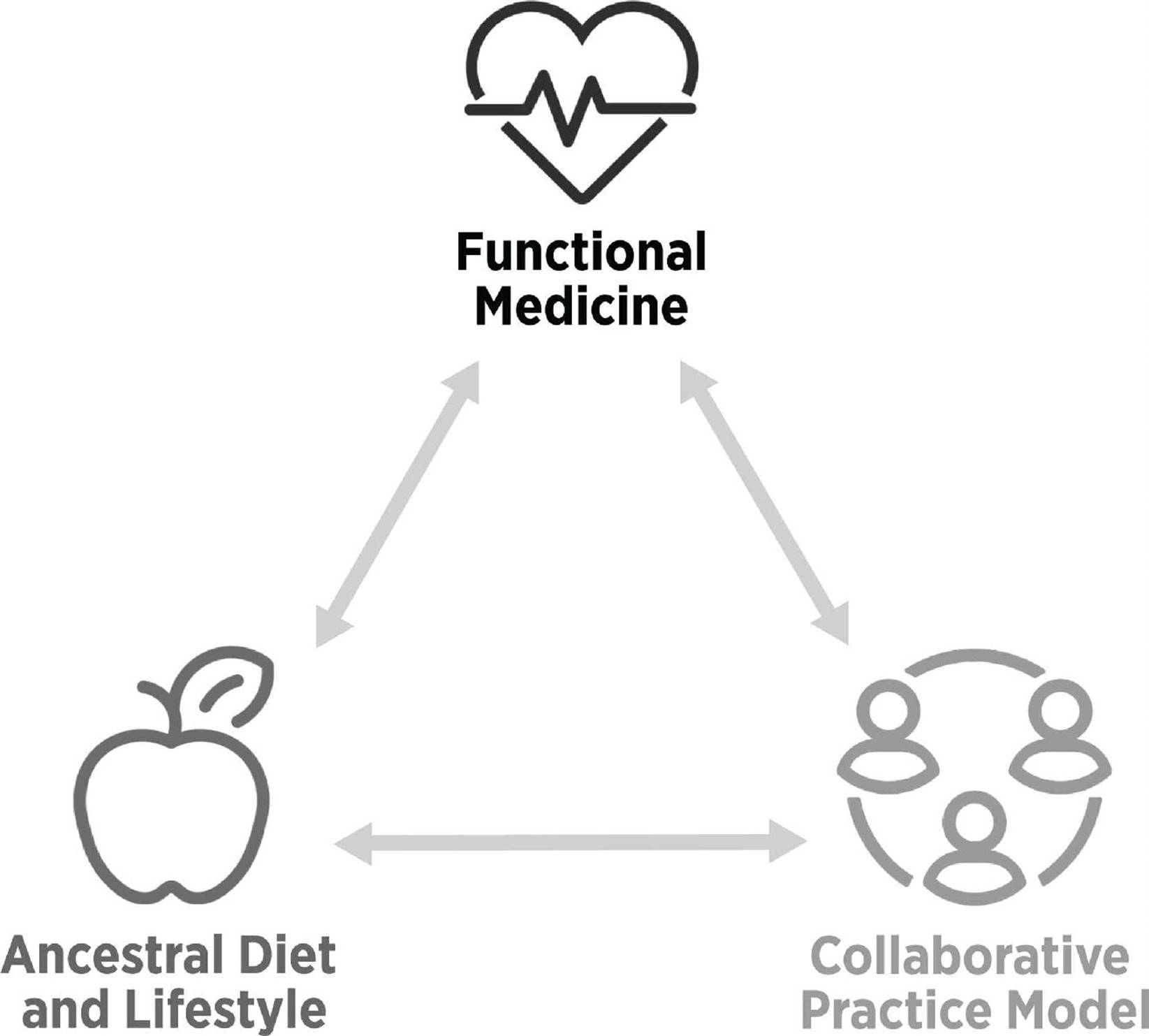
The ADAPT Framework
I’ll describe each of these elements in detail in the following chapters. But before I do that, I’d like to tell you more about how I developed this framework, and why I believe it’s our best option for ending chronic disease.
The Evolution of the ADAPT Framework
I arrived at the ADAPT Framework not only through research and studying larger trends, but through my own experience—both in my personal healing journey, and in my work with patients. You may recall from the introduction that I suffered from a debilitating, chronic illness that took me nearly a decade to recover from. My first big step forward came when I discovered the ancestral health approach. I brought my diet and lifestyle into closer alignment with what my genes and biology are hard-wired for. My second step forward came when I worked with the acupuncturist. Although she wasn’t practicing Functional Medicine per se, her approach embraced many elements of it, and it launched me toward learning more. Finally, as I adopted the principles of ancestral health and Functional Medicine, I assembled a team of practitioners that could support me in the various areas I needed help in: a doctor who practiced Functional Medicine, a bodyworker who helped unwind the tension in my gut, a therapist who supported me in addressing the psychological and emotional challenges of my chronic illness, a meditation teacher who continued to guide me in my practice, and several other healers, teachers, coaches, and supporters over the years.
Later, when I started to work with patients, I made the same discoveries all over again. I already knew of the ancestral diet and lifestyle and Functional Medicine from my own healing journey. As I started to use these approaches with patients, I quickly learned that one was not enough without the other.
Functional Medicine provided the crucial shift in focus from symptom suppression and disease management to preventing and reversing disease by addressing its underlying cause. Yet most Functional Medicine seminars and training programs I attended did not embrace the ancestral diet and lifestyle. Certainly, they advocated for the importance of diet and lifestyle change in general, but the recommendations they made were based more on a plant-based, low-fat diet, which was a disconnect with what I had come to believe from my research, my own healing journey, and my work with patients. The ancestral perspective was important for two reasons. First, it provided an important frame and context for sharing diet and lifestyle recommendations with patients. Second, the recommendations that came out of this frame were far more effective than any other approaches I’d used in the past.
On the other hand, I also learned that the ancestral diet and lifestyle—though extremely effective in most cases—was often not enough to completely reverse the patient’s health problems and restore optimal function. Functional Medicine offered a more comprehensive toolset, with cutting-edge laboratory testing and evidence-based treatment protocols using botanicals, supplements, and when necessary, targeted and safe medication.
Finally, as I gained more experience working with patients, I saw that as powerful as Functional Medicine and the ancestral perspective were, their potential could not be fully realized without a care model that supported these interventions. Consider a patient we’ll call Nguyen. She came to see me with a long list of symptoms, including neuropathy, muscle and joint pain, brain fog, memory loss, anxiety, insomnia, constipation, gas, bloating, cold hands and feet, dysmenorrhea and abnormal menstrual cycles, asthma, allergies, frequent ear infections, acne, eczema, dry eyes and mouth, weight gain, and food intolerances.
After a thorough initial work-up, I discovered that she had a parasite (Giardia), Hashimoto’s thyroiditis, elevated mercury levels, B12 and folate deficiency with borderline anemia, vitamin D deficiency, HPA axis disruption (often erroneously referred to as “adrenal fatigue”), impaired methylation, low estrogen, progesterone, and testosterone, and several other problems. Her treatment involved an antimicrobial protocol to address the gut infections; a thirty-day elimination diet (based on ancestral diet principles); a mercury detox protocol; specific foods and supplements to increase her B12, folate, and vitamin D levels, and improve methylation; and an intensive behavior and lifestyle protocol involving stress reduction, improved sleep hygiene, circadian regulation (reducing her exposure to artificial light at night, and increasing her exposure to sunlight during the day), gentle physical activity, more time outdoors (especially in natural environments), and a meditation practice.
Nguyen clearly needed a Functional Medicine and ancestral diet and lifestyle approach. But let me ask you this: do you think her treatment would be successful with just a thirty-minute appointment with me every three to six months? This is, unfortunately, still the default model even in most Functional Medicine practices. One of my biggest regrets is not realizing the deficiency of this model sooner; I feel sad when I think of the patients like Nguyen who we weren’t able to help because we couldn’t provide the support they needed.
That’s where the collaborative practice model comes in. It provides a methodology and structure for offering patients like Nguyen the tools, resources, and support they require to successfully implement the Functional Medicine and ancestral health protocols. Instead of only seeing a clinician once every three to four months for thirty minutes, Nguyen will have a fifteen-to-thirty-minute check in with a nurse practitioner or physician assistant by phone or video conference every two weeks while she’s on her protocol. She can also work intensively with a health coach, who will help her with her new diet (providing recipes, meal plans, and tips for shopping, travel, and eating out) and support her lifestyle and behavior changes. Nguyen may also sign up for one of the groups or classes our clinic might offer for people dealing with specific conditions, such as chronic pain, autoimmune disease, or digestive distress. Through the patient portal in our electronic health record (EHR), she has access to her labs, a library of handouts with guidance on her protocols, appointment scheduling, and a messaging system where she can communicate with her practitioners.
This is a night-and-day difference from her experience with her conventional doctor, where she had less than fifteen minutes to describe her symptoms, no investigation was done to discover their root cause, and the only treatments offered were drugs that either didn’t work or caused side effects that were worse than her original complaints. But it’s also a significant difference even from most Functional Medicine clinics, where the episodic model of care—periodic appointments with the licensed clinician, with little support offered in between—is still common. Nguyen’s experience is exactly why this third element of the ADAPT Framework is so important.
Ready to learn more? Let’s dive in.