
AS I (RICK) SAT DOWN TO WRITE THIS CHAPTER, I STRETCHED MY ARMS BACK above my head and immediately felt a dull pain in my biceps and shoulders — a “good” pain — called delayed onset muscle soreness (DOMS). You may know the feeling. You complete a really tough workout, and during the following days your muscles feel sore or stiff. Sometimes it’s even a source of pride: “I really must have worked those muscles hard to feel this sore!”
When you exercise vigorously, you induce microscopic tears in your muscle fibers. Your body experiences this as an injury and responds by increasing blood flow to that area, sending white blood cells and other immune cells to promote healing. This inflammatory response helps promote recovery of your damaged muscle tissue — in fact, the tissue regenerates and is actually stronger than it was before the injury. This is why the first time you do certain exercises, you may feel excruciating soreness afterward. But the second time you do the exact same exercises, you are not nearly as sore. Your muscles have adapted and can now better handle the workout. This is known as the “repeated bout effect.”
Traumatic injuries — such as burns, frostbite, and infection — also prompt an inflammatory response. This short-term inflammation is part of the highly complex biological response God created in order for our bodies to heal. However, inflammation is problematic when it becomes a long-term, or chronic, condition. In fact, chronic low-grade systemic inflammation is associated with a variety of diseases and has received a great deal of attention in recent years.
INFLAMMATION AND DISEASE
Scientists have discovered links between chronic inflammation and a variety of diseases. In fact, some researchers suggest that inflammation could be the single most significant factor regulating disease.30 However, while few doubt that inflammation is associated with disease, it’s not yet clear if inflammation plays a role in causing the disease or if it is a consequence of having the disease. In either case, inflammation is a complicating factor linked to diseases such as asthma and allergies (inflammation impacts the airway), osteoarthritis (inflammation impacts the joints), diabetes (inflammation impairs insulin sensitivity), and atherosclerosis (scientific focus so far has been on inflammation as a major contributing factor).
As discussed in chapter 7, atherosclerosis involves a progressive narrowing of the arteries that supply blood to our body tissues. When narrowed or blocked, blood flow to the heart or the brain or other tissues is reduced or stops, leading to tissue death. This happens with a heart attack or a stroke. Atherosclerosis is a highly complex, age-related disease. As you get older, the degree of artery narrowing increases. Inflammation is thought to be involved in all stages of the disease, from initiation to progression and finally to the formation of a potentially fatal clot.
The inflammatory cells and free radicals interact with LDL-cholesterol and promote the formation of fatty plaques in blood vessels. Over time, these plaques reduce the opening in blood vessels and ultimately reduce blood flow. Because of this link between LDL-cholesterol and inflammatory cells, many physicians, when evaluating heart disease risk, are interested not only in measuring cholesterol levels of their patients but also in measuring their degree of inflammation.
EATING AND INFLAMMATION
High-calorie, high-fat, high-sugar meals can induce a state of systemic inflammation, which may persist for several hours following a meal. If you eat such meals regularly, you may find yourself in a state of chronic inflammation. This is why a healthy eating plan should include small and frequent meals of lean protein, fiber-rich carbohydrates, limited saturated fat, and a wealth of vitamins and minerals.
A main focus of research in my (Rick’s) lab over the past several years has been the study of metabolism after eating. We focus on the biochemical changes that occur in the body following meals with high fat and high sugar. (See “The Science behind the Daniel Fast” on page 281.) We focus both on how free radicals modify important molecules, such as protein and lipids, as well as the interplay between free radicals and inflammation.
The take-home message from our work and the work of other scientists is that when you consume high-calorie, high-saturated-fat, sugar-rich meals, you (1) produce a significant amount of free radicals that can damage important molecules such as proteins, lipids, and DNA; and (2) induce a significant increase in inflammation (possibly related to the increase in free radicals).
The combination of excess free radical production and increased inflammation may lead to the development of disease or accelerate aging. Adopting a clean-eating approach, coupled with regular exercise, can lessen both free radical production and inflammation — leading to improved quality and quantity of life.
HOW IS INFLAMMATION MEASURED?
With acute conditions like infection or muscle injury, you can actually feel or see the inflammation. When I was in graduate school, I worked on a study that used a high-tech computerized exercise device to induce muscle trauma in our subjects and we then assessed the degree of injury over a period of days. We measured muscle girth with a tape measure to determine the degree of swelling. Where there is pronounced swelling, there is inflammation, which involves increased blood flow to promote healing. Many of us exercise enthusiasts experience this regularly, and it has no effect on our overall health. Remember, the body generally repairs itself to a stronger state than it was in before the injury. So don’t use this as an excuse not to exercise.
Beyond feeling and seeing inflammation, we can also measure it with blood tests that analyze inflammatory biomarkers. These biomarkers provide a quantitative assessment of the degree of systemic inflammation. The most commonly used inflammation biomarker in clinical practice is something called C-reactive protein (CRP). CRP is an acute-phase protein, meaning that the level of CRP rises or falls in response to a short-term change in inflammation in the body. For example, the CRP level in your blood may rise in the days before, during, or after you have an acute illness or infection. Your CRP also may increase following strenuous exercise or even after ingesting a high-fat meal. When you have your CRP level measured, it is important to do so when you are in a healthy, rested, and fasting state. Table 8.1 shows typical values for CRP in relation to disease risk.
Doctors use CRP to assess chronic systemic inflammation, a condition in which the inflammation persists over time and is not tied to one specific event (such as an illness or strenuous exercise). If you are obese or have diabetes or cardiovascular disease, chances are good your CRP is elevated. But it’s not something you can feel. There are no symptoms associated with elevated CRP. If your CRP is elevated, it may indicate an underlying problem that needs to be addressed. The good news is that CRP levels are very responsive to healthy eating and regular exercise, especially when these changes result in weight loss. These lifestyle changes may significantly reduce your CRP levels — and that’s a good thing.
TABLE 8.1 C-Reactive Protein Levels
|
< 1.0 mg/L |
Lowest Risk |
|
1.0–3.0 mg/L |
Average Risk |
|
> 3.0 mg/L |
Highest Risk |
THE DANIEL FAST AND INFLAMMATION
If you want to increase systemic inflammation, routinely consume meals that are high in calories, saturated fat, sugar, and processed foods. If you want to decrease systemic inflammation, consume meals — similar to those of the Daniel Fast — that are low in or devoid of these things. (See “Eating and Inflammation” on page 81.)
The men and women who participated in our research on the Daniel Fast have experienced remarkable effects on their CRP levels, reducing their CRP levels by an average of 40 to 50 percent in just three weeks. And many who were obese and started the study with very high CRP levels experienced an even greater reduction. One participant, Antonio, reduced his CRP from 2.6 mg/L to 0.3 mg/L — an 88 percent reduction. Of great interest to us was the simultaneous reduction in CRP and body weight experienced by many who followed a traditional or slightly modified Daniel Fast for six months — highlighting the interplay between excess body weight and increased inflammation.
Table 8.2 demonstrates the dramatic changes experienced by four of our participants.
TABLE 8.2: Impact of a Traditional or Modified Daniel Fast on CRP and BMI over Six Months
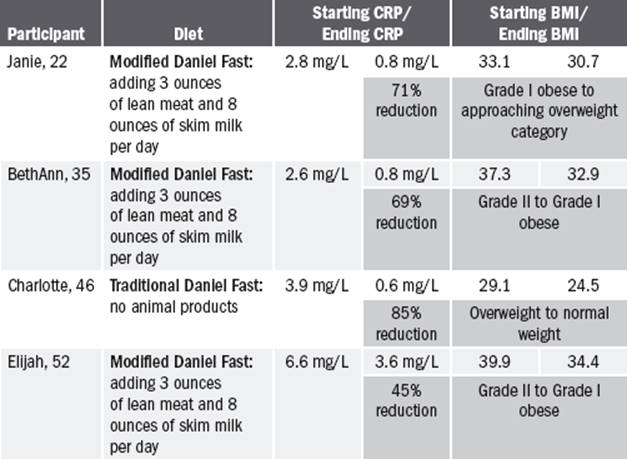
These people made dramatic improvements in their health by eating a traditional or modified Daniel Fast diet. They learned to eat “clean” by reducing their intake of saturated fat and eliminating processed foods, simple sugars, additives, and preservatives. And while we cannot state with certainty that their dietary changes guarantee a prolonged lifespan, the scientific evidence is clear that a lifestyle of clean eating and regular exercise will absolutely reduce the risk factors for a variety of diseases and improve the overall quality of life. The men and women in our clinical studies were amazed at how quickly their bodies responded to their changes in diet. Many were on a sure road to serious health risks but now have experienced the powerful results of eating a healthy diet.
INFLAMMATION AND YOU
So what does inflammation and CRP mean for you? It means that being healthy is about more than simply losing a few pounds and looking better. Reducing systemic inflammation — indicated by your CRP level — has significant implications for improving your overall health. The potential benefits include avoiding certain diseases, reducing joint pain, becoming more physically active, and leading a more fulfilling and enjoyable life. Just because you cannot see the improvement in systemic inflammation by looking in the mirror does not mean that improvement in your overall health is not present. In fact, when you adopt the Daniel Fast eating plan, the improvements you cannot see are often more important than those you can see.
This opportunity to dramatically change your health is open to you. You can do this. You can literally choose life when you step out in faith and begin to make the necessary step-by-step changes for health.
TURN YOUR THOUGHTS INTO ACTIONS
1Think of yourself as having lower systemic inflammation within your body — allowing for healthy blood vessels, reduced joint discomfort, and lowered risk for chronic disease.
2Choose to eliminate one or all of the following from your diet: fried foods, processed lunch meat, and calorie-containing soft drinks and other calorie-containing beverages (aside from milk and natural fruit and vegetable juice).
3Consider taking a daily fish oil supplement. Read the nutritional label and choose a supplement that includes 1,000–2,000 mg (combined) Eicosapentaenoic acid (EPA) and Docosahexaenoic acid (DHA). Studies on the omega-3 fatty acids in fish oil have repeatedly demonstrated a reduction in systemic inflammation. See www.DanielCure.com/supplements.