
CARDIOVASCULAR DISEASE, WITH SPECIFIC REFERENCE TO HEART DISEASE, IS the leading cause of death for both men and women in the United States. In fact, every year about 600,000 people die from heart disease. That equates to one in every four deaths, with one in every three deaths attributed to combined heart disease and stroke. Each year about 935,000 Americans have a heart attack,23 with a large number of those occurring without any prior warning of heart disease.
“Cardiovascular disease” is an all-encompassing term that includes heart disease and blood vessel disease (including high blood pressure and stroke). The term “heart disease” covers a number of conditions, such as valve disease, congestive heart failure, and coronary artery disease. What first comes to mind for most people when they hear the term “heart disease” is heart attack — sometimes referred to as “myocardial infarction,” or heart muscle death. Heart attacks are often linked to a narrowing of the arteries that supply the heart with blood and oxygen. This narrowing is typically caused by fatty plaques inside the arteries that cause the artery opening to become narrower and eventually blocked. Blood cannot flow freely to the working heart muscle, and the heart muscle becomes deprived of oxygen. The part of the heart muscle that does not receive adequate blood flow can die. The most common type of heart disease in the US, coronary artery disease, kills more than 385,000 people each year.24
RISK FACTORS FOR CARDIOVASCULAR DISEASE
Cardiovascular disease is a problem of lifestyle. It is well known that the following medical conditions and activities increase the risk of cardiovascular disease. (See “Assessing Your Risk for Cardiovascular Disease” on page 78.)
• overweight or obese classification
• diabetes
• smoking
• excessive alcohol use
• physical inactivity
• poor dietary intake (foods high in cholesterol, saturated fat, simple sugars)
• high blood LDL-cholesterol
• high blood pressure (hypertension)
If your goal is to live a lifestyle of health, then eat a nutritious diet, stop cigarette smoking and excessive alcohol use, and increase your physical activity. (See “What about Exercise?” on page 111.) Two other risk factors are high blood LDL-cholesterol and high blood pressure. Due to their prevalence and importance, we’ll discuss these in much greater detail.
ELEVATED BLOOD CHOLESTEROL
In the opening section of this chapter, we discussed the usual cause of a heart attack— blockage in the coronary arteries. This process of blockage is traditionally thought to be linked to elevated blood cholesterol— which may lead to a condition called “atherosclerosis,” a specific type of arteriosclerosis, or hardening of the arteries. In Greek, athere means “gruel,” and skleros means “hard.” (See “Is There a Genetic Contribution to Cardiovascular Disease?” on page 75.) Through a series of complex events, elevated blood cholesterol can ultimately lead to a buildup of dead cellular debris, called plaque, in artery walls — narrowing the artery opening and preventing normal blood flow (see figure). This is why many doctors are concerned about reducing high blood cholesterol levels in their patients. They are trying to control the development of atherosclerosis, which may help reduce the likelihood of heart attack.*

For many with elevated blood cholesterol, the treatment of choice is medication with a class of drugs known as statins. These are among the most widely prescribed drugs in the world. According to documentation presented in “Understanding Statin Use in America and Gaps in Education,”25 more than 200 million prescriptions for statins are written annually by physicians worldwide. Sales of statin drugs each year are in the multi-billion-dollar range. Clearly, high cholesterol is big business — and a big problem for many.
Cholesterol is a waxy, fat-like substance that is measured in three ways:*
• total cholesterol: the sum of all cholesterol particles in the blood
• HDL-cholesterol: the so-called good cholesterol
• LDL-cholesterol: the so-called bad cholesterol
An easy way to remember which cholesterol is good and which is bad is to know that you want to have a High good HDL-cholesterol count and a Low bad LDL-cholesterol count. HDL-cholesterol is viewed as a healthy form of cholesterol because it acts to remove harmful LDL-cholesterol from where it doesn’t belong. High levels of HDL-cholesterol reduce the risk for coronary artery disease, whereas low levels increase the risk. Elevated LDL-cholesterol is thought to contribute to blood vessel disease, which can lead to heart attack and stroke. For these reasons, your physician pays close attention to your blood cholesterol profile. The current recommended values for fasting blood cholesterol are shown in table 7.1.26
TABLE 7.1: Blood Cholesterol Profile
|
Cholesterol Type |
Desirable Value |
Comments |
|
Total cholesterol |
<200 mg/dL |
At one time, the upper limit for total cholesterol was 240 mg/dL. However, in recent years, the suggested value for total cholesterol of less than 200 mg/dL is desirable. |
|
LDL-cholesterol |
<100 mg/dL |
For anyone with no history of heart disease, 130 mg/dL is sometimes used as an upper limit. |
|
HDL-cholesterol |
>40 mg/dL (men) >50 mg/dL (women) |
HDL-cholesterol helps to clear cholesterol from the body. A high HDL-cholesterol, preferably over 60 mg/dL, is better. Women tend to have much higher HDL-cholesterol than men. |
A low HDL-cholesterol and a high LDL-cholesterol may promote a buildup of fatty plaque on the walls of your arteries, possibly resulting in a heart attack or stroke. If your cholesterol levels are outside the recommended ranges, your doctor may prescribe a statin drug as a first step in protecting your health. As with all drugs, there exists the minor chance for adverse side effects. Potential side effects with statins include muscle pain and weakness, liver damage, neurological effects, and increased blood sugar. The increase in blood sugar could lead to the development or progression of type 2 diabetes.27 Many people accept the risk of statin use, but some prefer alternatives to reduce their blood cholesterol. Enter the Daniel Fast.
Over the last few years, we have witnessed both men and women of varying ages significantly improve their overall cholesterol profile, with dramatic decreases in both total and LDL-cholesterol. Table 7.2 presents just a few of these cases and should provide encouragement to you concerning your own ability to simply change to a healthy eating plan and lower cholesterol without the use of medication.*
TABLE 7.2: Impact of the Daniel Fast on Total Cholesterol over 21 Days

Note three things about the information in the table. First, regardless of age or sex, we see a significant decrease in total cholesterol. Second, the changes occur despite the fact that the participants’ starting cholesterol values are not very high — six of the ten participants started the fast within the “normal” range. It is possible that those with higher starting cholesterol values may experience an even more pronounced decrease. Third, most of the participants are of normal weight, highlighting the fact that body weight alone does not provide a complete indication of overall health.
In many cases, these impressive reductions in cholesterol are similar to reductions achieved with the use of prescription statins. The results listed in the table are not unusual for those using the Daniel Fast. Many on the Daniel Fast, regardless of age, experience a 25 percent or greater reduction in total cholesterol. This includes those who have low levels to begin with, like Mark in table 7.2.
These results are achieved simply by following the Daniel Fast plan for twenty-one days. No doctor visits. No drugs. No adverse side effects. No out-of-pocket expenses. Just a lifestyle change. And the benefits aren’t limited to lowering total cholesterol. In our studies, we have observed corresponding decreases in LDL-cholesterol as well as a 10 percent reduction in triglycerides — another important component of the overall lipid panel.*
ELEVATED BLOOD PRESSURE
Blood pressure is defined as the pressure exerted by blood against the walls of blood vessels, in particular the arteries. Hypertension, or high blood pressure, is a problem for two reasons:
1. It can lead to blood vessel damage. This damage can then complicate the problem of elevated blood cholesterol — leading to both heart disease and stroke.
2. It can lead to heart failure, as high pressure forces the heart to work harder and harder to pump blood. Over time, the heart muscle becomes weaker and cannot pump as much blood out of the heart as it should. This is called congestive heart failure.
Although there is some debate about the role cholesterol plays in the development of cardiovascular disease (see “Does Cholesterol Really Contribute to Cardiovascular Disease?” on page 72), there is general agreement that elevated blood pressure plays a significant role.
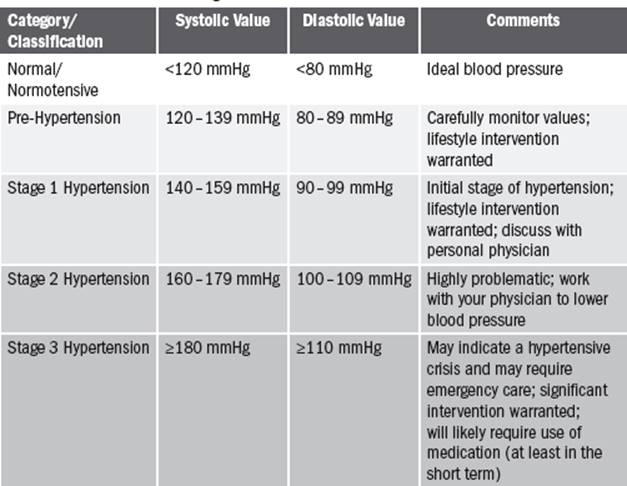
Blood pressure is measured in millimeters of mercury (mmHg) with two numbers — a systolic pressure and a diastolic pressure, shown as 120/80 mmHg, for example. The top number, or systolic reading, is the pressure in your arteries when the heart contracts. The bottom number, or diastolic number, is the pressure in your arteries when the heart is relaxed. Table 7.3 provides the reference ranges for blood pressure values in assessing health and hypertension. Note that for diagnostic purposes, blood pressure should be measured at rest (at least five minutes of quiet, seated rest before reading is obtained).
TABLE 7.3: Reference Ranges for Blood Pressure
When blood pressure is elevated for an extended period of time, it can lead to various long-term problems, especially blood vessel damage, which can develop into coronary artery disease and/or stroke. When blood surges through the vessels under high pressure, the vessels are more prone to damage. Think of a standard garden hose subjected to excessively high water pressure. Since the hose isn’t designed to handle such high pressure, over time it will likely become weaker or brittle and develop bulges, cracks, or tears. With hypertension, blood vessels experience the same kind of damage.
When damaged, blood vessels are more susceptible to the small and dense LDL-cholesterol particles getting deep inside the wall of the blood vessel, where they are eventually “modified” by molecules called free radicals. This is discussed in the next section. (See also “The Science behind the Daniel Fast” on page 281.) This modification leads to formation of fatty plaques that can eventually block blood flow and lead to heart attack and stroke. Smoking can worsen this problem, as the chemicals in cigarette smoke can damage blood vessels and modify LDL-cholesterol in negative ways. This is one reason why smoking is a risk factor for cardiovascular disease. If you smoke, do whatever you have to do to quit. It’s vitally important to your health.
Heart failure is another potential consequence of chronic high blood pressure. Each time the heart beats, it must overcome the blood pressure in the aorta in order to push its oxygen-rich blood out into circulation. The aorta is the large main artery connected to the heart. A valve, called the aortic valve, regulates the blood flow between the heart and the aorta. Blood is ejected from the heart through the valve into the aorta and then makes its way throughout the body.
The issue with heart failure lies in the effort required by the heart to open the valve so blood can get through. The higher the blood pressure, the harder the heart must work — every beat, every minute, every hour — to open the valve. Like other muscles in the body, if the heart works harder against a higher resistance (in this case, the pressure in your aorta), it gets bigger. Up to a point, this is not necessarily a problem. But there is a threshold at which an increase in heart size leads to a “stretched out” and much weaker heart muscle — one that can no longer effectively pump blood to body tissues.
DOES CHOLESTEROL REALLY CONTRIBUTE TO CARDIOVASCULAR DISEASE?
The answer for most physicians and scientists ten to twenty years ago would have been a clear “yes.” However, more recent evidence calls that assumption into question. Much of the controversy stems from the aggressive and widespread treatment of elevated blood cholesterol with statin drugs — in particular with patients who do not yet have a history of cardiovascular disease or many risk factors for cardiovascular disease. In addition, it has been suggested that national guidelines for cholesterol levels have been inappropriately influenced by individuals with a financial interest in drug companies that sell medications used to treat elevated cholesterol. And, perhaps of greatest importance, recent evidence indicates no clear association between total cholesterol levels and cardiovascular disease. All of this has prompted many scientists to question the importance of total cholesterol levels with regard to cardiovascular disease.
What most scientists do seem to agree on is that the entire lipid panel — not merely total cholesterol — needs to be taken into consideration in assessing a patient’s risk for cardiovascular disease. The entire lipid panel includes values for:
total cholesterol
triglycerides
LDL-cholesterol (called “bad” cholesterol)
HDL-cholesterol (called “good” cholesterol)
sub-fractions of both LDL-cholesterol and HDL-cholesterol
It’s also important to know the potential for LDL-cholesterol modification (oxidation) by free radicals — as the modification of LDL-cholesterol appears more important than the actual amount of LDL-cholesterol circulating in the blood.
Bottom line: A complete picture is needed to fully understand the role of cholesterol in cardiovascular disease. In general, the most desirable profile has low triglycerides, low total cholesterol, and low LDL-cholesterol, and high HDL-cholesterol and high blood antioxidant capacity.
When this happens, the heart is like an overstretched rubber band. When a rubber band is new and tight, you can stretch it out and it recoils with great force. However, if you continue to stretch it out over and over again, it eventually loses its elasticity and its ability to recoil is reduced. When chronically overworked, the heart does the same thing — it becomes larger in a non-functional way. It no longer is capable of generating sufficient force to move blood through the body. Over time, the reduced blood flow leads to severe fatigue, heart failure, and possibly death.
This is why it is critical to have annual physical exams in which your doctor checks your blood pressure and other items, such as your blood cholesterol and blood sugar. At some point, your doctor may also check your heart function with a more sophisticated test such as an echocardiogram. You may never feel a heart problem brewing. And if you routinely avoid an annual exam — which men are prone to do — you may discover a problem when it is too advanced, making it more difficult to treat. The CDC estimates that of the 68 million adults in the US who have elevated blood pressure, only half have been diagnosed and have the condition under control.*
FREE RADICALS, INFLAMMATION, AND CARDIOVASCULAR DISEASE
While high blood cholesterol and high blood pressure have been considered risk factors for cardiovascular disease for many years, two new risk factors have been identified. These are elevated oxidative stress and inflammation. We’ll take a closer look at inflammation in chapter 8, and you can read more about oxidative stress in “The Science behind the Daniel Fast” on page 281. But here’s a brief introduction to both topics.
Oxidative stress occurs when your body’s capacity to detoxify certain substances (specifically, free radicals) is inadequate. Free radicals are molecules that can have both beneficial and hazardous roles in the body. At relatively low concentrations, free radicals are helpful and act to send signals to other molecules, telling them what to do to aid normal biological functioning. However, too many free radicals can overwhelm the body’s antioxidant defense system. When this happens, free radicals can lead to disease-promoting modifications of proteins, lipids, and DNA. This process is what we call oxidative stress.*
When you are under a lot of stress, the formation of free radicals increases. A lot. While psychological stress may lead to an increase, one of the primary triggers of free radical formation is the ingestion of high-calorie, high-saturated-fat, sugar-rich meals. In fact, aside from cigarette smoking, in our research we have noted no other stressor that compares to high-fat meal ingestion. This is one reason why attempts should be made to reduce the intake of saturated fat.
Free radicals are a big problem in association with LDL-cholesterol molecules, since free radicals modify LDL-cholesterol to become more harmful. In fact, it’s the modification of LDL-cholesterol (as opposed to simply the amount of LDL-cholesterol) that appears most problematic with regard to the development of atherosclerosis. In our work, we have noted a decrease in oxidative stress when participants follow the Daniel Fast plan.
Inflammation is the immune system’s defense against injury or disease. But chronic inflammation, or systemic inflammation, is linked with various diseases. In fact, it might be an initiating factor in certain cardiovascular diseases such as atherosclerosis. In our clinical studies, we have documented significant decreases in systemic inflammation when participants follow a Daniel Fast for as little as twenty-one days.
The fact that the Daniel Fast plan can significantly improve the cardiovascular disease risk profile in a wide variety of individuals should be strongly considered as we explore this next section pertaining to the cost of cardiovascular disease. All of these factors are largely, if not totally, influenced by the lifestyle choices you make. That’s what’s so amazing. You can control your risk of developing cardiovascular disease … if you choose to do so.
THE COST OF CARDIOVASCULAR DISEASE
Each year in the United States, the cost of treating coronary heart disease alone well exceeds $100 billion — this includes the cost of health-care services, medications, and lost productivity. Treating other forms of cardiovascular disease increases this total to an estimated $444 billion — a sum that continues to rise each year.28 According to the American Heart Association, the projected cost of treating coronary heart disease, stroke, heart failure, and high blood pressure in the US in 2030 will be $818 billion — nearly triple the $272 billion spent in 2010. An estimated 40 percent of the US population (116 million people) are projected to have some form of cardiovascular disease by 2030. The economic projections alone are staggering, but the implications of 40 percent of the population suffering from cardiovascular disease have catastrophic meaning.
Despite all the money spent to treat heart disease, interventions performed to correct blocked heart vessels, particularly bypass surgery and angioplasty, produce poor results overall. For example, each year Americans spend more than $100 billion in surgical interventions to treat heart disease. Yet, the success of these interventions in terms of prolonging life and preventing future heart attacks is only about 5 percent. Because this cost is borne primarily by Medicare and other insurers, the overall cost is passed on to taxpayers and those who purchase insurance policies. That means we are paying billions of dollars annually for largely ineffective surgical procedures.
IS THERE A GENETIC CONTRIBUTION TO CARDIOVASCULAR DISEASE?
Yes, there is. In fact, some individuals do everything right — follow a healthy diet, exercise regularly, maintain an ideal body mass, don’t smoke, don’t drink, and because of family history, still die at a very early age from cardiovascular disease. But this is uncommon, and it does not give you an excuse for failing to do everything possible to help control this genetic influence.
I (Rick) have had people say to me, “Why should I bother following a healthy diet and exercise regularly when both my parents died prematurely from heart disease?” My response is something like this: “Well, you can adopt that defeated mentality, do absolutely nothing to improve your health, and possibly die prematurely. That’s one option. Or you can do everything possible to take control of your health, including adopting a program of structured exercise and optimal dietary intake, and possibly extend your life to sixty, seventy, or even more than eighty years.” Of course, there is still the possibility that a person who opts for a healthy lifestyle might die at the “early” age of sixty-five. Was the choice to live healthy worth it? Absolutely. The fact remains that the quantity of this person’s life was likely much longer than it otherwise would have been, and the quality of life was also likely much better. It’s tough to argue with that.
The idea that genetics predetermines every aspect of your existence, including disease onset and life expectancy, assumes that your actions have no impact on how your genes respond to what you do — which is not accurate. While all of us may have a certain genetic makeup, our actions can regulate the genetic response (a scientific field known as epigenetics or epigenomics). Your actions may have such a profound impact on your genetics that you never develop the condition you were concerned about in the first place. The bottom line is this: You should do everything in your God-given power to improve and maintain your health.
In contrast, the United States spends next to nothing on lifestyle approaches used to prevent cardiovascular disease despite strong evidence supporting the great success of preventive strategies. For example, the INTERHEART study followed 30,000 men and women on six different continents and determined that changing the lifestyle could prevent at least 90 percent of all heart disease (with specific reference to heart attacks).29 Clearly, our health-care decisions and priorities need to be reevaluated.
THE DANIEL FAST AND CARDIOVASCULAR DISEASE
If you agree that preventing potential disease is preferable to treating existing disease, we strongly encourage you to consider launching your approach to healthy eating by using the Daniel Fast. This plant-based dietary strategy promotes lifestyle changes that can significantly reduce the risk factors for developing cardiovascular disease.
• The Daniel Fast typically results in weight loss, which often leads to corresponding reductions in cholesterol, blood glucose, blood pressure, oxidative stress, and systemic inflammation.
• Eliminating or reducing animal products reduces intake of dietary cholesterol and saturated fat — both of which are found almost exclusively in animal foods. This in turn reduces blood cholesterol.
• Increased consumption of dietary fiber leads to a reduction in blood cholesterol, as fiber helps to carry cholesterol from the circulation to the liver for removal from the body.
• Daniel Fast plan foods include a rich source of dietary antioxidants in the form of fruits and vegetables, in addition to whole grains. These antioxidants combat the potential damage of free radicals and lessen or prevent oxidative stress.
• The Daniel Fast involves “clean” eating without additives, preservatives, saturated fat, and processed foods. This may be one explanation for the significant reduction in inflammation.
• The high volume of vegetables consumed on the Daniel Fast offers a high nitrate content, which is associated with increased nitric oxide levels in the blood. This enables blood vessels to relax and open more fully, which may in turn reduce blood pressure — the tube is bigger, therefore the pressure in the tube is reduced. (For more information on nitric oxide, see “The Science behind the Daniel Fast” on page 281.)
Table 7.4 demonstrates the dramatic changes in blood pressure experienced by participants in our Daniel Fast studies.
TABLE 7.4: Impact of the Daniel Fast on Blood Pressure over 21 Days
|
Participant, Age, BMI Classification |
Starting Blood Pressure |
Ending Blood Pressure |
|
Jerome, 28, obese |
141/98 mmHg |
113/68 mmHg |
|
Louise, 41, normal weight |
147/85 mmHg |
115/73 mmHg |
|
Johnny, 58, obese |
134/98 mmHg |
121/78 mmHg |
|
Vivian, 58, obese |
147/87 mmHg |
130/71 mmHg |
|
Seth, 60, obese |
162/80 mmHg |
128/66 mmHg |
The blood pressure values presented yield a decrease in both systolic and diastolic pressure of close to 20 percent. All participants were classified as hypertensive at the start of the fast. At the conclusion of just twenty-one days, all participants’ values were below the cutoff for hypertension. This is a big deal.
One potential reason for the significant reductions in blood pressure with the Daniel Fast is the noted increase in nitric oxide associated with increased vegetable intake. In our Daniel Fast studies, we have documented increases in nitric oxide levels of 64 percent, 116 percent, and 238 percent in men, as well as increases of 160 percent, 188 percent, and 319 percent in women.* These are remarkable findings and support the results of other studies using specific dietary approaches to increase nitric oxide, which relaxes blood vessels, to reduce blood pressure.
IT’S YOUR TURN NOW
Every day in the United States, close to 1,650 people die of cardiovascular disease — that’s more than one person every minute. Perhaps the saddest thing is that most of us know what to do to reduce our risk of this disease, but we simply choose not to do it.
So, what about you? Are you ready to do something about your risk?
The Daniel Cure involves a lifestyle approach to healthy eating that can dramatically reduce certain cardiovascular disease risk factors. These include obesity, type 2 diabetes, blood cholesterol, and blood pressure. It also results in a significant reduction in systemic inflammation — an emerging risk factor for most human diseases and discussed in detail in the following chapter. We presented the evidence. Now it’s up to you to take action.
Perhaps you are overweight. Maybe your doctor recently informed you that your cholesterol is too high. You might have a demanding job, get little sleep, and are concerned that your blood pressure is elevated. A twenty-one-day Daniel Fast followed by the Daniel Cure approach can help you. It’s a realistic plan and can have a measurable and lasting impact on your overall health. Believe it.
ASSESSING YOUR RISK FOR CARDIOVASCULAR DISEASE
Some physicians like to use a risk assessment when determining an individual’s long-term (ten-year) risk of having a cardiovascular event (usually a heart attack). While a risk assessment is not 100 percent accurate, it does provide information to help you gauge where you are and what you might need to focus on in terms of lowering your risk.* Although other factors such as obesity, diabetes, dietary intake, and physical activity are now considered by many physicians when calculating risk, the variables in the table have been used historically and are well-known risk factors for cardiovascular disease.
Cardiovascular Risk Factors
|
Variable |
Description / How to Lower Risk |
|
Age |
The higher the age, the higher the risk; cardiovascular disease is age related. |
|
Sex |
Earlier in life, men are more prone to cardiovascular disease than women. |
|
Total Cholesterol |
Should be less than 200 mg/dL. |
|
HDL-Cholesterol |
Should be greater than 40 mg/dL. |
|
Smoker |
Quite simply, you should not smoke cigarettes. |
|
Systolic Blood Pressure |
Should be less than 120 mmHg. |
If you have certain risk factors for cardiovascular disease, seriously consider doing something to get these under control now, before it is too late. Embarking on the Daniel Cure is a great start.
*A frequently used risk calculator is that of the National Cholesterol Education Program, available at http://hp2010.nhlbihin.net/atpiii/calculator.asp.
TURN YOUR THOUGHTS INTO ACTIONS
1Think of your body as a well-tuned machine. You provide it what it needs to function at peak performance.
2Eat at least 20 grams of fiber every day if you’re a woman and 30 grams if you’re a man (more fiber if you are under the age of fifty). For example: one cup of raspberries has about 8 grams; one-half cup cooked beans (any variety) about 5 grams; one cup cooked broccoli about 5 grams; one-half cup uncooked oats about 4 grams; one large banana about 3 grams; one-half cup cooked brown rice about 2 grams.
3Consume at least five servings of vegetables every day. A typical vegetable serving is equal to one-half cup; a serving of green leafy vegetables is equal to one cup. These are rather small amounts and are easily obtainable on a daily basis.
* Atherosclerosis does not impact only the coronary arteries. It affects all arteries. In the brain, the narrowing of the arteries increases the risk of stroke. Blood vessels in the legs can be affected, leading to a condition known as peripheral arterial disease, or PAD.
* These forms of cholesterol are measured as part of a blood lipid panel, a routine blood test conducted as part of a physical examination. One other important variable measured is blood triglycerides. For more information, see the appendix “The Science behind the Daniel Fast” on page 281.
* While many people may be able to control blood cholesterol by adopting a lifestyle of increased physical activity and optimal dietary intake, others may still require the assistance of medication. You should always consult your physician for guidance on this important issue.
* To learn more about cholesterol and triglycerides, see “The Science behind the Daniel Fast” on page 281.
* http://www.cdc.gov/chronicdisease/resources/publications/AAG/dhdsp.htm.
* In an attempt to combat oxidative stress, many people take antioxidant dietary supplements. For more information about antioxidant supplements, visit www.DanielCure.com/supplements.
* Nitric oxide is a short-lived molecule with multiple functions within the body. With regard to blood pressure, it helps blood vessels to relax, allowing blood to flow more freely.