
Bones of the Oral Cavity
 The floor of the nasal cavity (the maxilla and palatine bone) forms the roof of the oral cavity, the hard palate. The two horizontal processes of the maxilla (the palatine processes) grow together during development, eventually fusing at the median palatine suture. Failure to fuse results in a cleft palate.
Fig. 36.1 Hard palate: Inferior view

Fig. 36.2 Hard palate: Superior view
Removed: Maxilla (upper part).

Fig. 36.3 Hard palate: Oblique posterior view
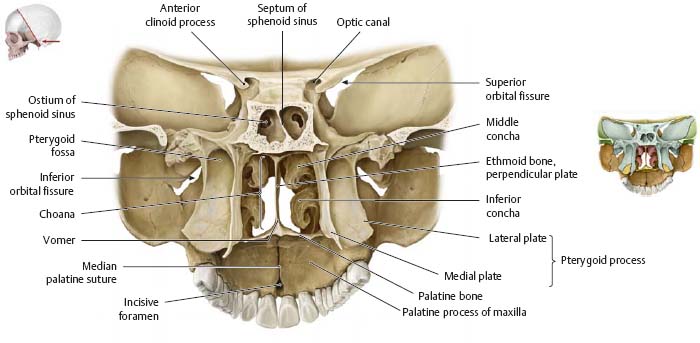
Fig. 36.4 Mandible
The mandible (jaw) is connected to the viscerocranium at the temporomandibular joint (p. 540).

Fig. 36.5 Hyoid bone
The hyoid bone is suspended in the neck by muscles between the floor of the mouth and the larynx. Although not listed among the cranial bones, the hyoid bone gives attachment to the muscles of the oral floor. The greater horn and body of the hyoid are palpable in the neck.

Temporomandibular Joint
Fig. 36.6 Temporomandibular joint
The head of the mandible articulates with the mandibular fossa in the temporomandibular joint.

Fig. 36.7 Ligaments of the temporomandibular joint

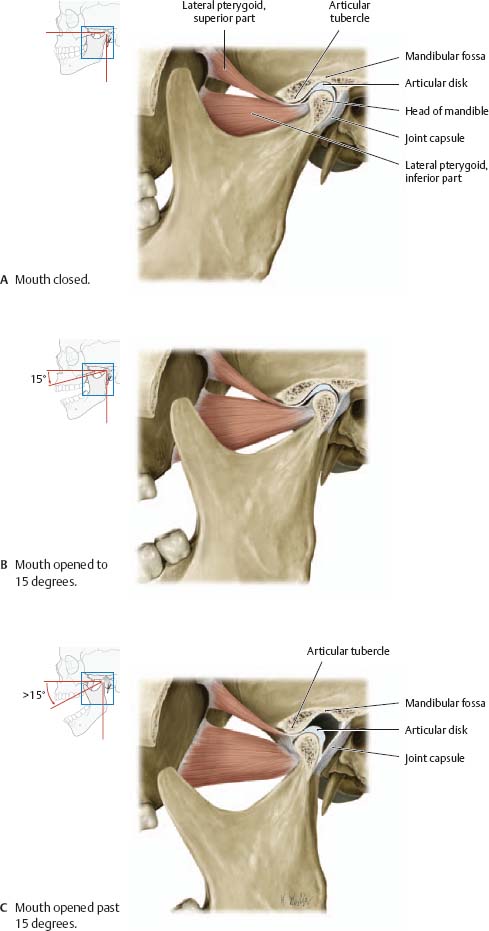
Fig. 36.8 Movement of the temporomandibular joint
Left lateral view. Up to 15 degrees of abduction, the head of the mandible remains in the mandibular fossa. Past 15 degrees, the head of the mandible glides forward onto the articular tubercle.
 Clinical
Dislocation of the temporomandibular joint
Dislocation may occur if the head of the mandible slides past the articular tubercle. The mandible then becomes locked in a protruded position, a condition reduced by pressing on the mandibular row of teeth.
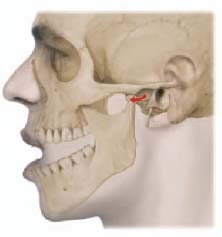
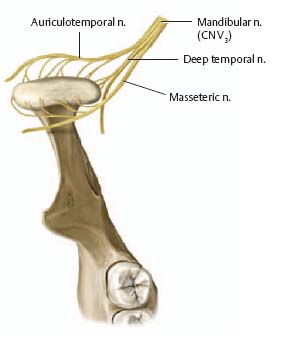
Fig. 36.9 Innervation of the temporo mandibular joint capsule
Superior view.
Teeth
Fig. 36.10 Structure of a tooth
Each tooth consists of hard tissue (enamel, dentin, cementum) and soft tissue (dental pulp) arranged into a crown, neck (cervix), and root.

Fig. 36.11 Permanent teeth
Each half of the maxilla and mandible contains a set of three anterior teeth (two incisors, one canine) and five posterior (postcanine) teeth (two premolars, three molars).
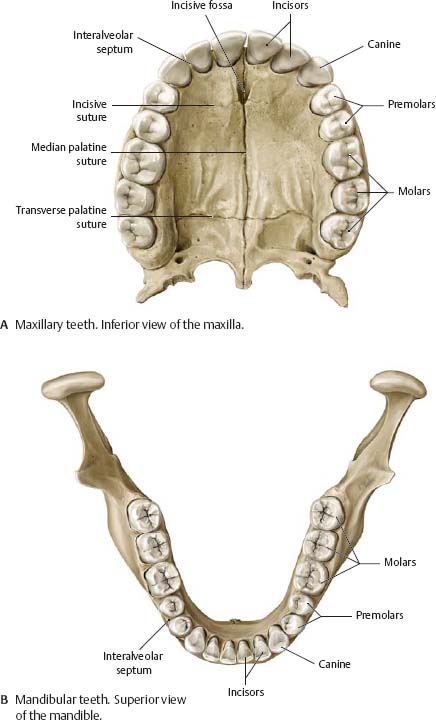
Fig. 36.12 Tooth surfaces
The top of the tooth is known as the occlusal surface.

Fig. 36.13 Coding of the teeth
In the United States, the 32 permanent teeth are numbered sequentially (not assigned to quadrants). Note: The 20 deciduous (baby) teeth are coded A to J (upper arch), and K to T in a similar clockwise fashion. The third upper right molar is 1; the second upper right premolar is A.

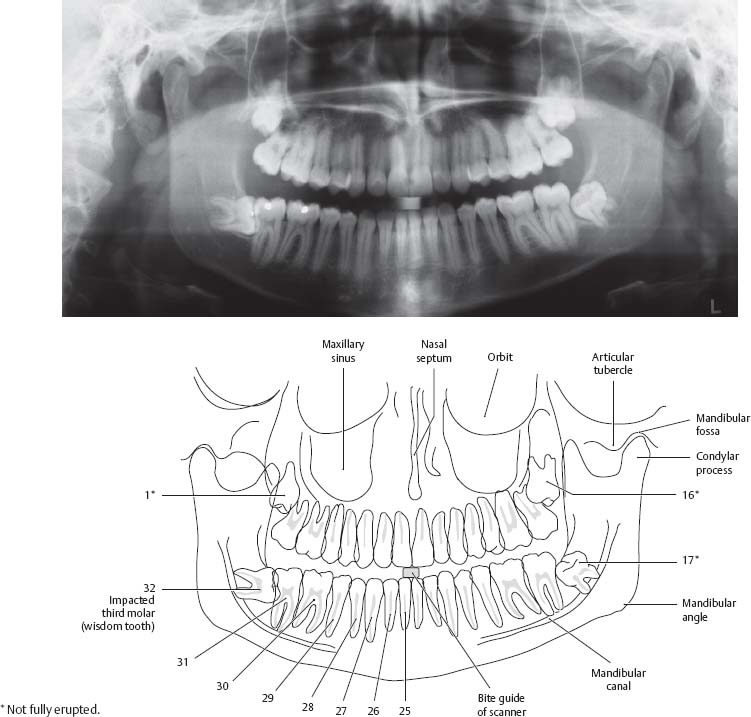
Fig. 36.14 Dental panoramic tomogram
The dental panoramic tomogram (DPT) is a survey radiograph that allows preliminary assessment of the temporomandibular joints, maxillary sinuses, maxillomandibular bone, and dental status (carious lesions, location of wisdom teeth, etc.). DPT courtesy of Dr. U. J. Rother, Director of the Department of Diagnostic Radiology, Center for Dentistry and Oromaxillofacial Surgery, Eppendorf University Medical Center, Hamburg, Germany.
Oral Cavity Muscle Facts
Fig. 36.15 Muscles of the oral floor
See pp. 562–563 for the infrahyoid muscles.

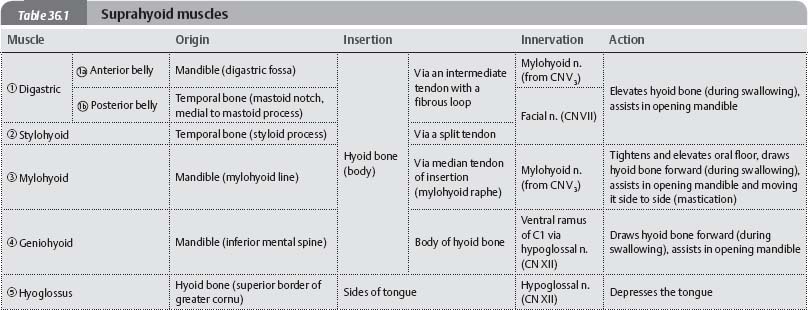
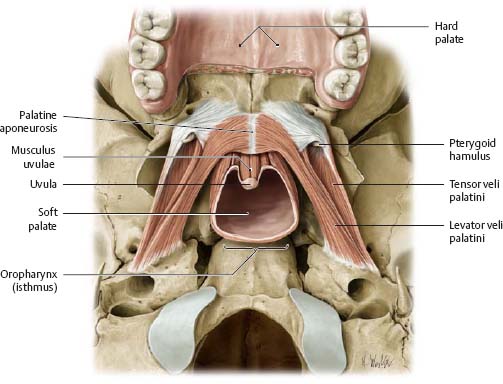
Fig. 36.16 Muscles of the soft palate
Inferior view. The soft palate forms the posterior boundary of the oral cavity, separating it from the oropharynx.
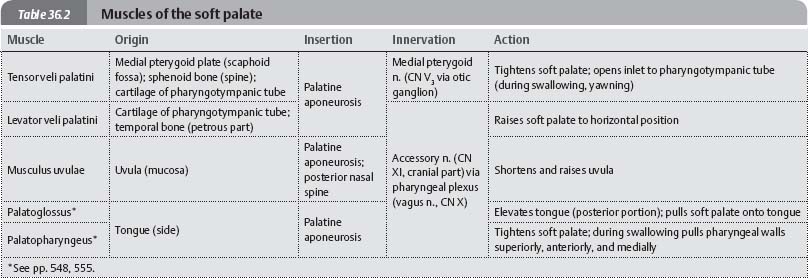
Innervation of the Oral Cavity
Fig. 36.17 Trigeminal nerve in the oral cavity
Right lateral view.
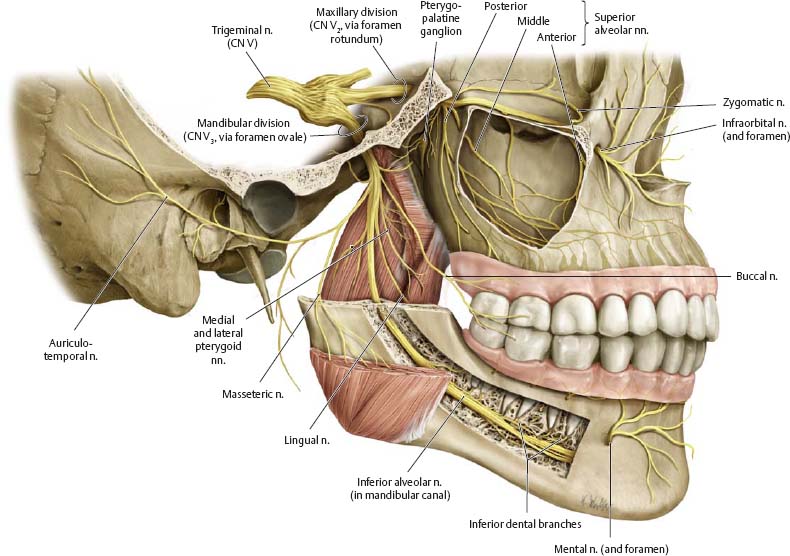
Fig. 36.18 Neurovasculature of the hard palate
Inferior view. The hard palate receives sensory innervation primarily from terminal branches of the maxillary division of the trigeminal nerve (CN V2). The arteries of the hard palate arise from the maxillary artery.

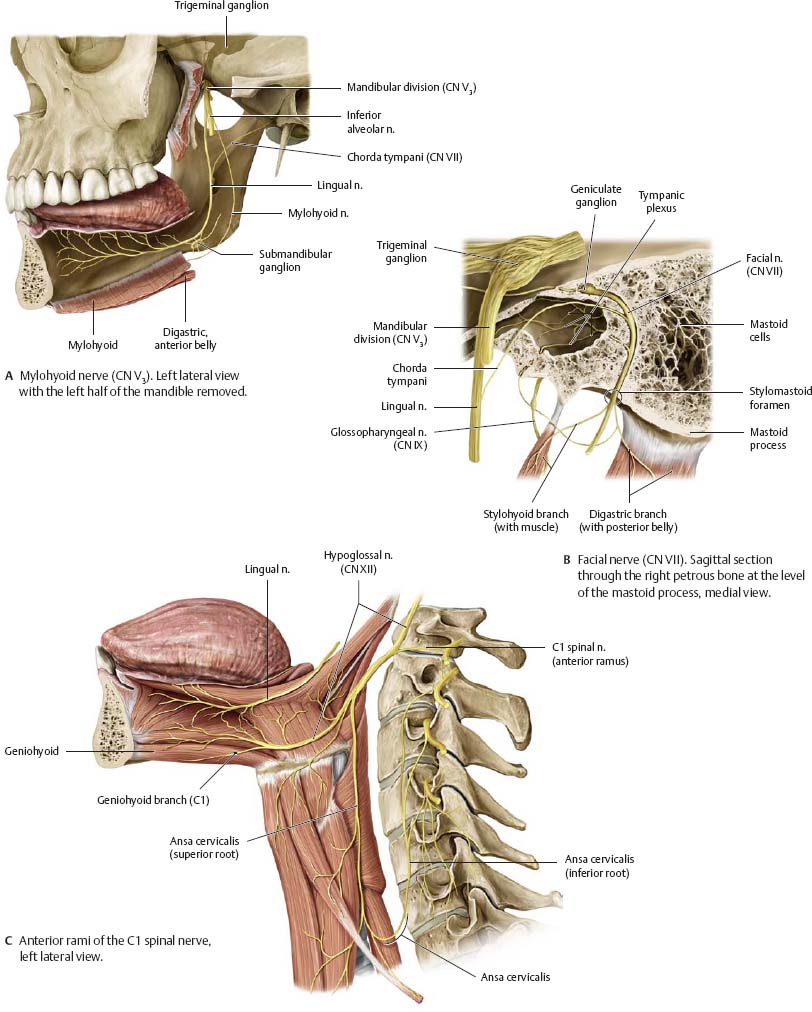
The muscles of the oral floor have a complex nerve supply with contributions from the trigeminal nerve (CN V3), facial nerve (CN VII), and C1 spinal nerve via the hypoglossal nerve (CN XII).
Fig. 36.19 Innervation of the oral floor muscles
Tongue
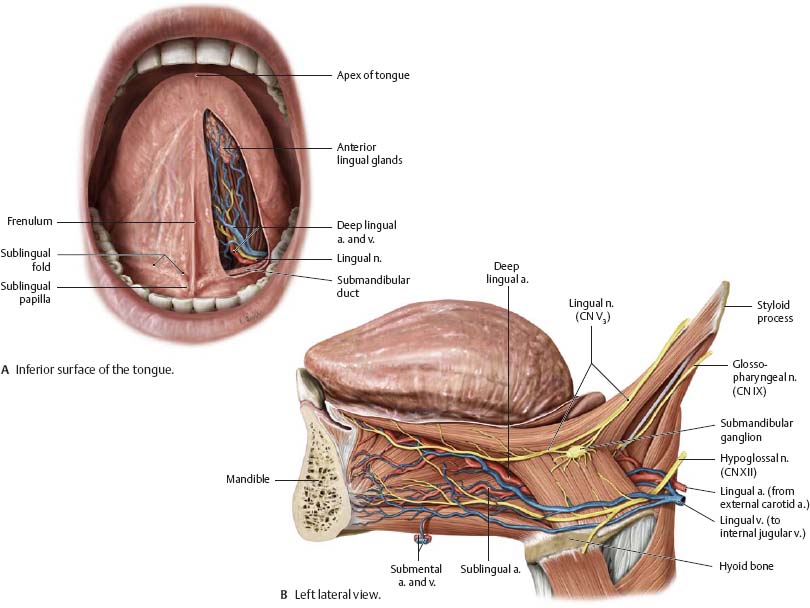
The dorsum of the tongue is covered by a highly specialized mucosa that supports its sensory functions (taste and fine tactile discrimination; see p. 616). The tongue is endowed with a very powerful muscular body to support its motor properties during mastication, swallowing, and speaking.
Fig. 36.20 Structure of the tongue
The V-shaped sulcus terminalis divides the tongue into an anterior (oral, presulcal) and a posterior (pharyngeal, postsulcal) part.

Fig. 36.21 Muscles of the tongue
The extrinsic lingual muscles (genioglossus, hyoglossus, palatoglossus, and styloglossus) have bony attachments and move the tongue as a whole. The intrinsic lingual muscles (superior and inferior longitudinal muscles, transverse muscle, and vertical muscle) have no bony attachments and alter the shape of the tongue.

Fig. 36.22 Somatosensory and taste innervation of the tongue
Anterior view.
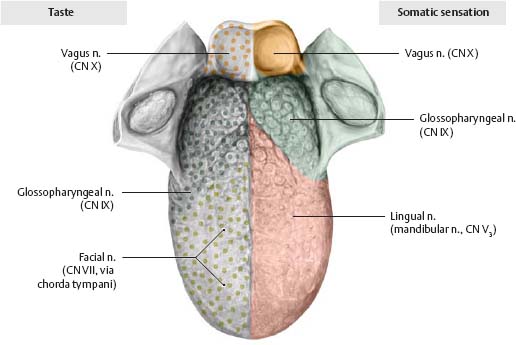
Fig. 36.23 Neurovasculature of the tongue
The lingual muscles receive somatomotor innervation from the hypoglossal nerve (CN XII), with the exception of the palatoglossus (supplied by the vagus nerve, CN X).
Clinical
Unilateral hy pogiossal nerve palsy
Damage to the hypoglossal nerve causes paralysis of the genioglossus muscle on the affected side. The healthy (innervated) genioglossus on the unaffected side will therefore dominate. Upon protrusion, the tongue will deviate toward the paralyzed side.

Topography of the Oral Cavity & Salivary Glands
The oral cavity is located below the nasal cavity and anterior to the pharynx. It is bounded by the hard and soft palates, the tongue and muscles of the oral floor, and the uvula.
Fig. 36.24 Oral cavity
Midsagittal section, left lateral view.

Fig. 36.25 Divisions of the oral cavity
Anterior view.

|
Table 36.3 Divisions of the oral cavity |
||
|
Part |
Anterior boundary |
Posterior boundary |
|
Oral vestibule |
Lips/cheek |
Dental arches |
|
Oral cavity proper |
Dental arches |
Palatoglossal arch |
|
Fauces (throat) |
Palatoglossal arch |
Palatopharyngeal arch |
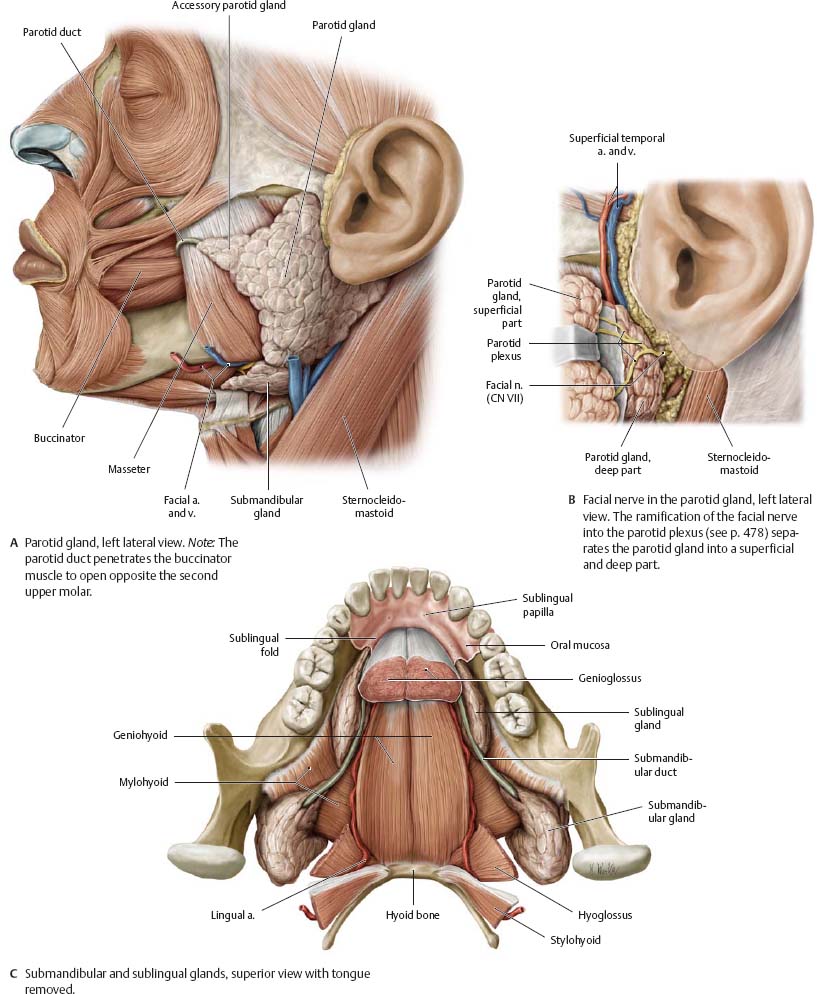
The three large, paired salivary glands are the parotid, submandibular, and sublingual glands. The parotid gland is a purely serous (watery) salivary gland. The sublingual gland is predominantly mucous; the submandibular gland is a mixed seromucous gland.
Fig. 36.26 Salivary glands
Tonsils & Pharynx
Fig. 36.27 Tonsils

|
Table 36.4 Structures in Waldeyer's ring |
|
|
Tonsil |
# |
|
Pharyngeal tonsil |
1 |
|
Tubal tonsils |
2 |
|
Palatine tonsils |
2 |
|
Lingual tonsil |
1 |
|
Lateral bands |
2 |
Clinical
Tonsil infections
Abnormal enlargement of the palatine tonsils due to severe viral or bacterial infection can result in obstruction of the oropharynx, causing difficulty swallowing.

Particularly well developed in young children, the pharyngeal tonsil begins to regress at 6 to 7 years of age. Abnormal enlargement is common, with the tonsil bulging into the nasopharynx and obstructing air passages, forcing the child to “mouth breathe.”

Fig. 36.28 Pharyngeal mucosa
Posterior view of the opened pharynx. The anterior portion of the muscular tube contains three openings: choanae (to the nasal cavity), faucial isthmus (to the oral cavity), and aditus (to the laryngeal inlet).

Pharyngeal Muscles
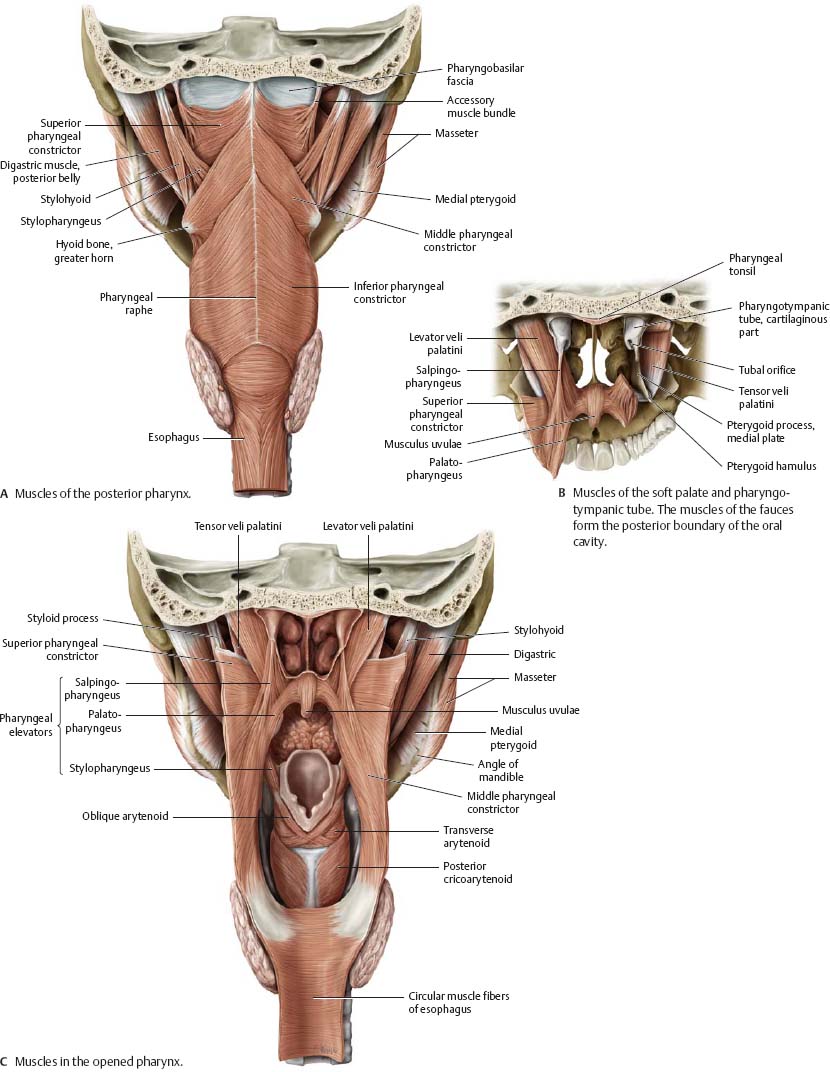
Fig. 36.29 Pharyngeal muscles: Left lateral view
The pharyngeal musculature consists of thepharyngeal constrictors and the relatively weak pharyngeal elevators.

|
Table 36.5 Pharyngeal constrictors |
|
|
Superior pharyngeal constrictor |
|
|
S1 |
Pterygopharyngeal part |
|
S2 |
Buccopharyngeal part |
|
S3 |
Mylopharyngeal part |
|
S4 |
Glossopharyngeal part |
|
Middle pharyngeal constrictor |
|
|
M1 |
Chondropharyngeal part |
|
M2 |
Ceratopharyngeal part |
|
Inferior pharyngeal constrictor |
|
|
I1 |
Thyropharyngeal part |
|
I2 |
Cricopharyngeal part |
Fig. 36.30 Pharyngeal muscles: Posterior view
Neurovasculature of the Pharynx
Fig. 36.31 Neurovasculature in the parapharyngeal space
Posterior view. Removed: Vertebral column and posterior structures.
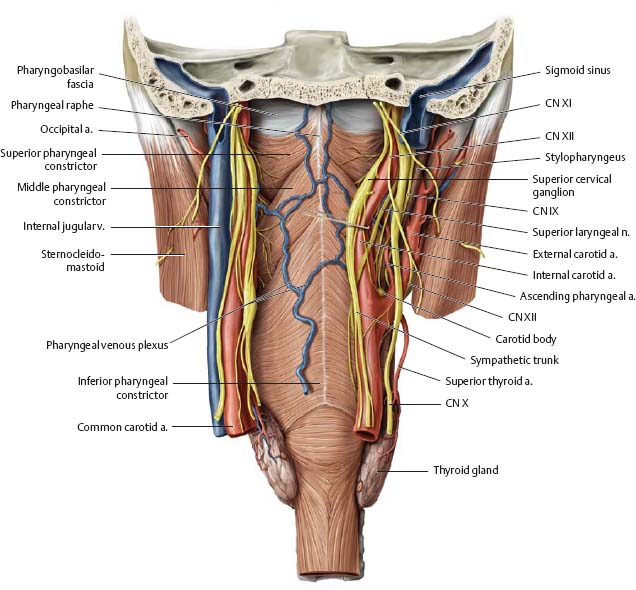
Fig. 36.32 Parapharyngeal space
Transverse section, superior view.

Fig. 36.33 Neurovasculature of the opened pharynx
Posterior view.
