
Bones & Ligaments of the Neck
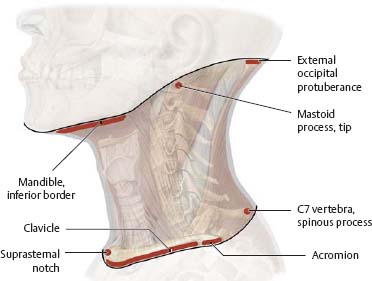
Fig. 37.1 Boundaries of the neck
Left lateral view.
|
Table 37.1 Bones and joints of the neck |
||
|
Cervical spinep. |
p.6 |
|
|
Hyoid bone |
p. 539 |
|
|
Craniovertebral joints |
Atlanto-occipital jointsp. |
p. 16 |
|
Atlantoaxial joints |
||
|
Uncovertebral joints |
p.15 |
|
|
Zygapophyseal (intervertebral facet) joints |
p. 14 |
|
|
Larynxp. |
p. 571 |
|
Fig. 37.2 Bony structures of the neck
Left lateral view.
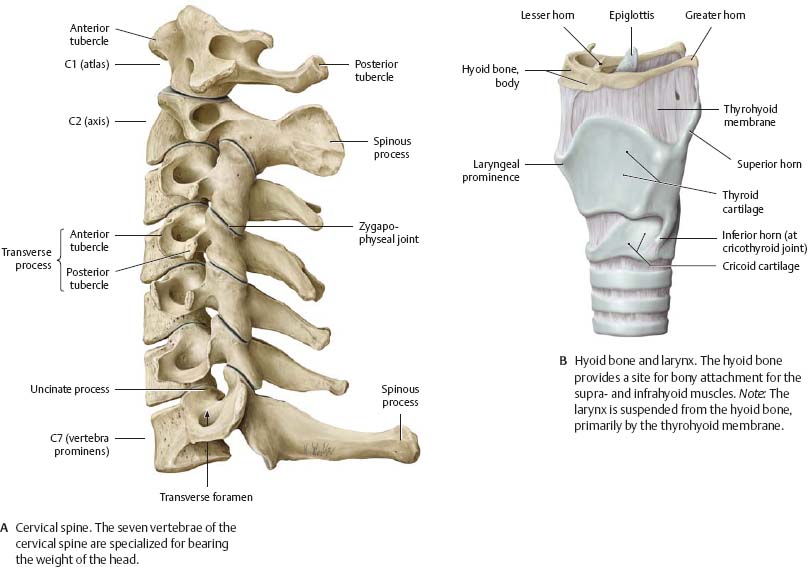
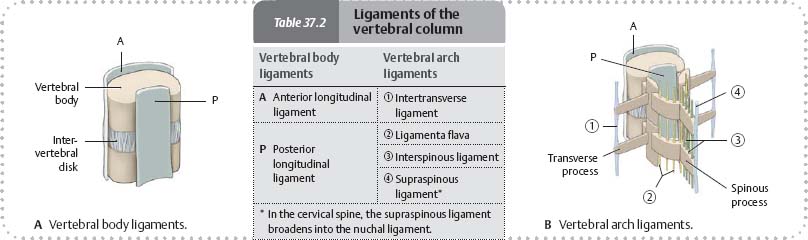
Fig. 37.3 Ligaments of the cervical spine
Midsagittal section, viewed from the left side. For the ligaments of the craniovertebral joints, see p. 16.

Muscle Facts (I)
 From a topographical standpoint, there are six major muscle groups in the neck. Functionally, however, the platysma belongs to the muscles of facial expression, the trapezius belongs to the muscles of the shoulder girdle, and the nuchal muscles belong to the intrinsic back muscles. The suboccipital muscles (short nuchal and craniovertebral joint muscles) are included in this chapter with the deep muscles of the neck.
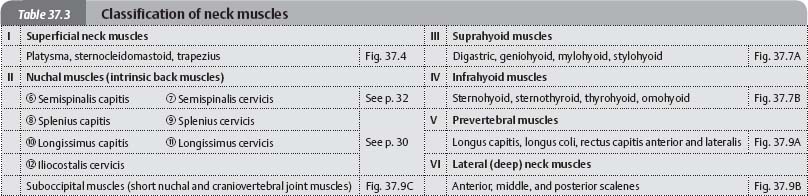
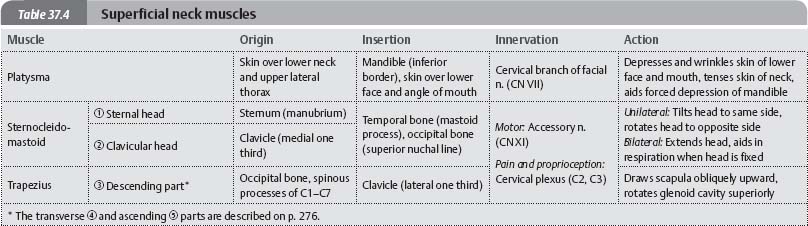
Fig. 37.4 Superficial neck muscles
See Table 37.4 for details.

Fig. 37.5 Nuchal muscles
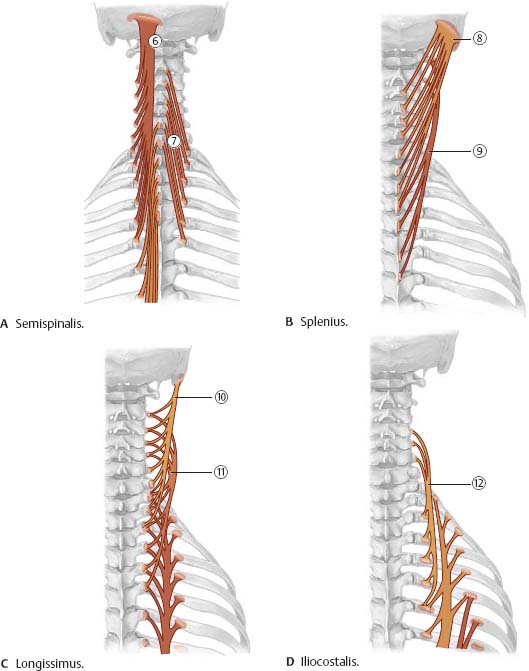
Fig. 37.6 Superficial musculature of the neck

Muscle Facts (II)
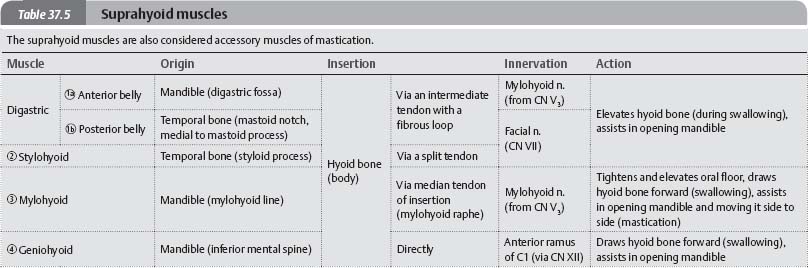
Fig. 37.7 Supra- and infrahyoid muscles

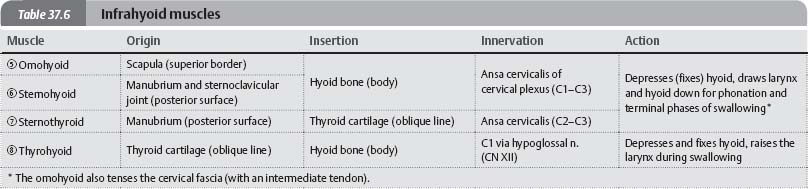
Fig. 37.8 Supra- and infrahyoid muscles

Muscle Facts (III)
Fig. 37.9 Deep muscles of the neck
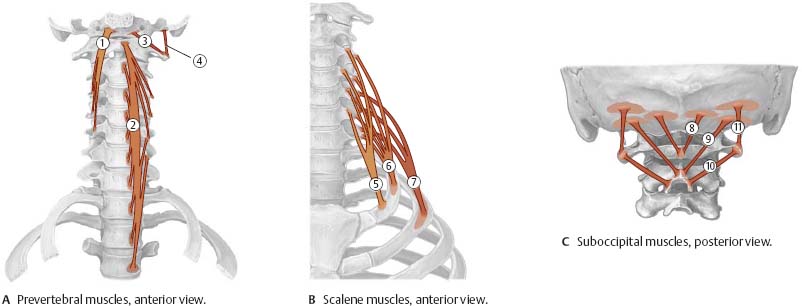
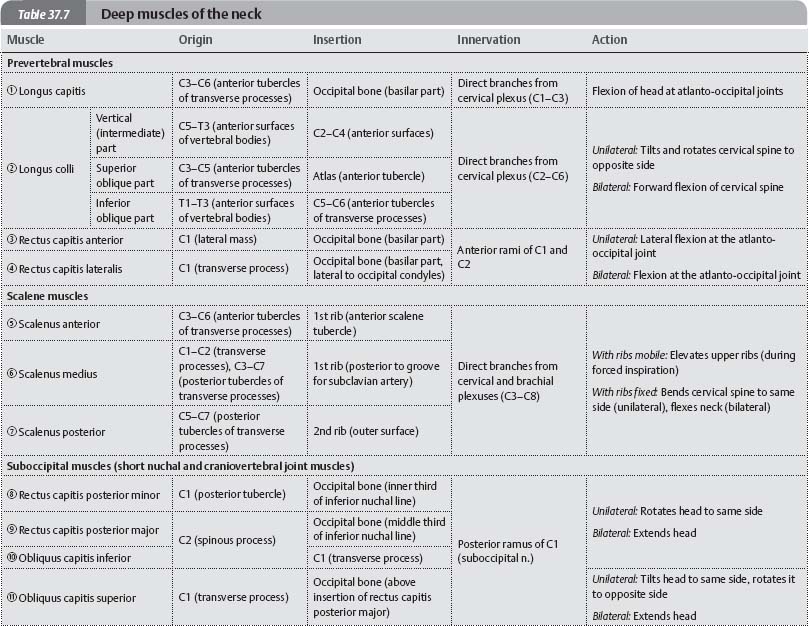
Fig. 37.10 Deep muscles of the neck

Arteries & Veins of the Neck
Fig. 37.11 Arteries of the neck
Left lateral view. The structures of the neck are primarily supplied by the external carotid artery (anterior branches) and the subclavian artery (vertebral artery, thyrocervical trunk, and costocervical trunk).

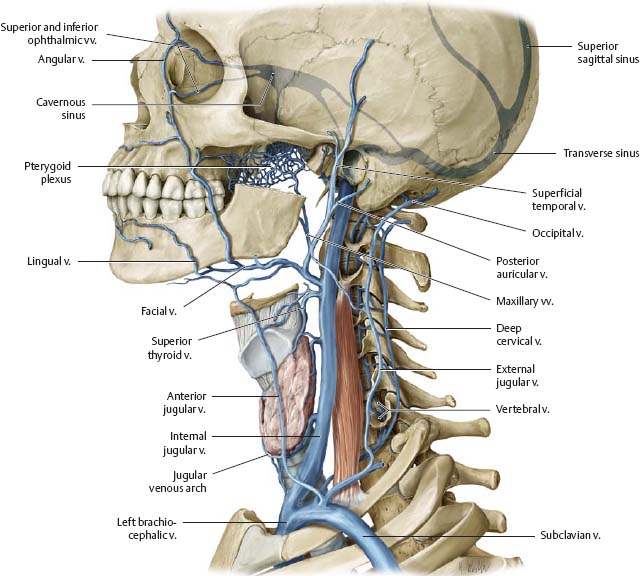
Fig. 37.12 Veins of the neck
Left lateral view. The principal veins of the neck are the internal, external, and anterior jugularveins.
 Clinical
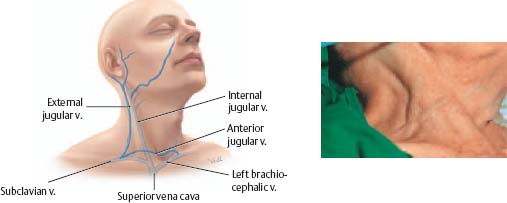
Impeded blood flow and veins of the neck
When clinical factors (e.g., chronic lung disease, mediastinal tumors, or infections) impede the flow of blood to the right heart, blood darns up in the superior vena cava and, consequently, the jugular veins. This causes conspicuous swelling in the jugular (and sometimes more minor) veins.
Innervation of the Neck
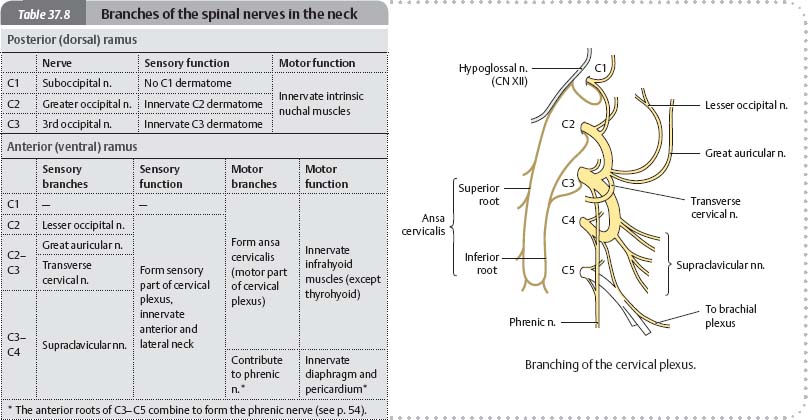
Fig. 37.13 Innervation of the nuchal region
Posterior view.
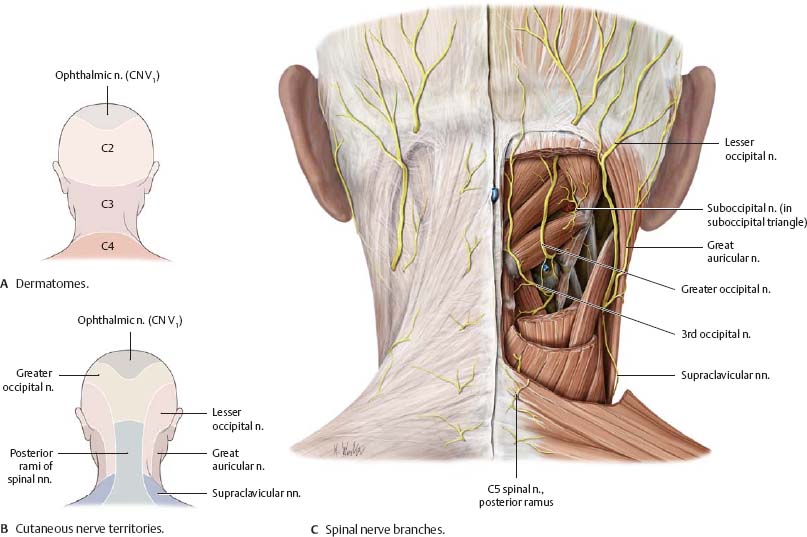
Fig. 37.14 Sensory innervation of the anterolateral neck
Left lateral view.

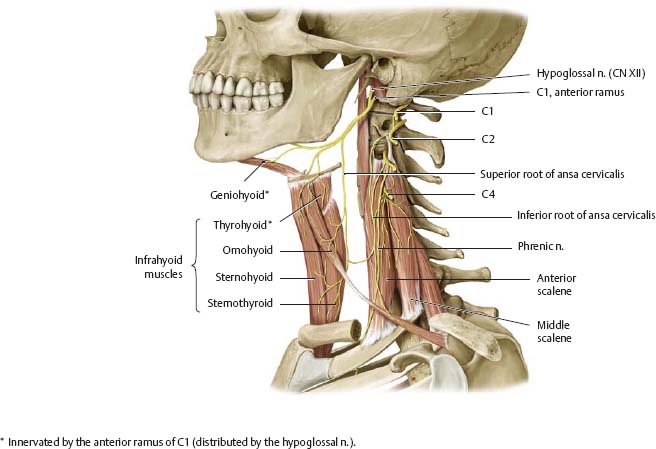
Fig. 37.15 Motor innervation of the anterolateral neck
Left lateral view.
Larynx: Cartilage & Structure
Fig. 37.16 Laryngeal cartilages
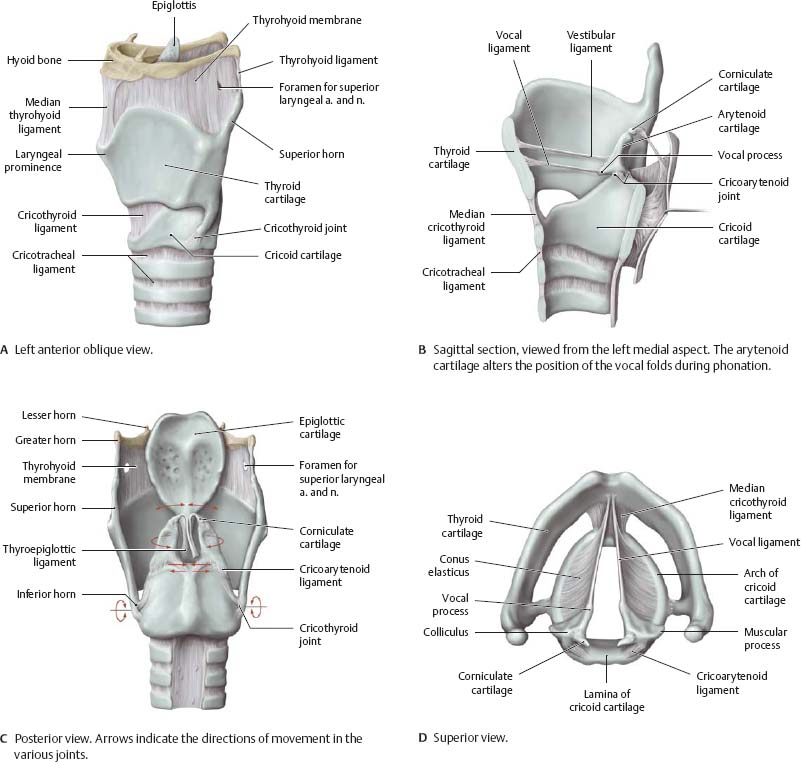
Left lateral view. The larynx consists of five laryngeal cartilages: epiglot-tic, thyroid, cricoid, and the paired arytenoid and corniculate cartilages. They are connected to each other, the trachea, and the hyoid bone by elastic ligaments.
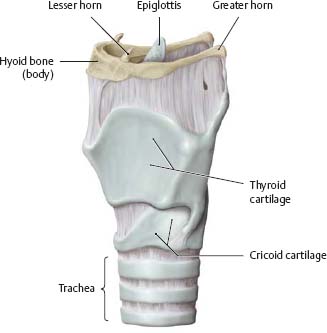
Fig. 37.17 Epiglottic cartilage
The elastic epiglottic cartilage comprises the internal skeleton of the epiglottis, providing resilience to return it to its initial position after swallowing.
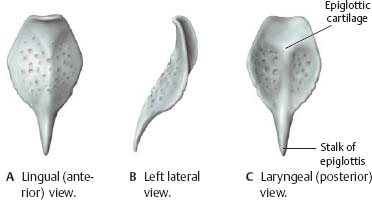
Fig. 37.18 Thyroid cartilage
Left oblique view.
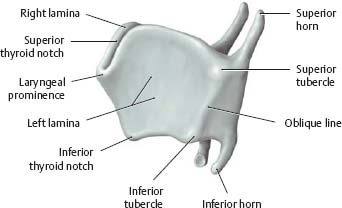
Fig. 37.19 Cricoid cartilage

Fig. 37.20 Arytenoid and corniculate cartilages
Right cartilages.
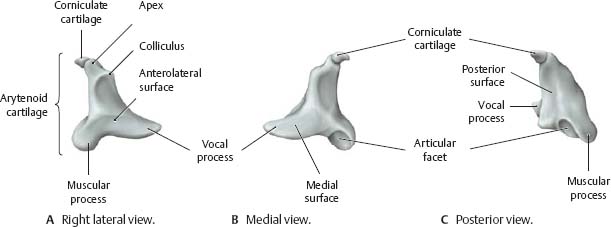
Fig. 37.21 Structure of the larynx
Larynx: Muscles & Levels
Fig. 37.22 Laryngeal muscles
The laryngeal muscles move the laryngeal cartilages relative to one another, affecting the tension and/or position of the vocal folds. Muscles that move the larynx as a whole (infra- and suprahyoid muscles) are described on p. 562.
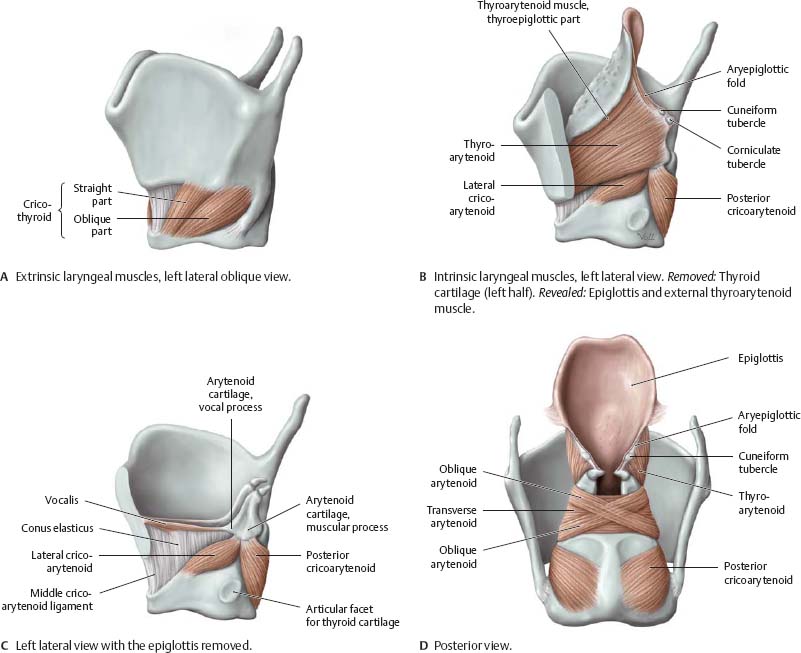
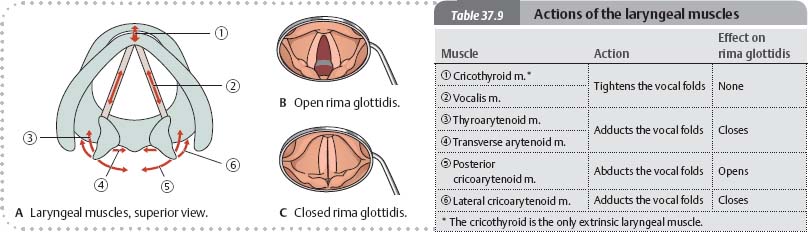

Fig. 37.23 Cavity of the larynx
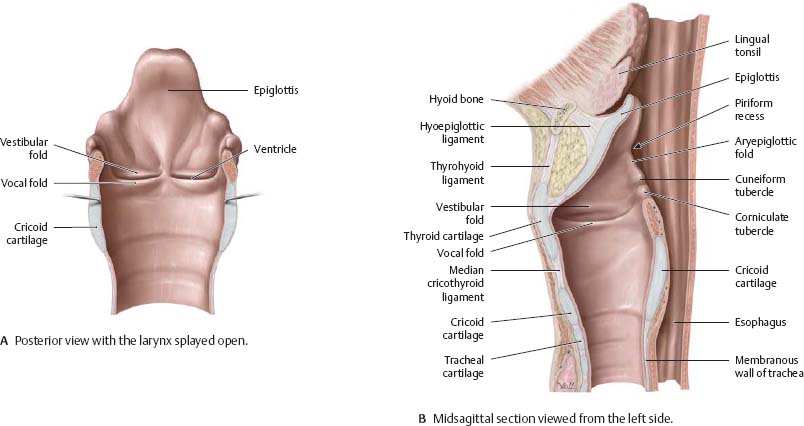
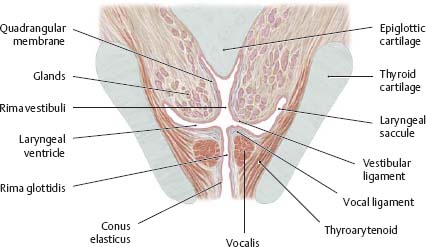
Fig. 37.24 Vestibular and vocal folds
Coronal section, superior view.
Neurovasculature of the Larynx, Thyroid & Parathyroids
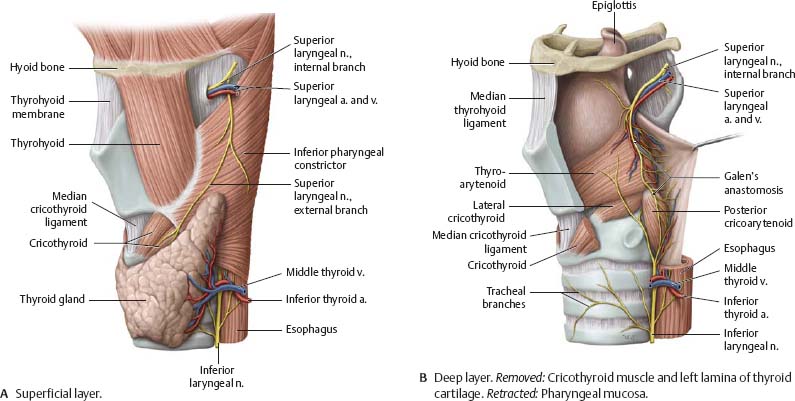
Fig. 37.25 Thyroid and parathyroid glands
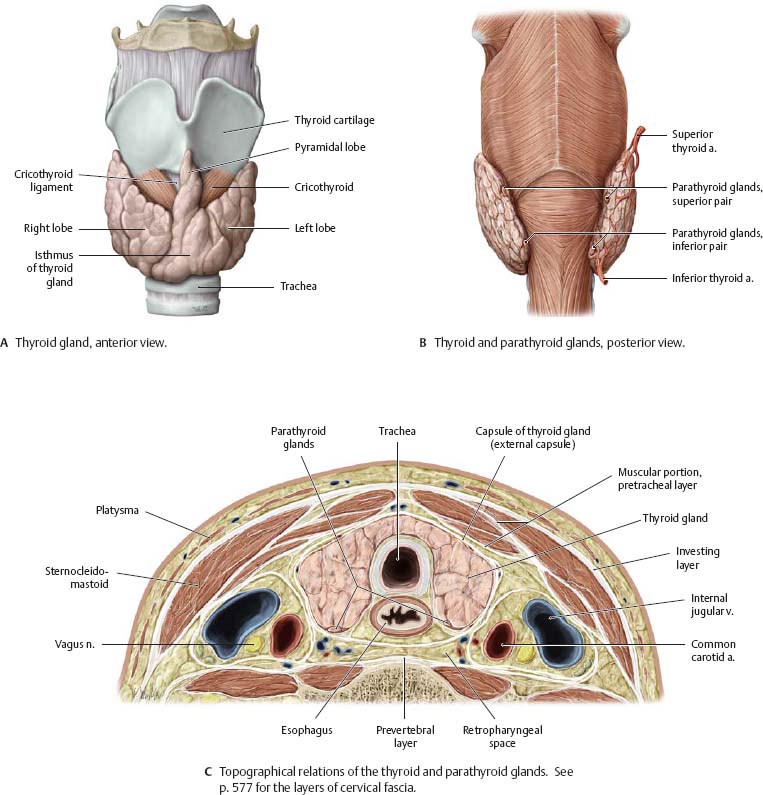
Fig. 37.26 Arteries and nerves
Anterior view.
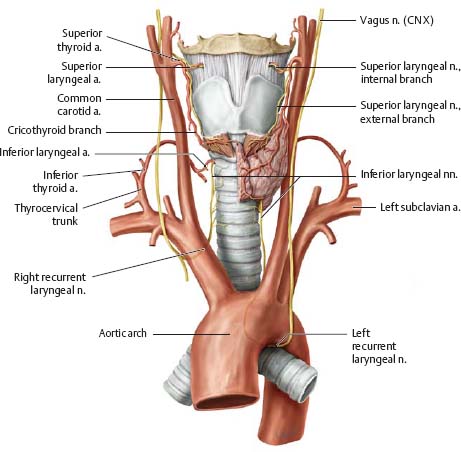
Fig. 37.27 Veins
Left lateral view. Note: The inferior thyroid vein generally drains into the left brachiocephalic vein.
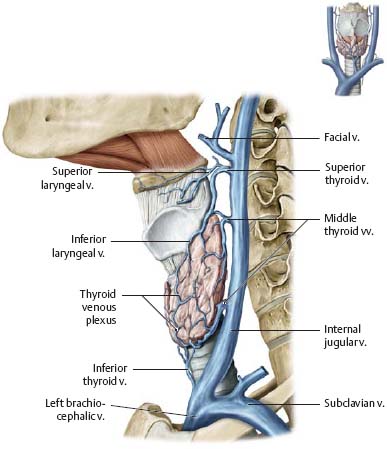
Fig. 37.28 Neurovasculature
Left lateral view.
Topography of the Neck: Regions & Fascia

Fig. 37.29 Cervical regions
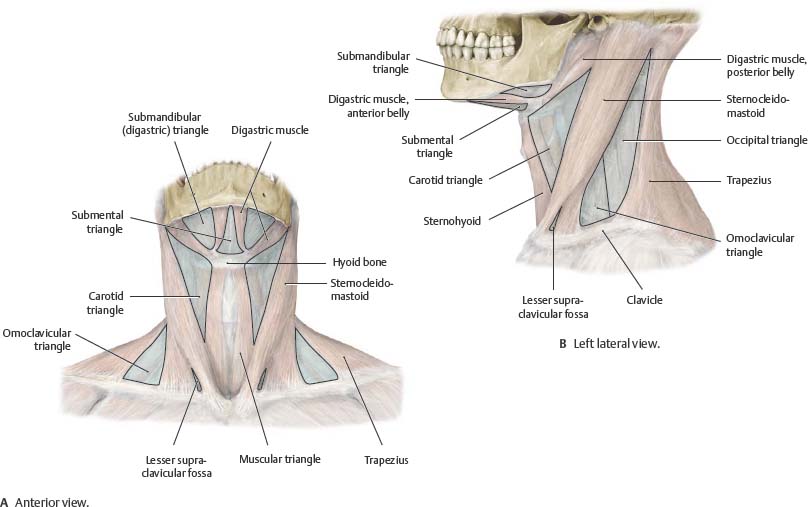
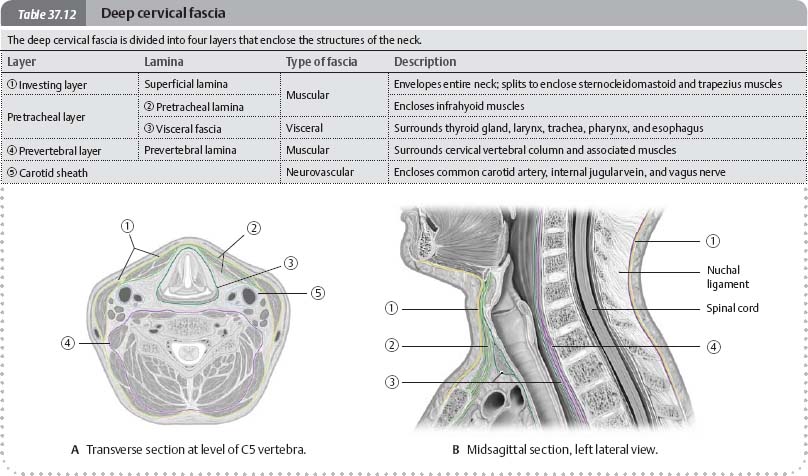
Fig. 37.30 Deep cervical fascial layers
Anterior view.

Topography of the Anterior Cervical Region
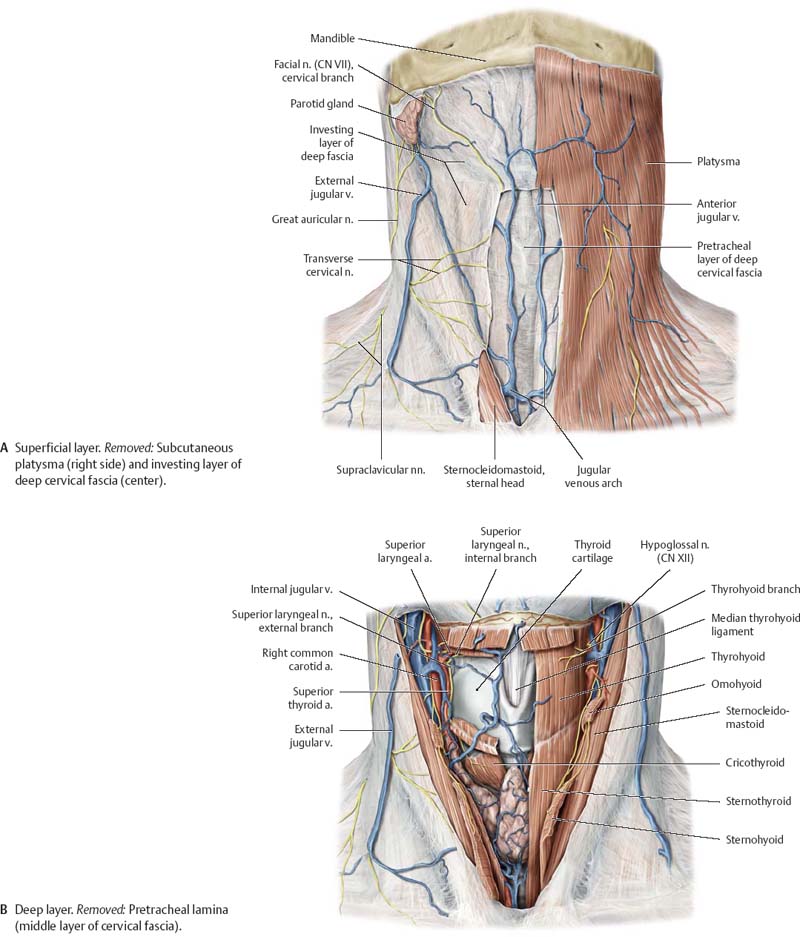
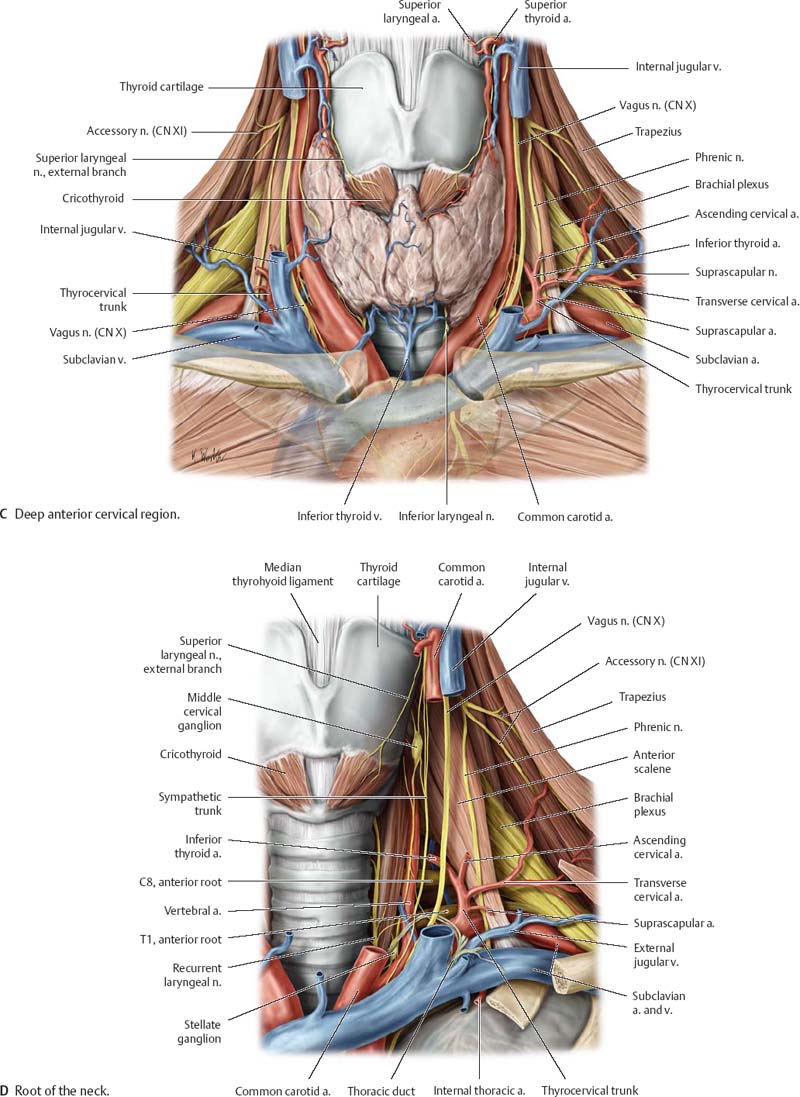
Fig. 37.31 Anterior cervical triangle
Anterior view.
Topography of the Anterior & Lateral Cervical Regions
Fig. 37.32 Carotid triangle
Right lateral view.
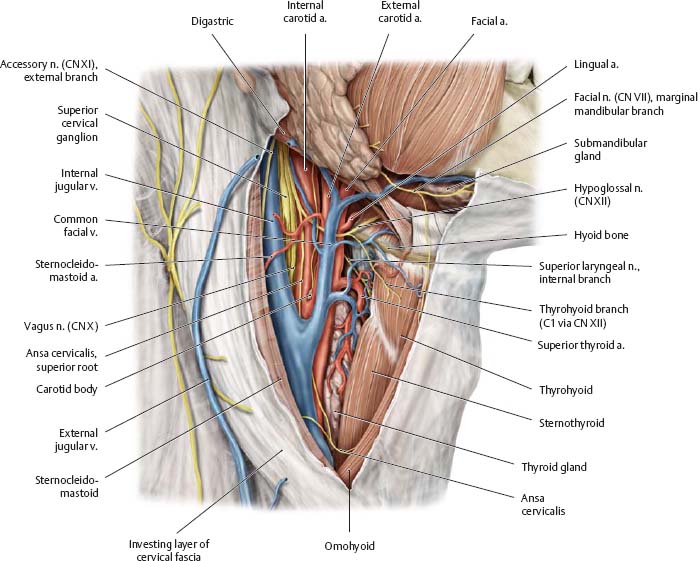
Fig. 37.33 Deep lateral cervical region
Right lateral view with sternocleidomastoid windowed.
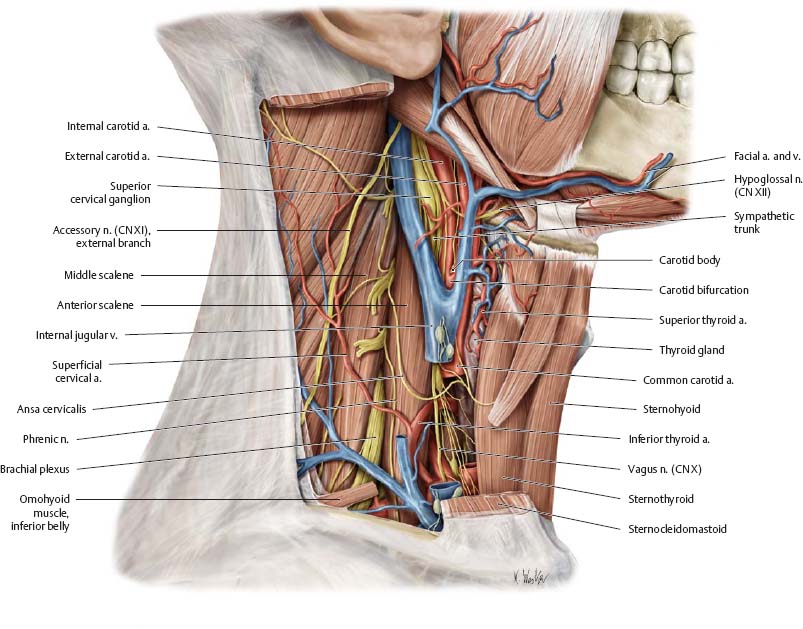
Topography of the Lateral Cervical Region
Fig. 37.34 Lateral cervical region
Right lateral view. The contents of the deep lateral cervical region are found in Fig. 37.33.

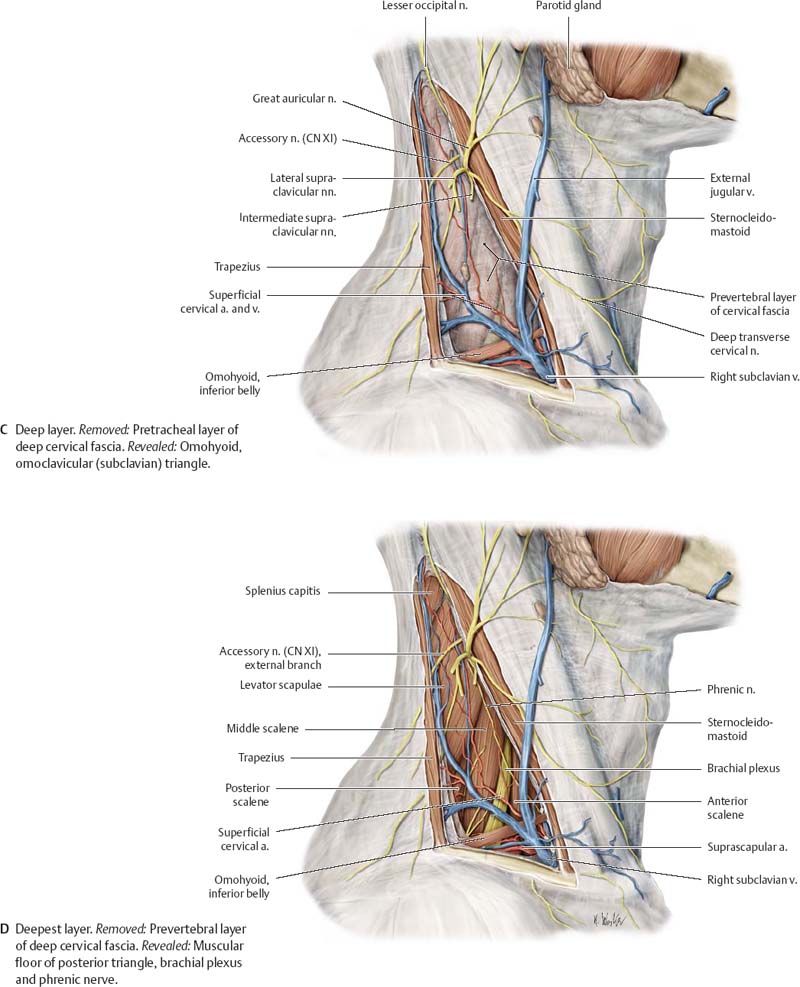
Topography of the Posterior Cervical Region
Fig. 37.35 Occipital and posterior cervical regions
Posterior view. Subcutaneous layer (left), subfascial layer (right). The occiput is technically a region of the head, but it is included here due to the continuity of the vessels and nerves from the neck.

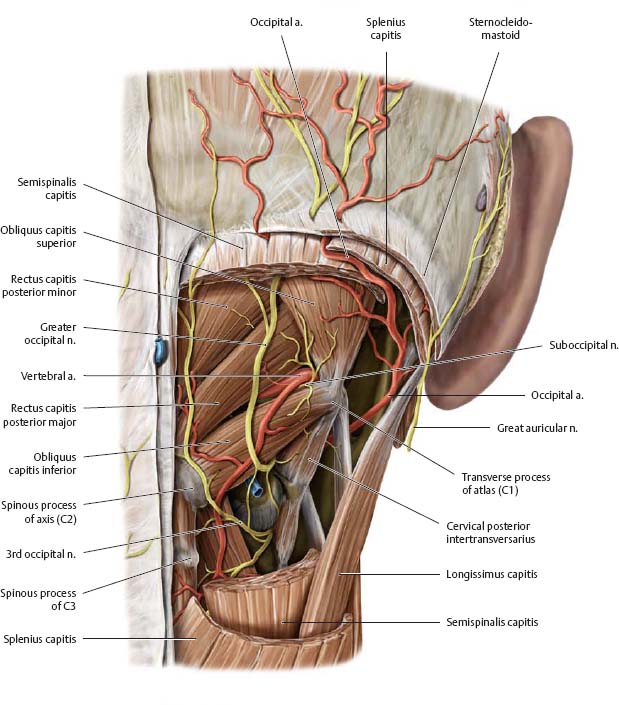
Fig. 37.36 Suboccipital triangle
Right side, posterior view. The suboccipital triangle is bounded by the suboccipital muscles (rectus capitis posterior major and obliquus capitis superior and inferior) and contains the vertebral artery. The left and right vertebral arteries pass through the atlanto-occipital membrane and combine to form the basilar artery.
Lymphatics of the Neck
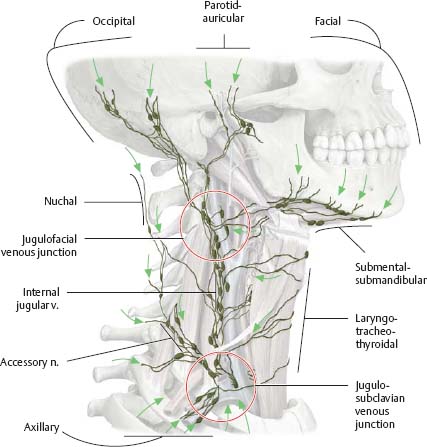
Fig. 37.37 Lymphatic drainage regions
Right lateral view.
Clinical
Tumor metastasis
Lymph from the entire body is channeled to the left and right jugulosubclavian junctions (red circles). Gastric carcinoma may metastasize to the left supraclavicular group of lymph nodes, producing an enlarged sentinel node (see pp. 73, 231). Systemic lymphomas may also spread to the cervical lymph nodes by this pathway.
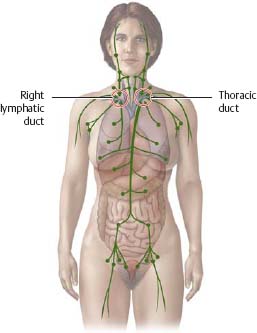
Fig. 37.38 Superficial cervical lymph nodes
Right lateral view.
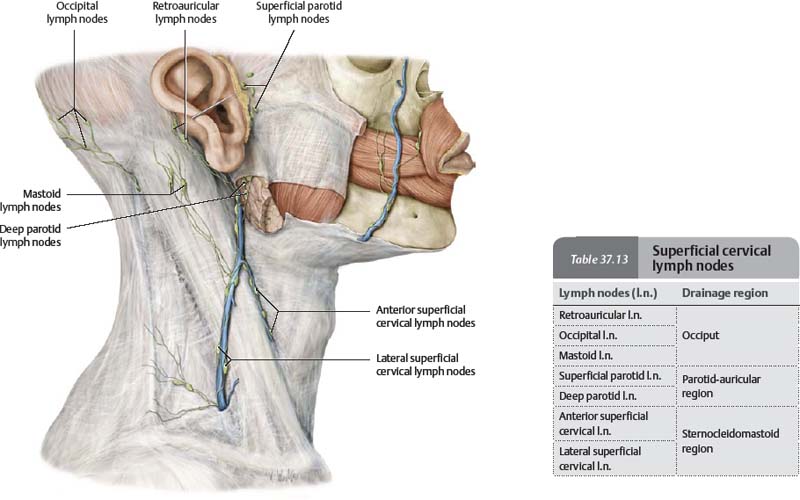
Fig. 37.39 Deep cervical lymph nodes
Right lateral view.
