
Robert S. Hockberger and Joseph Ravera
Depression is the most common psychological disturbance affecting humankind: data from 2005 estimated a lifetime prevalence of 13% for the US population (1). Similarly, a 2006 Centers for Disease Control survey of over 200,000 US adults found that 9% met the diagnostic criteria for major depressive disorder (2). Suicide, the most notable sequela of depression, is the 11th most commonly reported cause of death in the United States, accounting for approximately 35,000 deaths annually (3). The number of annual suicide deaths is likely underestimated and may actually approach 100,000 (4). A 2003 audit of US workers found that depression costs employers approximately $44 billion per year in lost productivity (5).
Patients frequently seek nonpsychiatric medical care shortly before committing suicide. Up to 45% of those who commit suicide have visited a physician in the months prior to their death (6). It may be difficult for physicians without formal psychiatric training to recognize and evaluate depression and suicide potential, because many patients do not complain of depression or readily admit to suicidal ideation unless specifically questioned (7,8). Emergency physicians (EP) are further hampered by the hectic environment of the emergency department (ED), constantly changing priorities that limit one’s ability to spend significant time with individual patients, and difficulty in obtaining after-hours psychiatric consultation. Nevertheless, the EP’s ability to make these assessments and to decide when to seek urgent psychiatric referral or hospitalization for potentially suicidal patients is a vital link in the effective management of a highly disabling and often fatal affliction. A 2001 US Public Health Service report emphasized the vital role of the ED in enhancing suicide-prevention efforts and recommended that guidelines be developed for the assessment of suicide risk among persons receiving care in the ED by 2005 (9). Although several scoring systems and clinical prediction rules are available, there are still no universally accepted guidelines for the determination of suicide risk.
CLINICAL PRESENTATION
Depression and suicidal ideation generally present in one of two ways. Most commonly, patients present overtly with chief complaints of suicidal ideation, request for psychiatric help, or following suicide attempts. Alternatively, depressed patients may present with occult complaints, most commonly multiple vague, ill-defined somatic symptoms such as weakness, malaise, weight loss, headache, and back pain; however, a thorough medical evaluation should be made before attributing such physical complaints to a psychological cause. Depressed individuals frequently have low self-esteem; loss of interest in or lack of enjoyment of previously pleasurable activities; depressed mood; loss of energy; poor appetite and weight loss (weight gain less often); sleep disturbances, including insomnia or hypersomnia; decreased attention span and ability to concentrate; decreased productivity at school, work, or home; episodes of tearfulness or crying; irritability or excessive anger (particularly in adolescents); feelings of hopelessness and worthlessness with a pessimistic attitude toward the future; and recurrent thoughts of death (7).
The potential for suicide should be considered in the following groups of patients:
1. Patients who have made a recent suicide attempt or have experienced recent suicidal ideation. Although most completed suicides involve firearms, drug overdose accounts for 70% to 90% of all suicide attempts (10). Major and minor tranquilizers and antidepressants have replaced barbiturates and other sedatives as the major agents involved in intentional overdose.
2. Patients who state that they are depressed or who complain of symptoms of depression.
3. Patients who present with problems related to chronic alcoholism, drug abuse, or any psychiatric disorder (particularly affective disorders, psychosis, and panic attacks).
4. Patients who present with apparently unintentional overdoses, self-inflicted gunshot wounds, lacerated wrists, falls from heights, or motor vehicle accidents of unclear cause (i.e., one-car, one-victim accidents in clear weather).
In some settings, a triage nurse may provide an initial screening assessment of suicide risk on selected or all patients presenting to the ED. When this occurs, communication of positive results with subsequent providers is critical to assure further evaluation and appropriate care.
DIFFERENTIAL DIAGNOSIS
A number of psychiatric and medical disorders may present with symptoms of depression. Approximately 80% of people suffering bereavement have one or more symptoms of depression for 1 year or more following the death of a loved one (10). Persons suffering from an adjustment disorder may develop similar symptoms within several months of the onset of psychological stresses (e.g., economic loss, physical illness, or troubled interpersonal relationships) with which they are unable to cope. The diagnosis of organic affective syndrome is made when symptoms of depression are found to accompany organic neurologic disease such as organic brain syndrome, stroke, tumor, or trauma. Symptoms of depression may be exacerbated or even caused by medications, including antihypertensive drugs (β-blockers, clonidine, methyldopa, and reserpine), antidepressants, antihistamines, neuroleptic agents, sedative hypnotic drugs, cimetidine, and alcohol (11).
When these diagnostic possibilities have been eliminated in a patient exhibiting symptoms of depression, a final diagnosis of dysthymic disorder (depressive neurosis or minor depression) or major affective syndrome (major depressive disorder) should be considered. This difference is one of degree, with each of these disorders falling somewhere on the disease spectrum of depressive illness, and the final diagnosis is best left to a psychiatrist.
ED EVALUATION AND MANAGEMENT
The clinical assessment of depression and suicide risk is an art as well as a science. Patients feel more at ease speaking about difficult personal issues when health professionals exhibit a friendly, nonjudgmental, supportive attitude and convey their willingness to listen. However, several studies have shown that many health professionals do not display these qualities, particularly ED staff. Reasons cited for this situation include inadequate time and staffing, patient behavior that is perceived as either abusive or manipulative, value conflicts, and staff frustration regarding ineffective disposition and follow-up options (12,13). Expression of a negative or hostile attitude by a respected authority figure, such as a physician or nurse, reinforces a depressed patient’s feeling of diminished self-worth and may increase the likelihood of another suicide attempt.
Overtly depressed and suicidal patients are not very diagnostically challenging, but covertly suicidal patients presenting solely with somatic complaints can pose a diagnostic dilemma. Subtle presentations of a psychiatric problem may include midnight visits for minor complaints, multiple nonspecific somatic complaints involving many organ systems, unusual patient requests, indications of difficulties at home (particularly domestic violence), and trauma of unclear etiology. These potentially “silently suicidal” patients should be assessed in a sympathetic but direct manner.
Studies evaluating the utility of questionnaires and scales used to assess patients for depression in the outpatient setting have shown a wide range of sensitivity and specificity and many are cumbersome to use (14). In general, a stepwise approach should be used when approaching patients who may have occult depression and may be silently suicidal. First, the presenting complaint should be addressed by asking general questions about the patient’s home, work, and social situations. These general questions should be followed by specific questions regarding the signs and symptoms of depression. Finally, the physician should ask direct questions regarding suicide, such as these:
“Have you ever felt so bad that you thought about killing yourself?”
“Do you have thoughts of harming yourself now?”
“What plans have you made to do this?”
Physicians should not be reluctant to ask patients directly about suicidal thoughts from fear that doing so might bring to the surface subconscious thoughts of suicide and result in suicidal behavior. There is no evidence to support this concern; to the contrary, most depressed patients are relieved by the opportunity to openly discuss their problems when the clinician demonstrates an interest and a willingness to listen.
The main objective of the ED management of markedly depressed and suicidal patients is protecting them from further self-harm while performing an assessment and arranging for appropriate disposition. Suicidal patients must be kept under constant observation by a staff member and should be accompanied at all times, including restroom visits. Patients must be searched for medications and weapons and placed in a quiet area of the ED that is free of potentially harmful objects. No potentially suicidal patient should be allowed to leave the department before an evaluation is completed. All states have statutes permitting physicians to detain individuals deemed to be dangerous to themselves or others. Mechanical restraints should be used only when necessary to protect the patient or healthcare providers. The reasons for using restraints and the manner of restraint must be documented in the medical record. Restrained patients must be rigorously monitored and evaluated for complications. Chemical restraints such as intramuscular haloperidol or lorazepam may be required for patients who remain agitated or violent, but these agents can impair psychiatric evaluation and should be avoided when possible.
Following the medical management of a patient’s overdose, injury, or associated medical problems, the patient’s degree of depression and potential risk for suicide should be assessed. Many studies have attempted to identify patients at high risk for suicide. Although no combination of clinical characteristics has been found that accurately identifies all patients likely to complete suicide, a number of high-risk characteristics have been determined. For example, a young woman who takes a few aspirin as a suicide gesture after fighting with her boyfriend is at less risk for successfully committing suicide than an elderly man who tries to hang himself on the anniversary of his wife’s death. Most patients fall somewhere between these two extremes, and estimating a particular individual’s risk for suicide is often difficult (11,15,16). Adding to this challenge for EPs is the fact that potentially suicidal patients often present at night and on weekends when psychiatrists are not readily available for consultation.
There is added difficulty in rural settings. Although depression rates are similar in urban and rural areas, studies indicate a higher rate of suicide in the latter, thought to be related to greater social isolation and lethality of method (firearms) in rural populations (17,18).
EPs should follow guidelines and protocols for suicidal risk assessment developed for their particular practice setting. Consultation may be provided by an on-call psychiatrist, by a psychiatric emergency team (PET) staffed by trained psychiatric nurses or social workers, by a patient’s private physician or by the on-call primary care provider. EPs should be familiar with their state or county’s policy regarding patients who have been placed on emergency psychiatric holds in the prehospital setting. In some areas, these holds mandate a psychiatric evaluation before they can be rescinded.
There are no studies demonstrating that hospitalization of high-risk patients prevents further suicide attempts or completed suicides. This lack of evidence, combined with national trends toward providing more cost-effective outpatient treatment regimens, may place the busy EP in the position of making disposition decisions with high medicolegal risk.
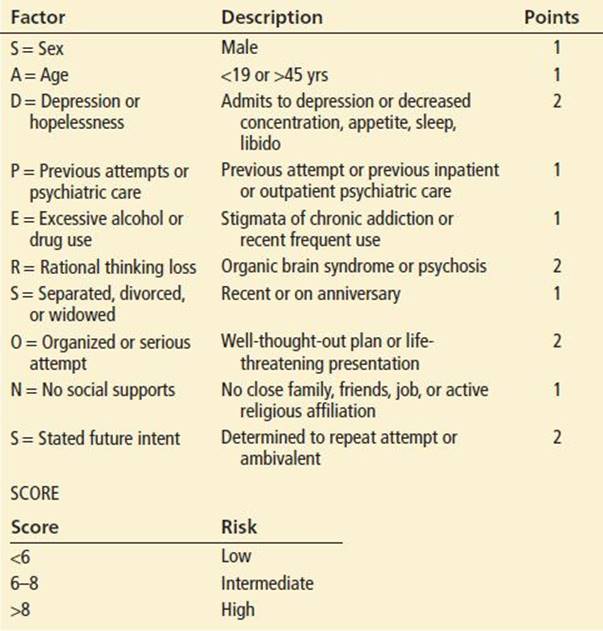
The vast majority of patients attempting suicide do not go on to successfully complete suicide, which has led numerous investigators to develop and test a large number of clinical rating scales to predict suicide risk (19). Several studies have looked at screening tools to assess depression and suicide risk in ED patients (20–23). The modified SAD PERSONS scale (MSPS) has been used in the ED setting to guide the decision to admit patients based on suicide risk. The SAD PERSONS mnemonic incorporates several high-risk characteristics, which can help the clinician assess potentially suicidal patients (Table 164.1) (24,25). In one study, for nonintoxicated patients whose history can be corroborated by family or friends, the numerical SAD PERSONS score correlated closely with the need for hospitalization as determined by a psychiatrist. In this study, hospitalization was deemed necessary in almost all patients with a high SAD PERSONS score (>8), in approximately half of patients with intermediate scores (6 to 8), and in almost none of the patients with low scores (<6). The authors concluded that patients with an MSPS of <6 can be safely referred for expedited outpatient psychiatric evaluation, but a score of 6 or greater required emergent psychiatric evaluation and often hospitalization (sensitivity of 94% and specificity of 71%) (24). A more recent study prospectively evaluated six clinical rating scales, including the MSPS. The outcome variable was eventual admission based on a psychiatrist’s assessment of suicide risk. In this study, all six scales had 100% sensitivity for identifying patients requiring hospitalization. This confirmed the usefulness of the MSPS in the emergency setting. The remaining five scales were just as sensitive but were more complex and less practical for use in the ED (15). Although the MSPS is a rapid and convenient tool to help organize, document, and communicate the assessment of a patient’s suicide potential, a low score (<6) should not preclude emergent psychiatric consultation when the physician is uncomfortable with his or her assessment or when the patient requests to see a psychiatrist. Strict cut-off scores alone should not be used to dictate consultation and admission to the hospital.
TABLE 164.1
SAD PERSONS Score
CRITICAL INTERVENTIONS
• Assess for depression and suicidal potential in patients with psychiatric disorders including substance abuse, in patients with multiple nonspecific somatic complaints, in victims of domestic violence, in patients with apparently unintentional overdose, and in victims of trauma of unclear etiology.
• Document your assessment in a consistent and standardized method; the modified SAD PERSONS scale is one approach that has been validated in the ED setting.
• Monitor potentially suicidal patients carefully in the ED; whenever possible, use patient sitters and avoid the use of restraints.
DISPOSITION
Potentially suicidal patients generally require hospitalization and admission to an inpatient psychiatric unit. Discharge from the ED should not be considered unless the following conditions have been met:
• The patient’s injuries or associated medical problems do not necessitate hospitalization.
• The patient states that he or she is no longer suicidal and is not intoxicated, demented, or psychotic. Patients should be directly asked about the presence of auditory hallucinations and must be specifically assessed for signs of psychosis.
• The acute precipitant of the crisis has been identified, addressed, and resolved.
• The patient has cooperated with an evaluation and is deemed to be at very low risk for suicide. In general, nonpsychotic younger patients whose attempts involve low risk, high likelihood of rescue, and high manipulative intent can be discharged safely.
• Psychiatric consultation has been obtained (at least by telephone), and hospitalization is judged unnecessary.
• Short-term outpatient follow-up (within 1 to 2 days) has been arranged. The reliability of such patients in keeping follow-up appointments is poor. When ED personnel demonstrate a positive, supportive attitude and the patient is given a scheduled outpatient follow-up appointment at the time of discharge, patient compliance with follow-up improves markedly (26,27,28).
• The patient agrees to return to the ED immediately if further self-destructive urges arise.
• A positive, supportive environment with family or friends is available into which the patient can be released. Arrangements should be made to ensure removal of all pills, poisons, and weapons, especially guns, from the home.
A potentially suicidal patient should not be transferred to another facility or to a psychiatrist’s office unless accompanied by medical personnel or family members who agree to deliver the patient and maintain close observation of the patient during transport.
Common Pitfalls
• “Accidental” trauma may be a manifestation of suicidal behavior. When the stated mechanism of injury is questionable or inconsistent with the injury seen, a more in-depth evaluation of the patient’s emotional state and motives is warranted to screen for depression and suicide risk.
• Information obtained from a potentially suicidal patient must be corroborated with family or friends. Patients who vehemently deny suicide intent, refuse to answer questions, give abrupt answers to questions, or appear anxious to leave the ED may be committed to finishing the act they began.
• Anxiolytics, antidepressants, or any other potentially lethal medication should not be prescribed to patients who are depressed or potentially suicidal. More than half of patients who die by intentional overdose use a single prescription drug (9).
REFERENCES
1. Grant B, Stinson F, Dawson D, et al. Prevalence and co-occurrence of substance abuse disorders and independent mood and anxiety disorders. Arch Gen Psych. 2004;61(8);807–816.
2. Centers for Disease Control and Prevention. Current depression among adults–United States, 2006 and 2008. MMWR Morb Mortal Wkly Rep. 2010;59(38):1229–1235; (Survey; 235,067 subjects).
3. Centers for Disease Control and Prevention (CDC). Homicides and suicides–National Violent Death Reporting System, United States, 2003–2004. MMWR Morb Mortal Wkly Rep. 2006;55:721–724; (Epidemiologic data).
4. Vastag B. Suicide prevention plan calls for physicians’ help. JAMA. 2001;285:2701–2703.
5. Stewart WF, Ricci JA, Chee S, et al. Cost of lost productive time among US workers with depression. JAMA. 2003;289:3135–3144.
6. Luoma JB, Martin CE, Pearson JL. Contact with mental health and primary care providers before suicide: A review of the evidence. Am J Psychiatry. 2002;159:909–916.
7. Verdick BM, Homes CB, Waln RF. Recognition of suicide signs by physicians in different areas of specialization. J Med Educ. 1983;58:716–721.
8. Weissberg M. The meagerness of physicians’ training in emergency psychiatric intervention. Acad Med. 1990;65:747–750.
9. U.S. Public Health Service. National strategy for suicide prevention: Goals and objectives for action, 2001. http://www.mentalhealth.org/suicide prevention. Accessed September 27, 2007.
10. Hirschfeld RM, Russell JM. Assessment and treatment of suicidal patients. N Engl J Med. 1997;337:911–915.
11. Tueth NJ. Predicting suicide in the emergency department. Am J Emerg Med. 1996;14:434–435.
12. Pallikkathayil L, Morgan SA. Emergency department nurses’ encounters with suicide attempters: A qualitative investigation. Sch Inq Nurs Pract. 1988;2:237–259.
13. Soukas J, Lonnquist J. Work stress has negative effects on the attitudes of emergency personnel towards patients who attempt suicide. Acta Psychiatr Scand. 1989;79;474–480.
14. Zuithoff N, Vergouwe Y, King M, et al. The Patient Health Questionnaire-9 for detection of major depressive disorder in primary care: Consequences of current thresholds in a crosssectional study. BMC Fam Pract. 2010;13(11):98.
15. Bouch J, Marshall JJ. Suicide risk: Structured professional judgement. Adv Psychiatr Treat. 2005;11:84–91.
16. Whitlock J, Knox KL. The relationship between self-injurious behavior and suicide in a young adult population. Arch Pediatr Med. 2007;151:634–640.
17. McCarthy JF, Blow FC, Ignacio RV, et al. Suicide among patients in the veterans affairs health system: Rural–urban differences in rates, risks, and methods. Am J Public Health. 2012;102(suppl 1):S111–S117.
18. Handley TE, Inder KJ, Kay-Lambkin FJ, et al. Contributors to suicidality in rural communities: Beyond the effects of depression. BMC Psychiatry. 2012;12:105.
19. Cochrane-Brink KA, Lofchy JS, Sakinofsky I. Clinical rating scales in suicide risk assessment. Gen Hospl Psychiatry. 2000;22:445–451.
20. Boudreaux ED, Cagande C, Kilgannon H, et al. A prospective study of depression among adult patients in an urban emergency department. J Clin Psychiatry. 2006;8:66–70.
21. Horowitz LM, Wang PS, Koocher GP, et al. Detecting suicide in a pediatric emergency department: Development of a brief screening tool. Pediatrics. 2001;107:1133–1137.
22. Hustey FM, Smith MD. A depression screen and intervention for older ED patients. Am J Emerg Med. 2007;25:133–137.
23. Kowalenko T, Khare R. Should we screen for depression in the emergency department? Acad Emerg Med. 2004;11:177–178.
24. Hockberger RS, Rothstein RJ. Assessment of suicide potential by non psychiatrists using the SAD PERSONS score. J Emerg Med. 1988;6:99–107.
25. Patterson WM, Dohn HH, Brid J, et al. Evaluation of suicidal patients: The SAD PERSONS scale. Psychosomatics. 1983;24:343–345.
26. Jellinek M. Referrals from a psychiatric emergency room: Relationship of compliance to demographic and interview variables. Am J Psychiatry. 1978;135:209–213.
27. Knesper DJ. A study of referral failures for potentially suicidal patients: A method of medical care evaluation. Hosp Commun Psychiatry. 1982;33:49–52.
28. Spirito A. Emergency department assessment of adolescent suicide attempters: Factors related to short-term follow-up outcome. Pediatr Emerg Care. 1994;10:6–12