
Kerryann B. Broderick
One in eight or nearly 12 million emergency department (ED) visits in the United States, in 2007 were due to mental health and/or substance use disorders (1). Mental health-related ED visits increased 75% between 1992 and 2003 (2).
Before the patient can be transferred to a psychiatric facility or service, the emergency physician (EP) is responsible for identifying any significant medical condition. The term medical clearance (many would debate is not an accurate term of what we perform) was developed in the 1970s. Weissberg’s 1979 article (3) describes the common scenarios in which EPs apply the concept of medical clearance: (a) the psychiatric patient found to have no physical illness, (b) a psychiatric patient with a known medical condition that is not currently impacting the psychiatric illness, and (c) the psychiatric patient whose acute medical issue has been treated and is now ready for transfer to a psychiatric facility.
There is a lack of standardized nomenclature in this area. The terms organic disease and functional disease are, perhaps, most frequently used. Organic disease denotes nonpsychiatric causes, and functional disease indicates a psychiatric cause. Defining a mental disorder as “organic,” however, implies that a nonorganic or functional mental disorder is unrelated to physical or biologic factors or processes (4,5). In fact, many chemical neurophysiologic and genetic factors have been documented to be related to psychiatric disease. The terms “functional” and “organic” were eliminated from the DSM manuals and it now distinguishes mental disorders due to medical conditions or secondary mental disorders from primary psychiatric conditions (6).
In fact, the role of EPs is to determine if the patient has a medical condition that is either (a) masquerading as psychiatric illness or (b) the one that needs treatment urgently before the patient can be treated by a psychiatric service/facility. The prevalence of physical illness among psychiatric patients appears to be dependent upon the population studied. One study specifically reviewing ED practice found that 80% of patients in whom medical disease should have been identified in the ED were documented as “medically clear” (7), whereas another study found “medical problems” in only 19% of ED patients (8).
CLINICAL PRESENTATION AND ED EVALUATION
Patients who require medical clearance may be separated into two general categories: those with a known psychiatric illness and those without a prior psychiatric diagnosis but presenting with abnormal behavior and thought. The clinical evaluation of these patients includes focused history and physical exam, directed laboratory and ancillary tests, and consideration of the care available by the receiving psychiatric facility or service. In January 2006, ACEP published a clinical policy guideline on many of the issues outlined in this chapter (9).
Important questions include time frame involved in the onset of symptoms and other events leading up to presentation. Obtaining history from patients and their perception of the current situation and using all other potential sources (emergency medical personnel, caretakers, and caseworkers) will ensure the most comprehensive and accurate history.
Psychiatric patients with substance abuse comorbidity have a significantly higher number of ED visits than those without substance abuse (10). A detailed history on medication use, recent changes, and noncompliance, both prescribed and not prescribed, are important as these frequently cause or contribute to psychiatric complaints, especially in the elderly.
Medical problems must be excluded or identified and treated appropriately. Infections, particularly central nervous system, cardiopulmonary, and urinary, can aggravate a patient’s underlying illness. Questions regarding history of fever, weight loss, appetite, recent surgery, and trauma should be included.
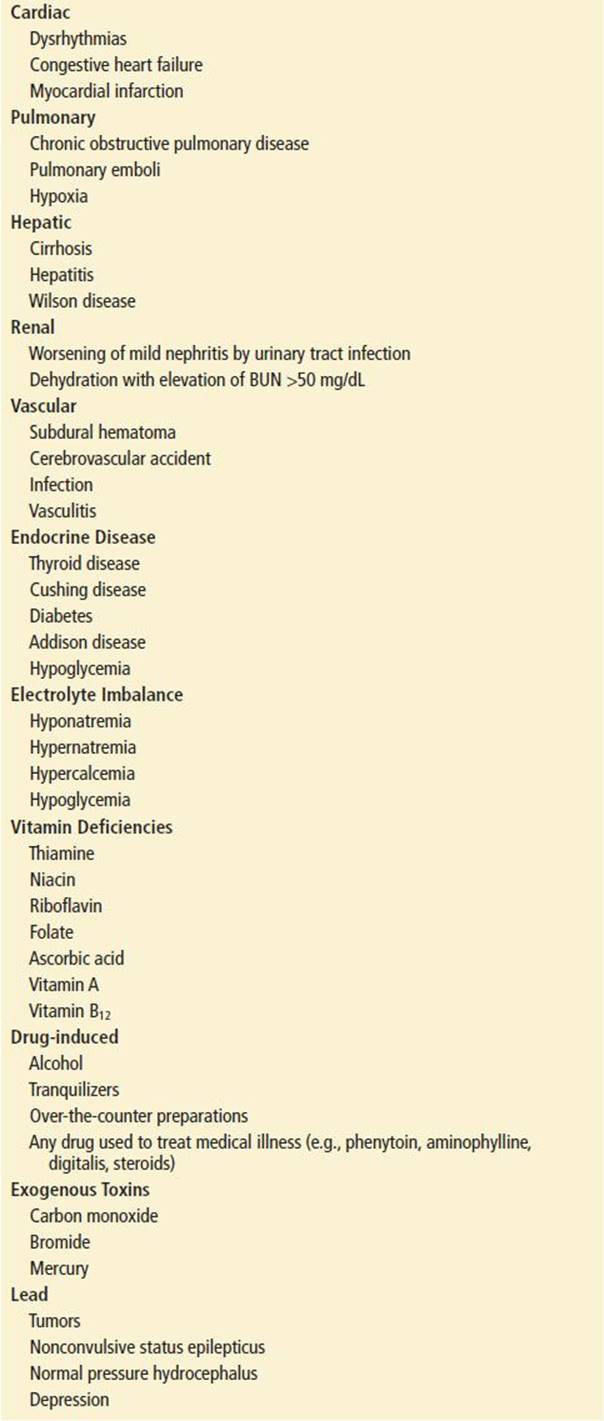
When a patient presents with psychiatric symptoms but does not have a known psychiatric disorder, it is critical to differentiate primary psychiatric illness versus secondary psychiatric illness (medical etiology). Factors strongly supporting a medical cause include age older than 40 years with no prior psychiatric history, abnormal vital signs, recent memory loss, and clouded consciousness (5,11). Medical conditions may manifest with significant psychiatric symptoms. The differential diagnosis of medical conditions that can present with psychiatric symptoms is broad. Table 163.1 includes some of these conditions.
TABLE 163.1
Treatable Causes of Acute Mental Disorders Due to a General Medical Condition
Multiple studies have documented that both emergency medicine and psychiatric physicians do a less-than-optimal job at documenting the physical examination (7,12). Psychiatrists surveyed reported completing a physical examination in only 13% of their inpatients, citing that they feel incompetent to do so (12). Therefore, it is very important that the EP perform a thorough search for evidence of medical illness that needs urgent treatment.
Two of the more frequent conditions encountered are delirium and dementia, and distinguishing between these two can be very important. Delirium is most often due to a medical condition and is an acute condition. Dementia is a more chronic condition. A mnemonic useful in rapid differentiation between delirium and dementia is COMA: consciousness, orientation, memory, and affect. Patients with dementia should have no significant alterations in these areas. The vital signs and a mini-mental status exam also help to distinguish between these two conditions (see Chapter 152).
Ancillary testing is a matter of great debate in the literature. Some facilities require mandatory testing, whereas others rely on their EP’s judgment. Parmar and others studied 598 patients prospectively and found that after cleared by the EP, psychiatry ordered lab or radiographic testing on 44% of patients transferred and only 0.5% had an abnormal result which led to a disposition change. The total reimbursement for this added testing was $37,682 (13). Most would agree that a thorough history and physical will guide most clinicians in indicated ancillary testing. Studies have demonstrated that where history is obtainable, patient self-reporting on medical symptoms has a 94% sensitivity of predicting disease (8).
Although there is no consensus from the literature on laboratory testing, there are some useful guidelines. New-onset psychiatric complaints may signal the need for more extensive testing for a medical etiology (14). Routine testing in patients older than the age of 40, especially in the geriatric population, may have a higher pretest probability for significant positive results that either demonstrate the etiology of the symptoms to be medical or signal the need for urgent treatment prior to medical clearance (15–17).
Clinicians should order focused testing (Accu-Chek, complete blood count, electrolytes, thyroid studies, urinalysis, toxicologic screen) based on history, physical exam, and vital signs. Alcohol levels and toxicologic screens may be useful in cases wherein the role of these substances in the patient’s altered mental status is not clear.
A head computed tomography (CT) is warranted for patients with altered mental status or abnormal findings on neurologic exam. However, the decision to perform a head CT on patients with new psychiatric illness is less clear. In one study, abnormal head CT findings were found in 8% of 100 consecutive alert patients with psychiatric illness, but it was not clear that these findings were contributing to the patients’ acute psychiatric illness (14).
DIFFERENTIAL DIAGNOSIS
Medications may be an important source of acute psychiatric symptoms. Anticholinergics, sympathomimetics, and serotonergics may be the etiology of a patient’s altered thoughts. Patients taking stimulants such as cocaine, methamphetamines, and PCP may also exhibit psychosis. Common withdrawal syndromes associated with acute psychiatric features include alcohol withdrawal, particularly delirium tremens.
Elderly patients are particularly susceptible to toxic effects of medications owing to polypharmacy, dosing errors, and altered metabolism. If a medication is identified as the precipitant, clear instructions for dosing changes or drug substitution must be communicated with caregivers.
Thyroid diseases may be the etiology of acute psychiatric symptoms. Thyrotoxic patients may appear manic, delusional, or confused. Extremes in glucose can cause profound mental status changes. Those with adrenal disease are also susceptible to profound behavioral changes, which may mimic psychiatric symptoms. See Table 163.1 for additional causes of acute mental disorders.
KEY TESTING
• Focused testing based on history, physical examination, and vital signs
• glucose
• complete blood count
• electrolytes, BUN, creatinine
• thyroid studies
• urinalysis
• toxicologic screen
ED MANAGEMENT
Extreme agitation is often part of the syndrome of delirium or psychiatric disease and can significantly interfere with evaluation. Chemical restraint (CR) is a safe and effective method for controlling agitated or overtly violent patients (18,19). CR is accomplished by administering a standard dose of a high-potency antipsychotic medication, such as haloperidol or droperidol, in 5- to 15-minute intervals. Research indicates that the combination of antipsychotic medication with lorazepam is more effective than either medication alone, though the synergistic effects may cause excessive sedation (18–20) (see Chapter 167).
CRITICAL INTERVENTIONS
• Perform a thorough search for evidence of medical illness that needs urgent treatment.
• Distinguish between delirium and dementia.
• Control agitated or overtly violent patients with rapid tranquilization when indicated.
DISPOSITION
Some psychiatric facilities require toxicology tests, blood alcohol levels, or various ancillary tests to be done before they accept patients in transfer. Although some studies have shown that most patients accurately self-report drug use (21), and although toxicology results usually do not impact the ED care, psychiatrists may find this information useful in their treatment of the patient (8). Shah et al. recently published a screening tool (22) that was modified from the one Zun previously developed (23). Psychiatry service ordered subsequent testing in 2.5% of those “cleared,” of which none of these required any alteration in disposition or urgent treatment (22). The development of guidelines and protocols and a system for assuring that they are routinely reviewed and updated are essential to both patient safety and cost control.
Hospital admission is clearly warranted for patients with identified medical illnesses that are associated with a risk of morbidity or mortality. Hospital admission is also necessary if the patient’s behavior jeopardizes further medical evaluation or care. Patients with delirium should be admitted for specific treatment if the cause is known or for further evaluation if the cause is unknown, with psychiatric consultation as needed.
Patient care may be transferred to a psychiatric service if an appropriate medical screening examination has been performed and it has been determined that the patient does not require further evaluation or treatment for an underlying medical condition, or for a medical condition that may be causing or exacerbating psychiatric symptoms.
Common Pitfalls
• Delirious patients who present to the ED are often inappropriately referred to a psychiatrist. This is especially true for those who present with bizarre and agitated behavior.
• Psychiatric patients who behave in a bizarre or disruptive manner may not be approached with the same sense of urgency or seriousness as are patients with cardiovascular disease or trauma. Clinicians often medically clear these patients without conducting a complete and thorough evaluation.
• Like disordered perception, the patient etiology that results in patient violence is often unclear, and these patients are often referred to a psychiatrist. A significant proportion of violence that occurs in psychiatric settings results from underlying medical illness or drug intoxication (24).
• Clinicians often fail to take seriously the complaints of elderly patients, commonly attributing their symptoms to “old age” (16,25). Premature labeling tends to preclude the exhaustive physical, neurologic, and laboratory evaluation necessary to identify potentially reversible causes of dementia or delirium.
REFERENCES
1. Mental Disorders and/or Substance Abuse Related to One of Every Eight Emergency Department Cases. AHRQ News and Numbers. Rockville, MD: Agency for healthcare Research and Quality; 2010. Available online at http://www.ahrq.gov/news/nn/nn070810.htm
2. Salinsky E, Loftis C. Shrinking inpatient psychiatric capacity: Cause for celebration or concern? Issue Brief Natl Health Policy Forum. 2007;823:1–21.
3. Weissberg MP. Emergency room medical clearance: An educational problem. Am J Psychiatry. 1979;136:787–790.
4. Dubin WR. Assessment and management of psychiatric manifestations of organic brain disease. In: Dubin WR, Hanke N, Nickens HW, eds. Clinics in Emergency Medicine: Psychiatric Emergencies. New York, NY: Churchill Livingstone; 1984.
5. Koranyi EK, Potoczny WM. Physical illness underlying psychiatric symptoms. Psycother Psychosom. 1992;58:155–160.
6. American Psychiatric Association. Diagnostic and Statistical Manual of Mental Disorders, 5th ed. Arlington, VA: American Psychiatric Publishing; 2013.
7. Tintinalli JE, Peacock FW, Wright MA. Emergency medical evaluation of psychiatric patients. Ann Emerg Med. 1994;23:859–862.
8. Olshaker JS, Browne B, Jerrard DA. Medical clearance of the psychiatric patients in the emergency department. Acad Emerg Med. 1997;4(2):124–128.
9. Lukens TA,Wolf SJ, Edlow JA, et al. Clinical policy: Critical issues in the diagnosis and management of the adult psychiatric patient in the emergency department. Ann Emerg Med. 2006;47:79–99.
10. Curran GM, Sullivan G, Williams K, et al. Emergency department use of persons with comorbid psychiatric and substance abuse disorders. Ann Emerg Med. 2003;41(5):659–667.
11. Williams ER, Sheperd SM. Psychiatric emergencies. Emerg Med Clin North Am. 2000;18:185–198.
12. McIntyre JS, Romano J. Is there a stethoscope in the house (and is it used)? Arch Gen Psychiatry. 1977;34:1147–1151.
13. Parmar P, Goolsby CA, Udomoanyanan K, et al. Value of mandatory screening studies in emergency department patients cleared for psychiatric admission. West J Emerg Med. 2012;13(5):388–393.
14. Henneman PL, Mendoza R, Lewis RJ. Prospective evaluation of emergency department medical clearance. Ann Emerg Med. 1994;24:672–677.
15. Aisen PS. Medical evaluation of the elderly psychiatric patient. Mt Sinai J Med. 1991;58:85–90.
16. Lewis LM, Miller DK, Morley JE. Unrecognized delirium in the ED geriatric patients. Am J Emerg Med. 1995;13:142–145.
17. Lipowski ZJ. Delirium in the elderly patient. N Engl J Med. 1989;320:578–581.
18. Dubin WR. Rapid tranquilization: Antipsychotics of benzodiazepines. J Clin Psychiatry. 1988;49(suppl):5–12.
19. Dubin WR, Weiss KJ, Dorn JM. Pharmacotherapy of psychiatric emergencies. J Clin Psychopharmacol. 1986;6:210–222.
20. Garza-Trevino ES, Hollister LE, Overall JE, et al. Efficacy of combination of intramuscular antipsychotics and sedative-hypnotics for control of psychotic agitation. Am J Psychiatry. 1989;146:1598–1601.
21. Schiller M, Shumway M, Batki S. Utility of routine drug screening in a psychiatric emergency setting. Psychiatr Serv. 2000;51:474–478.
22. Shah SJ, Fiorito M, McNamara RM, et al. A screening tool to medically clear psychiatric patients in the emergency department. Am J Emerg Med. 2012;43:871–875.
23. Zun LS, Leikin JB, Stotland ND. A tool for the emergency medicine evaluation of psychiatric patients. Am J Emerg. 1996;14:329–333.
24. Tardiff K, Sweillam A. Assault, suicide, and mental illness. Arch Gen Psychiatry. 1980;37:164–169.
25. Goodstein RK. Common clinical problems in the elderly, camouflaged by ageism and atypical presentation. Psychiatr Ann. 1985;15:299.